David
Who was David in the Bible?
The second king of the United Monarchy of Israel, a shepherd-warrior and psalmist known as a man after God's own heart.
David was the youngest son of Jesse of the tribe of Judah and became the most pivotal king in the history of the United Monarchy. His life is chronicled more extensively than perhaps any other figure in the Old Testament, spanning his humble beginnings as a shepherd in Bethlehem to his rise as a national hero and eventual coronation as king over all Israel. He is credited with establishing Jerusalem as the religious and political capital of the nation, bringing the Ark of the Covenant to the city, and preparing for the construction of the Temple.
Beyond his political and military achievements, David is fundamentally characterized by his complex spiritual life. He is traditionally recognized as the primary author of the Psalms and is described in the biblical record as a 'man after God’s own heart' (Acts 13:22). Despite significant personal failings, including his adultery with Bathsheba and the subsequent murder of Uriah, his life is presented as a model of sincere repentance and unwavering faith in the covenant promises of God.
Background and Family
David was born in Bethlehem, the youngest of eight sons of Jesse (1 Samuel 17:12). His lineage, traced back to Boaz and Ruth the Moabite (Ruth 4:22), placed him firmly within the tribe of Judah. As a youth, David served as a shepherd, a role that the biblical narrative suggests developed his courage and reliance on God, as he protected his flock from predators like lions and bears (1 Samuel 17:34-37). He had several siblings, including Eliab, Abinadab, Shimeah, Nethanel, Raddai, Ozem, and Elihu, as well as sisters Zeruiah and Abigail.
His family life as king was expansive and often fraught with internal conflict. David had numerous wives, including Michal (daughter of Saul), Abigail of Carmel, Ahinoam of Jezreel, Maacah, Haggith, Abital, Eglah, and Bathsheba. From these unions, he fathered many children, including his successor Solomon, and several sons who would later rebel or cause turmoil within the palace, such as Amnon, Absalom, and Adonijah. His only named daughter in the text is Tamar.
Major Life Events
Anointing and the Defeat of Goliath
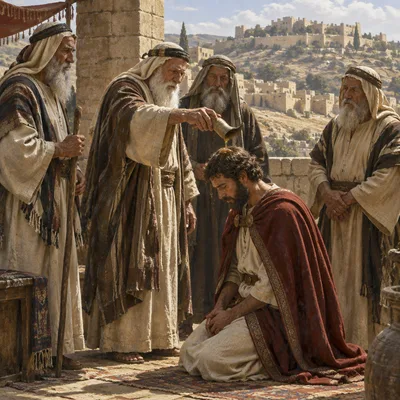
David’s public life began when the prophet Samuel, under divine instruction, traveled to Bethlehem to anoint a successor to King Saul. Though his older brothers appeared more kingly, God selected the young David (1 Samuel 16:7). Shortly after, David entered Saul’s service as a musician to soothe the king’s troubled spirit and as an armor-bearer. His fame escalated following the battle in the Valley of Elah, where, refusing traditional armor, David killed the Philistine champion Goliath with a single stone from a sling (1 Samuel 17:49-50).
Rise to Power and Exile
David’s military success and popularity triggered Saul’s jealousy, forcing David into a period of exile and flight. During this time, he led a band of outlaws and twice spared Saul’s life, refusing to 'stretch out his hand against the Lord's anointed.' After the death of Saul and his son Jonathan at Mount Gilboa, David was first anointed king over Judah in Hebron. Following a period of civil war with the house of Saul, he was eventually anointed king over all Israel, marking the peak of the United Monarchy.
The Davidic Covenant and Later Reign
Upon capturing the Jebusite stronghold of Jerusalem, David made it his capital. His desire to build a permanent temple for God resulted in the Davidic Covenant, where God promised through the prophet Nathan that David’s throne would be established forever (2 Samuel 7). However, David’s reign was later marred by his sin with Bathsheba. Though he was forgiven after a direct confrontation by Nathan, the remainder of his rule was characterized by domestic strife, including the rebellion of his son Absalom, which briefly forced David out of Jerusalem.
Relationship to Other Biblical Figures
David’s relationship with Saul was one of complex loyalty and persecution. In contrast, his bond with Saul’s son Jonathan is described as a deep, covenantal friendship where their 'souls were knit together' (1 Samuel 18:1). As king, David’s interactions with the prophet Nathan were crucial; Nathan served as the divine conscience of the court, delivering both the promise of an eternal dynasty and the rebuke for David's moral failures. Later in life, David's relationship with Solomon focused on the transition of power and the preparation for the Temple, ensuring that his son would fulfill the task he was not permitted to complete.
Spiritual Significance
David’s spiritual legacy is defined by his role as the 'sweet psalmist of Israel.' The New Testament frequently cites him, not only as a historical king but as a prophet whose writings foretold the life and resurrection of Jesus Christ (Acts 2:25-31). The title 'Son of David' became a primary Messianic designation used by those seeking healing from Jesus, acknowledging him as the heir to the Davidic throne. The Book of Revelation concludes by identifying Jesus as the 'Root and the Offspring of David' (Revelation 22:16), cementing David's position as the progenitor of the promised Savior. His life serves as a biblical archetype of the king who, while flawed, remains oriented toward the will and worship of God.
David is the central human figure of the Old Testament's monarchical period, serving as the standard by which all subsequent kings of Israel and Judah were measured. The 'Davidic Covenant' in 2 Samuel 7 is a cornerstone of biblical theology, providing the framework for the Messianic hope that a descendant of David would rule an eternal kingdom. This promise is fulfilled in the New Testament in the person of Jesus Christ, who is repeatedly identified as the Son of David.
Furthermore, David’s contributions to the Psalter provided the liturgical and devotional language for both the Jewish and Christian faiths. His transparency in prayer—expressing everything from ecstatic praise to profound agony and repentance—established a model for a personal relationship with God. In the New Testament, David is listed in the 'Hall of Faith' (Hebrews 11:32) and is frequently quoted by the apostles to demonstrate that the gospel was the fulfillment of the promises made to the patriarchs of the United Monarchy.
Frequently Asked Questions
Why is David called a man after God's own heart?
This description, first mentioned by Samuel (1 Samuel 13:14) and later by Paul (Acts 13:22), refers to David's fundamental desire to obey God's will and his deep, repentant heart when he failed, rather than a claim of sinless perfection.
Was David allowed to build the Temple?
No. Although David made extensive preparations and gathered materials, God told him through Nathan that his son Solomon would build the Temple because David had been a man of war and had shed much blood (1 Chronicles 22:8).
Who was David's most famous friend?
Jonathan, the son of King Saul. Despite being the heir to Saul's throne, Jonathan loved David as himself and made a covenant to support David's rise to the kingship, recognizing God's hand upon him.
What was David's hometown?
David was from Bethlehem in the territory of Judah, which later became known as the 'City of David' in the context of the New Testament birth narratives of Jesus.
How many years did David reign as king?
David reigned for a total of forty years: seven years and six months in Hebron over Judah, and thirty-three years in Jerusalem over all Israel and Judah (2 Samuel 5:4-5).
Family & Relationships
Parents
 JesseFatherRuth 4:17Stated
 Nahash, Parent of AbigailParent2 Samuel 17:25
Inferred
Reconstructed through Joab and Zeruiah: 1 Samuel 26:6 ties David to Joab (itself an inferred link); 2 Samuel 2:13 ties Joab to Zeruiah; 2 Samuel 17:25 ties Zeruiah to Nahash (itself an inferred link). No verse states the parent link between David and Nahash directly.Evidence: 2 Samuel 17:25
 Abigail, Wife of DavidWife1 Samuel 25:39Stated
 Ahinoam of Jezreel, Wife of DavidWife1 Samuel 25:43Stated
 MichalWife1 Samuel 19:11Stated
 AbitalWife2 Samuel 3:2–5Stated
 BathshebaWife2 Samuel 12:24Stated
 EglahWife2 Samuel 3:5Stated
 HaggithWife2 Samuel 3:2–5Stated
 Jerusalem Wives of DavidWife2 Samuel 5:13Stated
 Maacah, Daughter of King TalmaiWife2 Samuel 3:2–5Stated
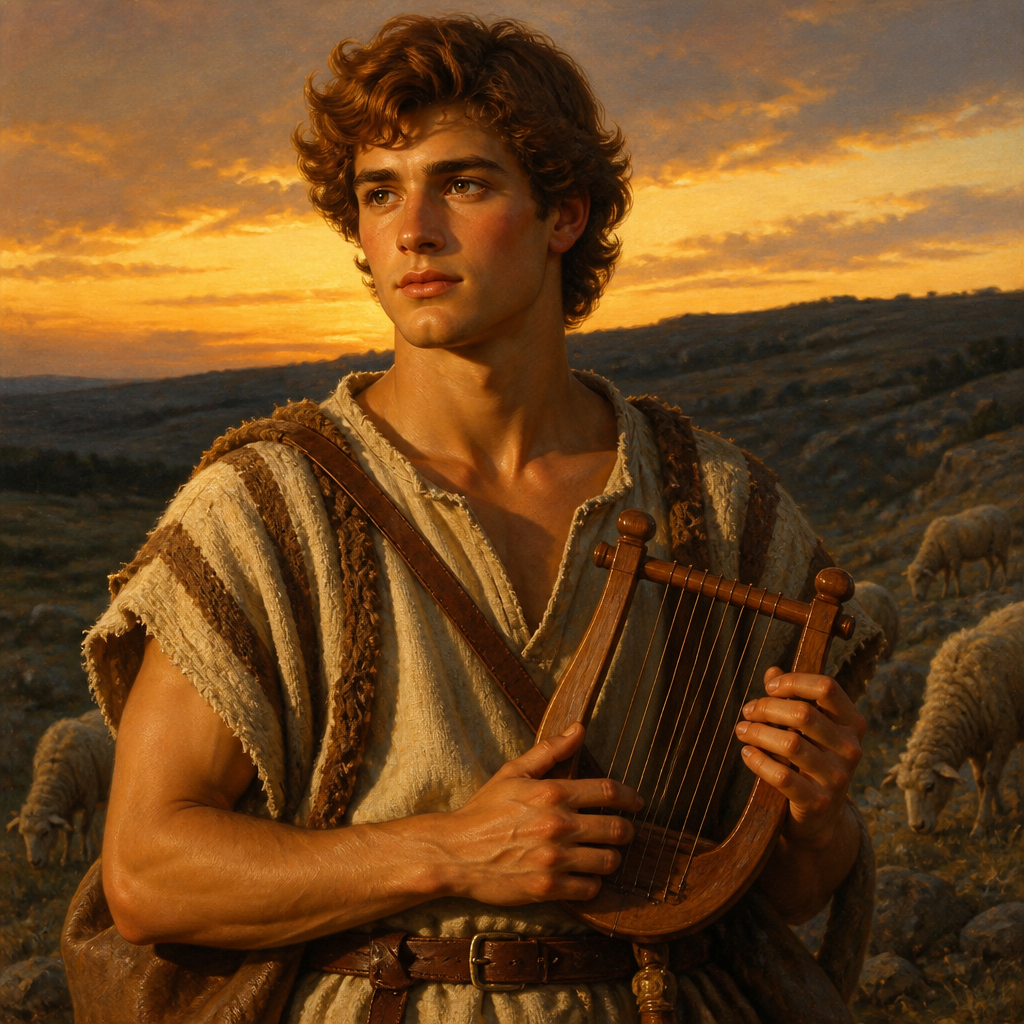 DavidThis page
 Abinadab, Son of JesseBrother1 Samuel 17:13–14Stated
 Eliab, Brother of DavidBrother1 Samuel 17:13–14Stated
 ZeruiahSister1 Chronicles 2:15–16Stated
 Abigail, Sister of DavidSister1 Chronicles 2:15–16Stated
 Shimeah, Brother of DavidBrother2 Samuel 13:3Stated
 Elihu, Brother of DavidBrother1 Chronicles 27:18Stated
 Nethanel, Brother of DavidBrother1 Chronicles 2:14–15Stated
 Ozem, Brother of DavidBrother1 Chronicles 2:15Stated
 RaddaiBrother1 Chronicles 2:14–15Stated
Children
 AbsalomSon2 Samuel 13:1Stated
 Adonijah, Son of DavidSon2 Samuel 3:4–5Stated
 Amnon, Firstborn Son of DavidSon2 Samuel 3:2Stated
 ChileabSon2 Samuel 3:2–3Stated
 Eliada, Son of DavidSon1 Chronicles 3:4–8Stated
 Eliphelet, Son of DavidSon1 Chronicles 3:6Stated
 Elishama, Son of DavidSon1 Chronicles 3:4–8Stated
 ElishuaSon1 Chronicles 3:6Stated
 IbharSon1 Chronicles 3:5–6Stated
 IthreamSon2 Samuel 3:5Stated
 Japhia, Son of DavidSon1 Chronicles 3:4–7Stated
 Nathan, Son of DavidSonLuke 3:31Stated
 Nepheg, Son of DavidSon1 Chronicles 3:4–7Stated
 Shammua, Son of DavidSon2 Samuel 3:2
Inferred
Reconstructed through Nathan: 2 Samuel 5:14 ties Shammua to Nathan (itself an inferred link); Luke 3:31 ties Nathan to David. No verse states the father link between Shammua and David directly.Evidence: 2 Samuel 3:2
 Shephatiah, Son of DavidSon2 Samuel 3:4–5Stated
 Shobab, Son of DavidSon1 Chronicles 3:4–5Stated
 SolomonSon2 Samuel 12:24Stated
 Tamar, Daughter of DavidDaughter1 Chronicles 3:9Stated
 ElpeletSon2 Samuel 3:2
Inferred
No verse names Elpelet and David together; the father link is carried from the surrounding genealogy and is not stated in Scripture.Evidence: 2 Samuel 3:2
 NogahSon1 Chronicles 3:4–7Stated
 Jerimoth, Son of DavidSon2 Chronicles 11:18Stated
Extended family
 Husband of ZeruiahBrother-in-law1 Samuel 26:6
Inferred
No verse names Husband of Zeruiah and David together; the brother-in-law link is carried from the surrounding genealogy and is not stated in Scripture.Evidence: 1 Samuel 26:6
 SaulFather-in-law1 Samuel 19:11
Inferred
1 Samuel 19:11 names Saul and David in the same verse but does not state a son-in-law tie between them; the link rests on the surrounding narrative.Evidence: 1 Samuel 19:11; 1 Samuel 25:44; 1 Samuel 18:20; 1 Samuel 18:27; 1 Samuel 18:28
 Talmai, King of GeshurFather-in-law2 Samuel 3:3
Inferred
Reconstructed through Absalom: 2 Samuel 3:3 ties Talmai to Absalom (itself an inferred link); 2 Samuel 13:1 ties Absalom to David. No verse states the son-in-law link between Talmai and David directly.Evidence: 2 Samuel 3:3
 Jether, Father of AmasaBrother-in-law1 Kings 2:32
Inferred
1 Kings 2:32 names Jether and David in the same verse but does not state a brother-in-law tie between them; the link rests on the surrounding narrative.Evidence: 1 Kings 2:32
 Obed, Son of Boaz and RuthGrandfatherRuth 4:17
Inferred
Ruth 4:17 names Obed and David in the same verse but does not state a grandson tie between them; the link rests on the surrounding narrative.Evidence: Ruth 4:17; Ruth 4:22; 1 Samuel 16:20; 1 Samuel 17:17; 1 Chronicles 2:12; Matthew 1:5; Luke 3:32
 SalmonGreat-Great-GrandfatherRuth 4:17
Inferred
Reconstructed through Boaz and Obed: Ruth 4:21 ties Salmon to Boaz; Ruth 4:21 ties Boaz to Obed; Ruth 4:17 ties Obed to David (itself an inferred link). No verse states the great-great-grandson link between Salmon and David directly.Evidence: Ruth 4:17
 Tamar, Daughter of AbsalomGranddaughter2 Samuel 14:27
Inferred
2 Samuel 13:1 names David and Tamar in the same verse but does not state a granddaughter tie between them; the link rests on the surrounding narrative.Evidence: 2 Samuel 14:27; 2 Samuel 13:1; Psalms 3:1
 Mahalath, Wife of RehoboamGranddaughter2 Chronicles 11:18Stated
 MattathaGrandsonLuke 3:31Stated
 MennaGrandsonLuke 3:31Stated
 NahshonAncestorExodus 6:23
Inferred
No verse names Nahshon and David together; the descendant link is carried from the surrounding genealogy and is not stated in Scripture.Evidence: Exodus 6:23
 Igal, Descendant of DavidDescendantRuth 4:17
Inferred
No verse names Igal and David together; the ancestor link is carried from the surrounding genealogy and is not stated in Scripture.Evidence: Ruth 4:17
 Shaphat, Son of ShemaiahDescendantRuth 4:17
Inferred
No verse names Shaphat and David together; the ancestor link is carried from the surrounding genealogy and is not stated in Scripture.Evidence: Ruth 4:17
 Shealtiel, Father of ZerubbabelDescendantLuke 3:27
Inferred
No verse names Shealtiel and David together; the ancestor link is carried from the surrounding genealogy and is not stated in Scripture.Evidence: Luke 3:27
 Zadok, Son of AzorDescendant2 Samuel 19:11
Inferred
2 Samuel 19:11 names Zadok and David together among the priests, which is a shared office rather than a stated ancestor tie.Evidence: 2 Samuel 19:11
 AddiDescendantRuth 4:17
Inferred
No verse names Addi and David together; the ancestor link is carried from the surrounding genealogy and is not stated in Scripture.Evidence: Ruth 4:17
 CosamDescendantRuth 4:17
Inferred
No verse names David and Cosam together; the descendant link is carried from the surrounding genealogy and is not stated in Scripture.Evidence: Ruth 4:17
 Eliakim, Son of MeleaDescendantLuke 3:30
Inferred
Reconstructed through Jonam and Joseph: Luke 3:30 ties Eliakim to Jonam; Luke 3:30 ties Jonam to Joseph; Matthew 1:20 ties Joseph to David (itself an inferred link). No verse states the ancestor link between Eliakim and David directly.Evidence: Luke 3:30
 Eliezer, Ancestor of JesusDescendantRuth 4:17
Inferred
No verse names Eliezer and David together; the ancestor link is carried from the surrounding genealogy and is not stated in Scripture.Evidence: Ruth 4:17
 JannaiDescendantRuth 4:17
Inferred
No verse names Jannai and David together; the ancestor link is carried from the surrounding genealogy and is not stated in Scripture.Evidence: Ruth 4:17
 JorimDescendantLuke 3:29
Inferred
No verse names David and Jorim together; the descendant link is carried from the surrounding genealogy and is not stated in Scripture.Evidence: Luke 3:29
 Joseph, Son of JonamDescendantMatthew 1:20
Inferred
Matthew 1:20 names Joseph and David in the same verse but does not state an ancestor tie between them; the link rests on the surrounding narrative.Evidence: Matthew 1:20
 Joshua, Ancestor of JesusDescendantLuke 3:29
Inferred
No verse names David and Joshua together; the descendant link is carried from the surrounding genealogy and is not stated in Scripture.Evidence: Luke 3:29
 Judah, Son of JosephDescendant1 Samuel 17:12
Inferred
1 Samuel 17:12 names David and Judah in the same verse but does not state a descendant tie between them; the link rests on the surrounding narrative.Evidence: 1 Samuel 17:12
 Melchi, Son of AddiDescendantRuth 4:17
Inferred
No verse names David and Melchi together; the descendant link is carried from the surrounding genealogy and is not stated in Scripture.Evidence: Ruth 4:17
 MeleaDescendantLuke 3:31Stated
 NaggaiDescendantRuth 4:17
Inferred
No verse names David and Naggai together; the descendant link is carried from the surrounding genealogy and is not stated in Scripture.Evidence: Ruth 4:17
 NeriDescendantLuke 3:27
Inferred
No verse names Neri and David together; the ancestor link is carried from the surrounding genealogy and is not stated in Scripture.Evidence: Luke 3:27
 SemeinDescendantLuke 3:26
Inferred
No verse names David and Semein together; the descendant link is carried from the surrounding genealogy and is not stated in Scripture.Evidence: Luke 3:26
 Simeon, Son of Judah in the Genealogy of JesusDescendantRuth 4:17
Inferred
Reconstructed through Judah: 1 Samuel 17:12 ties David to Judah (itself an inferred link); Luke 3:30 ties Judah to Simeon. No verse states the descendant link between David and Simeon directly.Evidence: Ruth 4:17
 Joab, Commander of the ArmyNephew1 Samuel 26:6
Inferred
1 Samuel 26:6 names David and Joab in the same verse but does not state a nephew tie between them; the link rests on the surrounding narrative.Evidence: 1 Samuel 26:6
 Amasa, Nephew of DavidNephew2 Samuel 17:25
Inferred
Reconstructed through Joab: 1 Samuel 26:6 ties David to Joab (itself an inferred link); 2 Samuel 17:25 ties Joab to Amasa (itself an inferred link). No verse states the nephew link between David and Amasa directly.Evidence: 2 Samuel 17:25
 Asahel, Brother of JoabNephew1 Samuel 26:6
Inferred
Reconstructed through Joab: 2 Samuel 3:27 ties Asahel to Joab; 1 Samuel 26:6 ties Joab to David (itself an inferred link). No verse states the uncle link between Asahel and David directly.Evidence: 1 Samuel 26:6
 Jonadab, Son of ShimeahNephew2 Samuel 13:3
Inferred
2 Samuel 13:3 names David and Jonadab in the same verse but does not state a nephew tie between them; the link rests on the surrounding narrative.Evidence: 2 Samuel 13:3
 Abihail, Daughter of EliabNiece2 Chronicles 11:18
Inferred
2 Chronicles 11:18 names Abihail and David in the same verse but does not state an uncle tie between them; the link rests on the surrounding narrative.Evidence: 2 Chronicles 11:18; 1 Samuel 17:28
Connected Figures
Family
Father · Ruth 4:17
The father of King David and a resident of Bethlehem, Jesse is a pivotal link in the genealogy of the Davidic dynasty and the Messianic line.
United MonarchyFirst: Ruth 4:1752 versesShepherdJudah
Parent · 2 Samuel 17:25
A figure mentioned in the genealogy of King David’s family, identified as the parent of Abigail and Zeruiah.
United MonarchyFirst: 2 Samuel 17:252 versesParent in the house of Jesse
Wife · 1 Samuel 25:39
An intelligent and beautiful woman from Carmel who averted a massacre through diplomacy and later became one of King David’s primary wives.
United MonarchyFirst: 1 Samuel 25:324 versesLandowner's wife, later Queen Consort
Wife · 1 Samuel 25:43
Ahinoam of Jezreel was the first of King David's wives during his wilderness years and the mother of his firstborn son, Amnon.
United MonarchyFirst: 1 Samuel 25:438 versesQueen consort / Wife of David
Wife · 1 Samuel 19:11
The daughter of King Saul and the first wife of King David, Michal is a complex figure who navigated the political and personal tensions of Israel's early monarchy.
United MonarchyFirst: 1 Samuel 14:4921 versesPrincess of Israel, Queen ConsortBenjamin
Wife · 2 Samuel 3:2–5
Abital was one of King David's wives during his reign in Hebron and the mother of his fifth son, Shephatiah.
United MonarchyFirst: 2 Samuel 3:45 versesQueen consort
Wife · 2 Samuel 12:24
The daughter of Eliam, wife of Uriah the Hittite, and later the wife of King David and mother of King Solomon.
United MonarchyFirst: 2 Samuel 11:312 versesQueen Consort, Queen MotherJudah
Wife · 2 Samuel 3:5
Eglah was one of King David's wives and the mother of his sixth son, Ithream, during David's reign in Hebron.
United MonarchyFirst: 2 Samuel 3:52 versesQueen consort
Wife · 2 Samuel 3:2–5
Haggith was one of King David's wives and the mother of Adonijah, who attempted to seize the throne during David's old age.
United MonarchyFirst: 2 Samuel 3:48 versesQueen consort of Israel
Wife · 2 Samuel 5:13
A group of women from the tribe of Judah who married King David after his move to Jerusalem, mothering several of his sons.
United MonarchyFirst: 2 Samuel 5:136 versesRoyal ConsortsJudah
Wife · 2 Samuel 3:2–5
A foreign princess and wife of King David who became the mother of Absalom and Tamar during the United Monarchy.
United MonarchyFirst: 2 Samuel 3:38 versesQueen Consort of Israel
Son · 2 Samuel 13:1
The third son of King David, Absalom was a charismatic prince who staged a major rebellion against his father and was ultimately killed in battle by Joab.
United MonarchyFirst: 2 Samuel 3:3104 versesPrince / Rebel LeaderJudah
Associates
Anointed him king · 2 Samuel 5:3
The leaders of Israel's tribes who came to David at Hebron, made a covenant with him before the LORD, and anointed him king over Israel (2 Samuel 5:3).
Categories
Mentions by Book
- Exodus1
- Ruth5
- 1 Samuel233
- 2 Samuel236
- 1 Kings74
- 2 Kings18
- 1 Chronicles167
- 2 Chronicles66
- Ezra3
- Nehemiah7
- Psalms86
- Proverbs1
- Ecclesiastes1
- Isaiah10
- Jeremiah15
- Ezekiel4
- Hosea1
- Amos2
- Zechariah5
- Matthew16
- Mark7
- Luke20
- John1
- Acts10
- Romans3
- 2 Timothy1
- Hebrews2
- Revelation3
Scripture References
All 998 indexed verses, in canonical order, from the Berean Standard Bible.
- Exodus 6:23Partial
And Aaron married Elisheba, the daughter of Amminadab and sister of Nahshon, and she bore him Nadab and Abihu, Eleazar and Ithamar.
Cited as evidence on a family card; added so References, Key Verses and Mentions by Book share one index.
- Ruth 4:17
The neighbor women said, “A son has been born to Naomi,” and they named him Obed. He became the father of Jesse, the father of David.
- Ruth 4:18Partial
Now these are the generations of Perez: Perez was the father of Hezron,
Cited as evidence on a family card; added so References, Key Verses and Mentions by Book share one index.
- Ruth 4:19Partial
Hezron was the father of Ram, Ram was the father of Amminadab,
Cited as evidence on a family card; added so References, Key Verses and Mentions by Book share one index.
- Ruth 4:20Partial
Amminadab was the father of Nahshon, Nahshon was the father of Salmon,
Cited as evidence on a family card; added so References, Key Verses and Mentions by Book share one index.
- Ruth 4:22
Obed was the father of Jesse, and Jesse was the father of David.
- 1 Samuel 16:13
So Samuel took the horn of oil and anointed him in the presence of his brothers, and the Spirit of the LORD rushed upon David from that day forward. Then Samuel set out and went to Ramah.
- 1 Samuel 16:19
So Saul sent messengers to Jesse and said, “Send me your son David, who is with the sheep.”
- 1 Samuel 16:20
And Jesse took a donkey loaded with bread, a skin of wine, and one young goat and sent them to Saul with his son David.
- 1 Samuel 16:21
When David came to Saul and entered his service, Saul loved him very much, and David became his armor-bearer.
- 1 Samuel 16:22
Then Saul sent word to Jesse, saying, “Let David remain in my service, for I am pleased with him.”
- 1 Samuel 16:23
And whenever the spirit from God came upon Saul, David would pick up his harp and play. Then Saul would find relief and feel better, and the spirit of distress would depart from him.
- 1 Samuel 17:12
Now David was the son of a man named Jesse, an Ephrathite from Bethlehem of Judah who had eight sons. And in the days of Saul, Jesse was old and well along in years.
- 1 Samuel 17:13Partial
The three older sons of Jesse had followed Saul into battle: The firstborn was Eliab, the second was Abinadab, and the third was Shammah.
Cited as evidence on a family card; added so References, Key Verses and Mentions by Book share one index.
- 1 Samuel 17:14
And David was the youngest. The three oldest had followed Saul,
- 1 Samuel 17:15
but David went back and forth from Saul to tend his father’s sheep in Bethlehem.
- 1 Samuel 17:17
One day Jesse said to his son David, “Take this ephah of roasted grain and these ten loaves of bread for your brothers and hurry to their camp.
- 1 Samuel 17:20
So David got up early in the morning, left the flock with a keeper, loaded up, and set out as Jesse had instructed him. He reached the camp as the army was marching out to its position and shouting the battle cry.
- 1 Samuel 17:22
Then David left his supplies in the care of the quartermaster and ran to the battle line. When he arrived, he asked his brothers how they were doing.
- 1 Samuel 17:23
And as he was speaking with them, suddenly the champion named Goliath, the Philistine from Gath, came forward from the ranks of the Philistines and shouted his usual words, which David also heard.
- 1 Samuel 17:26
David asked the men who were standing with him, “What will be done for the man who kills this Philistine and removes this disgrace from Israel? Just who is this uncircumcised Philistine, that he should defy the armies of the living God?”
- 1 Samuel 17:28
Now when David’s oldest brother Eliab heard him speaking to the men, his anger burned against David. “Why have you come down here?” he asked. “And with whom did you leave those few sheep in the wilderness? I know your pride and wickedness of heart—you have come down to see the battle!”
- 1 Samuel 17:29
“What have I done now?” said David. “Was it not just a question?”
- 1 Samuel 17:31
Now David’s words were overheard and reported to Saul, who sent for him.
- 1 Samuel 17:32
And David said to Saul, “Let no man’s heart fail on account of this Philistine. Your servant will go and fight him!”
- 1 Samuel 17:33
But Saul replied, “You cannot go out against this Philistine to fight him. You are just a boy, and he has been a warrior from his youth.”
- 1 Samuel 17:34
David replied, “Your servant has been tending his father’s sheep, and whenever a lion or a bear came and carried off a lamb from the flock,
- 1 Samuel 17:37Partial
David added, “The LORD, who delivered me from the claws of the lion and the bear, will deliver me from the hand of this Philistine.” “Go,” said Saul, “and may the LORD be with you.”
- 1 Samuel 17:38
Then Saul clothed David in his own tunic, put a bronze helmet on his head, and dressed him in armor.
- 1 Samuel 17:39Partial
David strapped his sword over the tunic and tried to walk, but he was not accustomed to them. “I cannot walk in these,” David said to Saul. “I am not accustomed to them.” So David took them off.
- 1 Samuel 17:41
Now the Philistine came closer and closer to David, with his shield-bearer before him.
- 1 Samuel 17:42
When the Philistine looked and saw David, he despised him because he was just a boy, ruddy and handsome.
- 1 Samuel 17:43Partial
“Am I a dog,” he said to David, “that you come at me with sticks?” And the Philistine cursed David by his gods.
- 1 Samuel 17:44
“Come here,” he called to David, “and I will give your flesh to the birds of the air and the beasts of the field!”
- 1 Samuel 17:45
But David said to the Philistine, “You come against me with sword and spear and javelin, but I come against you in the name of the LORD of Hosts, the God of the armies of Israel, whom you have defied.
- 1 Samuel 17:48Partial
As the Philistine started forward to attack him, David ran quickly toward the battle line to meet him.
- 1 Samuel 17:49
Then David reached into his bag, took out a stone, and slung it, striking the Philistine on the forehead. The stone sank into his forehead, and he fell facedown on the ground.
- 1 Samuel 17:50Partial
Thus David prevailed over the Philistine with a sling and a stone; without a sword in his hand he struck down the Philistine and killed him.
- 1 Samuel 17:51
David ran and stood over him. He grabbed the Philistine’s sword and pulled it from its sheath and killed him, and he cut off his head with the sword. When the Philistines saw that their hero was dead, they turned and ran.
- 1 Samuel 17:54
David took the head of the Philistine and brought it to Jerusalem, and he put Goliath’s weapons in his own tent.
- 1 Samuel 17:55
As Saul had watched David going out to confront the Philistine, he said to Abner the commander of the army, “Abner, whose son is this young man?” “As surely as you live, O king,” Abner replied, “I do not know.”
- 1 Samuel 17:57
So when David returned from killing the Philistine, still holding his head in his hand, Abner took him and brought him before Saul.
- 1 Samuel 17:58
“Whose son are you, young man?” asked Saul. “I am the son of your servant Jesse of Bethlehem,” David replied.
- 1 Samuel 18:1
After David had finished speaking with Saul, the souls of Jonathan and David were knit together, and Jonathan loved him as himself.
- 1 Samuel 18:3
Then Jonathan made a covenant with David because he loved him as himself.
- 1 Samuel 18:4
And Jonathan removed the robe he was wearing and gave it to David, along with his tunic, his sword, his bow, and his belt.
- 1 Samuel 18:5
So David marched out and prospered in everything Saul sent him to do, and Saul set him over the men of war. And this was pleasing in the sight of all the people, and of Saul’s officers as well.
- 1 Samuel 18:6
As the troops were returning home after David had killed the Philistine, the women came out of all the cities of Israel to meet King Saul with singing and dancing, with joyful songs, and with tambourines and other instruments.
- 1 Samuel 18:7
And as the women danced, they sang out: “Saul has slain his thousands, and David his tens of thousands.”
- 1 Samuel 18:8
And Saul was furious and resented this song. “They have ascribed tens of thousands to David,” he said, “but only thousands to me. What more can he have but the kingdom?”
- 1 Samuel 18:9
And from that day forward Saul kept a jealous eye on David.
- 1 Samuel 18:10
The next day a spirit of distress sent from God came upon Saul, and he prophesied inside the house while David played the harp as usual. Now Saul was holding a spear,
- 1 Samuel 18:11Partial
and he hurled it, thinking, “I will pin David to the wall.” But David eluded him twice.
- 1 Samuel 18:12
So Saul was afraid of David, because the LORD was with David but had departed from Saul.
- 1 Samuel 18:14
and he continued to prosper in all his ways, because the LORD was with him.
- 1 Samuel 18:16
But all Israel and Judah loved David, because he was leading them out to battle and back.
- 1 Samuel 18:17
Then Saul said to David, “Here is my older daughter Merab. I will give her to you in marriage. Only be valiant for me and fight the LORD’s battles.” But Saul was thinking, “I need not raise my hand against him; let the hand of the Philistines be against him.”
- 1 Samuel 18:18
And David said to Saul, “Who am I, and what is my family or my father’s clan in Israel, that I should become the son-in-law of the king?”
- 1 Samuel 18:19
So when it was time to give Saul’s daughter Merab to David, she was given in marriage to Adriel of Meholah.
- 1 Samuel 18:20
Now Saul’s daughter Michal loved David, and when this was reported to Saul, it pleased him.
- 1 Samuel 18:21
“I will give her to David,” Saul thought, “so that she may be a snare to him, and the hand of the Philistines may be against him.” So Saul said to David, “For a second time now you can be my son-in-law.”
- 1 Samuel 18:22
Then Saul ordered his servants, “Speak to David privately and tell him, ‘Behold, the king is pleased with you, and all his servants love you. Now therefore, become his son-in-law.’”
- 1 Samuel 18:23Partial
But when Saul’s servants relayed these words to David, he replied, “Does it seem trivial in your sight to be the son-in-law of the king? I am a poor man and lightly esteemed.”
- 1 Samuel 18:24
And the servants told Saul what David had said.
- 1 Samuel 18:25Partial
Saul replied, “Say to David, ‘The king desires no other dowry but a hundred Philistine foreskins as revenge on his enemies.’” But Saul intended to cause David’s death at the hands of the Philistines.
- 1 Samuel 18:26Partial
When the servants reported these terms to David, he was pleased to become the king’s son-in-law. Before the wedding day arrived,
- 1 Samuel 18:27Partial
David and his men went out and killed two hundred Philistines. He brought their foreskins and presented them as payment in full to become the king’s son-in-law. Then Saul gave his daughter Michal to David in marriage.
- 1 Samuel 18:28
When Saul realized that the LORD was with David and that his daughter Michal loved David,
- 1 Samuel 18:29Partial
he grew even more afraid of David. So from then on Saul was David’s enemy.
- 1 Samuel 18:30
Every time the Philistine commanders came out for battle, David was more successful than all of Saul’s officers, so that his name was highly esteemed.
- 1 Samuel 19:1Partial
Then Saul ordered his son Jonathan and all his servants to kill David. But Jonathan delighted greatly in David,
- 1 Samuel 19:2
so he warned David, saying, “My father Saul intends to kill you. Be on your guard in the morning; find a secret place and hide there.
- 1 Samuel 19:4Partial
Then Jonathan spoke well of David to his father Saul and said to him, “The king should not sin against his servant David; he has not sinned against you. In fact, his actions have been highly beneficial to you.
- 1 Samuel 19:5
He took his life in his hands when he struck down the Philistine, and the LORD worked a great salvation for all Israel. You saw it and rejoiced, so why would you sin against innocent blood by killing David for no reason?”
- 1 Samuel 19:7Partial
So Jonathan summoned David and told him all these things. Then Jonathan brought David to Saul, and David was with Saul as before.
- 1 Samuel 19:8
When war broke out again, David went out and fought the Philistines and struck them with such a mighty blow that they fled before him.
- 1 Samuel 19:9
But as Saul was sitting in his house with his spear in his hand, a spirit of distress from the LORD came upon him. While David was playing the harp,
- 1 Samuel 19:10Partial
Saul tried to pin him to the wall with his spear. But David eluded him and the spear struck the wall. And David fled and escaped that night.
- 1 Samuel 19:11Partial
Then Saul sent messengers to David’s house to watch him and kill him in the morning. But David’s wife Michal warned him, “If you do not run for your life tonight, tomorrow you will be dead!”
- 1 Samuel 19:12
So Michal lowered David from the window, and he ran away and escaped.
- 1 Samuel 19:14
When Saul sent the messengers to seize David, Michal said, “He is ill.”
- 1 Samuel 19:15
But Saul sent the messengers back to see David and told them, “Bring him up to me in his bed so I can kill him.”
- 1 Samuel 19:18
So David ran away and escaped. And he went to Samuel at Ramah and told him all that Saul had done to him. Then he and Samuel went to Naioth and stayed there.
- 1 Samuel 19:19
When Saul was told that David was at Naioth in Ramah,
- 1 Samuel 19:20
he sent messengers to seize him. But when they saw the group of prophets prophesying, with Samuel leading them, the Spirit of God came upon them, and Saul’s messengers also began to prophesy.
- 1 Samuel 19:22
Finally, Saul himself left for Ramah and came to the large cistern at Secu, where he asked, “Where are Samuel and David?” “At Naioth in Ramah,” he was told.
- 1 Samuel 20:1
Then David fled from Naioth in Ramah. He came to Jonathan and asked, “What have I done? What is my iniquity? How have I sinned against your father, that he wants to take my life?”
- 1 Samuel 20:3
But David again vowed, “Your father knows very well that I have found favor in your eyes, and he has said, ‘Jonathan must not know of this, or he will be grieved.’ As surely as the LORD lives and as you yourself live, there is but a step between me and death.”
- 1 Samuel 20:4
Then Jonathan said to David, “Whatever you desire, I will do for you.”
- 1 Samuel 20:5
So David told him, “Look, tomorrow is the New Moon, and I am supposed to dine with the king. Instead, let me go and hide in the field until the third evening from now.
- 1 Samuel 20:6
If your father misses me at all, tell him, ‘David urgently requested my permission to hurry to Bethlehem, his hometown, because there is an annual sacrifice for his whole clan.’
- 1 Samuel 20:10
Then David asked Jonathan, “Who will tell me if your father answers you harshly?”
- 1 Samuel 20:11
“Come,” he replied, “let us go out to the field.” So the two of them went out into the field,
- 1 Samuel 20:12Partial
and Jonathan said, “By the LORD, the God of Israel, I will sound out my father by this time tomorrow or the next day. If he is favorable toward you, will I not send for you and tell you?
- 1 Samuel 20:15
and do not ever cut off your loving devotion from my household—not even when the LORD cuts off every one of David’s enemies from the face of the earth.”
- 1 Samuel 20:16Partial
So Jonathan made a covenant with the house of David, saying, “May the LORD hold David’s enemies accountable.”
- 1 Samuel 20:17
And Jonathan had David reaffirm his vow out of love for him, for Jonathan loved David as he loved himself.
- 1 Samuel 20:24
So David hid in the field, and when the New Moon had come, the king sat down to eat.
- 1 Samuel 20:25
He sat in his usual place by the wall, opposite Jonathan and beside Abner, but David’s place was empty.
- 1 Samuel 20:27
But on the day after the New Moon, the second day, David’s place was still empty, and Saul asked his son Jonathan, “Why hasn’t the son of Jesse come to the meal either yesterday or today?”
- 1 Samuel 20:28
Jonathan answered, “David urgently requested my permission to go to Bethlehem,
- 1 Samuel 20:33
Then Saul hurled his spear at Jonathan to kill him. So Jonathan knew that his father was determined to kill David.
- 1 Samuel 20:34
Jonathan got up from the table in fierce anger and did not eat any food that second day of the month, for he was grieved by his father’s shameful treatment of David.
- 1 Samuel 20:35
In the morning Jonathan went out to the field for the appointment with David, and a small boy was with him.
- 1 Samuel 20:39
But the boy did not know anything; only Jonathan and David knew the arrangement.
- 1 Samuel 20:41Partial
When the young man had gone, David got up from the south side of the stone, fell facedown, and bowed three times. Then he and Jonathan kissed each other and wept together—though David wept more.
- 1 Samuel 20:42
And Jonathan said to David, “Go in peace, for the two of us have sworn in the name of the LORD, saying, ‘May the LORD be a witness between you and me, and between your descendants and mine forever.’” Then David got up and departed, and Jonathan went back into the city.
- 1 Samuel 21:1Partial
Then David came to Nob, to Ahimelech the priest. And when Ahimelech met David, he trembled and asked him, “Why are you alone? Why is no one with you?”
- 1 Samuel 21:2
“The king has given me a mission,” David replied. “He told me no one is to know about the mission on which I am sending you. And I have directed my young men to meet me at a certain place.
- 1 Samuel 21:4
“There is no common bread on hand,” the priest replied, “but there is some consecrated bread—provided that the young men have kept themselves from women.”
- 1 Samuel 21:5
David answered, “Women have indeed been kept from us, as is usual when I set out. And the bodies of the young men are holy even on common missions. How much more so today!”
- 1 Samuel 21:8
Then David asked Ahimelech, “Is there not a spear or sword on hand here? For I have brought neither my sword nor my weapons with me, because the king’s mission was urgent.”
- 1 Samuel 21:9
The priest replied, “The sword of Goliath the Philistine, whom you killed in the Valley of Elah, is here; it is wrapped in a cloth behind the ephod. If you want, you may take it. For there is no other but this one here.” And David said, “There is none like it; give it to me.”
- 1 Samuel 21:10
That day David fled from Saul and went to Achish king of Gath.
- 1 Samuel 21:11Partial
But the servants of Achish said to him, “Is this not David, the king of the land? Did they not sing about him in their dances, saying: ‘Saul has slain his thousands, and David his tens of thousands’?”
- 1 Samuel 21:12
Now David took these words to heart and was very much afraid of Achish the king of Gath.
- 1 Samuel 22:1
So David left Gath and took refuge in the cave of Adullam. When his brothers and the rest of his father’s household heard about it, they went down to him there.
- 1 Samuel 22:3
From there David went to Mizpeh of Moab, where he said to the king of Moab, “Please let my father and mother stay with you until I learn what God will do for me.”
- 1 Samuel 22:4
So he left them in the care of the king of Moab, and they stayed with him the whole time David was in the stronghold.
- 1 Samuel 22:5Partial
Then the prophet Gad said to David, “Do not stay in the stronghold. Depart and go into the land of Judah.” So David left and went to the forest of Hereth.
- 1 Samuel 22:6
Soon Saul learned that David and his men had been discovered. At that time Saul was sitting under the tamarisk tree on the hill at Gibeah, with his spear in hand and all his servants standing around him.
- 1 Samuel 22:14
Ahimelech answered the king, “Who among all your servants is as faithful as David, the king’s son-in-law, the captain of your bodyguard and honored in your house?
- 1 Samuel 22:17
Then the king ordered the guards at his side, “Turn and kill the priests of the LORD, because they too sided with David. For they knew he was fleeing, but they did not tell me.” But the king’s servants would not lift a hand to strike the priests of the LORD.
- 1 Samuel 22:20
But one of the sons of Ahimelech son of Ahitub escaped. His name was Abiathar, and he fled to David.
- 1 Samuel 22:21
And Abiathar told David that Saul had killed the priests of the LORD.
- 1 Samuel 22:22
Then David said to Abiathar, “I knew that Doeg the Edomite was there that day, and that he was sure to tell Saul. I myself am responsible for the lives of everyone in your father’s house.
- 1 Samuel 23:1
Now it was reported to David, “Look, the Philistines are fighting against Keilah and looting the threshing floors.”
- 1 Samuel 23:2Partial
So David inquired of the LORD, “Should I go and attack these Philistines?” And the LORD said to David, “Go and attack the Philistines and save Keilah.”
- 1 Samuel 23:3
But David’s men said to him, “Look, we are afraid here in Judah; how much more if we go to Keilah against the armies of the Philistines?”
- 1 Samuel 23:4
Once again, David inquired of the LORD, and the LORD answered him: “Go at once to Keilah, for I will deliver the Philistines into your hand.”
- 1 Samuel 23:5Partial
Then David and his men went to Keilah, fought against the Philistines, and carried off their livestock, striking them with a mighty blow. So David saved the people of Keilah.
- 1 Samuel 23:6
(Now Abiathar son of Ahimelech had brought the ephod with him when he fled to David at Keilah.)
- 1 Samuel 23:7
When Saul was told that David had gone to Keilah, he said, “God has delivered him into my hand, for he has trapped himself by entering a town with gates and bars.”
- 1 Samuel 23:8
Then Saul summoned all his troops to go to war at Keilah and besiege David and his men.
- 1 Samuel 23:9
When David learned that Saul was plotting evil against him, he said to Abiathar the priest, “Bring the ephod.”
- 1 Samuel 23:10
And David said, “O LORD, God of Israel, Your servant has heard that Saul intends to come to Keilah and destroy the city on my account.
- 1 Samuel 23:12
So David asked, “Will the citizens of Keilah surrender me and my men into the hand of Saul?” “They will,” said the LORD.
- 1 Samuel 23:13Partial
Then David and his men, about six hundred strong, set out and departed from Keilah, moving from place to place. When Saul was told that David had escaped from Keilah, he declined to go forth.
- 1 Samuel 23:14
And David stayed in the wilderness strongholds and in the hill country of the Wilderness of Ziph. Day after day Saul searched for him, but God would not deliver David into his hand.
- 1 Samuel 23:15Partial
While David was in Horesh in the Wilderness of Ziph, he saw that Saul had come out to take his life.
- 1 Samuel 23:16
And Saul’s son Jonathan came to David in Horesh and strengthened his hand in God,
- 1 Samuel 23:18
So the two of them made a covenant before the LORD. And David remained in Horesh, while Jonathan went home.
- 1 Samuel 23:19
Then the Ziphites came up to Saul at Gibeah and said, “Is not David hiding among us in the strongholds at Horesh, on the hill of Hachilah south of Jeshimon?
- 1 Samuel 23:24
So they set out and went to Ziph ahead of Saul. Now David and his men were in the Wilderness of Maon in the Arabah south of Jeshimon,
- 1 Samuel 23:25Partial
and Saul and his men went to seek him. When David was told about it, he went down to the rock and stayed in the Wilderness of Maon. And when Saul heard of this, he pursued David there.
- 1 Samuel 23:26Partial
Saul was proceeding along one side of the mountain, and David and his men along the other side. Even though David was hurrying to get away, Saul and his men were closing in on David and his men to capture them.
- 1 Samuel 23:28
So Saul broke off his pursuit of David and went to meet the Philistines. That is why that place is called Sela-hammahlekoth.
- 1 Samuel 23:29
And David went up from there and lived in the strongholds of En-gedi.
- 1 Samuel 24:1
After Saul had returned from pursuing the Philistines, he was told, “David is in the wilderness of En-gedi.”
- 1 Samuel 24:2
So Saul took three thousand chosen men from all Israel and went to look for David and his men in the region of the Rocks of the Wild Goats.
- 1 Samuel 24:3
Soon Saul came to the sheepfolds along the road, where there was a cave, and he went in to relieve himself. And David and his men were hiding in the recesses of the cave.
- 1 Samuel 24:4Partial
So David’s men said to him, “This is the day about which the LORD said to you, ‘Behold, I will deliver your enemy into your hand, that you may do with him as you wish.’” Then David crept up and stealthily cut off a corner of Saul’s robe.
- 1 Samuel 24:5
Afterward, David’s conscience was stricken because he had cut off the corner of Saul’s robe.
- 1 Samuel 24:7
With these words David restrained his men, and he did not let them rise up against Saul. Then Saul left the cave and went on his way.
- 1 Samuel 24:8Partial
After that, David got up, went out of the cave, and called out to Saul, “My lord the king!” When Saul looked behind him, David bowed facedown in reverence
- 1 Samuel 24:9Partial
and said to Saul, “Why do you listen to the words of men who say, ‘Look, David intends to harm you’?
- 1 Samuel 24:16Partial
When David had finished saying these things, Saul called back, “Is that your voice, David my son?” Then Saul wept aloud
- 1 Samuel 24:17
and said to David, “You are more righteous than I, for you have rewarded me with good, though I have rewarded you with evil.
- 1 Samuel 24:22Partial
So David gave his oath to Saul. Then Saul returned home, but David and his men went up to the stronghold.
- 1 Samuel 25:1
When Samuel died, all Israel gathered to mourn for him; and they buried him at his home in Ramah. Then David set out and went down to the Wilderness of Paran.
- 1 Samuel 25:4
While David was in the wilderness, he heard that Nabal was shearing sheep.
- 1 Samuel 25:5Partial
So David sent ten young men and instructed them, “Go up to Nabal at Carmel. Greet him in my name
- 1 Samuel 25:8
Ask your young men, and they will tell you. So let my young men find favor with you, for we have come on the day of a feast. Please give whatever you can spare to your servants and to your son David.’”
- 1 Samuel 25:9Partial
When David’s young men arrived, they relayed all these words to Nabal on behalf of David. Then they waited.
- 1 Samuel 25:10Partial
But Nabal asked them, “Who is David? Who is this son of Jesse? Many servants these days are breaking away from their masters.
- 1 Samuel 25:12
So David’s men turned around and went back, and they relayed to him all these words.
- 1 Samuel 25:13Partial
And David said to his men, “Strap on your swords!” So David and all his men strapped on their swords, and about four hundred men followed David, while two hundred stayed with the supplies.
- 1 Samuel 25:14
Meanwhile, one of Nabal’s young men informed Nabal’s wife Abigail, “Look, David sent messengers from the wilderness to greet our master, but he screamed at them.
- 1 Samuel 25:20
As Abigail came riding her donkey into a mountain ravine, she saw David and his men coming down toward her, and she met them.
- 1 Samuel 25:21
Now David had just said, “In vain I have protected all that belonged to this man in the wilderness. Nothing that belongs to him has gone missing, yet he has paid me back evil for good.
- 1 Samuel 25:22
May God punish David, and ever so severely, if I let one male belonging to Nabal survive until morning.”
- 1 Samuel 25:23Partial
When Abigail saw David, she quickly got off the donkey, fell facedown, and bowed before him.
- 1 Samuel 25:32
Then David said to Abigail, “Blessed be the LORD, the God of Israel, who sent you to meet me this day!
- 1 Samuel 25:35
Then David accepted from her hand what she had brought him, and he said to her, “Go home in peace. See, I have heeded your voice and granted your request.”
- 1 Samuel 25:39Partial
On hearing that Nabal was dead, David said, “Blessed be the LORD, who has upheld my cause against the reproach of Nabal and has restrained His servant from evil. For the LORD has brought the wickedness of Nabal down upon his own head.” Then David sent word to Abigail, asking her to become his wife.
- 1 Samuel 25:40Partial
When his servants came to Abigail at Carmel, they said, “David has sent us to take you as his wife.”
- 1 Samuel 25:42
So Abigail hurried and got on a donkey, and attended by five of her maidens, she followed David’s messengers and became his wife.
- 1 Samuel 25:43
David had also married Ahinoam of Jezreel. So she and Abigail were both his wives.
- 1 Samuel 25:44
But Saul had given his daughter Michal, David’s wife, to Palti son of Laish, who was from Gallim.
- 1 Samuel 26:1
Then the Ziphites came to Saul at Gibeah and said, “Is not David hiding on the hill of Hachilah, opposite Jeshimon?”
- 1 Samuel 26:2
So Saul, accompanied by three thousand chosen men of Israel, went down to the Wilderness of Ziph to search for David there.
- 1 Samuel 26:3
Saul camped beside the road at the hill of Hachilah opposite Jeshimon, but David was living in the wilderness. When he realized that Saul had followed him there,
- 1 Samuel 26:4
David sent out spies to verify that Saul had arrived.
- 1 Samuel 26:5Partial
Then David set out and went to the place where Saul had camped. He saw the place where Saul and Abner son of Ner, the general of his army, had lain down. Saul was lying inside the inner circle of the camp, with the troops camped around him.
- 1 Samuel 26:6
And David asked Ahimelech the Hittite and Abishai son of Zeruiah, Joab’s brother, “Who will go down with me to Saul in the camp?” “I will go with you,” answered Abishai.
- 1 Samuel 26:7
That night David and Abishai came to the troops, and Saul was lying there asleep in the inner circle of the camp, with his spear stuck in the ground by his head. And Abner and the troops were lying around him.
- 1 Samuel 26:8
Abishai said to David, “Today God has delivered your enemy into your hand. Now, therefore, please let me thrust the spear through him into the ground with one stroke. I will not need to strike him twice!”
- 1 Samuel 26:9
But David said to Abishai, “Do not destroy him, for who can extend a hand against the LORD’s anointed and be guiltless?”
- 1 Samuel 26:10
David added, “As surely as the LORD lives, the LORD Himself will strike him down; either his day will come and he will die, or he will go into battle and perish.
- 1 Samuel 26:12
So David took the spear and water jug by Saul’s head, and they departed. No one saw them or knew about it, nor did anyone wake up; they all remained asleep, because a deep sleep from the LORD had fallen on them.
- 1 Samuel 26:13
Then David crossed to the other side and stood atop the mountain at a distance; there was a wide gulf between them.
- 1 Samuel 26:14
And David shouted to the troops and to Abner son of Ner, “Will you not answer me, Abner?” “Who are you who calls to the king?” Abner replied.
- 1 Samuel 26:15
So David said to Abner, “You are a man, aren’t you? And who in Israel is your equal? Why then did you not protect your lord the king when one of the people came to destroy him?
- 1 Samuel 26:17Partial
Then Saul recognized David’s voice and asked, “Is that your voice, David my son?” “It is my voice, my lord and king,” David said.
- 1 Samuel 26:21
Then Saul replied, “I have sinned. Come back, David my son. I will never harm you again, because today you considered my life precious. I have played the fool and have committed a grave error!”
- 1 Samuel 26:22
“Here is the king’s spear,” David answered. “Let one of the young men come over and get it.
- 1 Samuel 26:25Partial
Saul said to him, “May you be blessed, David my son. You will accomplish great things and will surely prevail.” So David went on his way, and Saul returned home.
- 1 Samuel 27:1
David, however, said to himself, “One of these days now I will be swept away by the hand of Saul. There is nothing better for me than to escape to the land of the Philistines. Then Saul will stop searching for me all over Israel, and I will slip out of his hand.”
- 1 Samuel 27:2
So David set out with his six hundred men and went to Achish son of Maoch, the king of Gath.
- 1 Samuel 27:3Partial
David and his men settled in Gath with Achish. Each man had his family with him, and David had his two wives: Ahinoam of Jezreel and Abigail of Carmel, the widow of Nabal.
- 1 Samuel 27:4
And when Saul learned that David had fled to Gath, he no longer searched for him.
- 1 Samuel 27:5
Then David said to Achish, “If I have found favor in your eyes, let me be assigned a place in one of the outlying towns, so I can live there. For why should your servant live in the royal city with you?”
- 1 Samuel 27:7
And the time that David lived in Philistine territory amounted to a year and four months.
- 1 Samuel 27:8
Now David and his men went up and raided the Geshurites, the Girzites, and the Amalekites. (From ancient times these people had inhabited the land extending to Shur and Egypt.)
- 1 Samuel 27:9
Whenever David attacked a territory, he did not leave a man or woman alive, but he took the flocks and herds, the donkeys, camels, and clothing. Then he would return to Achish,
- 1 Samuel 27:10
who would ask him, “What have you raided today?” And David would reply, “The Negev of Judah,” or “The Negev of Jerahmeel,” or “The Negev of the Kenites.”
- 1 Samuel 27:11Partial
David did not leave a man or woman alive to be brought to Gath, for he said, “Otherwise they will report us, saying, ‘This is what David did.’” And this was David’s custom the whole time he lived in Philistine territory.
- 1 Samuel 27:12
So Achish trusted David, thinking, “Since he has made himself an utter stench to his people Israel, he will be my servant forever.”
- 1 Samuel 28:1
Now in those days the Philistines gathered their forces for warfare against Israel. So Achish said to David, “You must understand that you and your men are to go out to battle with me.”
- 1 Samuel 28:2Partial
David replied, “Then you will come to know what your servant can do.” “Very well,” said Achish. “I will make you my bodyguard for life.”
- 1 Samuel 28:17
He has done exactly what He spoke through me: The LORD has torn the kingdom out of your hand and given it to your neighbor David.
- 1 Samuel 29:2
As the Philistine leaders marched out with their units of hundreds and thousands, David and his men marched behind them with Achish.
- 1 Samuel 29:3
Then the commanders of the Philistines asked, “What about these Hebrews?” Achish replied, “Is this not David, the servant of King Saul of Israel? He has been with me all these days, even years, and from the day he defected until today I have found no fault in him.”
- 1 Samuel 29:5Partial
Is this not the David about whom they sing in their dances: ‘Saul has slain his thousands, and David his tens of thousands’?”
- 1 Samuel 29:6
So Achish summoned David and told him, “As surely as the LORD lives, you have been upright, and it seems right in my sight that you should march in and out with me in the army, because I have found no fault in you from the day you came to me until this day. But you are not good in the sight of the leaders.
- 1 Samuel 29:8
“But what have I done?” David replied. “What have you found against your servant, from the day I came to you until today, to keep me from going along to fight against the enemies of my lord the king?”
- 1 Samuel 29:9
Achish replied, “I know that you are as pleasing in my sight as an angel of God. But the commanders of the Philistines have said, ‘He must not go into battle with us.’
- 1 Samuel 29:11
So David and his men got up early in the morning to return to the land of the Philistines. And the Philistines went up to Jezreel.
- 1 Samuel 30:1
On the third day David and his men arrived in Ziklag, and the Amalekites had raided the Negev, attacked Ziklag, and burned it down.
- 1 Samuel 30:3
When David and his men came to the city, they found it burned down and their wives and sons and daughters taken captive.
- 1 Samuel 30:4
So David and the troops with him lifted up their voices and wept until they had no strength left to weep.
- 1 Samuel 30:5
David’s two wives, Ahinoam of Jezreel and Abigail the widow of Nabal of Carmel, had been taken captive.
- 1 Samuel 30:6Partial
And David was greatly distressed because the people spoke of stoning him, because the soul of every man grieved for his sons and daughters. But David found strength in the LORD his God.
- 1 Samuel 30:7Partial
Then David said to Abiathar the priest, the son of Ahimelech, “Bring me the ephod.” So Abiathar brought it to him,
- 1 Samuel 30:8
and David inquired of the LORD: “Should I pursue these raiders? Will I overtake them?” “Pursue them,” the LORD replied, “for you will surely overtake them and rescue the captives.”
- 1 Samuel 30:9
So David and his six hundred men went to the Brook of Besor, where some stayed behind
- 1 Samuel 30:10
because two hundred men were too exhausted to cross the brook. But David and four hundred men continued in pursuit.
- 1 Samuel 30:11
Now his men found an Egyptian in the field and brought him to David. They gave the man water to drink and food to eat—
- 1 Samuel 30:13
Then David asked him, “To whom do you belong, and where are you from?” “I am an Egyptian,” he replied, “the slave of an Amalekite. My master abandoned me three days ago when I fell ill.
- 1 Samuel 30:15
“Will you lead me to these raiders?” David asked. And the man replied, “Swear to me by God that you will not kill me or deliver me into the hand of my master, and I will lead you to them.”
- 1 Samuel 30:17
And David struck them down from twilight until the evening of the next day. Not a man escaped, except four hundred young men who fled, riding off on camels.
- 1 Samuel 30:18Partial
So David recovered everything the Amalekites had taken, including his two wives.
- 1 Samuel 30:19
Nothing was missing, young or old, son or daughter, or any of the plunder the Amalekites had taken. David brought everything back.
- 1 Samuel 30:20Partial
And he took all the flocks and herds, which his men drove ahead of the other livestock, calling out, “This is David’s plunder!”
- 1 Samuel 30:21Partial
When David came to the two hundred men who had been too exhausted to follow him and who were left behind at the Brook of Besor, they came out to meet him and the troops with him. As David approached the men, he greeted them,
- 1 Samuel 30:22
but all the wicked and worthless men among those who had gone with David said, “Because they did not go with us, we will not share with them the plunder we recovered, except for each man’s wife and children. They may take them and go.”
- 1 Samuel 30:23
But David said, “My brothers, you must not do this with what the LORD has given us. He has protected us and delivered into our hands the raiders who came against us.
- 1 Samuel 30:26
When David arrived in Ziklag, he sent some of the plunder to his friends, the elders of Judah, saying, “Here is a gift for you from the plunder of the LORD’s enemies.”
- 1 Samuel 30:31
and to those in Hebron and in all the places where David and his men had roamed.
- 2 Samuel 1:1Partial
After the death of Saul, David returned from the slaughter of the Amalekites and stayed in Ziklag two days.
- 2 Samuel 1:2
On the third day a man with torn clothes and dust on his head arrived from Saul’s camp. When he came to David, he fell to the ground to pay him homage.
- 2 Samuel 1:3
“Where have you come from?” David asked. “I have escaped from the Israelite camp,” he replied.
- 2 Samuel 1:4
“What was the outcome?” David asked. “Please tell me.” “The troops fled from the battle,” he replied. “Many of them fell and died. And Saul and his son Jonathan are also dead.”
- 2 Samuel 1:5
Then David asked the young man who had brought him the report, “How do you know that Saul and his son Jonathan are dead?”
- 2 Samuel 1:11
Then David took hold of his own clothes and tore them, and all the men who were with him did the same.
- 2 Samuel 1:13
And David inquired of the young man who had brought him the report, “Where are you from?” “I am the son of a foreigner,” he answered. “I am an Amalekite.”
- 2 Samuel 1:14
So David asked him, “Why were you not afraid to lift your hand to destroy the LORD’s anointed?”
- 2 Samuel 1:15
Then David summoned one of the young men and said, “Go, execute him!” So the young man struck him down, and he died.
- 2 Samuel 1:16
For David had said to the Amalekite, “Your blood be on your own head because your own mouth has testified against you, saying, ‘I killed the LORD’s anointed.’”
- 2 Samuel 1:17
Then David took up this lament for Saul and his son Jonathan,
- 2 Samuel 2:1Partial
Some time later, David inquired of the LORD, “Should I go up to one of the towns of Judah?” “Go up,” the LORD answered. Then David asked, “Where should I go?” “To Hebron,” replied the LORD.
- 2 Samuel 2:2
So David went there with his two wives, Ahinoam of Jezreel and Abigail the widow of Nabal of Carmel.
- 2 Samuel 2:3
David also took the men who were with him, each with his household, and they settled in the towns near Hebron.
- 2 Samuel 2:4Partial
Then the men of Judah came to Hebron, and there they anointed David king over the house of Judah. And they told David, “It was the men of Jabesh-gilead who buried Saul.”
- 2 Samuel 2:5
So David sent messengers to the men of Jabesh-gilead to tell them, “The LORD bless you, because you showed this kindness to Saul your lord when you buried him.
- 2 Samuel 2:10
Saul’s son Ish-bosheth was forty years old when he began to reign over Israel, and he reigned for two years. The house of Judah, however, followed David.
- 2 Samuel 2:11
And the length of time that David was king in Hebron over the house of Judah was seven years and six months.
- 2 Samuel 2:13
So Joab son of Zeruiah and the servants of David marched out and met them by the pool of Gibeon. And the two groups took up positions on opposite sides of the pool.
- 2 Samuel 2:15
So they got up and were counted off—twelve for Benjamin and Ish-bosheth son of Saul, and twelve for David.
- 2 Samuel 2:17
The battle that day was intense, and Abner and the men of Israel were defeated by the servants of David.
- 2 Samuel 2:30
When Joab returned from pursuing Abner, he gathered all the troops. In addition to Asahel, nineteen of David’s servants were missing,
- 2 Samuel 2:31
but they had struck down 360 Benjamites who were with Abner.
- 2 Samuel 3:1Partial
Now the war between the house of Saul and the house of David was protracted. And David grew stronger and stronger, while the house of Saul grew weaker and weaker.
- 2 Samuel 3:2
And sons were born to David in Hebron: His firstborn was Amnon, by Ahinoam of Jezreel;
- 2 Samuel 3:3Partial
his second was Chileab, by Abigail the widow of Nabal of Carmel; his third was Absalom, the son of Maacah daughter of King Talmai of Geshur;
Cited as evidence on a family card; added so References, Key Verses and Mentions by Book share one index.
- 2 Samuel 3:4Partial
his fourth was Adonijah, the son of Haggith; his fifth was Shephatiah, the son of Abital;
Cited as evidence on a family card; added so References, Key Verses and Mentions by Book share one index.
- 2 Samuel 3:5Partial
and his sixth was Ithream, by David’s wife Eglah. These sons were born to David in Hebron.
- 2 Samuel 3:6
During the war between the house of Saul and the house of David, Abner had continued to strengthen his position in the house of Saul.
- 2 Samuel 3:8
Abner was furious over Ish-bosheth’s accusation. “Am I the head of a dog that belongs to Judah?” he asked. “All this time I have been loyal to the house of your father Saul, to his brothers, and to his friends. I have not delivered you into the hand of David, but now you accuse me of wrongdoing with this woman!
- 2 Samuel 3:9
May God punish Abner, and ever so severely, if I do not do for David what the LORD has sworn to him:
- 2 Samuel 3:10
to transfer the kingdom from the house of Saul and to establish the throne of David over Israel and Judah, from Dan to Beersheba.”
- 2 Samuel 3:12
Then Abner sent messengers on his behalf to say to David, “To whom does the land belong? Make your covenant with me, and surely my hand will be with you to bring all Israel over to you.”
- 2 Samuel 3:14
Then David sent messengers to say to Ish-bosheth son of Saul, “Give me back my wife, Michal, whom I betrothed to myself for a hundred Philistine foreskins.”
- 2 Samuel 3:17
Now Abner conferred with the elders of Israel and said, “In the past you sought David as your king.
- 2 Samuel 3:18Partial
Now take action, because the LORD has said to David, ‘Through My servant David I will save My people Israel from the hands of the Philistines and of all their enemies.’”
- 2 Samuel 3:19
Abner also spoke to the Benjamites. Then he went to Hebron to tell David all that seemed good to Israel and to the whole house of Benjamin.
- 2 Samuel 3:20Partial
When Abner and twenty of his men came to David at Hebron, David held a feast for them.
- 2 Samuel 3:21Partial
Then Abner said to David, “Let me go at once, and I will gather all Israel to my lord the king, that they may make a covenant with you, and that you may rule over all that your heart desires.” So David dismissed Abner, and he went in peace.
- 2 Samuel 3:22Partial
Just then David’s soldiers and Joab returned from a raid, bringing with them a great plunder. But Abner was not with David in Hebron, because David had sent him on his way in peace.
- 2 Samuel 3:26Partial
As soon as Joab had left David, he sent messengers after Abner, who brought him back from the well of Sirah. But David was unaware of it.
- 2 Samuel 3:28
Afterward, David heard about this and said, “I and my kingdom are forever guiltless before the LORD concerning the blood of Abner son of Ner.
- 2 Samuel 3:31Partial
Then David ordered Joab and all the people with him, “Tear your clothes, put on sackcloth, and mourn before Abner.” And King David himself walked behind the funeral bier.
- 2 Samuel 3:35Partial
Then all the people came and urged David to eat something while it was still day, but David took an oath, saying, “May God punish me, and ever so severely, if I taste bread or anything else before the sun sets!”
- 2 Samuel 4:8
They brought the head of Ish-bosheth to David at Hebron and said to the king, “Here is the head of Ish-bosheth son of Saul, your enemy who sought your life. Today the LORD has granted vengeance to my lord the king against Saul and his offspring.”
- 2 Samuel 4:9
But David answered Rechab and his brother Baanah, the sons of Rimmon the Beerothite, “As surely as the LORD lives, who has redeemed my life from all distress,
- 2 Samuel 4:12
So David commanded his young men, and they killed Rechab and Baanah. They cut off their hands and feet and hung their bodies by the pool in Hebron, but they took the head of Ish-bosheth and buried it in Abner’s tomb in Hebron.
- 2 Samuel 5:1
Then all the tribes of Israel came to David at Hebron and said, “Here we are, your own flesh and blood.
- 2 Samuel 5:3Partial
So all the elders of Israel came to the king at Hebron, where King David made with them a covenant before the LORD. And they anointed him king over Israel.
- 2 Samuel 5:4
David was thirty years old when he became king, and he reigned forty years.
- 2 Samuel 5:6Partial
Now the king and his men marched to Jerusalem against the Jebusites who inhabited the land. The Jebusites said to David: “You will never get in here. Even the blind and lame can repel you.” For they thought, “David cannot get in here.”
- 2 Samuel 5:7Partial
Nevertheless, David captured the fortress of Zion (that is, the City of David).
- 2 Samuel 5:8Partial
On that day he said, “Whoever attacks the Jebusites must use the water shaft to reach the lame and blind who are despised by David.” That is why it is said, “The blind and the lame will never enter the palace.”
- 2 Samuel 5:9Partial
So David took up residence in the fortress and called it the City of David. He built it up all the way around, from the supporting terraces inward.
- 2 Samuel 5:10
And David became greater and greater, for the LORD God of Hosts was with him.
- 2 Samuel 5:11Partial
Now Hiram king of Tyre sent envoys to David, along with cedar logs, carpenters, and stonemasons, and they built a palace for David.
- 2 Samuel 5:12
And David realized that the LORD had established him as king over Israel and had exalted his kingdom for the sake of His people Israel.
- 2 Samuel 5:13Partial
After he had arrived from Hebron, David took more concubines and wives from Jerusalem, and more sons and daughters were born to him.
- 2 Samuel 5:14Partial
These are the names of the children born to him in Jerusalem: Shammua, Shobab, Nathan, Solomon,
Cited as evidence on a family card; added so References, Key Verses and Mentions by Book share one index.
- 2 Samuel 5:17Partial
When the Philistines heard that David had been anointed king over Israel, they all went in search of him; but David learned of this and went down to the stronghold.
- 2 Samuel 5:19Partial
So David inquired of the LORD, “Should I go up against the Philistines? Will You deliver them into my hand?” “Go up,” replied the LORD, “for I will surely deliver the Philistines into your hand.”
- 2 Samuel 5:20Partial
So David went to Baal-perazim, where he defeated the Philistines and said, “Like a bursting flood, the LORD has burst out against my enemies before me.” So he called that place Baal-perazim.
- 2 Samuel 5:21
There the Philistines abandoned their idols, and David and his men carried them away.
- 2 Samuel 5:23
So David inquired of the LORD, who answered, “Do not march straight up, but circle around behind them and attack them in front of the balsam trees.
- 2 Samuel 5:25
So David did as the LORD had commanded him, and he struck down the Philistines all the way from Gibeon to Gezer.
- 2 Samuel 6:1
David again assembled the chosen men of Israel, thirty thousand in all.
- 2 Samuel 6:2
And he and all his troops set out for Baale of Judah to bring up from there the ark of God, which is called by the Name—the name of the LORD of Hosts, who is enthroned between the cherubim that are on it.
- 2 Samuel 6:5
David and all the house of Israel were celebrating before the LORD with all kinds of wood instruments, harps, stringed instruments, tambourines, sistrums, and cymbals.
- 2 Samuel 6:8
Then David became angry because the LORD had burst forth against Uzzah. So he named that place Perez-uzzah, as it is called to this day.
- 2 Samuel 6:9
That day David feared the LORD and asked, “How can the ark of the LORD ever come to me?”
- 2 Samuel 6:10Partial
So he was unwilling to move the ark of the LORD to the City of David; instead, he took it aside to the house of Obed-edom the Gittite.
- 2 Samuel 6:12Partial
Now it was reported to King David, “The LORD has blessed the house of Obed-edom and all that belongs to him, because of the ark of God.” So David went and had the ark of God brought up from the house of Obed-edom into the City of David with rejoicing.
- 2 Samuel 6:14Partial
And David, wearing a linen ephod, danced with all his might before the LORD,
- 2 Samuel 6:15
while he and all the house of Israel brought up the ark of the LORD with shouting and the sounding of the ram’s horn.
- 2 Samuel 6:16Partial
As the ark of the LORD was entering the City of David, Saul’s daughter Michal looked down from a window and saw King David leaping and dancing before the LORD, and she despised him in her heart.
- 2 Samuel 6:17Partial
So they brought the ark of the LORD and set it in its place inside the tent that David had pitched for it. Then David offered burnt offerings and peace offerings before the LORD.
- 2 Samuel 6:18
When David had finished sacrificing the burnt offerings and peace offerings, he blessed the people in the name of the LORD of Hosts.
- 2 Samuel 6:20Partial
When David returned home to bless his own household, Saul’s daughter Michal came out to meet him. “How the king of Israel has distinguished himself today!” she said. “He has uncovered himself today in the sight of the maidservants of his subjects, like a vulgar person would do.”
- 2 Samuel 6:21
But David said to Michal, “I was dancing before the LORD, who chose me over your father and all his house when He appointed me ruler over the LORD’s people Israel. I will celebrate before the LORD,
- 2 Samuel 7:5
“Go and tell My servant David that this is what the LORD says: Are you the one to build for Me a house to dwell in?
- 2 Samuel 7:8
Now then, you are to tell My servant David that this is what the LORD of Hosts says: I took you from the pasture, from following the flock, to be the ruler over My people Israel.
- 2 Samuel 7:12Partial
And when your days are fulfilled and you rest with your fathers, I will raise up your descendant after you, who will come from your own body, and I will establish his kingdom.
Cited as a key verse; added so References, Key Verses and Mentions by Book share one index.
- 2 Samuel 7:13Partial
He will build a house for My Name, and I will establish the throne of his kingdom forever.
Cited as a key verse; added so References, Key Verses and Mentions by Book share one index.
- 2 Samuel 7:14Partial
I will be his Father, and he will be My son. When he does wrong, I will discipline him with the rod of men and with the blows of the sons of men.
Cited as a key verse; added so References, Key Verses and Mentions by Book share one index.
- 2 Samuel 7:15Partial
But My loving devotion will never be removed from him as I removed it from Saul, whom I removed from before you.
Cited as a key verse; added so References, Key Verses and Mentions by Book share one index.
- 2 Samuel 7:16Partial
Your house and kingdom will endure forever before Me, and your throne will be established forever.”
Cited as a key verse; added so References, Key Verses and Mentions by Book share one index.
- 2 Samuel 7:17
So Nathan relayed to David all the words of this entire revelation.
- 2 Samuel 7:18
Then King David went in, sat before the LORD, and said, “Who am I, O Lord GOD, and what is my house, that You have brought me this far?
- 2 Samuel 7:20
What more can David say to You? For You know Your servant, O Lord GOD.
- 2 Samuel 7:26
so that Your name will be magnified forever when it is said, ‘The LORD of Hosts is God over Israel.’ And the house of Your servant David will be established before You.
- 2 Samuel 8:1Partial
Some time later, David defeated the Philistines, subdued them, and took Metheg-ammah from the hand of the Philistines.
- 2 Samuel 8:2
David also defeated the Moabites, made them lie down on the ground, and measured them off with a cord. He measured off with two lengths those to be put to death, and with one length those to be spared. So the Moabites became subject to David and brought him tribute.
- 2 Samuel 8:3
David also defeated Hadadezer son of Rehob, king of Zobah, who had marched out to restore his dominion along the Euphrates River.
- 2 Samuel 8:4Partial
David captured from him a thousand chariots, seven thousand charioteers, and twenty thousand foot soldiers, and he hamstrung all the horses except a hundred he kept for the chariots.
- 2 Samuel 8:5
When the Arameans of Damascus came to help King Hadadezer of Zobah, David struck down twenty-two thousand of their men.
- 2 Samuel 8:6Partial
Then he placed garrisons in Aram of Damascus, and the Arameans became subject to David and brought him tribute. So the LORD made David victorious wherever he went.
- 2 Samuel 8:7
And David took the gold shields that belonged to the officers of Hadadezer and brought them to Jerusalem.
- 2 Samuel 8:8
And from Betah and Berothai, cities of Hadadezer, King David took a large amount of bronze.
- 2 Samuel 8:9
When King Toi of Hamath heard that David had defeated the entire army of Hadadezer,
- 2 Samuel 8:10
he sent his son Joram to greet King David and bless him for fighting and defeating Hadadezer, who had been at war with Toi. Joram brought with him articles of silver and gold and bronze,
- 2 Samuel 8:11
and King David dedicated these to the LORD, along with the silver and gold he had dedicated from all the nations he had subdued—
- 2 Samuel 8:13
And David made a name for himself when he returned from striking down eighteen thousand Edomites in the Valley of Salt.
- 2 Samuel 8:14Partial
He placed garrisons throughout Edom, and all the Edomites were subject to David. So the LORD made David victorious wherever he went.
- 2 Samuel 8:15Partial
Thus David reigned over all Israel and administered justice and righteousness for all his people:
- 2 Samuel 8:18
Benaiah son of Jehoiada was over the Cherethites and Pelethites; and David’s sons were priestly leaders.
- 2 Samuel 9:1
Then David asked, “Is there anyone left from the house of Saul to whom I can show kindness for the sake of Jonathan?”
- 2 Samuel 9:2
And there was a servant of the house of Saul named Ziba. They summoned him to David, and the king inquired, “Are you Ziba?” “I am your servant,” he replied.
- 2 Samuel 9:5
So King David had him brought from the house of Machir son of Ammiel in Lo-debar.
- 2 Samuel 9:6Partial
And when Mephibosheth son of Jonathan, the son of Saul, came to David, he fell facedown in reverence. Then David said, “Mephibosheth!” “I am your servant,” he replied.
- 2 Samuel 9:7
“Do not be afraid,” said David, “for surely I will show you kindness for the sake of your father Jonathan. I will restore to you all the land of your grandfather Saul, and you will always eat at my table.”
- 2 Samuel 10:2Partial
And David said, “I will show kindness to Hanun son of Nahash, just as his father showed kindness to me.” So David sent some of his servants to console Hanun concerning his father. But when they arrived in the land of the Ammonites,
- 2 Samuel 10:3Partial
the princes of the Ammonites said to Hanun their lord, “Just because David has sent you comforters, do you really believe he is showing respect for your father? Has not David instead sent his servants to explore the city, spy it out, and overthrow it?”
- 2 Samuel 10:4
So Hanun took David’s servants, shaved off half of each man’s beard, cut off their garments at the hips, and sent them away.
- 2 Samuel 10:5
When this was reported to David, he sent messengers to meet the men, since they had been thoroughly humiliated. The king told them, “Stay in Jericho until your beards have grown back, and then return.”
- 2 Samuel 10:6
When the Ammonites realized that they had become a stench to David, they hired twenty thousand Aramean foot soldiers from Beth-rehob and Zoba, as well as a thousand men from the king of Maacah and twelve thousand men from Tob.
- 2 Samuel 10:7
On hearing this, David sent Joab and the entire army of mighty men.
- 2 Samuel 10:17Partial
When this was reported to David, he gathered all Israel, crossed the Jordan, and went to Helam. Then the Arameans arrayed themselves against David and fought against him.
- 2 Samuel 10:18
But the Arameans fled before Israel, and David killed seven hundred charioteers and forty thousand foot soldiers. He also struck down Shobach the commander of their army, who died there.
- 2 Samuel 11:1Partial
In the spring, at the time when kings march out to war, David sent out Joab and his servants with the whole army of Israel. They destroyed the Ammonites and besieged Rabbah, but David remained in Jerusalem.
- 2 Samuel 11:2
One evening David got up from his bed and strolled around on the roof of the palace. And from the roof he saw a woman bathing—a very beautiful woman.
- 2 Samuel 11:3
So David sent and inquired about the woman, and he was told, “This is Bathsheba, the daughter of Eliam and the wife of Uriah the Hittite.”
- 2 Samuel 11:4
Then David sent messengers to get her, and when she came to him, he slept with her. (Now she had just purified herself from her uncleanness.) Then she returned home.
- 2 Samuel 11:5
And the woman conceived and sent word to David, saying, “I am pregnant.”
- 2 Samuel 11:6Partial
At this, David sent orders to Joab: “Send me Uriah the Hittite.” So Joab sent him to David.
- 2 Samuel 11:7
When Uriah came to him, David asked how Joab and the troops were doing and how the war was going.
- 2 Samuel 11:8
Then he said to Uriah, “Go down to your house and wash your feet.” So Uriah left the palace, and a gift from the king followed him.
- 2 Samuel 11:10Partial
And David was told, “Uriah did not go home.” “Haven’t you just arrived from a journey?” David asked Uriah. “Why didn’t you go home?”
- 2 Samuel 11:11
Uriah answered, “The ark and Israel and Judah are dwelling in tents, and my master Joab and his soldiers are camped in the open field. How can I go to my house to eat and drink and sleep with my wife? As surely as you live, and as your soul lives, I will not do such a thing!”
- 2 Samuel 11:12
“Stay here one more day,” David said to Uriah, “and tomorrow I will send you back.” So Uriah stayed in Jerusalem that day and the next.
- 2 Samuel 11:13
Then David invited Uriah to eat and drink with him, and he got Uriah drunk. And in the evening Uriah went out to lie down on his cot with his master’s servants, but he did not go home.
- 2 Samuel 11:14
The next morning David wrote a letter to Joab and sent it with Uriah.
- 2 Samuel 11:17
And when the men of the city came out and fought against Joab, some of David’s servants fell, and Uriah the Hittite also died.
- 2 Samuel 11:18
Joab sent to David a full account of the battle
- 2 Samuel 11:22
So the messenger set out and reported to David all that Joab had sent him to say.
- 2 Samuel 11:23
The messenger said to David, “The men overpowered us and came out against us in the field, but we drove them back to the entrance of the gate.
- 2 Samuel 11:25
Then David told the messenger, “Say this to Joab: ‘Do not let this matter upset you, for the sword devours one as well as another. Strengthen your attack against the city and demolish it.’ Encourage him with these words.”
- 2 Samuel 11:27Partial
And when the time of mourning was over, David had her brought to his house, and she became his wife and bore him a son. But the thing that David had done was evil in the sight of the LORD.
- 2 Samuel 12:1
Then the LORD sent Nathan to David, and when he arrived, he said, “There were two men in a certain city, one rich and the other poor.
- 2 Samuel 12:5
David burned with anger against the man and said to Nathan: “As surely as the LORD lives, the man who did this deserves to die!
- 2 Samuel 12:7
Then Nathan said to David, “You are that man! This is what the LORD, the God of Israel, says: ‘I anointed you king over Israel, and I delivered you from the hand of Saul.
- 2 Samuel 12:13Partial
Then David said to Nathan, “I have sinned against the LORD.” “The LORD has taken away your sin,” Nathan replied. “You will not die.
- 2 Samuel 12:15
After Nathan had gone home, the LORD struck the child that Uriah’s wife had borne to David, and he became ill.
- 2 Samuel 12:16Partial
David pleaded with God for the boy. He fasted and went into his house and spent the night lying in sackcloth on the ground.
- 2 Samuel 12:18
On the seventh day the child died. But David’s servants were afraid to tell him that the child was dead, for they said, “Look, while the child was alive, we spoke to him, and he would not listen to us. So how can we tell him the child is dead? He may even harm himself.”
- 2 Samuel 12:19Partial
When David saw that his servants were whispering to one another, he perceived that the child was dead. So he asked his servants, “Is the child dead?” “He is dead,” they replied.
- 2 Samuel 12:20
Then David got up from the ground, washed and anointed himself, changed his clothes, and went into the house of the LORD and worshiped. Then he went to his own house, and at his request they set food before him, and he ate.
- 2 Samuel 12:24
Then David comforted his wife Bathsheba, and he went to her and lay with her. So she gave birth to a son, and they named him Solomon. Now the LORD loved the child
- 2 Samuel 12:27
Then Joab sent messengers to David to say, “I have fought against Rabbah and have captured the water supply of the city.
- 2 Samuel 12:29
So David assembled all the troops and went to Rabbah; and he fought against it and captured it.
- 2 Samuel 12:30
Then he took the crown from the head of their king. It weighed a talent of gold and was set with precious stones, and it was placed on David’s head. And David took a great amount of plunder from the city.
- 2 Samuel 12:31
David brought out the people who were there and put them to work with saws, iron picks, and axes, and he made them work at the brick kilns. He did the same to all the Ammonite cities. Then David and all his troops returned to Jerusalem.
- 2 Samuel 13:1Partial
After some time, David’s son Amnon fell in love with Tamar, the beautiful sister of David’s son Absalom.
- 2 Samuel 13:3
Now Amnon had a friend named Jonadab, the son of David’s brother Shimeah. Jonadab was a very shrewd man,
- 2 Samuel 13:7
Then David sent word to Tamar at the palace: “Please go to the house of Amnon your brother and prepare a meal for him.”
- 2 Samuel 13:21
When King David heard all this, he was furious.
- 2 Samuel 13:30
While they were on the way, a report reached David: “Absalom has struck down all the sons of the king; not one of them is left!”
- 2 Samuel 13:32
But Jonadab, the son of David’s brother Shimeah, spoke up: “My lord must not think they have killed all the sons of the king, for only Amnon is dead. In fact, Absalom has planned this since the day Amnon violated his sister Tamar.
- 2 Samuel 13:37
Now Absalom fled and went to Talmai son of Ammihud, the king of Geshur. But David mourned for his son every day.
Cited as evidence on a family card; added so References, Key Verses and Mentions by Book share one index.
- 2 Samuel 13:39
And King David longed to go to Absalom, for he had been consoled over Amnon’s death.
- 2 Samuel 14:27Partial
Three sons were born to Absalom, and a daughter named Tamar, who was a beautiful woman.
Cited as evidence on a family card; added so References, Key Verses and Mentions by Book share one index.
- 2 Samuel 15:12
While Absalom was offering the sacrifices, he sent for Ahithophel the Gilonite, David’s counselor, to come from his hometown of Giloh. So the conspiracy gained strength, and Absalom’s following kept increasing.
- 2 Samuel 15:13
Then a messenger came to David and reported, “The hearts of the men of Israel are with Absalom.”
- 2 Samuel 15:14
And David said to all the servants with him in Jerusalem, “Arise and let us flee, or we will not escape from Absalom! We must leave quickly, or he will soon overtake us, heap disaster on us, and put the city to the sword.”
- 2 Samuel 15:22
“March on then,” said David to Ittai. So Ittai the Gittite marched past with all his men and all the little ones who were with him.
- 2 Samuel 15:30
But David continued up the Mount of Olives, weeping as he went up. His head was covered, and he was walking barefoot. And all the people with him covered their heads and went up, weeping as they went.
- 2 Samuel 15:31Partial
Now someone told David: “Ahithophel is among the conspirators with Absalom.” So David pleaded, “O LORD, please turn the counsel of Ahithophel into foolishness!”
- 2 Samuel 15:32
When David came to the summit, where he used to worship God, Hushai the Archite was there to meet him with his robe torn and dust on his head.
- 2 Samuel 15:33
David said to him, “If you go on with me, you will be a burden to me.
- 2 Samuel 15:37
So David’s friend Hushai arrived in Jerusalem just as Absalom was entering the city.
- 2 Samuel 16:1
When David had gone a little beyond the summit, Ziba the servant of Mephibosheth was there to meet him. He had a pair of saddled donkeys loaded with two hundred loaves of bread, a hundred clusters of raisins, a hundred summer fruits, and a skin of wine.
- 2 Samuel 16:5
As King David approached Bahurim, a man from the family of the house of Saul was just coming out. His name was Shimei son of Gera, and as he approached, he kept yelling out curses.
- 2 Samuel 16:6Partial
He threw stones at David and at all the servants of the king, though the troops and all the mighty men were on David’s right and left.
- 2 Samuel 16:10
But the king replied, “What have I to do with you, O sons of Zeruiah? If he curses me because the LORD told him, ‘Curse David,’ who can ask, ‘Why did you do this?’”
- 2 Samuel 16:11
Then David said to Abishai and to all his servants, “Behold, my own son, my own flesh and blood, seeks my life. How much more, then, this Benjamite! Leave him alone and let him curse me, for the LORD has told him so.
- 2 Samuel 16:13
So David and his men proceeded along the road as Shimei went along the ridge of the hill opposite him. As Shimei went, he yelled curses, threw stones, and flung dust at David.
- 2 Samuel 16:16
And David’s friend Hushai the Archite went to Absalom and said to him, “Long live the king! Long live the king!”
- 2 Samuel 16:23
Now in those days the advice of Ahithophel was like the consultation of the word of God. Such was the regard that both David and Absalom had for Ahithophel’s advice.
- 2 Samuel 17:1
Furthermore, Ahithophel said to Absalom, “Let me choose twelve thousand men and set out tonight in pursuit of David.
- 2 Samuel 17:16
Now send quickly and tell David, ‘Do not spend the night at the fords of the wilderness, but be sure to cross over. Otherwise the king and all the people with him will be swallowed up.’”
- 2 Samuel 17:17
Now Jonathan and Ahimaaz were staying at En-rogel, where a servant girl would come and pass along information to them. They in turn would go and inform King David, for they dared not be seen entering the city.
- 2 Samuel 17:21Partial
After the men had gone, Ahimaaz and Jonathan climbed up out of the well and went to inform King David, saying, “Get up and cross over the river at once, for Ahithophel has given this advice against you.”
- 2 Samuel 17:22
So David and all the people with him got up and crossed the Jordan. By daybreak, there was no one left who had not crossed the Jordan.
- 2 Samuel 17:24
Then David went to Mahanaim, and Absalom crossed the Jordan with all the men of Israel.
- 2 Samuel 17:25Partial
Absalom had appointed Amasa over the army in place of Joab. Amasa was the son of a man named Ithra, the Ishmaelite who had married Abigail, the daughter of Nahash and sister of Zeruiah the mother of Joab.
Cited as evidence on a family card; added so References, Key Verses and Mentions by Book share one index.
- 2 Samuel 17:27
When David came to Mahanaim, he was met by Shobi son of Nahash from Rabbah of the Ammonites, Machir son of Ammiel from Lo-debar, and Barzillai the Gileadite from Rogelim.
- 2 Samuel 17:29
honey, curds, sheep, and cheese from the herd for David and his people to eat. For they said, “The people have become hungry, exhausted, and thirsty in the wilderness.”
- 2 Samuel 18:1
Then David reviewed his troops and appointed over them commanders of thousands and of hundreds.
- 2 Samuel 18:2
He sent out the troops, a third under Joab, a third under Joab’s brother Abishai son of Zeruiah, and a third under Ittai the Gittite. And the king said to the troops, “I will surely march out with you as well.”
- 2 Samuel 18:7
There the people of Israel were defeated by David’s servants, and the slaughter was great that day—twenty thousand men.
- 2 Samuel 18:9
Now Absalom was riding on his mule when he met the servants of David, and as the mule went under the thick branches of a large oak, Absalom’s head was caught fast in the tree. The mule under him kept going, so that he was suspended in midair.
- 2 Samuel 18:24
Now David was sitting between the two gates when the watchman went up to the roof of the gateway by the wall, looked out, and saw a man running alone.
- 2 Samuel 19:11
Then King David sent this message to Zadok and Abiathar, the priests: “Say to the elders of Judah, ‘Why should you be the last to restore the king to his palace, since the talk of all Israel has reached the king at his quarters?
- 2 Samuel 19:16
Then Shimei son of Gera, a Benjamite from Bahurim, hurried down with the men of Judah to meet King David,
- 2 Samuel 19:22
And David replied, “Sons of Zeruiah, what have I to do with you, that you should be my adversaries today? Should any man be put to death in Israel today? Am I not indeed aware that today I am king over Israel?”
- 2 Samuel 19:41
Soon all the men of Israel came to the king and asked, “Why did our brothers, the men of Judah, take you away secretly and bring the king and his household across the Jordan, together with all of David’s men?”
- 2 Samuel 19:43
“We have ten shares in the king,” answered the men of Israel, “so we have more claim to David than you. Why then do you despise us? Were we not the first to speak of restoring our king?” But the men of Judah spoke more fiercely than the men of Israel.
- 2 Samuel 20:1
Now a worthless man named Sheba son of Bichri, a Benjamite, happened to be there, and he blew the ram’s horn and shouted: “We have no share in David, no inheritance in Jesse’s son. Every man to his tent, O Israel!”
- 2 Samuel 20:2
So all the men of Israel deserted David to follow Sheba son of Bichri. But the men of Judah stayed by their king all the way from the Jordan to Jerusalem.
- 2 Samuel 20:3
When David returned to his palace in Jerusalem, he took the ten concubines he had left to take care of the palace, and he placed them in a house under guard. He provided for them, but he no longer slept with them. They were confined until the day of their death, living as widows.
- 2 Samuel 20:6
And David said to Abishai, “Now Sheba the son of Bichri will do us more harm than Absalom. Take your lord’s servants and pursue him, or he will find fortified cities and elude us.”
- 2 Samuel 20:11
One of Joab’s young men stood near Amasa and said, “Whoever favors Joab, and whoever is for David, let him follow Joab!”
- 2 Samuel 20:21
That is not the case. But a man named Sheba son of Bichri, from the hill country of Ephraim, has lifted up his hand against the king, against David. Deliver him alone, and I will depart from the city.” “Look,” the woman replied, “his head will be thrown to you over the wall.”
- 2 Samuel 20:26
and Ira the Jairite was David’s priest.
- 2 Samuel 21:1Partial
During the reign of David there was a famine for three successive years, and David sought the face of the LORD. And the LORD said, “It is because of the blood shed by Saul and his family, because he killed the Gibeonites.”
- 2 Samuel 21:3
So David asked the Gibeonites, “What shall I do for you? How can I make amends so that you may bless the inheritance of the LORD?”
- 2 Samuel 21:7
Now the king spared Mephibosheth son of Jonathan, the son of Saul, because of the oath before the LORD between David and Jonathan son of Saul.
- 2 Samuel 21:11
When David was told what Saul’s concubine Rizpah, daughter of Aiah, had done,
- 2 Samuel 21:12
he went and took the bones of Saul and his son Jonathan from the men of Jabesh-gilead, who had stolen them from the public square of Beth-shan where the Philistines had hung the bodies after they had struck down Saul at Gilboa.
- 2 Samuel 21:15Partial
Once again the Philistines waged war against Israel, and David and his servants went down and fought against the Philistines. But David became exhausted.
- 2 Samuel 21:16
Then Ishbi-benob, a descendant of Rapha, whose bronze spear weighed three hundred shekels and who was bearing a new sword, resolved to kill David.
- 2 Samuel 21:17
But Abishai son of Zeruiah came to his aid, struck the Philistine, and killed him. Then David’s men swore to him, “You must never again go out with us to battle, so that the lamp of Israel may not be extinguished.”
- 2 Samuel 21:21
and when he taunted Israel, Jonathan the son of David’s brother Shimei killed him.
- 2 Samuel 21:22
So these four descendants of Rapha in Gath fell at the hands of David and his servants.
- 2 Samuel 22:1
And David sang this song to the LORD on the day the LORD had delivered him from the hand of all his enemies and from the hand of Saul.
- 2 Samuel 22:51
Great salvation He brings to His king. He shows loving devotion to His anointed, to David and his descendants forever.”
- 2 Samuel 23:1Partial
These are the last words of David: “The oracle of David son of Jesse, the oracle of the man raised on high, the one anointed by the God of Jacob, and the sweet psalmist of Israel:
- 2 Samuel 23:8
These are the names of David’s mighty men: Josheb-basshebeth the Tahchemonite was chief of the Three. He wielded his spear against eight hundred men, whom he killed at one time.
- 2 Samuel 23:9
Next in command was Eleazar son of Dodo the Ahohite. As one of the three mighty men, he went with David to taunt the Philistines who had gathered for battle at Pas-dammim. The men of Israel retreated,
- 2 Samuel 23:13
At harvest time, three of the thirty chief men went down to David at the cave of Adullam, while a company of Philistines was encamped in the Valley of Rephaim.
- 2 Samuel 23:14
At that time David was in the stronghold, and the garrison of the Philistines was at Bethlehem.
- 2 Samuel 23:15
David longed for water and said, “Oh, that someone would get me a drink of water from the well near the gate of Bethlehem!”
- 2 Samuel 23:16
So the three mighty men broke through the Philistine camp, drew water from the well near the gate of Bethlehem, and brought it back to David. But he refused to drink it; instead, he poured it out to the LORD,
- 2 Samuel 23:23
He was most honored among the Thirty, but he did not become one of the Three. And David appointed him over his guard.
- 2 Samuel 24:1
Again the anger of the LORD burned against Israel, and He stirred up David against them, saying, “Go and take a census of Israel and Judah.”
- 2 Samuel 24:10Partial
After David had numbered the troops, his conscience was stricken and he said to the LORD, “I have sinned greatly in what I have done. Now, O LORD, I beg You to take away the iniquity of Your servant, for I have acted very foolishly.”
- 2 Samuel 24:11Partial
When David got up in the morning, the word of the LORD had come to Gad the prophet, David’s seer:
- 2 Samuel 24:12
“Go and tell David that this is what the LORD says: ‘I am offering you three options. Choose one of them, and I will carry it out against you.’”
- 2 Samuel 24:13
So Gad went and said to David, “Do you choose to endure three years of famine in your land, three months of fleeing the pursuit of your enemies, or three days of plague upon your land? Now then, think it over and decide how I should reply to Him who sent me.”
- 2 Samuel 24:14
David answered Gad, “I am deeply distressed. Please, let us fall into the hand of the LORD, for His mercies are great; but do not let me fall into the hands of men.”
- 2 Samuel 24:17
When David saw the angel striking down the people, he said to the LORD, “Surely I, the shepherd, have sinned and acted wickedly. But these sheep, what have they done? Please, let Your hand fall upon me and my father’s house.”
- 2 Samuel 24:18
And that day Gad came to David and said to him, “Go up and build an altar to the LORD on the threshing floor of Araunah the Jebusite.”
- 2 Samuel 24:19
So David went up at the word of Gad, just as the LORD had commanded.
- 2 Samuel 24:21
“Why has my lord the king come to his servant?” Araunah said. “To buy your threshing floor,” David replied, “that I may build an altar to the LORD, so that the plague upon the people may be halted.”
- 2 Samuel 24:22
Araunah said to David, “May my lord the king take whatever seems good to him and offer it up. Here are the oxen for a burnt offering and the threshing sledges and ox yokes for the wood.
- 2 Samuel 24:24
“No,” replied the king, “I insist on paying a price, for I will not offer to the LORD my God burnt offerings that cost me nothing.” So David bought the threshing floor and the oxen for fifty shekels of silver.
- 2 Samuel 24:25
And there he built an altar to the LORD and offered burnt offerings and peace offerings. Then the LORD answered the prayers on behalf of the land, and the plague upon Israel was halted.
- 1 Kings 1:1
Now King David was old and well along in years, and though they covered him with blankets, he could not keep warm.
- 1 Kings 1:8
But Zadok the priest, Benaiah son of Jehoiada, Nathan the prophet, Shimei, Rei, and David’s mighty men would not join Adonijah.
- 1 Kings 1:11
Then Nathan said to Bathsheba the mother of Solomon, “Have you not heard that Adonijah son of Haggith has become king, and our lord David does not know it?
- 1 Kings 1:13
Go at once to King David and say, ‘My lord the king, did you not swear to your maidservant, “Surely your son Solomon will reign after me, and he will sit on my throne”? Why then has Adonijah become king?’
- 1 Kings 1:28
Then King David said, “Call in Bathsheba for me.” So she came into the king’s presence and stood before him.
- 1 Kings 1:31
Bathsheba bowed facedown in homage to the king and said, “May my lord King David live forever!”
- 1 Kings 1:32
Then King David said, “Call in for me Zadok the priest, Nathan the prophet, and Benaiah son of Jehoiada.” So they came before the king.
- 1 Kings 1:37
Just as the LORD was with my lord the king, so may He be with Solomon and make his throne even greater than that of my lord King David.”
- 1 Kings 1:38
Then Zadok the priest, Nathan the prophet, and Benaiah son of Jehoiada, along with the Cherethites and Pelethites, went down and set Solomon on King David’s mule, and they escorted him to Gihon.
- 1 Kings 1:43
“Not at all,” Jonathan replied. “Our lord King David has made Solomon king.
- 1 Kings 1:47
The king’s servants have also gone to congratulate our lord King David, saying, ‘May your God make the name of Solomon more famous than your own name, and may He make his throne greater than your throne.’ And the king has bowed in worship on his bed,
- 1 Kings 2:1
As the time drew near for David to die, he charged his son Solomon,
- 1 Kings 2:10Partial
Then David rested with his fathers and was buried in the City of David.
- 1 Kings 2:11
The length of David’s reign over Israel was forty years—seven years in Hebron and thirty-three years in Jerusalem.
- 1 Kings 2:12
So Solomon sat on the throne of his father David, and his kingdom was firmly established.
- 1 Kings 2:24
And now, as surely as the LORD lives—the One who established me, who set me on the throne of my father David, and who founded for me a dynasty as He promised—surely Adonijah shall be put to death today!”
- 1 Kings 2:26
Then the king said to Abiathar the priest, “Go back to your fields in Anathoth. Even though you deserve to die, I will not put you to death at this time, since you carried the ark of the Lord GOD before my father David, and you suffered through all that my father suffered.”
- 1 Kings 2:32
The LORD will bring his bloodshed back upon his own head, for without the knowledge of my father David he struck down two men more righteous and better than he when he put to the sword Abner son of Ner, commander of Israel’s army, and Amasa son of Jether, commander of Judah’s army.
- 1 Kings 2:33
Their blood will come back upon the heads of Joab and his descendants forever; but for David, his descendants, his house, and his throne, there shall be peace from the LORD forever.”
- 1 Kings 2:44
The king also said, “You know in your heart all the evil that you did to my father David. Therefore the LORD will bring your evil back upon your head.
- 1 Kings 2:45
But King Solomon will be blessed and David’s throne will remain secure before the LORD forever.”
- 1 Kings 3:1
Later, Solomon formed an alliance with Pharaoh king of Egypt by marrying his daughter. Solomon brought her to the City of David until he had finished building his palace and the house of the LORD, as well as the wall around Jerusalem.
- 1 Kings 3:3
And Solomon loved the LORD and walked in the statutes of his father David, except that he sacrificed and burned incense on the high places.
- 1 Kings 3:6
Solomon replied, “You have shown much loving devotion to Your servant, my father David, because he walked before You in faithfulness, righteousness, and uprightness of heart. And You have maintained this loving devotion by giving him a son to sit on his throne this very day.
- 1 Kings 3:7
And now, O LORD my God, You have made Your servant king in my father David’s place. But I am only a little child, not knowing how to go out or come in.
- 1 Kings 3:14
So if you walk in My ways and keep My statutes and commandments, just as your father David did, I will prolong your days.”
- 1 Kings 5:1
Now when Hiram king of Tyre heard that Solomon had been anointed king in his father’s place, he sent envoys to Solomon; for Hiram had always been a friend of David.
- 1 Kings 5:3
“As you are well aware, due to the wars waged on all sides against my father David, he could not build a house for the Name of the LORD his God until the LORD had put his enemies under his feet.
- 1 Kings 5:5
So behold, I plan to build a house for the Name of the LORD my God, according to what the LORD said to my father David: ‘I will put your son on your throne in your place, and he will build the house for My Name.’
- 1 Kings 5:7
When Hiram received Solomon’s message, he rejoiced greatly and said, “Blessed be the LORD this day! He has given David a wise son over this great people!”
- 1 Kings 6:12
“As for this temple you are building, if you walk in My statutes, carry out My ordinances, and keep all My commandments by walking in them, I will fulfill through you the promise I made to your father David.
- 1 Kings 7:51
So all the work that King Solomon had performed for the house of the LORD was completed. Then Solomon brought in the items his father David had dedicated—the silver, the gold, and the furnishings—and he placed them in the treasuries of the house of the LORD.
- 1 Kings 8:1
At that time Solomon assembled before him in Jerusalem the elders of Israel—all the tribal heads and family leaders of the Israelites—to bring up the ark of the covenant of the LORD from Zion, the City of David.
- 1 Kings 8:15
and said: “Blessed be the LORD, the God of Israel, who has fulfilled with His own hand what He spoke with His mouth to my father David, saying,
- 1 Kings 8:16
‘Since the day I brought My people Israel out of Egypt, I have not chosen a city from any tribe of Israel in which to build a house so that My Name would be there. But I have chosen David to be over My people Israel.’
- 1 Kings 8:17
Now it was in the heart of my father David to build a house for the Name of the LORD, the God of Israel.
- 1 Kings 8:18
But the LORD said to my father David, ‘Since it was in your heart to build a house for My Name, you have done well to have this in your heart.
- 1 Kings 8:20
Now the LORD has fulfilled the word that He spoke. I have succeeded my father David, and I sit on the throne of Israel, as the LORD promised. I have built the house for the Name of the LORD, the God of Israel.
- 1 Kings 8:24
You have kept Your promise to Your servant, my father David. What You spoke with Your mouth You have fulfilled with Your hand this day.
- 1 Kings 8:25
Therefore now, O LORD, God of Israel, keep for Your servant, my father David, what You promised when You said: ‘You will never fail to have a man to sit before Me on the throne of Israel, if only your descendants guard their way to walk before Me as you have done.’
- 1 Kings 8:26
And now, O God of Israel, please confirm what You promised to Your servant, my father David.
- 1 Kings 8:66
On the fifteenth day Solomon sent the people away. So they blessed the king and went home, joyful and glad in heart for all the good things that the LORD had done for His servant David and for His people Israel.
- 1 Kings 9:4
And as for you, if you walk before Me as your father David walked, with a heart of integrity and uprightness, doing all I have commanded you, and if you keep My statutes and ordinances,
- 1 Kings 9:5
then I will establish your royal throne over Israel forever, as I promised your father David when I said, ‘You will never fail to have a man on the throne of Israel.’
- 1 Kings 9:24
As soon as Pharaoh’s daughter had come up from the City of David to the palace that Solomon had built for her, he built the supporting terraces.
- 1 Kings 11:4
For when Solomon grew old, his wives turned his heart after other gods, and he was not wholeheartedly devoted to the LORD his God, as his father David had been.
- 1 Kings 11:6
So Solomon did evil in the sight of the LORD; unlike his father David, he did not follow the LORD completely.
- 1 Kings 11:12
Nevertheless, for the sake of your father David, I will not do it during your lifetime; I will tear it out of the hand of your son.
- 1 Kings 11:13
Yet I will not tear the whole kingdom away from him. I will give one tribe to your son for the sake of My servant David and for the sake of Jerusalem, which I have chosen.”
- 1 Kings 11:15
Earlier, when David was in Edom, Joab the commander of the army had gone to bury the dead and had struck down every male in Edom.
- 1 Kings 11:21
When Hadad heard in Egypt that David had rested with his fathers and that Joab, the commander of the army, was dead, he said to Pharaoh, “Let me go, that I may return to my own country.”
- 1 Kings 11:24
and had gathered men to himself. When David killed the Zobaites, Rezon captained a band of raiders and went to Damascus, where they settled and gained control.
- 1 Kings 11:27
and this is the account of his rebellion against the king. Solomon had built the supporting terraces and repaired the gap in the wall of the city of his father David.
- 1 Kings 11:32
But one tribe will remain for the sake of My servant David and for the sake of Jerusalem, the city I have chosen out of all the tribes of Israel.
- 1 Kings 11:33
For they have forsaken Me to worship Ashtoreth the goddess of the Sidonians, Chemosh the god of the Moabites, and Milcom the god of the Ammonites. They have not walked in My ways, nor done what is right in My eyes, nor kept My statutes and judgments, as Solomon’s father David did.
- 1 Kings 11:34
Nevertheless, I will not take the whole kingdom out of Solomon’s hand, because I have made him ruler all the days of his life for the sake of David My servant, whom I chose because he kept My commandments and statutes.
- 1 Kings 11:36
I will give one tribe to his son, so that My servant David will always have a lamp before Me in Jerusalem, the city where I chose to put My Name.
- 1 Kings 11:38Partial
If you listen to all that I command you, walk in My ways, and do what is right in My sight in order to keep My statutes and commandments as My servant David did, then I will be with you. I will build you a lasting dynasty just as I built for David, and I will give Israel to you.
- 1 Kings 11:39
Because of this, I will humble David’s descendants—but not forever.’”
- 1 Kings 11:43
And Solomon rested with his fathers and was buried in the city of his father David. And his son Rehoboam reigned in his place.
- 1 Kings 12:16Partial
When all Israel saw that the king had refused to listen to them, they answered the king: “What portion do we have in David, and what inheritance in the son of Jesse? To your tents, O Israel! Look now to your own house, O David!” So the Israelites went home,
- 1 Kings 12:19
So to this day Israel has been in rebellion against the house of David.
- 1 Kings 12:20
When all Israel heard that Jeroboam had returned, they summoned him to the assembly and made him king over all Israel. Only the tribe of Judah followed the house of David.
- 1 Kings 12:26
Jeroboam said in his heart, “Now the kingdom might revert to the house of David.
- 1 Kings 13:2
And he cried out against the altar by the word of the LORD, “O altar, O altar, this is what the LORD says: ‘A son named Josiah will be born to the house of David, and upon you he will sacrifice the priests of the high places who burn incense upon you, and human bones will be burned upon you.’”
- 1 Kings 14:8Partial
I tore the kingdom away from the house of David and gave it to you. But you have not been like My servant David, who kept My commandments and followed Me with all his heart, doing only what was right in My eyes.
- 1 Kings 14:31
And Rehoboam rested with his fathers and was buried with them in the City of David; his mother’s name was Naamah the Ammonite. And his son Abijam reigned in his place.
- 1 Kings 15:3
And Abijam walked in all the sins that his father before him had committed, and his heart was not as fully devoted to the LORD his God as the heart of David his forefather had been.
- 1 Kings 15:4
Nevertheless, for the sake of David, the LORD his God gave him a lamp in Jerusalem by raising up a son to succeed him and to make Jerusalem strong.
- 1 Kings 15:5
For David had done what was right in the eyes of the LORD and had not turned aside from anything the LORD commanded all the days of his life, except in the matter of Uriah the Hittite.
- 1 Kings 15:8
And Abijam rested with his fathers and was buried in the City of David, and his son Asa reigned in his place.
- 1 Kings 15:11
And Asa did what was right in the eyes of the LORD, as his father David had done.
- 1 Kings 15:24
And Asa rested with his fathers and was buried with them in the city of his father David, and his son Jehoshaphat reigned in his place.
- 1 Kings 22:50
And Jehoshaphat rested with his fathers and was buried with them in the city of his father David. And his son Jehoram reigned in his place.
- 2 Kings 8:19
Yet for the sake of His servant David, the LORD was unwilling to destroy Judah, since He had promised to maintain a lamp for David and his descendants forever.
- 2 Kings 8:24
And Jehoram rested with his fathers and was buried with them in the City of David. And his son Ahaziah reigned in his place.
- 2 Kings 9:28
Then his servants carried him by chariot to Jerusalem and buried him with his fathers in his tomb in the City of David.
- 2 Kings 11:10
Then the priest gave to the commanders of hundreds the spears and shields of King David from the house of the LORD.
- 2 Kings 12:21
His servants Jozabad son of Shimeath and Jehozabad son of Shomer struck him down, and he died. And they buried him with his fathers in the City of David, and his son Amaziah reigned in his place.
- 2 Kings 14:3
And he did what was right in the eyes of the LORD, but not as his father David had done. He did everything as his father Joash had done.
- 2 Kings 14:20
They carried him back on horses and buried him in Jerusalem with his fathers in the City of David.
- 2 Kings 15:7
And Azariah rested with his fathers and was buried near them in the City of David. And his son Jotham reigned in his place.
- 2 Kings 15:38
And Jotham rested with his fathers and was buried with them in the City of David his father. And his son Ahaz reigned in his place.
- 2 Kings 16:2
Ahaz was twenty years old when he became king, and he reigned in Jerusalem sixteen years. And unlike David his father, he did not do what was right in the eyes of the LORD his God.
- 2 Kings 16:20
And Ahaz rested with his fathers and was buried with them in the City of David, and his son Hezekiah reigned in his place.
- 2 Kings 17:21
When the LORD had torn Israel away from the house of David, they made Jeroboam son of Nebat king, and Jeroboam led Israel away from following the LORD and caused them to commit a great sin.
- 2 Kings 18:3
And he did what was right in the eyes of the LORD, just as his father David had done.
- 2 Kings 19:34
I will defend this city and save it for My own sake and for the sake of My servant David.’”
- 2 Kings 20:5
“Go back and tell Hezekiah the leader of My people that this is what the LORD, the God of your father David, says: ‘I have heard your prayer; I have seen your tears. I will surely heal you. On the third day from now you will go up to the house of the LORD.
- 2 Kings 20:6
I will add fifteen years to your life. And I will deliver you and this city from the hand of the king of Assyria. I will defend this city for My sake and for the sake of My servant David.’”
- 2 Kings 21:7
Manasseh even took the carved Asherah pole he had made and set it up in the temple, of which the LORD had said to David and his son Solomon, “In this temple and in Jerusalem, which I have chosen out of all the tribes of Israel, I will establish My Name forever.
- 2 Kings 22:2
And he did what was right in the eyes of the LORD and walked in all the ways of his father David; he did not turn aside to the right or to the left.
- 1 Chronicles 2:12Partial
Boaz was the father of Obed, and Obed was the father of Jesse.
Cited as evidence on a family card; added so References, Key Verses and Mentions by Book share one index.
- 1 Chronicles 2:14Partial
Nethanel fourth, Raddai fifth,
Cited as evidence on a family card; added so References, Key Verses and Mentions by Book share one index.
- 1 Chronicles 2:15
Ozem sixth, and David seventh.
- 1 Chronicles 2:16Partial
Their sisters were Zeruiah and Abigail. And the three sons of Zeruiah were Abishai, Joab, and Asahel.
Cited as evidence on a family card; added so References, Key Verses and Mentions by Book share one index.
- 1 Chronicles 2:17Partial
Abigail was the mother of Amasa, whose father was Jether the Ishmaelite.
Cited as evidence on a family card; added so References, Key Verses and Mentions by Book share one index.
- 1 Chronicles 3:1
These were the sons of David who were born to him in Hebron: The firstborn was Amnon by Ahinoam of Jezreel; the second was Daniel by Abigail of Carmel;
- 1 Chronicles 3:4
These six sons were born to David in Hebron, where he reigned seven years and six months. And David reigned in Jerusalem thirty-three years,
Cited as evidence on a family card; added so References, Key Verses and Mentions by Book share one index.
- 1 Chronicles 3:5Partial
and these sons were born to him in Jerusalem: Shimea, Shobab, Nathan, and Solomon. These four were born to him by Bathsheba daughter of Ammiel.
Cited as evidence on a family card; added so References, Key Verses and Mentions by Book share one index.
- 1 Chronicles 3:6
David’s other sons were Ibhar, Elishua, Eliphelet,
Cited as evidence on a family card; added so References, Key Verses and Mentions by Book share one index.
- 1 Chronicles 3:7Partial
Nogah, Nepheg, Japhia,
Cited as evidence on a family card; added so References, Key Verses and Mentions by Book share one index.
- 1 Chronicles 3:8Partial
Elishama, Eliada, and Eliphelet—nine in all.
Cited as evidence on a family card; added so References, Key Verses and Mentions by Book share one index.
- 1 Chronicles 3:9
These were all the sons of David, besides the sons by his concubines. And Tamar was their sister.
- 1 Chronicles 3:22Partial
The six descendants of Shecaniah were Shemaiah and his sons: Hattush, Igal, Bariah, Neariah, and Shaphat.
Cited as evidence on a family card; added so References, Key Verses and Mentions by Book share one index.
- 1 Chronicles 4:31
Beth-marcaboth, Hazar-susim, Beth-biri, and Shaaraim. These were their cities until the reign of David.
- 1 Chronicles 6:31
These are the men David put in charge of the music in the house of the LORD after the ark rested there.
- 1 Chronicles 7:2
The sons of Tola: Uzzi, Rephaiah, Jeriel, Jahmai, Ibsam, and Shemuel, the heads of their families. In the days of David, 22,600 descendants of Tola were numbered in their genealogies as mighty men of valor.
- 1 Chronicles 9:22
The number of those chosen to be gatekeepers at the thresholds was 212. They were registered by genealogy in their villages. David and Samuel the seer had appointed them to their positions of trust.
- 1 Chronicles 10:14
and he failed to inquire of the LORD. So the LORD put him to death and turned the kingdom over to David son of Jesse.
- 1 Chronicles 11:1
Then all Israel came together to David at Hebron and said, “Here we are, your own flesh and blood.
- 1 Chronicles 11:3Partial
So all the elders of Israel came to the king at Hebron, where David made a covenant with them before the LORD. And they anointed him king over Israel, according to the word of the LORD through Samuel.
- 1 Chronicles 11:4
Then David and all the Israelites marched to Jerusalem (that is, Jebus), where the Jebusites inhabited the land.
- 1 Chronicles 11:5Partial
The people of Jebus said to David, “You will never get in here.” Nevertheless, David captured the fortress of Zion (that is, the City of David).
- 1 Chronicles 11:6
Now David had said, “Whoever is the first to strike down a Jebusite will become chief commander.” And Joab son of Zeruiah went up first, and he became the chief.
- 1 Chronicles 11:7Partial
So David took up residence in the fortress; that is why it was called the City of David.
- 1 Chronicles 11:9
And David became greater and greater, for the LORD of Hosts was with him.
- 1 Chronicles 11:10
Now these were the chiefs of David’s mighty men, who, together with all Israel, bolstered and strengthened his kingdom, according to the word of the LORD concerning Israel.
- 1 Chronicles 11:11
This is the list of David’s mighty men: Jashobeam son of Hachmoni was chief of the officers; he wielded his spear against three hundred men, whom he killed at one time.
- 1 Chronicles 11:13
He was with David at Pas-dammim when the Philistines gathered there for battle. At a place with a field full of barley, the troops fled from the Philistines.
- 1 Chronicles 11:15
Three of the thirty chief men went down to David, to the rock at the cave of Adullam, while a company of Philistines was encamped in the Valley of Rephaim.
- 1 Chronicles 11:16
At that time David was in the stronghold, and the garrison of the Philistines was at Bethlehem.
- 1 Chronicles 11:17
David longed for water and said, “Oh, that someone would get me a drink of water from the well near the gate of Bethlehem!”
- 1 Chronicles 11:18Partial
So the Three broke through the Philistine camp, drew water from the well at the gate of Bethlehem, and brought it back to David. But he refused to drink it; instead, he poured it out to the LORD,
- 1 Chronicles 11:25
He was most honored among the Thirty, but he did not become one of the Three. And David appointed him over his guard.
- 1 Chronicles 12:1
Now these were the men who came to David at Ziklag, while he was still banished from the presence of Saul son of Kish (they were among the mighty men who helped him in battle;
- 1 Chronicles 12:8
Some Gadites defected to David at his stronghold in the wilderness. They were mighty men of valor, trained for battle, experts with the shield and spear, whose faces were like the faces of lions and who were as swift as gazelles on the mountains:
- 1 Chronicles 12:16
Other Benjamites and some men from Judah also came to David in his stronghold.
- 1 Chronicles 12:17
And David went out to meet them, saying, “If you have come to me in peace to help me, my heart will be united with you; but if you have come to betray me to my enemies when my hands are free of violence, may the God of our fathers see it and judge you.”
- 1 Chronicles 12:18Partial
Then the Spirit came upon Amasai, the chief of the Thirty, and he said: “We are yours, O David! We are with you, O son of Jesse! Peace, peace to you, and peace to your helpers, for your God helps you.” So David received them and made them leaders of his troops.
- 1 Chronicles 12:19
Some from Manasseh defected to David when he went with the Philistines to fight against Saul. (They did not help the Philistines because the Philistine rulers consulted and sent David away, saying, “It will cost us our heads if he defects to his master Saul.”)
- 1 Chronicles 12:21
They helped David against the raiders, for they were all mighty men of valor and commanders in the army.
- 1 Chronicles 12:22
For at that time men came to David day after day to help him, until he had a great army, like the army of God.
- 1 Chronicles 12:23
Now these are the numbers of men armed for battle who came to David at Hebron to turn Saul’s kingdom over to him, in accordance with the word of the LORD:
- 1 Chronicles 12:31
From the half-tribe of Manasseh: 18,000 designated by name to come and make David king.
- 1 Chronicles 12:38Partial
All these men of war, arrayed for battle, came to Hebron fully determined to make David king over all Israel. And all the rest of the Israelites were of one mind to make David king.
- 1 Chronicles 12:39
They spent three days there eating and drinking with David, for their relatives had provided for them.
- 1 Chronicles 13:1
Then David conferred with all his leaders, the commanders of thousands and of hundreds.
- 1 Chronicles 13:2
And he said to the whole assembly of Israel, “If it seems good to you, and if this is of the LORD our God, let us send word far and wide to the rest of our brothers in all the land of Israel, and also to the priests and Levites in their cities and pasturelands, so that they may join us.
- 1 Chronicles 13:5
So David assembled all Israel, from the River Shihor in Egypt to Lebo-hamath, to bring the ark of God from Kiriath-jearim.
- 1 Chronicles 13:6
David and all Israel went up to Baalah of Judah (that is, Kiriath-jearim) to bring up from there the ark of God the LORD, who is enthroned between the cherubim—the ark that is called by the Name.
- 1 Chronicles 13:8
David and all the Israelites were celebrating before God with all their might, with songs and on harps and lyres, with tambourines, cymbals, and trumpets.
- 1 Chronicles 13:11
Then David became angry because the LORD had burst forth against Uzzah. So he named that place Perez-uzzah, as it is called to this day.
- 1 Chronicles 13:12
That day David feared God and asked, “How can I ever bring the ark of God to me?”
- 1 Chronicles 13:13Partial
So he did not move the ark with him to the City of David; instead, he took it aside to the house of Obed-edom the Gittite.
- 1 Chronicles 14:1
Now Hiram king of Tyre sent envoys to David, along with cedar logs, stonemasons, and carpenters, to build a palace for him.
- 1 Chronicles 14:2
And David realized that the LORD had established him as king over Israel and had highly exalted his kingdom for the sake of His people Israel.
- 1 Chronicles 14:3Partial
And David took more wives in Jerusalem and became the father of more sons and daughters.
- 1 Chronicles 14:8Partial
When the Philistines heard that David had been anointed king over all Israel, they all went in search of him; but David learned of this and went out to face them.
- 1 Chronicles 14:10
So David inquired of God, “Should I go up against the Philistines? Will You deliver them into my hand?” “Go,” replied the LORD, “for I will deliver them into your hand.”
- 1 Chronicles 14:11Partial
So David and his men went up to Baal-perazim, where he defeated the Philistines and said, “Like a bursting flood, God has burst out against my enemies by my hand.” So they called that place Baal-perazim.
- 1 Chronicles 14:12
There the Philistines abandoned their gods, and David ordered that they be burned in the fire.
- 1 Chronicles 14:14
So David again inquired of God, who answered him, “Do not march up after them, but circle around them and attack them in front of the balsam trees.
- 1 Chronicles 14:16
So David did as God had commanded him, and they struck down the army of the Philistines all the way from Gibeon to Gezer.
- 1 Chronicles 14:17
And David’s fame went out into every land, and the LORD caused all nations to fear him.
- 1 Chronicles 15:1
David constructed buildings for himself in the City of David, and he prepared a place for the ark of God and pitched a tent for it.
- 1 Chronicles 15:2
Then David said, “No one but the Levites may carry the ark of God, because the LORD has chosen them to carry the ark of the LORD and to minister before Him forever.”
- 1 Chronicles 15:3
And David assembled all Israel in Jerusalem to bring up the ark of the LORD to the place he had prepared for it.
- 1 Chronicles 15:4
Then he gathered together the descendants of Aaron and the Levites:
- 1 Chronicles 15:11
David summoned the priests Zadok and Abiathar and the Levites Uriel, Asaiah, Joel, Shemaiah, Eliel, and Amminadab.
- 1 Chronicles 15:16
David also told the leaders of the Levites to appoint their relatives as singers to lift up their voices with joy, accompanied by musical instruments—harps, lyres, and cymbals.
- 1 Chronicles 15:25
So David, the elders of Israel, and the commanders of thousands went with rejoicing to bring the ark of the covenant of the LORD from the house of Obed-edom.
- 1 Chronicles 15:27Partial
Now David was dressed in a robe of fine linen, as were all the Levites who were carrying the ark, as well as the singers and Chenaniah, the director of music for the singers. David also wore a linen ephod.
- 1 Chronicles 15:29Partial
As the ark of the covenant of the LORD was entering the City of David, Saul’s daughter Michal looked down from a window and saw King David dancing and celebrating, and she despised him in her heart.
- 1 Chronicles 16:1
So they brought the ark of God and placed it inside the tent that David had pitched for it. And they presented burnt offerings and peace offerings before God.
- 1 Chronicles 16:2
When David had finished sacrificing the burnt offerings and peace offerings, he blessed the people in the name of the LORD.
- 1 Chronicles 16:7
On that day David first committed to Asaph and his associates this song of thanksgiving to the LORD:
- 1 Chronicles 16:43
Then all the people departed for their homes, and David returned home to bless his household.
- 1 Chronicles 17:1Partial
After David had settled into his palace, he said to Nathan the prophet, “Here I am, living in a house of cedar, while the ark of the covenant of the LORD is under a tent.”
- 1 Chronicles 17:2
And Nathan replied to David, “Do all that is in your heart, for God is with you.”
- 1 Chronicles 17:4
“Go and tell My servant David that this is what the LORD says: You are not the one to build Me a house in which to dwell.
- 1 Chronicles 17:7
Now then, you are to tell My servant David that this is what the LORD of Hosts says: I took you from the pasture, from following the flock, to be the ruler over My people Israel.
- 1 Chronicles 17:15
So Nathan relayed to David all the words of this entire revelation.
- 1 Chronicles 17:16
Then King David went in, sat before the LORD, and said, “Who am I, O LORD God, and what is my house, that You have brought me this far?
- 1 Chronicles 17:18
What more can David say to You for honoring Your servant? For You know Your servant,
- 1 Chronicles 17:24
so that Your name will be established and magnified forever when it is said, ‘The LORD of Hosts, the God of Israel, is God over Israel.’ And may the house of Your servant David be established before You.
- 1 Chronicles 18:1
Some time later, David defeated the Philistines, subdued them, and took Gath and its villages from the hand of the Philistines.
- 1 Chronicles 18:2
David also defeated the Moabites, and they became subject to David and brought him tribute.
- 1 Chronicles 18:3
As far as Hamath, David also defeated King Hadadezer of Zobah, who had marched out to establish his dominion along the Euphrates River.
- 1 Chronicles 18:4Partial
David captured from him a thousand chariots, seven thousand charioteers, and twenty thousand foot soldiers, and he hamstrung all the horses except a hundred he kept for the chariots.
- 1 Chronicles 18:5
When the Arameans of Damascus came to help King Hadadezer of Zobah, David struck down twenty-two thousand of their men.
- 1 Chronicles 18:6Partial
Then he placed garrisons in Aram of Damascus, and the Arameans became subject to David and brought him tribute. So the LORD made David victorious wherever he went.
- 1 Chronicles 18:7
And David took the gold shields that belonged to the officers of Hadadezer and brought them to Jerusalem.
- 1 Chronicles 18:8
And from Tibhath and Cun, cities of Hadadezer, David took a large amount of bronze, with which Solomon made the bronze Sea, the pillars, and various bronze articles.
- 1 Chronicles 18:9
When King Tou of Hamath heard that David had defeated the entire army of Hadadezer king of Zobah,
- 1 Chronicles 18:10
he sent his son Hadoram to greet King David and bless him for fighting and defeating Hadadezer, who had been at war with Tou. Hadoram brought all kinds of articles of gold and silver and bronze,
- 1 Chronicles 18:11
and King David dedicated these to the LORD, along with the silver and gold he had carried off from all these nations—from Edom and Moab, and from the Ammonites, Philistines, and Amalekites.
- 1 Chronicles 18:13Partial
He placed garrisons in Edom, and all the Edomites were subject to David. So the LORD made David victorious wherever he went.
- 1 Chronicles 18:14
Thus David reigned over all Israel and administered justice and righteousness for all his people:
- 1 Chronicles 18:17
Benaiah son of Jehoiada was over the Cherethites and Pelethites; and David’s sons were chief officials at the king’s side.
- 1 Chronicles 19:2Partial
And David said, “I will show kindness to Hanun son of Nahash, because his father showed kindness to me.” So David sent messengers to console Hanun concerning his father. But when David’s servants arrived in the land of the Ammonites to console him,
- 1 Chronicles 19:3
the princes of the Ammonites said to Hanun, “Just because David has sent you comforters, do you really believe he is showing respect for your father? Have not his servants come to you to explore the land, spy it out, and overthrow it?”
- 1 Chronicles 19:4
So Hanun took David’s servants, shaved their beards, cut off their garments at the hips, and sent them away.
- 1 Chronicles 19:5
When someone came and told David about his men, he sent messengers to meet them, since the men had been thoroughly humiliated. The king told them, “Stay in Jericho until your beards have grown back, and then return.”
- 1 Chronicles 19:6
When the Ammonites realized that they had become a stench to David, Hanun and the Ammonites sent a thousand talents of silver to hire for themselves chariots and horsemen from Aram-naharaim, Aram-maacah, and Zobah.
- 1 Chronicles 19:8
On hearing this, David sent Joab and the entire army of mighty men.
- 1 Chronicles 19:17Partial
When this was reported to David, he gathered all Israel, crossed the Jordan, advanced toward the Arameans, and arrayed for battle against them. When David lined up to engage them in battle, they fought against him.
- 1 Chronicles 19:18
But the Arameans fled before Israel, and David killed seven thousand of their charioteers and forty thousand foot soldiers. He also killed Shophach the commander of their army.
- 1 Chronicles 19:19
When Hadadezer’s subjects saw that they had been defeated by Israel, they made peace with David and became subject to him. So the Arameans were unwilling to help the Ammonites anymore.
- 1 Chronicles 20:1
In the spring, at the time when kings march out to war, Joab led out the army and ravaged the land of the Ammonites. He came to Rabbah and besieged it, but David remained in Jerusalem. And Joab attacked Rabbah and demolished it.
- 1 Chronicles 20:2Partial
Then David took the crown from the head of their king. It was found to weigh a talent of gold and was set with precious stones, and it was placed on David’s head. And David took a great amount of plunder from the city.
- 1 Chronicles 20:3Partial
David brought out the people who were there and put them to work with saws, iron picks, and axes. And he did the same to all the Ammonite cities. Then David and all his troops returned to Jerusalem.
- 1 Chronicles 20:7
and when he taunted Israel, Jonathan the son of David’s brother Shimei killed him.
- 1 Chronicles 20:8
So these descendants of Rapha in Gath fell at the hands of David and his servants.
- 1 Chronicles 21:1
Then Satan rose up against Israel and incited David to take a census of Israel.
- 1 Chronicles 21:2
So David said to Joab and the commanders of the troops, “Go and count the Israelites from Beersheba to Dan and bring me a report, so that I may know their number.”
- 1 Chronicles 21:5
And Joab reported to David the total number of the troops. In all Israel there were 1,100,000 men who drew the sword, including 470,000 in Judah.
- 1 Chronicles 21:8
Then David said to God, “I have sinned greatly because I have done this thing. Now I beg You to take away the iniquity of Your servant, for I have acted very foolishly.”
- 1 Chronicles 21:9
And the LORD instructed Gad, David’s seer,
- 1 Chronicles 21:10
“Go and tell David that this is what the LORD says: ‘I am offering you three options. Choose one of them, and I will carry it out against you.’”
- 1 Chronicles 21:11
So Gad went and said to David, “This is what the LORD says: ‘You must choose
- 1 Chronicles 21:13
David answered Gad, “I am deeply distressed. Please, let me fall into the hand of the LORD, for His mercies are very great; but do not let me fall into the hands of men.”
- 1 Chronicles 21:16Partial
When David lifted up his eyes and saw the angel of the LORD standing between heaven and earth, with a drawn sword in his hand stretched out over Jerusalem, David and the elders, clothed in sackcloth, fell facedown.
- 1 Chronicles 21:17
And David said to God, “Was it not I who gave the order to count the people? I am the one who has sinned and acted wickedly. But these sheep, what have they done? O LORD my God, please let Your hand fall upon me and my father’s house, but do not let this plague remain upon Your people.”
- 1 Chronicles 21:18Partial
Then the angel of the LORD ordered Gad to tell David to go up and build an altar to the LORD on the threshing floor of Ornan the Jebusite.
- 1 Chronicles 21:19
So David went up at the word that Gad had spoken in the name of the LORD.
- 1 Chronicles 21:21Partial
David came to Ornan, and when Ornan looked out and saw David, he left the threshing floor and bowed facedown before David.
- 1 Chronicles 21:22
Then David said to Ornan, “Grant me the site of this threshing floor, that I may build an altar to the LORD. Sell it to me for the full price, so that the plague upon the people may be halted.”
- 1 Chronicles 21:23
Ornan said to David, “Take it! May my lord the king do whatever seems good to him. Look, I will give the oxen for the burnt offerings, the threshing sledges for the wood, and the wheat for the grain offering—I will give it all.”
- 1 Chronicles 21:24
“No,” replied King David, “I insist on paying the full price, for I will not take for the LORD what belongs to you, nor will I offer burnt offerings that cost me nothing.”
- 1 Chronicles 21:25
So David paid Ornan six hundred shekels of gold for the site.
- 1 Chronicles 21:26
And there he built an altar to the LORD and offered burnt offerings and peace offerings. He called upon the LORD, who answered him with fire from heaven on the altar of burnt offering.
- 1 Chronicles 21:28
At that time, when David saw that the LORD had answered him at the threshing floor of Ornan the Jebusite, he offered sacrifices there.
- 1 Chronicles 21:30
but David could not go before it to inquire of God, because he was afraid of the sword of the angel of the LORD.
- 1 Chronicles 22:1
Then David said, “Here shall be the house of the LORD God, as well as the altar of burnt offering for Israel.”
- 1 Chronicles 22:2
So David gave orders to gather the foreigners in the land of Israel, from whom he appointed stonecutters to prepare finished stones for building the house of God.
- 1 Chronicles 22:3
David provided a large quantity of iron to make the nails for the doors of the gateways and for the fittings, together with more bronze than could be weighed
- 1 Chronicles 22:4
and more cedar logs than could be counted; for the Sidonians and Tyrians had brought a large quantity of cedar logs to David.
- 1 Chronicles 22:5Partial
And David said, “My son Solomon is young and inexperienced, and the house to be built for the LORD must be exceedingly magnificent—famous and glorious throughout all lands. Therefore I must make preparations for it.” So David made lavish preparations before his death.
- 1 Chronicles 22:7
“My son,” said David to Solomon, “it was in my heart to build a house for the Name of the LORD my God,
- 1 Chronicles 22:17
Then David ordered all the leaders of Israel to help his son Solomon:
- 1 Chronicles 23:1
When David was old and full of years, he installed his son Solomon as king over Israel.
- 1 Chronicles 23:6
Then David divided the Levites into divisions according to the sons of Levi: Gershon, Kohath, and Merari.
- 1 Chronicles 23:25
For David had said, “The LORD, the God of Israel, has given rest to His people and has come to dwell in Jerusalem forever.
- 1 Chronicles 23:27
For according to the final instructions of David, the Levites twenty years of age or older were counted,
- 1 Chronicles 24:3
With the help of Eleazar’s descendant Zadok and Ithamar’s descendant Ahimelech, David divided them according to the offices of their service.
- 1 Chronicles 24:31
As their brothers the descendants of Aaron did, they also cast lots in the presence of King David and of Zadok, Ahimelech, and the heads of the families of the priests and Levites—the family heads and their younger brothers alike.
- 1 Chronicles 25:1
Additionally, David and the commanders of the army set apart some of the sons of Asaph, Heman, and Jeduthun to prophesy with the accompaniment of lyres, harps, and cymbals. The following is the list of the men who performed this service:
- 1 Chronicles 26:26
This Shelomith and his brothers were in charge of all the treasuries for the things dedicated by King David, by the heads of families who were the commanders of thousands and of hundreds, and by the army commanders.
- 1 Chronicles 26:31
As for the Hebronites, Jerijah was the chief of the Hebronites, according to the genealogies of his ancestors. In the fortieth year of David’s reign the records were searched, and strong, capable men were found among the Hebronites at Jazer in Gilead.
- 1 Chronicles 26:32
Among Jerijah’s relatives there were 2,700 capable men who were heads of families. King David appointed them over the Reubenites, the Gadites, and the half-tribe of Manasseh for every matter pertaining to God and for the affairs of the king.
- 1 Chronicles 27:18
over Judah was Elihu, one of David’s brothers; over Issachar was Omri son of Michael;
- 1 Chronicles 27:23
David did not count the men aged twenty or under, because the LORD had said that He would make Israel as numerous as the stars of the sky.
- 1 Chronicles 27:24
Joab son of Zeruiah began to count the men but did not finish. For because of this census wrath came upon Israel, and the number was not entered in the Book of the Chronicles of King David.
- 1 Chronicles 27:31
Jaziz the Hagrite was in charge of the flocks. All these officials were in charge of King David’s property.
- 1 Chronicles 27:32
David’s uncle Jonathan was a counselor; he was a man of insight and a scribe. Jehiel son of Hachmoni attended to the sons of the king.
- 1 Chronicles 28:1
Now David summoned all the leaders of Israel to Jerusalem: the leaders of the tribes, the leaders of the divisions in the king’s service, the commanders of thousands and of hundreds, and the officials in charge of all the property and cattle of the king and his sons, along with the court officials and mighty men—every mighty man of valor.
- 1 Chronicles 28:2
Then King David rose to his feet and said, “Listen to me, my brothers and my people. It was in my heart to build a house as a resting place for the ark of the covenant of the LORD and as a footstool for our God. I had made preparations to build it,
- 1 Chronicles 28:11
Then David gave his son Solomon the plans for the portico of the temple, its buildings, storehouses, upper rooms, inner rooms, and the room for the mercy seat.
- 1 Chronicles 28:20
David also said to Solomon his son, “Be strong and courageous, and do it. Do not be afraid or discouraged, for the LORD God, my God, is with you. He will neither fail you nor forsake you before all the work for the service of the house of the LORD is finished.
- 1 Chronicles 29:1
Then King David said to the whole assembly, “My son Solomon, the one whom God has chosen, is young and inexperienced. The task is great because this palace is not for man, but for the LORD God.
- 1 Chronicles 29:9
And the people rejoiced at the willing response of their leaders, for they had given to the LORD freely and wholeheartedly. And King David also rejoiced greatly.
- 1 Chronicles 29:10Partial
Then David blessed the LORD in the sight of all the assembly and said: “May You be blessed, O LORD, God of our father Israel, from everlasting to everlasting.
- 1 Chronicles 29:20
Then David said to the whole assembly, “Bless the LORD your God.” So the whole assembly blessed the LORD, the God of their fathers. They bowed down and paid homage to the LORD and to the king.
- 1 Chronicles 29:22
That day they ate and drank with great joy in the presence of the LORD. Then, for a second time, they designated David’s son Solomon as king, anointing him before the LORD as ruler, and Zadok as the priest.
- 1 Chronicles 29:23
So Solomon sat on the throne of the LORD as king in place of his father David. He prospered, and all Israel obeyed him.
- 1 Chronicles 29:24
All the officials and mighty men, as well as all of King David’s sons, pledged their allegiance to King Solomon.
- 1 Chronicles 29:26
David son of Jesse was king over all Israel.
- 1 Chronicles 29:29
Now the acts of King David, from first to last, are indeed written in the Chronicles of Samuel the Seer, the Chronicles of Nathan the Prophet, and the Chronicles of Gad the Seer,
- 2 Chronicles 1:1
Now Solomon son of David established himself securely over his kingdom, and the LORD his God was with him and highly exalted him.
- 2 Chronicles 1:4Partial
Now David had brought the ark of God from Kiriath-jearim to the place he had prepared for it, because he had pitched a tent for it in Jerusalem.
- 2 Chronicles 1:8
Solomon replied to God: “You have shown much loving devotion to my father David, and You have made me king in his place.
- 2 Chronicles 1:9
Now, O LORD God, let Your promise to my father David be fulfilled. For You have made me king over a people as numerous as the dust of the earth.
- 2 Chronicles 2:3
Then Solomon sent word to Hiram king of Tyre: “Do for me as you did for my father David when you sent him cedars to build himself a house to live in.
- 2 Chronicles 2:7
Send me, therefore, a craftsman skilled in engraving to work with gold and silver, with bronze and iron, and with purple, crimson, and blue yarn. He will work with my craftsmen in Judah and Jerusalem, whom my father David provided.
- 2 Chronicles 2:12
And Hiram added: “Blessed be the LORD, the God of Israel, who made the heavens and the earth! He has given King David a wise son with insight and understanding, who will build a temple for the LORD and a royal palace for himself.
- 2 Chronicles 2:14
He is the son of a woman from the daughters of Dan, and his father is a man of Tyre. He is skilled in work with gold and silver, bronze and iron, stone and wood, purple, blue, and crimson yarn, and fine linen. He is experienced in every kind of engraving and can execute any design that is given him. He will work with your craftsmen and with those of my lord, your father David.
- 2 Chronicles 2:17
Solomon numbered all the foreign men in the land of Israel following the census his father David had conducted, and there were found to be 153,600 in all.
- 2 Chronicles 3:1Partial
Then Solomon began to build the house of the LORD in Jerusalem on Mount Moriah, where the LORD had appeared to his father David. This was the place that David had prepared on the threshing floor of Ornan the Jebusite.
- 2 Chronicles 5:1
So all the work that Solomon had performed for the house of the LORD was completed. Then Solomon brought in the items his father David had dedicated—the silver, the gold, and all the furnishings—and he placed them in the treasuries of the house of God.
- 2 Chronicles 5:2
At that time Solomon assembled in Jerusalem the elders of Israel—all the tribal heads and family leaders of the Israelites—to bring up the ark of the covenant of the LORD from Zion, the City of David.
- 2 Chronicles 6:4
and said: “Blessed be the LORD, the God of Israel, who has fulfilled with His own hand what He spoke with His mouth to my father David, saying,
- 2 Chronicles 6:6
But now I have chosen Jerusalem for My Name to be there, and I have chosen David to be over My people Israel.’
- 2 Chronicles 6:7
Now it was in the heart of my father David to build a house for the Name of the LORD, the God of Israel.
- 2 Chronicles 6:8
But the LORD said to my father David, ‘Since it was in your heart to build a house for My Name, you have done well to have this in your heart.
- 2 Chronicles 6:10
Now the LORD has fulfilled the word that He spoke. I have succeeded my father David, and I sit on the throne of Israel, as the LORD promised. I have built the house for the Name of the LORD, the God of Israel.
- 2 Chronicles 6:15
You have kept Your promise to Your servant, my father David. What You spoke with Your mouth You have fulfilled with Your hand this day.
- 2 Chronicles 6:16
Therefore now, O LORD, God of Israel, keep for Your servant, my father David, what You promised when You said: ‘You will never fail to have a man to sit before Me on the throne of Israel, if only your descendants guard their way to walk in My law as you have walked before Me.’
- 2 Chronicles 6:17
And now, O LORD, God of Israel, please confirm what You promised to Your servant David.
- 2 Chronicles 6:42
O LORD God, do not reject Your anointed one. Remember Your loving devotion to Your servant David.”
- 2 Chronicles 7:6Partial
The priests stood at their posts, as did the Levites with the musical instruments of the LORD, which King David had made for giving thanks to the LORD and with which David had offered praise, saying, “For His loving devotion endures forever.” Across from the Levites, the priests sounded trumpets, and all the Israelites were standing.
- 2 Chronicles 7:10
On the twenty-third day of the seventh month, Solomon sent the people away to their homes, joyful and glad of heart for the good things that the LORD had done for David, for Solomon, and for His people Israel.
- 2 Chronicles 7:17
And as for you, if you walk before Me as your father David walked, doing all I have commanded you, and if you keep My statutes and ordinances,
- 2 Chronicles 7:18
then I will establish your royal throne, as I covenanted with your father David when I said, ‘You will never fail to have a man to rule over Israel.’
- 2 Chronicles 8:11Partial
Solomon brought the daughter of Pharaoh up from the City of David to the palace he had built for her. For he said, “My wife must not live in the house of David king of Israel, because the places the ark of the LORD has entered are holy.”
- 2 Chronicles 8:14Partial
In keeping with the ordinances of his father David, Solomon appointed the divisions of the priests over their service, and the Levites for their duties to offer praise and to minister before the priests according to the daily requirement. He also appointed gatekeepers by their divisions at each gate, for this had been the command of David, the man of God.
- 2 Chronicles 9:31
And Solomon rested with his fathers and was buried in the city of his father David. And his son Rehoboam reigned in his place.
- 2 Chronicles 10:16Partial
When all Israel saw that the king had refused to listen to them, they answered the king: “What portion do we have in David, and what inheritance in the son of Jesse? To your tents, O Israel! Look now to your own house, O David!” So all the Israelites went home,
- 2 Chronicles 10:19
So to this day Israel has been in rebellion against the house of David.
- 2 Chronicles 11:17
So they strengthened the kingdom of Judah and supported Rehoboam son of Solomon for three years, because they walked for three years in the way of David and Solomon.
- 2 Chronicles 11:18
And Rehoboam married Mahalath, who was the daughter of David’s son Jerimoth and of Abihail, the daughter of Jesse’s son Eliab.
- 2 Chronicles 12:16
And Rehoboam rested with his fathers and was buried in the City of David. And his son Abijah reigned in his place.
- 2 Chronicles 13:5
Do you not know that the LORD, the God of Israel, has given the kingship of Israel to David and his descendants forever by a covenant of salt?
- 2 Chronicles 13:6
Yet Jeroboam son of Nebat, a servant of Solomon son of David, rose up and rebelled against his master.
- 2 Chronicles 13:8
And now you think you can resist the kingdom of the LORD, which is in the hands of David’s descendants. You are indeed a vast army, and you have with you the golden calves that Jeroboam made for you as gods.
- 2 Chronicles 14:1
Then Abijah rested with his fathers and was buried in the City of David. And his son Asa reigned in his place, and in his days the land was at peace for ten years.
- 2 Chronicles 16:14
And he was buried in the tomb that he had cut out for himself in the City of David. They laid him on a bier that was full of spices and various blended perfumes; then they made a great fire in his honor.
- 2 Chronicles 17:3
Now the LORD was with Jehoshaphat because he walked in the earlier ways of his father David. He did not seek the Baals,
- 2 Chronicles 21:1
And Jehoshaphat rested with his fathers and was buried with them in the City of David. And his son Jehoram reigned in his place.
- 2 Chronicles 21:7Partial
Yet the LORD was unwilling to destroy the house of David, because of the covenant He had made with David, and since He had promised to maintain a lamp for David and his descendants forever.
- 2 Chronicles 21:12
Then a letter came to Jehoram from Elijah the prophet, which stated: “This is what the LORD, the God of your father David, says: ‘You have not walked in the ways of your father Jehoshaphat or of Asa king of Judah,
- 2 Chronicles 21:20
Jehoram was thirty-two years old when he became king, and he reigned in Jerusalem eight years. He died, to no one’s regret, and was buried in the City of David, but not in the tombs of the kings.
- 2 Chronicles 23:3
the whole assembly made a covenant with the king in the house of God. “Behold, the king’s son!” said Jehoiada. “He must reign, just as the LORD promised concerning the descendants of David.
- 2 Chronicles 23:9
Then Jehoiada the priest gave to the commanders of hundreds the spears and the large and small shields of King David that were in the house of God.
- 2 Chronicles 23:18Partial
Moreover, Jehoiada put the oversight of the house of the LORD into the hands of the Levitical priests, whom David had appointed over the house of the LORD, to offer burnt offerings to the LORD as written in the Law of Moses, with rejoicing and song, as ordained by David.
- 2 Chronicles 24:16
And Jehoiada was buried with the kings in the City of David, because he had done what was good in Israel for God and His temple.
- 2 Chronicles 24:25
And when the Arameans had withdrawn, they left Joash severely wounded. His own servants conspired against him for shedding the blood of the son of Jehoiada the priest, and they killed him on his bed. So he died and was buried in the City of David, but not in the tombs of the kings.
- 2 Chronicles 27:9
And Jotham rested with his fathers and was buried in the City of David. And his son Ahaz reigned in his place.
- 2 Chronicles 28:1
Ahaz was twenty years old when he became king, and he reigned in Jerusalem sixteen years. And unlike David his father, he did not do what was right in the eyes of the LORD.
- 2 Chronicles 29:2
And he did what was right in the eyes of the LORD, just as his father David had done.
- 2 Chronicles 29:25
Hezekiah stationed the Levites in the house of the LORD with cymbals, harps, and lyres according to the command of David, of Gad the king’s seer, and of Nathan the prophet. For the command had come from the LORD through His prophets.
- 2 Chronicles 29:26
The Levites stood with the instruments of David, and the priests with the trumpets.
- 2 Chronicles 29:27
And Hezekiah ordered that the burnt offering be sacrificed on the altar. When the burnt offering began, the song of the LORD and the trumpets began as well, accompanied by the instruments of David king of Israel.
- 2 Chronicles 29:30
Then King Hezekiah and his officials ordered the Levites to sing praises to the LORD in the words of David and of Asaph the seer. So they sang praises with gladness and bowed down and worshiped.
- 2 Chronicles 30:26
So there was great rejoicing in Jerusalem, for nothing like this had happened there since the days of Solomon son of David king of Israel.
- 2 Chronicles 32:5
Then Hezekiah worked resolutely to rebuild all the broken sections of the wall and to raise up towers on it. He also built an outer wall and reinforced the supporting terraces of the City of David, and he produced an abundance of weapons and shields.
- 2 Chronicles 32:30
It was Hezekiah who blocked the upper outlet of the Spring of Gihon and channeled it down to the west side of the City of David. And Hezekiah prospered in all that he did.
- 2 Chronicles 32:33
And Hezekiah rested with his fathers and was buried in the upper tombs of David’s descendants. All Judah and the people of Jerusalem paid him honor at his death. And his son Manasseh reigned in his place.
- 2 Chronicles 33:7
Manasseh even took the carved image he had made and set it up in the house of God, of which God had said to David and his son Solomon, “In this temple and in Jerusalem, which I have chosen out of all the tribes of Israel, I will establish My Name forever.
- 2 Chronicles 33:14
After this, Manasseh rebuilt the outer wall of the City of David from west of Gihon in the valley to the entrance of the Fish Gate, and he brought it around the hill of Ophel and heightened it considerably. He also stationed military commanders in all the fortified cities of Judah.
- 2 Chronicles 34:2
And he did what was right in the eyes of the LORD and walked in the ways of his father David; he did not turn aside to the right or to the left.
- 2 Chronicles 34:3
In the eighth year of his reign, while he was still young, Josiah began to seek the God of his father David, and in the twelfth year he began to cleanse Judah and Jerusalem of the high places, the Asherah poles, the carved idols, and the cast images.
- 2 Chronicles 35:3
To the Levites who taught all Israel and were holy to the LORD, Josiah said: “Put the holy ark in the temple built by Solomon son of David king of Israel. It is not to be carried around on your shoulders. Now serve the LORD your God and His people Israel.
- 2 Chronicles 35:4
Prepare yourselves by families in your divisions, according to the instructions written by David king of Israel and Solomon his son.
- 2 Chronicles 35:15
The singers, the descendants of Asaph, were at their stations according to the command of David, Asaph, Heman, and Jeduthun the king’s seer. And the gatekeepers at each gate did not need to leave their posts, because their fellow Levites made preparations for them.
- Ezra 3:10
When the builders had laid the foundation of the temple of the LORD, the priests in their apparel with trumpets, and the Levites (the sons of Asaph) with cymbals, took their positions to praise the LORD, as David king of Israel had prescribed.
- Ezra 8:2
from the descendants of Phinehas, Gershom; from the descendants of Ithamar, Daniel; from the descendants of David, Hattush
- Ezra 8:20
They also brought 220 of the temple servants, all designated by name. David and the officials had appointed them to assist the Levites.
- Nehemiah 3:15
The Fountain Gate was repaired by Shallun son of Col-hozeh, ruler of the district of Mizpah. He rebuilt it, roofed it, and installed its doors, bolts, and bars. He also repaired the wall of the Pool of Shelah near the king’s garden, as far as the stairs that descend from the City of David.
- Nehemiah 3:16
Beyond him, Nehemiah son of Azbuk, ruler of a half-district of Beth-zur, made repairs up to a point opposite the tombs of David, as far as the artificial pool and the House of the Mighty.
- Nehemiah 12:24
The leaders of the Levites were Hashabiah, Sherebiah, and Jeshua son of Kadmiel, along with their associates, who stood across from them to give praise and thanksgiving as one section alternated with the other, as prescribed by David the man of God.
- Nehemiah 12:36
and his associates—Shemaiah, Azarel, Milalai, Gilalai, Maai, Nethanel, Judah, and Hanani—with the musical instruments prescribed by David the man of God. Ezra the scribe led the procession.
- Nehemiah 12:37Partial
At the Fountain Gate they went directly up the steps of the City of David on the ascent to the wall and passed above the house of David to the Water Gate on the east.
- Nehemiah 12:45
They performed the service of their God and the service of purification, along with the singers and gatekeepers, as David and his son Solomon had prescribed.
- Nehemiah 12:46
For long ago, in the days of David and Asaph, there were directors for the singers and for the songs of praise and thanksgiving to God.
- Psalms 3:1
A Psalm of David, when he fled from his son Absalom. O LORD, how my foes have increased! How many rise up against me!
- Psalms 4:1
For the choirmaster. With stringed instruments. A Psalm of David. Answer me when I call, O God of my righteousness! You have relieved my distress; show me grace and hear my prayer.
- Psalms 5:1
For the choirmaster, to be accompanied by flutes. A Psalm of David. Give ear to my words, O LORD; consider my groaning.
- Psalms 6:1
For the choirmaster. With stringed instruments, according to Sheminith. A Psalm of David. O LORD, do not rebuke me in Your anger or discipline me in Your wrath.
- Psalms 7:1
A Shiggaion of David, which he sang to the LORD concerning the words of Cush, a Benjamite. O LORD my God, I take refuge in You; save me and deliver me from all my pursuers,
- Psalms 8:1
For the choirmaster. According to Gittith. A Psalm of David. O LORD, our Lord, how majestic is Your name in all the earth! You have set Your glory above the heavens.
- Psalms 9:1
For the choirmaster. To the tune of “The Death of the Son.” A Psalm of David. I will give thanks to the LORD with all my heart; I will recount all Your wonders.
- Psalms 11:1
For the choirmaster. Of David. In the LORD I take refuge. How then can you say to me: “Flee like a bird to your mountain!
- Psalms 12:1
For the choirmaster. According to Sheminith. A Psalm of David. Help, O LORD, for the godly are no more; the faithful have vanished from among men.
- Psalms 13:1
For the choirmaster. A Psalm of David. How long, O LORD? Will You forget me forever? How long will You hide Your face from me?
- Psalms 14:1
For the choirmaster. Of David. The fool says in his heart, “There is no God.” They are corrupt; their acts are vile. There is no one who does good.
- Psalms 15:1
A Psalm of David. O LORD, who may abide in Your tent? Who may dwell on Your holy mountain?
- Psalms 16:1
A Miktam of David. Preserve me, O God, for in You I take refuge.
- Psalms 17:1
A prayer of David. Hear, O LORD, my righteous plea; listen to my cry. Give ear to my prayer—it comes from lips free of deceit.
- Psalms 18:1
For the choirmaster. Of David the servant of the LORD, who sang this song to the LORD on the day the LORD had delivered him from the hand of all his enemies and from the hand of Saul. He said: I love You, O LORD, my strength.
- Psalms 18:50
Great salvation He brings to His king. He shows loving devotion to His anointed, to David and his descendants forever.
- Psalms 19:1
For the choirmaster. A Psalm of David. The heavens declare the glory of God; the skies proclaim the work of His hands.
- Psalms 20:1
For the choirmaster. A Psalm of David. May the LORD answer you in the day of trouble; may the name of the God of Jacob protect you.
- Psalms 21:1
For the choirmaster. A Psalm of David. O LORD, the king rejoices in Your strength. How greatly he exults in Your salvation!
- Psalms 22:1
For the choirmaster. To the tune of “The Doe of the Dawn.” A Psalm of David. My God, my God, why have You forsaken me? Why are You so far from saving me, so far from my words of groaning?
- Psalms 23:1
A Psalm of David. The LORD is my shepherd; I shall not want.
- Psalms 24:1
A Psalm of David. The earth is the LORD’s, and the fullness thereof, the world and all who dwell therein.
- Psalms 25:1
Of David. To You, O LORD, I lift up my soul;
- Psalms 26:1
Of David. Vindicate me, O LORD! For I have walked with integrity; I have trusted in the LORD without wavering.
- Psalms 27:1
Of David. The LORD is my light and my salvation—whom shall I fear? The LORD is the stronghold of my life—whom shall I dread?
- Psalms 28:1
Of David. To You, O LORD, I call; be not deaf to me, O my Rock. For if You remain silent, I will be like those descending to the Pit.
- Psalms 29:1
A Psalm of David. Ascribe to the LORD, O heavenly beings, ascribe to the LORD glory and strength.
- Psalms 30:1
A Psalm. A song for the dedication of the temple. Of David. I will exalt You, O LORD, for You have lifted me up and have not allowed my foes to rejoice over me.
- Psalms 31:1
For the choirmaster. A Psalm of David. In You, O LORD, I have taken refuge; let me never be put to shame; save me by Your righteousness.
- Psalms 32:1
Of David. A Maskil. Blessed is he whose transgressions are forgiven, whose sins are covered.
- Psalms 34:1
Of David, when he pretended to be insane before Abimelech, so that the king drove him away. I will bless the LORD at all times; His praise will always be on my lips.
- Psalms 35:1
Of David. Contend with my opponents, O LORD; fight against those who fight against me.
- Psalms 36:1
For the choirmaster. A Psalm of David, the servant of the LORD. An oracle is in my heart regarding the transgression of the wicked man: There is no fear of God before his eyes.
- Psalms 37:1
Of David. Do not fret over those who do evil; do not envy those who do wrong.
- Psalms 38:1
A Psalm of David, for remembrance. O LORD, do not rebuke me in Your anger or discipline me in Your wrath.
- Psalms 39:1
For the choirmaster. For Jeduthun. A Psalm of David. I said, “I will watch my ways so that I will not sin with my tongue; I will guard my mouth with a muzzle as long as the wicked are present.”
- Psalms 40:1
For the choirmaster. A Psalm of David. I waited patiently for the LORD; He inclined to me and heard my cry.
- Psalms 41:1
For the choirmaster. A Psalm of David. Blessed is the one who cares for the poor; the LORD will deliver him in the day of trouble.
- Psalms 51:1
For the choirmaster. A Psalm of David. When Nathan the prophet came to him after his adultery with Bathsheba. Have mercy on me, O God, according to Your loving devotion; according to Your great compassion, blot out my transgressions.
- Psalms 52:1Partial
For the choirmaster. A Maskil of David. After Doeg the Edomite went to Saul and told him, “David has gone to the house of Ahimelech.” Why do you boast of evil, O mighty man? The loving devotion of God endures all day long.
- Psalms 53:1
For the choirmaster. According to Mahalath. A Maskil of David. The fool says in his heart, “There is no God.” They are corrupt; their ways are vile. There is no one who does good.
- Psalms 54:1Partial
For the choirmaster. With stringed instruments. A Maskil of David. When the Ziphites went to Saul and said, “Is David not hiding among us?” Save me, O God, by Your name, and vindicate me by Your might!
- Psalms 55:1
For the choirmaster. With stringed instruments. A Maskil of David. Listen to my prayer, O God, and do not ignore my plea.
- Psalms 56:1
For the choirmaster. To the tune of “A Dove on Distant Oaks.” A Miktam of David, when the Philistines seized him in Gath. Be merciful to me, O God, for men are hounding me; all day they press their attack.
- Psalms 57:1
For the choirmaster. To the tune of “Do Not Destroy.” A Miktam of David, when he fled from Saul into the cave. Have mercy on me, O God, have mercy, for in You my soul takes refuge. In the shadow of Your wings I will take shelter until the danger has passed.
- Psalms 58:1
For the choirmaster. To the tune of “Do Not Destroy.” A Miktam of David. Do you indeed speak justly, O rulers? Do you judge uprightly, O sons of men?
- Psalms 59:1
For the choirmaster. To the tune of “Do Not Destroy.” A Miktam of David, when Saul sent men to watch David’s house in order to kill him. Deliver me from my enemies, O my God; protect me from those who rise against me.
- Psalms 60:1
For the choirmaster. To the tune of “The Lily of the Covenant.” A Miktam of David for instruction. When he fought Aram-naharaim and Aram-zobah, and Joab returned and struck down 12,000 Edomites in the Valley of Salt. You have rejected us, O God; You have broken us; You have been angry; restore us!
- Psalms 61:1
For the choirmaster. With stringed instruments. Of David. Hear my cry, O God; attend to my prayer.
- Psalms 62:1
For the choirmaster. According to Jeduthun. A Psalm of David. In God alone my soul finds rest; my salvation comes from Him.
- Psalms 63:1
A Psalm of David, when he was in the Wilderness of Judah. O God, You are my God. Earnestly I seek You; my soul thirsts for You. My body yearns for You in a dry and weary land without water.
- Psalms 64:1
For the choirmaster. A Psalm of David. Hear, O God, my voice of complaint; preserve my life from dread of the enemy.
- Psalms 65:1
For the choirmaster. A Psalm of David. A song. Praise awaits You, O God, in Zion; to You our vows will be fulfilled.
- Psalms 68:1
For the choirmaster. A Psalm of David. A song. God arises. His enemies are scattered, and those who hate Him flee His presence.
- Psalms 69:1
For the choirmaster. To the tune of “Lilies.” Of David. Save me, O God, for the waters are up to my neck.
- Psalms 70:1
For the choirmaster. Of David. To bring remembrance. Make haste, O God, to deliver me! Hurry, O LORD, to help me!
- Psalms 72:20
Thus conclude the prayers of David son of Jesse.
- Psalms 78:70
He chose David His servant and took him from the sheepfolds;
- Psalms 86:1
A prayer of David. Incline Your ear, O LORD, and answer me, for I am poor and needy.
- Psalms 89:3
You said, “I have made a covenant with My chosen one, I have sworn to David My servant:
- Psalms 89:20
I have found My servant David; with My sacred oil I have anointed him.
- Psalms 89:35
Once and for all I have sworn by My holiness—I will not lie to David—
- Psalms 89:49
Where, O Lord, is Your loving devotion of old, which You faithfully swore to David?
- Psalms 101:1
A Psalm of David. I will sing of Your loving devotion and justice; to You, O LORD, I will sing praises.
- Psalms 103:1
Of David. Bless the LORD, O my soul; all that is within me, bless His holy name.
- Psalms 108:1
A song. A Psalm of David. My heart is steadfast, O God; I will sing and make music with all my being.
- Psalms 109:1
For the choirmaster. A Psalm of David. O God of my praise, be not silent.
- Psalms 110:1
A Psalm of David. The LORD said to my Lord: “Sit at My right hand until I make Your enemies a footstool for Your feet.”
- Psalms 122:1
A song of ascents. Of David. I was glad when they said to me, “Let us go to the house of the LORD.”
- Psalms 122:5
For there the thrones of judgment stand, the thrones of the house of David.
- Psalms 124:1
A song of ascents. Of David. If the LORD had not been on our side—let Israel now declare—
- Psalms 131:1
A song of ascents. Of David. My heart is not proud, O LORD, my eyes are not haughty. I do not aspire to great things or matters too lofty for me.
- Psalms 132:1
A song of ascents. O LORD, remember on behalf of David all the hardships he endured,
- Psalms 132:10
For the sake of Your servant David, do not reject Your anointed one.
- Psalms 132:11
The LORD swore an oath to David, a promise He will not revoke: “One of your descendants I will place on your throne.
- Psalms 132:17
There I will make a horn grow for David; I have prepared a lamp for My anointed one.
- Psalms 133:1
A song of ascents. Of David. Behold, how good and pleasant it is when brothers live together in harmony!
- Psalms 138:1
Of David. I give You thanks with all my heart; before the gods I sing Your praises.
- Psalms 139:1
For the choirmaster. A Psalm of David. O LORD, You have searched me and known me.
- Psalms 140:1
For the choirmaster. A Psalm of David. Rescue me, O LORD, from evil men. Protect me from men of violence,
- Psalms 141:1
A Psalm of David. I call upon You, O LORD; come quickly to me. Hear my voice when I call to You.
- Psalms 142:1
A Maskil of David, when he was in the cave. A prayer. I cry aloud to the LORD; I lift my voice to the LORD for mercy.
- Psalms 143:1
A Psalm of David. O LORD, hear my prayer. In Your faithfulness, give ear to my plea; in Your righteousness, answer me.
- Psalms 144:1
Of David. Blessed be the LORD, my Rock, who trains my hands for war, my fingers for battle.
- Psalms 144:10
to Him who gives victory to kings, who frees His servant David from the deadly sword.
- Psalms 145:1
A Psalm of praise. Of David. I will exalt You, my God and King; I will bless Your name forever and ever.
- Proverbs 1:1
These are the proverbs of Solomon son of David, king of Israel,
- Ecclesiastes 1:1
These are the words of the Teacher, the son of David, king in Jerusalem:
- Isaiah 7:2
When it was reported to the house of David that Aram was in league with Ephraim, the hearts of Ahaz and his people trembled like trees in the forest shaken by the wind.
- Isaiah 7:13
Then Isaiah said, “Hear now, O house of David! Is it not enough to try the patience of men? Will you try the patience of my God as well?
- Isaiah 9:7
Of the increase of His government and peace there will be no end. He will reign on the throne of David and over his kingdom, to establish and sustain it with justice and righteousness from that time and forevermore. The zeal of the LORD of Hosts will accomplish this.
- Isaiah 16:5
in loving devotion a throne will be established in the tent of David. A judge seeking justice and hastening righteousness will sit on it in faithfulness.
- Isaiah 22:9
You saw that there were many breaches in the walls of the City of David. You collected water from the lower pool.
- Isaiah 22:22
I will place on his shoulder the key to the house of David. What he opens no one can shut, and what he shuts no one can open.
- Isaiah 29:1
Woe to you, O Ariel, the city of Ariel where David camped! Year upon year let your festivals recur.
- Isaiah 37:35
‘I will defend this city and save it for My own sake and for the sake of My servant David.’”
- Isaiah 38:5
“Go and tell Hezekiah that this is what the LORD, the God of your father David, says: ‘I have heard your prayer; I have seen your tears. Behold, I will add fifteen years to your life.
- Isaiah 55:3
Incline your ear and come to Me; listen, so that your soul may live. I will make with you an everlasting covenant—My loving devotion promised to David.
- Jeremiah 13:13
then you are to tell them that this is what the LORD says: ‘I am going to fill with drunkenness all who live in this land—the kings who sit on David’s throne, the priests, the prophets, and all the people of Jerusalem.
- Jeremiah 17:25
then kings and princes will enter through the gates of this city. They will sit on the throne of David, riding in chariots and on horses with their officials, along with the men of Judah and the residents of Jerusalem, and this city will be inhabited forever.
- Jeremiah 21:12
O house of David, this is what the LORD says: ‘Administer justice every morning, and rescue the victim of robbery from the hand of his oppressor, or My wrath will go forth like fire and burn with no one to extinguish it because of their evil deeds.
- Jeremiah 22:2
saying, ‘Hear the word of the LORD, O king of Judah, who sits on the throne of David—you and your officials and your people who enter these gates.
- Jeremiah 22:4
For if you will indeed carry out these commands, then kings who sit on David’s throne will enter through the gates of this palace riding on chariots and horses—they and their officials and their people.
- Jeremiah 22:30
This is what the LORD says: “Enroll this man as childless, a man who will not prosper in his lifetime. None of his descendants will prosper to sit on the throne of David or to rule again in Judah.”
- Jeremiah 23:5
Behold, the days are coming, declares the LORD, when I will raise up for David a righteous Branch, and He will reign wisely as King and will administer justice and righteousness in the land.
- Jeremiah 29:16
this is what the LORD says about the king who sits on David’s throne and all the people who remain in this city, your brothers who did not go with you into exile—
- Jeremiah 30:9
Instead, they will serve the LORD their God and David their king, whom I will raise up for them.
- Jeremiah 33:15
In those days and at that time I will cause to sprout for David a righteous Branch, and He will administer justice and righteousness in the land.
- Jeremiah 33:17
For this is what the LORD says: David will never lack a man to sit on the throne of the house of Israel,
- Jeremiah 33:21
then My covenant may also be broken with David My servant and with My ministers the Levites who are priests, so that David will not have a son to reign on his throne.
- Jeremiah 33:22
As the hosts of heaven cannot be counted and as the sand on the seashore cannot be measured, so too will I multiply the descendants of My servant David and the Levites who minister before Me.”
- Jeremiah 33:26
then I would also reject the descendants of Jacob and of My servant David, so as not to take from his descendants rulers over the descendants of Abraham, Isaac, and Jacob. For I will restore them from captivity and will have compassion on them.”
- Jeremiah 36:30
Therefore this is what the LORD says about Jehoiakim king of Judah: He will have no one to sit on David’s throne, and his body will be thrown out and exposed to heat by day and frost by night.
- Ezekiel 34:23
I will appoint over them one shepherd, My servant David, and he will feed them. He will feed them and be their shepherd.
- Ezekiel 34:24
I, the LORD, will be their God, and My servant David will be a prince among them. I, the LORD, have spoken.
- Ezekiel 37:24
My servant David will be king over them, and there will be one shepherd for all of them. They will follow My ordinances and keep and observe My statutes.
- Ezekiel 37:25
They will live in the land that I gave to My servant Jacob, where your fathers lived. They will live there forever with their children and grandchildren, and My servant David will be their prince forever.
- Hosea 3:5
Afterward, the people of Israel will return and seek the LORD their God and David their king. They will come trembling to the LORD and to His goodness in the last days.
- Amos 6:5
You improvise songs on the harp like David and invent your own musical instruments.
- Amos 9:11
“In that day I will restore the fallen tent of David. I will repair its gaps, restore its ruins, and rebuild it as in the days of old,
- Zechariah 12:7
The LORD will save the tents of Judah first, so that the glory of the house of David and of the people of Jerusalem may not be greater than that of Judah.
- Zechariah 12:8Partial
On that day the LORD will defend the people of Jerusalem, so that the weakest among them will be like David, and the house of David will be like God, like the angel of the LORD going before them.
- Zechariah 12:10
Then I will pour out on the house of David and on the people of Jerusalem a spirit of grace and prayer, and they will look on Me, the One they have pierced. They will mourn for Him as one mourns for an only child, and grieve bitterly for Him as one grieves for a firstborn son.
- Zechariah 12:12
The land will mourn, each clan on its own: the clan of the house of David and their wives, the clan of the house of Nathan and their wives,
- Zechariah 13:1
“On that day a fountain will be opened to the house of David and the people of Jerusalem, to cleanse them from sin and impurity.
- Matthew 1:1
This is the record of the genealogy of Jesus Christ, the son of David, the son of Abraham:
- Matthew 1:5Partial
Salmon was the father of Boaz by Rahab, Boaz the father of Obed by Ruth, Obed the father of Jesse,
Cited as evidence on a family card; added so References, Key Verses and Mentions by Book share one index.
- Matthew 1:6Partial
and Jesse the father of David the king. Next: David was the father of Solomon by Uriah’s wife,
- Matthew 1:17Partial
In all, then, there were fourteen generations from Abraham to David, fourteen from David to the exile to Babylon, and fourteen from the exile to the Christ.
- Matthew 1:20
But after he had pondered these things, an angel of the Lord appeared to him in a dream and said, “Joseph, son of David, do not be afraid to embrace Mary as your wife, for the One conceived in her is from the Holy Spirit.
- Matthew 9:27
As Jesus went on from there, two blind men followed Him, crying out, “Have mercy on us, Son of David!”
- Matthew 12:3
Jesus replied, “Have you not read what David did when he and his companions were hungry?
- Matthew 12:23
The crowds were astounded and asked, “Could this be the Son of David?”
- Matthew 15:22
And a Canaanite woman from that region came to Him, crying out, “Lord, Son of David, have mercy on me! My daughter is miserably possessed by a demon.”
- Matthew 20:30
And there were two blind men sitting beside the road. When they heard that Jesus was passing by, they cried out, “Lord, Son of David, have mercy on us!”
- Matthew 20:31
The crowd admonished them to be silent, but they cried out all the louder, “Lord, Son of David, have mercy on us!”
- Matthew 21:9
The crowds that went ahead of Him and those that followed were shouting: “Hosanna to the Son of David!” “Blessed is He who comes in the name of the Lord!” “Hosanna in the highest!”
- Matthew 21:15
But the chief priests and scribes were indignant when they saw the wonders He performed and the children shouting in the temple courts, “Hosanna to the Son of David!”
- Matthew 22:42
“What do you think about the Christ? Whose son is He?” “David’s,” they answered.
- Matthew 22:43
Jesus said to them, “How then does David in the Spirit call Him ‘Lord’? For he says:
- Matthew 22:45
So if David calls Him ‘Lord,’ how can He be David’s son?”
- Mark 2:25
Jesus replied, “Have you never read what David did when he and his companions were hungry and in need?
- Mark 10:47
When he heard that it was Jesus of Nazareth, he began to cry out, “Jesus, Son of David, have mercy on me!”
- Mark 10:48
Many people admonished him to be silent, but he cried out all the louder, “Son of David, have mercy on me!”
- Mark 11:10
“Blessed is the coming kingdom of our father David!” “Hosanna in the highest!”
- Mark 12:35
While Jesus was teaching in the temple courts, He asked, “How can the scribes say that the Christ is the Son of David?
- Mark 12:36
Speaking by the Holy Spirit, David himself declared: ‘The Lord said to my Lord, “Sit at My right hand until I put Your enemies under Your feet.”’
- Mark 12:37
David himself calls Him ‘Lord.’ So how can He be David’s son?” And the large crowd listened to Him with delight.
- Luke 1:27
to a virgin pledged in marriage to a man named Joseph, who was of the house of David. And the virgin’s name was Mary.
- Luke 1:32
He will be great and will be called the Son of the Most High. The Lord God will give Him the throne of His father David,
- Luke 1:69
He has raised up a horn of salvation for us in the house of His servant David,
- Luke 2:4Partial
So Joseph also went up from Nazareth in Galilee to Judea, to the city of David called Bethlehem, since he was from the house and line of David.
- Luke 2:11
Today in the city of David a Savior has been born to you. He is Christ the Lord!
- Luke 3:24Partial
the son of Matthat, the son of Levi, the son of Melchi, the son of Jannai, the son of Joseph,
Cited as evidence on a family card; added so References, Key Verses and Mentions by Book share one index.
- Luke 3:25Partial
the son of Mattathias, the son of Amos, the son of Nahum, the son of Esli, the son of Naggai,
Cited as evidence on a family card; added so References, Key Verses and Mentions by Book share one index.
- Luke 3:26Partial
the son of Maath, the son of Mattathias, the son of Semein, the son of Josech, the son of Joda,
Cited as evidence on a family card; added so References, Key Verses and Mentions by Book share one index.
- Luke 3:27Partial
the son of Joanan, the son of Rhesa, the son of Zerubbabel, the son of Shealtiel, the son of Neri,
Cited as evidence on a family card; added so References, Key Verses and Mentions by Book share one index.
- Luke 3:28Partial
the son of Melchi, the son of Addi, the son of Cosam, the son of Elmadam, the son of Er,
Cited as evidence on a family card; added so References, Key Verses and Mentions by Book share one index.
- Luke 3:29Partial
the son of Joshua, the son of Eliezer, the son of Jorim, the son of Matthat, the son of Levi,
Cited as evidence on a family card; added so References, Key Verses and Mentions by Book share one index.
- Luke 3:30Partial
the son of Simeon, the son of Judah, the son of Joseph, the son of Jonam, the son of Eliakim,
Cited as evidence on a family card; added so References, Key Verses and Mentions by Book share one index.
- Luke 3:31
the son of Melea, the son of Menna, the son of Mattatha, the son of Nathan, the son of David,
- Luke 3:32Partial
the son of Jesse, the son of Obed, the son of Boaz, the son of Sala, the son of Nahshon,
Cited as evidence on a family card; added so References, Key Verses and Mentions by Book share one index.
- Luke 6:3
Jesus replied, “Have you not read what David did when he and his companions were hungry?
- Luke 18:38
So he called out, “Jesus, Son of David, have mercy on me!”
- Luke 18:39
Those who led the way admonished him to be silent, but he cried out all the louder, “Son of David, have mercy on me!”
- Luke 20:41
Then Jesus declared, “How can it be said that the Christ is the Son of David?
- Luke 20:42
For David himself says in the book of Psalms: ‘The Lord said to my Lord, “Sit at My right hand
- Luke 20:44
Thus David calls Him ‘Lord.’ So how can He be David’s son?”
- John 7:42Partial
Doesn’t the Scripture say that the Christ will come from the line of David and from Bethlehem, the village where David lived?”
- Acts 1:16
“Brothers, the Scripture had to be fulfilled that the Holy Spirit foretold through the mouth of David concerning Judas, who became a guide for those who arrested Jesus.
- Acts 2:25
David says about Him: ‘I saw the Lord always before me; because He is at my right hand, I will not be shaken.
- Acts 2:29
Brothers, I can tell you with confidence that the patriarch David died and was buried, and his tomb is with us to this day.
- Acts 2:34
For David did not ascend into heaven, but he himself says: ‘The Lord said to my Lord, “Sit at My right hand
- Acts 4:25
You spoke by the Holy Spirit through the mouth of Your servant, our father David: ‘Why do the nations rage and the peoples plot in vain?
- Acts 7:45
And our fathers who received it brought it in with Joshua when they dispossessed the nations God drove out before them. It remained until the time of David,
- Acts 13:22Partial
After removing Saul, He raised up David as their king and testified about him: ‘I have found David son of Jesse a man after My own heart; he will carry out My will in its entirety.’
- Acts 13:34
In fact, God raised Him from the dead, never to see decay. As He has said: ‘I will give you the holy and sure blessings promised to David.’
- Acts 13:36
For when David had served God’s purpose in his own generation, he fell asleep. His body was buried with his fathers and saw decay.
- Acts 15:16
‘After this I will return and rebuild the fallen tent of David. Its ruins I will rebuild, and I will restore it,
- Romans 1:3
regarding His Son, who was a descendant of David according to the flesh,
- Romans 4:6
And David speaks likewise of the blessedness of the man to whom God credits righteousness apart from works:
- Romans 11:9
And David says: “May their table become a snare and a trap, a stumbling block and a retribution to them.
- 2 Timothy 2:8
Remember Jesus Christ, raised from the dead, descended from David, as proclaimed by my gospel,
- Hebrews 4:7
God again designated a certain day as “Today,” when a long time later He spoke through David as was just stated: “Today, if you hear His voice, do not harden your hearts.”
- Hebrews 11:32
And what more shall I say? Time will not allow me to tell of Gideon, Barak, Samson, Jephthah, David, Samuel, and the prophets,
- Revelation 3:7
To the angel of the church in Philadelphia write: These are the words of the One who is holy and true, who holds the key of David. What He opens no one can shut, and what He shuts no one can open.
- Revelation 5:5
Then one of the elders said to me, “Do not weep! Behold, the Lion of the tribe of Judah, the Root of David, has triumphed to open the scroll and its seven seals.”
- Revelation 22:16
“I, Jesus, have sent My angel to give you this testimony for the churches. I am the Root and the Offspring of David, the bright Morning Star.”