Adonijah, Son of David
Who was Adonijah, Son of David, in the Bible?
The fourth son of King David, Adonijah attempted to seize the throne of Israel during his father's final days, ultimately failing and meeting his execution under King Solomon.
This is one of 3 people named Adonijah in the Bible. See all 3 →
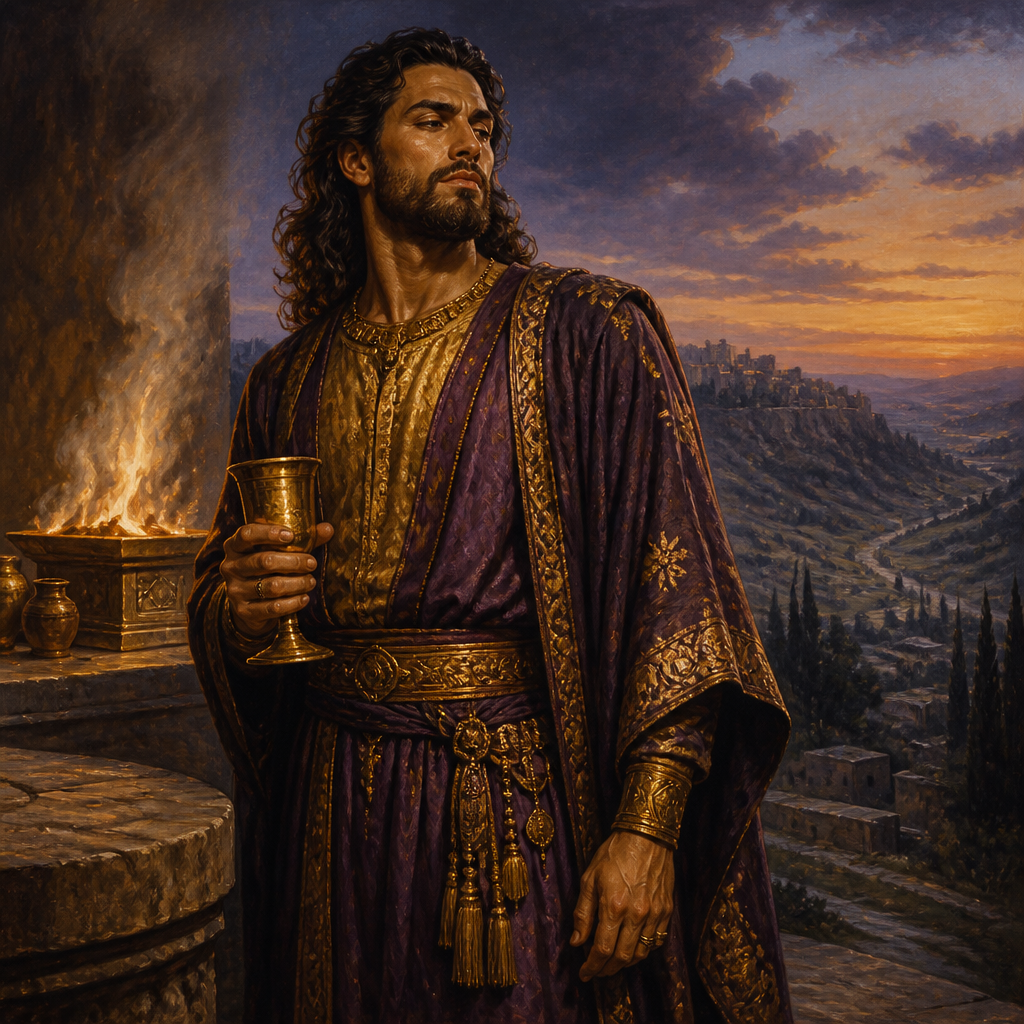
Adonijah was a prominent prince of the United Monarchy, born to King David and his wife Haggith during David’s reign in Hebron. As David’s elder sons—Amnon and Absalom—met violent deaths, and the second-born Chileab remains absent from the political narrative, Adonijah became the eldest surviving claimant to the Davidic throne by right of primogeniture. He is described in scripture as a man of exceptional physical beauty and one who had never been disciplined or restrained by his father, a temperament that likely contributed to his political ambitions.
His primary historical significance lies in his premature attempt to secure the kingship as David’s health declined. By enlisting the support of high-ranking officials such as Joab and Abiathar, Adonijah initiated a succession crisis that forced the elderly David to formally crown Solomon. Although initially spared by Solomon, Adonijah’s continued political maneuvering after David’s death resulted in his execution, marking the consolidation of Solomon's power.
Background and Family
Adonijah was the fourth son of King David, born in Hebron while David was reigning over the tribe of Judah (2 Samuel 3:4; 1 Chronicles 3:2). His mother was Haggith, one of David’s several wives. The biblical record places Adonijah within a complex web of royal siblings, including the ill-fated Amnon and the rebellious Absalom. By the time King David reached his advanced years, Adonijah had become the eldest surviving son, following the deaths of his older brothers.
The scripture provides a rare glimpse into Adonijah’s upbringing and character in 1 Kings 1:6, noting that he was "very handsome" and that his father, David, "had never rebuked him at any time by asking, ‘Why have you done this?’" This lack of paternal discipline is often highlighted by scholars as a contributing factor to his entitlement and eventual insurrection. Living in the shadow of Absalom’s failed rebellion, Adonijah seemed to adopt similar tactics, surrounding himself with a personal guard of fifty men and chariots to project an image of royal authority.
Major Life Events
The Attempted Usurpation
As King David grew frail and could no longer maintain his warmth or active governance, Adonijah moved to claim the throne. He declared, "I will be king!" and organized a coronation feast at the stone of Zoheleth near En-rogel (1 Kings 1:5-9). To legitimize his claim, he secured the allegiance of Joab, the commander of the army, and Abiathar, one of the two high priests. He invited all his royal brothers and the men of Judah, pointedly excluding Solomon, the prophet Nathan, and David’s elite "mighty men."
However, the prophet Nathan and Bathsheba, Solomon’s mother, intervened. They informed David of Adonijah’s actions and reminded the king of his secret oath that Solomon would be his successor. David acted immediately, ordering Zadok the priest and Nathan to anoint Solomon at Gihon Spring. When the sound of the ram’s horn and the shouts of "Long live King Solomon!" reached Adonijah’s feast, his supporters fled in terror.
The Horns of the Altar
Fearing for his life, Adonijah sought sanctuary in the Tabernacle, grabbing the horns of the altar. This was a traditional gesture of seeking divine and royal clemency. Solomon granted a conditional pardon, stating that if Adonijah proved to be a "worthy man," he would live, but if "wickedness" were found in him, he would die (1 Kings 1:52). Adonijah was then allowed to return home after paying homage to the new king.
The Final Request and Death
Following David’s death, Adonijah approached Bathsheba with a request that would prove fatal. He asked for Abishag the Shunammite, the young woman who had cared for David in his final days, to be given to him as a wife. In the Ancient Near East, taking a member of the deceased king’s harem was a symbolic claim to the throne itself. Solomon recognized this as a renewed bid for power. Declaring that Adonijah had made this request "at the expense of his life," Solomon sent Benaiah son of Jehoiada to execute him (1 Kings 2:23-25).
Relationship to Other Biblical Figures
Adonijah’s relationships were defined by political competition and shifting loyalties. His most significant allies were Joab and Abiathar. Joab’s support gave Adonijah military credibility, while Abiathar provided religious sanction. Conversely, Adonijah was the direct rival of Solomon. Unlike Absalom, who sought to overthrow David, Adonijah sought to bypass Solomon while David was still alive but incapacitated. His relationship with Bathsheba was one of manipulation; he attempted to use her influence over Solomon to secure Abishag, a move Solomon interpreted as a veiled coup.
Spiritual Significance
Theologically, the story of Adonijah serves as a narrative bridge between the chaotic end of David’s reign and the stability of Solomon’s. It illustrates the dangers of self-exaltation and the consequences of failing to heed the divine will regarding leadership. While Adonijah relied on primogeniture (the right of the firstborn) and political alliances, the text emphasizes that the throne was ultimately a gift of God, bestowed upon Solomon according to God’s choice and David’s oath. Adonijah’s downfall is presented as the fulfillment of Solomon's warning that "wickedness"—specifically the refusal to accept God’s appointed ruler—would result in judgment.
Adonijah represents the final challenge to the establishment of the Solomonic dynasty. His narrative underscores the transition from the charismatic, often turbulent leadership style of David’s house to the more structured and absolute monarchy of Solomon. From a biblical perspective, Adonijah's failure serves as a testament to the sovereignty of God's choice over human tradition; although he was the eldest and physically impressive, he was not the divinely intended successor.
His death also signifies the final 'purging' of David's court. Along with the removal of Joab and the exile of Abiathar, Adonijah’s execution marked the end of the factions that had plagued David’s later years. In the broader context of the Old Testament, Adonijah is often cited as a cautionary example of a father’s failure to provide moral guidance, as David’s indulgence is explicitly linked to Adonijah’s lack of restraint and eventual ruin.
Frequently Asked Questions
Why did Adonijah think he should be king?
As the fourth son of David, Adonijah became the eldest surviving son after the deaths of Amnon and Absalom (and the apparent absence of Chileab). In many Ancient Near Eastern cultures, the eldest son had the primary claim to the throne through primogeniture.
Who supported Adonijah's claim to the throne?
His two most powerful supporters were Joab, the commander of David's army, and Abiathar the priest. He also had the support of most of his brothers and the royal officials from the tribe of Judah.
Why did Solomon execute Adonijah after initially pardoning him?
Solomon executed Adonijah because he requested to marry Abishag the Shunammite, King David's final caregiver. In that culture, marrying a king's concubine or consort was seen as a direct claim to the king's authority and throne.
What does the Bible say about Adonijah's appearance and character?
The Bible describes him as 'very handsome' and notes that King David had never disciplined or rebuked him throughout his life, suggesting he was a spoiled and overly confident prince.
What is the 'stone of Zoheleth'?
It was a landmark near En-rogel where Adonijah held his unauthorized coronation feast and sacrificed sheep and oxen to celebrate his self-proclamation as king.
Family & Relationships
 Adonijah, Son of DavidThis page
 AbsalomBrother2 Samuel 3:3–4Stated
 Amnon, Firstborn Son of DavidBrother2 Samuel 3:2–4Stated
 ChileabBrother2 Samuel 3:3–4Stated
 Eliada, Son of DavidBrother2 Samuel 3:4
Inferred
No verse names Eliada and Adonijah together; the brother link is carried from the surrounding genealogy and is not stated in Scripture.Evidence: 2 Samuel 3:4; 1 Chronicles 3:8
 Eliphelet, Son of DavidBrother2 Samuel 3:4
Inferred
Reconstructed through Solomon and David: 1 Kings 2:22 ties Adonijah to Solomon; 2 Samuel 12:24 ties Solomon to David; 1 Chronicles 3:6 ties David to Eliphelet. No verse states the brother link between Adonijah and Eliphelet directly.Evidence: 2 Samuel 3:4; 1 Chronicles 3:6
 Elishama, Son of DavidBrother2 Samuel 3:4
Inferred
No verse names Adonijah and Elishama together; the brother link is carried from the surrounding genealogy and is not stated in Scripture.Evidence: 2 Samuel 3:4; 1 Chronicles 3:6
 ElishuaBrother2 Samuel 3:4
Inferred
Reconstructed through Solomon and David: 1 Kings 2:22 ties Adonijah to Solomon; 2 Samuel 12:24 ties Solomon to David; 1 Chronicles 3:6 ties David to Elishua. No verse states the brother link between Adonijah and Elishua directly.Evidence: 2 Samuel 3:4; 1 Chronicles 3:6
 IbharBrother2 Samuel 3:4
Inferred
Reconstructed through David and Solomon: 1 Chronicles 3:6 ties Ibhar to David; 2 Samuel 12:24 ties David to Solomon; 1 Kings 2:22 ties Solomon to Adonijah. No verse states the brother link between Ibhar and Adonijah directly.Evidence: 2 Samuel 3:4; 1 Chronicles 3:6
 IthreamBrother2 Samuel 3:4–5Stated
 Japhia, Son of DavidBrother2 Samuel 3:4
Inferred
No verse names Japhia and Adonijah together; the brother link is carried from the surrounding genealogy and is not stated in Scripture.Evidence: 2 Samuel 3:4; 1 Chronicles 3:7
 Nathan, Son of DavidBrother2 Samuel 3:4
Inferred
Reconstructed through Solomon: 2 Samuel 5:14 ties Nathan to Solomon; 1 Kings 2:22 ties Solomon to Adonijah. No verse states the brother link between Nathan and Adonijah directly.Evidence: 2 Samuel 3:4; Luke 3:31
 Nepheg, Son of DavidBrother2 Samuel 3:4
Inferred
No verse names Nepheg and Adonijah together; the brother link is carried from the surrounding genealogy and is not stated in Scripture.Evidence: 2 Samuel 3:4; 1 Chronicles 3:7
 Shammua, Son of DavidBrother2 Samuel 3:4
Inferred
Reconstructed through Solomon: 2 Samuel 5:14 ties Shammua to Solomon (itself an inferred link); 1 Kings 2:22 ties Solomon to Adonijah. No verse states the brother link between Shammua and Adonijah directly.Evidence: 2 Samuel 3:4
 Shephatiah, Son of DavidBrother2 Samuel 3:4Stated
 Shobab, Son of DavidBrother2 Samuel 3:4
Inferred
Reconstructed through Solomon: 1 Chronicles 3:5 ties Shobab to Solomon; 1 Kings 2:22 ties Solomon to Adonijah. No verse states the brother link between Shobab and Adonijah directly.Evidence: 2 Samuel 3:4; 1 Chronicles 3:4
 SolomonBrother1 Kings 2:22Stated
 Tamar, Daughter of DavidSister2 Samuel 3:4
Inferred
Reconstructed through David and Solomon: 1 Chronicles 3:9 ties Tamar to David; 2 Samuel 12:24 ties David to Solomon; 1 Kings 2:22 ties Solomon to Adonijah. No verse states the brother link between Tamar and Adonijah directly.Evidence: 2 Samuel 3:4; 1 Chronicles 3:9
 ElpeletBrother2 Samuel 3:4
Inferred
No verse names Elpelet and Adonijah together; the brother link is carried from the surrounding genealogy and is not stated in Scripture.Evidence: 2 Samuel 3:4
 NogahBrother2 Samuel 3:4
Inferred
No verse names Nogah and Adonijah together; the brother link is carried from the surrounding genealogy and is not stated in Scripture.Evidence: 2 Samuel 3:4; 1 Chronicles 3:7
 Jerimoth, Son of DavidBrother2 Samuel 3:4
Inferred
Reconstructed through Rehoboam and Solomon: 2 Chronicles 11:18 ties Jerimoth to Rehoboam (itself an inferred link); 1 Kings 12:6 ties Rehoboam to Solomon; 1 Kings 2:22 ties Solomon to Adonijah. No verse states the brother link between Jerimoth and Adonijah directly.Evidence: 2 Samuel 3:4; 2 Chronicles 11:18
Connected Figures
Family

Father · 2 Samuel 3:4–5
The second king of the United Monarchy of Israel, a shepherd-warrior and psalmist known as a man after God's own heart.
United MonarchyFirst: Ruth 4:17998 versesKing of Israel, Shepherd, Musician, WarriorJudah

Mother · 2 Samuel 3:4
Haggith was one of King David's wives and the mother of Adonijah, who attempted to seize the throne during David's old age.
United MonarchyFirst: 2 Samuel 3:48 versesQueen consort of Israel
Brother · 2 Samuel 3:3–4
The third son of King David, Absalom was a charismatic prince who staged a major rebellion against his father and was ultimately killed in battle by Joab.
United MonarchyFirst: 2 Samuel 3:3104 versesPrince / Rebel LeaderJudah
Brother · 2 Samuel 3:2–4
The firstborn son of King David, Amnon is primarily known for the violation of his half-sister Tamar, an act that triggered a bloody cycle of revenge within the royal family.
United MonarchyFirst: 2 Samuel 3:232 versesPrince and heir apparentJudah
Brother · 2 Samuel 3:3–4
Chileab was the second son of King David, born in Hebron to Abigail the widow of Nabal of Carmel during the United Monarchy.
United MonarchyFirst: 2 Samuel 3:313 versesPrince of IsraelJudah
Brother · 2 Samuel 3:4
Eliada was a son of King David born in Jerusalem, listed among the children of the United Monarchy period.
United MonarchyFirst: 2 Samuel 5:1616 versesPrince of IsraelJudah
Brother · 2 Samuel 3:4
Eliphelet was a son of King David, born in Jerusalem during the United Monarchy, and is listed among the royal children in the books of Samuel and Chronicles.
United MonarchyFirst: 2 Samuel 5:1615 versesPrince of IsraelJudah
Brother · 2 Samuel 3:4
A son of King David born in Jerusalem during the United Monarchy and listed among the royal descendants in the books of Samuel and Chronicles.
United MonarchyFirst: 2 Samuel 5:1616 versesPrince of IsraelJudah
Brother · 2 Samuel 3:4
A son of King David born in Jerusalem during the early years of the United Monarchy.
United MonarchyFirst: 2 Samuel 5:1514 versesPrince of IsraelJudah
Brother · 2 Samuel 3:4
Ibhar was a son of King David, born in Jerusalem during the era of the United Monarchy.
United MonarchyFirst: 2 Samuel 5:1514 versesPrince of IsraelJudah
Brother · 2 Samuel 3:4–5
The sixth son of King David, born to his wife Eglah during David's seven-year reign in Hebron.
United MonarchyFirst: 2 Samuel 3:512 versesPrince of IsraelJudah
Brother · 2 Samuel 3:4
Japhia was a son of King David born in Jerusalem, listed among the children born to David after he established his throne in the holy city.
United MonarchyFirst: 2 Samuel 5:1515 versesPrince of IsraelJudah
Categories
Mentions by Book
- 2 Samuel5
- 1 Kings23
- 1 Chronicles4
- 2 Chronicles1
- Luke1
Scripture References
All 34 indexed verses, in canonical order, from the Berean Standard Bible.
- 2 Samuel 3:2Partial
And sons were born to David in Hebron: His firstborn was Amnon, by Ahinoam of Jezreel;
Cited as evidence on a family card; added so References, Key Verses and Mentions by Book share one index.
- 2 Samuel 3:3Partial
his second was Chileab, by Abigail the widow of Nabal of Carmel; his third was Absalom, the son of Maacah daughter of King Talmai of Geshur;
Cited as evidence on a family card; added so References, Key Verses and Mentions by Book share one index.
- 2 Samuel 3:4
his fourth was Adonijah, the son of Haggith; his fifth was Shephatiah, the son of Abital;
- 2 Samuel 3:5Partial
and his sixth was Ithream, by David’s wife Eglah. These sons were born to David in Hebron.
Cited as evidence on a family card; added so References, Key Verses and Mentions by Book share one index.
- 2 Samuel 5:14Partial
These are the names of the children born to him in Jerusalem: Shammua, Shobab, Nathan, Solomon,
Cited as evidence on a family card; added so References, Key Verses and Mentions by Book share one index.
- 1 Kings 1:5
At that time Adonijah, David’s son by Haggith, began to exalt himself, saying, “I will be king!” And he acquired chariots and horsemen and fifty men to run ahead of him.
- 1 Kings 1:7
So Adonijah conferred with Joab son of Zeruiah and with Abiathar the priest, who supported him.
- 1 Kings 1:8
But Zadok the priest, Benaiah son of Jehoiada, Nathan the prophet, Shimei, Rei, and David’s mighty men would not join Adonijah.
- 1 Kings 1:9
And Adonijah sacrificed sheep, oxen, and fattened calves near the stone of Zoheleth, which is next to En-rogel. He invited all his royal brothers and all the men of Judah who were servants of the king.
- 1 Kings 1:11
Then Nathan said to Bathsheba the mother of Solomon, “Have you not heard that Adonijah son of Haggith has become king, and our lord David does not know it?
- 1 Kings 1:13
Go at once to King David and say, ‘My lord the king, did you not swear to your maidservant, “Surely your son Solomon will reign after me, and he will sit on my throne”? Why then has Adonijah become king?’
- 1 Kings 1:18
But now, behold, Adonijah has become king, and you, my lord the king, do not know it.
- 1 Kings 1:24
“My lord the king,” said Nathan, “did you say, ‘Adonijah will reign after me, and he will sit on my throne’?
- 1 Kings 1:25
For today he has gone down and sacrificed an abundance of oxen, fattened calves, and sheep, and has invited all the sons of the king, the commanders of the army, and Abiathar the priest. And behold, they are eating and drinking before him, saying, ‘Long live King Adonijah!’
- 1 Kings 1:41
Now Adonijah and all his guests were finishing their feast when they heard the sound of the ram’s horn. “Why is the city in such a loud uproar?” asked Joab.
- 1 Kings 1:42
As he was speaking, suddenly Jonathan the son of Abiathar the priest arrived. “Come in,” said Adonijah, “for you are a man of valor. You must be bringing good news.”
- 1 Kings 1:43
“Not at all,” Jonathan replied. “Our lord King David has made Solomon king.
- 1 Kings 1:49
At this, all the guests of Adonijah arose in terror and scattered.
- 1 Kings 1:50
But Adonijah, in fear of Solomon, got up and went to take hold of the horns of the altar.
- 1 Kings 1:51
It was reported to Solomon: “Behold, Adonijah fears King Solomon, and he has taken hold of the horns of the altar, saying, ‘Let King Solomon first swear to me not to put his servant to the sword.’”
- 1 Kings 2:13
Now Adonijah son of Haggith went to Bathsheba the mother of Solomon, and she asked, “Do you come in peace?” “Yes, in peace,” he replied.
- 1 Kings 2:19
So Bathsheba went to King Solomon to speak to him for Adonijah. The king stood up to greet her, bowed to her, and sat down on his throne. Then the king had a throne brought for his mother, who sat down at his right hand.
- 1 Kings 2:21
So Bathsheba said, “Let Abishag the Shunammite be given to your brother Adonijah as his wife.”
- 1 Kings 2:22
King Solomon answered his mother, “Why do you request Abishag the Shunammite for Adonijah? Since he is my older brother, you might as well request the kingdom for him and for Abiathar the priest and for Joab son of Zeruiah!”
- 1 Kings 2:23
Then King Solomon swore by the LORD: “May God punish me, and ever so severely, if Adonijah has not made this request at the expense of his life.
- 1 Kings 2:24
And now, as surely as the LORD lives—the One who established me, who set me on the throne of my father David, and who founded for me a dynasty as He promised—surely Adonijah shall be put to death today!”
- 1 Kings 2:25
So King Solomon gave orders to Benaiah son of Jehoiada, and he struck down Adonijah and he died.
Cited as a key verse; added so References, Key Verses and Mentions by Book share one index.
- 1 Kings 2:28
When the news reached Joab, who had conspired with Adonijah but not with Absalom, he fled to the tent of the LORD and took hold of the horns of the altar.
- 1 Chronicles 3:2
the third was Absalom the son of Maacah daughter of King Talmai of Geshur; the fourth was Adonijah the son of Haggith;
- 1 Chronicles 3:4Partial
These six sons were born to David in Hebron, where he reigned seven years and six months. And David reigned in Jerusalem thirty-three years,
Cited as evidence on a family card; added so References, Key Verses and Mentions by Book share one index.
- 1 Chronicles 3:6Partial
David’s other sons were Ibhar, Elishua, Eliphelet,
Cited as evidence on a family card; added so References, Key Verses and Mentions by Book share one index.
- 1 Chronicles 3:9Partial
These were all the sons of David, besides the sons by his concubines. And Tamar was their sister.
Cited as evidence on a family card; added so References, Key Verses and Mentions by Book share one index.
- 2 Chronicles 11:18Partial
And Rehoboam married Mahalath, who was the daughter of David’s son Jerimoth and of Abihail, the daughter of Jesse’s son Eliab.
Cited as evidence on a family card; added so References, Key Verses and Mentions by Book share one index.
- Luke 3:31Partial
the son of Melea, the son of Menna, the son of Mattatha, the son of Nathan, the son of David,
Cited as evidence on a family card; added so References, Key Verses and Mentions by Book share one index.
Others Named Adonijah
Compare all 3 bearers →Adonijah, Levite of the Divided Monarchy2 Chronicles 17:8
A Levite commissioned by King Jehoshaphat to travel throughout Judah teaching the Book of the Law to the people.
Adonijah, Chief of the PeopleNehemiah 10:16
A Jewish leader who signed the sacred covenant with Nehemiah to observe the Law of Moses following the return from Babylonian exile.