Bathsheba
Who was Bathsheba in the Bible?
The daughter of Eliam, wife of Uriah the Hittite, and later the wife of King David and mother of King Solomon.
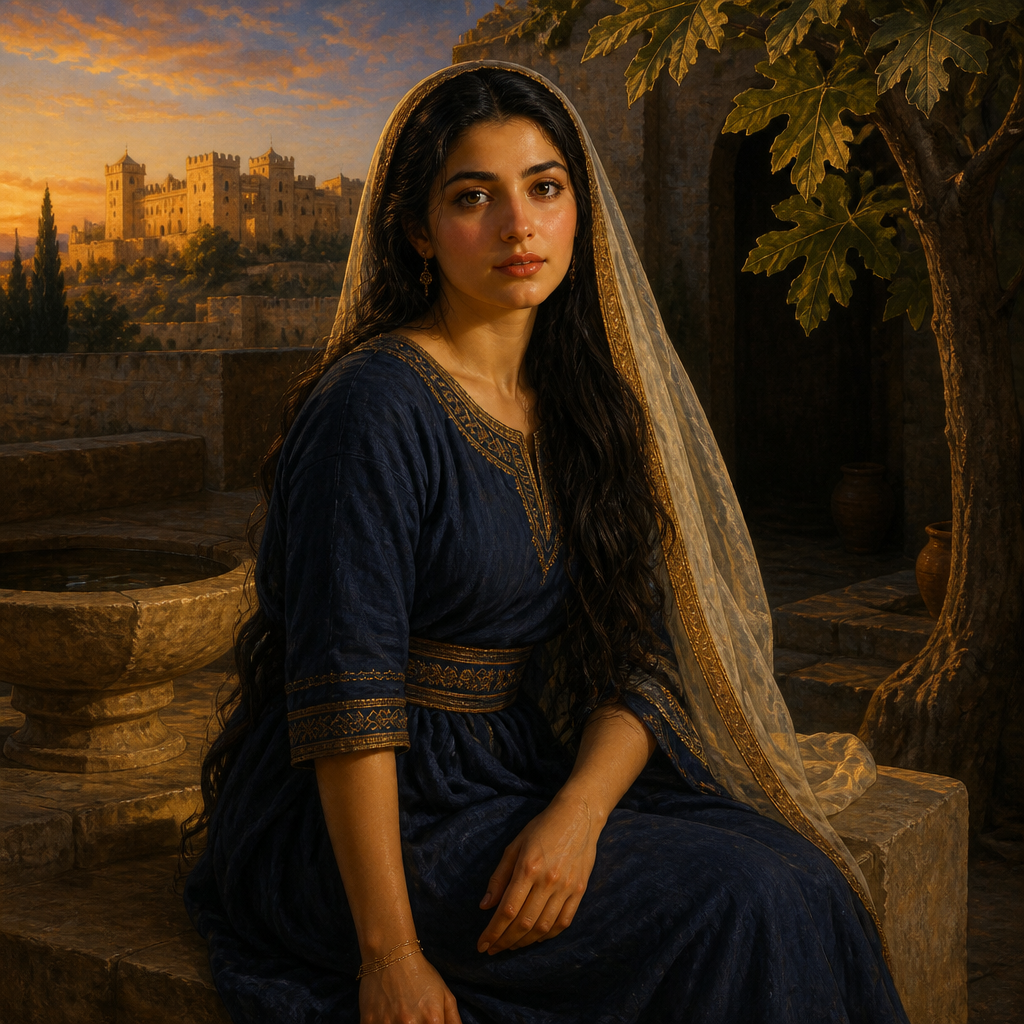
Bathsheba was a prominent woman in the United Monarchy of Israel during the 10th century BC. Primarily known as the daughter of Eliam and the wife of Uriah the Hittite, her life was inextricably linked to the trajectory of the Davidic dynasty. Her initial entry into the biblical narrative occurs under circumstances of royal scandal, but she eventually emerges as a powerful and influential figure within the Judean court, particularly during the transition of power from David to their son, Solomon.
While often viewed through the lens of her relationship with David, the biblical text portrays Bathsheba as a woman of significant resilience and political agency. As the mother of the heir to the throne, she secured the succession of Solomon amidst internal palace intrigue, ensuring the continuity of the covenant line. Her status as Queen Mother (Gebirah) established a precedent for the influence of the king's mother in the subsequent history of the Judean monarchy.
Background and Family
Bathsheba’s lineage is clearly defined in the Hebrew Bible, although her tribal affiliation is not explicitly stated. She is identified as the daughter of Eliam (2 Samuel 11:3) and, in the genealogical record of 1 Chronicles 3:5, as the daughter of Ammiel (an alternative form of the same name). Her family appears to have had significant ties to David’s inner circle; Eliam was one of David’s "mighty men" (2 Samuel 23:34), as was her first husband, Uriah the Hittite.
Initially, Bathsheba was the wife of Uriah, a loyal soldier in David’s army. The text describes her as a woman of striking beauty. Following the death of her first husband and her subsequent marriage to King David, she bore several sons in Jerusalem, including Shammua (or Shimea), Shobab, Nathan, and Solomon. Of these, Solomon is the most prominent, eventually succeeding David as the third king of the United Monarchy.
Major Life Events
The Encounter with David
The narrative of Bathsheba begins in 2 Samuel 11, during the time of the spring wars. While her husband Uriah was at the front lines with the army, King David observed Bathsheba bathing from his rooftop. David summoned her to the palace and engaged in an adulterous relationship with her, which resulted in a pregnancy. In an attempt to conceal the affair, David recalled Uriah from the battlefield, hoping he would sleep with his wife. When Uriah’s integrity prevented him from enjoying domestic comforts while his comrades were at war, David orchestrated Uriah’s death in battle.
Following a period of mourning, David took Bathsheba as his wife. However, the prophet Nathan confronted David regarding his sins of adultery and murder. The child born of this initial union died shortly after birth, a consequence foretold by Nathan. Despite this tragedy, the relationship between David and Bathsheba continued, and she subsequently gave birth to Solomon, whom the biblical record notes was loved by the Lord (2 Samuel 12:24).
The Succession Crisis
In the twilight of David’s life, Bathsheba played a pivotal role in securing the throne for Solomon. When David’s eldest surviving son, Adonijah, attempted to seize the kingship, the prophet Nathan alerted Bathsheba. She approached the elderly king in his private chambers, reminding him of his previous oath that Solomon would rule after him. Her diplomatic intervention, supported by Nathan’s testimony, prompted David to command the immediate coronation of Solomon, effectively neutralizing Adonijah’s rebellion (1 Kings 1).
The Request of Adonijah
After Solomon’s ascension, Bathsheba’s role transitioned to that of the Queen Mother. Adonijah approached her with a request for the hand of Abishag the Shunammite in marriage. Bathsheba agreed to present this petition to King Solomon. The biblical account describes Solomon’s high regard for his mother; he rose to meet her, bowed, and placed a throne for her at his right hand (1 Kings 2:19). However, Solomon interpreted Adonijah’s request as a veiled attempt to reclaim the throne and ordered his execution, demonstrating that while Bathsheba held great honor, the final political authority rested with the king.
Relationship to Other Biblical Figures
Bathsheba’s primary relationships are defined by her roles as wife and mother. Her relationship with David began in scandal but evolved into a stable partnership where she became his most influential wife. As the mother of Solomon, she was his advocate and advisor during his rise to power. Her first husband, Uriah the Hittite, is portrayed as a man of exceptional honor whose death highlights the gravity of the sins committed against him. Additionally, the prophet Nathan serves as a crucial ally to Bathsheba, collaborating with her to ensure that the divine promise regarding Solomon’s kingship was fulfilled.
Spiritual Significance
The story of Bathsheba is often studied for its themes of sin, repentance, and restoration. The superscription of Psalm 51 directly links David’s greatest penitential prayer to his actions involving Bathsheba. While the early narrative focuses on the consequences of David’s choices, the later accounts highlight Bathsheba's dignity and her role in the fulfillment of the Davidic covenant. Her inclusion in the lineage of the Messiah (referenced by implication in Matthew 1 through "the wife of Uriah") underscores the theme of God working through complex and broken human histories to achieve His redemptive purposes.
Bathsheba’s theological significance lies in her role as the link between David and Solomon, ensuring the continuation of the messianic line. Her story serves as the catalyst for one of the most profound biblical meditations on divine mercy and human failure, as seen in the aftermath of David’s sin and the eventual birth of Solomon.
Her ability to navigate the dangerous politics of the royal court and her honored position at the right hand of the king provide a biblical model for the influence of godly women in high-stakes historical transitions.
Frequently Asked Questions
Who was Bathsheba's first husband?
Her first husband was Uriah the Hittite, a loyal soldier in King David's army and one of his 'mighty men.'
How many children did Bathsheba have with David?
According to 1 Chronicles 3:5, she bore four sons to David in Jerusalem: Shimea (Shammua), Shobab, Nathan, and Solomon. An unnamed son born earlier died in infancy.
What role did Bathsheba play in Solomon becoming king?
Bathsheba, alerted by the prophet Nathan, informed the aging King David of Adonijah’s attempt to take the throne. She reminded David of his promise that Solomon would be his heir, prompting David to officially crown Solomon.
Who was Bathsheba's father?
She was the daughter of Eliam, according to 2 Samuel 11:3, also referred to as Ammiel in 1 Chronicles 3:5.
How did Solomon treat Bathsheba when he was king?
Solomon treated her with great honor; when she entered his presence, he stood up, bowed to her, and had a throne placed for her at his right hand.
Family & Relationships
Parents
 Eliam, Father of BathshebaFather2 Samuel 11:3Stated
 DavidHusband2 Samuel 12:24Stated
 Uriah the HittiteHusband2 Samuel 11:3Stated
 BathshebaThis page
Children
 Nathan, Son of DavidSon1 Chronicles 3:5Stated
 Shammua, Son of DavidSon1 Chronicles 3:5
Inferred
Reconstructed through Shobab: 2 Samuel 5:14 ties Shammua to Shobab (itself an inferred link); 1 Chronicles 3:5 ties Shobab to Bathsheba. No verse states the mother link between Shammua and Bathsheba directly.Evidence: 1 Chronicles 3:5
 Shobab, Son of DavidSon1 Chronicles 3:5Stated
 SolomonSon2 Samuel 12:24Stated
Connected Figures
Family
Father · 2 Samuel 11:3
Eliam was a man of the United Monarchy best known as the father of Bathsheba and a relative by marriage to King David.
United MonarchyFirst: 2 Samuel 11:35 versesFather of Bathsheba
Husband · 2 Samuel 12:24
The second king of the United Monarchy of Israel, a shepherd-warrior and psalmist known as a man after God's own heart.
United MonarchyFirst: Ruth 4:17998 versesKing of Israel, Shepherd, Musician, WarriorJudah
Husband · 2 Samuel 11:3
A loyal elite soldier in King David’s army whose integrity served as a foil to the king's adultery and eventual plot to have him killed in battle.
United MonarchyFirst: 2 Samuel 11:322 versesElite soldier (One of 'The Thirty')
Son · 1 Chronicles 3:5
Nathan was a son of King David and Bathsheba, born in Jerusalem during the United Monarchy, and is listed as a direct ancestor of Jesus Christ in the genealogy provided by Luke.
United MonarchyFirst: 2 Samuel 5:1414 versesPrince of IsraelJudah
Son · 1 Chronicles 3:5
Shammua was a son of King David and Bathsheba, born in Jerusalem during the United Monarchy as a full brother to King Solomon.
United MonarchyFirst: 2 Samuel 5:1414 versesPrince of IsraelJudah
Son · 1 Chronicles 3:5
Shobab was a son of King David and Bathsheba, born in Jerusalem during the United Monarchy of Israel.
United MonarchyFirst: 2 Samuel 5:1413 versesPrince of IsraelJudah
Son · 2 Samuel 12:24
The third king of Israel who built the First Temple in Jerusalem and was renowned for his God-given wisdom and immense wealth during the United Monarchy.
United MonarchyFirst: 2 Samuel 5:14292 versesKing of IsraelJudah
Categories
Mentions by Book
- 2 Samuel2
- 1 Kings8
- 1 Chronicles1
- Psalms1
Scripture References
All 12 indexed verses, in canonical order, from the Berean Standard Bible.
2 Samuel · 2
- 2 Samuel 11:3
So David sent and inquired about the woman, and he was told, “This is Bathsheba, the daughter of Eliam and the wife of Uriah the Hittite.”
- 2 Samuel 12:24
Then David comforted his wife Bathsheba, and he went to her and lay with her. So she gave birth to a son, and they named him Solomon. Now the LORD loved the child
1 Kings · 8
- 1 Kings 1:11
Then Nathan said to Bathsheba the mother of Solomon, “Have you not heard that Adonijah son of Haggith has become king, and our lord David does not know it?
- 1 Kings 1:15
So Bathsheba went to see the king in his bedroom. Since the king was very old, Abishag the Shunammite was serving him.
- 1 Kings 1:16
And Bathsheba bowed down in homage to the king, who asked, “What is your desire?”
- 1 Kings 1:28
Then King David said, “Call in Bathsheba for me.” So she came into the king’s presence and stood before him.
- 1 Kings 1:31
Bathsheba bowed facedown in homage to the king and said, “May my lord King David live forever!”
- 1 Kings 2:13
Now Adonijah son of Haggith went to Bathsheba the mother of Solomon, and she asked, “Do you come in peace?” “Yes, in peace,” he replied.
- 1 Kings 2:18
“Very well,” Bathsheba replied. “I will speak to the king for you.”
- 1 Kings 2:19
So Bathsheba went to King Solomon to speak to him for Adonijah. The king stood up to greet her, bowed to her, and sat down on his throne. Then the king had a throne brought for his mother, who sat down at his right hand.
1 Chronicles · 1
- 1 Chronicles 3:5
and these sons were born to him in Jerusalem: Shimea, Shobab, Nathan, and Solomon. These four were born to him by Bathsheba daughter of Ammiel.
Psalms · 1
- Psalms 51:1
For the choirmaster. A Psalm of David. When Nathan the prophet came to him after his adultery with Bathsheba. Have mercy on me, O God, according to Your loving devotion; according to Your great compassion, blot out my transgressions.