Solomon
Who was Solomon in the Bible?
The third king of Israel who built the First Temple in Jerusalem and was renowned for his God-given wisdom and immense wealth during the United Monarchy.
Solomon was the son of King David and Bathsheba, designated by God to succeed his father and lead the nation of Israel into an era of unprecedented peace and prosperity. Known as 'Jedidiah' (meaning 'beloved of the Lord') by the prophet Nathan, Solomon’s reign marked the peak of the United Monarchy. His administration was characterized by administrative sophistication, international trade, and monumental construction projects, most notably the Temple in Jerusalem.
Despite his early devotion and plea for wisdom to lead God's people, Solomon's later years were marked by spiritual decline. His vast harem of foreign wives influenced him to build high places for pagan deities, leading to a divine decree that the kingdom would be divided after his death. Nevertheless, his legacy remains central to the biblical narrative as a symbol of wisdom, a prolific author of proverbs and songs, and the builder of God’s earthly dwelling place.
Background and Family
Solomon was born in Jerusalem during the latter part of King David’s reign. He was the son of Bathsheba, the former wife of Uriah the Hittite. Though David had several older sons from different wives—including Amnon, Absalom, and Adonijah—the Lord specifically chose Solomon to be the heir to the throne. 2 Samuel 12:24 notes that the Lord loved the child from his birth, and the prophet Nathan gave him the name Jedidiah.
Solomon’s rise to power was not without conflict. As David approached death, his eldest surviving son, Adonijah, attempted to seize the throne. However, Nathan and Bathsheba intervened, reminding the aged king of his oath that Solomon would reign. David ordered Solomon to be anointed at Gibeon, riding on the king’s own mule, which effectively ended Adonijah's rebellion. Solomon was the fourth son born to Bathsheba and David in Jerusalem, according to 1 Chronicles 3:5.
Major Life Events
The Request for Wisdom
Early in his reign, Solomon traveled to the high place at Gibeon to offer sacrifices. In a dream, the Lord appeared to him and invited him to ask for anything he desired. Recognizing his youth and the heavy responsibility of ruling, Solomon did not ask for long life or riches, but for an 'understanding heart' to discern between good and evil. Pleased with this request, God granted him wisdom exceeding all others, along with the wealth and honor he had not requested.
The Building of the Temple
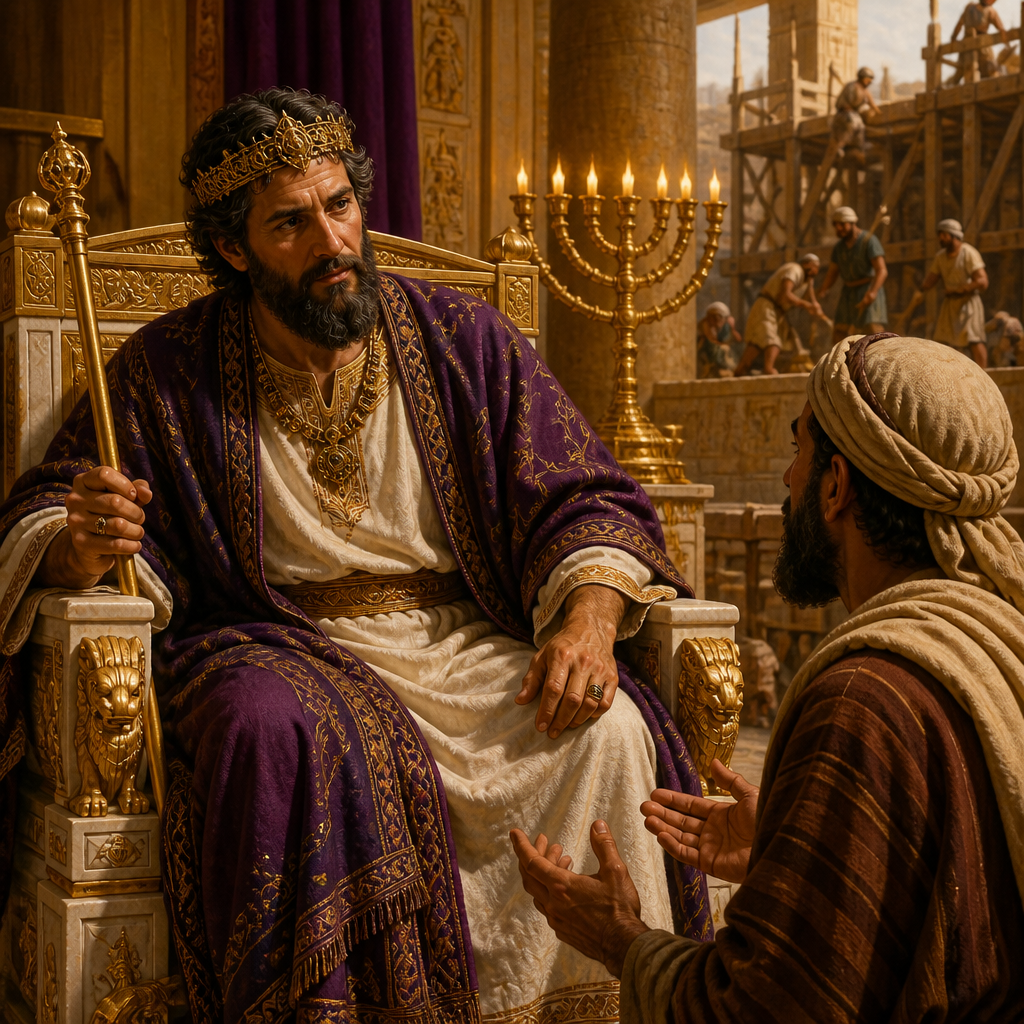
Solomon’s most significant achievement was the construction of the Temple in Jerusalem. David had made extensive preparations and gathered materials, but he was forbidden from building it because he was a man of war. Solomon, a 'man of rest,' oversaw the seven-year project using cedar from Lebanon and gold from Ophir. The dedication of the Temple (1 Kings 8) was a pinnacle of Israelite history, featuring Solomon’s lengthy prayer of dedication and the visible presence of the glory of the Lord filling the house.
The Visit of the Queen of Sheba
Solomon’s fame spread throughout the known world. The Queen of Sheba traveled a great distance to test him with hard questions. Upon seeing the order of his court, the quality of his food, and the depth of his wisdom, she remarked that the reports she had heard did not even tell half of the reality of his greatness. This interaction underscored Solomon’s role as a light to the nations.
Spiritual Decline and End of Reign
In direct violation of the Mosaic Law regarding kings, Solomon accumulated a massive number of horses from Egypt and took many foreign wives—700 wives and 300 concubines. These women turned his heart toward their gods, including Ashtoreth, Chemosh, and Molech. Solomon built high places for these idols on the hill east of Jerusalem. As a result, God raised up adversaries like Hadad the Edomite and Rezon of Damascus, and eventually informed Solomon that the kingdom would be torn away from his son.
Relationship to Other Biblical Figures
Solomon’s primary relationship was with his father, David, whose charge he received to walk in the ways of the Lord to ensure the endurance of the Davidic line. He also had a complex relationship with his half-brother Adonijah, whom he eventually executed for continuing to pursue the throne through a request for Abishag the Shunammite. Solomon maintained a long-standing alliance with Hiram, King of Tyre, who provided materials for the Temple.
In the New Testament, Solomon is frequently referenced. Jesus mentions Solomon’s glory when comparing it to the lilies of the field and identifies Himself as 'one greater than Solomon' who has come to bring wisdom and salvation (Matthew 12:42).
Spiritual Significance
Solomon serves as a complex figure of both promise and warning. He represents the fulfillment of the Davidic Covenant in the physical realm—ruling over a vast territory, building the Temple, and enjoying peace. His wisdom, preserved in the books of Proverbs, Ecclesiastes, and the Song of Solomon, remains a foundational pillar of biblical ethics and poetry.
However, his life also serves as a cautionary tale regarding the dangers of syncretism and the gradual erosion of devotion. His failure to maintain an undivided heart resulted in the fracture of the nation. Theologically, Solomon points forward to Jesus Christ, the true Son of David and Prince of Peace, who builds a spiritual temple not made with hands and whose wisdom is perfect and eternal.
Solomon occupies a unique theological position as the builder of the First Temple, which centralized Jewish worship and became the dwelling place of God's presence on earth. His reign is viewed as the 'Golden Age' of Israel, fulfilling the geographical promises made to Abraham. As a type of Christ, his peaceful reign and wisdom prefigure the Messianic kingdom, yet his personal failures emphasize the need for a King who will not turn away from God's commands. His contributions to the Wisdom Literature of the Bible—Proverbs, Ecclesiastes, and Song of Solomon—provide the framework for biblical living and the exploration of the meaning of life under the sun.
Frequently Asked Questions
Who was Solomon's mother?
Solomon's mother was Bathsheba, the daughter of Ammiel and wife of King David.
Why did Solomon build the Temple?
Solomon built the Temple because God had chosen him to do so, telling David that his son would be a man of rest who would build a house for His Name.
How many wives did Solomon have?
The Bible records that Solomon had 700 wives and 300 concubines, many of whom were from foreign nations like Moab, Ammon, and Egypt.
What was Solomon's other name?
The prophet Nathan called him 'Jedidiah,' which means 'beloved of the Lord,' by the word of the Lord.
Who succeeded Solomon as king?
Solomon was succeeded by his son Rehoboam, whose mother was Naamah the Ammonite.
Family & Relationships
 Naamah the AmmoniteWife1 Kings 14:21
Inferred
1 Kings 14:21 names Naamah the Ammonite as the mother of Solomon’s son Rehoboam.Evidence: 1 Kings 14:21; 1 Kings 14:31; 2 Chronicles 12:13
 Pharaoh's Daughter, Wife of SolomonWife1 Kings 7:8Stated
 The Wife of Solomon (Mother of Taphath)Wife1 Kings 4:11Stated
 SolomonThis page
 AbsalomBrother1 Kings 2:7–12Stated
 Adonijah, Son of DavidBrother1 Kings 2:22Stated
 Amnon, Firstborn Son of DavidBrother2 Samuel 12:24
Inferred
Reconstructed through David: 2 Samuel 12:24 ties Solomon to David; 2 Samuel 3:2 ties David to Amnon. No verse states the brother link between Solomon and Amnon directly.Evidence: 2 Samuel 12:24; 2 Samuel 13:1
 ChileabBrother2 Samuel 3:2
Inferred
Reconstructed through Abigail and David: 2 Samuel 3:3 ties Chileab to Abigail (itself an inferred link); 1 Samuel 25:39 ties Abigail to David; 2 Samuel 12:24 ties David to Solomon. No verse states the brother link between Chileab and Solomon directly.Evidence: 2 Samuel 3:2; 2 Samuel 12:24
 Eliada, Son of DavidBrother1 Chronicles 3:5–8Stated
 Eliphelet, Son of DavidBrother1 Chronicles 3:5–6Stated
 Elishama, Son of DavidBrother1 Chronicles 3:5–8Stated
 ElishuaBrother1 Chronicles 3:5–6Stated
 IbharBrother1 Chronicles 3:5–6Stated
 IthreamBrother2 Samuel 3:5
Inferred
Reconstructed through David: 2 Samuel 12:24 ties Solomon to David; 2 Samuel 3:5 ties David to Ithream. No verse states the brother link between Solomon and Ithream directly.Evidence: 2 Samuel 3:5; 2 Samuel 12:24
 Japhia, Son of DavidBrother1 Chronicles 3:5–7Stated
 Nathan, Son of DavidBrother2 Samuel 5:14Stated
 Nepheg, Son of DavidBrother1 Chronicles 3:5–7Stated
 Shammua, Son of DavidBrother2 Samuel 5:14
Inferred
2 Samuel 5:14 names Shammua and Solomon in the same verse but does not state a brother tie between them; the link rests on the surrounding narrative.Evidence: 2 Samuel 5:14
 Shephatiah, Son of DavidBrother2 Samuel 3:4
Inferred
Reconstructed through Adonijah: 1 Kings 2:22 ties Solomon to Adonijah; 2 Samuel 3:4 ties Adonijah to Shephatiah. No verse states the brother link between Solomon and Shephatiah directly.Evidence: 2 Samuel 3:4; 2 Samuel 12:24
 Shobab, Son of DavidBrother1 Chronicles 3:5Stated
 Tamar, Daughter of DavidSister1 Chronicles 3:9–10Stated
 ElpeletBrother2 Samuel 5:14
Inferred
No verse names Solomon and Elpelet together; the brother link is carried from the surrounding genealogy and is not stated in Scripture.Evidence: 2 Samuel 5:14
 NogahBrother1 Chronicles 3:5–7Stated
 Jerimoth, Son of DavidBrother2 Samuel 12:24
Inferred
Reconstructed through Rehoboam: 2 Chronicles 11:18 ties Jerimoth to Rehoboam (itself an inferred link); 1 Kings 12:6 ties Rehoboam to Solomon. No verse states the brother link between Jerimoth and Solomon directly.Evidence: 2 Samuel 12:24; 2 Chronicles 11:18
Children
Extended family
 Eliam, Father of BathshebaGrandfather2 Samuel 11:3
Inferred
Reconstructed through Bathsheba: 2 Samuel 12:24 ties Solomon to Bathsheba; 2 Samuel 11:3 ties Bathsheba to Eliam. No verse states the grandfather link between Solomon and Eliam directly.Evidence: 2 Samuel 11:3; 2 Samuel 12:24; 1 Kings 1:11; 1 Kings 2:13; 1 Chronicles 3:5
 Attai, Son of RehoboamGrandson2 Chronicles 11:18
Inferred
Reconstructed through Abijah and Rehoboam: 2 Chronicles 11:20 ties Attai to Abijah; Matthew 1:7 ties Abijah to Rehoboam; 1 Kings 12:6 ties Rehoboam to Solomon. No verse states the grandfather link between Attai and Solomon directly.Evidence: 2 Chronicles 11:18; 2 Chronicles 11:20; 1 Kings 12:6; 1 Kings 12:21; 1 Kings 12:23; 1 Kings 14:21
Connected Figures
Family
Father · 2 Samuel 12:24
The second king of the United Monarchy of Israel, a shepherd-warrior and psalmist known as a man after God's own heart.
United MonarchyFirst: Ruth 4:17998 versesKing of Israel, Shepherd, Musician, WarriorJudah

Mother · 2 Samuel 12:24
The daughter of Eliam, wife of Uriah the Hittite, and later the wife of King David and mother of King Solomon.
United MonarchyFirst: 2 Samuel 11:312 versesQueen Consort, Queen MotherJudah
Wife · 1 Kings 14:21
The Ammonite wife of King Solomon and the mother of King Rehoboam during the transition from the United Monarchy to the Divided Monarchy.
Divided MonarchyFirst: 1 Kings 14:213 versesQueen consort of Israel; Queen Mother of Judah
Wife · 1 Kings 7:8
An Egyptian princess who married King Solomon, marking a significant political alliance between the United Monarchy of Israel and Egypt.
United MonarchyFirst: 1 Kings 3:15 versesQueen consort of Israel
Wife · 1 Kings 4:11
A wife of King Solomon and mother of Princess Taphath, whose marriage to a regional governor solidified Solomon's administrative control over Dor.

Daughter · 1 Kings 4:15
Basemath was a daughter of King Solomon and the wife of Ahimaaz, one of the twelve district governors in the United Monarchy.
United MonarchyFirst: 1 Kings 4:156 versesPrincess of IsraelJudah

Son · 1 Kings 12:6
The son of Solomon and grandson of David, Rehoboam was the first king of Judah following the division of the United Monarchy of Israel.
United MonarchyFirst: 1 Kings 11:4349 versesKing of JudahJudah
Daughter · 1 Kings 4:11
A daughter of King Solomon and the wife of Ben-abinadab, one of Solomon's twelve regional governors during the United Monarchy.
United MonarchyFirst: 1 Kings 4:116 versesPrincess of IsraelJudah
Brother · 1 Kings 2:7–12
The third son of King David, Absalom was a charismatic prince who staged a major rebellion against his father and was ultimately killed in battle by Joab.
United MonarchyFirst: 2 Samuel 3:3104 versesPrince / Rebel LeaderJudah
Brother · 1 Kings 2:22
The fourth son of King David, Adonijah attempted to seize the throne of Israel during his father's final days, ultimately failing and meeting his execution under King Solomon.
United MonarchyFirst: 2 Samuel 3:434 versesPrince of IsraelJudah
Brother · 2 Samuel 12:24
The firstborn son of King David, Amnon is primarily known for the violation of his half-sister Tamar, an act that triggered a bloody cycle of revenge within the royal family.
United MonarchyFirst: 2 Samuel 3:232 versesPrince and heir apparentJudah
Brother · 2 Samuel 3:2
Chileab was the second son of King David, born in Hebron to Abigail the widow of Nabal of Carmel during the United Monarchy.
United MonarchyFirst: 2 Samuel 3:313 versesPrince of IsraelJudah
Categories
Mentions by Book
- 2 Samuel7
- 1 Kings145
- 2 Kings4
- 1 Chronicles28
- 2 Chronicles78
- Ezra2
- Nehemiah5
- Psalms2
- Proverbs3
- Song of Solomon7
- Jeremiah1
- Matthew4
- Luke2
- John1
- Acts3
Scripture References
All 292 indexed verses, in canonical order, from the Berean Standard Bible.
- 2 Samuel 3:2Partial
And sons were born to David in Hebron: His firstborn was Amnon, by Ahinoam of Jezreel;
Cited as evidence on a family card; added so References, Key Verses and Mentions by Book share one index.
- 2 Samuel 3:4Partial
his fourth was Adonijah, the son of Haggith; his fifth was Shephatiah, the son of Abital;
Cited as evidence on a family card; added so References, Key Verses and Mentions by Book share one index.
- 2 Samuel 3:5Partial
and his sixth was Ithream, by David’s wife Eglah. These sons were born to David in Hebron.
Cited as evidence on a family card; added so References, Key Verses and Mentions by Book share one index.
- 2 Samuel 5:14
These are the names of the children born to him in Jerusalem: Shammua, Shobab, Nathan, Solomon,
- 2 Samuel 11:3Partial
So David sent and inquired about the woman, and he was told, “This is Bathsheba, the daughter of Eliam and the wife of Uriah the Hittite.”
Cited as evidence on a family card; added so References, Key Verses and Mentions by Book share one index.
- 2 Samuel 12:24
Then David comforted his wife Bathsheba, and he went to her and lay with her. So she gave birth to a son, and they named him Solomon. Now the LORD loved the child
- 2 Samuel 12:25
and sent word through Nathan the prophet to name him Jedidiah because the LORD loved him.
- 1 Kings 1:10
But he did not invite Nathan the prophet, Benaiah, the mighty men, or his brother Solomon.
- 1 Kings 1:11
Then Nathan said to Bathsheba the mother of Solomon, “Have you not heard that Adonijah son of Haggith has become king, and our lord David does not know it?
- 1 Kings 1:12
Now please, come and let me advise you. Save your own life and the life of your son Solomon.
- 1 Kings 1:13
Go at once to King David and say, ‘My lord the king, did you not swear to your maidservant, “Surely your son Solomon will reign after me, and he will sit on my throne”? Why then has Adonijah become king?’
- 1 Kings 1:17
“My lord,” she replied, “you yourself swore to your maidservant by the LORD your God: ‘Surely your son Solomon will reign after me, and he will sit on my throne.’
- 1 Kings 1:19
And he has sacrificed an abundance of oxen, fattened calves, and sheep, and has invited all the other sons of the king, as well as Abiathar the priest and Joab the commander of the army. But he has not invited your servant Solomon.
- 1 Kings 1:21
Otherwise, when my lord the king rests with his fathers, I and my son Solomon will be counted as criminals.”
- 1 Kings 1:26
But me your servant he has not invited, nor Zadok the priest, nor Benaiah son of Jehoiada, nor your servant Solomon.
- 1 Kings 1:30
I will carry out this very day exactly what I swore to you by the LORD, the God of Israel: Surely your son Solomon will reign after me, and he will sit on my throne in my place.”
- 1 Kings 1:33
“Take my servants with you,” said the king. “Set my son Solomon on my own mule and take him down to Gihon.
- 1 Kings 1:34
There Zadok the priest and Nathan the prophet are to anoint him king over Israel. You are to blow the ram’s horn and declare, ‘Long live King Solomon!’
- 1 Kings 1:37
Just as the LORD was with my lord the king, so may He be with Solomon and make his throne even greater than that of my lord King David.”
- 1 Kings 1:38
Then Zadok the priest, Nathan the prophet, and Benaiah son of Jehoiada, along with the Cherethites and Pelethites, went down and set Solomon on King David’s mule, and they escorted him to Gihon.
- 1 Kings 1:39Partial
Zadok the priest took the horn of oil from the tabernacle and anointed Solomon. Then they blew the ram’s horn, and all the people proclaimed, “Long live King Solomon!”
- 1 Kings 1:43
“Not at all,” Jonathan replied. “Our lord King David has made Solomon king.
- 1 Kings 1:46
Moreover, Solomon has taken his seat on the royal throne.
- 1 Kings 1:47
The king’s servants have also gone to congratulate our lord King David, saying, ‘May your God make the name of Solomon more famous than your own name, and may He make his throne greater than your throne.’ And the king has bowed in worship on his bed,
- 1 Kings 1:50
But Adonijah, in fear of Solomon, got up and went to take hold of the horns of the altar.
- 1 Kings 1:51Partial
It was reported to Solomon: “Behold, Adonijah fears King Solomon, and he has taken hold of the horns of the altar, saying, ‘Let King Solomon first swear to me not to put his servant to the sword.’”
- 1 Kings 1:52
And Solomon replied, “If he is a man of character, not a single hair of his will fall to the ground. But if evil is found in him, he will die.”
- 1 Kings 1:53Partial
So King Solomon summoned Adonijah down from the altar, and he came and bowed down before King Solomon, who said to him, “Go to your home.”
- 1 Kings 2:1
As the time drew near for David to die, he charged his son Solomon,
- 1 Kings 2:7Partial
But show loving devotion to the sons of Barzillai the Gileadite, and let them be among those who eat at your table, because they stood by me when I fled from your brother Absalom.
Cited as evidence on a family card; added so References, Key Verses and Mentions by Book share one index.
- 1 Kings 2:8Partial
Keep an eye on Shimei the son of Gera, the Benjamite from Bahurim who is with you. He called down bitter curses against me on the day I went to Mahanaim, but when he came down to meet me at the Jordan, I swore to him by the LORD: ‘I will never put you to the sword.’
Cited as evidence on a family card; added so References, Key Verses and Mentions by Book share one index.
- 1 Kings 2:9Partial
Now therefore, do not hold him guiltless, for you are a wise man. You know what you ought to do to him to bring his gray head down to Sheol in blood.”
Cited as evidence on a family card; added so References, Key Verses and Mentions by Book share one index.
- 1 Kings 2:10Partial
Then David rested with his fathers and was buried in the City of David.
Cited as evidence on a family card; added so References, Key Verses and Mentions by Book share one index.
- 1 Kings 2:11Partial
The length of David’s reign over Israel was forty years—seven years in Hebron and thirty-three years in Jerusalem.
Cited as evidence on a family card; added so References, Key Verses and Mentions by Book share one index.
- 1 Kings 2:12
So Solomon sat on the throne of his father David, and his kingdom was firmly established.
- 1 Kings 2:13
Now Adonijah son of Haggith went to Bathsheba the mother of Solomon, and she asked, “Do you come in peace?” “Yes, in peace,” he replied.
- 1 Kings 2:17
Adonijah replied, “Please speak to King Solomon, since he will not turn you down. Let him give me Abishag the Shunammite as my wife.”
- 1 Kings 2:19
So Bathsheba went to King Solomon to speak to him for Adonijah. The king stood up to greet her, bowed to her, and sat down on his throne. Then the king had a throne brought for his mother, who sat down at his right hand.
- 1 Kings 2:22
King Solomon answered his mother, “Why do you request Abishag the Shunammite for Adonijah? Since he is my older brother, you might as well request the kingdom for him and for Abiathar the priest and for Joab son of Zeruiah!”
- 1 Kings 2:23
Then King Solomon swore by the LORD: “May God punish me, and ever so severely, if Adonijah has not made this request at the expense of his life.
- 1 Kings 2:25
So King Solomon gave orders to Benaiah son of Jehoiada, and he struck down Adonijah and he died.
- 1 Kings 2:27
So Solomon banished Abiathar from the priesthood of the LORD and thus fulfilled the word that the LORD had spoken at Shiloh against the house of Eli.
- 1 Kings 2:29Partial
It was reported to King Solomon: “Joab has fled to the tent of the LORD and is now beside the altar.” So Solomon sent Benaiah son of Jehoiada, saying, “Go, strike him down!”
- 1 Kings 2:41
When Solomon was told that Shimei had gone from Jerusalem to Gath and had returned,
- 1 Kings 2:45
But King Solomon will be blessed and David’s throne will remain secure before the LORD forever.”
- 1 Kings 2:46
Then the king commanded Benaiah son of Jehoiada, and he went out and struck Shimei down, and he died. Thus the kingdom was firmly established in the hand of Solomon.
- 1 Kings 3:1
Later, Solomon formed an alliance with Pharaoh king of Egypt by marrying his daughter. Solomon brought her to the City of David until he had finished building his palace and the house of the LORD, as well as the wall around Jerusalem.
- 1 Kings 3:3
And Solomon loved the LORD and walked in the statutes of his father David, except that he sacrificed and burned incense on the high places.
- 1 Kings 3:4
Now the king went to Gibeon to sacrifice there, for it was the great high place. Solomon offered a thousand burnt offerings on the altar there.
- 1 Kings 3:5
One night at Gibeon the LORD appeared to Solomon in a dream, and God said, “Ask, and I will give it to you!”
- 1 Kings 3:6
Solomon replied, “You have shown much loving devotion to Your servant, my father David, because he walked before You in faithfulness, righteousness, and uprightness of heart. And You have maintained this loving devotion by giving him a son to sit on his throne this very day.
- 1 Kings 3:9Partial
Therefore give Your servant an understanding heart to judge Your people and to discern between good and evil. For who is able to govern this great people of Yours?”
Cited as a key verse; added so References, Key Verses and Mentions by Book share one index.
- 1 Kings 3:10
Now it pleased the Lord that Solomon had made this request.
- 1 Kings 3:15
Then Solomon awoke, and indeed it had been a dream. So he returned to Jerusalem, stood before the ark of the covenant of the Lord, and offered burnt offerings and peace offerings. Then he held a feast for all his servants.
- 1 Kings 4:1
So King Solomon ruled over Israel,
- 1 Kings 4:7
Solomon had twelve governors over all Israel to provide food for the king and his household. Each one would arrange provisions for one month of the year,
- 1 Kings 4:11
Ben-abinadab in Naphath-dor (Taphath, a daughter of Solomon, was his wife);
- 1 Kings 4:15
Ahimaaz in Naphtali (he had married Basemath, a daughter of Solomon);
- 1 Kings 4:21Partial
And Solomon reigned over all the kingdoms from the Euphrates to the land of the Philistines, as far as the border of Egypt. These kingdoms offered tribute and served Solomon all the days of his life.
- 1 Kings 4:22
Solomon’s provisions for a single day were thirty cors of fine flour, sixty cors of meal,
- 1 Kings 4:25
Throughout the days of Solomon, Judah and Israel dwelt securely from Dan to Beersheba, each man under his own vine and his own fig tree.
- 1 Kings 4:26
Solomon had 4,000 stalls for his chariot horses and 12,000 horses.
- 1 Kings 4:27Partial
Each month the governors in turn provided food for King Solomon and all who came to his table. They saw to it that nothing was lacking.
- 1 Kings 4:29
And God gave Solomon wisdom, exceedingly deep insight, and understanding beyond measure, like the sand on the seashore.
- 1 Kings 4:30
Solomon’s wisdom was greater than that of all the men of the East, greater than all the wisdom of Egypt.
- 1 Kings 4:34
So men of all nations came to listen to Solomon’s wisdom, sent by all the kings of the earth, who had heard of his wisdom.
- 1 Kings 5:1
Now when Hiram king of Tyre heard that Solomon had been anointed king in his father’s place, he sent envoys to Solomon; for Hiram had always been a friend of David.
- 1 Kings 5:2
And Solomon relayed this message to Hiram:
- 1 Kings 5:7
When Hiram received Solomon’s message, he rejoiced greatly and said, “Blessed be the LORD this day! He has given David a wise son over this great people!”
- 1 Kings 5:8
Then Hiram sent a reply to Solomon, saying: “I have received your message; I will do all you desire regarding the cedar and cypress timber.
- 1 Kings 5:10
So Hiram provided Solomon with all the cedar and cypress timber he wanted,
- 1 Kings 5:11Partial
and year after year Solomon would provide Hiram with 20,000 cors of wheat as food for his household, as well as 20,000 baths of pure olive oil.
- 1 Kings 5:12Partial
And the LORD gave Solomon wisdom, as He had promised him. There was peace between Hiram and Solomon, and the two of them made a treaty.
- 1 Kings 5:13
Then King Solomon conscripted a labor force of 30,000 men from all Israel.
- 1 Kings 5:15
Solomon had 70,000 porters and 80,000 stonecutters in the mountains,
- 1 Kings 5:16
not including his 3,300 foremen who supervised the workers.
- 1 Kings 5:18
So Solomon’s and Hiram’s builders, along with the Gebalites, quarried the stone and prepared the timber and stone for the construction of the temple.
- 1 Kings 6:1
In the four hundred and eightieth year after the Israelites had come out of the land of Egypt, in the fourth year of Solomon’s reign over Israel, in the month of Ziv, the second month, he began to build the house of the LORD.
- 1 Kings 6:2
The house that King Solomon built for the LORD was sixty cubits long, twenty cubits wide, and thirty cubits high.
- 1 Kings 6:11
Then the word of the LORD came to Solomon, saying:
- 1 Kings 6:14
So Solomon built the temple and finished it.
- 1 Kings 6:21
So Solomon overlaid the inside of the temple with pure gold, and he extended gold chains across the front of the inner sanctuary, which was overlaid with gold.
- 1 Kings 7:1
Solomon, however, took thirteen years to complete the construction of his entire palace.
- 1 Kings 7:8
And the palace where Solomon would live, set further back, was of similar construction. He also made a palace like this hall for Pharaoh’s daughter, whom he had married.
- 1 Kings 7:13
Now King Solomon sent to bring Huram from Tyre.
- 1 Kings 7:14
He was the son of a widow from the tribe of Naphtali, and his father was a man of Tyre, a craftsman in bronze. Huram had great skill, understanding, and knowledge for every kind of bronze work. So he came to King Solomon and carried out all his work.
- 1 Kings 7:40
Additionally, Huram made the pots, shovels, and sprinkling bowls. So Huram finished all the work that he had undertaken for King Solomon in the house of the LORD:
- 1 Kings 7:45
and the pots, shovels, and sprinkling bowls. All the articles that Huram made for King Solomon in the house of the LORD were made of burnished bronze.
- 1 Kings 7:47
Solomon left all these articles unweighed, because there were so many. The weight of the bronze could not be determined.
- 1 Kings 7:48
Solomon also made all the furnishings for the house of the LORD: the golden altar; the golden table on which was placed the Bread of the Presence;
- 1 Kings 7:51Partial
So all the work that King Solomon had performed for the house of the LORD was completed. Then Solomon brought in the items his father David had dedicated—the silver, the gold, and the furnishings—and he placed them in the treasuries of the house of the LORD.
- 1 Kings 8:1Partial
At that time Solomon assembled before him in Jerusalem the elders of Israel—all the tribal heads and family leaders of the Israelites—to bring up the ark of the covenant of the LORD from Zion, the City of David.
- 1 Kings 8:2
And all the men of Israel came together to King Solomon at the feast in the seventh month, the month of Ethanim.
- 1 Kings 8:5
There, before the ark, King Solomon and the whole congregation of Israel who had assembled with him sacrificed so many sheep and oxen that they could not be counted or numbered.
- 1 Kings 8:12
Then Solomon declared: “The LORD has said that He would dwell in the thick cloud.
- 1 Kings 8:22
Then Solomon stood before the altar of the LORD in front of the whole assembly of Israel, spread out his hands toward heaven,
- 1 Kings 8:54
Now when Solomon had finished praying this entire prayer and petition to the LORD, he got up before the altar of the LORD, where he had been kneeling with his hands spread out toward heaven.
- 1 Kings 8:63
And Solomon offered as peace offerings to the LORD 22,000 oxen and 120,000 sheep. So the king and all the Israelites dedicated the house of the LORD.
- 1 Kings 8:65
So at that time Solomon and all Israel with him—a great assembly of people from Lebo-hamath to the Brook of Egypt—kept the feast before the LORD our God for seven days and seven more days—fourteen days in all.
- 1 Kings 9:1Partial
Now when Solomon had finished building the house of the LORD and the royal palace, and had achieved all that he had desired to do,
- 1 Kings 9:2
the LORD appeared to him a second time, as He had appeared to him at Gibeon.
- 1 Kings 9:10
Now at the end of the twenty years during which Solomon built these two houses, the house of the LORD and the royal palace,
- 1 Kings 9:11Partial
King Solomon gave twenty towns in the land of Galilee to Hiram king of Tyre, who had supplied him with cedar and cypress logs and gold for his every desire.
- 1 Kings 9:12
So Hiram went out from Tyre to inspect the towns that Solomon had given him, but he was not pleased with them.
- 1 Kings 9:15
This is the account of the forced labor that King Solomon imposed to build the house of the LORD, his own palace, the supporting terraces, and the wall of Jerusalem, as well as Hazor, Megiddo, and Gezer.
- 1 Kings 9:16
Pharaoh king of Egypt had attacked and captured Gezer. He had set it on fire, killed the Canaanites who lived in the city, and given it as a dowry to his daughter, Solomon’s wife.
- 1 Kings 9:17
So Solomon rebuilt Gezer, Lower Beth-horon,
- 1 Kings 9:19Partial
as well as all the store cities that Solomon had for his chariots and horses—whatever he desired to build in Jerusalem, Lebanon, and throughout the land of his dominion.
- 1 Kings 9:21
their descendants who remained in the land, those whom the Israelites were unable to devote to destruction—Solomon conscripted these people to be forced laborers, as they are to this day.
- 1 Kings 9:22
But Solomon did not consign any of the Israelites to slavery, because they were his men of war, his servants, his officers, his captains, and the commanders of his chariots and cavalry.
- 1 Kings 9:23
They were also the chief officers over Solomon’s projects: 550 supervisors over the people who did the work.
- 1 Kings 9:25
Three times a year Solomon offered burnt offerings and peace offerings on the altar he had built for the LORD, burning incense with them before the LORD. So he completed the temple.
- 1 Kings 9:26
King Solomon also assembled a fleet of ships at Ezion-geber, which is near Eloth in Edom, on the shore of the Red Sea.
- 1 Kings 9:27
And Hiram sent his servants, sailors who knew the sea, to serve in the fleet with Solomon’s servants.
- 1 Kings 9:28
They sailed to Ophir and imported gold from there—420 talents—and delivered it to Solomon.
- 1 Kings 10:1
Now when the queen of Sheba heard about the fame of Solomon concerning the name of the LORD, she came to test him with difficult questions.
- 1 Kings 10:2
She arrived in Jerusalem with a very large caravan—with camels bearing spices, gold in great abundance, and precious stones. And she came to Solomon and spoke to him all that was on her mind.
- 1 Kings 10:3
And Solomon answered all her questions; nothing was too difficult for the king to explain.
- 1 Kings 10:4
When the queen of Sheba saw all the wisdom of Solomon, the palace he had built,
- 1 Kings 10:10
Then she gave the king 120 talents of gold, a great quantity of spices, and precious stones. Never again were spices in such abundance brought in as those the queen of Sheba gave to King Solomon.
- 1 Kings 10:13Partial
King Solomon gave the queen of Sheba all she desired—whatever she asked—besides what he had given her out of his royal bounty. Then she left and returned to her own country, along with her servants.
- 1 Kings 10:14
The weight of gold that came to Solomon each year was 666 talents,
- 1 Kings 10:16
King Solomon made two hundred large shields of hammered gold; six hundred shekels of gold went into each shield.
- 1 Kings 10:21Partial
All King Solomon’s drinking cups were gold, and all the utensils of the House of the Forest of Lebanon were pure gold. There was no silver, because it was accounted as nothing in the days of Solomon.
- 1 Kings 10:23
So King Solomon surpassed all the kings of the earth in riches and wisdom.
- 1 Kings 10:24
The whole world sought an audience with Solomon to hear the wisdom that God had put in his heart.
- 1 Kings 10:26
Solomon accumulated 1,400 chariots and 12,000 horses, which he stationed in the chariot cities and also with him in Jerusalem.
- 1 Kings 10:28
Solomon’s horses were imported from Egypt and Kue; the royal merchants purchased them from Kue.
- 1 Kings 11:1
King Solomon, however, loved many foreign women along with the daughter of Pharaoh—women of Moab, Ammon, Edom, and Sidon, as well as Hittite women.
- 1 Kings 11:2
These women were from the nations about which the LORD had told the Israelites, “You must not intermarry with them, for surely they will turn your hearts after their gods.” Yet Solomon clung to these women in love.
- 1 Kings 11:4
For when Solomon grew old, his wives turned his heart after other gods, and he was not wholeheartedly devoted to the LORD his God, as his father David had been.
- 1 Kings 11:5
Solomon followed Ashtoreth the goddess of the Sidonians and Milcom the abomination of the Ammonites.
- 1 Kings 11:6
So Solomon did evil in the sight of the LORD; unlike his father David, he did not follow the LORD completely.
- 1 Kings 11:7
At that time on a hill east of Jerusalem, Solomon built a high place for Chemosh the abomination of Moab and for Molech the abomination of the Ammonites.
- 1 Kings 11:9
Now the LORD grew angry with Solomon, because his heart had turned away from the LORD, the God of Israel, who had appeared to him twice.
- 1 Kings 11:11
Then the LORD said to Solomon, “Because you have done this and have not kept My covenant and My statutes, which I have commanded you, I will tear the kingdom away from you and give it to your servant.
- 1 Kings 11:14
Then the LORD raised up against Solomon an adversary, Hadad the Edomite, from the royal line of Edom.
- 1 Kings 11:25
Rezon was Israel’s enemy throughout the days of Solomon, adding to the trouble caused by Hadad. So Rezon ruled over Aram with hostility toward Israel.
- 1 Kings 11:26
Now Jeroboam son of Nebat was an Ephraimite from Zeredah whose mother was a widow named Zeruah. Jeroboam was a servant of Solomon, but he rebelled against the king,
- 1 Kings 11:27
and this is the account of his rebellion against the king. Solomon had built the supporting terraces and repaired the gap in the wall of the city of his father David.
- 1 Kings 11:28
Now Jeroboam was a mighty man of valor. So when Solomon noticed that the young man was industrious, he put him in charge of the whole labor force of the house of Joseph.
- 1 Kings 11:31
and said to Jeroboam, “Take ten pieces for yourself, for this is what the LORD, the God of Israel, says: ‘Behold, I will tear the kingdom out of the hand of Solomon, and I will give you ten tribes.
- 1 Kings 11:40Partial
Solomon therefore sought to kill Jeroboam. But Jeroboam arose and fled to Egypt, to Shishak king of Egypt, where he remained until the death of Solomon.
- 1 Kings 11:41Partial
As for the rest of the acts of Solomon—all that he did, as well as his wisdom—are they not written in the Book of the Acts of Solomon?
- 1 Kings 11:42
Thus the time that Solomon reigned in Jerusalem over all Israel was forty years.
- 1 Kings 11:43
And Solomon rested with his fathers and was buried in the city of his father David. And his son Rehoboam reigned in his place.
- 1 Kings 12:2
When Jeroboam son of Nebat heard about this, he was still in Egypt where he had fled from King Solomon and had been living ever since.
- 1 Kings 12:6
Then King Rehoboam consulted with the elders who had served his father Solomon during his lifetime. “How do you advise me to respond to these people?” he asked.
- 1 Kings 12:21
And when Rehoboam arrived in Jerusalem, he mobilized the whole house of Judah and the tribe of Benjamin—180,000 chosen warriors—to fight against the house of Israel and restore the kingdom to Rehoboam son of Solomon.
- 1 Kings 12:23
“Tell Rehoboam son of Solomon king of Judah, all the house of Judah and Benjamin, and the rest of the people
- 1 Kings 14:21
Meanwhile, Rehoboam son of Solomon reigned in Judah. He was forty-one years old when he became king, and he reigned seventeen years in Jerusalem, the city the LORD had chosen from all the tribes of Israel in which to put His Name. His mother’s name was Naamah the Ammonite.
- 1 Kings 14:26
He seized the treasures of the house of the LORD and of the royal palace. He took everything, including all the gold shields that Solomon had made.
- 2 Kings 21:7
Manasseh even took the carved Asherah pole he had made and set it up in the temple, of which the LORD had said to David and his son Solomon, “In this temple and in Jerusalem, which I have chosen out of all the tribes of Israel, I will establish My Name forever.
- 2 Kings 23:13
The king also desecrated the high places east of Jerusalem, to the south of the Mount of Corruption, which King Solomon of Israel had built for Ashtoreth the abomination of the Sidonians, for Chemosh the abomination of the Moabites, and for Milcom the abomination of the Ammonites.
- 2 Kings 24:13
As the LORD had declared, Nebuchadnezzar also carried off all the treasures from the house of the LORD and the royal palace, and he cut into pieces all the gold articles that Solomon king of Israel had made in the temple of the LORD.
- 2 Kings 25:16
As for the two pillars, the Sea, and the movable stands that Solomon had made for the house of the LORD, the weight of the bronze from all these articles was beyond measure.
- 1 Chronicles 3:5
and these sons were born to him in Jerusalem: Shimea, Shobab, Nathan, and Solomon. These four were born to him by Bathsheba daughter of Ammiel.
- 1 Chronicles 3:6Partial
David’s other sons were Ibhar, Elishua, Eliphelet,
Cited as evidence on a family card; added so References, Key Verses and Mentions by Book share one index.
- 1 Chronicles 3:7Partial
Nogah, Nepheg, Japhia,
Cited as evidence on a family card; added so References, Key Verses and Mentions by Book share one index.
- 1 Chronicles 3:8Partial
Elishama, Eliada, and Eliphelet—nine in all.
Cited as evidence on a family card; added so References, Key Verses and Mentions by Book share one index.
- 1 Chronicles 3:9Partial
These were all the sons of David, besides the sons by his concubines. And Tamar was their sister.
Cited as evidence on a family card; added so References, Key Verses and Mentions by Book share one index.
- 1 Chronicles 3:10
Solomon’s son was Rehoboam: Abijah was his son, Asa his son, Jehoshaphat his son,
- 1 Chronicles 6:10
Johanan was the father of Azariah, who served as priest in the temple that Solomon built in Jerusalem,
- 1 Chronicles 6:32
They ministered with song before the tabernacle, the Tent of Meeting, until Solomon built the house of the LORD in Jerusalem. And they performed their duties according to the regulations given them.
- 1 Chronicles 14:4
These are the names of the children born to him in Jerusalem: Shammua, Shobab, Nathan, Solomon,
- 1 Chronicles 18:8
And from Tibhath and Cun, cities of Hadadezer, David took a large amount of bronze, with which Solomon made the bronze Sea, the pillars, and various bronze articles.
- 1 Chronicles 22:5
And David said, “My son Solomon is young and inexperienced, and the house to be built for the LORD must be exceedingly magnificent—famous and glorious throughout all lands. Therefore I must make preparations for it.” So David made lavish preparations before his death.
- 1 Chronicles 22:6
Then David called for his son Solomon and instructed him to build a house for the LORD, the God of Israel.
- 1 Chronicles 22:7
“My son,” said David to Solomon, “it was in my heart to build a house for the Name of the LORD my God,
- 1 Chronicles 22:9
But a son will be born to you who will be a man of rest. I will give him rest from all his enemies on every side; for his name will be Solomon, and I will grant to Israel peace and quiet during his reign.
- 1 Chronicles 22:17
Then David ordered all the leaders of Israel to help his son Solomon:
- 1 Chronicles 23:1
When David was old and full of years, he installed his son Solomon as king over Israel.
- 1 Chronicles 28:5
And of all my sons—for the LORD has given me many sons—He has chosen Solomon my son to sit on the throne of the kingdom of the LORD over Israel.
- 1 Chronicles 28:6
And He said to me, ‘Solomon your son is the one who will build My house and My courts, for I have chosen him as My son, and I will be his Father.
- 1 Chronicles 28:9
As for you, Solomon my son, know the God of your father and serve Him wholeheartedly and with a willing mind, for the LORD searches every heart and understands the intent of every thought. If you seek Him, He will be found by you; but if you forsake Him, He will reject you forever.
- 1 Chronicles 28:11
Then David gave his son Solomon the plans for the portico of the temple, its buildings, storehouses, upper rooms, inner rooms, and the room for the mercy seat.
- 1 Chronicles 28:20
David also said to Solomon his son, “Be strong and courageous, and do it. Do not be afraid or discouraged, for the LORD God, my God, is with you. He will neither fail you nor forsake you before all the work for the service of the house of the LORD is finished.
- 1 Chronicles 29:1
Then King David said to the whole assembly, “My son Solomon, the one whom God has chosen, is young and inexperienced. The task is great because this palace is not for man, but for the LORD God.
- 1 Chronicles 29:19
And give my son Solomon a whole heart to keep and carry out all Your commandments, decrees, and statutes, and to build Your palace for which I have made provision.”
- 1 Chronicles 29:22
That day they ate and drank with great joy in the presence of the LORD. Then, for a second time, they designated David’s son Solomon as king, anointing him before the LORD as ruler, and Zadok as the priest.
- 1 Chronicles 29:23
So Solomon sat on the throne of the LORD as king in place of his father David. He prospered, and all Israel obeyed him.
- 1 Chronicles 29:24
All the officials and mighty men, as well as all of King David’s sons, pledged their allegiance to King Solomon.
- 1 Chronicles 29:25
The LORD highly exalted Solomon in the sight of all Israel and bestowed on him royal majesty such as had not been bestowed on any king in Israel before him.
- 1 Chronicles 29:28
He died at a ripe old age, full of years, riches, and honor, and his son Solomon reigned in his place.
- 2 Chronicles 1:1
Now Solomon son of David established himself securely over his kingdom, and the LORD his God was with him and highly exalted him.
- 2 Chronicles 1:2
Then Solomon spoke to all Israel, to the commanders of thousands and of hundreds, to the judges, and to every leader in all Israel—the heads of the families.
- 2 Chronicles 1:3
And Solomon and the whole assembly went to the high place at Gibeon because it was the location of God’s Tent of Meeting, which Moses the servant of the LORD had made in the wilderness.
- 2 Chronicles 1:5
But the bronze altar made by Bezalel son of Uri, the son of Hur, was in Gibeon before the tabernacle of the LORD. So Solomon and the assembly inquired of Him there.
- 2 Chronicles 1:6
Solomon offered sacrifices there before the LORD on the bronze altar at the Tent of Meeting, where he offered a thousand burnt offerings.
- 2 Chronicles 1:7
That night God appeared to Solomon and said, “Ask, and I will give it to you!”
- 2 Chronicles 1:8
Solomon replied to God: “You have shown much loving devotion to my father David, and You have made me king in his place.
- 2 Chronicles 1:11
God said to Solomon, “Since this was in your heart instead of requesting riches or wealth or honor for yourself or death for your enemies—and since you have not even requested long life but have asked for wisdom and knowledge to govern My people over whom I have made you king—
- 2 Chronicles 1:13
So Solomon went to Jerusalem from the high place in Gibeon, from before the Tent of Meeting, and he reigned over Israel.
- 2 Chronicles 1:14
Solomon accumulated 1,400 chariots and 12,000 horses, which he stationed in the chariot cities and also with him in Jerusalem.
- 2 Chronicles 1:16
Solomon’s horses were imported from Egypt and Kue; the royal merchants purchased them from Kue.
- 2 Chronicles 2:1
Now Solomon purposed to build a house for the Name of the LORD and a royal palace for himself.
- 2 Chronicles 2:2
So he conscripted 70,000 porters, 80,000 stonecutters in the mountains, and 3,600 supervisors.
- 2 Chronicles 2:3
Then Solomon sent word to Hiram king of Tyre: “Do for me as you did for my father David when you sent him cedars to build himself a house to live in.
- 2 Chronicles 2:11
Then Hiram king of Tyre wrote a letter in reply to Solomon: “Because the LORD loves His people, He has set you over them as king.”
- 2 Chronicles 2:17
Solomon numbered all the foreign men in the land of Israel following the census his father David had conducted, and there were found to be 153,600 in all.
- 2 Chronicles 3:1
Then Solomon began to build the house of the LORD in Jerusalem on Mount Moriah, where the LORD had appeared to his father David. This was the place that David had prepared on the threshing floor of Ornan the Jebusite.
- 2 Chronicles 3:3
The foundation that Solomon laid for the house of God was sixty cubits long and twenty cubits wide, according to the old standard.
- 2 Chronicles 4:11
Additionally, Huram made the pots, shovels, and sprinkling bowls. So Huram finished the work that he had undertaken for King Solomon in the house of God:
- 2 Chronicles 4:16
and the pots, shovels, meat forks, and all the other articles. All these objects that Huram-abi made for King Solomon for the house of the LORD were of polished bronze.
- 2 Chronicles 4:18
Solomon made all these articles in such great abundance that the weight of the bronze could not be determined.
- 2 Chronicles 4:19
Solomon also made all the furnishings for the house of God: the golden altar; the tables on which was placed the Bread of the Presence;
- 2 Chronicles 5:1Partial
So all the work that Solomon had performed for the house of the LORD was completed. Then Solomon brought in the items his father David had dedicated—the silver, the gold, and all the furnishings—and he placed them in the treasuries of the house of God.
- 2 Chronicles 5:2
At that time Solomon assembled in Jerusalem the elders of Israel—all the tribal heads and family leaders of the Israelites—to bring up the ark of the covenant of the LORD from Zion, the City of David.
- 2 Chronicles 5:6
There, before the ark, King Solomon and the whole congregation of Israel who had assembled with him sacrificed so many sheep and oxen that they could not be counted or numbered.
- 2 Chronicles 6:1
Then Solomon declared: “The LORD has said that He would dwell in the thick cloud.
- 2 Chronicles 6:13
Now Solomon had made a bronze platform five cubits long, five cubits wide, and three cubits high and had placed it in the middle of the courtyard. He stood on it, knelt down before the whole assembly of Israel, spread out his hands toward heaven,
- 2 Chronicles 6:18Partial
But will God indeed dwell with man upon the earth? The heavens, even the highest heavens, cannot contain You, much less this temple I have built.
Cited as a key verse; added so References, Key Verses and Mentions by Book share one index.
- 2 Chronicles 7:1
When Solomon had finished praying, fire came down from heaven and consumed the burnt offering and the sacrifices, and the glory of the LORD filled the temple.
- 2 Chronicles 7:5
And King Solomon offered a sacrifice of 22,000 oxen and 120,000 sheep. So the king and all the people dedicated the house of God.
- 2 Chronicles 7:7Partial
Then Solomon consecrated the middle of the courtyard in front of the house of the LORD, and there he offered the burnt offerings and the fat of the peace offerings, since the bronze altar he had made could not hold all these offerings.
- 2 Chronicles 7:8
So at that time Solomon and all Israel with him—a very great assembly of people from Lebo-hamath to the Brook of Egypt—kept the feast for seven days.
- 2 Chronicles 7:10
On the twenty-third day of the seventh month, Solomon sent the people away to their homes, joyful and glad of heart for the good things that the LORD had done for David, for Solomon, and for His people Israel.
- 2 Chronicles 7:11Partial
When Solomon had finished the house of the LORD and the royal palace, successfully carrying out all that was in his heart to do for the house of the LORD and for his own palace,
- 2 Chronicles 7:12
the LORD appeared to him at night and said to him: “I have heard your prayer and have chosen this place for Myself as a house of sacrifice.
- 2 Chronicles 8:1
Now at the end of the twenty years during which Solomon had built the house of the LORD and his own palace,
- 2 Chronicles 8:2
Solomon rebuilt the cities Hiram had given him and settled Israelites there.
- 2 Chronicles 8:3
Then Solomon went to Hamath-zobah and captured it.
- 2 Chronicles 8:6Partial
as well as Baalath, all the store cities that belonged to Solomon, and all the cities for his chariots and horses—whatever he desired to build in Jerusalem, Lebanon, and throughout the land of his dominion.
- 2 Chronicles 8:8
their descendants who remained in the land, those whom the Israelites had not destroyed—Solomon conscripted these people to be forced laborers, as they are to this day.
- 2 Chronicles 8:9
But Solomon did not consign any of the Israelites to slave labor, because they were his men of war, the leaders of his captains, and the commanders of his chariots and cavalry.
- 2 Chronicles 8:10
They were also the chief officers for King Solomon: 250 supervisors.
- 2 Chronicles 8:11
Solomon brought the daughter of Pharaoh up from the City of David to the palace he had built for her. For he said, “My wife must not live in the house of David king of Israel, because the places the ark of the LORD has entered are holy.”
- 2 Chronicles 8:12
At that time Solomon offered burnt offerings to the LORD on the altar of the LORD he had built in front of the portico.
- 2 Chronicles 8:16
Thus all the work of Solomon was carried out, from the day the foundation was laid for the house of the LORD until it was finished. So the house of the LORD was completed.
- 2 Chronicles 8:17
Then Solomon went to Ezion-geber and to Eloth on the coast of Edom.
- 2 Chronicles 8:18Partial
So Hiram sent him ships captained by his servants, along with crews of experienced sailors. They went with Solomon’s servants to Ophir and acquired from there 450 talents of gold, which they delivered to King Solomon.
- 2 Chronicles 9:1Partial
Now when the queen of Sheba heard about the fame of Solomon, she came to test him with difficult questions. She arrived in Jerusalem with a very large caravan—with camels bearing spices, gold in abundance, and precious stones. And she came to Solomon and spoke with him about all that was on her mind.
- 2 Chronicles 9:2Partial
And Solomon answered all her questions; nothing was too difficult for him to explain.
- 2 Chronicles 9:3
When the queen of Sheba saw the wisdom of Solomon, the palace he had built,
- 2 Chronicles 9:9
Then she gave the king 120 talents of gold, a great quantity of spices, and precious stones. There had never been such spices as those the queen of Sheba gave to King Solomon.
- 2 Chronicles 9:10
(The servants of Hiram and of Solomon who brought gold from Ophir also brought algum wood and precious stones.
- 2 Chronicles 9:12
King Solomon gave the queen of Sheba all she desired—whatever she asked—far more than she had brought the king. Then she left and returned to her own country, along with her servants.
- 2 Chronicles 9:13
The weight of gold that came to Solomon each year was 666 talents,
- 2 Chronicles 9:14
not including the revenue from the merchants and traders. And all the Arabian kings and governors of the land also brought gold and silver to Solomon.
- 2 Chronicles 9:15
King Solomon made two hundred large shields of hammered gold; six hundred shekels of hammered gold went into each shield.
- 2 Chronicles 9:20Partial
All King Solomon’s drinking cups were gold, and all the utensils of the House of the Forest of Lebanon were pure gold. There was no silver, because it was accounted as nothing in the days of Solomon.
- 2 Chronicles 9:22
So King Solomon surpassed all the kings of the earth in riches and wisdom.
- 2 Chronicles 9:23
All the kings of the earth sought an audience with Solomon to hear the wisdom that God had put in his heart.
- 2 Chronicles 9:25
Solomon had 4,000 stalls for horses and chariots, and 12,000 horses, which he stationed in the chariot cities and also with him in Jerusalem.
- 2 Chronicles 9:28
Solomon’s horses were imported from Egypt and from all the lands.
- 2 Chronicles 9:29
As for the rest of the acts of Solomon, from beginning to end, are they not written in the Records of Nathan the Prophet, in the Prophecy of Ahijah the Shilonite, and in the Visions of Iddo the Seer concerning Jeroboam son of Nebat?
- 2 Chronicles 9:30
Solomon reigned in Jerusalem over all Israel forty years.
- 2 Chronicles 9:31
And Solomon rested with his fathers and was buried in the city of his father David. And his son Rehoboam reigned in his place.
- 2 Chronicles 10:2
When Jeroboam son of Nebat heard about this, he returned from Egypt, where he had fled from King Solomon.
- 2 Chronicles 10:6
Then King Rehoboam consulted with the elders who had served his father Solomon during his lifetime. “How do you advise me to respond to these people?” he asked.
- 2 Chronicles 11:3
“Tell Rehoboam son of Solomon king of Judah and all the Israelites in Judah and Benjamin
- 2 Chronicles 11:17Partial
So they strengthened the kingdom of Judah and supported Rehoboam son of Solomon for three years, because they walked for three years in the way of David and Solomon.
- 2 Chronicles 11:18Partial
And Rehoboam married Mahalath, who was the daughter of David’s son Jerimoth and of Abihail, the daughter of Jesse’s son Eliab.
Cited as evidence on a family card; added so References, Key Verses and Mentions by Book share one index.
- 2 Chronicles 11:19Partial
She bore sons to him: Jeush, Shemariah, and Zaham.
Cited as evidence on a family card; added so References, Key Verses and Mentions by Book share one index.
- 2 Chronicles 11:20Partial
After her, he married Maacah daughter of Absalom, and she bore to him Abijah, Attai, Ziza, and Shelomith.
Cited as evidence on a family card; added so References, Key Verses and Mentions by Book share one index.
- 2 Chronicles 12:9
So King Shishak of Egypt attacked Jerusalem and seized the treasures of the house of the LORD and of the royal palace. He took everything, including the gold shields that Solomon had made.
- 2 Chronicles 13:6
Yet Jeroboam son of Nebat, a servant of Solomon son of David, rose up and rebelled against his master.
- 2 Chronicles 13:7
Then worthless and wicked men gathered around him to resist Rehoboam son of Solomon when he was young, inexperienced, and unable to resist them.
- 2 Chronicles 30:26
So there was great rejoicing in Jerusalem, for nothing like this had happened there since the days of Solomon son of David king of Israel.
- 2 Chronicles 33:7
Manasseh even took the carved image he had made and set it up in the house of God, of which God had said to David and his son Solomon, “In this temple and in Jerusalem, which I have chosen out of all the tribes of Israel, I will establish My Name forever.
- 2 Chronicles 35:3
To the Levites who taught all Israel and were holy to the LORD, Josiah said: “Put the holy ark in the temple built by Solomon son of David king of Israel. It is not to be carried around on your shoulders. Now serve the LORD your God and His people Israel.
- 2 Chronicles 35:4
Prepare yourselves by families in your divisions, according to the instructions written by David king of Israel and Solomon his son.
- Ezra 2:55
The descendants of the servants of Solomon: the descendants of Sotai, the descendants of Hassophereth, the descendants of Peruda,
- Ezra 2:58
The temple servants and descendants of the servants of Solomon numbered 392 in all.
- Nehemiah 7:57
The descendants of the servants of Solomon: the descendants of Sotai, the descendants of Sophereth, the descendants of Perida,
- Nehemiah 7:60
The temple servants and descendants of the servants of Solomon numbered 392 in all.
- Nehemiah 11:3
These are the heads of the provinces who settled in Jerusalem. (In the villages of Judah, however, each lived on his own property in their towns—the Israelites, priests, Levites, temple servants, and descendants of Solomon’s servants—
- Nehemiah 12:45
They performed the service of their God and the service of purification, along with the singers and gatekeepers, as David and his son Solomon had prescribed.
- Nehemiah 13:26
Did not King Solomon of Israel sin in matters like this? There was not a king like him among many nations, and he was loved by his God, who made him king over all Israel—yet foreign women drew him into sin.
- Psalms 72:1
Of Solomon. Endow the king with Your justice, O God, and the son of the king with Your righteousness.
- Psalms 127:1
A song of ascents. Of Solomon. Unless the LORD builds the house, its builders labor in vain; unless the LORD protects the city, its watchmen stand guard in vain.
- Proverbs 1:1
These are the proverbs of Solomon son of David, king of Israel,
- Proverbs 10:1
The proverbs of Solomon: A wise son brings joy to his father, but a foolish son grief to his mother.
- Proverbs 25:1
These are additional proverbs of Solomon, which were copied by the men of Hezekiah king of Judah:
- Song of Solomon 1:1
This is Solomon’s Song of Songs.
- Song of Solomon 1:5
I am dark, yet lovely, O daughters of Jerusalem, like the tents of Kedar, like the curtains of Solomon.
- Song of Solomon 3:7
Behold, it is Solomon’s carriage, escorted by sixty of the mightiest men of Israel.
- Song of Solomon 3:9
King Solomon has made his carriage out of the timber of Lebanon.
- Song of Solomon 3:11
Come out, O daughters of Zion, and gaze at King Solomon, wearing the crown with which his mother crowned him on the day of his wedding—the day of his heart’s rejoicing.
- Song of Solomon 8:11
Solomon had a vineyard in Baal-hamon. He leased it to the tenants. For its fruit, each was to bring a thousand shekels of silver.
- Song of Solomon 8:12
But my own vineyard is mine to give; the thousand shekels are for you, O Solomon, and two hundred are for those who tend its fruit.
- Jeremiah 52:20
As for the two pillars, the Sea, the twelve bronze bulls under it, and the movable stands that King Solomon had made for the house of the LORD, the weight of the bronze from all these articles was beyond measure.
- Matthew 1:6
and Jesse the father of David the king. Next: David was the father of Solomon by Uriah’s wife,
- Matthew 1:7
Solomon the father of Rehoboam, Rehoboam the father of Abijah, and Abijah the father of Asa.
- Matthew 6:29
Yet I tell you that not even Solomon in all his glory was adorned like one of these.
- Matthew 12:42Partial
The Queen of the South will rise at the judgment with this generation and condemn it; for she came from the ends of the earth to hear the wisdom of Solomon, and now One greater than Solomon is here.
- Luke 11:31Partial
The Queen of the South will rise at the judgment with the men of this generation and condemn them; for she came from the ends of the earth to hear the wisdom of Solomon, and now One greater than Solomon is here.
- Luke 12:27
Consider how the lilies grow: They do not labor or spin. Yet I tell you, not even Solomon in all his glory was adorned like one of these.
- John 10:23
and Jesus was walking in the temple courts in Solomon’s Colonnade.
- Acts 3:11
While the man clung to Peter and John, all the people were astonished and ran to them in the walkway called Solomon’s Colonnade.
Solomon's Colonnade in the temple courts, named for Solomon.
- Acts 5:12
The apostles performed many signs and wonders among the people, and with one accord the believers gathered together in Solomon’s Colonnade.
Solomon's Colonnade in the temple courts, named for Solomon.
- Acts 7:47
But it was Solomon who built the house for Him.