Goliath
Who was Goliath in the Bible?
A champion warrior from Gath of enormous stature who served in the Philistine army during the reign of King Saul.
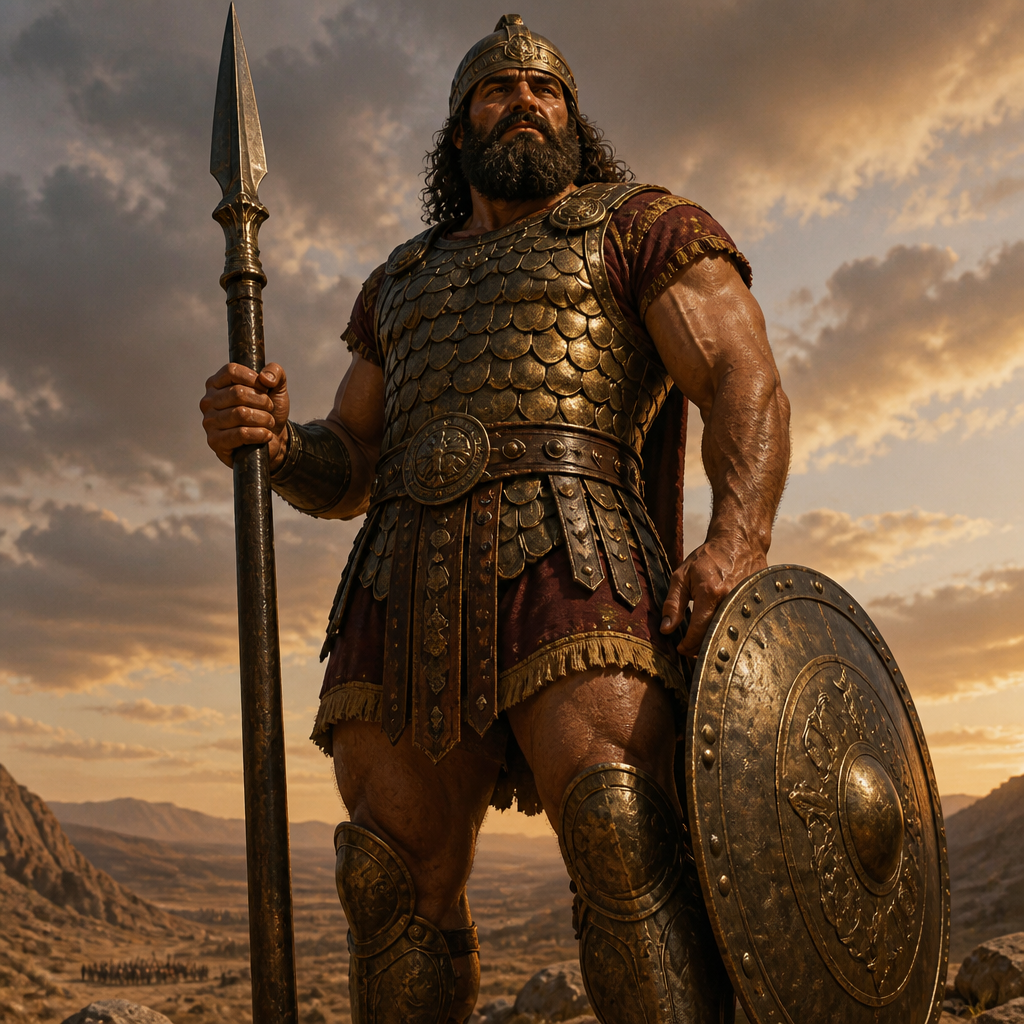
Goliath was a formidable warrior from the city of Gath, identified as a champion of the Philistine forces during the era of the United Monarchy. He is most famously recognized for his physical dimensions, described in the biblical text as standing six cubits and a span in height. His presence served as a psychological and military obstacle for the Israelite army under King Saul, as he issued daily challenges for a single combat encounter to decide the outcome of the conflict in the Valley of Elah.
Historically, Goliath represents the military threat posed by the Philistine pentapolis against the fledgling Israelite kingdom. His equipment—including a bronze helmet, a coat of scale armor weighing five thousand shekels of bronze, and a spear with a head of six hundred shekels of iron—underscores the advanced metallurgical capabilities of the Philistine culture compared to their contemporaries. His eventual defeat by the young David remains one of the most significant narrative pivot points in the Old Testament.
Background and Family
Goliath was a native of Gath, one of the five major city-states of the Philistine confederation. The biblical record places his lineage within the descendants of Rapha (or the Rephaites), a group noted for their extraordinary physical stature. According to 1 Chronicles 20:5 and 2 Samuel 21:19, Goliath was part of a broader family of giants. His brothers included Lahmi, Ishbi-benob, and Saph. Additionally, the text mentions another unnamed sibling characterized by having six fingers on each hand and six toes on each foot. This genealogical context suggests that Goliath was not an isolated physical anomaly but belonged to a specific warrior sub-culture or ethnic remnant known for their size and strength.
Major Life Events
The Challenge at Elah
The primary account of Goliath’s life occurs in 1 Samuel 17. During a standoff between the Philistines and the Israelites at the Valley of Elah, Goliath emerged from the Philistine camp to propose a representative duel. For forty days, he stepped forward each morning and evening to defy the ranks of Israel, demanding that they send out a man to fight him. The terms he set were absolute: the losing nation would become subjects to the victors. The biblical text records that Saul and all Israel were "dismayed and terrified" by his presence and his verbal taunts.
Confrontation with David
While the seasoned soldiers of Israel declined the challenge, the young shepherd David, who had come to the camp to bring provisions to his brothers, accepted it. Goliath, seeing David’s youth and lack of traditional armor, reacted with disdain. The text records Goliath’s curse: "Am I a dog, that you come at me with sticks?" He threatened to give David's flesh to the birds of the air and the beasts of the field. However, David utilized a sling to sink a stone into Goliath’s forehead. The champion fell facedown on the ground, and David subsequently used Goliath’s own sword to decapitate him, leading to a total rout of the Philistine army.
The Fate of His Weaponry
Following his death, Goliath’s equipment became significant artifacts in the Israelite narrative. His sword was initially kept at the tabernacle in Nob, wrapped in a cloth behind the ephod. When David was later fleeing from King Saul, the priest Ahimelech gave the sword back to David, who remarked, "There is none like it." The spear of Goliath is also frequently highlighted in the text for its immense size, described as having a shaft like a "weaver’s beam."
Relationship to Other Biblical Figures
Goliath’s primary relationship in the text is one of antagonism toward King Saul and David. However, the record in 1 Chronicles 20:5 and 2 Samuel 21:19 expands his social circle to include his brothers, specifically Lahmi. These passages describe subsequent battles at Gob and Gath where David’s men, such as Elhanan son of Jair, killed Goliath’s remaining kinsmen. This indicates that while Goliath was the most prominent among them, he was part of a larger clan of warriors that posed a persistent threat to David's kingdom throughout the early years of the United Monarchy.
Spiritual Significance
In the biblical narrative, Goliath serves as the ultimate archetype of worldly power and self-reliance set in opposition to divine providence. His reliance on his physical stature, his heavy bronze armor, and his sophisticated weaponry is contrasted sharply with David’s reliance on the name of the LORD of Hosts. Goliath’s defiance was not merely against a human army but against the God of Israel. His defeat is presented as a demonstration that "it is not by sword or spear that the Lord saves" (1 Samuel 17:47). Consequently, Goliath remains a theological symbol for the overcoming of seemingly insurmountable obstacles through faith rather than human strength.
Goliath signifies the transition of power and divine favor from Saul to David. As Saul was tall and impressive among the Israelites yet shrank back in fear, the giant Goliath highlighted Saul's failure as a leader. David’s victory over Goliath served as his public vindication as the true anointed king who possessed the courage and faith that the sitting monarch lacked.
Beyond the historical narrative, Goliath represents the persistent threat of the Philistines, who were Israel’s primary rivals during the transition from the Period of the Judges to the United Monarchy. His defeat is not just a personal victory for David but a national liberation for Israel, signifying that the God of Israel is superior to the gods and champions of the surrounding pagan nations.
Frequently Asked Questions
How tall was Goliath?
According to 1 Samuel 17:4, Goliath was six cubits and a span in height, which translates to approximately nine feet and nine inches.
What city was Goliath from?
Goliath was from the Philistine city of Gath, which was one of the five major Philistine strongholds.
Who were Goliath's brothers?
The Bible mentions Lahmi, Ishbi-benob, Saph, and an unnamed six-fingered brother as the siblings of Goliath (or sons of Rapha).
What happened to Goliath's sword after his death?
His sword was kept at Nob by the priest Ahimelech and was later given back to David when David was fleeing from King Saul.
Who else is credited with killing a member of Goliath's family?
Elhanan son of Jair is credited with killing Lahmi, the brother of Goliath, during a later battle at Gob.
Family & Relationships
Parents
 RaphaFather2 Samuel 21:22Stated
 GoliathThis page
 Huge Man of GathBrother1 Samuel 17:4
Inferred
No verse names Huge Man and Goliath together; the brother link is carried from the surrounding genealogy and is not stated in Scripture.Evidence: 1 Samuel 17:4
 Ishbi-benobBrother1 Samuel 17:4
Inferred
No verse names Ishbi-benob and Goliath together; the brother link is carried from the surrounding genealogy and is not stated in Scripture.Evidence: 1 Samuel 17:4
 SaphBrother2 Samuel 21:18Stated
 LahmiBrother1 Chronicles 20:5Stated
Connected Figures
Family
Father · 2 Samuel 21:22
An ancestral figure in Gath during the United Monarchy whose descendants were giants who fought against King David’s forces.
United MonarchyFirst: 2 Samuel 21:169 versesPatriarch of a warrior clan
Brother · 1 Samuel 17:4
A giant warrior of Gath and descendant of Rapha, noted for having twenty-four digits and fighting against Israel during the United Monarchy.
Brother · 1 Samuel 17:4
A giant of the Rapha family who nearly killed King David during the United Monarchy before being slain by Abishai.
United MonarchyFirst: 2 Samuel 21:166 versesWarrior / Giant
Brother · 2 Samuel 21:18
A Philistine warrior of giant stature and a descendant of Rapha who was slain by Sibbecai the Hushathite during the wars of King David.
Brother · 1 Chronicles 20:5
A Philistine warrior and brother of Goliath who was killed by Elhanan during the wars of King David’s reign.
United MonarchyFirst: 1 Chronicles 20:58 versesWarrior champion
Categories
Mentions by Book
- 1 Samuel5
- 2 Samuel4
- 1 Chronicles2
Scripture References
All 11 indexed verses, in canonical order, from the Berean Standard Bible.
1 Samuel · 5
- 1 Samuel 17:4
Then a champion named Goliath, who was from Gath, came out from the Philistine camp. He was six cubits and a span in height,
- 1 Samuel 17:23
And as he was speaking with them, suddenly the champion named Goliath, the Philistine from Gath, came forward from the ranks of the Philistines and shouted his usual words, which David also heard.
- 1 Samuel 17:45Partial
But David said to the Philistine, “You come against me with sword and spear and javelin, but I come against you in the name of the LORD of Hosts, the God of the armies of Israel, whom you have defied.
Cited as a key verse; added so References, Key Verses and Mentions by Book share one index.
- 1 Samuel 21:9
The priest replied, “The sword of Goliath the Philistine, whom you killed in the Valley of Elah, is here; it is wrapped in a cloth behind the ephod. If you want, you may take it. For there is no other but this one here.” And David said, “There is none like it; give it to me.”
- 1 Samuel 22:10
Ahimelech inquired of the LORD for him and gave him provisions. He also gave him the sword of Goliath the Philistine.”
2 Samuel · 4
- 2 Samuel 21:16Partial
Then Ishbi-benob, a descendant of Rapha, whose bronze spear weighed three hundred shekels and who was bearing a new sword, resolved to kill David.
Cited as evidence on a family card; added so References, Key Verses and Mentions by Book share one index.
- 2 Samuel 21:18Partial
Some time later at Gob, there was another battle with the Philistines. At that time Sibbecai the Hushathite killed Saph, a descendant of Rapha.
Cited as evidence on a family card; added so References, Key Verses and Mentions by Book share one index.
- 2 Samuel 21:19
Once again there was a battle with the Philistines at Gob, and Elhanan son of Jair the Bethlehemite killed the brother of Goliath the Gittite, the shaft of whose spear was like a weaver’s beam.
- 2 Samuel 21:20Partial
And there was also a battle at Gath, where there was a man of great stature with six fingers on each hand and six toes on each foot—twenty-four in all. He too was descended from Rapha,
Cited as evidence on a family card; added so References, Key Verses and Mentions by Book share one index.
1 Chronicles · 2
- 1 Chronicles 20:5
Once again there was a battle with the Philistines, and Elhanan son of Jair killed Lahmi the brother of Goliath the Gittite, the shaft of whose spear was like a weaver’s beam.
- 1 Chronicles 20:6Partial
And there was also a battle at Gath, where there was a man of great stature with six fingers on each hand and six toes on each foot—twenty-four in all. He too was descended from Rapha,
Cited as evidence on a family card; added so References, Key Verses and Mentions by Book share one index.