Huge Man of Gath
Who was Huge Man of Gath in the Bible?
A giant warrior of Gath and descendant of Rapha, noted for having twenty-four digits and fighting against Israel during the United Monarchy.
The individual often identified as the 'huge man' or 'man of great stature' was a Philistine warrior from the city of Gath who fought against the forces of King David during the era of the United Monarchy. He is distinctively characterized in the biblical record not only by his immense size but by a specific physical anomaly: polydactyly, possessing six fingers on each hand and six toes on each foot, totaling twenty-four digits.
Historically, this figure is situated within the closing accounts of David’s military campaigns against the remnants of the Rephaim, a race of giants. His appearance in the text serves to highlight the ongoing conflict between the burgeoning Kingdom of Israel and the established Philistine city-states, specifically the family of Rapha, which produced several formidable adversaries for David’s mighty men.
Background and Family
The biblical record identifies this figure as a descendant of Rapha (or 'the giant'), a lineage associated with the ancient Rephaim who inhabited the Levant. He was a native of Gath, one of the five primary city-states of the Philistines. According to the genealogical information provided in 2 Samuel and 1 Chronicles, he was part of a formidable brotherhood of giants. His siblings included Ishbi-benob, Saph (also known as Sippai), Lahmi, and the famous Goliath who was slain by David.
The household of Rapha represented the final vestiges of a giant population that had long challenged the expansion of Israel. While the text does not provide a specific personal name for this individual, referring to him primarily by his stature (mid-dah), his inclusion in the list of Rapha’s progeny establishes his status as a high-ranking warrior within the Philistine military aristocracy.
Major Life Events
The life of this warrior is defined by his participation in the perpetual border wars between the Philistines and Israel. The specific engagement in which he appears took place at Gath. Unlike the duel between David and Goliath, this battle involved a broader military confrontation where the giant acted as a champion or primary combatant.
The text notes his physical uniqueness: "he had six fingers on each hand and six toes on each foot—twenty-four in all" (2 Samuel 21:20). This detail was likely recorded to emphasize his unnatural power and intimidating presence on the battlefield. During the skirmish, the giant defied Israel, a term that implies a verbal challenge or blasphemy against the God of Israel and His army. His career ended when he was confronted by Jonathan son of Shimeah, David’s nephew. Jonathan succeeded in killing the giant, contributing to the eventual neutralization of the house of Rapha.
Relationship to Other Biblical Figures
This figure’s primary significance in the narrative is defined by his relationships to both his kin and his enemies. As a sibling to Goliath, he represents the continuation of the threat that David had faced in the Valley of Elah decades earlier. The narrative structure of 2 Samuel 21 and 1 Chronicles 20 suggests a thematic 'cleanup' operation, where David’s lieutenants and relatives—such as Abishai, Sibbekai, Elhanan, and Jonathan—finish the work David began by defeating the remaining giants of Gath.
His killer, Jonathan son of Shimeah, was the son of David’s brother. This highlights the transition of the heroic mantle from David himself to the next generation and his inner circle of 'Mighty Men,' showing that the strength to defeat the enemies of the United Monarchy had permeated the royal family and the military leadership.
Spiritual Significance
In a theological context, the defeat of the 'huge man' symbolizes the total triumph of the Davidic kingdom over the chaotic and formidable forces that opposed God's established order. The Rephaim often represent the 'old world' of Canaan—monstrous, intimidating, and defiant of the LORD. By detailing the death of this twenty-four-digited giant, the biblical authors emphasize that no physical advantage or genetic anomaly could withstand those acting under the covenantal authority of the King of Israel. It serves as a concluding testimony to the success of David’s reign in securing the borders of the land.
The figure represents the final eradication of the Rephaim (giants) from the land of Canaan during the reign of King David. His defeat by Jonathan, David’s nephew, signifies the military maturity of Israel and the fulfillment of the conquest initiated centuries earlier.
Frequently Asked Questions
What was the 'huge man's' physical deformity?
He had polydactyly, specifically six fingers on each hand and six toes on each foot, for a total of twenty-four digits.
Who killed the huge man of Gath?
He was killed by Jonathan son of Shimeah, who was the nephew of King David.
Which city did he come from?
He was a native of Gath, a major Philistine city.
Who were his famous brothers?
His brothers included Goliath of Gath, Ishbi-benob, Saph (Sippai), and Lahmi.
What tribe did he belong to?
He was not an Israelite; he was a descendant of Rapha, belonging to the Philistines/Rephaim.
Family & Relationships
Parents
 RaphaFather2 Samuel 21:16
Inferred
No verse names Rapha and Huge Man together; the son link is carried from the surrounding genealogy and is not stated in Scripture.Evidence: 2 Samuel 21:16
 Huge Man of GathThis page
 GoliathBrother1 Samuel 17:4
Inferred
No verse names Goliath and Huge Man together; the brother link is carried from the surrounding genealogy and is not stated in Scripture.Evidence: 1 Samuel 17:4
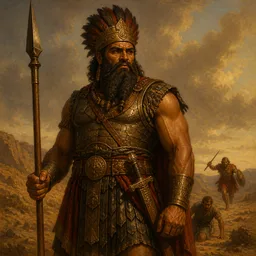 Ishbi-benobBrother2 Samuel 21:16
Inferred
No verse names Huge Man and Ishbi-benob together; the brother link is carried from the surrounding genealogy and is not stated in Scripture.Evidence: 2 Samuel 21:16
 SaphBrother2 Samuel 21:18
Inferred
No verse names Huge Man and Saph together; the brother link is carried from the surrounding genealogy and is not stated in Scripture.Evidence: 2 Samuel 21:18
 LahmiBrother1 Chronicles 20:5
Inferred
No verse names Huge Man and Lahmi together; the brother link is carried from the surrounding genealogy and is not stated in Scripture.Evidence: 1 Chronicles 20:5
Connected Figures
Family
Father · 2 Samuel 21:16
An ancestral figure in Gath during the United Monarchy whose descendants were giants who fought against King David’s forces.
United MonarchyFirst: 2 Samuel 21:169 versesPatriarch of a warrior clan
Brother · 1 Samuel 17:4
A champion warrior from Gath of enormous stature who served in the Philistine army during the reign of King Saul.
United MonarchyFirst: 1 Samuel 17:411 versesChampion warrior
Brother · 2 Samuel 21:16
A giant of the Rapha family who nearly killed King David during the United Monarchy before being slain by Abishai.
United MonarchyFirst: 2 Samuel 21:166 versesWarrior / Giant
Brother · 2 Samuel 21:18
A Philistine warrior of giant stature and a descendant of Rapha who was slain by Sibbecai the Hushathite during the wars of King David.
Brother · 1 Chronicles 20:5
A Philistine warrior and brother of Goliath who was killed by Elhanan during the wars of King David’s reign.
United MonarchyFirst: 1 Chronicles 20:58 versesWarrior champion
Categories
Mentions by Book
- 1 Samuel1
- 2 Samuel3
- 1 Chronicles2
Scripture References
All 6 indexed verses, in canonical order, from the Berean Standard Bible.
1 Samuel · 1
- 1 Samuel 17:4Partial
Then a champion named Goliath, who was from Gath, came out from the Philistine camp. He was six cubits and a span in height,
Cited as evidence on a family card; added so References, Key Verses and Mentions by Book share one index.
2 Samuel · 3
- 2 Samuel 21:16Partial
Then Ishbi-benob, a descendant of Rapha, whose bronze spear weighed three hundred shekels and who was bearing a new sword, resolved to kill David.
Cited as evidence on a family card; added so References, Key Verses and Mentions by Book share one index.
- 2 Samuel 21:18Partial
Some time later at Gob, there was another battle with the Philistines. At that time Sibbecai the Hushathite killed Saph, a descendant of Rapha.
Cited as evidence on a family card; added so References, Key Verses and Mentions by Book share one index.
- 2 Samuel 21:20
And there was also a battle at Gath, where there was a man of great stature with six fingers on each hand and six toes on each foot—twenty-four in all. He too was descended from Rapha,
1 Chronicles · 2
- 1 Chronicles 20:5Partial
Once again there was a battle with the Philistines, and Elhanan son of Jair killed Lahmi the brother of Goliath the Gittite, the shaft of whose spear was like a weaver’s beam.
Cited as evidence on a family card; added so References, Key Verses and Mentions by Book share one index.
- 1 Chronicles 20:6
And there was also a battle at Gath, where there was a man of great stature with six fingers on each hand and six toes on each foot—twenty-four in all. He too was descended from Rapha,