Ishbi-benob
Who was Ishbi-benob in the Bible?
A giant of the Rapha family who nearly killed King David during the United Monarchy before being slain by Abishai.
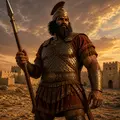
Ishbi-benob was a prominent warrior of the Rapha descent (often associated with the Rephaim or giants) who rose to prominence during the latter years of King David's reign. He is recorded in the biblical narrative as a formidable adversary who sought to capitalize on David's physical decline during a battle against the Philistines. His appearance serves as a narrative marker for the transition of David from a warrior-king to a monarch who must be protected by his subordinates.
The biblical account characterizes Ishbi-benob by his massive physical stature and his advanced weaponry. He is specifically described as carrying a bronze spear of immense weight and a new sword, signaling both his wealth and his specialized role as a champion among the Philistine forces. His primary historical significance lies in his near-successful attempt to end the Davidic dynasty on the battlefield.
Background and Family
Ishbi-benob is identified as a descendant of Rapha (2 Samuel 21:16), a term likely referring to a clan of exceptionally large individuals known as the Rephaim. The biblical record establishes him as part of a specific group of giants residing in Gath who were contemporaries of King David. Within this familial structure, Ishbi-benob is listed alongside several other notable giants, including Saph, Lahmi, and the unnamed 'huge man of Gath' who possessed twenty-four fingers and toes.
Crucially, these figures are linked to Goliath, the most famous of the Gittite giants. While the text refers to them as 'children' or 'descendants' of Rapha, the genealogical language suggests they were brothers or close kinsmen who formed a specialized elite unit within the Philistine military. Their presence highlights the ongoing threat posed by the remnants of the pre-Israelite giant clans during the United Monarchy.
Major Life Events
The single recorded event in the life of Ishbi-benob occurs during a conflict between Israel and the Philistines at Gob. During this engagement, King David, who was by then advanced in age, became exhausted in the heat of battle. Recognizing David's vulnerability, Ishbi-benob 'resolved to kill David,' targeting the king as a strategic prize that would demoralize the Israelite forces.
Ishbi-benob’s equipment is detailed to emphasize the danger he posed. His bronze spearhead weighed three hundred shekels (approximately 7.5 pounds), and he was armed with a 'new sword' (or, according to some translations, a new suit of armor). Before he could strike the killing blow, Abishai the son of Zeruiah intervened. Abishai came to David's aid, struck the giant, and killed him. This event prompted David’s men to swear that he would no longer go out to battle with them, lest the 'lamp of Israel' be extinguished.
Relationship to Other Biblical Figures
Ishbi-benob’s primary relationships are defined by his kinship with the other giants of Gath. As a sibling or kinsman to Goliath, he represents the lingering shadow of David's earliest victory. While David defeated Goliath as a youth, Ishbi-benob represents a reversal of that dynamic; in this encounter, the king is the one needing rescue. His death at the hands of Abishai reinforces the importance of David's 'Mighty Men' (the Gibborim), particularly the sons of Zeruiah, who functioned as the king's primary protectors.
Spiritual Significance
The account of Ishbi-benob serves as a theological and historical bookend to David’s career as a warrior. If the defeat of Goliath signaled David’s rise through divine favor, the encounter with Ishbi-benob signals the natural limits of David’s physical strength. The passage emphasizes that while God’s covenant with David remained firm, the preservation of the 'lamp of Israel' now required the combined effort of the king’s loyal followers. The defeat of Ishbi-benob and his kin symbolizes the final subjugation of the ancient giant clans that had once terrified the Israelites during the era of the Spies and the Conquest.
His encounter with David highlights the king’s mortality and the transition of David’s role from a front-line soldier to a symbolic and administrative leader whose life was too precious to risk in direct combat. Theologically, the episode demonstrates that God provides deliverance through others—in this case, Abishai—rather than solely through the individual prowess of the king.
Frequently Asked Questions
Who killed Ishbi-benob?
Ishbi-benob was killed by Abishai the son of Zeruiah, who was one of King David’s most prominent military commanders and his nephew.
How heavy was Ishbi-benob's spear?
The bronze head of his spear weighed three hundred shekels, which is approximately 7.5 pounds (3.4 kilograms).
Was Ishbi-benob related to Goliath?
Yes, according to 2 Samuel 21, he was a descendant of Rapha and is considered a brother or close kinsman of Goliath of Gath.
Where did the fight with Ishbi-benob take place?
The battle occurred at a place called Gob (2 Samuel 21:16-18) during a war against the Philistines.
Family & Relationships
Parents
 RaphaFather2 Samuel 21:16
Inferred
2 Samuel 21:16 names Ishbi-benob and Rapha in the same verse but does not state a father tie between them; the link rests on the surrounding narrative.Evidence: 2 Samuel 21:16
 Ishbi-benobThis page
 GoliathBrother1 Samuel 17:4
Inferred
No verse names Goliath and Ishbi-benob together; the brother link is carried from the surrounding genealogy and is not stated in Scripture.Evidence: 1 Samuel 17:4
 Huge Man of GathBrother2 Samuel 21:16
Inferred
No verse names Huge Man and Ishbi-benob together; the brother link is carried from the surrounding genealogy and is not stated in Scripture.Evidence: 2 Samuel 21:16
 SaphBrother2 Samuel 21:16
Inferred
Reconstructed through Rapha: 2 Samuel 21:18 ties Saph to Rapha; 2 Samuel 21:16 ties Rapha to Ishbi-benob (itself an inferred link). No verse states the brother link between Saph and Ishbi-benob directly.Evidence: 2 Samuel 21:16
 LahmiBrother2 Samuel 21:16
Inferred
No verse names Ishbi-benob and Lahmi together; the brother link is carried from the surrounding genealogy and is not stated in Scripture.Evidence: 2 Samuel 21:16
Connected Figures
Family
Father · 2 Samuel 21:16
An ancestral figure in Gath during the United Monarchy whose descendants were giants who fought against King David’s forces.
United MonarchyFirst: 2 Samuel 21:169 versesPatriarch of a warrior clan
Brother · 1 Samuel 17:4
A champion warrior from Gath of enormous stature who served in the Philistine army during the reign of King Saul.
United MonarchyFirst: 1 Samuel 17:411 versesChampion warrior
Brother · 2 Samuel 21:16
A giant warrior of Gath and descendant of Rapha, noted for having twenty-four digits and fighting against Israel during the United Monarchy.
Brother · 2 Samuel 21:16
A Philistine warrior of giant stature and a descendant of Rapha who was slain by Sibbecai the Hushathite during the wars of King David.
Brother · 2 Samuel 21:16
A Philistine warrior and brother of Goliath who was killed by Elhanan during the wars of King David’s reign.
United MonarchyFirst: 1 Chronicles 20:58 versesWarrior champion
Categories
Mentions by Book
- 1 Samuel1
- 2 Samuel4
- 1 Chronicles1
Scripture References
All 6 indexed verses, in canonical order, from the Berean Standard Bible.
1 Samuel · 1
- 1 Samuel 17:4Partial
Then a champion named Goliath, who was from Gath, came out from the Philistine camp. He was six cubits and a span in height,
Cited as evidence on a family card; added so References, Key Verses and Mentions by Book share one index.
2 Samuel · 4
- 2 Samuel 21:16
Then Ishbi-benob, a descendant of Rapha, whose bronze spear weighed three hundred shekels and who was bearing a new sword, resolved to kill David.
- 2 Samuel 21:17Partial
But Abishai son of Zeruiah came to his aid, struck the Philistine, and killed him. Then David’s men swore to him, “You must never again go out with us to battle, so that the lamp of Israel may not be extinguished.”
Cited as evidence on a family card; added so References, Key Verses and Mentions by Book share one index.
- 2 Samuel 21:18Partial
Some time later at Gob, there was another battle with the Philistines. At that time Sibbecai the Hushathite killed Saph, a descendant of Rapha.
Cited as evidence on a family card; added so References, Key Verses and Mentions by Book share one index.
- 2 Samuel 21:20Partial
And there was also a battle at Gath, where there was a man of great stature with six fingers on each hand and six toes on each foot—twenty-four in all. He too was descended from Rapha,
Cited as evidence on a family card; added so References, Key Verses and Mentions by Book share one index.
1 Chronicles · 1
- 1 Chronicles 20:5Partial
Once again there was a battle with the Philistines, and Elhanan son of Jair killed Lahmi the brother of Goliath the Gittite, the shaft of whose spear was like a weaver’s beam.
Cited as evidence on a family card; added so References, Key Verses and Mentions by Book share one index.