Zeruiah
Who was Zeruiah in the Bible?
The sister of King David and mother of his three most powerful military leaders, Joab, Abishai, and Asahel, during the United Monarchy.
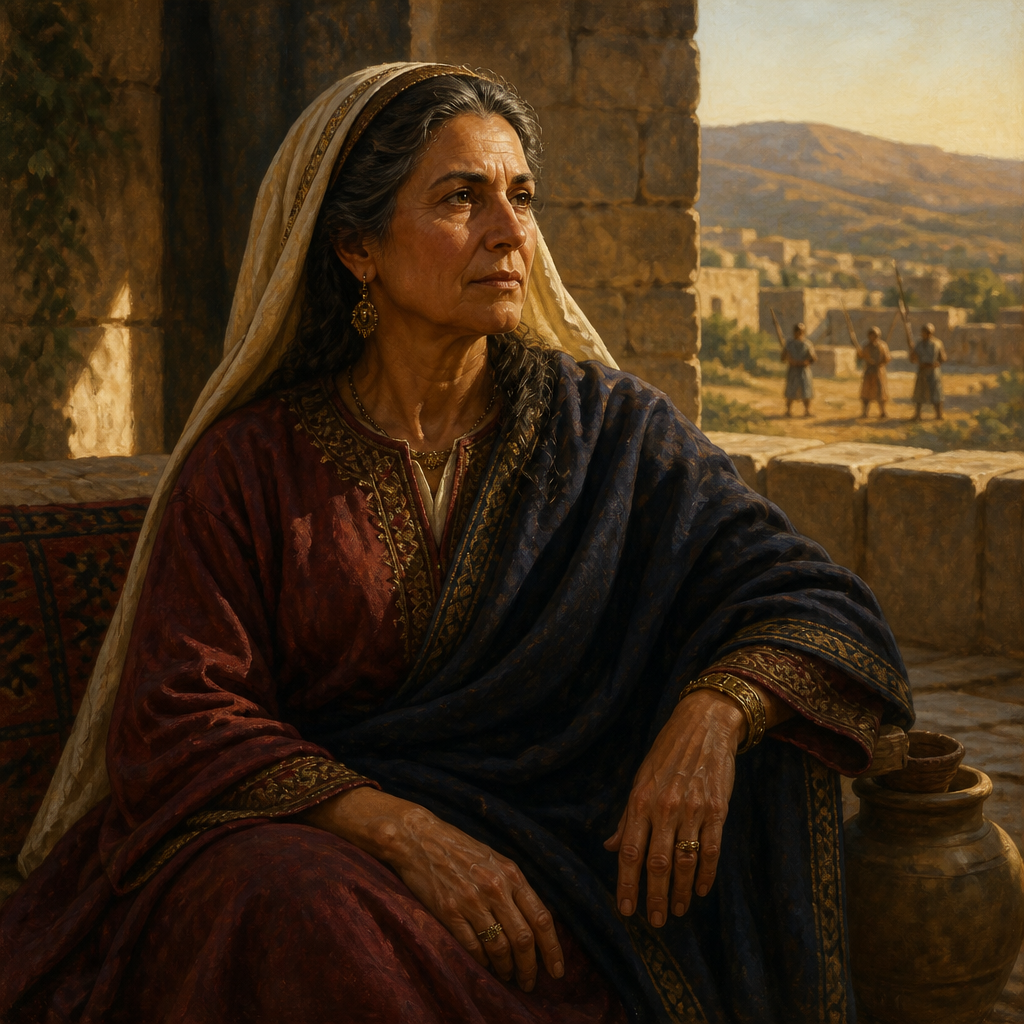
Zeruiah was a prominent woman of the tribe of Judah during the establishment of the United Monarchy in Israel. As the sister of King David, she held a position of significant influence within the royal household. Unlike many women in the biblical genealogies who are mentioned only in passing, Zeruiah is uniquely distinguished by the fact that her three sons—Joab, Abishai, and Asahel—are consistently identified by their relationship to her rather than their father.
Her sons served as the backbone of David’s military and political power, though their fierce and often impulsive nature frequently brought them into conflict with the king’s more diplomatic desires. While Zeruiah herself is not depicted as a direct participant in the battles or political maneuvers of the era, her name appears twenty-six times in the biblical record, serving as a constant identifier for the most formidable warriors in David's inner circle.
Background and Family
Zeruiah was the daughter of Jesse, making her a member of the tribe of Judah and the household from which the Davidic dynasty emerged. According to 1 Chronicles 2:16, she was one of the two sisters of David, the other being Abigail. However, a genealogical detail in 2 Samuel 17:25 adds a layer of complexity to her lineage, identifying her sister Abigail as the daughter of Nahash. This has led scholars to suggest several possibilities: that Nahash was another name for Jesse, that Zeruiah and Abigail were David’s half-sisters through their mother, or that Zeruiah was related to the house of Nahash the Ammonite by a previous marriage. Regardless of the specific patriarchal link, the biblical text firmly establishes her as David’s sister and a central matriarchal figure in the royal family.
Zeruiah had three sons: Joab, the commander of David's army; Abishai, a chief among the mighty men; and Asahel, a renowned runner. The Bible does not provide the name of her husband, referring to him only as the father of her children in general terms, though his burial place is mentioned in Bethlehem. The recurring phrase "son of Zeruiah" suggests that her own status or lineage carried more weight in the Judean court than that of her husband.
Major Life Events
While the biblical narrative does not record Zeruiah’s personal actions, she is the constant backdrop for the careers of her sons. During David’s early years as a fugitive from King Saul, Zeruiah’s family supported him. Her son Abishai accompanied David into Saul’s camp (1 Samuel 26:6), showing the deep-seated loyalty the "sons of Zeruiah" held for their uncle.
After David became king, Zeruiah’s sons rose to the highest levels of military command. Joab became the commander-in-chief after leading the conquest of Jebus (Jerusalem). However, their tenure was marked by violence that often distressed David. When Joab murdered Abner in retaliation for the death of their brother Asahel, David lamented his inability to control them, famously stating, "And I am weak this day, though anointed as king, and these men, the sons of Zeruiah, are too fierce for me" (2 Samuel 3:39). This phrase became a recurring motif; whenever David's nephews acted with excessive zeal or cruelty—such as Abishai’s desire to execute Shimei for cursing the king—David would rebuke them by asking, "What have I to do with you, O sons of Zeruiah?" (2 Samuel 16:10, 19:22).
Relationship to Other Biblical Figures
Zeruiah’s primary relationship was to King David. As his sister, she provided him with his most loyal, albeit difficult, lieutenants. Her sons were David’s protectors, but they were also his political liabilities. The tension between David’s mercy and the "sons of Zeruiah's" ruthlessness defines much of the history of the United Monarchy.
Beyond David, Zeruiah was sister to Eliab, Abinadab, Shimea, Nethanel, Raddai, and Ozem. Her nephew, Amasa (the son of her sister Abigail), eventually became a rival to her son Joab, leading to a tragic family internal conflict when Joab murdered Amasa to secure his position. This web of relationships highlights that the early years of the United Monarchy were essentially a family-run enterprise, with Zeruiah’s immediate offspring serving as the primary enforcers of the Davidic throne.
Spiritual Significance
In the biblical text, Zeruiah functions as a symbol of a specific kind of worldly strength—a strength that is necessary for the survival of a kingdom but often at odds with the spiritual ideals of the king. The constant identification of Joab and Abishai as the "sons of Zeruiah" underscores the importance of her lineage and perhaps her own formidable character, which was reflected in her sons.
Theologically, the struggle between David and the sons of Zeruiah illustrates the difficulty of reigning with righteousness in a world of violent political necessity. Zeruiah’s name, which may be derived from the Hebrew word for "balsam" or "distress/tribulation," aptly fits her role as a woman whose sons brought both healing (victory) and distress to the house of Israel. Her legacy is one of fierce loyalty to the Davidic line, ensuring that the "lamp of Israel" was not extinguished during the tumultuous years of David's reign.
Theologically, Zeruiah represents the intersection of family loyalty and the administrative burdens of the Davidic covenant. Her presence in the text as a mother whose name defines her sons' identities is a rarity in the patriarchal genealogies of the Old Testament, suggesting her significant status within the tribe of Judah. Her sons acted as the physical 'shield' for the Messianic line of David, even when their methods were condemned by David himself.
Her recurring mention serves as a literary device to group Joab and Abishai as a singular force of 'fierce' human nature that David, as the man after God’s own heart, had to constantly navigate. This highlights the theme that God's kingdom is built through imperfect family lines and that the human strength provided by the 'sons of Zeruiah' must ultimately be balanced by the justice and mercy of the King.
Frequently Asked Questions
Who was Zeruiah's husband?
The Bible does not name Zeruiah's husband. He is mentioned only as the father of her sons, and 2 Samuel 2:32 notes that he was buried in a tomb in Bethlehem.
Why are her sons always called 'the sons of Zeruiah' instead of their father's name?
While the Bible does not explicitly state why, it is highly unusual in ancient Israelite culture. It likely indicates that Zeruiah was a woman of exceptional status, or that her relationship to David was the most significant factor in her sons' social and political standing.
How many sons did Zeruiah have?
Zeruiah had three sons: Joab (the commander of David’s army), Abishai (a high-ranking warrior), and Asahel (a renowned fast runner who was killed by Abner).
Was Zeruiah related to King David?
Yes, Zeruiah was David's sister. According to 1 Chronicles 2:16, she and Abigail were the sisters of David and the other sons of Jesse.
What does the name Zeruiah mean?
The name Zeruiah (Tseruyah) is often interpreted to mean 'balsam' or 'perfume,' though some scholars suggest roots related to 'pain' or 'tribulation.'
Family & Relationships
Parents
 JesseFather1 Chronicles 2:12Stated
 Nahash, Parent of AbigailParent2 Samuel 17:25
Inferred
2 Samuel 17:25 names Zeruiah and Nahash in the same verse but does not state a parent tie between them; the link rests on the surrounding narrative.Evidence: 2 Samuel 17:25
 Husband of ZeruiahHusband1 Samuel 26:6
Inferred
No verse names Zeruiah and Husband of Zeruiah together; the husband link is carried from the surrounding genealogy and is not stated in Scripture.Evidence: 1 Samuel 26:6
 ZeruiahThis page
 DavidBrother1 Chronicles 2:15–16Stated
 Abinadab, Son of JesseBrother1 Chronicles 2:13–16Stated
 Eliab, Brother of DavidBrother1 Chronicles 2:12Stated
 Abigail, Sister of DavidSister1 Chronicles 2:16Stated
 Shimeah, Brother of DavidBrother1 Chronicles 2:12Stated
 Elihu, Brother of DavidBrother1 Chronicles 2:16
Inferred
Reconstructed through David and Joab: 1 Chronicles 27:18 ties Elihu to David; 1 Samuel 26:6 ties David to Joab (itself an inferred link); 2 Samuel 2:13 ties Joab to Zeruiah. No verse states the sister link between Elihu and Zeruiah directly.Evidence: 1 Chronicles 2:16
 Nethanel, Brother of DavidBrother1 Chronicles 2:14–16Stated
 Ozem, Brother of DavidBrother1 Chronicles 2:15–16Stated
 RaddaiBrother1 Chronicles 2:14–16Stated
Children
 AbishaiSon1 Samuel 26:6Stated
 Joab, Commander of the ArmySon2 Samuel 2:13Stated
 Asahel, Brother of JoabSon1 Chronicles 2:16Stated
Connected Figures
Family
Father · 1 Chronicles 2:12
The father of King David and a resident of Bethlehem, Jesse is a pivotal link in the genealogy of the Davidic dynasty and the Messianic line.
United MonarchyFirst: Ruth 4:1752 versesShepherdJudah
Parent · 2 Samuel 17:25
A figure mentioned in the genealogy of King David’s family, identified as the parent of Abigail and Zeruiah.
United MonarchyFirst: 2 Samuel 17:252 versesParent in the house of Jesse
Husband · 1 Samuel 26:6
The unnamed father of David's three most prominent military leaders: Joab, Abishai, and Asahel during the United Monarchy.
Son · 1 Samuel 26:6
A high-ranking military commander and nephew of King David, known for his fierce loyalty, battlefield prowess, and leadership during the United Monarchy.
United MonarchyFirst: 1 Samuel 26:624 versesMilitary CommanderJudah
Son · 2 Samuel 2:13
Joab was the nephew of King David and the supreme commander of Israel's military during the United Monarchy, known for his tactical brilliance and ruthless pragmatism.
United MonarchyFirst: 1 Samuel 26:6121 versesCommander of the ArmyJudah
Son · 1 Chronicles 2:16
A renowned warrior and nephew of King David known for his incredible speed, who served as a commander in David's army before being killed by Abner.
United MonarchyFirst: 2 Samuel 2:1816 versesMilitary Commander, Elite WarriorJudah
Brother · 1 Chronicles 2:15–16
The second king of the United Monarchy of Israel, a shepherd-warrior and psalmist known as a man after God's own heart.
United MonarchyFirst: Ruth 4:17998 versesKing of Israel, Shepherd, Musician, WarriorJudah
Brother · 1 Chronicles 2:13–16
The second-born son of Jesse and elder brother of King David who served in the army of King Saul during the Philistine wars.
United MonarchyFirst: 1 Samuel 16:812 versesSoldierJudah
Brother · 1 Chronicles 2:12
Eliab was the firstborn son of Jesse of Bethlehem and the eldest brother of King David, known for his imposing stature and service in King Saul's army.
United MonarchyFirst: 1 Samuel 16:615 versesSoldierJudah
Sister · 1 Chronicles 2:16
Abigail was a daughter of Nahash or Jesse, a sister to King David, and the mother of Amasa, the commander of Absalom's rebel army.
Brother · 1 Chronicles 2:12
The third son of Jesse and an elder brother of King David, Shimeah served in the army of Saul and was the father of the shrewd Jonadab and the warrior Jonathan.
United MonarchyFirst: 2 Samuel 13:316 versesSoldierJudah
Brother · 1 Chronicles 2:16
A son of Jesse and brother of King David who served as the tribal leader of Judah during the United Monarchy.
United MonarchyFirst: 1 Chronicles 27:1814 versesPrince of JudahJudah
Categories
Mentions by Book
- Ruth2
- 1 Samuel4
- 2 Samuel17
- 1 Kings3
- 1 Chronicles12
Scripture References
All 38 indexed verses, in canonical order, from the Berean Standard Bible.
- Ruth 4:17Partial
The neighbor women said, “A son has been born to Naomi,” and they named him Obed. He became the father of Jesse, the father of David.
Cited as evidence on a family card; added so References, Key Verses and Mentions by Book share one index.
- Ruth 4:22Partial
Obed was the father of Jesse, and Jesse was the father of David.
Cited as evidence on a family card; added so References, Key Verses and Mentions by Book share one index.
- 1 Samuel 16:20Partial
And Jesse took a donkey loaded with bread, a skin of wine, and one young goat and sent them to Saul with his son David.
Cited as evidence on a family card; added so References, Key Verses and Mentions by Book share one index.
- 1 Samuel 17:13Partial
The three older sons of Jesse had followed Saul into battle: The firstborn was Eliab, the second was Abinadab, and the third was Shammah.
Cited as evidence on a family card; added so References, Key Verses and Mentions by Book share one index.
- 1 Samuel 17:17Partial
One day Jesse said to his son David, “Take this ephah of roasted grain and these ten loaves of bread for your brothers and hurry to their camp.
Cited as evidence on a family card; added so References, Key Verses and Mentions by Book share one index.
- 1 Samuel 26:6
And David asked Ahimelech the Hittite and Abishai son of Zeruiah, Joab’s brother, “Who will go down with me to Saul in the camp?” “I will go with you,” answered Abishai.
- 2 Samuel 2:13
So Joab son of Zeruiah and the servants of David marched out and met them by the pool of Gibeon. And the two groups took up positions on opposite sides of the pool.
- 2 Samuel 2:18
The three sons of Zeruiah were there: Joab, Abishai, and Asahel. Now Asahel was fleet of foot like a wild gazelle,
- 2 Samuel 3:39
And I am weak this day, though anointed as king, and these men, the sons of Zeruiah, are too fierce for me. May the LORD repay the evildoer according to his evil!”
- 2 Samuel 8:16
Joab son of Zeruiah was over the army; Jehoshaphat son of Ahilud was the recorder;
- 2 Samuel 13:3Partial
Now Amnon had a friend named Jonadab, the son of David’s brother Shimeah. Jonadab was a very shrewd man,
Cited as evidence on a family card; added so References, Key Verses and Mentions by Book share one index.
- 2 Samuel 13:32Partial
But Jonadab, the son of David’s brother Shimeah, spoke up: “My lord must not think they have killed all the sons of the king, for only Amnon is dead. In fact, Absalom has planned this since the day Amnon violated his sister Tamar.
Cited as evidence on a family card; added so References, Key Verses and Mentions by Book share one index.
- 2 Samuel 14:1
Now Joab son of Zeruiah perceived that the king’s heart longed for Absalom.
- 2 Samuel 16:9
Then Abishai son of Zeruiah said to the king, “Why should this dead dog curse my lord the king? Let me go over and cut off his head!”
- 2 Samuel 16:10
But the king replied, “What have I to do with you, O sons of Zeruiah? If he curses me because the LORD told him, ‘Curse David,’ who can ask, ‘Why did you do this?’”
- 2 Samuel 17:25
Absalom had appointed Amasa over the army in place of Joab. Amasa was the son of a man named Ithra, the Ishmaelite who had married Abigail, the daughter of Nahash and sister of Zeruiah the mother of Joab.
- 2 Samuel 18:2
He sent out the troops, a third under Joab, a third under Joab’s brother Abishai son of Zeruiah, and a third under Ittai the Gittite. And the king said to the troops, “I will surely march out with you as well.”
- 2 Samuel 19:21
But Abishai son of Zeruiah said, “Shouldn’t Shimei be put to death for this, because he cursed the LORD’s anointed?”
- 2 Samuel 19:22
And David replied, “Sons of Zeruiah, what have I to do with you, that you should be my adversaries today? Should any man be put to death in Israel today? Am I not indeed aware that today I am king over Israel?”
- 2 Samuel 21:17
But Abishai son of Zeruiah came to his aid, struck the Philistine, and killed him. Then David’s men swore to him, “You must never again go out with us to battle, so that the lamp of Israel may not be extinguished.”
- 2 Samuel 21:21Partial
and when he taunted Israel, Jonathan the son of David’s brother Shimei killed him.
Cited as evidence on a family card; added so References, Key Verses and Mentions by Book share one index.
- 2 Samuel 23:18
Now Abishai, the brother of Joab and son of Zeruiah, was chief of the Three, and he wielded his spear against three hundred men, killed them, and won a name along with the Three.
- 2 Samuel 23:37
Zelek the Ammonite, Naharai the Beerothite, the armor-bearer of Joab son of Zeruiah,
- 1 Kings 1:7
So Adonijah conferred with Joab son of Zeruiah and with Abiathar the priest, who supported him.
- 1 Kings 2:5
Moreover, you know what Joab son of Zeruiah did to me—what he did to Abner son of Ner and Amasa son of Jether, the two commanders of the armies of Israel. He killed them in peacetime to avenge the blood of war. He stained with the blood of war the belt around his waist and the sandals on his feet.
- 1 Kings 2:22
King Solomon answered his mother, “Why do you request Abishag the Shunammite for Adonijah? Since he is my older brother, you might as well request the kingdom for him and for Abiathar the priest and for Joab son of Zeruiah!”
- 1 Chronicles 2:13Partial
Jesse was the father of Eliab his firstborn; Abinadab was born second, Shimea third,
Cited as evidence on a family card; added so References, Key Verses and Mentions by Book share one index.
- 1 Chronicles 2:14Partial
Nethanel fourth, Raddai fifth,
Cited as evidence on a family card; added so References, Key Verses and Mentions by Book share one index.
- 1 Chronicles 2:15Partial
Ozem sixth, and David seventh.
Cited as evidence on a family card; added so References, Key Verses and Mentions by Book share one index.
- 1 Chronicles 2:16Partial
Their sisters were Zeruiah and Abigail. And the three sons of Zeruiah were Abishai, Joab, and Asahel.
- 1 Chronicles 11:6
Now David had said, “Whoever is the first to strike down a Jebusite will become chief commander.” And Joab son of Zeruiah went up first, and he became the chief.
- 1 Chronicles 11:39
Zelek the Ammonite, Naharai the Beerothite, the armor-bearer of Joab son of Zeruiah,
- 1 Chronicles 18:12
Moreover, Abishai son of Zeruiah struck down eighteen thousand Edomites in the Valley of Salt.
- 1 Chronicles 18:15
Joab son of Zeruiah was over the army; Jehoshaphat son of Ahilud was the recorder;
- 1 Chronicles 20:7Partial
and when he taunted Israel, Jonathan the son of David’s brother Shimei killed him.
Cited as evidence on a family card; added so References, Key Verses and Mentions by Book share one index.
- 1 Chronicles 26:28
Everything that had been dedicated by Samuel the seer, Saul son of Kish, Abner son of Ner, and Joab son of Zeruiah, along with everything else that was dedicated, was under the care of Shelomith and his brothers.
- 1 Chronicles 27:18Partial
over Judah was Elihu, one of David’s brothers; over Issachar was Omri son of Michael;
Cited as evidence on a family card; added so References, Key Verses and Mentions by Book share one index.
- 1 Chronicles 27:24
Joab son of Zeruiah began to count the men but did not finish. For because of this census wrath came upon Israel, and the number was not entered in the Book of the Chronicles of King David.