Raddai
Who was Raddai in the Bible?
Raddai was a son of Jesse and a brother of King David, belonging to the tribe of Judah during the United Monarchy.
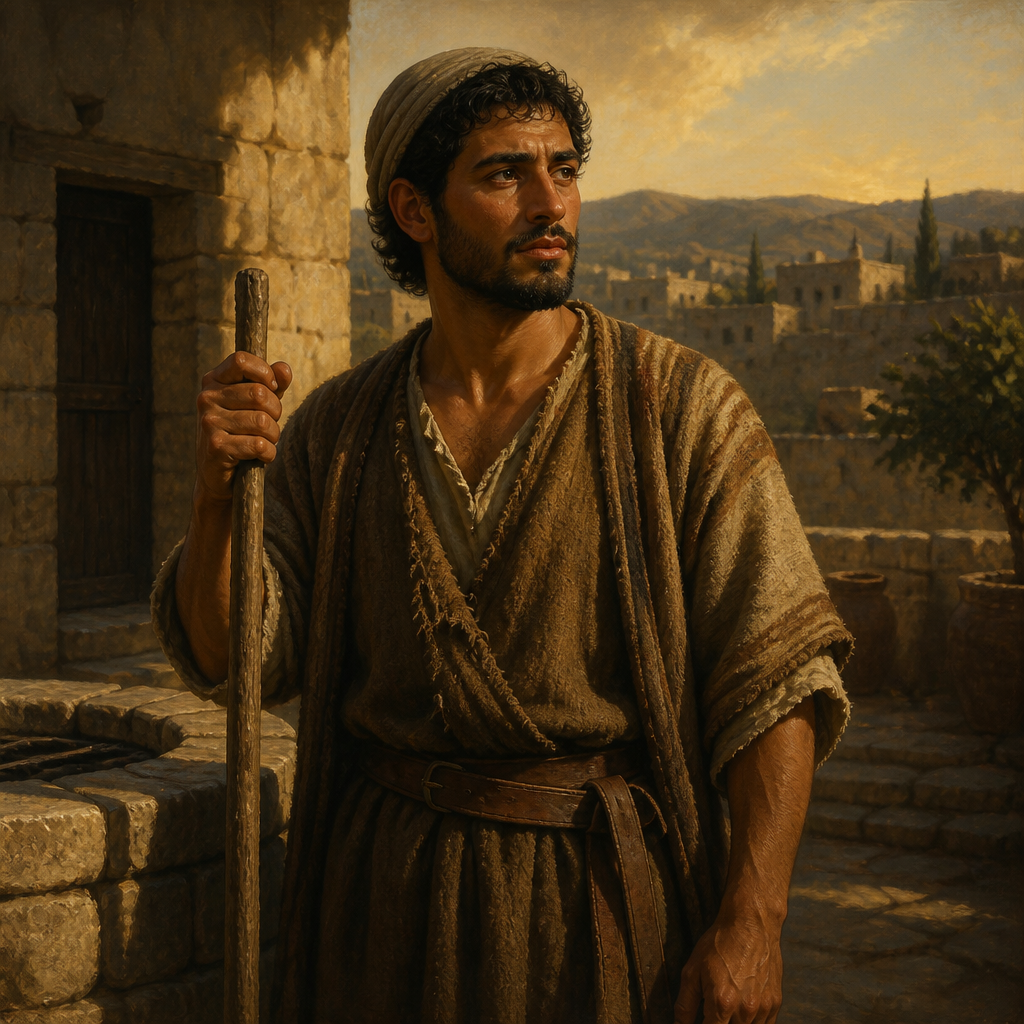
Raddai was a member of the tribe of Judah and the fifth son of Jesse of Bethlehem. He lived during the transition between the reign of Saul and the establishment of the United Monarchy under his youngest brother, David. While his life is not detailed in the narrative prose of the books of Samuel, his inclusion in the chronicler's genealogy underscores his status within the foundational family of the Davidic dynasty.
As one of the seven sons of Jesse, Raddai was part of a household that played a central role in the political and spiritual history of Israel. His identity is defined entirely by his kinship, serving as a biological link in the lineage that the Bible emphasizes as the chosen line for Israel's kingship and the eventual messianic promise.
Background and Family
Raddai was born into the house of Jesse in the village of Bethlehem. According to the genealogical records in the Old Testament, he was the fifth of seven sons. His father, Jesse, was a grandson of Boaz and Ruth, making Raddai part of a prominent family within the tribe of Judah. The scriptures identify his brothers as Eliab (the firstborn), Abinadab, Shimea (or Shimeah), Nethanel, Ozem, and David. He also had two sisters, Zeruiah and Abigail.
The mention of Nahash in relation to his sisters suggests a complex family structure, though Raddai is explicitly listed as a descendant of Jesse in the primary genealogical record of the tribe of Judah. His upbringing would have been centered around the agrarian lifestyle of Bethlehem during a time when the nation of Israel was shifting from the localized rule of judges to a centralized monarchy.
Major Life Events
The biblical record for Raddai is exceptionally brief, consisting of his placement within a list of Jesse’s progeny. He is mentioned by name only in 1 Chronicles 2:14. Unlike his brothers Eliab, Abinadab, and Shimea, who are depicted as soldiers in Saul’s army during the confrontation with Goliath (1 Samuel 17:13), Raddai does not appear in the narrative descriptions of David’s early life or his flight from Saul.
Historical silence regarding his specific deeds suggests that while Raddai was a recognized member of the royal household, he did not hold a prominent military or political office that warranted narrative detail. He remains a figure of genealogical importance rather than one of narrative action.
Relationship to Other Biblical Figures
Raddai’s primary significance is his relationship to David, the second king of Israel. As an older brother to the king, he was part of the inner circle of the house of Jesse. During the period when David was being hunted by King Saul, the Bible notes that David’s entire "father's house" went down to join him at the Cave of Adullam to escape Saul’s potential retribution (1 Samuel 22:1). It is highly probable that Raddai was among these family members who sought refuge with David, though the text does not name him individually in that instance.
Spiritual Significance
Theological study of Raddai focuses on the concept of election and the sovereign choice of God. When the prophet Samuel came to Bethlehem to anoint a new king, he reviewed the sons of Jesse. While Raddai would have been among those considered by human standards, he—like his other older brothers—was passed over in favor of the youngest, David. His presence in the biblical text serves to provide a complete accounting of the family from which the "Branch of Jesse" would grow, ensuring the legal and biological record of the Davidic line is preserved for posterity.
Raddai's significance lies in his contribution to the genealogical integrity of the House of David. In the ancient Near East, lineage was the primary validator of royal and land rights; by recording Raddai, the Chronicler confirms the historical reality of David’s family and the fulfillment of the tribal inheritance of Judah. He represents the broader family context that supported—and at times necessitated the protection of—the Lord’s anointed king.
Frequently Asked Questions
How many brothers did Raddai have?
According to 1 Chronicles 2:13-15, Raddai had six brothers: Eliab, Abinadab, Shimea, Nethanel, Ozem, and David.
Was Raddai present when Samuel anointed David?
While 1 Samuel 16 states that Jesse made seven of his sons pass before Samuel, Raddai is not mentioned by name in that specific scene, though he is listed as the fifth son in the Chronicles genealogy.
What does the name Raddai mean?
The name Raddai (Hebrew: רַדַּי) is generally understood to mean 'treading' or 'spreading out,' or potentially 'subduing.'
To which tribe did Raddai belong?
Raddai belonged to the tribe of Judah, the tribe from which the kings of Israel and the Messiah were prophesied to descend.
Does Raddai appear in the New Testament?
No, Raddai is not mentioned in the New Testament. His name appears only in the Old Testament genealogical records of 1 Chronicles.
Family & Relationships
Parents
 JesseFather1 Chronicles 2:12Stated
 RaddaiThis page
 DavidBrother1 Chronicles 2:14–15Stated
 Abinadab, Son of JesseBrother1 Chronicles 2:13–14Stated
 Eliab, Brother of DavidBrother1 Chronicles 2:12Stated
 ZeruiahSister1 Chronicles 2:14–16Stated
 Abigail, Sister of DavidSister1 Chronicles 2:14–16Stated
 Shimeah, Brother of DavidBrother1 Chronicles 2:12Stated
 Elihu, Brother of DavidBrother1 Chronicles 2:14
Inferred
No verse names Elihu and Raddai together; the brother link is carried from the surrounding genealogy and is not stated in Scripture.Evidence: 1 Chronicles 2:14
 Nethanel, Brother of DavidBrother1 Chronicles 2:14Stated
 Ozem, Brother of DavidBrother1 Chronicles 2:14–15Stated
Connected Figures
Family
Father · 1 Chronicles 2:12
The father of King David and a resident of Bethlehem, Jesse is a pivotal link in the genealogy of the Davidic dynasty and the Messianic line.
United MonarchyFirst: Ruth 4:1752 versesShepherdJudah
Brother · 1 Chronicles 2:14–15
The second king of the United Monarchy of Israel, a shepherd-warrior and psalmist known as a man after God's own heart.
United MonarchyFirst: Ruth 4:17998 versesKing of Israel, Shepherd, Musician, WarriorJudah
Brother · 1 Chronicles 2:13–14
The second-born son of Jesse and elder brother of King David who served in the army of King Saul during the Philistine wars.
United MonarchyFirst: 1 Samuel 16:812 versesSoldierJudah
Brother · 1 Chronicles 2:12
Eliab was the firstborn son of Jesse of Bethlehem and the eldest brother of King David, known for his imposing stature and service in King Saul's army.
United MonarchyFirst: 1 Samuel 16:615 versesSoldierJudah
Sister · 1 Chronicles 2:14–16
The sister of King David and mother of his three most powerful military leaders, Joab, Abishai, and Asahel, during the United Monarchy.
United MonarchyFirst: 1 Samuel 26:638 versesMatriarch of the Davidic Royal FamilyJudah
Sister · 1 Chronicles 2:14–16
Abigail was a daughter of Nahash or Jesse, a sister to King David, and the mother of Amasa, the commander of Absalom's rebel army.
Brother · 1 Chronicles 2:12
The third son of Jesse and an elder brother of King David, Shimeah served in the army of Saul and was the father of the shrewd Jonadab and the warrior Jonathan.
United MonarchyFirst: 2 Samuel 13:316 versesSoldierJudah
Brother · 1 Chronicles 2:14
A son of Jesse and brother of King David who served as the tribal leader of Judah during the United Monarchy.
United MonarchyFirst: 1 Chronicles 27:1814 versesPrince of JudahJudah
Brother · 1 Chronicles 2:14
Nethanel was the fourth son of Jesse and an elder brother of King David during the era of the United Monarchy.
Brother · 1 Chronicles 2:14–15
Ozem was the sixth son of Jesse and a biological brother of King David within the tribe of Judah during the United Monarchy.
Categories
Mentions by Book
- 1 Samuel1
- 2 Samuel3
- 1 Chronicles6
Scripture References
All 10 indexed verses, in canonical order, from the Berean Standard Bible.
1 Samuel · 1
- 1 Samuel 17:13Partial
The three older sons of Jesse had followed Saul into battle: The firstborn was Eliab, the second was Abinadab, and the third was Shammah.
Cited as evidence on a family card; added so References, Key Verses and Mentions by Book share one index.
2 Samuel · 3
- 2 Samuel 13:3Partial
Now Amnon had a friend named Jonadab, the son of David’s brother Shimeah. Jonadab was a very shrewd man,
Cited as evidence on a family card; added so References, Key Verses and Mentions by Book share one index.
- 2 Samuel 13:32Partial
But Jonadab, the son of David’s brother Shimeah, spoke up: “My lord must not think they have killed all the sons of the king, for only Amnon is dead. In fact, Absalom has planned this since the day Amnon violated his sister Tamar.
Cited as evidence on a family card; added so References, Key Verses and Mentions by Book share one index.
- 2 Samuel 21:21Partial
and when he taunted Israel, Jonathan the son of David’s brother Shimei killed him.
Cited as evidence on a family card; added so References, Key Verses and Mentions by Book share one index.
1 Chronicles · 6
- 1 Chronicles 2:13Partial
Jesse was the father of Eliab his firstborn; Abinadab was born second, Shimea third,
Cited as evidence on a family card; added so References, Key Verses and Mentions by Book share one index.
- 1 Chronicles 2:14
Nethanel fourth, Raddai fifth,
- 1 Chronicles 2:15Partial
Ozem sixth, and David seventh.
Cited as evidence on a family card; added so References, Key Verses and Mentions by Book share one index.
- 1 Chronicles 2:16Partial
Their sisters were Zeruiah and Abigail. And the three sons of Zeruiah were Abishai, Joab, and Asahel.
Cited as evidence on a family card; added so References, Key Verses and Mentions by Book share one index.
- 1 Chronicles 20:7Partial
and when he taunted Israel, Jonathan the son of David’s brother Shimei killed him.
Cited as evidence on a family card; added so References, Key Verses and Mentions by Book share one index.
- 1 Chronicles 27:18Partial
over Judah was Elihu, one of David’s brothers; over Issachar was Omri son of Michael;
Cited as evidence on a family card; added so References, Key Verses and Mentions by Book share one index.