Ruth
Who was Ruth in the Bible?
A Moabite widow who demonstrated profound loyalty to her mother-in-law Naomi and became the great-grandmother of King David.
Ruth is the central figure of the book that bears her name, a narrative set during the turbulent period of the Judges, though she is genealogically situated as a significant matriarch in the history of Israel. Originally a woman of Moab, she entered the biblical record through her marriage to Mahlon, a Judean man who had migrated to Moab with his family to escape a famine. Following the deaths of her husband, his brother, and her father-in-law, Ruth made the unprecedented decision to remain with her mother-in-law, Naomi, rather than returning to her own people and gods.
Her journey from Moab to Bethlehem marks a transition from a foreign outsider to a foundational figure in the lineage of the Davidic monarchy. Through her labor in the fields and her adherence to the customs of Israel—specifically the laws regarding gleaning and the kinsman-redeemer—she secured a future for herself and Naomi. Her marriage to Boaz, a wealthy landowner, serves as the climax of her personal narrative and a vital link in the messianic genealogy recorded in the New Testament.
Background and Family
Ruth was a native of Moab, a nation often in conflict with Israel, yet she was brought into the sphere of the covenant through marriage. Her first husband was Mahlon, one of the two sons of Elimelech and Naomi, who had come from Bethlehem to Moab due to a severe famine (Ruth 1:4). The biblical record indicates that Ruth lived in Moab for approximately ten years during this first marriage. During this time, she was part of a household that bridged two cultures, though the text suggests the family maintained their identity as Judeans.
After the death of Mahlon, Ruth was left as a childless widow alongside her sister-in-law Orpah and her mother-in-law Naomi. When Naomi determined to return to Bethlehem upon hearing that the famine had ended, she urged both daughters-in-law to return to their mother's houses in Moab to find new husbands. While Orpah eventually agreed and returned to her people, Ruth refused, choosing instead a life of uncertainty in a foreign land (Ruth 1:14).
Major Life Events
The Vow of Loyalty
Upon Naomi's insistence that she return to Moab, Ruth uttered one of the most famous declarations of loyalty in scripture. She pledged not only to follow Naomi geographically but to adopt her social and spiritual identity: "For wherever you go, I will go, and wherever you live, I will live; your people will be my people, and your God will be my God" (Ruth 1:16). This vow marked her formal break from her Moabite heritage and her entry into the community of Israel.
Gleaning in the Fields
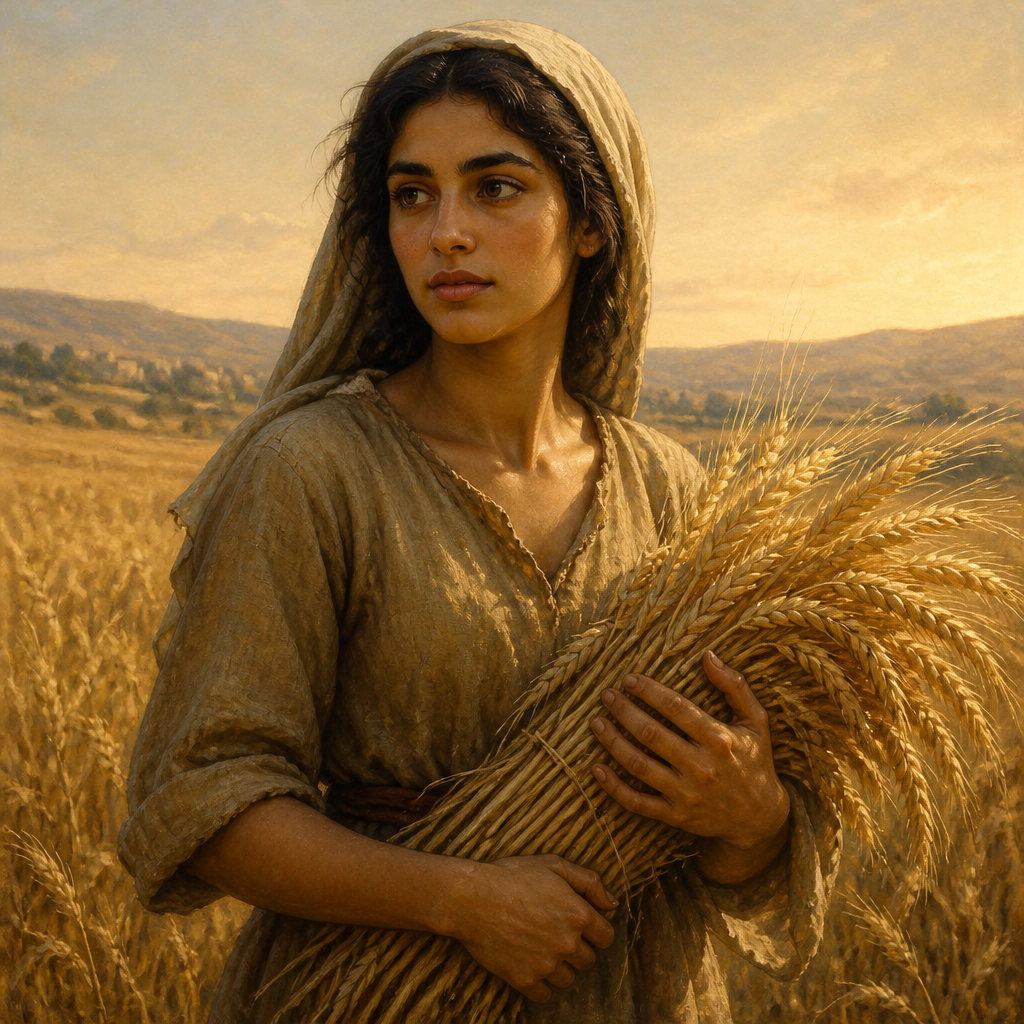
Arriving in Bethlehem at the start of the barley harvest, Ruth took the initiative to provide for herself and Naomi by gleaning—a practice allowed by Israelite law for the poor and foreigners. She happened upon the field of Boaz, a relative of her late father-in-law (Ruth 2:2-3). Boaz, hearing of her reputation and her kindness toward Naomi, provided her with special protection and abundance, ensuring she was safe from harassment and had sufficient grain to take home.
The Kinsman-Redeemer
Following Naomi's instructions, Ruth approached Boaz at the threshing floor during the night, requesting that he act as a kinsman-redeemer (go'el) by spreading his garment over her—a symbolic request for marriage and protection (Ruth 3:9). Boaz accepted the responsibility but noted there was a closer relative who had the first right of redemption. After the closer relative declined to fulfill the duty due to the financial and genealogical implications, Boaz publicly acquired the right to marry Ruth to "raise up the name of the deceased through his inheritance" (Ruth 4:10).
Relationship to Other Biblical Figures
Ruth’s primary relationship is with Naomi, whom she served with unwavering devotion. However, her union with Boaz is the pivot point of her historical significance. Through Boaz, Ruth became the mother of Obed. The genealogy concludes by identifying Obed as the father of Jesse, who was the father of King David (Ruth 4:17, 22). This lineage is reaffirmed in the New Testament, where Ruth is one of the few women specifically named in the genealogy of Jesus Christ (Matthew 1:5).
Spiritual Significance
Ruth represents the inclusion of the Gentiles into the blessings of Israel through faith and loyalty. Despite her origins in Moab, she is portrayed as a model of hesed—a Hebrew term denoting loving-kindness, loyalty, and covenantal faithfulness. Her story illustrates the providence of God working through ordinary lives to accomplish a grander redemptive purpose. By choosing the God of Israel, Ruth transitioned from a widow in a foreign land to a celebrated matriarch whose descendants would include the Messiah.
Ruth occupies a unique position as a Moabitess who becomes a central figure in the lineage of the Davidic covenant. Her inclusion in the genealogy of Jesus Christ in Matthew 1:5 highlights the biblical theme of God's grace extending beyond ethnic boundaries. She serves as a bridge between the chaotic era of the Judges and the establishment of the Monarchy, demonstrating that even in times of national spiritual decline, individual piety and loyalty remain powerful.
Theologically, Ruth is often viewed as a type of the Gentile church—grafted into the promises of Israel through a 'Kinsman-Redeemer.' Her story emphasizes the importance of the law of the levirate marriage and the redemption of land, showing how these social laws functioned to preserve families and ultimately prepare the way for the royal line of David.
Frequently Asked Questions
Why is Ruth called 'the Moabitess'?
The text repeatedly uses this title (Ruth 1:22, 2:2, 2:21, 4:5, 4:10) to emphasize her foreign origin and the remarkable nature of her integration into Israelite society and the messianic bloodline.
Who was Ruth's first husband?
Ruth was first married to Mahlon, the son of Elimelech and Naomi. He died in Moab before they had any children (Ruth 1:4-5).
What did Ruth do to show her loyalty to Naomi?
Ruth refused to abandon Naomi after their husbands died, traveling with her to Bethlehem and vowing to adopt Naomi’s people and God as her own (Ruth 1:16-17).
How is Ruth related to King David?
Ruth is the great-grandmother of King David. She gave birth to Obed, who was the father of Jesse, who was the father of David (Ruth 4:21-22).
What does the term 'Kinsman-Redeemer' mean in Ruth's story?
A kinsman-redeemer was a relative who had the right or responsibility to help a family member in need, such as buying back sold land or marrying a childless widow to carry on the family name.
Family & Relationships
Children
 Obed, Son of Boaz and RuthSonMatthew 1:5Stated
Extended family
 ChilionBrother-in-lawRuth 1:4
Inferred
Reconstructed through Mahlon: Ruth 1:2 ties Chilion to Mahlon (itself an inferred link); Ruth 4:10 ties Mahlon to Ruth. No verse states the sister-in-law link between Chilion and Ruth directly.Evidence: Ruth 1:4
 ElimelechFather-in-lawRuth 2:3
Inferred
Ruth 2:3 names Elimelech and Ruth in the same verse but does not state a daughter-in-law tie between them; the link rests on the surrounding narrative.Evidence: Ruth 2:3
 NaomiMother-in-lawRuth 1:4
Inferred
Reconstructed through Elimelech: Ruth 1:2 ties Naomi to Elimelech; Ruth 2:3 ties Elimelech to Ruth (itself an inferred link). No verse states the daughter-in-law link between Naomi and Ruth directly.Evidence: Ruth 1:4
 OrpahSister-in-lawRuth 1:4
Inferred
Ruth 1:4 names Orpah and Ruth in the same verse but does not state a sister-in-law tie between them; the link rests on the surrounding narrative.Evidence: Ruth 1:4
 JesseGrandsonRuth 4:22
Inferred
Matthew 1:5 names Ruth and Jesse in the same verse but does not state a grandson tie between them; the link rests on the surrounding narrative.Evidence: Ruth 4:22; 1 Chronicles 2:12; Matthew 1:5; Luke 3:32
Connected Figures
Family

Husband · Matthew 1:5
A prominent landowner from Bethlehem and a kinsman-redeemer who married Ruth, becoming a pivotal ancestor in the Davidic line and the genealogy of Jesus Christ.
Conquest and JudgesFirst: Ruth 2:123 versesJudge-era ElderJudah

Husband · Ruth 4:10
Mahlon was a Judean from Bethlehem and the first husband of Ruth, whose death in Moab set the stage for the redemption of Elimelech's family line.
Conquest and JudgesFirst: Ruth 1:26 versesNone recordedJudah
Son · Matthew 1:5
Obed was the son of Boaz and Ruth and the grandfather of King David, serving as a vital link in the Davidic line and the genealogy of Jesus Christ.
Conquest and JudgesFirst: Ruth 4:178 versesPatriarchJudah
Brother-in-law · Ruth 1:4
Chilion was a man of the tribe of Judah who migrated to Moab during a famine and became the husband of Orpah.
Conquest and JudgesFirst: Ruth 1:25 versesSettlerJudah
Father-in-law · Ruth 2:3
A man of Bethlehem in Judah who moved his family to Moab during a famine, serving as the patriarchal head of the family featured in the Book of Ruth.
Mother-in-law · Ruth 1:4
The wife of Elimelech and mother-in-law of Ruth, Naomi returned to Bethlehem after a decade in Moab, eventually securing her family's lineage through the kinsman-redeemer Boaz.
Conquest and JudgesFirst: Ruth 1:222 versesMatriarchJudah
Sister-in-law · Ruth 1:4
A Moabite woman who married Chilion, the son of Elimelech and Naomi, and later returned to her people after her husband's death.
Grandson · Ruth 4:22
The father of King David and a resident of Bethlehem, Jesse is a pivotal link in the genealogy of the Davidic dynasty and the Messianic line.
United MonarchyFirst: Ruth 4:1752 versesShepherdJudah
Categories
Mentions by Book
- Ruth17
- 1 Chronicles1
- Matthew1
- Luke1
Scripture References
All 20 indexed verses, in canonical order, from the Berean Standard Bible.
Ruth · 17
- Ruth 1:4
who took Moabite women as their wives, one named Orpah and the other named Ruth. And after they had lived in Moab about ten years,
- Ruth 1:5Partial
both Mahlon and Chilion also died, and Naomi was left without her two sons and without her husband.
Cited as evidence on a family card; added so References, Key Verses and Mentions by Book share one index.
- Ruth 1:14
Again they wept aloud, and Orpah kissed her mother-in-law goodbye, but Ruth clung to her.
- Ruth 1:16
But Ruth replied: “Do not urge me to leave you or to turn from following you. For wherever you go, I will go, and wherever you live, I will live; your people will be my people, and your God will be my God.
- Ruth 1:18
When Naomi saw that Ruth was determined to go with her, she stopped trying to persuade her.
Cited as evidence on a family card; added so References, Key Verses and Mentions by Book share one index.
- Ruth 1:22
So Naomi returned from the land of Moab with her daughter-in-law Ruth the Moabitess. And they arrived in Bethlehem at the beginning of the barley harvest.
- Ruth 2:2
And Ruth the Moabitess said to Naomi, “Please let me go into the fields and glean heads of grain after someone in whose sight I may find favor.” “Go ahead, my daughter,” Naomi replied.
- Ruth 2:3
So Ruth departed and went out into the field and gleaned after the harvesters. And she happened to come to the part of the field belonging to Boaz, who was from the clan of Elimelech.
Cited as evidence on a family card; added so References, Key Verses and Mentions by Book share one index.
- Ruth 2:8
Then Boaz said to Ruth, “Listen, my daughter. Do not go and glean in another field, and do not go away from this place, but stay here close to my servant girls.
- Ruth 2:12Partial
May the LORD repay your work, and may you receive a rich reward from the LORD, the God of Israel, under whose wings you have taken refuge.”
Cited as a key verse; added so References, Key Verses and Mentions by Book share one index.
- Ruth 2:21
Then Ruth the Moabitess said, “He also told me, ‘Stay with my young men until they have finished gathering all my harvest.’”
- Ruth 2:22
And Naomi said to her daughter-in-law Ruth, “My daughter, it is good for you to work with his young women, so that nothing will happen to you in another field.”
- Ruth 3:9
“Who are you?” he asked. “I am your servant Ruth,” she replied. “Spread the corner of your garment over me, for you are a kinsman-redeemer.”
- Ruth 4:5
Then Boaz said, “On the day you buy the land from Naomi and also from Ruth the Moabitess, you must also acquire the widow of the deceased in order to raise up the name of the deceased on his inheritance.”
- Ruth 4:10
Moreover, I have acquired Ruth the Moabitess, Mahlon’s widow, as my wife, to raise up the name of the deceased through his inheritance, so that his name will not disappear from among his brothers or from the gate of his home. You are witnesses today.”
- Ruth 4:13
So Boaz took Ruth, and she became his wife. And when he had relations with her, the LORD enabled her to conceive, and she gave birth to a son.
- Ruth 4:22Partial
Obed was the father of Jesse, and Jesse was the father of David.
Cited as evidence on a family card; added so References, Key Verses and Mentions by Book share one index.
1 Chronicles · 1
- 1 Chronicles 2:12Partial
Boaz was the father of Obed, and Obed was the father of Jesse.
Cited as evidence on a family card; added so References, Key Verses and Mentions by Book share one index.
Matthew · 1
- Matthew 1:5
Salmon was the father of Boaz by Rahab, Boaz the father of Obed by Ruth, Obed the father of Jesse,
Luke · 1
- Luke 3:32Partial
the son of Jesse, the son of Obed, the son of Boaz, the son of Sala, the son of Nahshon,
Cited as evidence on a family card; added so References, Key Verses and Mentions by Book share one index.