Naomi
Who was Naomi in the Bible?
The wife of Elimelech and mother-in-law of Ruth, Naomi returned to Bethlehem after a decade in Moab, eventually securing her family's lineage through the kinsman-redeemer Boaz.
Naomi is a central figure in the Old Testament, whose life story is recorded exclusively in the Book of Ruth. An Ephrathite from Bethlehem in Judah, she lived during the turbulent Period of the Judges. Her narrative begins with a famine that drives her family to the land of Moab, a move that would ultimately lead to a series of personal tragedies, including the deaths of her husband and her two sons.
Following these losses, Naomi returns to her homeland accompanied by her devoted daughter-in-law, Ruth. Her story is one of profound transition from bitterness and grief to restoration and joy. Through her guidance of Ruth and the legal intervention of their relative Boaz, Naomi experiences a social and familial redemption that secures her place in the messianic genealogy of Israel.
Background and Family
Naomi was the wife of Elimelech, an Ephrathite from the town of Bethlehem in Judah. During a period of severe famine in Israel, the couple migrated to the land of Moab with their two sons, Mahlon and Chilion. The biblical text indicates that the family settled there for approximately ten years. During this time, Naomi's sons married Moabitess women—Ruth and Orpah.
Tragedy struck the household when Elimelech died, followed by the deaths of both Mahlon and Chilion, leaving Naomi without her husband or heirs in a foreign land. This loss left her in a state of extreme vulnerability, as a widow in the ancient Near East often lacked legal protection and financial security.
Major Life Events
Upon hearing that the LORD had provided food for His people in Judah, Naomi decided to return to Bethlehem. She initially urged her daughters-in-law to stay in Moab, reasoning that she was too old to provide them with new husbands to fulfill the requirements of levirate marriage. While Orpah eventually departed, Ruth famously pledged her lifelong loyalty to Naomi and the God of Israel.
When the two women arrived in Bethlehem at the start of the barley harvest, the city was stirred by Naomi's return. However, she was so changed by grief that she requested the townspeople no longer call her Naomi (meaning "pleasant") but rather Mara (meaning "bitter"). She testified that while she had gone away full, the Almighty had brought her back empty.
As the harvest progressed, Naomi recognized the hand of Providence when Ruth began gleaning in the field of Boaz, a wealthy relative of Elimelech. Naomi took on a strategic role, instructing Ruth on how to approach Boaz at the threshing floor to request that he act as their kinsman-redeemer. Her guidance facilitated the legal process by which Boaz purchased Elimelech's land and married Ruth, thereby preserving the family name.
Relationship to Other Biblical Figures
Naomi’s most significant relationships are defined by her ties to the house of Elimelech and her bond with Ruth. Though Ruth was a Moabitess, Naomi treated her with the affection of a biological mother, referring to her as "my daughter."
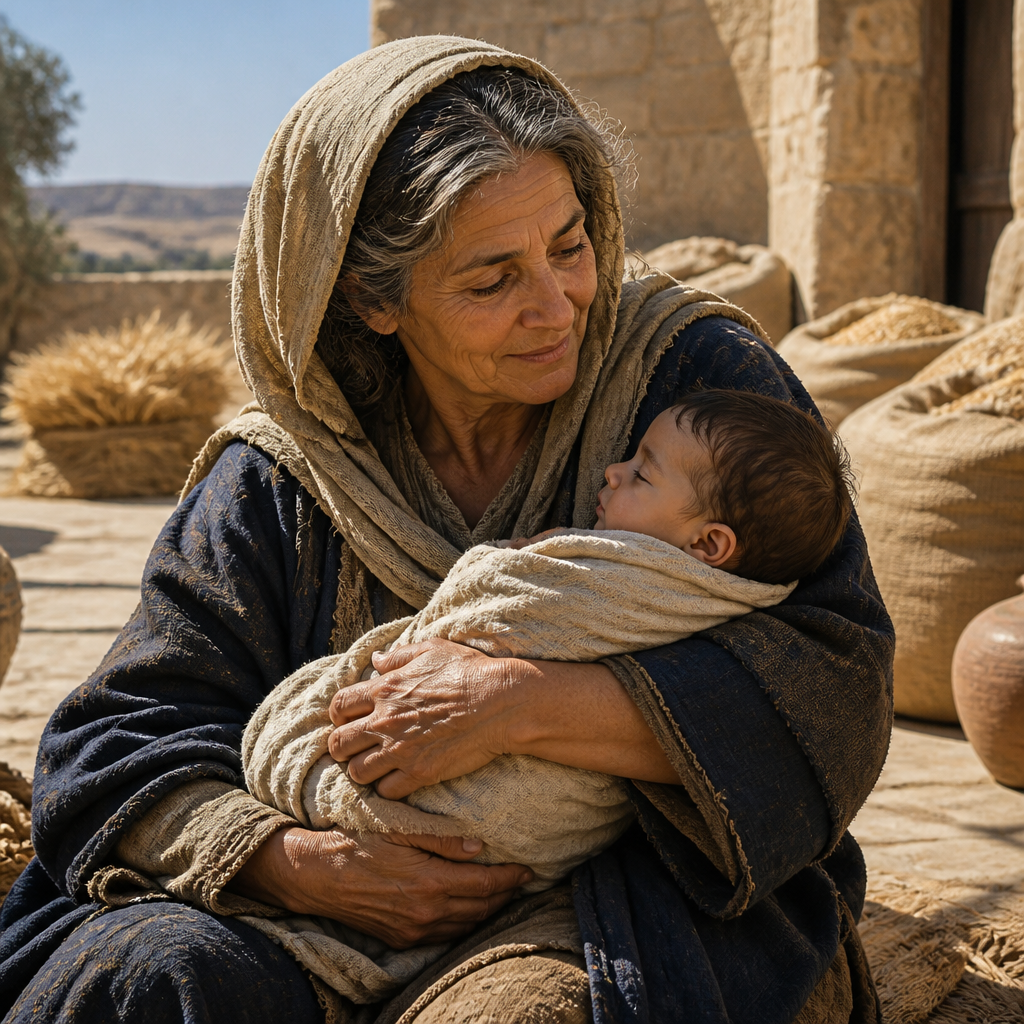
Naomi’s connection to Boaz is also crucial; she identifies him as one of the family's "close relatives" who had the right to redeem their inheritance. The culmination of these relationships is seen in the birth of Ruth and Boaz's son, Obed. The women of Bethlehem declared that a son had been "born to Naomi," and she took the child and served as his nurse. This child, Obed, became the father of Jesse and the grandfather of King David.
Spiritual Significance
Naomi’s life serves as a theological illustration of the movement from emptiness to fullness under the sovereignty of God. Her initial bitterness reflects a raw, honest lament commonly found in the Psalms, yet she remains within the covenant community.
She acts as a catalyst for the inclusion of a Gentile (Ruth) into the lineage of Israel. Through her wisdom and adherence to the laws regarding land and redemption, Naomi ensures that the line of Elimelech continues. Her restoration is not merely personal but national, as her grandson Obed becomes the progenitor of the Davidic line, which Christians believe eventually leads to the birth of Jesus Christ. Her story emphasizes that even in times of extreme personal loss, the providence of God works through social structures and loyal relationships to bring about redemption.
Naomi is historically and theologically significant for her role in the preservation of the Davidic lineage. Her movement from Moab back to Bethlehem marks a return to the covenant land, and her strategic guidance of Ruth leads to the marriage that produces Obed, the grandfather of King David. Her story highlights the themes of divine providence, the role of the kinsman-redeemer, and the inclusion of faithful outsiders into the people of God.
Frequently Asked Questions
What does the name Naomi mean?
The name Naomi is derived from the Hebrew word for 'pleasant' or 'delightful.'
Why did Naomi want to be called Mara?
Following the deaths of her husband and sons, Naomi felt that the Almighty had dealt bitterly with her. 'Mara' is the Hebrew word for 'bitter,' reflecting her state of grief upon her return to Bethlehem.
Was Naomi a Moabitess?
No, Naomi was an Israelite, specifically an Ephrathite from Bethlehem in Judah. She only lived in Moab temporarily to escape a famine.
How was Naomi related to King David?
Naomi was the mother-in-law of Ruth. Ruth and Boaz had a son named Obed, who was the father of Jesse and the father of King David. Thus, Naomi was the 'nursing mother' or legal grandmother figure to David's grandfather.
Who were Naomi's sons?
Her sons were Mahlon and Chilion, both of whom died while living in the land of Moab.
Family & Relationships
 ElimelechHusbandRuth 1:2Stated
 NaomiThis page
Children
 ChilionSonRuth 1:2
Inferred
Ruth 1:2 names Chilion and Naomi in the same verse but does not state a mother tie between them; the link rests on the surrounding narrative.Evidence: Ruth 1:2
 MahlonSonRuth 1:2
Inferred
Ruth 1:2 names Mahlon and Naomi in the same verse but does not state a mother tie between them; the link rests on the surrounding narrative.Evidence: Ruth 1:2
Extended family
 OrpahDaughter-in-lawRuth 1:2
Inferred
Reconstructed through Ruth and Elimelech: Ruth 1:4 ties Orpah to Ruth (itself an inferred link); Ruth 2:3 ties Ruth to Elimelech (itself an inferred link); Ruth 1:2 ties Elimelech to Naomi. No verse states the mother-in-law link between Orpah and Naomi directly.Evidence: Ruth 1:2
 RuthDaughter-in-lawRuth 1:4
Inferred
Reconstructed through Elimelech: Ruth 1:2 ties Naomi to Elimelech; Ruth 2:3 ties Elimelech to Ruth (itself an inferred link). No verse states the daughter-in-law link between Naomi and Ruth directly.Evidence: Ruth 1:4
Connected Figures
Family
Husband · Ruth 1:2
A man of Bethlehem in Judah who moved his family to Moab during a famine, serving as the patriarchal head of the family featured in the Book of Ruth.
Son · Ruth 1:2
Chilion was a man of the tribe of Judah who migrated to Moab during a famine and became the husband of Orpah.
Conquest and JudgesFirst: Ruth 1:25 versesSettlerJudah
Son · Ruth 1:2
Mahlon was a Judean from Bethlehem and the first husband of Ruth, whose death in Moab set the stage for the redemption of Elimelech's family line.
Conquest and JudgesFirst: Ruth 1:26 versesNone recordedJudah
Daughter-in-law · Ruth 1:2
A Moabite woman who married Chilion, the son of Elimelech and Naomi, and later returned to her people after her husband's death.
Daughter-in-law · Ruth 1:4
A Moabite widow who demonstrated profound loyalty to her mother-in-law Naomi and became the great-grandmother of King David.
Categories
Mentions by Book
- Ruth22
Scripture References
All 22 indexed verses, in canonical order, from the Berean Standard Bible.
Ruth · 22
- Ruth 1:2
The man’s name was Elimelech, his wife’s name was Naomi, and the names of his two sons were Mahlon and Chilion. They were Ephrathites from Bethlehem in Judah, and they entered the land of Moab and settled there.
- Ruth 1:3
Then Naomi’s husband Elimelech died, and she was left with her two sons,
- Ruth 1:4Partial
who took Moabite women as their wives, one named Orpah and the other named Ruth. And after they had lived in Moab about ten years,
Cited as evidence on a family card; added so References, Key Verses and Mentions by Book share one index.
- Ruth 1:8
Then Naomi said to her two daughters-in-law, “Go back, each of you to your mother’s home. May the LORD show you loving devotion, as you have shown to your dead and to me.
- Ruth 1:11
But Naomi replied, “Return home, my daughters. Why would you go with me? Are there still sons in my womb to become your husbands?
- Ruth 1:18
When Naomi saw that Ruth was determined to go with her, she stopped trying to persuade her.
Cited as evidence on a family card; added so References, Key Verses and Mentions by Book share one index.
- Ruth 1:19
So Naomi and Ruth traveled until they came to Bethlehem. When they entered Bethlehem, the whole town was stirred because of them, and the women of the town exclaimed, “Can this be Naomi?”
- Ruth 1:20
“Do not call me Naomi,” she replied. “Call me Mara, because the Almighty has dealt quite bitterly with me.
- Ruth 1:21
I went away full, but the LORD has brought me back empty. Why call me Naomi? After all, the LORD has testified against me, and the Almighty has afflicted me.”
- Ruth 1:22
So Naomi returned from the land of Moab with her daughter-in-law Ruth the Moabitess. And they arrived in Bethlehem at the beginning of the barley harvest.
- Ruth 2:1
Now Naomi had a relative on her husband’s side, a prominent man of noble character from the clan of Elimelech, whose name was Boaz.
- Ruth 2:2
And Ruth the Moabitess said to Naomi, “Please let me go into the fields and glean heads of grain after someone in whose sight I may find favor.” “Go ahead, my daughter,” Naomi replied.
- Ruth 2:6
The foreman answered, “She is the Moabitess who returned with Naomi from the land of Moab.
- Ruth 2:20Partial
Then Naomi said to her daughter-in-law, “May he be blessed by the LORD, who has not withdrawn His kindness from the living or the dead.” Naomi continued, “The man is a close relative. He is one of our kinsman-redeemers.”
- Ruth 2:22
And Naomi said to her daughter-in-law Ruth, “My daughter, it is good for you to work with his young women, so that nothing will happen to you in another field.”
- Ruth 3:1
One day Ruth’s mother-in-law Naomi said to her, “My daughter, should I not seek a resting place for you, that it may be well with you?
- Ruth 4:3
And he said to the kinsman-redeemer, “Naomi, who has returned from the land of Moab, is selling the piece of land that belonged to our brother Elimelech.
- Ruth 4:5
Then Boaz said, “On the day you buy the land from Naomi and also from Ruth the Moabitess, you must also acquire the widow of the deceased in order to raise up the name of the deceased on his inheritance.”
- Ruth 4:9
At this, Boaz said to the elders and all the people, “You are witnesses today that I am buying from Naomi all that belonged to Elimelech, Chilion, and Mahlon.
- Ruth 4:14
Then the women said to Naomi, “Blessed be the LORD, who has not left you this day without a kinsman-redeemer. May his name become famous in Israel.
- Ruth 4:16
And Naomi took the child, placed him on her lap, and became a nurse to him.
- Ruth 4:17
The neighbor women said, “A son has been born to Naomi,” and they named him Obed. He became the father of Jesse, the father of David.