Orpah
Who was Orpah in the Bible?
A Moabite woman who married Chilion, the son of Elimelech and Naomi, and later returned to her people after her husband's death.
Orpah was a Moabite woman who lived during the period of the Judges, a turbulent era in Israel's history. She is introduced in the Book of Ruth as one of two Moabite women who married into an Israelite family that had migrated to Moab to escape a famine in Bethlehem. Her husband was Chilion, one of the two sons of Elimelech and Naomi.
Following the deaths of her husband, her brother-in-law Mahlon, and her father-in-law Elimelech, Orpah faced a critical life decision. When Naomi determined to return to Judah, Orpah initially set out with her. However, after a poignant exchange and Naomi’s urging to return to her ancestral home, Orpah chose to remain in Moab. Her departure serves as a narrative foil to the commitment of her sister-in-law, Ruth, who famously chose to stay with Naomi.
Background and Family
Orpah resided in the land of Moab during the time of the Judges (c. 1100 BC). Her arrival into the biblical narrative is linked to a period of famine in Israel, which drove Elimelech of Bethlehem and his wife Naomi to seek refuge in the fields of Moab. According to Ruth 1:4, their two sons, Mahlon and Chilion, eventually married local Moabite women. Orpah became the wife of Chilion.
For approximately ten years, Orpah lived within this integrated household. The biblical text provides no specific details regarding her lineage or parents within Moab, focusing instead on her status as a widow following the death of Chilion. The loss of all three men in the family—Elimelech first, and Mahlon and Chilion some ten years later (Ruth 1:3-5)—left Orpah, Ruth, and Naomi in a position of extreme social and economic vulnerability.
Major Life Events
The defining moment of Orpah’s recorded life occurs when Naomi decides to return to her homeland of Bethlehem after hearing that the famine in Israel had ended. Orpah, along with Ruth, began the journey toward Judah with Naomi. However, Naomi eventually paused to release her daughters-in-law from any obligation to her, urging them each to return to her "mother's house."
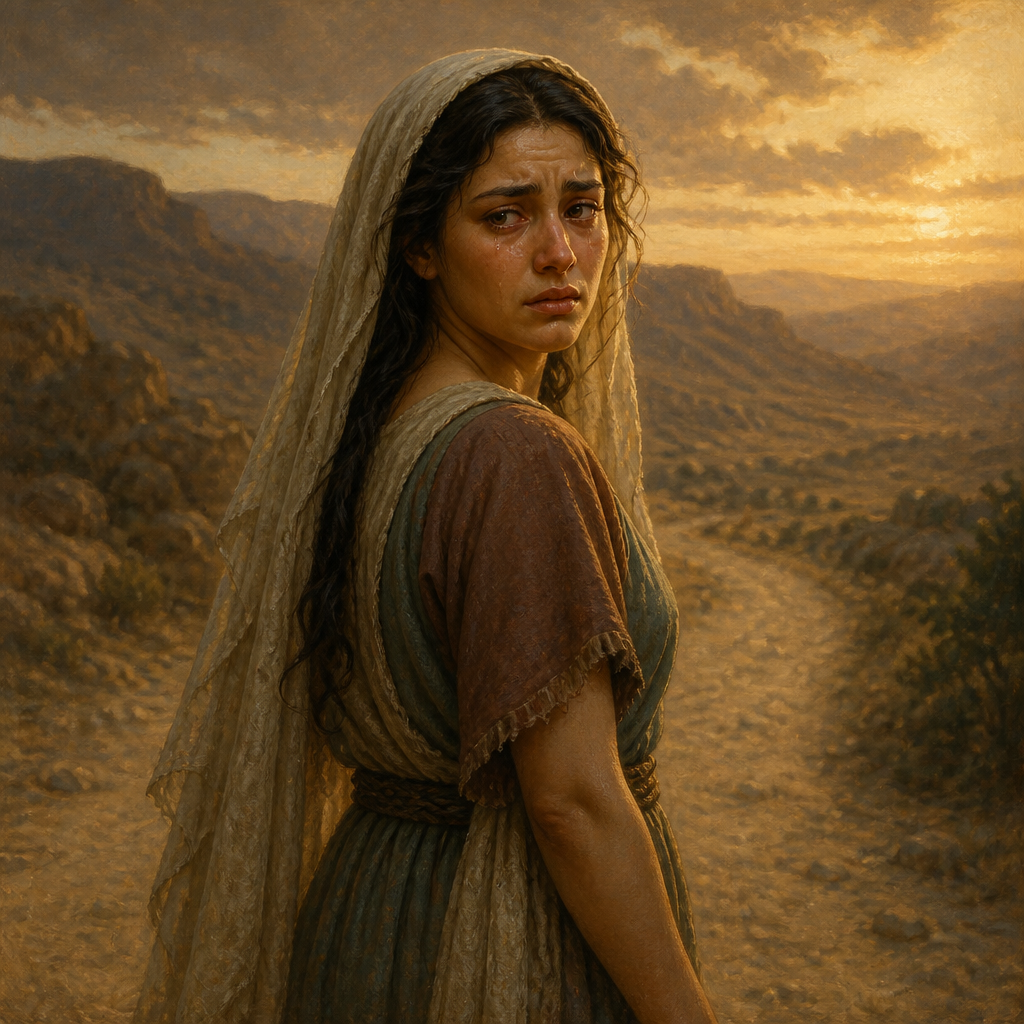
Initially, Orpah resisted this suggestion. The text notes in Ruth 1:10 that both women wept and insisted on accompanying Naomi. However, Naomi presented a pragmatic and bleak assessment of their future: she could offer them no more sons to marry, and staying with her would likely mean a life of continued hardship and widowhood. In Ruth 1:14, the final interaction is recorded: "Again they wept aloud, and Orpah kissed her mother-in-law goodbye, but Ruth clung to her." Orpah’s kiss was a gesture of genuine affection and respect, marking the conclusion of her relationship with the house of Elimelech as she returned to her own people and her gods.
Relationship to Other Biblical Figures
Orpah’s primary relationships were defined by her marriage and her bond with Naomi. As the wife of Chilion, she was a sister-in-law to Ruth (the wife of Mahlon). The two women shared a decade of domestic life and the collective trauma of losing their husbands. Her relationship with Naomi was characterized by mutual kindness; Naomi herself acknowledged that Orpah had dealt kindly with the deceased and with her (Ruth 1:8). Unlike Ruth, who is celebrated for her conversion and loyalty to the God of Israel, Orpah’s story ends with her physical and spiritual return to the culture of Moab.
Spiritual Significance
In biblical scholarship, Orpah is often viewed as a neutral figure rather than a villainous one. She represents the "natural" path—the logical decision to seek security and return to one's own heritage when faced with an uncertain future. While Ruth is held up as a model of extraordinary faith and covenantal loyalty (hesed), Orpah serves as the baseline of human behavior. She fulfilled her duty to her husband during his life and demonstrated sincere grief at the parting. Her departure emphasizes the radical nature of Ruth’s choice; by showing that Orpah did what was expected and reasonable, the text highlights that Ruth did what was unexpected and sacrificial. Orpah vanishes from the biblical record after Ruth 1:14, returning to the cultural and religious sphere of the Moabites.
Orpah serves as a literary and theological foil to Ruth. Her decision to return to Moab highlights the exceptional nature of Ruth’s devotion to Naomi and the LORD. While Orpah is not condemned for her choice—Naomi herself encourages it—her departure signifies the end of her connection to the line of promise that would eventually lead to King David and Jesus Christ.
Frequently Asked Questions
Who was Orpah's husband?
Orpah was married to Chilion, the son of Elimelech and Naomi.
What does the name Orpah mean?
The name is often associated with the Hebrew word for 'neck' or 'back of the neck,' which some scholars suggest alludes to her turning her back to leave Naomi.
Did Orpah do something wrong by leaving Naomi?
The biblical text does not present Orpah's departure as a sin; Naomi actively encouraged both Orpah and Ruth to return to their families for their own safety and future prospects.
Where did Orpah go after leaving Naomi?
According to Ruth 1:15, she returned to her people (Moab) and to her gods.
Is Orpah mentioned anywhere else in the Bible?
No, Orpah appears only in the first chapter of the Book of Ruth.
Family & Relationships
 ChilionHusbandRuth 1:2Stated
 OrpahThis page
Extended family
 MahlonBrother-in-lawRuth 1:2
Inferred
Reconstructed through Ruth: Ruth 1:4 ties Orpah to Ruth (itself an inferred link); Ruth 4:10 ties Ruth to Mahlon. No verse states the brother-in-law link between Orpah and Mahlon directly.Evidence: Ruth 1:2
 NaomiMother-in-lawRuth 1:2
Inferred
Reconstructed through Ruth and Elimelech: Ruth 1:4 ties Orpah to Ruth (itself an inferred link); Ruth 2:3 ties Ruth to Elimelech (itself an inferred link); Ruth 1:2 ties Elimelech to Naomi. No verse states the mother-in-law link between Orpah and Naomi directly.Evidence: Ruth 1:2
 RuthSister-in-lawRuth 1:4
Inferred
Ruth 1:4 names Orpah and Ruth in the same verse but does not state a sister-in-law tie between them; the link rests on the surrounding narrative.Evidence: Ruth 1:4
Connected Figures
Family
Husband · Ruth 1:2
Chilion was a man of the tribe of Judah who migrated to Moab during a famine and became the husband of Orpah.
Conquest and JudgesFirst: Ruth 1:25 versesSettlerJudah
Brother-in-law · Ruth 1:2
Mahlon was a Judean from Bethlehem and the first husband of Ruth, whose death in Moab set the stage for the redemption of Elimelech's family line.
Conquest and JudgesFirst: Ruth 1:26 versesNone recordedJudah
Mother-in-law · Ruth 1:2
The wife of Elimelech and mother-in-law of Ruth, Naomi returned to Bethlehem after a decade in Moab, eventually securing her family's lineage through the kinsman-redeemer Boaz.
Conquest and JudgesFirst: Ruth 1:222 versesMatriarchJudah
Sister-in-law · Ruth 1:4
A Moabite widow who demonstrated profound loyalty to her mother-in-law Naomi and became the great-grandmother of King David.
Categories
Mentions by Book
- Ruth4
Scripture References
All 4 indexed verses, in canonical order, from the Berean Standard Bible.
Ruth · 4
- Ruth 1:2Partial
The man’s name was Elimelech, his wife’s name was Naomi, and the names of his two sons were Mahlon and Chilion. They were Ephrathites from Bethlehem in Judah, and they entered the land of Moab and settled there.
Cited as evidence on a family card; added so References, Key Verses and Mentions by Book share one index.
- Ruth 1:3Partial
Then Naomi’s husband Elimelech died, and she was left with her two sons,
Cited as evidence on a family card; added so References, Key Verses and Mentions by Book share one index.
- Ruth 1:4
who took Moabite women as their wives, one named Orpah and the other named Ruth. And after they had lived in Moab about ten years,
- Ruth 1:14
Again they wept aloud, and Orpah kissed her mother-in-law goodbye, but Ruth clung to her.