Saph
Who was Saph in the Bible?
A Philistine warrior of giant stature and a descendant of Rapha who was slain by Sibbecai the Hushathite during the wars of King David.
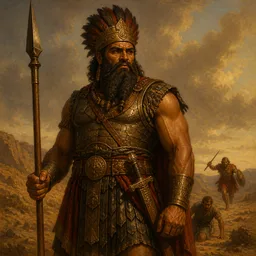
Saph (also referred to as Sippai) was a prominent Philistine warrior during the United Monarchy era, specifically noted for his immense physical size and lineage. He is identified in the biblical record as one of the descendants of Rapha, a term often associated with the Rephaim, an ancient race of giants known for their formidable strength and height.
His role in the biblical narrative is brief but historically significant, as it occurs during a series of secondary conflicts that followed the primary expansion of David’s borders. Saph is primarily remembered for his defeat at the hands of one of David’s elite soldiers, an event that highlighted the continued shift in military dominance from the Philistine giants to the organized forces of the Israelite monarchy.
Background and Family
Saph was a member of a specialized group of warriors residing in Gath, a Philistine stronghold. According to the genealogical data provided in 2 Samuel 21 and 1 Chronicles 20, he was a child of Rapha. This lineage connects him to a broader group of large-statured individuals often referred to as the Rephaim. The biblical record establishes Saph as a brother to several other notable giants, most famously Goliath of Gath, who was killed by David in his youth. His other siblings included Ishbi-benob, Lahmi, and an unnamed warrior described as the "Huge Man of Gath" who possessed six fingers on each hand and six toes on each foot.
While the specific tribe or nation of Saph is not explicitly named beyond his Philistine affiliation, his residence in Gath and his descent from Rapha place him within the cultural and military elite of the Philistine pentapolis. The term "descendant of Rapha" suggests he belonged to a remnant of an ancient, large-framed population that the Philistines utilized as a vanguard in their perennial conflicts with the Israelites.
Major Life Events
The historical record of Saph is concentrated on a single military engagement at a location called Gob (also identified as Gezer in the parallel account in 1 Chronicles). This battle took place "some time later" after the initial wars of David's reign, indicating a period of renewed Philistine aggression or a localized revolt during the later years of the United Monarchy.
During the heat of the battle, Saph confronted the Israelite forces. His physical presence was intended to intimidate and break the Israelite lines, following the traditional Philistine strategy of employing champions. However, Saph was engaged by Sibbecai the Hushathite, one of David’s distinguished "Mighty Men." Sibbecai succeeded in killing Saph, an act that contributed significantly to the eventual subduing of the Philistine forces in that theater of war.
Relationship to Other Biblical Figures
Saph’s identity is defined largely by his relationship to the house of Rapha. As a sibling to Goliath, he represents the ongoing struggle between the house of David and the remnants of the Rephaim. While Goliath served as the initial foil to David’s rise, Saph and his other brothers—Ishbi-benob and Lahmi—served as the final obstacles to the total security of David’s throne.
His primary antagonist, Sibbecai the Hushathite, is listed among the elite warriors of Israel. The victory of Sibbecai over Saph mirrors the earlier victory of David over Goliath, emphasizing that the strength of the Israelite military was no longer dependent solely on its king, but had produced a cadre of heroes capable of defeating the most formidable enemies. Following Saph’s death, the biblical text notes that the Philistines were "subdued," marking the end of the era of the giants that had plagued Israel since the time of the conquest.
Spiritual Significance
The account of Saph, though brief, serves a specific theological and narrative purpose within the books of Samuel and Chronicles. It functions as a concluding chapter to the motif of "the giant-slayer." In the ancient Near Eastern context, giants were often seen as chaotic, quasi-mythical threats to divine order. By recording the death of Saph at the hands of Sibbecai, the biblical author demonstrates that God’s covenant with David extended to his subordinates, enabling them to overcome supernatural or overwhelming physical odds.
Furthermore, the death of Saph underscores the transition from the individual heroism of the Judges era to the institutionalized military success of the United Monarchy. It signals the final removal of the Rephaim from the land, fulfilling the long-standing promise of Israelite sovereignty over the coastal plains. The mention of Saph’s specific lineage ensures that he is not viewed as an isolated threat, but as part of a defeated legacy that stood in opposition to the established kingdom of God.
Saph represents the lingering remnants of the Rephaim that the Israelite monarchy had to systematically eliminate to secure the Promised Land. His defeat is recorded to demonstrate that the victory over Goliath was not a solitary fluke but the beginning of a total displacement of the Philistine champions by David’s men. Theologically, Saph’s demise signifies the triumph of the covenant people over the formidable 'sons of Anak' archetypes that had once terrified the Israelite spies in the wilderness.
His mention in both 2 Samuel and 1 Chronicles serves to document the specific heroes of David's army. By naming the individual who killed Saph (Sibbecai), the text honors the bravery of the King's men and reinforces the theme that God provides the strength necessary to overcome literal and symbolic giants.
Frequently Asked Questions
Was Saph related to Goliath?
Yes, according to the biblical record, Saph was a descendant of Rapha and a sibling to Goliath of Gath, as well as Ishbi-benob and Lahmi.
Who killed Saph in the Bible?
Saph was killed by Sibbecai the Hushathite, one of King David’s elite warriors, during a battle at Gob (also known as Gezer).
Is Saph the same person as Sippai?
Yes. While 2 Samuel 21:18 refers to him as Saph, the parallel account in 1 Chronicles 20:4 uses the name Sippai. They are the same individual.
Where did the battle with Saph take place?
The battle took place at a location called Gob in 2 Samuel, which is identified as Gezer in the book of 1 Chronicles.
What tribe did Saph belong to?
Saph was not an Israelite; he was a Philistine from Gath and a descendant of the Rephaim (Rapha).
Family & Relationships
Parents
 RaphaFather2 Samuel 21:18Stated
 SaphThis page
 GoliathBrother2 Samuel 21:18Stated
 Huge Man of GathBrother2 Samuel 21:18
Inferred
No verse names Huge Man and Saph together; the brother link is carried from the surrounding genealogy and is not stated in Scripture.Evidence: 2 Samuel 21:18
 Ishbi-benobBrother2 Samuel 21:16
Inferred
Reconstructed through Rapha: 2 Samuel 21:18 ties Saph to Rapha; 2 Samuel 21:16 ties Rapha to Ishbi-benob (itself an inferred link). No verse states the brother link between Saph and Ishbi-benob directly.Evidence: 2 Samuel 21:16
 LahmiBrother2 Samuel 21:18
Inferred
No verse names Saph and Lahmi together; the brother link is carried from the surrounding genealogy and is not stated in Scripture.Evidence: 2 Samuel 21:18; 1 Chronicles 20:5
Connected Figures
Family
Father · 2 Samuel 21:18
An ancestral figure in Gath during the United Monarchy whose descendants were giants who fought against King David’s forces.
United MonarchyFirst: 2 Samuel 21:169 versesPatriarch of a warrior clan
Brother · 2 Samuel 21:18
A champion warrior from Gath of enormous stature who served in the Philistine army during the reign of King Saul.
United MonarchyFirst: 1 Samuel 17:411 versesChampion warrior
Brother · 2 Samuel 21:18
A giant warrior of Gath and descendant of Rapha, noted for having twenty-four digits and fighting against Israel during the United Monarchy.
Brother · 2 Samuel 21:16
A giant of the Rapha family who nearly killed King David during the United Monarchy before being slain by Abishai.
United MonarchyFirst: 2 Samuel 21:166 versesWarrior / Giant
Brother · 2 Samuel 21:18
A Philistine warrior and brother of Goliath who was killed by Elhanan during the wars of King David’s reign.
United MonarchyFirst: 1 Chronicles 20:58 versesWarrior champion
Categories
Mentions by Book
- 2 Samuel5
- 1 Chronicles2
Scripture References
All 7 indexed verses, in canonical order, from the Berean Standard Bible.
2 Samuel · 5
- 2 Samuel 21:16Partial
Then Ishbi-benob, a descendant of Rapha, whose bronze spear weighed three hundred shekels and who was bearing a new sword, resolved to kill David.
Cited as evidence on a family card; added so References, Key Verses and Mentions by Book share one index.
- 2 Samuel 21:17Partial
But Abishai son of Zeruiah came to his aid, struck the Philistine, and killed him. Then David’s men swore to him, “You must never again go out with us to battle, so that the lamp of Israel may not be extinguished.”
Cited as evidence on a family card; added so References, Key Verses and Mentions by Book share one index.
- 2 Samuel 21:18
Some time later at Gob, there was another battle with the Philistines. At that time Sibbecai the Hushathite killed Saph, a descendant of Rapha.
- 2 Samuel 21:19Partial
Once again there was a battle with the Philistines at Gob, and Elhanan son of Jair the Bethlehemite killed the brother of Goliath the Gittite, the shaft of whose spear was like a weaver’s beam.
Cited as evidence on a family card; added so References, Key Verses and Mentions by Book share one index.
- 2 Samuel 21:20Partial
And there was also a battle at Gath, where there was a man of great stature with six fingers on each hand and six toes on each foot—twenty-four in all. He too was descended from Rapha,
Cited as evidence on a family card; added so References, Key Verses and Mentions by Book share one index.
1 Chronicles · 2
- 1 Chronicles 20:4Partial
Some time later, war broke out with the Philistines at Gezer. At that time Sibbecai the Hushathite killed Sippai, a descendant of the Rephaim, and the Philistines were subdued.
Cited as a key verse; added so References, Key Verses and Mentions by Book share one index.
- 1 Chronicles 20:5Partial
Once again there was a battle with the Philistines, and Elhanan son of Jair killed Lahmi the brother of Goliath the Gittite, the shaft of whose spear was like a weaver’s beam.
Cited as evidence on a family card; added so References, Key Verses and Mentions by Book share one index.