Lahmi
Who was Lahmi in the Bible?
A Philistine warrior and brother of Goliath who was killed by Elhanan during the wars of King David’s reign.
Lahmi was a Philistine soldier of immense stature who lived during the United Monarchy in the 10th century BC. He is specifically identified in the biblical record as the brother of Goliath of Gath, the famous champion defeated by David. Lahmi belonged to a lineage of giants known as the descendants of Rapha (or the Rephaim) who resided in the Philistine city-state of Gath. These warriors were characterized by their extraordinary physical size and military prowess.
His role in the biblical narrative is brief but historically significant, as it occurs during a series of secondary conflicts between Israel and the Philistines following David's consolidation of power. Lahmi is distinguished by the description of his weaponry, which mirrored that of his brother, suggesting he was an elite combatant in the Philistine army. His death at the hands of one of David’s mighty men marked another step in the decline of the giant clans that had previously dominated the region.
Background and Family
Lahmi was a member of the Rephaim, an ancient group of people known for their unusual height and strength. According to the genealogical and descriptive markers provided in 1 Chronicles 20 and 2 Samuel 21, he was the son of Rapha (or a descendant of the Rephaite line) in Gath. His family included several other formidable warriors: he was the brother of Goliath, Ishbi-benob, Saph, and an unnamed warrior characterized by having six fingers on each hand and six toes on each foot. These siblings formed a core group of elite Philistine champions who challenged the armies of Israel during the reign of King David.
The name 'Lahmi' is often associated with the Hebrew root for 'bread' or 'war,' and he is specifically linked to the city of Gath, one of the five primary cities of the Philistine pentapolis. As a Gittite, Lahmi grew up in a culture that was in constant territorial and religious friction with the Israelites. The presence of these giants in Gath suggests that the city served as a final stronghold for the remaining Rephaim who had inhabited the Levant since the days of the conquest.
Major Life Events
The primary event recorded regarding Lahmi is his final confrontation with the forces of Israel. During the United Monarchy, specifically during the later years of David's military campaigns, the Philistines engaged Israel in several battles at Gob. It was during one of these skirmishes that Lahmi faced Elhanan, the son of Jair (also referred to as the son of Jaare-oregim).
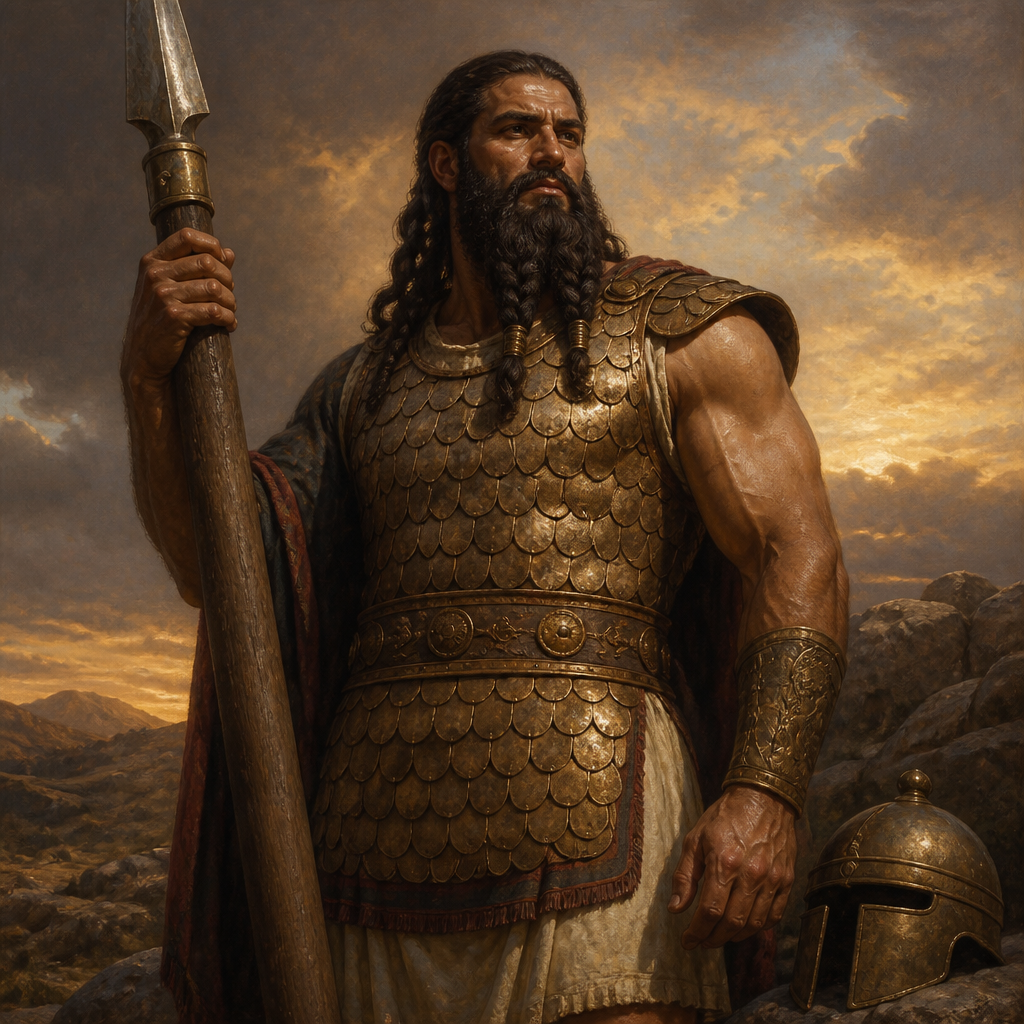
The biblical text highlights Lahmi’s formidable presence by noting that he carried a spear with a shaft "like a weaver’s beam." This description is a technical military detail intended to convey the weight and thickness of the weapon, implying that only a man of supernatural strength could wield it effectively. Despite his physical advantages and high-status weaponry, Lahmi was defeated and killed by Elhanan. This victory by one of David’s soldiers mirrored David’s own earlier victory over Lahmi’s brother, Goliath.
Relationship to Other Biblical Figures
Lahmi’s significance is largely defined by his relationship to the house of David and his own kinship with Goliath. He represents the persistent threat of the giant clans that David and his "Mighty Men" (the Gibborim) were tasked with eliminating. While David himself killed Goliath, his subordinates—such as Elhanan, Sibbecai, and Jonathan son of Shimei—were responsible for neutralizing the remaining brothers of Goliath, including Lahmi. This collective effort demonstrates the transition of Israel from a nation intimidated by giants to one that systematically dismantled the Rephaite threat.
Spiritual Significance
In the broader context of the Old Testament narrative, the death of Lahmi and his brothers symbolizes the fulfillment of the conquest of Canaan. The giants had long been a source of fear for Israel, dating back to the report of the ten spies in the wilderness who claimed the Israelites were like grasshoppers compared to the Nephilim. The defeat of Lahmi by a regular Israelite soldier like Elhanan signifies that the terror once inspired by the Rephaim had been overcome through the divine favor resting on David’s kingdom. Lahmi serves as a testament to the fact that even the most physically imposing enemies of God's people were eventually subdued as the United Monarchy established its borders.
Lahmi represents the final remnants of the giant clans (Rephaim) that stood in opposition to the establishment of the Kingdom of God in Israel. His defeat by Elhanan, rather than by David himself, highlights the growing strength and courage of the Israelite military under Davidic leadership. It serves to show that the victory over Goliath was not an isolated miracle but the beginning of the end for the Philistine champions.
Theologically, Lahmi’s death reinforces the theme that human stature and superior technology (symbolized by the weaver's beam spear) cannot prevail against those acting under the covenant of the Lord. His life and death are recorded to document the total victory of David over the house of Rapha, ensuring that no giants remained to challenge Israel's sovereignty in the promised land.
Frequently Asked Questions
Who killed Lahmi?
Lahmi was killed by Elhanan the son of Jair (also called the son of Jaare-oregim) in a battle against the Philistines.
How was Lahmi related to Goliath?
Lahmi was the brother of Goliath the Gittite, the famous giant whom David defeated.
What weapon did Lahmi use?
Lahmi used a spear with a shaft described as being 'like a weaver’s beam,' indicating its massive size and weight.
Where did Lahmi come from?
He was a Gittite, meaning he was from the Philistine city of Gath.
Which biblical books mention Lahmi?
Lahmi is mentioned in 1 Chronicles 20:5, and his death is described in the parallel account of 2 Samuel 21:19.
Family & Relationships
Parents
 RaphaFather1 Chronicles 20:5–8Stated
 LahmiThis page
 GoliathBrother1 Chronicles 20:5Stated
 Huge Man of GathBrother1 Chronicles 20:5
Inferred
No verse names Huge Man and Lahmi together; the brother link is carried from the surrounding genealogy and is not stated in Scripture.Evidence: 1 Chronicles 20:5
 Ishbi-benobBrother2 Samuel 21:16
Inferred
No verse names Ishbi-benob and Lahmi together; the brother link is carried from the surrounding genealogy and is not stated in Scripture.Evidence: 2 Samuel 21:16
 SaphBrother2 Samuel 21:18
Inferred
No verse names Saph and Lahmi together; the brother link is carried from the surrounding genealogy and is not stated in Scripture.Evidence: 2 Samuel 21:18; 1 Chronicles 20:5
Connected Figures
Family
Father · 1 Chronicles 20:5–8
An ancestral figure in Gath during the United Monarchy whose descendants were giants who fought against King David’s forces.
United MonarchyFirst: 2 Samuel 21:169 versesPatriarch of a warrior clan
Brother · 1 Chronicles 20:5
A champion warrior from Gath of enormous stature who served in the Philistine army during the reign of King Saul.
United MonarchyFirst: 1 Samuel 17:411 versesChampion warrior
Brother · 1 Chronicles 20:5
A giant warrior of Gath and descendant of Rapha, noted for having twenty-four digits and fighting against Israel during the United Monarchy.
Brother · 2 Samuel 21:16
A giant of the Rapha family who nearly killed King David during the United Monarchy before being slain by Abishai.
United MonarchyFirst: 2 Samuel 21:166 versesWarrior / Giant
Brother · 2 Samuel 21:18
A Philistine warrior of giant stature and a descendant of Rapha who was slain by Sibbecai the Hushathite during the wars of King David.
Categories
Mentions by Book
- 2 Samuel4
- 1 Chronicles4
Scripture References
All 8 indexed verses, in canonical order, from the Berean Standard Bible.
2 Samuel · 4
- 2 Samuel 21:16Partial
Then Ishbi-benob, a descendant of Rapha, whose bronze spear weighed three hundred shekels and who was bearing a new sword, resolved to kill David.
Cited as evidence on a family card; added so References, Key Verses and Mentions by Book share one index.
- 2 Samuel 21:18Partial
Some time later at Gob, there was another battle with the Philistines. At that time Sibbecai the Hushathite killed Saph, a descendant of Rapha.
Cited as evidence on a family card; added so References, Key Verses and Mentions by Book share one index.
- 2 Samuel 21:19Partial
Once again there was a battle with the Philistines at Gob, and Elhanan son of Jair the Bethlehemite killed the brother of Goliath the Gittite, the shaft of whose spear was like a weaver’s beam.
Cited as a key verse; added so References, Key Verses and Mentions by Book share one index.
- 2 Samuel 21:20Partial
And there was also a battle at Gath, where there was a man of great stature with six fingers on each hand and six toes on each foot—twenty-four in all. He too was descended from Rapha,
Cited as evidence on a family card; added so References, Key Verses and Mentions by Book share one index.
1 Chronicles · 4
- 1 Chronicles 20:5
Once again there was a battle with the Philistines, and Elhanan son of Jair killed Lahmi the brother of Goliath the Gittite, the shaft of whose spear was like a weaver’s beam.
- 1 Chronicles 20:6Partial
And there was also a battle at Gath, where there was a man of great stature with six fingers on each hand and six toes on each foot—twenty-four in all. He too was descended from Rapha,
Cited as evidence on a family card; added so References, Key Verses and Mentions by Book share one index.
- 1 Chronicles 20:7Partial
and when he taunted Israel, Jonathan the son of David’s brother Shimei killed him.
Cited as evidence on a family card; added so References, Key Verses and Mentions by Book share one index.
- 1 Chronicles 20:8Partial
So these descendants of Rapha in Gath fell at the hands of David and his servants.
Cited as evidence on a family card; added so References, Key Verses and Mentions by Book share one index.