Nahshon
Who was Nahshon in the Bible?
The designated prince of the tribe of Judah during the Exodus and a direct ancestor of King David and Jesus Christ.
Nahshon, the son of Amminadab, stands as a pivotal figure in the early history of Israel’s tribal organization. As the designated prince (nasi) of the tribe of Judah during the wilderness wanderings following the Exodus from Egypt, Nahshon held a position of significant military and ceremonial prestige. His name, which appears across both the Old and New Testaments, is inextricably linked to the leadership of Judah, the tribe that would eventually produce the Davidic monarchy and the Messiah.
While the biblical record provides little in the way of his personal dialogue or individual exploits, it is consistent in placing him at the forefront of the Israelite camp. His role as the first tribal leader to present an offering at the dedication of the Tabernacle and his position at the head of the marching order underscores Judah’s primacy among the twelve tribes. Historically, Nahshon serves as a vital genealogical link connecting the patriarchs of the Egyptian sojourn to the subsequent establishment of the kingdom in the land of Canaan.
Background and Family
Nahshon was born into the tribe of Judah during the period of Israelite servitude in Egypt. He was the son of Amminadab and a descendant of Ram, placing him within the senior lineage of Judah. The biblical text highlights his family connections as a means of establishing his social and religious standing. According to Exodus 6:23, his sister, Elisheba, married Aaron, the first High Priest of Israel. This marriage created a powerful alliance between the leading family of Judah and the newly established Aaronic priesthood. Through this union, Nahshon was the brother-in-law of Aaron and the uncle to the next generation of priests, including Eleazar and Ithamar.
Nahshon’s own lineage continued through his son, Salmon. This genealogical line is meticulously preserved in the Book of Ruth and the genealogies of 1 Chronicles, confirming that Nahshon was the great-great-grandfather of King David. This placement in the ancestry of the Davidic line is his most enduring legacy in the biblical narrative.
Major Life Events
Nahshon’s public life is defined by his leadership during the first two years after the Exodus. When Moses was commanded to take a census of the men of Israel capable of bearing arms, Nahshon was specifically named as the representative for the tribe of Judah (Numbers 1:7).
One of the most significant moments in Nahshon’s career occurred during the dedication of the Tabernacle in the second year after the departure from Egypt. As recorded in Numbers 7, the leaders of the twelve tribes were instructed to bring offerings for the dedication of the altar. Nahshon was chosen to present his offering on the very first day, signaling the preeminence of the tribe of Judah. His offering was substantial, consisting of silver vessels filled with fine flour and oil, a gold dish filled with incense, and various livestock for burnt, sin, and peace offerings.
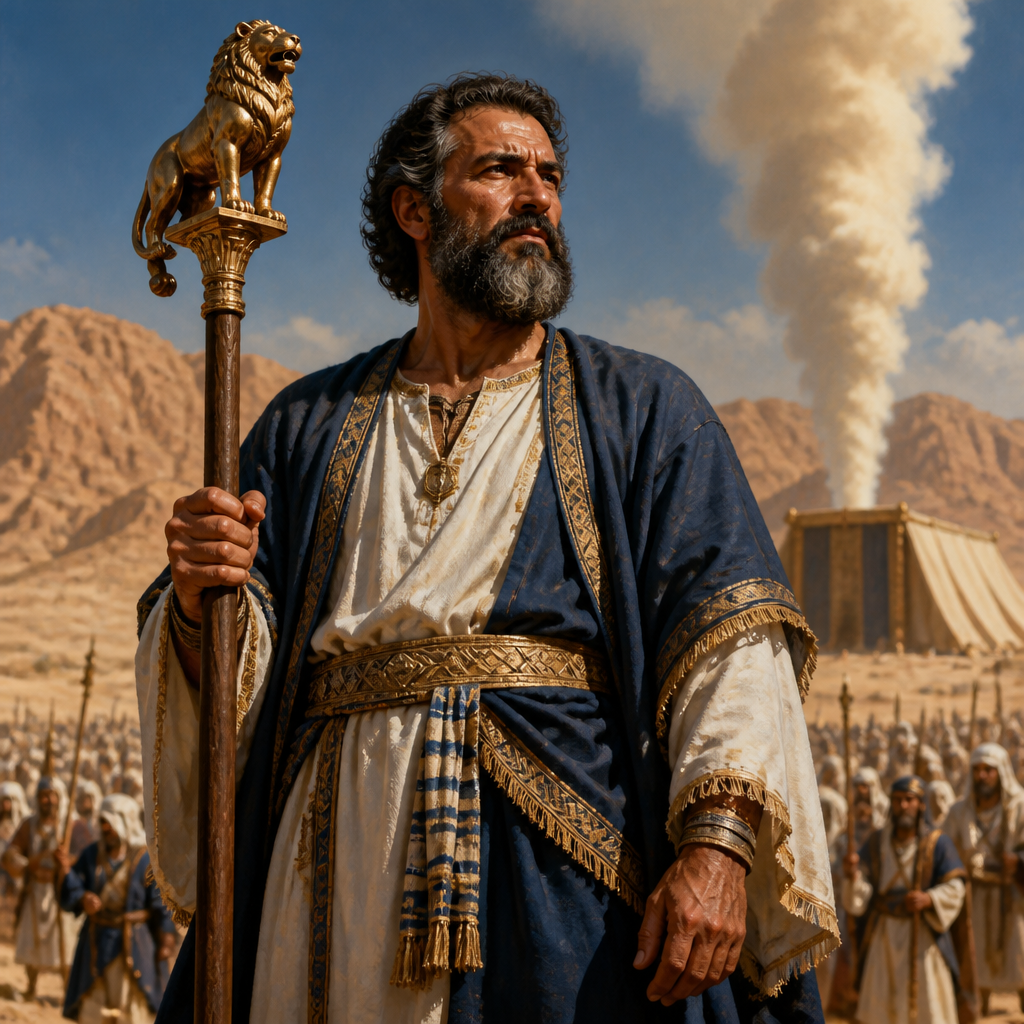
When the Israelites moved their camp in the wilderness, they followed a specific divinely ordained order. Nahshon was appointed to command the division of Judah, which was the first to set out when the cloud lifted from the Tabernacle (Numbers 10:14). Under his standard, the tribes of Issachar and Zebulun also marched, placing Nahshon in a position of authority over a significant portion of the Israelite host as they journeyed toward the Promised Land.
Relationship to Other Biblical Figures
Nahshon occupied a unique social space where the civil and religious leadership of Israel intersected. His relationship with Moses and Aaron was one of both kinship and subordinate leadership. As the prince of Judah, he was one of the twelve men who stood with Moses during the organization of the nation.
His role as a progenitor is equally important. By fathering Salmon, he became the ancestor of Boaz, who would later marry Ruth. This connection ensures that Nahshon’s name appears in the opening chapter of the New Testament. In Matthew 1:4 and Luke 3:32, Nahshon is listed in the formal genealogy of Jesus Christ, bridging the gap between the Exodus generation and the arrival of the Messiah.
Spiritual Significance
In the biblical tradition, Nahshon represents the transition from a group of enslaved clans to a structured, liturgical nation. His prominence in the book of Numbers serves a theological purpose: it establishes the tribe of Judah as the leader of the people of God long before the rise of the monarchy.
Although the Bible does not record the details of his death, it is implied that he was among the generation that perished in the wilderness due to the lack of faith following the report of the twelve spies, as he is not mentioned in the later census of the plains of Moab. Nevertheless, his faithfulness in leadership and his role in the lineage of the Savior afford him a place of honor. He is depicted as a man of order, generosity, and responsibility, setting a precedent for the 'Lion of Judah' that would eventually emerge from his descendants.
Nahshon’s primary significance lies in his status as the definitive leader of Judah during the formative years of the Exodus. His selection to offer the first sacrifice at the Tabernacle dedication underscores the theological theme of Judah's primacy, a theme that resonates through the eventual rise of the Davidic dynasty. In the New Testament, his inclusion in the genealogies of Jesus Christ in both Matthew and Luke confirms his role as a crucial link in the messianic line, demonstrating the continuity of God's covenant promises from the Egyptian sojourn to the Incarnation.
Frequently Asked Questions
Who was Nahshon's sister?
Nahshon's sister was Elisheba, who married Aaron, the first High Priest of Israel.
Which tribe did Nahshon lead?
Nahshon was the prince and leader of the tribe of Judah during the Exodus.
Is Nahshon mentioned in the New Testament?
Yes, Nahshon is listed in the genealogies of Jesus Christ found in Matthew 1:4 and Luke 3:32.
What was Nahshon's role in the Tabernacle dedication?
He was the first tribal leader to present an offering for the dedication of the altar, representing the tribe of Judah on the first day.
Who was Nahshon's son?
Nahshon's son was Salmon, who is known in the lineage of Boaz and King David.
Family & Relationships
Parents
 Amminadab, Prince of Judah in the ExodusFatherNumbers 1:7Stated
 NahshonThis page
 ElishebaSisterExodus 6:23Stated
Children
 SalmonSonRuth 4:20Stated
Extended family
 AaronBrother-in-lawExodus 6:23
Inferred
Exodus 6:23 names Aaron and Nahshon in the same verse but does not state a brother-in-law tie between them; the link rests on the surrounding narrative.Evidence: Exodus 6:23
 Ram, Son of HezronGrandfatherRuth 4:19
Inferred
1 Chronicles 2:10 lists Nahshon and Ram among the descendants of judah, but does not say how the two of them are related.Evidence: Ruth 4:19; 1 Chronicles 2:10; Matthew 1:4; Numbers 1:7; Numbers 2:3; Numbers 7:12; Numbers 7:17
 DavidDescendantExodus 6:23
Inferred
No verse names Nahshon and David together; the descendant link is carried from the surrounding genealogy and is not stated in Scripture.Evidence: Exodus 6:23
Connected Figures
Family
Father · Numbers 1:7
A prominent leader of the tribe of Judah during the Egyptian sojourn and the father of the high priestess Elisheba and the tribal chieftain Nahshon.
Egypt and WildernessFirst: Exodus 6:2311 versesPatriarchJudah
Son · Ruth 4:20
A prominent member of the tribe of Judah and a crucial link in the Davidic and Messianic genealogies, noted for being the father of Boaz.
Conquest and JudgesFirst: Ruth 4:209 versesPatriarchJudah
Sister · Exodus 6:23
The wife of Aaron the High Priest and a daughter of the tribe of Judah, Elisheba provided the genealogical link between the Levitical priesthood and the Davidic royal line.
Egypt and WildernessFirst: Exodus 6:232 versesMatriarch of the Aaronic PriesthoodJudah
Brother-in-law · Exodus 6:23
The first High Priest of Israel, elder brother of Moses, and primary spokesman for the Israelites during the Exodus from Egypt.
Egypt and WildernessFirst: Exodus 4:14338 versesHigh Priest, ProphetLevi
Grandfather · Ruth 4:19
A high-ranking member of the Tribe of Judah and a crucial link in the Davidic and Messianic genealogies, serving as the grandfather of Nahshon.
Descendant · Exodus 6:23
The second king of the United Monarchy of Israel, a shepherd-warrior and psalmist known as a man after God's own heart.
United MonarchyFirst: Ruth 4:17998 versesKing of Israel, Shepherd, Musician, WarriorJudah
Categories
Mentions by Book
- Exodus1
- Numbers5
- Ruth3
- 1 Chronicles2
- Matthew1
- Luke1
Scripture References
All 13 indexed verses, in canonical order, from the Berean Standard Bible.
Exodus · 1
- Exodus 6:23
And Aaron married Elisheba, the daughter of Amminadab and sister of Nahshon, and she bore him Nadab and Abihu, Eleazar and Ithamar.
Numbers · 5
- Numbers 1:7
from Judah, Nahshon son of Amminadab;
- Numbers 2:3
On the east side, toward the sunrise, the divisions of Judah are to camp under their standard: The leader of the Judahites is Nahshon son of Amminadab,
- Numbers 7:12
On the first day Nahshon son of Amminadab from the tribe of Judah drew near with his offering.
- Numbers 7:17
and a peace offering of two oxen, five rams, five male goats, and five male lambs a year old. This was the offering of Nahshon son of Amminadab.
- Numbers 10:14
First, the divisions of the camp of Judah set out under their standard, with Nahshon son of Amminadab in command.
Ruth · 3
- Ruth 4:17Partial
The neighbor women said, “A son has been born to Naomi,” and they named him Obed. He became the father of Jesse, the father of David.
Cited as evidence on a family card; added so References, Key Verses and Mentions by Book share one index.
- Ruth 4:19Partial
Hezron was the father of Ram, Ram was the father of Amminadab,
Cited as evidence on a family card; added so References, Key Verses and Mentions by Book share one index.
- Ruth 4:20Partial
Amminadab was the father of Nahshon, Nahshon was the father of Salmon,
1 Chronicles · 2
- 1 Chronicles 2:10
Ram was the father of Amminadab, and Amminadab was the father of Nahshon, a leader of the descendants of Judah.
- 1 Chronicles 2:11
Nahshon was the father of Salmon, and Salmon was the father of Boaz.
Matthew · 1
- Matthew 1:4Partial
Ram was the father of Amminadab, Amminadab the father of Nahshon, and Nahshon the father of Salmon.
Luke · 1
- Luke 3:32
the son of Jesse, the son of Obed, the son of Boaz, the son of Sala, the son of Nahshon,