Eleazar, Son of Aaron
Who was Eleazar, Son of Aaron, in the Bible?
Eleazar was the third son of Aaron and his successor as the High Priest of Israel, serving as a key leader alongside Moses and Joshua during the wilderness wanderings and the conquest of Canaan.
This is one of 8 people named Eleazar in the Bible. See all 8 →
Eleazar, son of Aaron, stands as one of the most pivotal figures in the religious and political stabilization of Israel during the transition from the generation of the Exodus to the settlement in the Promised Land. Born into the tribe of Levi, he was the third son of the first High Priest, Aaron, and his wife Elisheba. Following the tragic death of his older brothers, Nadab and Abihu, for offering "unauthorized fire," Eleazar ascended to a position of leadership, eventually succeeding his father as High Priest atop Mount Hor.
His role was both administrative and spiritual, acting as the primary mediator between God and the leadership of Israel, first with Moses and later with Joshua. He was instrumental in the census of the people, the distribution of the land of Canaan, and the maintenance of the Tabernacle's sanctity.
Background and Family
Eleazar was the son of Aaron and Elisheba, daughter of Amminadab and sister of Nahshon (Exodus 6:23). As a member of the tribe of Levi, he was born into the direct line of the priesthood. He had three brothers: Nadab, Abihu, and Ithamar. Eleazar married a daughter of Putiel, who bore him his son and successor, Phinehas (Exodus 6:25).
His early life was defined by the strict requirements of the newly established Tabernacle service. While his older brothers Nadab and Abihu held the status of the firstborn, their deaths in the Wilderness of Sinai—caused by their presentation of unauthorized fire before the Lord—resulted in a sudden shift in the priestly hierarchy. Because they died without sons, the duties of the priesthood fell solely to Eleazar and his younger brother Ithamar under their father’s supervision (Numbers 3:4).
Major Life Events
The Transition of Priesthood
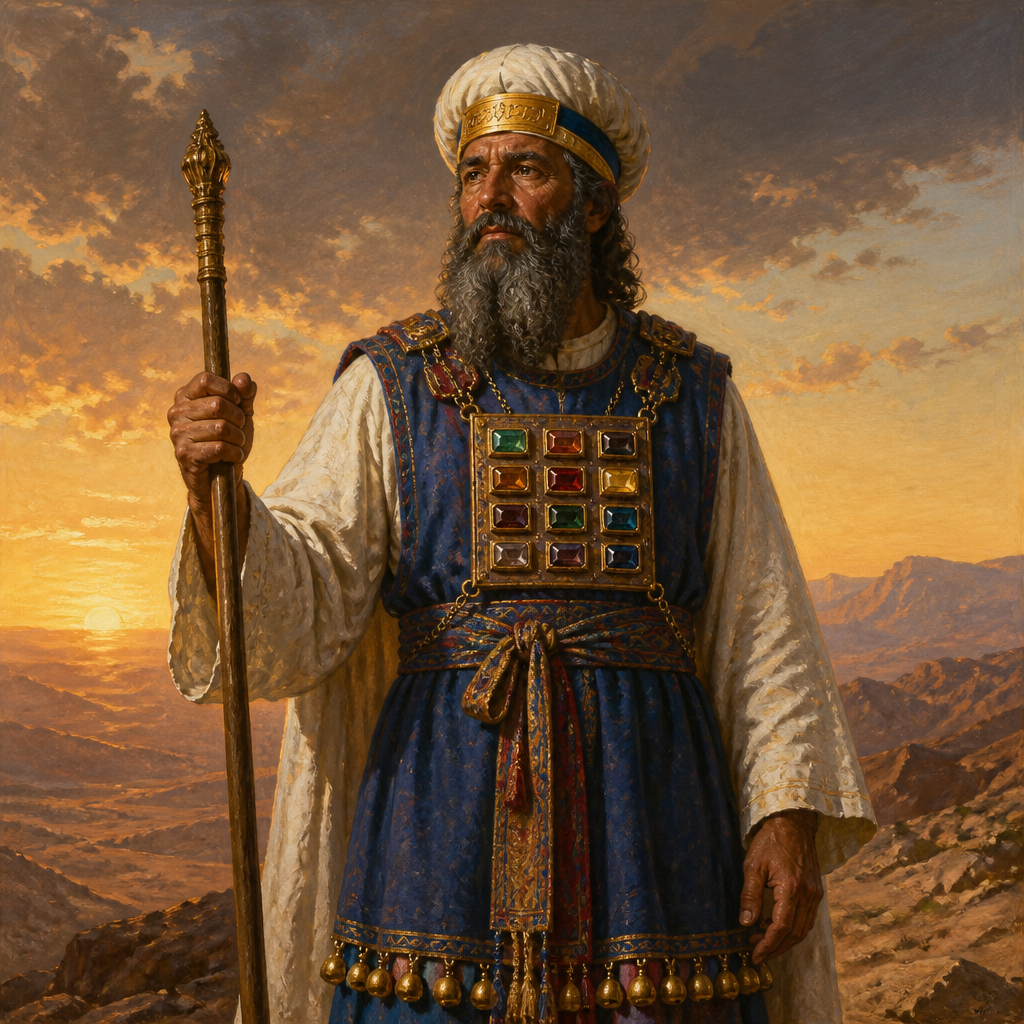
The most significant moment in Eleazar’s life occurred at Mount Hor. As the generation of the Exodus neared the end of its forty-year journey, God commanded Moses to bring Aaron and Eleazar up the mountain. In a solemn ceremony witnessed by the congregation, Moses removed Aaron’s priestly garments and placed them upon Eleazar. Aaron died shortly thereafter, and Eleazar descended the mountain as the new High Priest (Numbers 20:25–28). This event signaled the formal transfer of spiritual authority to the second generation.
Administrative Oversight
Even before his father’s death, Eleazar held immense responsibility. He was appointed as the "chief of the leaders of the Levites," overseeing those responsible for the duties of the sanctuary (Numbers 3:32). Specifically, he was charged with the oversight of the oil for the light, the fragrant incense, the daily grain offering, and the anointing oil (Numbers 4:16).
Following the rebellion of Korah, Eleazar was tasked with a unique duty: he collected the bronze censers used by the rebels from the flames and hammered them into plates to overlay the altar as a memorial and warning to the Israelites (Numbers 16:37–40). He also performed the ritual of the Red Heifer, taking its blood to sprinkle toward the Tent of Meeting to create the water of purification (Numbers 19:3–4).
The Conquest and Division of Land
During the plains of Moab phase and the subsequent entry into Canaan, Eleazar functioned as the spiritual counterpart to Joshua’s military leadership. He stood with Moses during the second census of Israel (Numbers 26:1–3). When Joshua was commissioned to succeed Moses, the Lord specified that Joshua must stand before Eleazar the priest, who would seek counsel for him through the judgment of the Urim (Numbers 27:21).
Once the Israelites crossed the Jordan, Eleazar played a central role in the distribution of the inheritance among the tribes. Alongside Joshua and the heads of the families, he cast lots at Shiloh to determine the boundaries of the land (Joshua 14:1, 19:51). This partnership ensured that the settlement of the land was viewed not merely as a military occupation, but as a divine allocation.
Relationship to Other Biblical Figures
Eleazar’s primary relationships were defined by obedience and service. As the son of Aaron, he was the faithful apprentice who avoided the errors of his siblings. With Moses, he was a subordinate yet essential officer who managed the logistics of the Tabernacle and the census. His relationship with Joshua was one of parity in leadership; while Joshua led the armies, Eleazar provided the divine sanction for their movements. Finally, his relationship with his son Phinehas is noted for the continuity of zeal, as Phinehas served as his father’s representative in both military and diplomatic matters (Numbers 31:6, Joshua 22:13).
Spiritual Significance
Eleazar represents the continuity of the covenant and the institutionalization of the Levitical priesthood. His life serves as a bridge between the foundational era of the Law under Moses and the settled life of the nation in Canaan. Theologically, Eleazar is the archetype of the faithful steward. Unlike his brothers, he respected the boundaries of the sacred, and unlike the rebellious leaders of Israel, he submitted to the established order of Moses.
The chroniclers and Ezra emphasize Eleazar’s lineage as the "rightful" line of the high priesthood (1 Chronicles 6:4–15, 50; Ezra 7:5). The fact that the line of Zadok—the dominant priestly family in the time of the monarchy—traced its ancestry back to Eleazar underscores his importance as the root of the legitimate Aaronic succession. His death in the hill country of Ephraim (Joshua 24:33) marks the end of the foundational era of the Exodus generation.
Eleazar is the essential link in the Aaronic priesthood, ensuring that the office survived the deaths of Aaron and his eldest sons. His service alongside Joshua represents the biblical ideal of the 'two olive branches'—the cooperation between civil and religious leadership. His work in the division of the Promised Land established the legal and spiritual framework for Israel's domestic life for centuries.
Theologically, Eleazar signifies divine grace through succession. Despite the failure of the firstborn sons (Nadab and Abihu), God provided a capable and faithful high priest in Eleazar to guide the nation into its inheritance. His record is one of consistent reliability, from managing the Tabernacle's holy objects to using the Urim and Thummim to discern the divine will for the nation's new leader.
Frequently Asked Questions
How did Eleazar become High Priest?
Eleazar became High Priest after his older brothers Nadab and Abihu died for offering 'unauthorized fire' and his father Aaron died on Mount Hor. Before Aaron's death, Moses formally transferred Aaron's priestly garments to Eleazar in the sight of the people (Numbers 20:25-28).
What was Eleazar’s role in the division of the Promised Land?
Eleazar worked alongside Joshua and the tribal leaders to distribute the land of Canaan by lot among the tribes of Israel at Shiloh, ensuring the inheritance was divided according to God's command (Joshua 14:1, 19:51).
Who was Eleazar's son?
Eleazar's son was Phinehas, who became famous for his zeal for the Lord and succeeded Eleazar as High Priest. Their lineage is traced through the genealogies in 1 Chronicles and Ezra.
What specific Tabernacle duties did Eleazar have?
He was the chief over the Levites and was specifically responsible for the oil for the light, the incense, the daily grain offering, and the anointing oil, as well as the oversight of the entire sanctuary (Numbers 4:16).
Where is Eleazar buried?
Eleazar was buried at Gibeah in the hill country of Ephraim, which had been given to his son Phinehas (Joshua 24:33).
Family & Relationships
 Daughter of PutielWifeExodus 6:25Stated
 Eleazar, Son of AaronThis page
 AbihuBrotherExodus 6:23Stated
 IthamarBrotherExodus 6:23Stated
 Nadab, Son of AaronBrotherExodus 6:23Stated
Children
 Phinehas, Son of EleazarSonExodus 6:25Stated
Connected Figures
Family

Father · Exodus 6:23
The first High Priest of Israel, elder brother of Moses, and primary spokesman for the Israelites during the Exodus from Egypt.
Egypt and WildernessFirst: Exodus 4:14338 versesHigh Priest, ProphetLevi

Mother · Exodus 6:23
The wife of Aaron the High Priest and a daughter of the tribe of Judah, Elisheba provided the genealogical link between the Levitical priesthood and the Davidic royal line.
Egypt and WildernessFirst: Exodus 6:232 versesMatriarch of the Aaronic PriesthoodJudah
Wife · Exodus 6:25
A woman of the tribe of Levi by marriage who was the wife of the priest Eleazar and the mother of the High Priest Phinehas.
Egypt and WildernessFirst: Exodus 6:254 versesMatriarch in the Priestly Lineage
Son · Exodus 6:25
Phinehas was a high-ranking priest known for his zeal for the holiness of God, famously halting a plague in Israel through an act of decisive judgment at Peor.
Egypt and WildernessFirst: Exodus 6:2521 versesHigh PriestLevi
Brother · Exodus 6:23
The second son of Aaron who was appointed as a priest but suffered divine judgment for offering unauthorized fire before the LORD.
Brother · Exodus 6:23
The youngest son of Aaron and Elisheba, Ithamar was a high-ranking priest who supervised the construction of the Tabernacle and the duties of the Levites during the Wilderness wanderings.
Egypt and WildernessFirst: Exodus 6:2323 versesPriest and Tabernacle AdministratorLevi
Brother · Exodus 6:23
Nadab was the firstborn son of Aaron and a high-ranking priest who was consumed by fire from the LORD for offering unauthorized incense during the wilderness wanderings.
Categories
Mentions by Book
- Exodus3
- Leviticus3
- Numbers34
- Deuteronomy1
- Joshua8
- Judges1
- 1 Chronicles10
- Ezra1
Scripture References
All 61 indexed verses, in canonical order, from the Berean Standard Bible.
- Exodus 6:23
And Aaron married Elisheba, the daughter of Amminadab and sister of Nahshon, and she bore him Nadab and Abihu, Eleazar and Ithamar.
- Exodus 6:25
Aaron’s son Eleazar married one of the daughters of Putiel, and she bore him Phinehas. These were the heads of the Levite families by their clans.
- Exodus 28:1
“Next, have your brother Aaron brought to you from among the Israelites, along with his sons Nadab, Abihu, Eleazar, and Ithamar, to serve Me as priests.
- Leviticus 10:6
Then Moses said to Aaron and his sons Eleazar and Ithamar, “Do not let your hair become disheveled and do not tear your garments, or else you will die, and the LORD will be angry with the whole congregation. But your brothers, the whole house of Israel, may mourn on account of the fire that the LORD has ignited.
- Leviticus 10:12
And Moses said to Aaron and his remaining sons, Eleazar and Ithamar, “Take the grain offering that remains from the food offerings to the LORD and eat it without leaven beside the altar, because it is most holy.
- Leviticus 10:16
Later, Moses searched carefully for the goat of the sin offering, and behold, it had been burned up. He was angry with Eleazar and Ithamar, Aaron’s remaining sons, and asked,
- Numbers 3:2
These are the names of the sons of Aaron: Nadab the firstborn, then Abihu, Eleazar, and Ithamar.
- Numbers 3:4
Nadab and Abihu, however, died in the presence of the LORD when they offered unauthorized fire before the LORD in the Wilderness of Sinai. And since they had no sons, only Eleazar and Ithamar served as priests during the lifetime of their father Aaron.
- Numbers 3:32
The chief of the leaders of the Levites was Eleazar son of Aaron the priest; he oversaw those responsible for the duties of the sanctuary.
- Numbers 4:16
Eleazar son of Aaron the priest shall oversee the oil for the light, the fragrant incense, the daily grain offering, and the anointing oil. He has oversight of the entire tabernacle and everything in it, including the holy objects and their utensils.”
- Numbers 16:37
“Tell Eleazar son of Aaron the priest to remove the censers from the flames and to scatter the coals far away, because the censers are holy.
- Numbers 16:39
So Eleazar the priest took the bronze censers brought by those who had been burned up, and he had them hammered out to overlay the altar,
- Numbers 19:3
Give it to Eleazar the priest, and he will have it brought outside the camp and slaughtered in his presence.
- Numbers 19:4
Eleazar the priest is to take some of its blood on his finger and sprinkle it seven times toward the front of the Tent of Meeting.
- Numbers 20:25
Take Aaron and his son Eleazar and bring them up Mount Hor.
- Numbers 20:26
Remove Aaron’s priestly garments and put them on his son Eleazar. Aaron will be gathered to his people and will die there.”
- Numbers 20:28Partial
After Moses had removed Aaron’s garments and put them on his son Eleazar, Aaron died there on top of the mountain. Then Moses and Eleazar came down from the mountain.
- Numbers 25:7
On seeing this, Phinehas son of Eleazar, the son of Aaron the priest, got up from the assembly, took a spear in his hand,
- Numbers 25:11
“Phinehas son of Eleazar, the son of Aaron the priest, has turned My wrath away from the Israelites; for he was zealous for My sake among them, so that I did not consume the Israelites in My zeal.
- Numbers 26:1
After the plague had ended, the LORD said to Moses and Eleazar son of Aaron the priest,
- Numbers 26:3
So on the plains of Moab by the Jordan, across from Jericho, Moses and Eleazar the priest issued the instruction,
- Numbers 26:60
Nadab, Abihu, Eleazar, and Ithamar were born to Aaron,
- Numbers 26:63
These were the ones numbered by Moses and Eleazar the priest when they counted the Israelites on the plains of Moab by the Jordan, across from Jericho.
- Numbers 27:2
the entrance to the Tent of Meeting, stood before Moses, Eleazar the priest, the leaders, and the whole congregation, and said,
- Numbers 27:19
Have him stand before Eleazar the priest and the whole congregation, and commission him in their sight.
- Numbers 27:21
He shall stand before Eleazar the priest, who will seek counsel for him before the LORD by the judgment of the Urim. At his command, he and all the Israelites with him—the entire congregation—will go out and come in.”
- Numbers 27:22
Moses did as the LORD had commanded him. He took Joshua, had him stand before Eleazar the priest and the whole congregation,
- Numbers 31:6
And Moses sent the thousand from each tribe into battle, along with Phinehas son of Eleazar the priest, who took with him the vessels of the sanctuary and the trumpets for signaling.
- Numbers 31:12
They brought the captives, spoils, and plunder to Moses, to Eleazar the priest, and to the congregation of Israel at the camp on the plains of Moab, by the Jordan across from Jericho.
- Numbers 31:13
And Moses, Eleazar the priest, and all the leaders of the congregation went to meet them outside the camp.
- Numbers 31:21
Then Eleazar the priest said to the soldiers who had gone into battle, “This is the statute of the law which the LORD has commanded Moses:
- Numbers 31:26
“You and Eleazar the priest and the family heads of the congregation are to take a count of what was captured, both of man and beast.
- Numbers 31:29
Take it from their half and give it to Eleazar the priest as an offering to the LORD.
- Numbers 31:31
So Moses and Eleazar the priest did as the LORD had commanded Moses,
- Numbers 31:41
Moses gave the tribute to Eleazar the priest as an offering for the LORD, as the LORD had commanded Moses.
- Numbers 31:51
So Moses and Eleazar the priest received from them all the articles made out of gold.
- Numbers 31:54
And Moses and Eleazar the priest received the gold from the commanders of thousands and of hundreds and brought it into the Tent of Meeting as a memorial for the Israelites before the LORD.
- Numbers 32:2
So the Gadites and Reubenites came to Moses, Eleazar the priest, and the leaders of the congregation, and said,
- Numbers 32:28
So Moses gave orders about them to Eleazar the priest, to Joshua son of Nun, and to the family leaders of the tribes of Israel.
- Numbers 34:17
“These are the names of the men who are to assign the land as an inheritance for you: Eleazar the priest and Joshua son of Nun.
- Deuteronomy 10:6
The Israelites traveled from Beeroth Bene-jaakan to Moserah, where Aaron died and was buried, and Eleazar his son succeeded him as priest.
- Joshua 14:1
Now these are the portions that the Israelites inherited in the land of Canaan, as distributed by Eleazar the priest, Joshua son of Nun, and the heads of the families of the tribes of Israel.
- Joshua 17:4
They approached Eleazar the priest, Joshua son of Nun, and the leaders, and said, “The LORD commanded Moses to give us an inheritance among our brothers.” So Joshua gave them an inheritance among their father’s brothers, in keeping with the command of the LORD.
- Joshua 19:51
These are the inheritances that Eleazar the priest, Joshua son of Nun, and the heads of the families distributed by lot to the tribes of Israel at Shiloh before the LORD at the entrance to the Tent of Meeting. So they finished dividing up the land.
- Joshua 21:1
Now the family heads of the Levites approached Eleazar the priest, Joshua son of Nun, and the heads of the other tribes of Israel
- Joshua 22:13
The Israelites sent Phinehas son of Eleazar the priest to the land of Gilead, to the Reubenites, the Gadites, and the half-tribe of Manasseh.
- Joshua 22:31
Phinehas son of Eleazar the priest said to the descendants of Reuben, Gad, and Manasseh, “Today we know that the LORD is among us, because you have not committed this breach of faith against Him. Consequently, you have delivered the Israelites from the hand of the LORD.”
- Joshua 22:32
Then Phinehas son of Eleazar the priest, together with the other leaders, returned to the Israelites in the land of Canaan and brought back a report regarding the Reubenites and Gadites in the land of Gilead.
- Joshua 24:33
Eleazar son of Aaron also died, and they buried him at Gibeah, which had been given to his son Phinehas in the hill country of Ephraim.
- Judges 20:28
and Phinehas son of Eleazar, the son of Aaron, served before it.) The Israelites asked, “Should we again go out to battle against our brothers the Benjamites, or should we stop?” The LORD answered, “Fight, for tomorrow I will deliver them into your hand.”
- 1 Chronicles 6:3
The children of Amram: Aaron, Moses, and Miriam. The sons of Aaron: Nadab, Abihu, Eleazar, and Ithamar.
- 1 Chronicles 6:4
Eleazar was the father of Phinehas, Phinehas was the father of Abishua,
- 1 Chronicles 6:50
These were the descendants of Aaron: Eleazar his son, Phinehas his son, Abishua his son,
- 1 Chronicles 9:20
In earlier times Phinehas son of Eleazar had been in charge of the gatekeepers, and the LORD was with him.
- 1 Chronicles 24:1
These were the divisions of the descendants of Aaron. The sons of Aaron were Nadab, Abihu, Eleazar, and Ithamar.
- 1 Chronicles 24:2
But Nadab and Abihu died before their father did, and they had no sons; so Eleazar and Ithamar served as priests.
- 1 Chronicles 24:3
With the help of Eleazar’s descendant Zadok and Ithamar’s descendant Ahimelech, David divided them according to the offices of their service.
- 1 Chronicles 24:4Partial
Since more leaders were found among Eleazar’s descendants than those of Ithamar, they were divided accordingly. There were sixteen heads of families from the descendants of Eleazar and eight from the descendants of Ithamar.
- 1 Chronicles 24:5
Thus they were divided by lot, for there were officers of the sanctuary and officers of God among both Eleazar’s and Ithamar’s descendants.
- 1 Chronicles 24:6
The scribe, Shemaiah son of Nethanel, a Levite, recorded their names in the presence of the king and of the officers: Zadok the priest, Ahimelech son of Abiathar, and the heads of families of the priests and the Levites—one family being taken from Eleazar, and then one from Ithamar.
- Ezra 7:5
the son of Abishua, the son of Phinehas, the son of Eleazar, the son of Aaron the chief priest—
Others Named Eleazar
Compare all 8 bearers →Eleazar, Son of PhinehasEzra 8:33
A high-ranking religious official who helped inventory the gold and silver for the Second Temple following the return from Babylon.
Eleazar, Musician of the ReturnNehemiah 12:42
A Jewish musician or official who participated in the joyous dedication ceremony of the rebuilt walls of Jerusalem under the leadership of Nehemiah.
Eleazar, Son of Abinadab1 Samuel 7:1
The son of Abinadab who was consecrated to guard the Ark of the Covenant during its twenty-year stay in Kiriath-jearim.
Eleazar, Son of ParoshEzra 10:25
An Israelite from the family of Parosh who was among those required to put away foreign wives during the reforms of Ezra.
Eleazar, Son of EliudMatthew 1:15
Eleazar was a member of the royal lineage of King David and an ancestor of Jesus Christ, appearing in the genealogy of Matthew.
Eleazar, Son of Dodo the Ahohite2 Samuel 23:9
One of King David’s 'Three Mighty Men' renowned for his exceptional bravery and military prowess during the Philistine wars of the United Monarchy.
Eleazar, Son of Mahli1 Chronicles 23:21
A Levite of the clan of Merari who died without sons, resulting in his daughters marrying their cousins to preserve the family inheritance.