Aaron
Who was Aaron in the Bible?
The first High Priest of Israel, elder brother of Moses, and primary spokesman for the Israelites during the Exodus from Egypt.
Aaron was a pivotal figure in the history of Israel, serving as the inaugural High Priest and the elder brother of Moses. Born into the tribe of Levi during the period of Egyptian bondage, Aaron was three years older than Moses. He was initially commissioned by God to serve as a 'prophet' or spokesman for Moses, who claimed to be slow of speech. Together, the brothers confronted Pharaoh, demanding the release of the Hebrew people and performing miraculous signs that demonstrated the power of the God of Israel.
While Moses was the primary lawgiver and mediator of the covenant, Aaron represented the liturgical and sacrificial heart of the nation. He was the progenitor of the Aaronic priesthood; all subsequent legitimate priests in Israelite history were required to be his direct descendants. Despite his high calling, Aaron’s narrative is also marked by human frailty, most notably his involvement in the construction of the golden calf at Mount Sinai while Moses was receiving the Ten Commandments. Nevertheless, he remained a central pillar of the wilderness community until his death on Mount Hor.
Background and Family
Aaron was the son of Amram and Jochebed, both of the tribe of Levi. He was the brother of Moses and Miriam (Numbers 26:59; 1 Chronicles 6:3). According to the biblical record, Aaron was eighty-three years old when he first stood before Pharaoh (Exodus 7:7). He married Elisheba, the daughter of Amminadab, and they had four sons: Nadab, Abihu, Eleazar, and Ithamar (Exodus 6:23).
Aaron’s lineage is of paramount importance in the Pentateuch, as it establishes the "House of Aaron." This specific family line was set apart for the service of the Tabernacle, distinct from the general Levites who served as assistants. His sons Nadab and Abihu met a tragic end early in their ministry when they offered "unauthorized fire" before the Lord and were consumed by fire (Leviticus 10:1-2). Consequently, the priesthood continued through the lines of Eleazar and Ithamar.
Major Life Events
The Exodus from Egypt
Aaron’s public ministry began when God met Moses at the burning bush. When Moses expressed reluctance to speak, God appointed Aaron as his mouth-piece: "Is not Aaron the Levite your brother? I know that he can speak well... he will be your prophet" (Exodus 4:14, 7:1). Aaron met Moses in the wilderness, and together they returned to Egypt to assemble the elders of Israel.
During the confrontations with Pharaoh, Aaron played a physical role in many of the plagues. It was Aaron who cast down his staff and saw it turn into a serpent—a serpent that swallowed those of the Egyptian magicians (Exodus 7:10-12). He also stretched out his hand to turn the Nile into blood and to summon the plagues of frogs and gnats.
The Golden Calf
One of the most difficult chapters in Aaron's life occurred at the base of Mount Sinai. While Moses was on the mountain for forty days, the people grew restless and pressured Aaron to make them gods. Aaron collected gold from the people and fashioned a golden calf, declaring, "These are your gods, O Israel" (Exodus 32:4). When Moses returned and confronted him, Aaron offered the weak defense that he threw gold into the fire and the calf "just came out." Despite this failure, Aaron was not removed from his office, likely due to Moses' intercession.
The High Priesthood
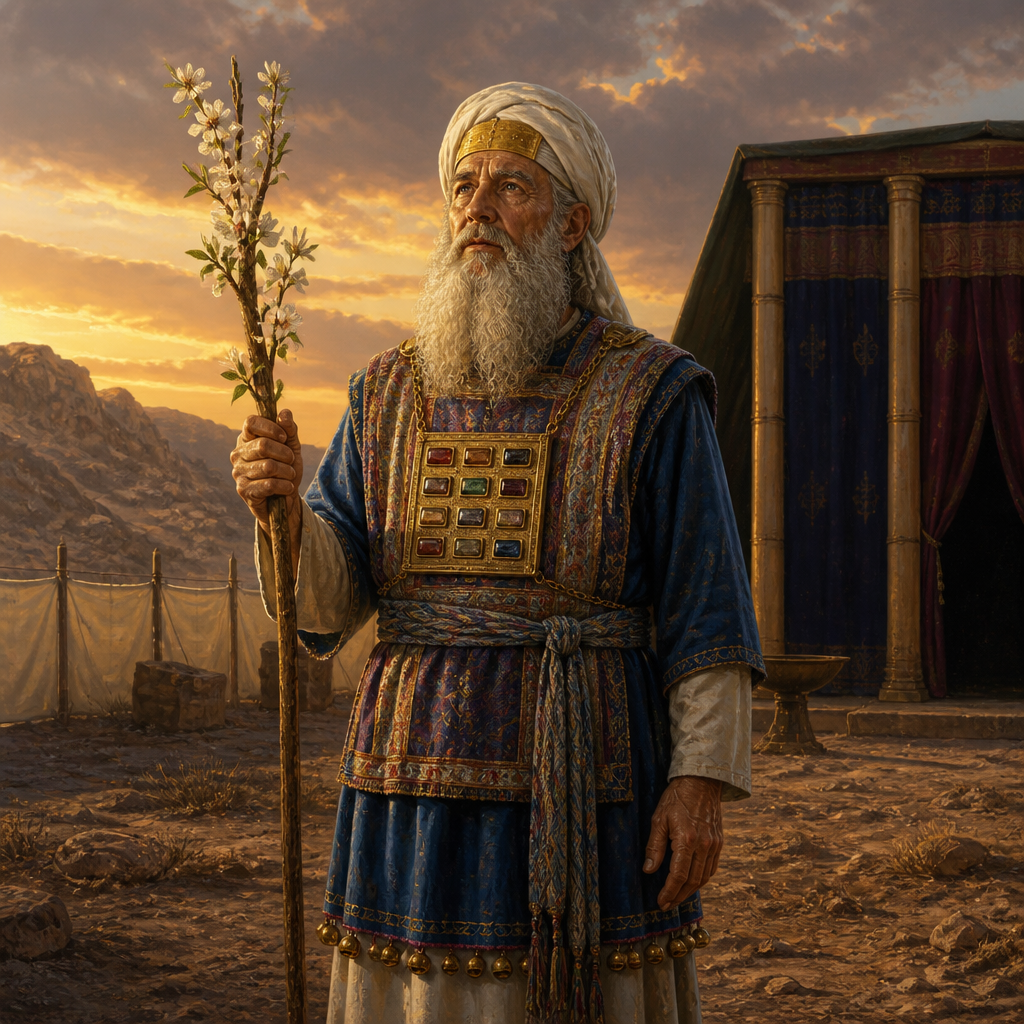
Aaron was formally consecrated as the High Priest in a seven-day ceremony described in Leviticus 8. He was dressed in elaborate garments, including a breastplate with twelve stones representing the tribes and a turban with a gold plate inscribed "Holy to the Lord." His primary duty was the oversight of the Tabernacle and the performance of the Day of Atonement (Yom Kippur) rituals. In this role, he alone entered the Most Holy Place to sprinkle blood upon the mercy seat to atone for the sins of the nation (Leviticus 16).
The Budding of the Staff
Aaron’s authority was challenged during the wilderness wanderings, most notably by Korah, a fellow Levite. To settle the dispute over who was divinely chosen for the priesthood, the Lord commanded that a staff from each tribe be placed in the Tent of Meeting. The next day, Aaron’s staff had not only sprouted but had budded, blossomed, and produced ripe almonds (Numbers 17:8). This miracle served as a permanent sign that the Aaronic line held the exclusive right to the priesthood.
Relationship to Other Biblical Figures
Aaron served as the bridge between Moses’ divine revelations and the people’s liturgical practice. While Moses was often secluded with God, Aaron was the visible religious leader among the camp. His relationship with his sister Miriam was also significant; they once collectively spoke against Moses regarding his Cushite wife, leading to Miriam being struck with leprosy until Aaron interceded with Moses for her healing (Numbers 12).
Spiritual Significance
In the New Testament, Aaron is presented as the prototype of the high priest who is "called by God" (Hebrews 5:4). However, the author of Hebrews also uses Aaron as a point of contrast to Jesus Christ. While the Aaronic priesthood was limited by human death and the need for repeated sacrifices for the priest's own sins, Christ is presented as a priest after the order of Melchizedek—eternal and sinless. Aaron’s staff, the jar of manna, and the stone tablets were later housed in the Ark of the Covenant, signifying his enduring legacy in Israel’s spiritual foundations (Hebrews 9:4).
Aaron is the foundational figure of the Israelite priesthood, establishing the standard for mediation between God and man through sacrifice and intercession. His life illustrates the tension between the high calling of divine office and the reality of human fallibility.
Theologically, Aaron serves as a 'type' or foreshadowing of Christ. His role in carrying the names of the tribes on his breastplate into the presence of God prefigures the intercessory work of the Messiah. The 'House of Aaron' became a synonymous term for the priesthood itself, emphasized in the Psalms as a group called to bless and trust the Lord, ensuring that his legacy remained central to the Jewish identity long after the wilderness era.
Frequently Asked Questions
Why did Aaron make the golden calf?
Under pressure from the Israelites who feared Moses had perished on Mount Sinai, Aaron yielded to their demands for a visible god to lead them. He fashioned the calf from their gold jewelry, though he later claimed the calf appeared miraculously when the gold was cast into the fire.
How did Aaron die?
Aaron died on Mount Hor at the age of 123. Because of his and Moses' disobedience at the waters of Meribah, he was not permitted to enter the Promised Land. Before his death, his priestly garments were removed and placed on his son Eleazar.
What was the significance of Aaron’s rod budding?
It was a divine sign to end the grumbling of the Israelites and the rebellion of Korah. By making Aaron’s wooden staff produce blossoms and almonds overnight, God confirmed that only Aaron and his descendants were chosen for the priesthood.
Who were Aaron’s parents?
Aaron was the son of Amram and Jochebed, both members of the tribe of Levi.
What were the duties of the High Priest?
The High Priest oversaw the Tabernacle, managed the other priests and Levites, consulted the Urim and Thummim to discern God's will, and performed the unique rituals of the Day of Atonement, including entering the Holy of Holies.
Family & Relationships
Parents
 Amram, Father of MosesFatherExodus 6:20Stated
 JochebedMotherExodus 6:20Stated
 ElishebaWifeExodus 6:23Stated
 AaronThis page
 Miriam, Prophetess and Sister of MosesSisterExodus 15:20Stated
 MosesBrotherExodus 6:20Stated
Children
 AbihuSonExodus 6:23Stated
 Eleazar, Son of AaronSonExodus 6:23Stated
 IthamarSonExodus 6:23Stated
 Nadab, Son of AaronSonExodus 6:23Stated
Extended family
 Amminadab, Prince of Judah in the ExodusFather-in-lawExodus 6:23
Inferred
Exodus 6:23 names Amminadab and Aaron in the same verse but does not state a son-in-law tie between them; the link rests on the surrounding narrative.Evidence: Exodus 6:23
 Daughter of PutielDaughter-in-lawExodus 6:25
Inferred
No verse names Aaron and Daughter of Putiel together; the daughter-in-law link is carried from the surrounding genealogy and is not stated in Scripture.Evidence: Exodus 6:25; Exodus 6:23
 NahshonBrother-in-lawExodus 6:23
Inferred
Exodus 6:23 names Nahshon and Aaron in the same verse but does not state a brother-in-law tie between them; the link rests on the surrounding narrative.Evidence: Exodus 6:23
 KohathGrandfatherExodus 6:18
Inferred
Reconstructed through Amram: Exodus 6:20 ties Aaron to Amram; Exodus 6:18 ties Amram to Kohath. No verse states the grandfather link between Aaron and Kohath directly.Evidence: Exodus 6:18; Numbers 26:58; 1 Chronicles 6:2; 1 Chronicles 6:18; Exodus 6:20; Numbers 26:59; 1 Chronicles 23:13
 Levi, Son of JacobGreat-GrandfatherNumbers 26:59
Inferred
Numbers 26:59 names Levi and Aaron in the same verse but does not state a great-grandson tie between them; the link rests on the surrounding narrative.Evidence: Numbers 26:59; Exodus 6:20
 Phinehas, Son of EleazarGrandsonJoshua 24:33
Inferred
Joshua 24:33 names Aaron and Phinehas in the same verse but does not state a grandson tie between them; the link rests on the surrounding narrative.Evidence: Joshua 24:33; Exodus 6:25
 Mishael, Son of UzzielCousinExodus 6:22
Inferred
Reconstructed through Amram and Uzziel: Exodus 6:20 ties Aaron to Amram; Exodus 6:18 ties Amram to Uzziel; Exodus 6:22 ties Uzziel to Mishael. No verse states the cousin link between Aaron and Mishael directly.Evidence: Exodus 6:22
 Uzziel, Son of KohathUncleExodus 6:18
Inferred
Reconstructed through Amram: Exodus 6:20 ties Aaron to Amram; Exodus 6:18 ties Amram to Uzziel. No verse states the uncle link between Aaron and Uzziel directly.Evidence: Exodus 6:18; Exodus 6:20; Numbers 26:59; 1 Chronicles 23:13
 Elizaphan, Son of UzzielCousinExodus 6:22
Inferred
Reconstructed through Amram and Uzziel: Exodus 6:20 ties Aaron to Amram; Exodus 6:18 ties Amram to Uzziel; Exodus 6:22 ties Uzziel to Elzaphan. No verse states the cousin link between Aaron and Elizaphan directly.Evidence: Exodus 6:22
Connected Figures
Family
Father · Exodus 6:20
A Levite of the Kohathite clan best known as the father of the three primary leaders of the Exodus: Moses, Aaron, and Miriam.
Mother · Exodus 6:20
A woman of the tribe of Levi who was the mother of Moses, Aaron, and Miriam during the Israelites' sojourn in Egypt.
Egypt and WildernessFirst: Exodus 6:205 versesMatriarch of the Levite leadershipLevi
Wife · Exodus 6:23
The wife of Aaron the High Priest and a daughter of the tribe of Judah, Elisheba provided the genealogical link between the Levitical priesthood and the Davidic royal line.
Egypt and WildernessFirst: Exodus 6:232 versesMatriarch of the Aaronic PriesthoodJudah
Son · Exodus 6:23
The second son of Aaron who was appointed as a priest but suffered divine judgment for offering unauthorized fire before the LORD.
Son · Exodus 6:23
Eleazar was the third son of Aaron and his successor as the High Priest of Israel, serving as a key leader alongside Moses and Joshua during the wilderness wanderings and the conquest of Canaan.
Egypt and WildernessFirst: Exodus 6:2361 versesHigh PriestLevi
Son · Exodus 6:23
The youngest son of Aaron and Elisheba, Ithamar was a high-ranking priest who supervised the construction of the Tabernacle and the duties of the Levites during the Wilderness wanderings.
Egypt and WildernessFirst: Exodus 6:2323 versesPriest and Tabernacle AdministratorLevi
Son · Exodus 6:23
Nadab was the firstborn son of Aaron and a high-ranking priest who was consumed by fire from the LORD for offering unauthorized incense during the wilderness wanderings.
Sister · Exodus 15:20
A prophetess of the Tribe of Levi who served as a prominent leader of Israel alongside her brothers Moses and Aaron during the Exodus and wilderness wanderings.
Egypt and WildernessFirst: Exodus 15:2012 versesProphetessLevi
Brother · Exodus 6:20
The preeminent prophet and lawgiver of Israel who led the Hebrews out of Egyptian bondage and mediated the Covenant at Mount Sinai.
Egypt and WildernessFirst: Exodus 2:10844 versesProphet, Judge, and LawgiverLevi
Father-in-law · Exodus 6:23
A prominent leader of the tribe of Judah during the Egyptian sojourn and the father of the high priestess Elisheba and the tribal chieftain Nahshon.
Egypt and WildernessFirst: Exodus 6:2311 versesPatriarchJudah
Daughter-in-law · Exodus 6:25
A woman of the tribe of Levi by marriage who was the wife of the priest Eleazar and the mother of the High Priest Phinehas.
Egypt and WildernessFirst: Exodus 6:254 versesMatriarch in the Priestly Lineage
Brother-in-law · Exodus 6:23
The designated prince of the tribe of Judah during the Exodus and a direct ancestor of King David and Jesus Christ.
Egypt and WildernessFirst: Exodus 6:2313 versesPrince of JudahJudah
Categories
Mentions by Book
- Exodus113
- Leviticus77
- Numbers98
- Deuteronomy3
- Joshua6
- Judges1
- 1 Samuel2
- 1 Chronicles14
- 2 Chronicles6
- Ezra1
- Nehemiah2
- Psalms9
- Micah1
- Luke1
- Acts1
- Hebrews3
Scripture References
All 338 indexed verses, in canonical order, from the Berean Standard Bible.
- Exodus 4:14
Then the anger of the LORD burned against Moses, and He said, “Is not Aaron the Levite your brother? I know that he can speak well, and he is now on his way to meet you. When he sees you, he will be glad in his heart.
- Exodus 4:27
Meanwhile, the LORD had said to Aaron, “Go and meet Moses in the wilderness.” So he went and met Moses at the mountain of God and kissed him.
- Exodus 4:28
And Moses told Aaron everything the LORD had sent him to say, and all the signs He had commanded him to perform.
- Exodus 4:29
Then Moses and Aaron went and assembled all the elders of the Israelites,
- Exodus 4:30
and Aaron relayed everything the LORD had said to Moses. And Moses performed the signs before the people,
- Exodus 5:1
After that, Moses and Aaron went to Pharaoh and said, “This is what the LORD, the God of Israel, says: ‘Let My people go, so that they may hold a feast to Me in the wilderness.’”
- Exodus 5:4
But the king of Egypt said to them, “Moses and Aaron, why do you draw the people away from their work? Get back to your labor!”
- Exodus 5:20
When they left Pharaoh, they confronted Moses and Aaron, who stood waiting to meet them.
- Exodus 6:13
Then the LORD spoke to Moses and Aaron and gave them a charge concerning both the Israelites and Pharaoh king of Egypt, to bring the Israelites out of the land of Egypt.
- Exodus 6:18Partial
The sons of Kohath were Amram, Izhar, Hebron, and Uzziel. Kohath lived 133 years.
Cited as evidence on a family card; added so References, Key Verses and Mentions by Book share one index.
- Exodus 6:19Partial
The sons of Merari were Mahli and Mushi. These were the clans of the Levites according to their records.
Cited as evidence on a family card; added so References, Key Verses and Mentions by Book share one index.
- Exodus 6:20
And Amram married his father’s sister Jochebed, and she bore him Aaron and Moses. Amram lived 137 years.
- Exodus 6:21Partial
The sons of Izhar were Korah, Nepheg, and Zichri.
Cited as evidence on a family card; added so References, Key Verses and Mentions by Book share one index.
- Exodus 6:22Partial
The sons of Uzziel were Mishael, Elzaphan, and Sithri.
Cited as evidence on a family card; added so References, Key Verses and Mentions by Book share one index.
- Exodus 6:23
And Aaron married Elisheba, the daughter of Amminadab and sister of Nahshon, and she bore him Nadab and Abihu, Eleazar and Ithamar.
- Exodus 6:25
Aaron’s son Eleazar married one of the daughters of Putiel, and she bore him Phinehas. These were the heads of the Levite families by their clans.
- Exodus 6:26
It was this Aaron and Moses to whom the LORD said, “Bring the Israelites out of the land of Egypt by their divisions.”
- Exodus 6:27
Moses and Aaron were the ones who spoke to Pharaoh king of Egypt in order to bring the Israelites out of Egypt.
- Exodus 7:1
The LORD answered Moses, “See, I have made you like God to Pharaoh, and your brother Aaron will be your prophet.
- Exodus 7:2
You are to speak all that I command you, and your brother Aaron is to tell Pharaoh to let the Israelites go out of his land.
- Exodus 7:6
So Moses and Aaron did just as the LORD had commanded them.
- Exodus 7:7
Moses was eighty years old and Aaron was eighty-three when they spoke to Pharaoh.
- Exodus 7:8
The LORD said to Moses and Aaron,
- Exodus 7:9
“When Pharaoh tells you, ‘Perform a miracle,’ you are to say to Aaron, ‘Take your staff and throw it down before Pharaoh,’ and it will become a serpent.”
- Exodus 7:10Partial
So Moses and Aaron went to Pharaoh and did just as the LORD had commanded. Aaron threw his staff down before Pharaoh and his officials, and it became a serpent.
- Exodus 7:12
Each one threw down his staff, and it became a serpent. But Aaron’s staff swallowed up the other staffs.
- Exodus 7:19
And the LORD said to Moses, “Tell Aaron, ‘Take your staff and stretch out your hand over the waters of Egypt—over their rivers and canals and ponds and all the reservoirs—that they may become blood.’ There will be blood throughout the land of Egypt, even in the vessels of wood and stone.”
- Exodus 7:20
Moses and Aaron did just as the LORD had commanded; in the presence of Pharaoh and his officials, Aaron raised the staff and struck the water of the Nile, and all the water was turned to blood.
- Exodus 8:5
And the LORD said to Moses, “Tell Aaron, ‘Stretch out your hand with your staff over the rivers and canals and ponds, and cause the frogs to come up onto the land of Egypt.’”
- Exodus 8:6
So Aaron stretched out his hand over the waters of Egypt, and the frogs came up and covered the land of Egypt.
- Exodus 8:8
Pharaoh summoned Moses and Aaron and said, “Pray to the LORD to take the frogs away from me and my people. Then I will let your people go, that they may sacrifice to the LORD.”
- Exodus 8:12
After Moses and Aaron had left Pharaoh, Moses cried out to the LORD for help with the frogs that He had brought against Pharaoh.
- Exodus 8:16
Then the LORD said to Moses, “Tell Aaron, ‘Stretch out your staff and strike the dust of the earth, that it may turn into swarms of gnats throughout the land of Egypt.’”
- Exodus 8:17
This they did, and when Aaron stretched out his hand with his staff and struck the dust of the earth, gnats came upon man and beast. All the dust of the earth turned into gnats throughout the land of Egypt.
- Exodus 8:25
Then Pharaoh summoned Moses and Aaron and said, “Go, sacrifice to your God within this land.”
- Exodus 9:8
Then the LORD said to Moses and Aaron, “Take handfuls of soot from the furnace; in the sight of Pharaoh, Moses is to toss it into the air.
- Exodus 9:27
Then Pharaoh summoned Moses and Aaron. “This time I have sinned,” he said. “The LORD is righteous, and I and my people are wicked.
- Exodus 10:3
So Moses and Aaron went to Pharaoh and told him, “This is what the LORD, the God of the Hebrews, says: ‘How long will you refuse to humble yourself before Me? Let My people go, so that they may worship Me.
- Exodus 10:8
So Moses and Aaron were brought back to Pharaoh. “Go, worship the LORD your God,” he said. “But who exactly will be going?”
- Exodus 10:16
Pharaoh quickly summoned Moses and Aaron and said, “I have sinned against the LORD your God and against you.
- Exodus 11:10
Moses and Aaron did all these wonders before Pharaoh, but the LORD hardened Pharaoh’s heart so that he would not let the Israelites go out of his land.
- Exodus 12:1
Now the LORD said to Moses and Aaron in the land of Egypt,
- Exodus 12:28
And the Israelites went and did just what the LORD had commanded Moses and Aaron.
- Exodus 12:31
Then Pharaoh summoned Moses and Aaron by night and said, “Get up, leave my people, both you and the Israelites! Go, worship the LORD as you have requested.
- Exodus 12:43
And the LORD said to Moses and Aaron, “This is the statute of the Passover: No foreigner is to eat of it.
- Exodus 12:50
Then all the Israelites did this—they did just as the LORD had commanded Moses and Aaron.
- Exodus 15:20
Then Miriam the prophetess, Aaron’s sister, took a tambourine in her hand, and all the women followed her with tambourines and dancing.
- Exodus 16:2
And there in the desert the whole congregation of Israel grumbled against Moses and Aaron.
- Exodus 16:6
So Moses and Aaron said to all the Israelites, “This evening you will know that it was the LORD who brought you out of the land of Egypt,
- Exodus 16:9
Then Moses said to Aaron, “Tell the whole congregation of Israel, ‘Come before the LORD, for He has heard your grumbling.’”
- Exodus 16:10
And as Aaron was speaking to the whole congregation of Israel, they looked toward the desert, and there in a cloud the glory of the LORD appeared.
- Exodus 16:33
So Moses told Aaron, “Take a jar and fill it with an omer of manna. Then place it before the LORD to be preserved for the generations to come.”
- Exodus 16:34
And Aaron placed it in front of the Testimony, to be preserved just as the LORD had commanded Moses.
- Exodus 17:10
Joshua did as Moses had instructed him and fought against the Amalekites, while Moses, Aaron, and Hur went up to the top of the hill.
- Exodus 17:12
When Moses’ hands grew heavy, they took a stone and put it under him, and he sat on it. Then Aaron and Hur held his hands up, one on each side, so that his hands remained steady until the sun went down.
- Exodus 18:12
Then Moses’ father-in-law Jethro brought a burnt offering and sacrifices to God, and Aaron came with all the elders of Israel to eat bread with Moses’ father-in-law in the presence of God.
- Exodus 19:24
And the LORD replied, “Go down and bring Aaron with you. But the priests and the people must not break through to come up to the LORD, or He will break out against them.”
- Exodus 24:1
Then the LORD said to Moses, “Come up to the LORD—you and Aaron, Nadab and Abihu, and seventy of Israel’s elders—and you are to worship at a distance.
- Exodus 24:9
Then Moses went up with Aaron, Nadab and Abihu, and seventy of the elders of Israel,
- Exodus 24:14
And he said to the elders, “Wait here for us until we return to you. Aaron and Hur are here with you. Whoever has a dispute can go to them.”
- Exodus 27:21
In the Tent of Meeting, outside the veil that is in front of the Testimony, Aaron and his sons are to tend the lamps before the LORD from evening until morning. This is to be a permanent statute for the Israelites for the generations to come.
- Exodus 28:1Partial
“Next, have your brother Aaron brought to you from among the Israelites, along with his sons Nadab, Abihu, Eleazar, and Ithamar, to serve Me as priests.
- Exodus 28:2
Make holy garments for your brother Aaron, to give him glory and splendor.
- Exodus 28:3
You are to instruct all the skilled craftsmen, whom I have filled with a spirit of wisdom, to make garments for Aaron’s consecration, so that he may serve Me as priest.
- Exodus 28:4
These are the garments that they shall make: a breastpiece, an ephod, a robe, a woven tunic, a turban, and a sash. They are to make these holy garments for your brother Aaron and his sons, so that they may serve Me as priests.
- Exodus 28:12
Fasten both stones on the shoulder pieces of the ephod as memorial stones for the sons of Israel. Aaron is to bear their names on his two shoulders as a memorial before the LORD.
- Exodus 28:29
Whenever Aaron enters the Holy Place, he shall bear the names of the sons of Israel over his heart on the breastpiece of judgment, as a continual reminder before the LORD.
- Exodus 28:30Partial
And place the Urim and Thummim in the breastpiece of judgment, so that they will also be over Aaron’s heart whenever he comes before the LORD. Aaron will continually carry the judgment of the sons of Israel over his heart before the LORD.
- Exodus 28:35
Aaron must wear the robe whenever he ministers, and its sound will be heard when he enters or exits the sanctuary before the LORD, so that he will not die.
- Exodus 28:38Partial
And it will be worn on Aaron’s forehead, so that he may bear the iniquity of the holy things that the sons of Israel consecrate with regard to all their holy gifts. It shall always be on his forehead, so that they may be acceptable before the LORD.
- Exodus 28:40
Make tunics, sashes, and headbands for Aaron’s sons, to give them glory and splendor.
- Exodus 28:41
After you put these garments on your brother Aaron and his sons, anoint them, ordain them, and consecrate them so that they may serve Me as priests.
- Exodus 28:43
Aaron and his sons must wear them whenever they enter the Tent of Meeting or approach the altar to minister in the Holy Place, so that they will not incur guilt and die. This is to be a permanent statute for Aaron and his descendants.
- Exodus 29:4
Then present Aaron and his sons at the entrance to the Tent of Meeting and wash them with water.
- Exodus 29:5
Take the garments and clothe Aaron with the tunic, the robe of the ephod, the ephod itself, and the breastplate. Fasten the ephod on him with its woven waistband.
- Exodus 29:9Partial
Wrap the sashes around Aaron and his sons and tie headbands on them. The priesthood shall be theirs by a permanent statute. In this way you are to ordain Aaron and his sons.
- Exodus 29:10
You are to present the bull at the front of the Tent of Meeting, and Aaron and his sons are to lay their hands on its head.
- Exodus 29:15
Take one of the rams, and Aaron and his sons shall lay their hands on its head.
- Exodus 29:19
Take the second ram, and Aaron and his sons are to lay their hands on its head.
- Exodus 29:20
Slaughter the ram, take some of its blood, and put it on the right earlobes of Aaron and his sons, on the thumbs of their right hands, and on the big toes of their right feet. Splatter the remaining blood on all sides of the altar.
- Exodus 29:21
And take some of the blood on the altar and some of the anointing oil and sprinkle it on Aaron and his garments, as well as on his sons and their garments. Then he and his garments will be consecrated, as well as his sons and their garments.
- Exodus 29:24
Put all these in the hands of Aaron and his sons and wave them before the LORD as a wave offering.
- Exodus 29:26
Take the breast of the ram of Aaron’s ordination and wave it before the LORD as a wave offering, and it will be your portion.
- Exodus 29:27
Consecrate for Aaron and his sons the breast of the wave offering that is waved and the thigh of the heave offering that is lifted up from the ram of ordination.
- Exodus 29:28
This will belong to Aaron and his sons as a regular portion from the Israelites, for it is the heave offering the Israelites will make to the LORD from their peace offerings.
- Exodus 29:29
The holy garments that belong to Aaron will belong to his sons after him, so they can be anointed and ordained in them.
- Exodus 29:32
At the entrance to the Tent of Meeting, Aaron and his sons are to eat the meat of the ram and the bread that is in the basket.
- Exodus 29:35
This is what you are to do for Aaron and his sons based on all that I have commanded you, taking seven days to ordain them.
- Exodus 29:44
So I will consecrate the Tent of Meeting and the altar, and I will consecrate Aaron and his sons to serve Me as priests.
- Exodus 30:7
And Aaron is to burn fragrant incense on it every morning when he tends the lamps.
- Exodus 30:8
When Aaron sets up the lamps at twilight, he must burn the incense perpetually before the LORD for the generations to come.
- Exodus 30:10
Once a year Aaron shall make atonement on the horns of the altar. Throughout your generations he shall make atonement on it annually with the blood of the sin offering of atonement. The altar is most holy to the LORD.”
- Exodus 30:19
with which Aaron and his sons are to wash their hands and feet.
- Exodus 30:30
Anoint Aaron and his sons and consecrate them to serve Me as priests.
- Exodus 31:10
as well as the woven garments, both the holy garments for Aaron the priest and the garments for his sons to serve as priests,
- Exodus 32:1
Now when the people saw that Moses was delayed in coming down from the mountain, they gathered around Aaron and said, “Come, make us gods who will go before us. As for this Moses who brought us up out of the land of Egypt, we do not know what has happened to him!”
- Exodus 32:2
So Aaron told them, “Take off the gold earrings that are on your wives and sons and daughters, and bring them to me.”
- Exodus 32:3
Then all the people took off their gold earrings and brought them to Aaron.
- Exodus 32:5Partial
When Aaron saw this, he built an altar before the calf and proclaimed: “Tomorrow shall be a feast to the LORD.”
- Exodus 32:21
“What did this people do to you,” Moses asked Aaron, “that you have led them into so great a sin?”
- Exodus 32:22
“Do not be enraged, my lord,” Aaron replied. “You yourself know that the people are intent on evil.
- Exodus 32:25
Moses saw that the people were out of control, for Aaron had let them run wild and become a laughingstock to their enemies.
- Exodus 32:35
And the LORD sent a plague on the people because of what they had done with the calf that Aaron had made.
- Exodus 34:30
Aaron and all the Israelites looked at Moses, and behold, his face was radiant. And they were afraid to approach him.
- Exodus 34:31
But Moses called out to them; so Aaron and all the leaders of the congregation returned to him, and Moses spoke to them.
- Exodus 35:19
and the woven garments for ministering in the holy place—both the holy garments for Aaron the priest and the garments for his sons to serve as priests.”
- Exodus 38:21
This is the inventory for the tabernacle, the tabernacle of the Testimony, as recorded at Moses’ command by the Levites under the direction of Ithamar son of Aaron the priest.
- Exodus 39:1
From the blue, purple, and scarlet yarn they made specially woven garments for ministry in the sanctuary, as well as the holy garments for Aaron, just as the LORD had commanded Moses.
- Exodus 39:27
For Aaron and his sons they made tunics of fine linen, the work of a weaver,
- Exodus 39:41
and the woven garments for ministering in the sanctuary, both the holy garments for Aaron the priest and the garments for his sons to serve as priests.
- Exodus 40:12
Then bring Aaron and his sons to the entrance to the Tent of Meeting and wash them with water.
- Exodus 40:13
And you are to clothe Aaron with the holy garments, anoint him, and consecrate him, so that he may serve Me as a priest.
- Exodus 40:31
and from it Moses, Aaron, and his sons washed their hands and feet.
- Leviticus 1:5
And he shall slaughter the young bull before the LORD, and Aaron’s sons the priests are to present the blood and splatter it on all sides of the altar at the entrance to the Tent of Meeting.
- Leviticus 1:7
The sons of Aaron the priest shall put a fire on the altar and arrange wood on the fire.
- Leviticus 1:8
Then Aaron’s sons the priests are to arrange the pieces, including the head and the fat, atop the burning wood on the altar.
- Leviticus 1:11
He shall slaughter it on the north side of the altar before the LORD, and Aaron’s sons the priests are to splatter its blood against the altar on all sides.
- Leviticus 2:2
and bring it to Aaron’s sons the priests. The priest shall take a handful of the flour and oil, together with all the frankincense, and burn this as a memorial portion on the altar, a food offering, a pleasing aroma to the LORD.
- Leviticus 2:3
The remainder of the grain offering shall belong to Aaron and his sons; it is a most holy part of the food offerings to the LORD.
- Leviticus 2:10
But the remainder of the grain offering shall belong to Aaron and his sons; it is a most holy part of the food offerings to the LORD.
- Leviticus 3:2
He is to lay his hand on the head of the offering and slaughter it at the entrance to the Tent of Meeting. Then Aaron’s sons the priests shall splatter the blood on all sides of the altar.
- Leviticus 3:5
Then Aaron’s sons are to burn it on the altar atop the burnt offering that is on the burning wood, as a food offering, a pleasing aroma to the LORD.
- Leviticus 3:8
He is to lay his hand on the head of his offering and slaughter it in front of the Tent of Meeting. Then Aaron’s sons shall splatter its blood on all sides of the altar.
- Leviticus 3:13
He must lay his hand on its head and slaughter it in front of the Tent of Meeting. Then Aaron’s sons shall splatter its blood on all sides of the altar.
- Leviticus 6:9
“Command Aaron and his sons that this is the law of the burnt offering: The burnt offering is to remain on the hearth of the altar all night, until morning, and the fire must be kept burning on the altar.
- Leviticus 6:14
Now this is the law of the grain offering: Aaron’s sons shall present it before the LORD in front of the altar.
- Leviticus 6:16
Aaron and his sons are to eat the remainder. It must be eaten without leaven in a holy place; they are to eat it in the courtyard of the Tent of Meeting.
- Leviticus 6:18
Any male among the sons of Aaron may eat it. This is a permanent portion from the food offerings to the LORD for the generations to come. Anything that touches them will become holy.”
- Leviticus 6:20
“This is the offering that Aaron and his sons must present to the LORD on the day he is anointed: a tenth of an ephah of fine flour as a regular grain offering, half of it in the morning and half in the evening.
- Leviticus 6:25
“Tell Aaron and his sons that this is the law of the sin offering: In the place where the burnt offering is slaughtered, the sin offering shall be slaughtered before the LORD; it is most holy.
- Leviticus 7:10
and every grain offering, whether dry or mixed with oil, belongs equally to all the sons of Aaron.
- Leviticus 7:31
The priest is to burn the fat on the altar, but the breast belongs to Aaron and his sons.
- Leviticus 7:33
The son of Aaron who presents the blood and fat of the peace offering shall have the right thigh as a portion.
- Leviticus 7:34
I have taken from the sons of Israel the breast of the wave offering and the thigh of the contribution of their peace offerings, and I have given them to Aaron the priest and his sons as a permanent portion from the sons of Israel.’”
- Leviticus 7:35
This is the portion of the food offerings to the LORD for Aaron and his sons since the day they were presented to serve the LORD as priests.
- Leviticus 8:2
“Take Aaron and his sons, their garments, the anointing oil, the bull of the sin offering, the two rams, and the basket of unleavened bread,
- Leviticus 8:6
Then Moses presented Aaron and his sons and washed them with water.
- Leviticus 8:12
He also poured some of the anointing oil on Aaron’s head and anointed him to consecrate him.
- Leviticus 8:13
Then Moses presented Aaron’s sons, put tunics on them, wrapped sashes around them, and tied headbands on them, just as the LORD had commanded him.
- Leviticus 8:14
Moses then brought the bull near for the sin offering, and Aaron and his sons laid their hands on its head.
- Leviticus 8:18
Then Moses presented the ram for the burnt offering, and Aaron and his sons laid their hands on its head.
- Leviticus 8:22
After that, Moses presented the other ram, the ram of ordination, and Aaron and his sons laid their hands on its head.
- Leviticus 8:23
Moses slaughtered the ram and took some of its blood and put it on Aaron’s right earlobe, on the thumb of his right hand, and on the big toe of his right foot.
- Leviticus 8:24
Moses also presented Aaron’s sons and put some of the blood on their right earlobes, on the thumbs of their right hands, and on the big toes of their right feet. Then he splattered the blood on all sides of the altar.
- Leviticus 8:27
He put all these in the hands of Aaron and his sons and waved them before the LORD as a wave offering.
- Leviticus 8:30Partial
Next, Moses took some of the anointing oil and some of the blood that was on the altar and sprinkled them on Aaron and his garments, and on his sons and their garments. So he consecrated Aaron and his garments, as well as Aaron’s sons and their garments.
- Leviticus 8:31Partial
And Moses said to Aaron and his sons, “Boil the meat at the entrance to the Tent of Meeting and eat it there with the bread that is in the basket of ordination offerings, as I commanded, saying, ‘Aaron and his sons are to eat it.’
- Leviticus 8:36
So Aaron and his sons did everything the LORD had commanded through Moses.
- Leviticus 9:1
On the eighth day Moses summoned Aaron and his sons and the elders of Israel.
- Leviticus 9:2
He said to Aaron, “Take for yourself a young bull for a sin offering and a ram for a burnt offering, both without blemish, and present them before the LORD.
- Leviticus 9:7
Then Moses said to Aaron, “Approach the altar and sacrifice your sin offering and your burnt offering to make atonement for yourself and for the people. And sacrifice the people’s offering to make atonement for them, as the LORD has commanded.”
- Leviticus 9:8
So Aaron approached the altar and slaughtered the calf as a sin offering for himself.
- Leviticus 9:9
The sons of Aaron brought the blood to him, and he dipped his finger in the blood and applied it to the horns of the altar. And he poured out the rest of the blood at the base of the altar.
- Leviticus 9:12
Then Aaron slaughtered the burnt offering. His sons brought him the blood, and he splattered it on all sides of the altar.
- Leviticus 9:18
Then he slaughtered the ox and the ram as the people’s peace offering. His sons brought him the blood, and he splattered it on all sides of the altar.
- Leviticus 9:21
but he waved the breasts and the right thigh as a wave offering before the LORD, as Moses had commanded.
- Leviticus 9:22
Aaron lifted up his hands toward the people and blessed them. And having made the sin offering, the burnt offering, and the peace offering, he stepped down.
- Leviticus 9:23
Moses and Aaron then entered the Tent of Meeting. When they came out, they blessed the people, and the glory of the LORD appeared to all the people.
- Leviticus 10:1
Now Aaron’s sons Nadab and Abihu took their censers, put fire in them and added incense, and offered unauthorized fire before the LORD, contrary to His command.
- Leviticus 10:3Partial
Then Moses said to Aaron, “This is what the LORD meant when He said: ‘To those who come near Me I will show My holiness, and in the sight of all the people I will reveal My glory.’” But Aaron remained silent.
- Leviticus 10:4
Moses summoned Mishael and Elzaphan, sons of Aaron’s uncle Uzziel, and said to them, “Come here; carry the bodies of your cousins outside the camp, away from the front of the sanctuary.”
- Leviticus 10:6
Then Moses said to Aaron and his sons Eleazar and Ithamar, “Do not let your hair become disheveled and do not tear your garments, or else you will die, and the LORD will be angry with the whole congregation. But your brothers, the whole house of Israel, may mourn on account of the fire that the LORD has ignited.
- Leviticus 10:8
Then the LORD said to Aaron,
- Leviticus 10:12
And Moses said to Aaron and his remaining sons, Eleazar and Ithamar, “Take the grain offering that remains from the food offerings to the LORD and eat it without leaven beside the altar, because it is most holy.
- Leviticus 10:16
Later, Moses searched carefully for the goat of the sin offering, and behold, it had been burned up. He was angry with Eleazar and Ithamar, Aaron’s remaining sons, and asked,
- Leviticus 10:19
But Aaron replied to Moses, “Behold, this very day they presented their sin offering and their burnt offering before the LORD. Since these things have happened to me, if I had eaten the sin offering today, would it have been acceptable in the sight of the LORD?”
- Leviticus 11:1
The LORD spoke again to Moses and Aaron, telling them,
- Leviticus 13:1
Then the LORD said to Moses and Aaron,
- Leviticus 13:2
“When someone has a swelling or rash or bright spot on his skin that may be an infectious skin disease, he must be brought to Aaron the priest or to one of his sons who is a priest.
- Leviticus 14:33
Then the LORD said to Moses and Aaron,
- Leviticus 15:1
And the LORD said to Moses and Aaron,
- Leviticus 16:1
Now the LORD spoke to Moses after the death of two of Aaron’s sons when they approached the presence of the LORD.
- Leviticus 16:2
And the LORD said to Moses: “Tell your brother Aaron not to enter freely into the Most Holy Place behind the veil in front of the mercy seat on the ark, or else he will die, because I appear in the cloud above the mercy seat.
- Leviticus 16:3
This is how Aaron is to enter the Holy Place: with a young bull for a sin offering and a ram for a burnt offering.
- Leviticus 16:6
Aaron is to present the bull for his sin offering and make atonement for himself and his household.
- Leviticus 16:8
After Aaron casts lots for the two goats, one for the LORD and the other for the scapegoat,
- Leviticus 16:9
he shall present the goat chosen by lot for the LORD and sacrifice it as a sin offering.
- Leviticus 16:11
When Aaron presents the bull for his sin offering and makes atonement for himself and his household, he is to slaughter the bull for his own sin offering.
- Leviticus 16:21
Then he is to lay both hands on the head of the live goat and confess over it all the iniquities and rebellious acts of the Israelites in regard to all their sins. He is to put them on the goat’s head and send it away into the wilderness by the hand of a man appointed for the task.
- Leviticus 16:23
Then Aaron is to enter the Tent of Meeting, take off the linen garments he put on before entering the Most Holy Place, and leave them there.
- Leviticus 17:2
“Speak to Aaron, his sons, and all the Israelites and tell them this is what the LORD has commanded:
- Leviticus 21:1
Then the LORD said to Moses, “Speak to Aaron’s sons, the priests, and tell them that a priest is not to defile himself for a dead person among his people,
- Leviticus 21:17
“Say to Aaron, ‘For the generations to come, none of your descendants who has a physical defect may approach to offer the food of his God.
- Leviticus 21:21
No descendant of Aaron the priest who has a defect shall approach to present the food offerings to the LORD. Since he has a defect, he is not to come near to offer the food of his God.
- Leviticus 21:24
Moses told this to Aaron and his sons and to all the Israelites.
- Leviticus 22:2
“Tell Aaron and his sons to treat with respect the sacred offerings that the Israelites have consecrated to Me, so that they do not profane My holy name. I am the LORD.
- Leviticus 22:4
If a descendant of Aaron has a skin disease or a discharge, he may not eat the sacred offerings until he is clean. Whoever touches anything defiled by a corpse or by a man who has an emission of semen,
- Leviticus 22:18
“Speak to Aaron and his sons and all the Israelites and tell them, ‘Any man of the house of Israel or any foreign resident who presents a gift for a burnt offering to the LORD, whether to fulfill a vow or as a freewill offering,
- Leviticus 24:3
Outside the veil of the Testimony in the Tent of Meeting, Aaron is to tend the lamps continually before the LORD from evening until morning. This is to be a permanent statute for the generations to come.
- Leviticus 24:9
It belongs to Aaron and his sons, who are to eat it in a holy place; for it is to him a most holy part of the food offerings to the LORD—his portion forever.”
- Numbers 1:3
You and Aaron are to number those who are twenty years of age or older by their divisions—everyone who can serve in Israel’s army.
- Numbers 1:17
So Moses and Aaron took these men who had been designated by name,
- Numbers 1:44
These were the men numbered by Moses and Aaron, with the assistance of the twelve leaders of Israel, each one representing his family.
- Numbers 2:1
Then the LORD said to Moses and Aaron:
- Numbers 3:1
This is the account of Aaron and Moses at the time the LORD spoke with Moses on Mount Sinai.
- Numbers 3:2
These are the names of the sons of Aaron: Nadab the firstborn, then Abihu, Eleazar, and Ithamar.
- Numbers 3:3
These were Aaron’s sons, the anointed priests, who were ordained to serve as priests.
- Numbers 3:4
Nadab and Abihu, however, died in the presence of the LORD when they offered unauthorized fire before the LORD in the Wilderness of Sinai. And since they had no sons, only Eleazar and Ithamar served as priests during the lifetime of their father Aaron.
- Numbers 3:6
“Bring the tribe of Levi and present them to Aaron the priest to assist him.
- Numbers 3:9
Assign the Levites to Aaron and his sons; they have been given exclusively to him from among the Israelites.
- Numbers 3:10
So you shall appoint Aaron and his sons to carry out the duties of the priesthood; but any outsider who approaches the tabernacle must be put to death.”
- Numbers 3:32
The chief of the leaders of the Levites was Eleazar son of Aaron the priest; he oversaw those responsible for the duties of the sanctuary.
- Numbers 3:38
Moses, Aaron, and Aaron’s sons were to camp to the east of the tabernacle, toward the sunrise, before the Tent of Meeting. They were to perform the duties of the sanctuary as a service on behalf of the Israelites; but any outsider who approached the sanctuary was to be put to death.
- Numbers 3:39
The total number of Levites that Moses and Aaron counted by their clans at the LORD’s command, including all the males a month old or more, was 22,000.
- Numbers 3:48
Give the money to Aaron and his sons as the redemption price for the excess among the Israelites.”
- Numbers 3:51
And Moses gave the redemption money to Aaron and his sons in obedience to the word of the LORD, just as the LORD had commanded him.
- Numbers 4:1
Then the LORD said to Moses and Aaron,
- Numbers 4:5
Whenever the camp sets out, Aaron and his sons are to go in, take down the veil of the curtain, and cover the ark of the Testimony with it.
- Numbers 4:15
When Aaron and his sons have finished covering the holy objects and all their equipment, as soon as the camp is ready to move, the Kohathites shall come and do the carrying. But they must not touch the holy objects, or they will die. These are the transportation duties of the Kohathites regarding the Tent of Meeting.
- Numbers 4:16
Eleazar son of Aaron the priest shall oversee the oil for the light, the fragrant incense, the daily grain offering, and the anointing oil. He has oversight of the entire tabernacle and everything in it, including the holy objects and their utensils.”
- Numbers 4:17
Then the LORD said to Moses and Aaron,
- Numbers 4:19
In order that they may live and not die when they come near the most holy things, do this for them: Aaron and his sons are to go in and assign each man his task and what he is to carry.
- Numbers 4:27
All the service of the Gershonites—all their transport duties and other work—is to be done at the direction of Aaron and his sons; you are to assign to them all that they are responsible to carry.
- Numbers 4:28
This is the service of the Gershonite clans at the Tent of Meeting, and their duties shall be under the direction of Ithamar son of Aaron the priest.
- Numbers 4:33
This is the service of the Merarite clans according to all their work at the Tent of Meeting, under the direction of Ithamar son of Aaron the priest.”
- Numbers 4:34
So Moses, Aaron, and the leaders of the congregation numbered the Kohathites by their clans and families,
- Numbers 4:37
These were counted from the Kohathite clans, everyone who could serve at the Tent of Meeting. Moses and Aaron numbered them according to the command of the LORD through Moses.
- Numbers 4:41
These were counted from the Gershonite clans who served at the Tent of Meeting, whom Moses and Aaron counted at the LORD’s command.
- Numbers 4:45
These were counted from the Merarite clans, whom Moses and Aaron numbered at the LORD’s command through Moses.
- Numbers 4:46
So Moses, Aaron, and the leaders of Israel numbered by their clans and families all the Levites
- Numbers 6:23
“Tell Aaron and his sons: This is how you are to bless the Israelites. Say to them:
- Numbers 7:8
and he gave the Merarites four carts and eight oxen, as their service required, all under the direction of Ithamar son of Aaron the priest.
- Numbers 8:2
“Speak to Aaron and tell him: ‘When you set up the seven lamps, they are to light the area in front of the lampstand.’”
- Numbers 8:3
And Aaron did so; he set up the lamps facing toward the front of the lampstand, just as the LORD had commanded Moses.
- Numbers 8:11
Aaron is to present the Levites before the LORD as a wave offering from the sons of Israel, so that they may perform the service of the LORD.
- Numbers 8:13
You are to have the Levites stand before Aaron and his sons and then present them before the LORD as a wave offering.
- Numbers 8:19
And I have given the Levites as a gift to Aaron and his sons from among the Israelites, to perform the service for the Israelites at the Tent of Meeting and to make atonement on their behalf, so that no plague will come against the Israelites when they approach the sanctuary.”
- Numbers 8:20
So Moses, Aaron, and the whole congregation of Israel did with the Levites everything that the LORD had commanded Moses they should do.
- Numbers 8:21Partial
The Levites purified themselves and washed their clothes, and Aaron presented them as a wave offering before the LORD. Aaron also made atonement for them to cleanse them.
- Numbers 8:22
After that, the Levites came to perform their service at the Tent of Meeting in the presence of Aaron and his sons. Thus they did with the Levites just as the LORD had commanded Moses.
- Numbers 9:6
But there were some men who were unclean due to a dead body, so they could not observe the Passover on that day. And they came before Moses and Aaron that same day
- Numbers 10:8
The sons of Aaron, the priests, are to sound the trumpets. This shall be a permanent statute for you and the generations to come.
- Numbers 12:1
Then Miriam and Aaron criticized Moses because of the Cushite woman he had married, for he had taken a Cushite wife.
- Numbers 12:4
And suddenly the LORD said to Moses, Aaron, and Miriam, “You three, come out to the Tent of Meeting.” So the three went out,
- Numbers 12:5
and the LORD came down in a pillar of cloud, stood at the entrance to the Tent, and summoned Aaron and Miriam. When both of them had stepped forward,
- Numbers 12:10
As the cloud lifted from above the Tent, suddenly Miriam became leprous, white as snow. Aaron turned toward her, saw that she was leprous,
- Numbers 12:11
and said to Moses, “My lord, please do not hold against us this sin we have so foolishly committed.
- Numbers 13:26
and they went back to Moses, Aaron, and the whole congregation of Israel in the Wilderness of Paran at Kadesh. They brought back a report for the whole congregation and showed them the fruit of the land.
- Numbers 14:2
All the Israelites grumbled against Moses and Aaron, and the whole congregation said to them, “If only we had died in the land of Egypt, or if only we had died in this wilderness!
- Numbers 14:5
Then Moses and Aaron fell facedown before the whole assembly of the congregation of Israel.
- Numbers 14:26
Then the LORD said to Moses and Aaron,
- Numbers 15:33
Those who found the man gathering wood brought him to Moses, Aaron, and the whole congregation,
- Numbers 16:3
They came together against Moses and Aaron and told them, “You have taken too much upon yourselves! For everyone in the entire congregation is holy, and the LORD is in their midst. Why then do you exalt yourselves above the assembly of the LORD?”
- Numbers 16:11
Therefore, it is you and all your followers who have conspired against the LORD! As for Aaron, who is he that you should grumble against him?”
- Numbers 16:16
And Moses said to Korah, “You and all your followers are to appear before the LORD tomorrow—you and they and Aaron.
- Numbers 16:17
Each man is to take his censer, place incense in it, and present it before the LORD—250 censers. You and Aaron are to present your censers as well.”
- Numbers 16:18
So each man took his censer, put fire and incense in it, and stood with Moses and Aaron at the entrance to the Tent of Meeting.
- Numbers 16:20
And the LORD said to Moses and Aaron,
- Numbers 16:37
“Tell Eleazar son of Aaron the priest to remove the censers from the flames and to scatter the coals far away, because the censers are holy.
- Numbers 16:40
just as the LORD commanded him through Moses. This was to be a reminder to the Israelites that no outsider who is not a descendant of Aaron should approach to offer incense before the LORD, lest he become like Korah and his followers.
- Numbers 16:41
The next day the whole congregation of Israel grumbled against Moses and Aaron, saying, “You have killed the LORD’s people!”
- Numbers 16:42
But when the congregation gathered against them, Moses and Aaron turned toward the Tent of Meeting, and suddenly the cloud covered it and the glory of the LORD appeared.
- Numbers 16:43
Then Moses and Aaron went to the front of the Tent of Meeting,
- Numbers 16:46
Moses said to Aaron, “Take your censer, place fire from the altar in it, and add incense. Go quickly to the congregation and make atonement for them, because wrath has come out from the LORD; the plague has begun.”
- Numbers 16:47
So Aaron took the censer as Moses had ordered and ran into the midst of the assembly. And seeing that the plague had begun among the people, he offered the incense and made atonement for the people.
- Numbers 16:50
Then Aaron returned to Moses at the entrance to the Tent of Meeting, since the plague had been halted.
- Numbers 17:3
and write Aaron’s name on the staff of Levi, because there must be one staff for the head of each tribe.
- Numbers 17:6
So Moses spoke to the Israelites, and each of their leaders gave him a staff—one for each of the leaders of their tribes, twelve staffs in all. And Aaron’s staff was among them.
- Numbers 17:8
The next day Moses entered the Tent of the Testimony and saw that Aaron’s staff, representing the house of Levi, had sprouted, put forth buds, blossomed, and produced almonds.
- Numbers 17:10
The LORD said to Moses, “Put Aaron’s staff back in front of the Testimony, to be kept as a sign for the rebellious, so that you may put an end to their grumbling against Me, lest they die.”
- Numbers 18:1
So the LORD said to Aaron, “You and your sons and your father’s house must bear the iniquity involving the sanctuary. And you and your sons alone must bear the iniquity involving your priesthood.
- Numbers 18:8
Then the LORD said to Aaron, “Behold, I have put you in charge of My offerings. As for all the sacred offerings of the Israelites, I have given them to you and your sons as a portion and a permanent statute.
- Numbers 18:20
Then the LORD said to Aaron, “You will have no inheritance in their land, nor will you have any portion among them. I am your portion and your inheritance among the Israelites.
- Numbers 18:28
So you are to present an offering to the LORD from all the tithes you receive from the Israelites, and from these you are to give the LORD’s offering to Aaron the priest.
- Numbers 19:1
Then the LORD said to Moses and Aaron,
- Numbers 20:2
Now there was no water for the congregation, so they gathered against Moses and Aaron.
- Numbers 20:6
Then Moses and Aaron went from the presence of the assembly to the entrance to the Tent of Meeting. They fell facedown, and the glory of the LORD appeared to them.
- Numbers 20:8
“Take the staff and assemble the congregation. You and your brother Aaron are to speak to the rock while they watch, and it will pour out its water. You will bring out water from the rock and provide drink for the congregation and their livestock.”
- Numbers 20:10
Then Moses and Aaron gathered the assembly in front of the rock, and Moses said to them, “Listen now, you rebels, must we bring you water out of this rock?”
- Numbers 20:12
But the LORD said to Moses and Aaron, “Because you did not trust Me to show My holiness in the sight of the Israelites, you will not bring this assembly into the land that I have given them.”
- Numbers 20:23
And at Mount Hor, near the border of the land of Edom, the LORD said to Moses and Aaron,
- Numbers 20:24
“Aaron will be gathered to his people; he will not enter the land that I have given the Israelites, because both of you rebelled against My command at the waters of Meribah.
- Numbers 20:25
Take Aaron and his son Eleazar and bring them up Mount Hor.
- Numbers 20:26Partial
Remove Aaron’s priestly garments and put them on his son Eleazar. Aaron will be gathered to his people and will die there.”
- Numbers 20:28Partial
After Moses had removed Aaron’s garments and put them on his son Eleazar, Aaron died there on top of the mountain. Then Moses and Eleazar came down from the mountain.
- Numbers 20:29Partial
When the whole congregation saw that Aaron had died, the entire house of Israel mourned for him thirty days.
- Numbers 25:7
On seeing this, Phinehas son of Eleazar, the son of Aaron the priest, got up from the assembly, took a spear in his hand,
- Numbers 25:11
“Phinehas son of Eleazar, the son of Aaron the priest, has turned My wrath away from the Israelites; for he was zealous for My sake among them, so that I did not consume the Israelites in My zeal.
- Numbers 26:1
After the plague had ended, the LORD said to Moses and Eleazar son of Aaron the priest,
- Numbers 26:9
and the sons of Eliab were Nemuel, Dathan, and Abiram. It was Dathan and Abiram, chosen by the congregation, who rebelled against Moses and Aaron with the followers of Korah who rebelled against the LORD.
- Numbers 26:59
and Amram’s wife was named Jochebed. She was also a daughter of Levi, born to Levi in Egypt. To Amram she bore Aaron, Moses, and their sister Miriam.
- Numbers 26:60
Nadab, Abihu, Eleazar, and Ithamar were born to Aaron,
- Numbers 26:64
Among all these, however, there was not one who had been numbered by Moses and Aaron the priest when they counted the Israelites in the Wilderness of Sinai.
- Numbers 27:13
After you have seen it, you too will be gathered to your people, as your brother Aaron was;
- Numbers 31:6Partial
And Moses sent the thousand from each tribe into battle, along with Phinehas son of Eleazar the priest, who took with him the vessels of the sanctuary and the trumpets for signaling.
Cited as evidence on a family card; added so References, Key Verses and Mentions by Book share one index.
- Numbers 33:1
These are the journeys of the Israelites when they came out of the land of Egypt by their divisions under the leadership of Moses and Aaron.
- Numbers 33:38
At the LORD’s command, Aaron the priest climbed Mount Hor and died there on the first day of the fifth month, in the fortieth year after the Israelites had come out of the land of Egypt.
- Numbers 33:39
Aaron was 123 years old when he died on Mount Hor.
- Deuteronomy 9:20Partial
The LORD was angry enough with Aaron to destroy him, but at that time I also prayed for Aaron.
- Deuteronomy 10:6
The Israelites traveled from Beeroth Bene-jaakan to Moserah, where Aaron died and was buried, and Eleazar his son succeeded him as priest.
- Deuteronomy 32:50
And there on the mountain that you climb, you will die and be gathered to your people, just as your brother Aaron died on Mount Hor and was gathered to his people.
- Joshua 21:4
The first lot came out for the Kohathite clans. The Levites who were descendants of Aaron the priest received thirteen cities by lot from the tribes of Judah, Simeon, and Benjamin.
- Joshua 21:10
to the descendants of Aaron from the Kohathite clans of the Levites, because the first lot fell to them:
- Joshua 21:13
So to the descendants of Aaron the priest they gave these cities, together with their pasturelands: Hebron, a city of refuge for the manslayer, Libnah,
- Joshua 21:19
In all, thirteen cities, together with their pasturelands, were given to the priests, the descendants of Aaron.
- Joshua 24:5
Then I sent Moses and Aaron, and I afflicted the Egyptians by what I did there, and afterward I brought you out.
- Joshua 24:33
Eleazar son of Aaron also died, and they buried him at Gibeah, which had been given to his son Phinehas in the hill country of Ephraim.
- Judges 20:28
and Phinehas son of Eleazar, the son of Aaron, served before it.) The Israelites asked, “Should we again go out to battle against our brothers the Benjamites, or should we stop?” The LORD answered, “Fight, for tomorrow I will deliver them into your hand.”
- 1 Samuel 12:6
Then Samuel said to the people, “The LORD is the One who appointed Moses and Aaron, and who brought your fathers up out of the land of Egypt.
- 1 Samuel 12:8
When Jacob went to Egypt, your fathers cried out to the LORD, and He sent them Moses and Aaron, who brought your fathers out of Egypt and settled them in this place.
- 1 Chronicles 6:3Partial
The children of Amram: Aaron, Moses, and Miriam. The sons of Aaron: Nadab, Abihu, Eleazar, and Ithamar.
- 1 Chronicles 6:49
But Aaron and his sons did all the work of the Most Holy Place. They presented the offerings on the altar of burnt offering and on the altar of incense to make atonement for Israel, according to all that Moses the servant of God had commanded.
- 1 Chronicles 6:50
These were the descendants of Aaron: Eleazar his son, Phinehas his son, Abishua his son,
- 1 Chronicles 6:54
Now these were the territories assigned to the descendants of Aaron from the Kohathite clan for their settlements, because the first lot fell to them:
- 1 Chronicles 6:57
So the descendants of Aaron were given Hebron (a city of refuge), Libnah, Jattir, Eshtemoa,
- 1 Chronicles 12:27
including Jehoiada, leader of the house of Aaron, with 3,700 men,
- 1 Chronicles 15:4
Then he gathered together the descendants of Aaron and the Levites:
- 1 Chronicles 23:13Partial
The sons of Amram: Aaron and Moses. Aaron and his descendants were set apart forever to consecrate the most holy things, to burn incense before the LORD, to minister before Him, and to pronounce blessings in His name forever.
- 1 Chronicles 23:28
but their duty was to assist the descendants of Aaron with the service of the house of the LORD, being responsible for the courts and chambers, the purification of all the holy things, and the work of the service of the house of God,
- 1 Chronicles 23:32
So the Levites were to carry out the responsibilities for the Tent of Meeting and the Holy Place, and, under their brothers the descendants of Aaron, the service of the house of the LORD.
- 1 Chronicles 24:1Partial
These were the divisions of the descendants of Aaron. The sons of Aaron were Nadab, Abihu, Eleazar, and Ithamar.
- 1 Chronicles 24:19
This was their appointed order for service when they entered the house of the LORD, according to the regulations prescribed for them by their forefather Aaron, as the LORD, the God of Israel, had commanded him.
- 1 Chronicles 24:31
As their brothers the descendants of Aaron did, they also cast lots in the presence of King David and of Zadok, Ahimelech, and the heads of the families of the priests and Levites—the family heads and their younger brothers alike.
- 1 Chronicles 27:17
over Levi was Hashabiah son of Kemuel; over Aaron was Zadok;
- 2 Chronicles 13:9
But did you not drive out the priests of the LORD, the sons of Aaron, and the Levites? And did you not make priests for yourselves as do the peoples of other lands? Now whoever comes to consecrate himself with a young bull and seven rams can become a priest of things that are not gods.
- 2 Chronicles 13:10
But as for us, the LORD is our God. We have not forsaken Him; the priests who minister to the LORD are sons of Aaron, and the Levites attend to their duties.
- 2 Chronicles 26:18
They took their stand against King Uzziah and said, “Uzziah, you have no right to offer incense to the LORD. Only the priests, the descendants of Aaron, are consecrated to burn incense. Leave the sanctuary, for you have acted unfaithfully; you will not receive honor from the LORD God.”
- 2 Chronicles 29:21
They brought seven bulls, seven rams, seven lambs, and seven male goats as a sin offering for the kingdom, for the sanctuary, and for Judah. And the king commanded the priests, the descendants of Aaron, to offer them on the altar of the LORD.
- 2 Chronicles 31:19
As for the priests, the descendants of Aaron, who lived on the farmlands around each of their cities or in any other city, men were designated by name to distribute a portion to every male among the priests and to every Levite listed by the genealogies.
- 2 Chronicles 35:14Partial
Afterward, they made preparations for themselves and for the priests, since the priests, the descendants of Aaron, were offering up burnt offerings and fat until nightfall. So the Levites made preparations for themselves and for the priests, the descendants of Aaron.
- Ezra 7:5
the son of Abishua, the son of Phinehas, the son of Eleazar, the son of Aaron the chief priest—
- Nehemiah 10:38
A priest of Aaron’s line is to accompany the Levites when they collect the tenth, and the Levites are to bring a tenth of these tithes to the storerooms of the treasury in the house of our God.
- Nehemiah 12:47
So in the days of Zerubbabel and Nehemiah, all Israel contributed the daily portions for the singers and gatekeepers. They also set aside daily portions for the Levites, and the Levites set aside daily portions for the descendants of Aaron.
- Psalms 77:20
You led Your people like a flock by the hand of Moses and Aaron.
- Psalms 99:6
Moses and Aaron were among His priests; Samuel was among those who called on His name. They called to the LORD and He answered.
- Psalms 105:26
He sent Moses His servant, and Aaron, whom He had chosen.
- Psalms 106:16
In the camp they envied Moses, as well as Aaron, the holy one of the LORD.
- Psalms 115:10
O house of Aaron, trust in the LORD! He is their help and shield.
- Psalms 115:12
The LORD is mindful of us; He will bless us. He will bless the house of Israel; He will bless the house of Aaron;
- Psalms 118:3
Let the house of Aaron say, “His loving devotion endures forever.”
- Psalms 133:2
It is like fine oil on the head, running down on the beard, running down Aaron’s beard over the collar of his robes.
- Psalms 135:19
O house of Israel, bless the LORD; O house of Aaron, bless the LORD;
- Micah 6:4
For I brought you up from the land of Egypt and redeemed you from the house of slavery. I sent Moses before you, as well as Aaron and Miriam.
- Luke 1:5
In the time of Herod king of Judea there was a priest named Zechariah, who belonged to the priestly division of Abijah, and whose wife Elizabeth was a descendant of Aaron.
- Acts 7:40
They said to Aaron, ‘Make us gods who will go before us! As for this Moses who led us out of the land of Egypt, we do not know what has happened to him.’
- Hebrews 5:4
No one takes this honor upon himself; he must be called by God, just as Aaron was.
- Hebrews 7:11
Now if perfection could have been attained through the Levitical priesthood (for on this basis the people received the law), why was there still need for another priest to appear—one in the order of Melchizedek and not in the order of Aaron?
- Hebrews 9:4
containing the golden altar of incense and the gold-covered ark of the covenant. Inside the ark were the gold jar of manna, Aaron’s staff that had budded, and the stone tablets of the covenant.