Ithamar
Who was Ithamar in the Bible?
The youngest son of Aaron and Elisheba, Ithamar was a high-ranking priest who supervised the construction of the Tabernacle and the duties of the Levites during the Wilderness wanderings.
Ithamar was the fourth and youngest son of Aaron, the first High Priest of Israel, and his wife Elisheba. Born into the tribe of Levi during the period of the Egyptian sojourn, he was consecrated as a priest alongside his father and three older brothers: Nadab, Abihu, and Eleazar. While he began his service as a subordinate priest, the premature deaths of his two eldest brothers, Nadab and Abihu, elevated his status and responsibilities within the nascent religious infrastructure of Israel.
Throughout the narrative of the Exodus and the subsequent wilderness journey, Ithamar emerged as a key administrative figure. He was specifically tasked by Moses with the oversight of the Tabernacle’s inventory and the supervision of two major Levite clans—the Gershonites and the Merarites. His lineage remained significant throughout Israel’s history, producing a priestly line that functioned alongside the descendants of his brother Eleazar.
Background and Family
Ithamar was born into the prominent Levite family of Aaron and Elisheba. His maternal grandfather was Amminadab, and his uncle was Nahshon, a leader of the tribe of Judah (Exodus 6:23). As the youngest of four brothers, Ithamar was part of the inaugural group of men set apart for the Aaronic priesthood. The biblical record establishes his pedigree firmly within the priestly cast, noting his inclusion in the divine command for Aaron and his sons to be brought forward to serve God (Exodus 28:1).
His early life was defined by the transition from Egyptian bondage to the freedom of the wilderness. Along with his family, he witnessed the miraculous events of the Exodus and the giving of the Law at Mount Sinai. However, his family life was marked by tragedy when his elder brothers, Nadab and Abihu, offered "unauthorized fire" before the Lord and were consumed by divine judgment (Numbers 3:4). Because the elder brothers died without heirs, the priestly duties fell entirely to Eleazar and Ithamar for the remainder of Aaron’s lifetime.
Major Life Events
The Inventory of the Tabernacle
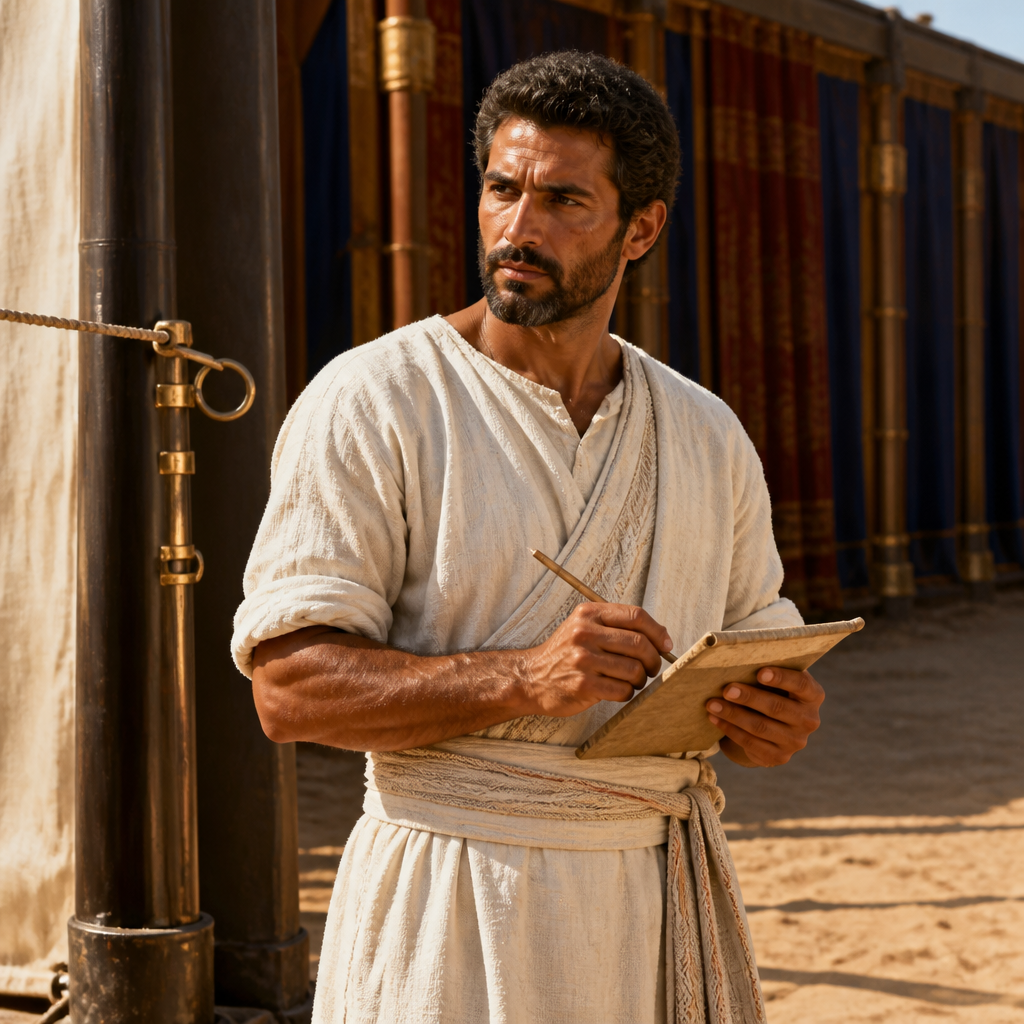
One of Ithamar's first recorded specific duties was the accounting of the Tabernacle materials. According to Exodus 38:21, the inventory of the gold, silver, and bronze used in the construction of the Tabernacle was recorded by the Levites under the direct supervision of Ithamar. This role suggests a high degree of administrative competence and trust, as he was responsible for the transparency and accuracy of the voluntary offerings provided by the Israelites.
Supervision of the Levite Clans
As the Israelites moved through the wilderness, the physical transport of the Tabernacle was a massive logistical undertaking. While his brother Eleazar oversaw the most sacred items (such as the Ark of the Covenant), Ithamar was placed in charge of the Gershonites and the Merarites (Numbers 4:28, 33). The Gershonites were responsible for the curtains, coverings, and screens, while the Merarites handled the heavy structural elements, including the boards, bars, pillars, and sockets. Ithamar’s role was to ensure these clans fulfilled their specific duties whenever the camp set out or rested. In Numbers 7:8, it is noted that he managed the distribution of four carts and eight oxen to the Merarites to facilitate this labor.
The Incident of the Sin Offering
Following the death of Nadab and Abihu, a moment of tension occurred between Moses and the remaining sons of Aaron. Moses became angry with Eleazar and Ithamar because they had burned the goat of the sin offering instead of eating it in a holy place as commanded (Leviticus 10:16-20). Aaron stepped in to defend his sons, explaining that in light of the day's tragedies, such an act seemed inappropriate. Moses was satisfied with the explanation, sparing Ithamar and his brother from further rebuke.
Relationship to Other Biblical Figures
Ithamar worked in close proximity to the two greatest leaders of the era: his father Aaron and his uncle Moses. His relationship with his brother Eleazar appears to have been one of shared responsibility rather than rivalry, though the biblical text later notes that Eleazar’s line became more numerous. In the time of King David, the descendants of Ithamar were organized into eight divisions of priests, while Eleazar’s descendants formed sixteen (1 Chronicles 24:4). Despite this difference in size, both lines were recognized as legitimate "officers of the sanctuary."
Spiritual Significance
Ithamar represents the theme of faithful service in the shadow of both privilege and peril. He witnessed the devastating consequences of liturgical disobedience through his brothers' deaths, yet he remained steadfast in his duties. His life emphasizes the importance of administrative stewardship within the community of faith. By overseeing the "inventory" and the "transport" of the Tabernacle, Ithamar demonstrated that mundane tasks—accounting, logistics, and manual labor—are essential components of divine worship. His legacy is one of endurance, as his line continued to serve the God of Israel for centuries.
Theologically, Ithamar serves as a bridge between the initial consecration of the Aaronic priesthood and the long-term institutionalization of Levite service. His role as an administrator highlights that the sanctity of the Tabernacle was maintained not only by the High Priest’s rituals but also by the diligent oversight of the physical structure and its resources. The survival and continued service of his lineage (the 'sons of Ithamar') throughout the Old Testament serve as a testament to God's preservation of the priestly office despite early familial failures.
His specific mention in the genealogies of 1 Chronicles and the book of Ezra confirms that he was a foundational figure for the Jewish priesthood. While his brother Eleazar held the primary line of the High Priesthood (producing Phinehas and Zadok), the house of Ithamar provided essential leadership, including figures like Ahimelech, ensuring that the service of God remained a multi-faceted communal endeavor.
Frequently Asked Questions
Who were Ithamar's parents?
Ithamar was the son of Aaron, the first High Priest, and Elisheba, the daughter of Amminadab.
What happened to Ithamar's older brothers?
His two oldest brothers, Nadab and Abihu, died when God sent fire to consume them for offering 'unauthorized fire' in the Tabernacle. His other brother, Eleazar, survived and served alongside him.
What was Ithamar's specific job in the wilderness?
He was responsible for the inventory of the Tabernacle materials and directed the work of the Gershonite and Merarite clans of the Levites, who transported the Tabernacle structure.
Did Ithamar have descendants who were also priests?
Yes.
Was Ithamar ever the High Priest?
The Bible does not record Ithamar becoming High Priest; that office passed from Aaron to his third son, Eleazar. However, Ithamar held a high leadership position within the priesthood.
Family & Relationships
 IthamarThis page
 AbihuBrotherExodus 6:23Stated
 Eleazar, Son of AaronBrotherExodus 6:23Stated
 Nadab, Son of AaronBrotherExodus 6:23Stated
Extended family
 MosesUncleExodus 6:23
Inferred
Exodus 38:21 names Ithamar and Moses together among the levites, which is a shared office rather than a stated uncle tie.Evidence: Exodus 6:23; Exodus 38:21; Numbers 4:28; Numbers 4:33; Leviticus 10:16
Connected Figures
Family

Father · Exodus 6:23
The first High Priest of Israel, elder brother of Moses, and primary spokesman for the Israelites during the Exodus from Egypt.
Egypt and WildernessFirst: Exodus 4:14338 versesHigh Priest, ProphetLevi

Mother · Exodus 6:23
The wife of Aaron the High Priest and a daughter of the tribe of Judah, Elisheba provided the genealogical link between the Levitical priesthood and the Davidic royal line.
Egypt and WildernessFirst: Exodus 6:232 versesMatriarch of the Aaronic PriesthoodJudah
Brother · Exodus 6:23
The second son of Aaron who was appointed as a priest but suffered divine judgment for offering unauthorized fire before the LORD.
Brother · Exodus 6:23
Eleazar was the third son of Aaron and his successor as the High Priest of Israel, serving as a key leader alongside Moses and Joshua during the wilderness wanderings and the conquest of Canaan.
Egypt and WildernessFirst: Exodus 6:2361 versesHigh PriestLevi
Brother · Exodus 6:23
Nadab was the firstborn son of Aaron and a high-ranking priest who was consumed by fire from the LORD for offering unauthorized incense during the wilderness wanderings.
Uncle · Exodus 6:23
The preeminent prophet and lawgiver of Israel who led the Hebrews out of Egyptian bondage and mediated the Covenant at Mount Sinai.
Egypt and WildernessFirst: Exodus 2:10844 versesProphet, Judge, and LawgiverLevi
Categories
Mentions by Book
- Exodus6
- Leviticus3
- Numbers6
- 1 Chronicles7
- Ezra1
Scripture References
All 23 indexed verses, in canonical order, from the Berean Standard Bible.
Exodus · 6
- Exodus 6:23
And Aaron married Elisheba, the daughter of Amminadab and sister of Nahshon, and she bore him Nadab and Abihu, Eleazar and Ithamar.
- Exodus 6:24Partial
The sons of Korah were Assir, Elkanah, and Abiasaph. These were the clans of the Korahites.
Cited as evidence on a family card; added so References, Key Verses and Mentions by Book share one index.
- Exodus 6:25Partial
Aaron’s son Eleazar married one of the daughters of Putiel, and she bore him Phinehas. These were the heads of the Levite families by their clans.
Cited as evidence on a family card; added so References, Key Verses and Mentions by Book share one index.
- Exodus 6:26Partial
It was this Aaron and Moses to whom the LORD said, “Bring the Israelites out of the land of Egypt by their divisions.”
Cited as evidence on a family card; added so References, Key Verses and Mentions by Book share one index.
- Exodus 28:1
“Next, have your brother Aaron brought to you from among the Israelites, along with his sons Nadab, Abihu, Eleazar, and Ithamar, to serve Me as priests.
- Exodus 38:21
This is the inventory for the tabernacle, the tabernacle of the Testimony, as recorded at Moses’ command by the Levites under the direction of Ithamar son of Aaron the priest.
Leviticus · 3
- Leviticus 10:6
Then Moses said to Aaron and his sons Eleazar and Ithamar, “Do not let your hair become disheveled and do not tear your garments, or else you will die, and the LORD will be angry with the whole congregation. But your brothers, the whole house of Israel, may mourn on account of the fire that the LORD has ignited.
- Leviticus 10:12
And Moses said to Aaron and his remaining sons, Eleazar and Ithamar, “Take the grain offering that remains from the food offerings to the LORD and eat it without leaven beside the altar, because it is most holy.
- Leviticus 10:16
Later, Moses searched carefully for the goat of the sin offering, and behold, it had been burned up. He was angry with Eleazar and Ithamar, Aaron’s remaining sons, and asked,
Numbers · 6
- Numbers 3:2
These are the names of the sons of Aaron: Nadab the firstborn, then Abihu, Eleazar, and Ithamar.
- Numbers 3:4
Nadab and Abihu, however, died in the presence of the LORD when they offered unauthorized fire before the LORD in the Wilderness of Sinai. And since they had no sons, only Eleazar and Ithamar served as priests during the lifetime of their father Aaron.
- Numbers 4:28
This is the service of the Gershonite clans at the Tent of Meeting, and their duties shall be under the direction of Ithamar son of Aaron the priest.
- Numbers 4:33
This is the service of the Merarite clans according to all their work at the Tent of Meeting, under the direction of Ithamar son of Aaron the priest.”
- Numbers 7:8
and he gave the Merarites four carts and eight oxen, as their service required, all under the direction of Ithamar son of Aaron the priest.
- Numbers 26:60
Nadab, Abihu, Eleazar, and Ithamar were born to Aaron,
1 Chronicles · 7
- 1 Chronicles 6:3
The children of Amram: Aaron, Moses, and Miriam. The sons of Aaron: Nadab, Abihu, Eleazar, and Ithamar.
- 1 Chronicles 24:1
These were the divisions of the descendants of Aaron. The sons of Aaron were Nadab, Abihu, Eleazar, and Ithamar.
- 1 Chronicles 24:2
But Nadab and Abihu died before their father did, and they had no sons; so Eleazar and Ithamar served as priests.
- 1 Chronicles 24:3
With the help of Eleazar’s descendant Zadok and Ithamar’s descendant Ahimelech, David divided them according to the offices of their service.
- 1 Chronicles 24:4Partial
Since more leaders were found among Eleazar’s descendants than those of Ithamar, they were divided accordingly. There were sixteen heads of families from the descendants of Eleazar and eight from the descendants of Ithamar.
- 1 Chronicles 24:5
Thus they were divided by lot, for there were officers of the sanctuary and officers of God among both Eleazar’s and Ithamar’s descendants.
- 1 Chronicles 24:6
The scribe, Shemaiah son of Nethanel, a Levite, recorded their names in the presence of the king and of the officers: Zadok the priest, Ahimelech son of Abiathar, and the heads of families of the priests and the Levites—one family being taken from Eleazar, and then one from Ithamar.
Ezra · 1
- Ezra 8:2
from the descendants of Phinehas, Gershom; from the descendants of Ithamar, Daniel; from the descendants of David, Hattush