Nadab, Son of Aaron
Who was Nadab, Son of Aaron, in the Bible?
Nadab was the firstborn son of Aaron and a high-ranking priest who was consumed by fire from the LORD for offering unauthorized incense during the wilderness wanderings.
This is one of 4 people named Nadab in the Bible. See all 4 →
Nadab was a central figure in the establishment of the Israelite priesthood during the Exodus and wilderness period. As the eldest son of Aaron and the nephew of Moses, he occupied a position of immense spiritual and social prestige. He was among the select few invited to ascend Mount Sinai to behold the glory of God, and he was later consecrated as one of the original priests of the Tabernacle.
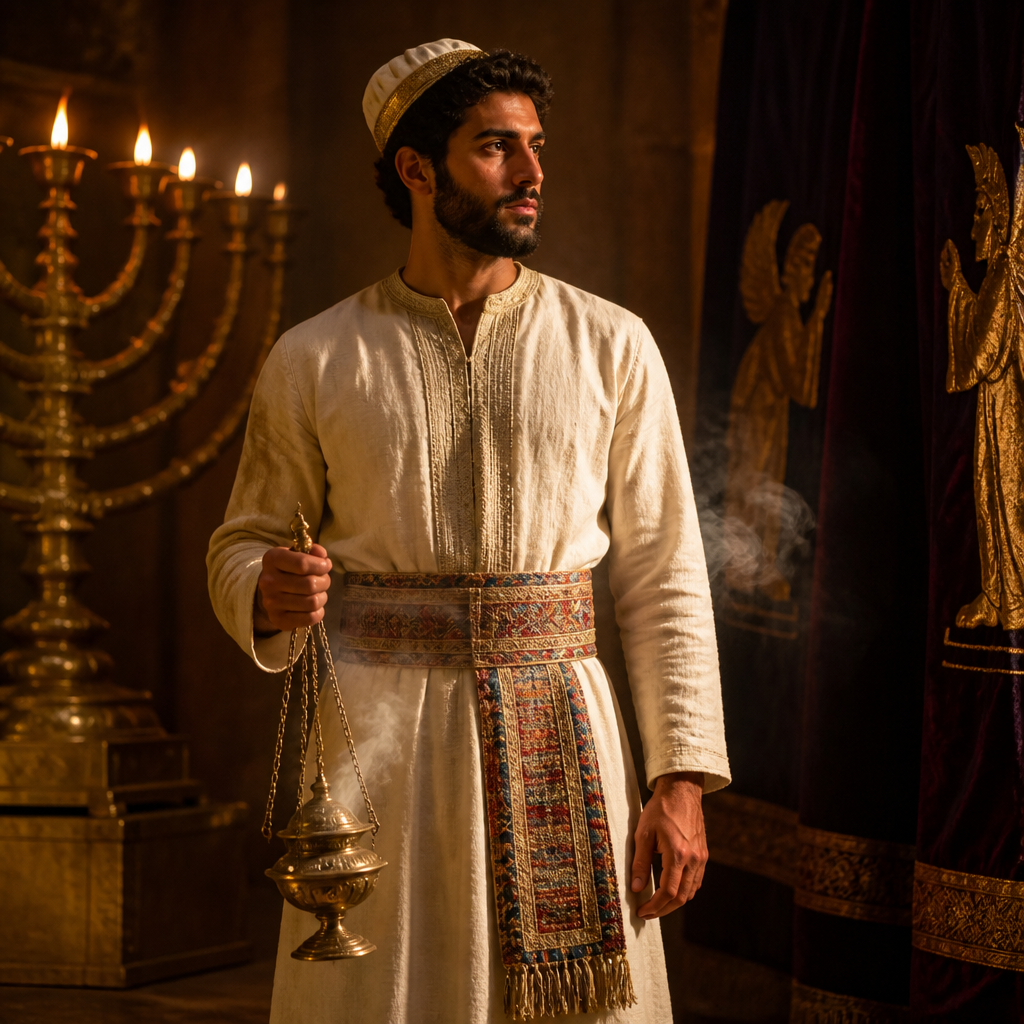
Despite his high calling and noble lineage, Nadab is primarily remembered for a single, catastrophic act of disobedience. Along with his brother Abihu, he presented 'unauthorized fire' before the LORD at the Tabernacle in the Sinai Wilderness. This breach of divine protocol resulted in his immediate death by fire from the presence of God, serving as a sobering warning regarding the holiness required of those who approach the Divine.
Background and Family
Nadab was born into the Tribe of Levi during the period of Israel's presence in Egypt. He was the firstborn son of Aaron, who would become Israel’s first High Priest, and Elisheba, the daughter of Amminadab (Exodus 6:23). His maternal lineage linked him to Nahshon, a prominent leader of the tribe of Judah. Nadab grew up with three brothers: Abihu, Eleazar, and Ithamar. As the eldest son, he likely carried significant expectations for leadership within the burgeoning nation of Israel.
His family was at the epicenter of the Exodus events. As his father Aaron served as the primary spokesman for Moses, Nadab would have witnessed the plagues of Egypt and the crossing of the Red Sea. Following the departure from Egypt, he was formally recognized in the genealogies of the Levites as a primary descendant of Amram (1 Chronicles 6:3).
Major Life Events
The Ascent of Mount Sinai
One of the most significant honors bestowed upon Nadab occurred shortly after the arrival of the Israelites at Mount Sinai. In Exodus 24, God commanded Moses to bring Aaron, Nadab, Abihu, and seventy elders up the mountain to worship. While the general congregation remained at the base, Nadab and his companions were permitted to see a vision of the God of Israel. The text describes a pavement of sapphire stone under God’s feet, as clear as the sky itself (Exodus 24:9-10). This experience solidified Nadab’s status as a top-tier leader and a witness to the divine presence.
Consecration to the Priesthood
In Exodus 28, God explicitly named Nadab as one of the individuals to be set apart for the priesthood. Along with his father and brothers, he underwent a rigorous seven-day consecration process involving ritual washings, the donning of sacred garments, and specific sacrifices. As a priest, Nadab was tasked with mediating between God and the people, maintaining the Tabernacle, and ensuring that sacrifices were performed according to the strict patterns revealed to Moses.
The Incident of Unauthorized Fire
The defining moment of Nadab’s life occurred shortly after the Tabernacle was inaugurated. According to Leviticus 10, Nadab and Abihu took their respective censers, put fire in them, added incense, and offered 'unauthorized fire' (sometimes translated as 'strange fire') before the LORD. The text specifies that this was 'contrary to His command.' The exact nature of their sin is a matter of scholarly debate—some suggest they used fire from a source other than the brazen altar, while others note the timing or the unauthorized entry into the Most Holy Place. Regardless of the technicality, the response was immediate: fire came out from the presence of the LORD and consumed them, and they died before the LORD (Leviticus 10:1-2).
Relationship to Other Biblical Figures
Nadab’s life was defined by his proximity to the founders of the Israelite religious system. He was the 'firstborn' (Numbers 3:2), which under normal circumstances would have made him the primary heir to Aaron’s high-priestly office. His death, however, shifted the line of succession. Because Nadab and his brother Abihu died without having any sons (Numbers 3:4, 1 Chronicles 24:2), the priestly duties fell to his younger brothers, Eleazar and Ithamar. The subsequent lineages of the Jewish priesthood were traced exclusively through these two younger brothers, as Nadab’s line ended with his death in the wilderness.
Spiritual Significance
In the biblical narrative, Nadab serves as a potent symbol of the dangers of liturgical presumption. His story emphasizes that proximity to the divine does not grant immunity from the requirements of obedience; rather, it increases the standard of accountability. Moses explained the tragedy to Aaron by quoting the LORD: 'Among those who approach me I will be proved holy; in the sight of all the people I will be honored' (Leviticus 10:3).
Nadab’s sudden death established a precedent for the sanctity of the Tabernacle and the absolute necessity of following divine instructions regarding worship. It highlighted the tension between God’s approachability (demonstrated by the meal on Mount Sinai) and His consuming holiness (demonstrated by the fire in the Tabernacle). The loss of Nadab was a foundational trauma for the house of Aaron, shaping the cautious and precise way the priesthood operated for centuries to come.
Theological reflection on Nadab typically focuses on the concept of 'strange fire' and the holiness of God. His life demonstrates that even those who have seen the glory of God firsthand (as he did on Sinai) are capable of fatal disobedience. His death marks a pivotal transition in the Aaronic priesthood, as the disqualification of the firstborn necessitated the rise of the younger lines of Eleazar and Ithamar, who would go on to define the Zadokite and other priestly orders.
Nadab is often cited in discussions regarding the 'regulative principle of worship'—the idea that God should only be worshiped in the ways He has specifically commanded. His narrative serves as a stark warning that the inner motives of worship must be matched by an outward adherence to God’s revealed will, especially for those in positions of religious leadership.
Frequently Asked Questions
What was the 'unauthorized fire' that Nadab offered?
The Bible does not provide a technical definition, but it notes the fire was 'contrary to [God's] command.' Most scholars believe it was fire taken from a common source rather than the sacred fire on the bronze altar, or that the offering was made at an unauthorized time or place.
Did Nadab have any children?
No. Numbers 3:4 and 1 Chronicles 24:2 explicitly state that Nadab and Abihu died without having any sons, which resulted in the priestly line continuing through their younger brothers.
What happened to Nadab's body after he died?
Moses instructed Mishael and Elzaphan, cousins of Aaron, to carry the bodies of Nadab and Abihu outside the camp while they were still in their priestly tunics.
Was Aaron allowed to mourn for Nadab?
No. Moses commanded Aaron and his surviving sons not to let their hair hang loose or tear their clothes in mourning, as they were still under the anointing of the priesthood. The rest of the Israelites, however, were permitted to mourn the loss.
Where did Nadab die?
Nadab died in the Wilderness of Sinai, specifically at the Tabernacle, shortly after it had been dedicated for service.
Family & Relationships
 Nadab, Son of AaronThis page
 AbihuBrotherExodus 6:23Stated
 Eleazar, Son of AaronBrotherExodus 6:23Stated
 IthamarBrotherExodus 6:23Stated
Extended family
 MosesUncleExodus 6:23
Inferred
1 Chronicles 6:3 lists Nadab and Moses among the children of amram, but does not say how the two of them are related.Evidence: Exodus 6:23; Numbers 3:2; Numbers 26:60; 1 Chronicles 6:3; Leviticus 10:16
Connected Figures
Family

Father · Exodus 6:23
The first High Priest of Israel, elder brother of Moses, and primary spokesman for the Israelites during the Exodus from Egypt.
Egypt and WildernessFirst: Exodus 4:14338 versesHigh Priest, ProphetLevi

Mother · Exodus 6:23
The wife of Aaron the High Priest and a daughter of the tribe of Judah, Elisheba provided the genealogical link between the Levitical priesthood and the Davidic royal line.
Egypt and WildernessFirst: Exodus 6:232 versesMatriarch of the Aaronic PriesthoodJudah
Brother · Exodus 6:23
The second son of Aaron who was appointed as a priest but suffered divine judgment for offering unauthorized fire before the LORD.
Brother · Exodus 6:23
Eleazar was the third son of Aaron and his successor as the High Priest of Israel, serving as a key leader alongside Moses and Joshua during the wilderness wanderings and the conquest of Canaan.
Egypt and WildernessFirst: Exodus 6:2361 versesHigh PriestLevi
Brother · Exodus 6:23
The youngest son of Aaron and Elisheba, Ithamar was a high-ranking priest who supervised the construction of the Tabernacle and the duties of the Levites during the Wilderness wanderings.
Egypt and WildernessFirst: Exodus 6:2323 versesPriest and Tabernacle AdministratorLevi
Uncle · Exodus 6:23
The preeminent prophet and lawgiver of Israel who led the Hebrews out of Egyptian bondage and mediated the Covenant at Mount Sinai.
Egypt and WildernessFirst: Exodus 2:10844 versesProphet, Judge, and LawgiverLevi
Categories
Mentions by Book
- Exodus7
- Leviticus2
- Numbers4
- 1 Chronicles3
Scripture References
All 16 indexed verses, in canonical order, from the Berean Standard Bible.
Exodus · 7
- Exodus 6:23
And Aaron married Elisheba, the daughter of Amminadab and sister of Nahshon, and she bore him Nadab and Abihu, Eleazar and Ithamar.
- Exodus 6:24Partial
The sons of Korah were Assir, Elkanah, and Abiasaph. These were the clans of the Korahites.
Cited as evidence on a family card; added so References, Key Verses and Mentions by Book share one index.
- Exodus 6:25Partial
Aaron’s son Eleazar married one of the daughters of Putiel, and she bore him Phinehas. These were the heads of the Levite families by their clans.
Cited as evidence on a family card; added so References, Key Verses and Mentions by Book share one index.
- Exodus 6:26Partial
It was this Aaron and Moses to whom the LORD said, “Bring the Israelites out of the land of Egypt by their divisions.”
Cited as evidence on a family card; added so References, Key Verses and Mentions by Book share one index.
- Exodus 24:1
Then the LORD said to Moses, “Come up to the LORD—you and Aaron, Nadab and Abihu, and seventy of Israel’s elders—and you are to worship at a distance.
- Exodus 24:9
Then Moses went up with Aaron, Nadab and Abihu, and seventy of the elders of Israel,
- Exodus 28:1
“Next, have your brother Aaron brought to you from among the Israelites, along with his sons Nadab, Abihu, Eleazar, and Ithamar, to serve Me as priests.
Leviticus · 2
- Leviticus 10:1
Now Aaron’s sons Nadab and Abihu took their censers, put fire in them and added incense, and offered unauthorized fire before the LORD, contrary to His command.
- Leviticus 10:2Partial
So fire came out from the presence of the LORD and consumed them, and they died in the presence of the LORD.
Cited as a key verse; added so References, Key Verses and Mentions by Book share one index.
Numbers · 4
- Numbers 3:2
These are the names of the sons of Aaron: Nadab the firstborn, then Abihu, Eleazar, and Ithamar.
- Numbers 3:4
Nadab and Abihu, however, died in the presence of the LORD when they offered unauthorized fire before the LORD in the Wilderness of Sinai. And since they had no sons, only Eleazar and Ithamar served as priests during the lifetime of their father Aaron.
- Numbers 26:60
Nadab, Abihu, Eleazar, and Ithamar were born to Aaron,
- Numbers 26:61
but Nadab and Abihu died when they offered unauthorized fire before the LORD.
1 Chronicles · 3
- 1 Chronicles 6:3
The children of Amram: Aaron, Moses, and Miriam. The sons of Aaron: Nadab, Abihu, Eleazar, and Ithamar.
- 1 Chronicles 24:1
These were the divisions of the descendants of Aaron. The sons of Aaron were Nadab, Abihu, Eleazar, and Ithamar.
- 1 Chronicles 24:2
But Nadab and Abihu died before their father did, and they had no sons; so Eleazar and Ithamar served as priests.
Others Named Nadab
Compare all 4 bearers →Nadab, Son of Jeroboam1 Kings 14:20
The second king of the northern kingdom of Israel, Nadab was the son of Jeroboam I and was assassinated by Baasha during the siege of Gibbethon.
Nadab, Son of Shammai1 Chronicles 2:28
A member of the Tribe of Judah through the lineage of Jerahmeel, Nadab was a family patriarch during the era of the conquest and the judges noted for his place in the Chronicler’s genealogy.
Nadab, Son of Abiel1 Chronicles 8:30
A Benjaminite nobleman of Gibeon and the son of Abiel, known as an uncle of King Saul and a member of the ancestral line that established the first royal house of Israel.