Moses
Who was Moses in the Bible?
The preeminent prophet and lawgiver of Israel who led the Hebrews out of Egyptian bondage and mediated the Covenant at Mount Sinai.
Moses is the central human figure of the Pentateuch, serving as the mediator between the LORD and the nation of Israel. Born during a period of intense persecution in Egypt, his life is traditionally divided into three distinct forty-year periods: his upbringing in the Egyptian royal court, his exile and shepherd life in Midian, and his leadership of the Israelites through the wilderness. He is uniquely described as the man whom the LORD knew face to face and the humblest man on the face of the earth.
Moses’ role encompassed that of a prophet, judge, military leader, and intercessor. He was the recipient of the Ten Commandments and the detailed instructions for the Tabernacle, establishing the liturgical and legal foundations of the Israelite faith. Despite his significance, the biblical record highlights his human frailties, including his initial reluctance to serve and the specific act of disobedience that prevented him from entering the Promised Land.
Background and Family
Moses was born to Amram and Jochebed of the tribe of Levi during a time when the Egyptian Pharaoh had decreed the death of all male Hebrew infants. To save him, his mother placed him in a basket among the reeds of the Nile. He was discovered and adopted by Pharaoh’s daughter, who named him Moses, stating, "I drew him out of the water" (Exodus 2:10). Despite his royal upbringing, he remained aware of his Hebrew heritage.
His immediate family played significant roles in his ministry. His brother, Aaron, served as his spokesperson and the first High Priest, while his sister, Miriam, was a prophetess. Moses married Zipporah, the daughter of Jethro (also called Reuel), a priest of Midian, while in exile after killing an Egyptian taskmaster. He had two sons, Gershom and Eliezer. Although his family provided support, they also presented challenges, such as when Miriam and Aaron criticized his marriage to a Cushite woman and questioned his unique authority (Numbers 12).
Major Life Events
The Burning Bush and the Exodus
Moses’ public ministry began at Mount Horeb, where God appeared to him in a burning bush that was not consumed. Despite Moses’ protests regarding his lack of eloquence, God appointed him to confront Pharaoh. Following a series of ten plagues that demonstrated God's sovereignty over the Egyptian pantheon, Moses led the Israelites out of Egypt, famously parting the Red Sea to escape the pursuing Egyptian army.
The Sinai Covenant
At Mount Sinai, Moses ascended into the presence of God to receive the Law. This period was marked by the delivery of the Decalogue (Ten Commandments) and the establishment of the Mosaic Covenant. During his forty-day absence, the people fell into idolatry with the Golden Calf, leading Moses to break the original stone tablets in anger—a reflection of the broken covenant. He subsequently interceded for the nation, sparing them from divine destruction, and received a second set of tablets.
The Wilderness Wanderings
For forty years, Moses led a rebellious and often ungrateful population through the wilderness. He managed constant complaints regarding food and water, organized the census of the tribes, and oversaw the construction of the Tabernacle according to the heavenly pattern shown to him. A pivotal moment occurred at Kadesh, where Moses struck a rock to produce water instead of speaking to it as commanded. This act of unbelief and failure to uphold God’s holiness resulted in the divine decree that Moses would see the Promised Land from a distance but never enter it.
Relationship to Other Biblical Figures
Moses’ most intimate relationship was with the LORD, with whom he spoke "face to face, as a man speaks to his friend" (Exodus 33:11). Among his peers, Joshua son of Nun emerged as his loyal attendant and eventual successor, being one of the few who remained faithful during the spying of Canaan. Moses also had a complex relationship with the Israelites; while he was their fiercest advocate in prayer, he was often the target of their grumbling and attempted insurrections, such as the rebellion led by Korah.
In the New Testament, Moses is frequently contrasted with Jesus Christ. While the Law was given through Moses, grace and truth came through Jesus Christ (John 1:17). However, the writer of Hebrews notes that Moses was "faithful in all God’s house" as a servant, pointing toward the greater glory of Christ as the Son over the house (Hebrews 3:5-6).
Spiritual Significance
Moses stands as the archetype of the prophet. His life illustrates the themes of redemption, law, and intercession. The "Song of Moses," recorded in both the Pentateuch and the Book of Revelation, signifies his lasting legacy as a witness to God’s justice and power. He is the standard by which all subsequent prophets in Israel were measured, and he notably appeared alongside Elijah during the Transfiguration of Jesus, representing the Law and the Prophets witnessing to the Messiah. His death on Mount Nebo and his burial by God Himself underscore his unique status in the biblical narrative.
Theologically, Moses is the foundational figure of the Old Covenant. He serves as the mediator through whom God revealed His holy name (YHWH) and His moral requirements for humanity. The 'Law of Moses' (Torah) became the definitive guide for Israel's identity, ethics, and worship. His life demonstrates the principle of divine election—God choosing a flawed, 'slow of speech' individual to confound the might of an empire.
In New Testament theology, Moses is viewed both as a historical figure of immense faith (Hebrews 11:23-28) and as a prophetic type of Christ. The promise in Deuteronomy 18:15 that God would raise up a 'prophet like Moses' is interpreted by the apostles as being fulfilled in Jesus. Furthermore, the transition from the Mosaic Law to the Gospel of Christ is a central theme in the Pauline epistles, which argue that while the Law revealed sin, Christ provided the justification the Law could not achieve.
Frequently Asked Questions
Why was Moses not allowed to enter the Promised Land?
Moses was barred from entering Canaan because he disobeyed God’s specific instruction at Meribah. Instead of speaking to the rock to bring forth water, he struck it twice in anger, failing to trust God and honor His holiness before the Israelites (Numbers 20:11-12).
What does the name 'Moses' mean?
According to Exodus 2:10, the name is derived from the Hebrew verb 'mashah,' meaning 'to draw out,' because Pharaoh’s daughter drew him out of the water of the Nile.
Who were the parents of Moses?
Moses was the son of Amram and Jochebed, both of whom were from the tribe of Levi (Exodus 6:20).
How long did Moses live?
Moses lived to be 120 years old. His life is traditionally divided into three 40-year segments: his time in Egypt, his time in Midian, and his time leading Israel in the wilderness (Deuteronomy 34:7).
Did Moses have a wife and children?
Yes, Moses married Zipporah, the daughter of Jethro. They had two sons named Gershom and Eliezer (Exodus 2:21-22, 18:3-4).
Family & Relationships
Parents
 Amram, Father of MosesFatherExodus 6:20Stated
 JochebedMotherExodus 6:20Stated
 ZipporahWifeExodus 18:2Stated
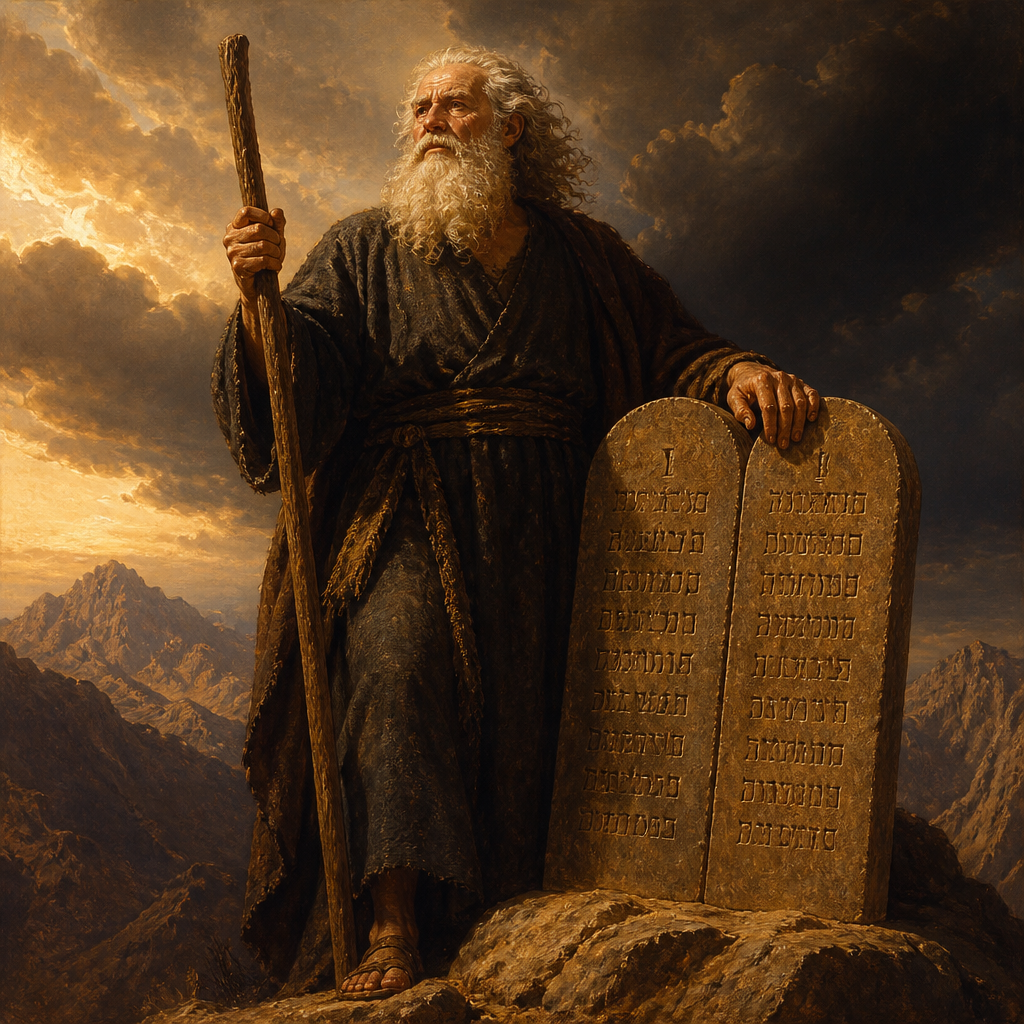 MosesThis page
 AaronBrotherExodus 6:20Stated
 Miriam, Prophetess and Sister of MosesSisterNumbers 26:59Stated
Children
 Eliezer, Son of MosesSon1 Chronicles 23:15Stated
 Gershom, Son of MosesSonJudges 18:30Stated
Extended family
 JethroFather-in-lawExodus 3:1Stated
 HobabBrother-in-lawExodus 2:21
Inferred
No verse names Hobab and Moses together; the brother-in-law link is carried from the surrounding genealogy and is not stated in Scripture.Evidence: Exodus 2:21
 KohathGrandfatherExodus 6:18
Inferred
Reconstructed through Amram: Exodus 6:20 ties Moses to Amram; Exodus 6:18 ties Amram to Kohath. No verse states the grandfather link between Moses and Kohath directly.Evidence: Exodus 6:18; Numbers 26:58; 1 Chronicles 6:2; 1 Chronicles 6:18; Exodus 6:20; Numbers 26:59
 Levi, Son of JacobGreat-GrandfatherNumbers 26:59
Inferred
Numbers 26:59 names Moses and Levi in the same verse but does not state a great-grandfather tie between them; the link rests on the surrounding narrative.Evidence: Numbers 26:59; Exodus 6:20
 Jonathan, Priest to the Tribe of DanGrandsonJudges 18:30Stated
 RehabiahGrandson1 Chronicles 23:15
Inferred
Reconstructed through Eliezer: 1 Chronicles 23:17 ties Rehabiah to Eliezer; 1 Chronicles 23:15 ties Eliezer to Moses. No verse states the grandfather link between Rehabiah and Moses directly.Evidence: 1 Chronicles 23:15; 1 Chronicles 23:17
 Shebuel, Grandson of MosesGrandson1 Chronicles 23:16
Inferred
1 Chronicles 26:24 names Moses and Shebuel in the same verse but does not state a grandson tie between them; the link rests on the surrounding narrative.Evidence: 1 Chronicles 23:16; Judges 18:30; 1 Chronicles 23:15; 1 Chronicles 26:24
 Hebron, Son of KohathUncleExodus 6:18
Inferred
Reconstructed through Amram: Exodus 6:18 ties Hebron to Amram; Exodus 6:20 ties Amram to Moses. No verse states the nephew link between Hebron and Moses directly.Evidence: Exodus 6:18; Exodus 6:20; Numbers 26:59
 IthamarNephewExodus 6:23
Inferred
Exodus 38:21 names Ithamar and Moses together among the levites, which is a shared office rather than a stated uncle tie.Evidence: Exodus 6:23; Exodus 38:21; Numbers 4:28; Numbers 4:33; Leviticus 10:16
 Izhar, Levite of the ExodusUncleExodus 6:18
Inferred
Reconstructed through Amram: Exodus 6:20 ties Moses to Amram; Exodus 6:18 ties Amram to Izhar. No verse states the uncle link between Moses and Izhar directly.Evidence: Exodus 6:18; Exodus 6:20; Numbers 26:59
 Nadab, Son of AaronNephewExodus 6:23
Inferred
1 Chronicles 6:3 lists Nadab and Moses among the children of amram, but does not say how the two of them are related.Evidence: Exodus 6:23; Numbers 3:2; Numbers 26:60; 1 Chronicles 6:3; Leviticus 10:16
 Nepheg, Son of IzharCousinExodus 2:10
Inferred
Reconstructed through Amram and Izhar: Exodus 6:20 ties Moses to Amram; Exodus 6:18 ties Amram to Izhar; Exodus 6:21 ties Izhar to Nepheg. No verse states the cousin link between Moses and Nepheg directly.Evidence: Exodus 2:10
 Zichri, Levite of the ExodusCousinExodus 6:20
Inferred
Reconstructed through Izhar and Shelomith: Exodus 6:21 ties Zichri to Izhar; 1 Chronicles 23:18 ties Izhar to Shelomith; Leviticus 24:11 ties Shelomith to Moses (itself an inferred link). No verse states the cousin link between Zichri and Moses directly.Evidence: Exodus 6:20
 SithriRelativeExodus 2:10
Inferred
Reconstructed through Uzziel and Amram: Exodus 6:22 ties Sithri to Uzziel; Exodus 6:18 ties Uzziel to Amram; Exodus 6:20 ties Amram to Moses. No verse states the relative link between Sithri and Moses directly.Evidence: Exodus 2:10
 Shelomith, Levite Son of IzharRelativeLeviticus 24:11
Inferred
Leviticus 24:11 names Moses and Shelomith in the same verse but does not state a relative tie between them; the link rests on the surrounding narrative.Evidence: Leviticus 24:11
Connected Figures
Family
Father · Exodus 6:20
A Levite of the Kohathite clan best known as the father of the three primary leaders of the Exodus: Moses, Aaron, and Miriam.
Mother · Exodus 6:20
A woman of the tribe of Levi who was the mother of Moses, Aaron, and Miriam during the Israelites' sojourn in Egypt.
Egypt and WildernessFirst: Exodus 6:205 versesMatriarch of the Levite leadershipLevi
Wife · Exodus 18:2
The Midianite wife of Moses who saved his life by performing an emergency circumcision during his return to Egypt.
Egypt and WildernessFirst: Exodus 2:217 versesDaughter of a priest, Shepherdess
Son · 1 Chronicles 23:15
The second son of Moses and Zipporah, whose name commemorates God's deliverance of his father from the sword of Pharaoh.
Son · Judges 18:30
Gershom was the firstborn son of the prophet Moses and Zipporah, born in Midian during Moses' exile from Egypt.
Brother · Exodus 6:20
The first High Priest of Israel, elder brother of Moses, and primary spokesman for the Israelites during the Exodus from Egypt.
Egypt and WildernessFirst: Exodus 4:14338 versesHigh Priest, ProphetLevi
Sister · Numbers 26:59
A prophetess of the Tribe of Levi who served as a prominent leader of Israel alongside her brothers Moses and Aaron during the Exodus and wilderness wanderings.
Egypt and WildernessFirst: Exodus 15:2012 versesProphetessLevi
Father-in-law · Exodus 3:1
The Midianite priest and father-in-law of Moses who provided sanctuary, gave administrative counsel, and acknowledged the sovereignty of Yahweh during the Exodus.
Egypt and WildernessFirst: Exodus 2:1814 versesPriest of Midian
Brother-in-law · Exodus 2:21
A Midianite and son of Reuel who served as a guide and ally to the Israelites during their wilderness wanderings.
Egypt and WildernessFirst: Numbers 10:296 versesDesert guide
Grandfather · Exodus 6:18
Kohath was the second son of Levi and the patriarchal ancestor of the Kohathites, the Levite clan responsible for transporting the most holy objects of the Tabernacle.
Egypt and WildernessFirst: Genesis 46:1123 versesPatriarch of the Kohathite clanLevi
Great-Grandfather · Numbers 26:59
The third son of Jacob and Leah, a patriarch whose descendants were set apart as the priestly and ministerial class for the nation of Israel.
PatriarchsFirst: Genesis 29:3416 versesPatriarchLevi
Grandson · Judges 18:30
A Levite during the Period of the Judges who established a hereditary priesthood for an idolatrous shrine in the northern territory of Dan.
Conquest and JudgesFirst: Judges 18:301 versesPriest for the Tribe of DanLevi
Categories
Mentions by Book
- Exodus296
- Leviticus84
- Numbers224
- Deuteronomy36
- Joshua52
- Judges5
- 1 Samuel2
- 1 Kings4
- 2 Kings6
- 1 Chronicles11
- 2 Chronicles12
- Ezra3
- Nehemiah7
- Psalms9
- Isaiah2
- Jeremiah1
- Daniel2
- Micah1
- Malachi1
- Matthew7
- Mark9
- Luke10
- John12
- Acts24
- Romans4
- 1 Corinthians2
- 2 Corinthians3
- 2 Timothy1
- Hebrews12
- Jude1
- Revelation1
Scripture References
All 844 indexed verses, in canonical order, from the Berean Standard Bible.
- Exodus 2:10
When the child had grown older, she brought him to Pharaoh’s daughter, and he became her son. She named him Moses and explained, “I drew him out of the water.”
- Exodus 2:11
One day, after Moses had grown up, he went out to his own people and observed their hard labor. He saw an Egyptian beating a Hebrew, one of his own people.
- Exodus 2:13
The next day Moses went out and saw two Hebrews fighting. He asked the one in the wrong, “Why are you attacking your companion?”
- Exodus 2:14
But the man replied, “Who made you ruler and judge over us? Are you planning to kill me as you killed the Egyptian?” Then Moses was afraid and thought, “This thing I have done has surely become known.”
- Exodus 2:15Partial
When Pharaoh heard about this matter, he sought to kill Moses. But Moses fled from Pharaoh and settled in the land of Midian, where he sat down beside a well.
- Exodus 2:17
And when some shepherds came along and drove them away, Moses rose up to help them and watered their flock.
- Exodus 2:21Partial
Moses agreed to stay with the man, and he gave his daughter Zipporah to Moses in marriage.
- Exodus 2:22
And she gave birth to a son, and Moses named him Gershom, saying, “I have become a foreigner in a foreign land.”
- Exodus 3:1
Meanwhile, Moses was shepherding the flock of his father-in-law Jethro, the priest of Midian. He led the flock to the far side of the wilderness and came to Horeb, the mountain of God.
- Exodus 3:2
There the angel of the LORD appeared to him in a blazing fire from within a bush. Moses saw the bush ablaze with fire, but it was not consumed.
- Exodus 3:3
So Moses thought, “I must go over and see this marvelous sight. Why is the bush not burning up?”
- Exodus 3:4Partial
When the LORD saw that he had gone over to look, God called out to him from within the bush, “Moses, Moses!” “Here I am,” he answered.
- Exodus 3:6
Then He said, “I am the God of your father, the God of Abraham, the God of Isaac, and the God of Jacob.” At this, Moses hid his face, for he was afraid to look at God.
- Exodus 3:11
But Moses asked God, “Who am I, that I should go to Pharaoh and bring the Israelites out of Egypt?”
- Exodus 3:13
Then Moses asked God, “Suppose I go to the Israelites and say to them, ‘The God of your fathers has sent me to you,’ and they ask me, ‘What is His name?’ What should I tell them?”
- Exodus 3:14
God said to Moses, “I AM WHO I AM. This is what you are to say to the Israelites: ‘I AM has sent me to you.’”
- Exodus 3:15
God also told Moses, “Say to the Israelites, ‘The LORD, the God of your fathers—the God of Abraham, the God of Isaac, and the God of Jacob—has sent me to you.’ This is My name forever, and this is how I am to be remembered in every generation.
- Exodus 4:1
Then Moses answered, “What if they do not believe me or listen to my voice? For they may say, ‘The LORD has not appeared to you.’”
- Exodus 4:3
“Throw it on the ground,” said the LORD. So Moses threw it on the ground, and it became a snake, and he ran from it.
- Exodus 4:4
“Stretch out your hand and grab it by the tail,” the LORD said to Moses, who reached out his hand and caught the snake, and it turned back into a staff in his hand.
- Exodus 4:6
Furthermore, the LORD said to Moses, “Put your hand inside your cloak.” So he put his hand inside his cloak, and when he took it out, his hand was leprous, white as snow.
- Exodus 4:7
“Put your hand back inside your cloak,” said the LORD. So Moses put his hand back inside his cloak, and when he took it out, it was restored, like the rest of his skin.
- Exodus 4:10
“Please, Lord,” Moses replied, “I have never been eloquent, neither in the past nor since You have spoken to Your servant, for I am slow of speech and tongue.”
- Exodus 4:13
But Moses replied, “Please, Lord, send someone else.”
- Exodus 4:14
Then the anger of the LORD burned against Moses, and He said, “Is not Aaron the Levite your brother? I know that he can speak well, and he is now on his way to meet you. When he sees you, he will be glad in his heart.
- Exodus 4:18Partial
Then Moses went back to his father-in-law Jethro and said to him, “Please let me return to my brothers in Egypt to see if they are still alive.” “Go in peace,” Jethro replied.
- Exodus 4:19
Now the LORD had said to Moses in Midian, “Go back to Egypt, for all the men who sought to kill you are dead.”
- Exodus 4:20Partial
So Moses took his wife and sons, put them on a donkey, and headed back to Egypt. And he took the staff of God in his hand.
- Exodus 4:21
The LORD instructed Moses, “When you go back to Egypt, see that you perform before Pharaoh all the wonders that I have put within your power. But I will harden his heart so that he will not let the people go.
- Exodus 4:24
Now at a lodging place along the way, the LORD met Moses and was about to kill him.
- Exodus 4:25
But Zipporah took a flint knife, cut off her son’s foreskin, and touched it to Moses’ feet. “Surely you are a bridegroom of blood to me,” she said.
- Exodus 4:27
Meanwhile, the LORD had said to Aaron, “Go and meet Moses in the wilderness.” So he went and met Moses at the mountain of God and kissed him.
- Exodus 4:28
And Moses told Aaron everything the LORD had sent him to say, and all the signs He had commanded him to perform.
- Exodus 4:29
Then Moses and Aaron went and assembled all the elders of the Israelites,
- Exodus 4:30
and Aaron relayed everything the LORD had said to Moses. And Moses performed the signs before the people,
- Exodus 5:1
After that, Moses and Aaron went to Pharaoh and said, “This is what the LORD, the God of Israel, says: ‘Let My people go, so that they may hold a feast to Me in the wilderness.’”
- Exodus 5:4
But the king of Egypt said to them, “Moses and Aaron, why do you draw the people away from their work? Get back to your labor!”
- Exodus 5:20
When they left Pharaoh, they confronted Moses and Aaron, who stood waiting to meet them.
- Exodus 5:22
So Moses returned to the LORD and asked, “Lord, why have You brought trouble upon this people? Is this why You sent me?
- Exodus 6:1
But the LORD said to Moses, “Now you will see what I will do to Pharaoh, for because of My mighty hand he will let the people go; because of My strong hand he will drive them out of his land.”
- Exodus 6:2
God also told Moses, “I am the LORD.
- Exodus 6:9Partial
Moses relayed this message to the Israelites, but on account of their broken spirit and cruel bondage, they did not listen to him.
- Exodus 6:10
So the LORD said to Moses,
- Exodus 6:12
But in the LORD’s presence Moses replied, “If the Israelites will not listen to me, then why would Pharaoh listen to me, since I am unskilled in speech?”
- Exodus 6:13
Then the LORD spoke to Moses and Aaron and gave them a charge concerning both the Israelites and Pharaoh king of Egypt, to bring the Israelites out of the land of Egypt.
- Exodus 6:18Partial
The sons of Kohath were Amram, Izhar, Hebron, and Uzziel. Kohath lived 133 years.
Cited as evidence on a family card; added so References, Key Verses and Mentions by Book share one index.
- Exodus 6:19Partial
The sons of Merari were Mahli and Mushi. These were the clans of the Levites according to their records.
Cited as evidence on a family card; added so References, Key Verses and Mentions by Book share one index.
- Exodus 6:20
And Amram married his father’s sister Jochebed, and she bore him Aaron and Moses. Amram lived 137 years.
- Exodus 6:21Partial
The sons of Izhar were Korah, Nepheg, and Zichri.
Cited as evidence on a family card; added so References, Key Verses and Mentions by Book share one index.
- Exodus 6:22Partial
The sons of Uzziel were Mishael, Elzaphan, and Sithri.
Cited as evidence on a family card; added so References, Key Verses and Mentions by Book share one index.
- Exodus 6:23Partial
And Aaron married Elisheba, the daughter of Amminadab and sister of Nahshon, and she bore him Nadab and Abihu, Eleazar and Ithamar.
Cited as evidence on a family card; added so References, Key Verses and Mentions by Book share one index.
- Exodus 6:24Partial
The sons of Korah were Assir, Elkanah, and Abiasaph. These were the clans of the Korahites.
Cited as evidence on a family card; added so References, Key Verses and Mentions by Book share one index.
- Exodus 6:25Partial
Aaron’s son Eleazar married one of the daughters of Putiel, and she bore him Phinehas. These were the heads of the Levite families by their clans.
Cited as evidence on a family card; added so References, Key Verses and Mentions by Book share one index.
- Exodus 6:26
It was this Aaron and Moses to whom the LORD said, “Bring the Israelites out of the land of Egypt by their divisions.”
- Exodus 6:27
Moses and Aaron were the ones who spoke to Pharaoh king of Egypt in order to bring the Israelites out of Egypt.
- Exodus 6:28
Now on the day that the LORD spoke to Moses in Egypt,
- Exodus 6:29
He said to him, “I am the LORD; tell Pharaoh king of Egypt everything I say to you.”
- Exodus 6:30
But in the LORD’s presence Moses replied, “Since I am unskilled in speech, why would Pharaoh listen to me?”
- Exodus 7:1
The LORD answered Moses, “See, I have made you like God to Pharaoh, and your brother Aaron will be your prophet.
- Exodus 7:6
So Moses and Aaron did just as the LORD had commanded them.
- Exodus 7:7
Moses was eighty years old and Aaron was eighty-three when they spoke to Pharaoh.
- Exodus 7:8
The LORD said to Moses and Aaron,
- Exodus 7:10
So Moses and Aaron went to Pharaoh and did just as the LORD had commanded. Aaron threw his staff down before Pharaoh and his officials, and it became a serpent.
- Exodus 7:14
Then the LORD said to Moses, “Pharaoh’s heart is unyielding; he refuses to let the people go.
- Exodus 7:19
And the LORD said to Moses, “Tell Aaron, ‘Take your staff and stretch out your hand over the waters of Egypt—over their rivers and canals and ponds and all the reservoirs—that they may become blood.’ There will be blood throughout the land of Egypt, even in the vessels of wood and stone.”
- Exodus 7:20
Moses and Aaron did just as the LORD had commanded; in the presence of Pharaoh and his officials, Aaron raised the staff and struck the water of the Nile, and all the water was turned to blood.
- Exodus 7:22
But the magicians of Egypt did the same things by their magic arts. So Pharaoh’s heart was hardened, and he would not listen to Moses and Aaron, just as the LORD had said.
- Exodus 8:1
Then the LORD said to Moses, “Go to Pharaoh and tell him that this is what the LORD says: ‘Let My people go, so that they may worship Me.
- Exodus 8:5
And the LORD said to Moses, “Tell Aaron, ‘Stretch out your hand with your staff over the rivers and canals and ponds, and cause the frogs to come up onto the land of Egypt.’”
- Exodus 8:8
Pharaoh summoned Moses and Aaron and said, “Pray to the LORD to take the frogs away from me and my people. Then I will let your people go, that they may sacrifice to the LORD.”
- Exodus 8:9
Moses said to Pharaoh, “You may have the honor over me. When shall I pray for you and your officials and your people that the frogs (except for those in the Nile) may be taken away from you and your houses?”
- Exodus 8:10
“Tomorrow,” Pharaoh answered. “May it be as you say,” Moses replied, “so that you may know that there is no one like the LORD our God.
- Exodus 8:12Partial
After Moses and Aaron had left Pharaoh, Moses cried out to the LORD for help with the frogs that He had brought against Pharaoh.
- Exodus 8:13
And the LORD did as Moses requested, and the frogs in the houses, the courtyards, and the fields died.
- Exodus 8:15
When Pharaoh saw that there was relief, however, he hardened his heart and would not listen to Moses and Aaron, just as the LORD had said.
- Exodus 8:16
Then the LORD said to Moses, “Tell Aaron, ‘Stretch out your staff and strike the dust of the earth, that it may turn into swarms of gnats throughout the land of Egypt.’”
- Exodus 8:20
Then the LORD said to Moses, “Get up early in the morning, and when Pharaoh goes out to the water, stand before him and tell him that this is what the LORD says: ‘Let My people go, so that they may worship Me.
- Exodus 8:25
Then Pharaoh summoned Moses and Aaron and said, “Go, sacrifice to your God within this land.”
- Exodus 8:26
But Moses replied, “It would not be right to do that, because the sacrifices we offer to the LORD our God would be detestable to the Egyptians. If we offer sacrifices that are detestable before the Egyptians, will they not stone us?
- Exodus 8:29
“As soon as I leave you,” Moses said, “I will pray to the LORD, so that tomorrow the swarms of flies will depart from Pharaoh and his officials and his people. But Pharaoh must not act deceitfully again by refusing to let the people go and sacrifice to the LORD.”
- Exodus 8:30
Then Moses left Pharaoh and prayed to the LORD,
- Exodus 8:31
and the LORD did as Moses requested. He removed the swarms of flies from Pharaoh and his officials and his people; not one fly remained.
- Exodus 9:1
Then the LORD said to Moses, “Go to Pharaoh and tell him that this is what the LORD, the God of the Hebrews, says: ‘Let My people go, so that they may worship Me.
- Exodus 9:8Partial
Then the LORD said to Moses and Aaron, “Take handfuls of soot from the furnace; in the sight of Pharaoh, Moses is to toss it into the air.
- Exodus 9:10
So they took soot from the furnace and stood before Pharaoh. Moses tossed it into the air, and festering boils broke out on man and beast.
- Exodus 9:11
The magicians could not stand before Moses, because the boils had broken out on them and on all the Egyptians.
- Exodus 9:12
But the LORD hardened Pharaoh’s heart, and he would not listen to them, just as the LORD had said to Moses.
- Exodus 9:13
Then the LORD said to Moses, “Get up early in the morning, stand before Pharaoh, and tell him that this is what the LORD, the God of the Hebrews, says: ‘Let My people go, so that they may worship Me.
- Exodus 9:22
Then the LORD said to Moses, “Stretch out your hand toward heaven, so that hail may fall on all the land of Egypt—on man and beast and every plant of the field throughout the land of Egypt.”
- Exodus 9:23
So Moses stretched out his staff toward heaven, and the LORD sent thunder and hail, and lightning struck the earth. So the LORD rained down hail upon the land of Egypt.
- Exodus 9:27
Then Pharaoh summoned Moses and Aaron. “This time I have sinned,” he said. “The LORD is righteous, and I and my people are wicked.
- Exodus 9:29
Moses said to him, “When I have left the city, I will spread out my hands to the LORD. The thunder will cease, and there will be no more hail, so that you may know that the earth is the LORD’s.
- Exodus 9:33
Then Moses departed from Pharaoh, went out of the city, and spread out his hands to the LORD. The thunder and hail ceased, and the rain no longer poured down on the land.
- Exodus 9:35
So Pharaoh’s heart was hardened, and he would not let the Israelites go, just as the LORD had said through Moses.
- Exodus 10:1
Then the LORD said to Moses, “Go to Pharaoh, for I have hardened his heart and the hearts of his officials, that I may perform these miraculous signs of Mine among them,
- Exodus 10:3
So Moses and Aaron went to Pharaoh and told him, “This is what the LORD, the God of the Hebrews, says: ‘How long will you refuse to humble yourself before Me? Let My people go, so that they may worship Me.
- Exodus 10:6
They will fill your houses and the houses of all your officials and every Egyptian—something neither your fathers nor your grandfathers have seen since the day they came into this land.’” Then Moses turned and left Pharaoh’s presence.
- Exodus 10:8
So Moses and Aaron were brought back to Pharaoh. “Go, worship the LORD your God,” he said. “But who exactly will be going?”
- Exodus 10:9
“We will go with our young and old,” Moses replied. “We will go with our sons and daughters, and with our flocks and herds, for we must hold a feast to the LORD.”
- Exodus 10:11
No, only the men may go and worship the LORD, since that is what you have been requesting.” And Moses and Aaron were driven from Pharaoh’s presence.
- Exodus 10:12
Then the LORD said to Moses, “Stretch out your hand over the land of Egypt, so that the locusts may swarm over it and devour every plant in the land—everything that the hail has left behind.”
- Exodus 10:13
So Moses stretched out his staff over the land of Egypt, and throughout that day and night the LORD sent an east wind across the land. By morning the east wind had brought the locusts.
- Exodus 10:16
Pharaoh quickly summoned Moses and Aaron and said, “I have sinned against the LORD your God and against you.
- Exodus 10:18
So Moses left Pharaoh’s presence and appealed to the LORD.
- Exodus 10:21
Then the LORD said to Moses, “Stretch out your hand toward heaven, so that darkness may spread over the land of Egypt—a palpable darkness.”
- Exodus 10:22
So Moses stretched out his hand toward heaven, and total darkness covered all the land of Egypt for three days.
- Exodus 10:24
Then Pharaoh summoned Moses and said, “Go, worship the LORD. Even your little ones may go with you; only your flocks and herds must stay behind.”
- Exodus 10:25
But Moses replied, “You must also provide us with sacrifices and burnt offerings to present to the LORD our God.
- Exodus 10:28
“Depart from me!” Pharaoh said to Moses. “Make sure you never see my face again, for on the day you see my face, you will die.”
- Exodus 10:29
“As you say,” Moses replied, “I will never see your face again.”
- Exodus 11:1
Then the LORD said to Moses, “I will bring upon Pharaoh and Egypt one more plague. After that, he will allow you to leave this place. And when he lets you go, he will drive you out completely.
- Exodus 11:3
And the LORD gave the people favor in the sight of the Egyptians. Moreover, Moses himself was highly regarded in Egypt by Pharaoh’s officials and by the people.
- Exodus 11:4
So Moses declared, “This is what the LORD says: ‘About midnight I will go throughout Egypt,
- Exodus 11:8
And all these officials of yours will come and bow before me, saying, ‘Go, you and all the people who follow you!’ After that, I will depart.” And hot with anger, Moses left Pharaoh’s presence.
- Exodus 11:9
The LORD said to Moses, “Pharaoh will not listen to you, so that My wonders may be multiplied in the land of Egypt.”
- Exodus 11:10
Moses and Aaron did all these wonders before Pharaoh, but the LORD hardened Pharaoh’s heart so that he would not let the Israelites go out of his land.
- Exodus 12:1
Now the LORD said to Moses and Aaron in the land of Egypt,
- Exodus 12:21
Then Moses summoned all the elders of Israel and told them, “Go at once and select for yourselves a lamb for each family, and slaughter the Passover lamb.
- Exodus 12:28
And the Israelites went and did just what the LORD had commanded Moses and Aaron.
- Exodus 12:31
Then Pharaoh summoned Moses and Aaron by night and said, “Get up, leave my people, both you and the Israelites! Go, worship the LORD as you have requested.
- Exodus 12:35
Furthermore, the Israelites acted on Moses’ word and asked the Egyptians for articles of silver and gold, and for clothing.
- Exodus 12:43
And the LORD said to Moses and Aaron, “This is the statute of the Passover: No foreigner is to eat of it.
- Exodus 12:50
Then all the Israelites did this—they did just as the LORD had commanded Moses and Aaron.
- Exodus 13:1
Then the LORD said to Moses,
- Exodus 13:3
So Moses told the people, “Remember this day, the day you came out of Egypt, out of the house of slavery; for the LORD brought you out of it by the strength of His hand. And nothing leavened shall be eaten.
- Exodus 13:19
Moses took the bones of Joseph with him because Joseph had made the sons of Israel swear a solemn oath when he said, “God will surely attend to you, and then you must carry my bones with you from this place.”
- Exodus 14:1
Then the LORD said to Moses,
- Exodus 14:11
They said to Moses, “Was it because there were no graves in Egypt that you brought us into the wilderness to die? What have you done to us by bringing us out of Egypt?
- Exodus 14:13
But Moses told the people, “Do not be afraid. Stand firm and you will see the LORD’s salvation, which He will accomplish for you today; for the Egyptians you see today, you will never see again.
- Exodus 14:15
Then the LORD said to Moses, “Why are you crying out to Me? Tell the Israelites to go forward.
- Exodus 14:21
Then Moses stretched out his hand over the sea, and all that night the LORD drove back the sea with a strong east wind that turned it into dry land. So the waters were divided,
- Exodus 14:26
Then the LORD said to Moses, “Stretch out your hand over the sea, so that the waters may flow back over the Egyptians and their chariots and horsemen.”
- Exodus 14:27
So Moses stretched out his hand over the sea, and at daybreak the sea returned to its normal state. As the Egyptians were retreating, the LORD swept them into the sea.
- Exodus 14:31
When Israel saw the great power that the LORD had exercised over the Egyptians, the people feared the LORD and believed in Him and in His servant Moses.
- Exodus 15:1
Then Moses and the Israelites sang this song to the LORD: “I will sing to the LORD, for He is highly exalted. The horse and rider He has thrown into the sea.
- Exodus 15:22
Then Moses led Israel from the Red Sea, and they went out into the Desert of Shur. For three days they walked in the desert without finding water.
- Exodus 15:24
So the people grumbled against Moses, saying, “What are we to drink?”
- Exodus 15:25
And Moses cried out to the LORD, and the LORD showed him a log. And when he cast it into the waters, they were sweetened. There the LORD made for them a statute and an ordinance, and there He tested them,
- Exodus 16:2
And there in the desert the whole congregation of Israel grumbled against Moses and Aaron.
- Exodus 16:4
Then the LORD said to Moses, “Behold, I will rain down bread from heaven for you. Each day the people are to go out and gather enough for that day. In this way I will test whether or not they will follow My instructions.
- Exodus 16:6
So Moses and Aaron said to all the Israelites, “This evening you will know that it was the LORD who brought you out of the land of Egypt,
- Exodus 16:8
And Moses added, “The LORD will give you meat to eat this evening and bread to fill you in the morning, for He has heard your grumbling against Him. Who are we? Your grumblings are not against us but against the LORD.”
- Exodus 16:9
Then Moses said to Aaron, “Tell the whole congregation of Israel, ‘Come before the LORD, for He has heard your grumbling.’”
- Exodus 16:11
Then the LORD said to Moses,
- Exodus 16:15
When the Israelites saw it, they asked one another, “What is it?” For they did not know what it was. So Moses told them, “It is the bread that the LORD has given you to eat.
- Exodus 16:19
Then Moses said to them, “No one may keep any of it until morning.”
- Exodus 16:20Partial
But they did not listen to Moses; some people left part of it until morning, and it became infested with maggots and began to smell. So Moses was angry with them.
- Exodus 16:22
On the sixth day, they gathered twice as much food—two omers per person—and all the leaders of the congregation came and reported this to Moses.
- Exodus 16:24
So they set it aside until morning as Moses had commanded, and it did not smell or contain any maggots.
- Exodus 16:25
“Eat it today,” Moses said, “because today is a Sabbath to the LORD. Today you will not find anything in the field.
- Exodus 16:28
Then the LORD said to Moses, “How long will you refuse to keep My commandments and instructions?
- Exodus 16:32
Moses said, “This is what the LORD has commanded: ‘Keep an omer of manna for the generations to come, so that they may see the bread I fed you in the wilderness when I brought you out of the land of Egypt.’”
- Exodus 16:33
So Moses told Aaron, “Take a jar and fill it with an omer of manna. Then place it before the LORD to be preserved for the generations to come.”
- Exodus 16:34
And Aaron placed it in front of the Testimony, to be preserved just as the LORD had commanded Moses.
- Exodus 17:2Partial
So the people contended with Moses, “Give us water to drink.” “Why do you contend with me?” Moses replied. “Why do you test the LORD?”
- Exodus 17:3
But the people thirsted for water there, and they grumbled against Moses: “Why have you brought us out of Egypt—to make us and our children and livestock die of thirst?”
- Exodus 17:4
Then Moses cried out to the LORD, “What should I do with these people? A little more and they will stone me!”
- Exodus 17:5
And the LORD said to Moses, “Walk on ahead of the people and take some of the elders of Israel with you. Take along in your hand the staff with which you struck the Nile, and go.
- Exodus 17:6
Behold, I will stand there before you by the rock at Horeb. And when you strike the rock, water will come out of it for the people to drink.” So Moses did this in the sight of the elders of Israel.
- Exodus 17:9
So Moses said to Joshua, “Choose some of our men and go out to fight the Amalekites. Tomorrow I will stand on the hilltop with the staff of God in my hand.”
- Exodus 17:10Partial
Joshua did as Moses had instructed him and fought against the Amalekites, while Moses, Aaron, and Hur went up to the top of the hill.
- Exodus 17:11
As long as Moses held up his hands, Israel prevailed; but when he lowered them, Amalek prevailed.
- Exodus 17:12
When Moses’ hands grew heavy, they took a stone and put it under him, and he sat on it. Then Aaron and Hur held his hands up, one on each side, so that his hands remained steady until the sun went down.
- Exodus 17:14
Then the LORD said to Moses, “Write this on a scroll as a reminder and recite it to Joshua, because I will utterly blot out the memory of Amalek from under heaven.”
- Exodus 17:15
And Moses built an altar and named it The LORD Is My Banner.
- Exodus 18:1Partial
Now Moses’ father-in-law Jethro, the priest of Midian, heard about all that God had done for Moses and His people Israel, and how the LORD had brought Israel out of Egypt.
- Exodus 18:2Partial
After Moses had sent back his wife Zipporah, his father-in-law Jethro had received her,
- Exodus 18:3
along with her two sons. One son was named Gershom, for Moses had said, “I have been a foreigner in a foreign land.”
- Exodus 18:4
The other son was named Eliezer, for Moses had said, “The God of my father was my helper and delivered me from the sword of Pharaoh.”
- Exodus 18:5Partial
Moses’ father-in-law Jethro, along with Moses’ wife and sons, came to him in the desert, where he was encamped at the mountain of God.
- Exodus 18:6
He sent word to Moses, “I, your father-in-law Jethro, am coming to you with your wife and her two sons.”
- Exodus 18:7
So Moses went out to meet his father-in-law and bowed down and kissed him. They greeted each other and went into the tent.
- Exodus 18:8
Then Moses recounted to his father-in-law all that the LORD had done to Pharaoh and the Egyptians for Israel’s sake, all the hardships they had encountered along the way, and how the LORD had delivered them.
- Exodus 18:12Partial
Then Moses’ father-in-law Jethro brought a burnt offering and sacrifices to God, and Aaron came with all the elders of Israel to eat bread with Moses’ father-in-law in the presence of God.
- Exodus 18:13Partial
The next day Moses took his seat to judge the people, and they stood around him from morning until evening.
- Exodus 18:14
When his father-in-law saw all that Moses was doing for the people, he asked, “What is this that you are doing for the people? Why do you sit alone as judge, with all the people standing around you from morning till evening?”
- Exodus 18:15
“Because the people come to me to inquire of God,” Moses replied.
- Exodus 18:17
But Moses’ father-in-law said to him, “What you are doing is not good.
- Exodus 18:24
Moses listened to his father-in-law and did everything he said.
- Exodus 18:25
So Moses chose capable men from all Israel and made them heads over the people as leaders of thousands, of hundreds, of fifties, and of tens.
- Exodus 18:26
And they judged the people at all times; they would bring the difficult cases to Moses, but any minor issue they would judge themselves.
- Exodus 18:27
Then Moses sent his father-in-law on his way, and Jethro returned to his own land.
- Exodus 19:3
Then Moses went up to God, and the LORD called to him from the mountain, “This is what you are to tell the house of Jacob and explain to the sons of Israel:
- Exodus 19:7
So Moses went back and summoned the elders of the people and set before them all these words that the LORD had commanded him.
- Exodus 19:8
And all the people answered together, “We will do everything that the LORD has spoken.” So Moses brought their words back to the LORD.
- Exodus 19:9Partial
The LORD said to Moses, “Behold, I will come to you in a dense cloud, so that the people will hear when I speak with you, and they will always put their trust in you.” And Moses relayed to the LORD what the people had said.
- Exodus 19:10
Then the LORD said to Moses, “Go to the people and consecrate them today and tomorrow. They must wash their clothes
- Exodus 19:14
When Moses came down from the mountain to the people, he consecrated them, and they washed their clothes.
- Exodus 19:17
Then Moses brought the people out of the camp to meet with God, and they stood at the foot of the mountain.
- Exodus 19:19
And as the sound of the ram’s horn grew louder and louder, Moses spoke and God answered him in the thunder.
- Exodus 19:20Partial
The LORD descended to the top of Mount Sinai and called Moses to the summit. So Moses went up,
- Exodus 19:21
and the LORD said to him, “Go down and warn the people not to break through to see the LORD, lest many of them perish.
- Exodus 19:23
But Moses said to the LORD, “The people cannot come up Mount Sinai, for You solemnly warned us, ‘Put a boundary around the mountain and set it apart as holy.’”
- Exodus 19:25
So Moses went down to the people and spoke to them.
- Exodus 20:19
“Speak to us yourself and we will listen,” they said to Moses. “But do not let God speak to us, or we will die.”
- Exodus 20:20
“Do not be afraid,” Moses replied. “For God has come to test you, so that the fear of Him may be before you, to keep you from sinning.”
- Exodus 20:21
And the people stood at a distance as Moses approached the thick darkness where God was.
- Exodus 20:22
Then the LORD said to Moses, “This is what you are to tell the Israelites: ‘You have seen for yourselves that I have spoken to you from heaven.
- Exodus 24:1
Then the LORD said to Moses, “Come up to the LORD—you and Aaron, Nadab and Abihu, and seventy of Israel’s elders—and you are to worship at a distance.
- Exodus 24:2
Moses alone shall approach the LORD, but the others must not come near. And the people may not go up with him.”
- Exodus 24:3
When Moses came and told the people all the words and ordinances of the LORD, they all responded with one voice: “All the words that the LORD has spoken, we will do.”
- Exodus 24:4
And Moses wrote down all the words of the LORD. Early the next morning he got up and built an altar at the base of the mountain, along with twelve pillars for the twelve tribes of Israel.
- Exodus 24:6
Moses took half of the blood and put it in bowls, and the other half he splattered on the altar.
- Exodus 24:8
So Moses took the blood, splattered it on the people, and said, “This is the blood of the covenant that the LORD has made with you in accordance with all these words.”
- Exodus 24:9
Then Moses went up with Aaron, Nadab and Abihu, and seventy of the elders of Israel,
- Exodus 24:12
Then the LORD said to Moses, “Come up to Me on the mountain and stay here, so that I may give you the tablets of stone, with the law and commandments I have written for their instruction.”
- Exodus 24:13Partial
So Moses set out with Joshua his attendant and went up on the mountain of God.
- Exodus 24:15
When Moses went up on the mountain, the cloud covered it,
- Exodus 24:16
and the glory of the LORD settled on Mount Sinai. For six days the cloud covered it, and on the seventh day the LORD called to Moses from within the cloud.
- Exodus 24:18Partial
Moses entered the cloud as he went up on the mountain, and he remained on the mountain forty days and forty nights.
- Exodus 25:1
Then the LORD said to Moses,
- Exodus 30:11
Then the LORD said to Moses,
- Exodus 30:17
And the LORD said to Moses,
- Exodus 30:22
Then the LORD said to Moses,
- Exodus 30:34
The LORD also said to Moses, “Take fragrant spices—gum resin, onycha, galbanum, and pure frankincense—in equal measures,
- Exodus 31:1
Then the LORD said to Moses,
- Exodus 31:12
And the LORD said to Moses,
- Exodus 31:18
When the LORD had finished speaking with Moses on Mount Sinai, He gave him the two tablets of the Testimony, tablets of stone inscribed by the finger of God.
- Exodus 32:1Partial
Now when the people saw that Moses was delayed in coming down from the mountain, they gathered around Aaron and said, “Come, make us gods who will go before us. As for this Moses who brought us up out of the land of Egypt, we do not know what has happened to him!”
- Exodus 32:7
Then the LORD said to Moses, “Go down at once, for your people, whom you brought up out of the land of Egypt, have corrupted themselves.
- Exodus 32:9
The LORD also said to Moses, “I have seen this people, and they are indeed a stiff-necked people.
- Exodus 32:11
But Moses sought the favor of the LORD his God, saying, “O LORD, why does Your anger burn against Your people, whom You brought out of the land of Egypt with great power and a mighty hand?
- Exodus 32:15
Then Moses turned and went down the mountain with the two tablets of the Testimony in his hands. They were inscribed on both sides, front and back.
- Exodus 32:17
When Joshua heard the sound of the people shouting, he said to Moses, “The sound of war is in the camp.”
- Exodus 32:18
But Moses replied: “It is neither the cry of victory nor the cry of defeat; I hear the sound of singing!”
- Exodus 32:19
As Moses approached the camp and saw the calf and the dancing, he burned with anger and threw the tablets out of his hands, shattering them at the base of the mountain.
- Exodus 32:21
“What did this people do to you,” Moses asked Aaron, “that you have led them into so great a sin?”
- Exodus 32:23
They told me, ‘Make us gods who will go before us. As for this Moses who brought us up out of the land of Egypt, we do not know what has happened to him!’
- Exodus 32:25
Moses saw that the people were out of control, for Aaron had let them run wild and become a laughingstock to their enemies.
- Exodus 32:26
So Moses stood at the entrance to the camp and said, “Whoever is for the LORD, come to me.” And all the Levites gathered around him.
- Exodus 32:28
The Levites did as Moses commanded, and that day about three thousand of the people fell dead.
- Exodus 32:29
Afterward, Moses said, “Today you have been ordained for service to the LORD, since each man went against his son and his brother; so the LORD has bestowed a blessing on you this day.”
- Exodus 32:30
The next day Moses said to the people, “You have committed a great sin. Now I will go up to the LORD; perhaps I can make atonement for your sin.”
- Exodus 32:31
So Moses returned to the LORD and said, “Oh, what a great sin these people have committed! They have made gods of gold for themselves.
- Exodus 32:33
The LORD replied to Moses, “Whoever has sinned against Me, I will blot out of My book.
- Exodus 33:1
Then the LORD said to Moses, “Leave this place, you and the people you brought up out of the land of Egypt, and go to the land that I promised to Abraham, Isaac, and Jacob when I said, ‘I will give it to your descendants.’
- Exodus 33:5
For the LORD had said to Moses, “Tell the Israelites, ‘You are a stiff-necked people. If I should go with you for a single moment, I would destroy you. Now take off your jewelry, and I will decide what to do with you.’”
- Exodus 33:7
Now Moses used to take the tent and pitch it at a distance outside the camp. He called it the Tent of Meeting, and anyone inquiring of the LORD would go to the Tent of Meeting outside the camp.
- Exodus 33:8Partial
Then, whenever Moses went out to the tent, all the people would stand at the entrances to their own tents and watch Moses until he entered the tent.
- Exodus 33:9Partial
As Moses entered the tent, the pillar of cloud would come down and remain at the entrance, and the LORD would speak with Moses.
- Exodus 33:11
Thus the LORD would speak to Moses face to face, as a man speaks to his friend. Then Moses would return to the camp, but his young assistant Joshua son of Nun would not leave the tent.
- Exodus 33:12
Then Moses said to the LORD, “Look, You have been telling me, ‘Lead this people up,’ but You have not let me know whom You will send with me. Yet You have said, ‘I know you by name, and you have found favor in My sight.’
- Exodus 33:15
“If Your Presence does not go with us,” Moses replied, “do not lead us up from here.
- Exodus 33:17
So the LORD said to Moses, “I will do this very thing you have asked, for you have found favor in My sight, and I know you by name.”
- Exodus 33:18
Then Moses said, “Please show me Your glory.”
- Exodus 34:1
Then the LORD said to Moses, “Chisel out two stone tablets like the originals, and I will write on them the words that were on the first tablets, which you broke.
- Exodus 34:4
So Moses chiseled out two stone tablets like the originals. He rose early in the morning, and taking the two stone tablets in his hands, he went up Mount Sinai as the LORD had commanded him.
- Exodus 34:6
Then the LORD passed in front of Moses and called out: “The LORD, the LORD God, is compassionate and gracious, slow to anger, abounding in loving devotion and faithfulness,
- Exodus 34:8
Moses immediately bowed down to the ground and worshiped.
- Exodus 34:27
The LORD also said to Moses, “Write down these words, for in accordance with these words I have made a covenant with you and with Israel.”
- Exodus 34:28
So Moses was there with the LORD forty days and forty nights without eating bread or drinking water. He wrote on the tablets the words of the covenant—the Ten Commandments.
- Exodus 34:29Partial
And when Moses came down from Mount Sinai with the two tablets of the Testimony in his hands, he was unaware that his face had become radiant from speaking with the LORD.
- Exodus 34:30
Aaron and all the Israelites looked at Moses, and behold, his face was radiant. And they were afraid to approach him.
- Exodus 34:31Partial
But Moses called out to them; so Aaron and all the leaders of the congregation returned to him, and Moses spoke to them.
- Exodus 34:32
And after this all the Israelites came near, and Moses commanded them to do everything that the LORD had told him on Mount Sinai.
- Exodus 34:33
When Moses had finished speaking with them, he put a veil over his face.
- Exodus 34:34
But whenever Moses went in before the LORD to speak with Him, he would remove the veil until he came out. And when he came out, he would tell the Israelites what he had been commanded,
- Exodus 34:35Partial
and the Israelites would see that the face of Moses was radiant. So Moses would put the veil back over his face until he went in to speak with the LORD.
- Exodus 35:1
Then Moses assembled the whole congregation of Israel and said to them, “These are the things that the LORD has commanded you to do:
- Exodus 35:4
Moses also told the whole congregation of Israel, “This is what the LORD has commanded:
- Exodus 35:20
Then the whole congregation of Israel withdrew from the presence of Moses.
- Exodus 35:29
So all the men and women of the Israelites whose hearts prompted them brought a freewill offering to the LORD for all the work that the LORD through Moses had commanded them to do.
- Exodus 35:30
Then Moses said to the Israelites, “See, the LORD has called by name Bezalel son of Uri, the son of Hur, of the tribe of Judah.
- Exodus 36:2
Then Moses summoned Bezalel, Oholiab, and every skilled person whom the LORD had gifted—everyone whose heart stirred him to come and do the work.
- Exodus 36:3
They received from Moses all the contributions that the Israelites had brought to carry out the service of constructing the sanctuary. Meanwhile, the people continued to bring freewill offerings morning after morning,
- Exodus 36:5
and said to Moses, “The people are bringing more than enough for doing the work the LORD has commanded us to do.”
- Exodus 36:6
After Moses had given an order, they sent a proclamation throughout the camp: “No man or woman should make anything else as an offering for the sanctuary.” So the people were restrained from bringing more,
- Exodus 38:21
This is the inventory for the tabernacle, the tabernacle of the Testimony, as recorded at Moses’ command by the Levites under the direction of Ithamar son of Aaron the priest.
- Exodus 38:22
Bezalel son of Uri, the son of Hur, of the tribe of Judah, made everything that the LORD had commanded Moses.
- Exodus 39:1
From the blue, purple, and scarlet yarn they made specially woven garments for ministry in the sanctuary, as well as the holy garments for Aaron, just as the LORD had commanded Moses.
- Exodus 39:5
And the skillfully woven waistband of the ephod was of one piece with the ephod, of the same workmanship—with gold, with blue, purple, and scarlet yarn, and with finely spun linen, just as the LORD had commanded Moses.
- Exodus 39:7
Then they fastened them on the shoulder pieces of the ephod as memorial stones for the sons of Israel, as the LORD had commanded Moses.
- Exodus 39:21
Then they tied the rings of the breastpiece to the rings of the ephod with a cord of blue yarn, so that the breastpiece was above the waistband of the ephod and would not swing out from the ephod, just as the LORD had commanded Moses.
- Exodus 39:26
alternating the bells and pomegranates around the lower hem of the robe to be worn for ministry, just as the LORD had commanded Moses.
- Exodus 39:29
and the sash of finely spun linen, embroidered with blue, purple, and scarlet yarn, just as the LORD had commanded Moses.
- Exodus 39:31
Then they fastened to it a blue cord to mount it on the turban, just as the LORD had commanded Moses.
- Exodus 39:32
So all the work for the tabernacle, the Tent of Meeting, was completed. The Israelites did everything just as the LORD had commanded Moses.
- Exodus 39:33
Then they brought the tabernacle to Moses: the tent with all its furnishings, its clasps, its frames, its crossbars, and its posts and bases;
- Exodus 39:42
The Israelites had done all the work just as the LORD had commanded Moses.
- Exodus 39:43Partial
And Moses inspected all the work and saw that they had accomplished it just as the LORD had commanded. So Moses blessed them.
- Exodus 40:1
Then the LORD said to Moses,
- Exodus 40:16
Moses did everything just as the LORD had commanded him.
- Exodus 40:18
When Moses set up the tabernacle, he laid its bases, positioned its frames, inserted its crossbars, and set up its posts.
- Exodus 40:19
Then he spread the tent over the tabernacle and put the covering over the tent, just as the LORD had commanded him.
- Exodus 40:20
Moses took the Testimony and placed it in the ark, attaching the poles to the ark; and he set the mercy seat atop the ark.
- Exodus 40:21
Then he brought the ark into the tabernacle, put up the veil for the screen, and shielded off the ark of the Testimony, just as the LORD had commanded him.
- Exodus 40:22
Moses placed the table in the Tent of Meeting on the north side of the tabernacle, outside the veil.
- Exodus 40:23
He arranged the bread on it before the LORD, just as the LORD had commanded him.
- Exodus 40:25
and set up the lamps before the LORD, just as the LORD had commanded him.
- Exodus 40:26
Moses placed the gold altar in the Tent of Meeting, in front of the veil,
- Exodus 40:27
and he burned fragrant incense on it, just as the LORD had commanded him.
- Exodus 40:29
He placed the altar of burnt offering near the entrance to the tabernacle, the Tent of Meeting, and offered on it the burnt offering and the grain offering, just as the LORD had commanded him.
- Exodus 40:31
and from it Moses, Aaron, and his sons washed their hands and feet.
- Exodus 40:32
They washed whenever they entered the Tent of Meeting or approached the altar, just as the LORD had commanded Moses.
- Exodus 40:33
And Moses set up the courtyard around the tabernacle and the altar, and he hung the curtain for the entrance to the courtyard. So Moses finished the work.
- Exodus 40:35
Moses was unable to enter the Tent of Meeting because the cloud had settled on it, and the glory of the LORD filled the tabernacle.
- Leviticus 1:1
Then the LORD called to Moses and spoke to him from the Tent of Meeting, saying,
- Leviticus 4:1
Then the LORD said to Moses,
- Leviticus 5:14
Then the LORD said to Moses,
- Leviticus 6:1
And the LORD said to Moses,
- Leviticus 6:8
Then the LORD said to Moses,
- Leviticus 6:19
Then the LORD said to Moses,
- Leviticus 6:24
And the LORD said to Moses,
- Leviticus 7:22
Then the LORD said to Moses,
- Leviticus 7:28
Then the LORD said to Moses,
- Leviticus 7:38
which the LORD gave Moses on Mount Sinai on the day He commanded the Israelites to present their offerings to the LORD in the Wilderness of Sinai.
- Leviticus 8:1
Then the LORD said to Moses,
- Leviticus 8:4
So Moses did as the LORD had commanded him, and the assembly gathered at the entrance to the Tent of Meeting.
- Leviticus 8:5
And Moses said to them, “This is what the LORD has commanded to be done.”
- Leviticus 8:6
Then Moses presented Aaron and his sons and washed them with water.
- Leviticus 8:9
Moses also put the turban on Aaron’s head and set the gold plate, the holy diadem, on the front of the turban, as the LORD had commanded him.
- Leviticus 8:10
Next, Moses took the anointing oil and anointed the tabernacle and everything in it; and so he consecrated them.
- Leviticus 8:13Partial
Then Moses presented Aaron’s sons, put tunics on them, wrapped sashes around them, and tied headbands on them, just as the LORD had commanded him.
- Leviticus 8:14
Moses then brought the bull near for the sin offering, and Aaron and his sons laid their hands on its head.
- Leviticus 8:15
Moses slaughtered the bull, took some of the blood, and applied it with his finger to all four horns of the altar, purifying the altar. He poured out the rest of the blood at the base of the altar and consecrated it so that atonement could be made on it.
- Leviticus 8:16
Moses also took all the fat that was on the entrails, the lobe of the liver, and both kidneys and their fat, and burned it all on the altar.
- Leviticus 8:17
But the bull with its hide, flesh, and dung he burned outside the camp, as the LORD had commanded him.
- Leviticus 8:18
Then Moses presented the ram for the burnt offering, and Aaron and his sons laid their hands on its head.
- Leviticus 8:19
Moses slaughtered the ram and splattered the blood on all sides of the altar.
- Leviticus 8:20
He cut the ram into pieces and burned the head, the pieces, and the fat.
- Leviticus 8:21Partial
He washed the entrails and legs with water and burned the entire ram on the altar as a burnt offering, a pleasing aroma, a food offering to the LORD, just as the LORD had commanded Moses.
- Leviticus 8:22
After that, Moses presented the other ram, the ram of ordination, and Aaron and his sons laid their hands on its head.
- Leviticus 8:23
Moses slaughtered the ram and took some of its blood and put it on Aaron’s right earlobe, on the thumb of his right hand, and on the big toe of his right foot.
- Leviticus 8:24Partial
Moses also presented Aaron’s sons and put some of the blood on their right earlobes, on the thumbs of their right hands, and on the big toes of their right feet. Then he splattered the blood on all sides of the altar.
- Leviticus 8:25
And Moses took the fat—the fat tail, all the fat that was on the entrails, the lobe of the liver, and both kidneys with their fat—as well as the right thigh.
- Leviticus 8:28
Then Moses took these from their hands and burned them on the altar with the burnt offering. This was an ordination offering, a pleasing aroma, a food offering to the LORD.
- Leviticus 8:29Partial
He also took the breast—Moses’ portion of the ram of ordination—and waved it before the LORD as a wave offering, as the LORD had commanded him.
- Leviticus 8:30
Next, Moses took some of the anointing oil and some of the blood that was on the altar and sprinkled them on Aaron and his garments, and on his sons and their garments. So he consecrated Aaron and his garments, as well as Aaron’s sons and their garments.
- Leviticus 8:31
And Moses said to Aaron and his sons, “Boil the meat at the entrance to the Tent of Meeting and eat it there with the bread that is in the basket of ordination offerings, as I commanded, saying, ‘Aaron and his sons are to eat it.’
- Leviticus 8:36
So Aaron and his sons did everything the LORD had commanded through Moses.
- Leviticus 9:1
On the eighth day Moses summoned Aaron and his sons and the elders of Israel.
- Leviticus 9:5
So they took what Moses had commanded to the front of the Tent of Meeting, and the whole congregation drew near and stood before the LORD.
- Leviticus 9:6
And Moses said, “This is what the LORD has commanded you to do, so that the glory of the LORD may appear to you.”
- Leviticus 9:7
Then Moses said to Aaron, “Approach the altar and sacrifice your sin offering and your burnt offering to make atonement for yourself and for the people. And sacrifice the people’s offering to make atonement for them, as the LORD has commanded.”
- Leviticus 9:10
On the altar he burned the fat, the kidneys, and the lobe of the liver from the sin offering, as the LORD had commanded Moses.
- Leviticus 9:21
but he waved the breasts and the right thigh as a wave offering before the LORD, as Moses had commanded.
- Leviticus 9:23
Moses and Aaron then entered the Tent of Meeting. When they came out, they blessed the people, and the glory of the LORD appeared to all the people.
- Leviticus 10:3
Then Moses said to Aaron, “This is what the LORD meant when He said: ‘To those who come near Me I will show My holiness, and in the sight of all the people I will reveal My glory.’” But Aaron remained silent.
- Leviticus 10:4
Moses summoned Mishael and Elzaphan, sons of Aaron’s uncle Uzziel, and said to them, “Come here; carry the bodies of your cousins outside the camp, away from the front of the sanctuary.”
- Leviticus 10:5
So they came forward and carried them, still in their tunics, outside the camp, as Moses had directed.
- Leviticus 10:6
Then Moses said to Aaron and his sons Eleazar and Ithamar, “Do not let your hair become disheveled and do not tear your garments, or else you will die, and the LORD will be angry with the whole congregation. But your brothers, the whole house of Israel, may mourn on account of the fire that the LORD has ignited.
- Leviticus 10:7
You shall not go outside the entrance to the Tent of Meeting, or you will die, for the LORD’s anointing oil is on you.” So they did as Moses instructed.
- Leviticus 10:11
so that you may teach the Israelites all the statutes that the LORD has given them through Moses.”
- Leviticus 10:12
And Moses said to Aaron and his remaining sons, Eleazar and Ithamar, “Take the grain offering that remains from the food offerings to the LORD and eat it without leaven beside the altar, because it is most holy.
- Leviticus 10:16
Later, Moses searched carefully for the goat of the sin offering, and behold, it had been burned up. He was angry with Eleazar and Ithamar, Aaron’s remaining sons, and asked,
- Leviticus 10:19
But Aaron replied to Moses, “Behold, this very day they presented their sin offering and their burnt offering before the LORD. Since these things have happened to me, if I had eaten the sin offering today, would it have been acceptable in the sight of the LORD?”
- Leviticus 10:20
And when Moses heard this explanation, he was satisfied.
- Leviticus 11:1
The LORD spoke again to Moses and Aaron, telling them,
- Leviticus 12:1
Then the LORD said to Moses,
- Leviticus 13:1
Then the LORD said to Moses and Aaron,
- Leviticus 14:1
Then the LORD said to Moses,
- Leviticus 14:33
Then the LORD said to Moses and Aaron,
- Leviticus 15:1
And the LORD said to Moses and Aaron,
- Leviticus 16:1
Now the LORD spoke to Moses after the death of two of Aaron’s sons when they approached the presence of the LORD.
- Leviticus 16:2
And the LORD said to Moses: “Tell your brother Aaron not to enter freely into the Most Holy Place behind the veil in front of the mercy seat on the ark, or else he will die, because I appear in the cloud above the mercy seat.
- Leviticus 16:34
This is to be a permanent statute for you, to make atonement once a year for the Israelites because of all their sins.” And all this was done as the LORD had commanded Moses.
- Leviticus 17:1
Then the LORD said to Moses,
- Leviticus 18:1
Then the LORD said to Moses,
- Leviticus 19:1
Then the LORD said to Moses,
- Leviticus 20:1
Then the LORD said to Moses,
- Leviticus 21:1
Then the LORD said to Moses, “Speak to Aaron’s sons, the priests, and tell them that a priest is not to defile himself for a dead person among his people,
- Leviticus 21:16
Then the LORD said to Moses,
- Leviticus 21:24
Moses told this to Aaron and his sons and to all the Israelites.
- Leviticus 22:1
Then the LORD said to Moses,
- Leviticus 22:17
Then the LORD said to Moses,
- Leviticus 22:26
Then the LORD said to Moses,
- Leviticus 23:1
Then the LORD said to Moses,
- Leviticus 23:9
And the LORD said to Moses,
- Leviticus 23:23
The LORD also said to Moses,
- Leviticus 23:26
Again the LORD said to Moses,
- Leviticus 23:33
And the LORD said to Moses,
- Leviticus 23:44
So Moses announced to the Israelites the appointed feasts of the LORD.
- Leviticus 24:1
Then the LORD said to Moses,
- Leviticus 24:11
The son of the Israelite woman blasphemed the Name with a curse. So they brought him to Moses. (His mother’s name was Shelomith daughter of Dibri, of the tribe of Dan.)
- Leviticus 24:13
Then the LORD said to Moses,
- Leviticus 24:23Partial
Then Moses spoke to the Israelites, and they took the blasphemer outside the camp and stoned him. So the Israelites did as the LORD had commanded Moses.
- Leviticus 25:1
Then the LORD said to Moses on Mount Sinai,
- Leviticus 26:46
These are the statutes, ordinances, and laws that the LORD established between Himself and the Israelites through Moses on Mount Sinai.
- Leviticus 27:1
Then the LORD said to Moses,
- Leviticus 27:34
These are the commandments that the LORD gave to Moses for the Israelites on Mount Sinai.
- Numbers 1:1
On the first day of the second month of the second year after the Israelites had come out of the land of Egypt, the LORD spoke to Moses in the Tent of Meeting in the Wilderness of Sinai. He said:
- Numbers 1:17
So Moses and Aaron took these men who had been designated by name,
- Numbers 1:19
just as the LORD had commanded Moses. So Moses numbered them in the Wilderness of Sinai:
- Numbers 1:44
These were the men numbered by Moses and Aaron, with the assistance of the twelve leaders of Israel, each one representing his family.
- Numbers 1:48
For the LORD had said to Moses:
- Numbers 1:54
Thus the Israelites did everything just as the LORD had commanded Moses.
- Numbers 2:1
Then the LORD said to Moses and Aaron:
- Numbers 2:33
But the Levites were not counted among the other Israelites, as the LORD had commanded Moses.
- Numbers 2:34
So the Israelites did everything the LORD commanded Moses; they camped under their standards in this way and set out in the same way, each man with his clan and his family.
- Numbers 3:1Partial
This is the account of Aaron and Moses at the time the LORD spoke with Moses on Mount Sinai.
- Numbers 3:5
Then the LORD said to Moses,
- Numbers 3:11
Again the LORD spoke to Moses, saying,
- Numbers 3:14
Then the LORD spoke to Moses in the Wilderness of Sinai, saying,
- Numbers 3:16
So Moses numbered them according to the word of the LORD, as he had been commanded.
- Numbers 3:38
Moses, Aaron, and Aaron’s sons were to camp to the east of the tabernacle, toward the sunrise, before the Tent of Meeting. They were to perform the duties of the sanctuary as a service on behalf of the Israelites; but any outsider who approached the sanctuary was to be put to death.
- Numbers 3:39
The total number of Levites that Moses and Aaron counted by their clans at the LORD’s command, including all the males a month old or more, was 22,000.
- Numbers 3:40
Then the LORD said to Moses, “Number every firstborn male of the Israelites a month old or more, and list their names.
- Numbers 3:42
So Moses numbered all the firstborn of the Israelites, as the LORD had commanded him.
- Numbers 3:44
Again the LORD spoke to Moses, saying,
- Numbers 3:49
So Moses collected the redemption money from those in excess of the number redeemed by the Levites.
- Numbers 3:51Partial
And Moses gave the redemption money to Aaron and his sons in obedience to the word of the LORD, just as the LORD had commanded him.
- Numbers 4:1
Then the LORD said to Moses and Aaron,
- Numbers 4:17
Then the LORD said to Moses and Aaron,
- Numbers 4:21
And the LORD said to Moses,
- Numbers 4:34
So Moses, Aaron, and the leaders of the congregation numbered the Kohathites by their clans and families,
- Numbers 4:37Partial
These were counted from the Kohathite clans, everyone who could serve at the Tent of Meeting. Moses and Aaron numbered them according to the command of the LORD through Moses.
- Numbers 4:41
These were counted from the Gershonite clans who served at the Tent of Meeting, whom Moses and Aaron counted at the LORD’s command.
- Numbers 4:45Partial
These were counted from the Merarite clans, whom Moses and Aaron numbered at the LORD’s command through Moses.
- Numbers 4:46
So Moses, Aaron, and the leaders of Israel numbered by their clans and families all the Levites
- Numbers 4:49Partial
At the LORD’s command through Moses they were numbered, and each one was assigned his work and burden, as the LORD had commanded Moses.
- Numbers 5:1
Then the LORD said to Moses,
- Numbers 5:4
So the Israelites did this, sending such people outside the camp. They did just as the LORD had instructed Moses.
- Numbers 5:5
And the LORD said to Moses,
- Numbers 5:11
Then the LORD said to Moses,
- Numbers 6:1
And the LORD said to Moses,
- Numbers 6:22
Then the LORD said to Moses,
- Numbers 7:1
On the day Moses finished setting up the tabernacle, he anointed and consecrated it and all its furnishings, along with the altar and all its utensils.
- Numbers 7:4
And the LORD said to Moses,
- Numbers 7:6
So Moses took the carts and oxen and gave them to the Levites.
- Numbers 7:11
And the LORD said to Moses, “Each day one leader is to present his offering for the dedication of the altar.”
- Numbers 7:89
When Moses entered the Tent of Meeting to speak with the LORD, he heard the voice speaking to him from between the two cherubim above the mercy seat on the ark of the Testimony. Thus the LORD spoke to him.
- Numbers 8:1
Then the LORD said to Moses,
- Numbers 8:3
And Aaron did so; he set up the lamps facing toward the front of the lampstand, just as the LORD had commanded Moses.
- Numbers 8:4
This is how the lampstand was constructed: it was made of hammered gold from its base to its blossoms, fashioned according to the pattern the LORD had shown Moses.
- Numbers 8:5
Again the LORD spoke to Moses, saying,
- Numbers 8:20Partial
So Moses, Aaron, and the whole congregation of Israel did with the Levites everything that the LORD had commanded Moses they should do.
- Numbers 8:22
After that, the Levites came to perform their service at the Tent of Meeting in the presence of Aaron and his sons. Thus they did with the Levites just as the LORD had commanded Moses.
- Numbers 8:23
And the LORD said to Moses,
- Numbers 9:1
In the first month of the second year after Israel had come out of the land of Egypt, the LORD spoke to Moses in the Wilderness of Sinai:
- Numbers 9:4
So Moses told the Israelites to observe the Passover,
- Numbers 9:5
and they did so in the Wilderness of Sinai, at twilight on the fourteenth day of the first month. The Israelites did everything just as the LORD had commanded Moses.
- Numbers 9:6
But there were some men who were unclean due to a dead body, so they could not observe the Passover on that day. And they came before Moses and Aaron that same day
- Numbers 9:7
and said to Moses, “We are unclean because of a dead body, but why should we be excluded from presenting the LORD’s offering with the other Israelites at the appointed time?”
- Numbers 9:8
“Wait here until I find out what the LORD commands concerning you,” Moses replied.
- Numbers 9:9
Then the LORD said to Moses,
- Numbers 9:23
They camped at the LORD’s command, and they set out at the LORD’s command; they carried out the LORD’s charge according to His command through Moses.
- Numbers 10:1
Then the LORD said to Moses,
- Numbers 10:13
They set out this first time according to the LORD’s command through Moses.
- Numbers 10:29Partial
Then Moses said to Hobab, the son of Moses’ father-in-law Reuel the Midianite, “We are setting out for the place of which the LORD said: ‘I will give it to you.’ Come with us, and we will treat you well, for the LORD has promised good things to Israel.”
- Numbers 10:31
“Please do not leave us,” Moses said, “since you know where we should camp in the wilderness, and you can serve as our eyes.
- Numbers 10:35
Whenever the ark set out, Moses would say, “Rise up, O LORD! May Your enemies be scattered; may those who hate You flee before You.”
- Numbers 11:2Partial
And the people cried out to Moses, and he prayed to the LORD, and the fire died down.
- Numbers 11:10Partial
Then Moses heard the people of family after family weeping at the entrances to their tents, and the anger of the LORD was kindled greatly, and Moses was also displeased.
- Numbers 11:11
So Moses asked the LORD, “Why have You brought this trouble on Your servant? Why have I not found favor in Your sight, that You have laid upon me the burden of all these people?
- Numbers 11:16
Then the LORD said to Moses, “Bring Me seventy of the elders of Israel known to you as leaders and officers of the people. Bring them to the Tent of Meeting and have them stand there with you.
- Numbers 11:21
But Moses replied, “Here I am among 600,000 men on foot, yet You say, ‘I will give them meat, and they will eat for a month.’
- Numbers 11:23
The LORD answered Moses, “Is the LORD’s arm too short? Now you will see whether or not My word will come to pass.”
- Numbers 11:24
So Moses went out and relayed to the people the words of the LORD, and he gathered seventy of the elders of the people and had them stand around the tent.
- Numbers 11:25
Then the LORD came down in the cloud and spoke to him, and He took some of the Spirit that was on Moses and placed that Spirit on the seventy elders. As the Spirit rested on them, they prophesied—but they never did so again.
- Numbers 11:27
A young man ran and reported to Moses, “Eldad and Medad are prophesying in the camp.”
- Numbers 11:28Partial
Joshua son of Nun, the attendant to Moses since youth, spoke up and said, “Moses, my lord, stop them!”
- Numbers 11:29
But Moses replied, “Are you jealous on my account? I wish that all the LORD’s people were prophets and that the LORD would place His Spirit on them!”
- Numbers 11:30
Then Moses returned to the camp, along with the elders of Israel.
- Numbers 12:1
Then Miriam and Aaron criticized Moses because of the Cushite woman he had married, for he had taken a Cushite wife.
- Numbers 12:2
“Does the LORD speak only through Moses?” they said. “Does He not also speak through us?” And the LORD heard this.
- Numbers 12:3
Now Moses was a very humble man, more so than any man on the face of the earth.
- Numbers 12:4
And suddenly the LORD said to Moses, Aaron, and Miriam, “You three, come out to the Tent of Meeting.” So the three went out,
- Numbers 12:7
But this is not so with My servant Moses; he is faithful in all My house.
- Numbers 12:8
I speak with him face to face, clearly and not in riddles; he sees the form of the LORD. Why then were you unafraid to speak against My servant Moses?”
- Numbers 12:11
and said to Moses, “My lord, please do not hold against us this sin we have so foolishly committed.
- Numbers 12:13
So Moses cried out to the LORD, “O God, please heal her!”
- Numbers 12:14
But the LORD answered Moses, “If her father had but spit in her face, would she not have been in disgrace for seven days? Let her be confined outside the camp for seven days; after that she may be brought back in.”
- Numbers 13:1
And the LORD said to Moses,
- Numbers 13:3
So at the command of the LORD, Moses sent them out from the Wilderness of Paran. All the men were leaders of the Israelites,
- Numbers 13:16Partial
These were the names of the men Moses sent to spy out the land; and Moses gave to Hoshea son of Nun the name Joshua.
- Numbers 13:17
When Moses sent them to spy out the land of Canaan, he told them, “Go up through the Negev and into the hill country.
- Numbers 13:26
and they went back to Moses, Aaron, and the whole congregation of Israel in the Wilderness of Paran at Kadesh. They brought back a report for the whole congregation and showed them the fruit of the land.
- Numbers 13:27
And they gave this account to Moses: “We went into the land to which you sent us, and indeed, it is flowing with milk and honey. Here is some of its fruit!
- Numbers 13:30
Then Caleb quieted the people before Moses and said, “We must go up and take possession of the land, for we can certainly conquer it!”
- Numbers 14:2
All the Israelites grumbled against Moses and Aaron, and the whole congregation said to them, “If only we had died in the land of Egypt, or if only we had died in this wilderness!
- Numbers 14:5
Then Moses and Aaron fell facedown before the whole assembly of the congregation of Israel.
- Numbers 14:11
And the LORD said to Moses, “How long will this people treat Me with contempt? How long will they refuse to believe in Me, despite all the signs I have performed among them?
- Numbers 14:13
But Moses said to the LORD, “The Egyptians will hear of it, for by Your strength You brought this people from among them.
- Numbers 14:26
Then the LORD said to Moses and Aaron,
- Numbers 14:36
So the men Moses had sent to spy out the land, who had returned and made the whole congregation grumble against him by bringing out a bad report about the land—
- Numbers 14:39
And when Moses relayed these words to all the Israelites, the people mourned bitterly.
- Numbers 14:41
But Moses said, “Why are you transgressing the commandment of the LORD? This will not succeed!
- Numbers 14:44
But they dared to go up to the ridge of the hill country, though neither Moses nor the ark of the covenant of the LORD moved from the camp.
- Numbers 15:1
Then the LORD said to Moses,
- Numbers 15:17
Then the LORD said to Moses,
- Numbers 15:22
Now if you stray unintentionally and do not obey all these commandments that the LORD has spoken to Moses—
- Numbers 15:23
all that the LORD has commanded you through Moses from the day the LORD gave them and continuing through the generations to come—
- Numbers 15:33
Those who found the man gathering wood brought him to Moses, Aaron, and the whole congregation,
- Numbers 15:35
And the LORD said to Moses, “The man must surely be put to death. The whole congregation is to stone him outside the camp.”
- Numbers 15:36
So the whole congregation took the man outside the camp and stoned him to death, as the LORD had commanded Moses.
- Numbers 15:37
And the LORD said to Moses,
- Numbers 16:2
a rebellion against Moses, along with 250 men of Israel renowned as leaders of the congregation and representatives in the assembly.
- Numbers 16:3
They came together against Moses and Aaron and told them, “You have taken too much upon yourselves! For everyone in the entire congregation is holy, and the LORD is in their midst. Why then do you exalt yourselves above the assembly of the LORD?”
- Numbers 16:4
When Moses heard this, he fell facedown.
- Numbers 16:8
Moses also said to Korah, “Now listen, you sons of Levi!
- Numbers 16:12
Then Moses summoned Dathan and Abiram, the sons of Eliab, but they said, “We will not come!
- Numbers 16:15
Then Moses became very angry and said to the LORD, “Do not regard their offering. I have not taken one donkey from them or mistreated a single one of them.”
- Numbers 16:16
And Moses said to Korah, “You and all your followers are to appear before the LORD tomorrow—you and they and Aaron.
- Numbers 16:18
So each man took his censer, put fire and incense in it, and stood with Moses and Aaron at the entrance to the Tent of Meeting.
- Numbers 16:20
And the LORD said to Moses and Aaron,
- Numbers 16:22
But Moses and Aaron fell facedown and said, “O God, the God of the spirits of all flesh, when one man sins, will You be angry with the whole congregation?”
- Numbers 16:23
Then the LORD said to Moses,
- Numbers 16:25
So Moses got up and went to Dathan and Abiram, and the elders of Israel followed him.
- Numbers 16:28
Then Moses said, “This is how you will know that the LORD has sent me to do all these things, for it was not my own doing:
- Numbers 16:31
As soon as Moses had finished saying all this, the ground beneath them split open,
- Numbers 16:36
Then the LORD said to Moses,
- Numbers 16:40
just as the LORD commanded him through Moses. This was to be a reminder to the Israelites that no outsider who is not a descendant of Aaron should approach to offer incense before the LORD, lest he become like Korah and his followers.
- Numbers 16:41
The next day the whole congregation of Israel grumbled against Moses and Aaron, saying, “You have killed the LORD’s people!”
- Numbers 16:42
But when the congregation gathered against them, Moses and Aaron turned toward the Tent of Meeting, and suddenly the cloud covered it and the glory of the LORD appeared.
- Numbers 16:43
Then Moses and Aaron went to the front of the Tent of Meeting,
- Numbers 16:44
and the LORD said to Moses,
- Numbers 16:45
“Get away from this congregation so that I may consume them in an instant.” And Moses and Aaron fell facedown.
- Numbers 16:46
Moses said to Aaron, “Take your censer, place fire from the altar in it, and add incense. Go quickly to the congregation and make atonement for them, because wrath has come out from the LORD; the plague has begun.”
- Numbers 16:47
So Aaron took the censer as Moses had ordered and ran into the midst of the assembly. And seeing that the plague had begun among the people, he offered the incense and made atonement for the people.
- Numbers 16:50
Then Aaron returned to Moses at the entrance to the Tent of Meeting, since the plague had been halted.
- Numbers 17:1
And the LORD said to Moses,
- Numbers 17:6
So Moses spoke to the Israelites, and each of their leaders gave him a staff—one for each of the leaders of their tribes, twelve staffs in all. And Aaron’s staff was among them.
- Numbers 17:7
Then Moses placed the staffs before the LORD in the Tent of the Testimony.
- Numbers 17:8
The next day Moses entered the Tent of the Testimony and saw that Aaron’s staff, representing the house of Levi, had sprouted, put forth buds, blossomed, and produced almonds.
- Numbers 17:9
Then Moses brought out all the staffs from the LORD’s presence to all the Israelites. They saw them, and each man took his own staff.
- Numbers 17:10
The LORD said to Moses, “Put Aaron’s staff back in front of the Testimony, to be kept as a sign for the rebellious, so that you may put an end to their grumbling against Me, lest they die.”
- Numbers 17:11
So Moses did as the LORD had commanded him.
- Numbers 17:12
Then the Israelites declared to Moses, “Look, we are perishing! We are lost; we are all lost!
- Numbers 18:25
And the LORD instructed Moses,
- Numbers 19:1
Then the LORD said to Moses and Aaron,
- Numbers 20:2
Now there was no water for the congregation, so they gathered against Moses and Aaron.
- Numbers 20:3
The people quarreled with Moses and said, “If only we had perished with our brothers before the LORD!
- Numbers 20:6
Then Moses and Aaron went from the presence of the assembly to the entrance to the Tent of Meeting. They fell facedown, and the glory of the LORD appeared to them.
- Numbers 20:7
And the LORD said to Moses,
- Numbers 20:9
So Moses took the staff from the LORD’s presence, just as he had been commanded.
- Numbers 20:10
Then Moses and Aaron gathered the assembly in front of the rock, and Moses said to them, “Listen now, you rebels, must we bring you water out of this rock?”
- Numbers 20:11
Then Moses raised his hand and struck the rock twice with his staff, so that a great amount of water gushed out, and the congregation and their livestock were able to drink.
- Numbers 20:12
But the LORD said to Moses and Aaron, “Because you did not trust Me to show My holiness in the sight of the Israelites, you will not bring this assembly into the land that I have given them.”
- Numbers 20:14
From Kadesh, Moses sent messengers to tell the king of Edom, “This is what your brother Israel says: You know all the hardship that has befallen us,
- Numbers 20:23
And at Mount Hor, near the border of the land of Edom, the LORD said to Moses and Aaron,
- Numbers 20:27
So Moses did as the LORD had commanded, and they climbed Mount Hor in the sight of the whole congregation.
- Numbers 20:28Partial
After Moses had removed Aaron’s garments and put them on his son Eleazar, Aaron died there on top of the mountain. Then Moses and Eleazar came down from the mountain.
- Numbers 21:5
and spoke against God and against Moses: “Why have you led us up out of Egypt to die in the wilderness? There is no bread or water, and we detest this wretched food!”
- Numbers 21:7Partial
Then the people came to Moses and said, “We have sinned by speaking against the LORD and against you. Intercede with the LORD so He will take the snakes away from us.” So Moses interceded for the people.
- Numbers 21:8
Then the LORD said to Moses, “Make a fiery serpent and mount it on a pole. When anyone who is bitten looks at it, he will live.”
- Numbers 21:9
So Moses made a bronze snake and mounted it on a pole. If anyone who was bitten looked at the bronze snake, he would live.
- Numbers 21:16
From there they went on to Beer, the well where the LORD said to Moses, “Gather the people so that I may give them water.”
- Numbers 21:32
After Moses had sent spies to Jazer, Israel captured its villages and drove out the Amorites who were there.
- Numbers 21:34
But the LORD said to Moses, “Do not fear him, for I have delivered him into your hand, along with all his people and his land. Do to him as you did to Sihon king of the Amorites, who lived in Heshbon.”
- Numbers 25:4
Then the LORD said to Moses, “Take all the leaders of the people and execute them in broad daylight before the LORD, so that His fierce anger may turn away from Israel.”
- Numbers 25:5
So Moses told the judges of Israel, “Each of you must kill all of his men who have joined in worshiping Baal of Peor.”
- Numbers 25:6
Just then an Israelite man brought to his family a Midianite woman in the sight of Moses and the whole congregation of Israel while they were weeping at the entrance to the Tent of Meeting.
- Numbers 25:10
Then the LORD said to Moses,
- Numbers 25:16
And the LORD said to Moses,
- Numbers 26:1
After the plague had ended, the LORD said to Moses and Eleazar son of Aaron the priest,
- Numbers 26:3
So on the plains of Moab by the Jordan, across from Jericho, Moses and Eleazar the priest issued the instruction,
- Numbers 26:4
“Take a census of the men twenty years of age or older, as the LORD has commanded Moses.” And these were the Israelites who came out of the land of Egypt:
- Numbers 26:9
and the sons of Eliab were Nemuel, Dathan, and Abiram. It was Dathan and Abiram, chosen by the congregation, who rebelled against Moses and Aaron with the followers of Korah who rebelled against the LORD.
- Numbers 26:52
Then the LORD said to Moses,
- Numbers 26:59
and Amram’s wife was named Jochebed. She was also a daughter of Levi, born to Levi in Egypt. To Amram she bore Aaron, Moses, and their sister Miriam.
- Numbers 26:63
These were the ones numbered by Moses and Eleazar the priest when they counted the Israelites on the plains of Moab by the Jordan, across from Jericho.
- Numbers 26:64
Among all these, however, there was not one who had been numbered by Moses and Aaron the priest when they counted the Israelites in the Wilderness of Sinai.
- Numbers 27:2
the entrance to the Tent of Meeting, stood before Moses, Eleazar the priest, the leaders, and the whole congregation, and said,
- Numbers 27:5
So Moses brought their case before the LORD,
- Numbers 27:6
and the LORD answered him,
- Numbers 27:11
And if his father has no brothers, give his inheritance to the next of kin from his clan, that he may take possession of it. This is to be a statutory ordinance for the Israelites, as the LORD has commanded Moses.’”
- Numbers 27:12
Then the LORD said to Moses, “Go up this mountain of the Abarim range and see the land that I have given the Israelites.
- Numbers 27:15
So Moses appealed to the LORD,
- Numbers 27:18
And the LORD replied to Moses, “Take Joshua son of Nun, a man with the Spirit in him, and lay your hands on him.
- Numbers 27:22
Moses did as the LORD had commanded him. He took Joshua, had him stand before Eleazar the priest and the whole congregation,
- Numbers 27:23
and laid his hands on him and commissioned him, as the LORD had instructed through Moses.
- Numbers 28:1
Then the LORD said to Moses,
- Numbers 29:40Partial
So Moses spoke all this to the Israelites just as the LORD had commanded him.
- Numbers 30:1
Then Moses said to the heads of the tribes of Israel, “This is what the LORD has commanded:
- Numbers 30:16
These are the statutes that the LORD commanded Moses concerning the relationship between a man and his wife, and between a father and a young daughter still in his home.
- Numbers 31:1
And the LORD said to Moses,
- Numbers 31:3
So Moses told the people, “Arm some of your men for war, that they may go against the Midianites and execute the LORD’s vengeance on them.
- Numbers 31:6
And Moses sent the thousand from each tribe into battle, along with Phinehas son of Eleazar the priest, who took with him the vessels of the sanctuary and the trumpets for signaling.
- Numbers 31:7
Then they waged war against Midian, as the LORD had commanded Moses, and they killed every male.
- Numbers 31:12
They brought the captives, spoils, and plunder to Moses, to Eleazar the priest, and to the congregation of Israel at the camp on the plains of Moab, by the Jordan across from Jericho.
- Numbers 31:13
And Moses, Eleazar the priest, and all the leaders of the congregation went to meet them outside the camp.
- Numbers 31:14
But Moses was angry with the officers of the army—the commanders of thousands and commanders of hundreds—who were returning from the battle.
- Numbers 31:15
“Have you spared all the women?” he asked them.
- Numbers 31:21
Then Eleazar the priest said to the soldiers who had gone into battle, “This is the statute of the law which the LORD has commanded Moses:
- Numbers 31:25
The LORD said to Moses,
- Numbers 31:31Partial
So Moses and Eleazar the priest did as the LORD had commanded Moses,
- Numbers 31:41Partial
Moses gave the tribute to Eleazar the priest as an offering for the LORD, as the LORD had commanded Moses.
- Numbers 31:42
From the Israelites’ half, which Moses had set apart from the men who had gone to war,
- Numbers 31:47Partial
From the Israelites’ half, Moses took one out of every fifty persons and animals and gave them to the Levites who kept charge of the tabernacle of the LORD, as the LORD had commanded him.
- Numbers 31:48
Then the officers who were over the units of the army—the commanders of thousands and of hundreds—approached Moses
- Numbers 31:49
and said, “Your servants have counted the soldiers under our command, and not one of us is missing.
- Numbers 31:51
So Moses and Eleazar the priest received from them all the articles made out of gold.
- Numbers 31:54
And Moses and Eleazar the priest received the gold from the commanders of thousands and of hundreds and brought it into the Tent of Meeting as a memorial for the Israelites before the LORD.
- Numbers 32:2
So the Gadites and Reubenites came to Moses, Eleazar the priest, and the leaders of the congregation, and said,
- Numbers 32:6
But Moses asked the Gadites and Reubenites, “Shall your brothers go to war while you sit here?
- Numbers 32:16
Then the Gadites and Reubenites approached Moses and said, “We want to build sheepfolds here for our livestock and cities for our little ones.
- Numbers 32:20
Moses replied, “If you will do this—if you will arm yourselves before the LORD for battle,
- Numbers 32:25
The Gadites and Reubenites said to Moses, “Your servants will do just as our lord commands.
- Numbers 32:28
So Moses gave orders about them to Eleazar the priest, to Joshua son of Nun, and to the family leaders of the tribes of Israel.
- Numbers 32:29
And Moses said to them, “If the Gadites and Reubenites cross the Jordan with you, with every man armed for battle before the LORD, and the land is subdued before you, then you are to give them the land of Gilead as a possession.
- Numbers 32:33
So Moses gave to the Gadites, to the Reubenites, and to the half-tribe of Manasseh son of Joseph the kingdom of Sihon king of the Amorites and the kingdom of Og king of Bashan—the land including its cities and the territory surrounding them.
- Numbers 32:40
So Moses gave Gilead to the clan of Machir son of Manasseh, and they settled there.
- Numbers 33:1
These are the journeys of the Israelites when they came out of the land of Egypt by their divisions under the leadership of Moses and Aaron.
- Numbers 33:2
At the LORD’s command, Moses recorded the stages of their journey. These are the stages listed by their starting points:
- Numbers 33:50
On the plains of Moab by the Jordan across from Jericho, the LORD said to Moses,
- Numbers 34:1
Then the LORD said to Moses,
- Numbers 34:13
So Moses commanded the Israelites, “Apportion this land by lot as an inheritance. The LORD has commanded that it be given to the nine and a half tribes.
- Numbers 34:16
Then the LORD said to Moses,
- Numbers 35:1
Again the LORD spoke to Moses on the plains of Moab by the Jordan across from Jericho:
- Numbers 35:9
Then the LORD said to Moses,
- Numbers 36:1
Now the family heads of the clan of Gilead son of Machir son of Manasseh, one of the clans of Joseph, approached Moses and the leaders who were the heads of the Israelite families and addressed them,
- Numbers 36:5
So at the word of the LORD, Moses commanded the Israelites: “The tribe of the sons of Joseph speaks correctly.
- Numbers 36:10
So the daughters of Zelophehad did as the LORD had commanded Moses.
- Numbers 36:13
These are the commandments and ordinances that the LORD gave the Israelites through Moses on the plains of Moab by the Jordan across from Jericho.
- Deuteronomy 1:1
These are the words that Moses spoke to all Israel in the wilderness east of the Jordan—in the Arabah opposite Suph—between Paran and Tophel, Laban, Hazeroth, and Dizahab.
- Deuteronomy 1:3
In the fortieth year, on the first day of the eleventh month, Moses proclaimed to the Israelites all that the LORD had commanded him concerning them.
- Deuteronomy 1:5
On the east side of the Jordan in the land of Moab, Moses began to explain this law, saying:
- Deuteronomy 4:41
Then Moses set aside three cities across the Jordan to the east
- Deuteronomy 4:44
This is the law that Moses set before the Israelites.
- Deuteronomy 4:45
These are the testimonies, statutes, and ordinances that Moses proclaimed to them after they had come out of Egypt,
- Deuteronomy 4:46
while they were in the valley across the Jordan facing Beth-peor in the land of Sihon king of the Amorites, who lived in Heshbon and was defeated by Moses and the Israelites after they had come out of Egypt.
- Deuteronomy 5:1
Then Moses summoned all Israel and said to them: Hear, O Israel, the statutes and ordinances that I declare in your hearing this day. Learn them and observe them carefully.
- Deuteronomy 27:1
Then Moses and the elders of Israel commanded the people: “Keep all the commandments I am giving you today.
- Deuteronomy 27:9
Then Moses and the Levitical priests spoke to all Israel: “Be silent, O Israel, and listen! This day you have become the people of the LORD your God.
- Deuteronomy 27:11
On that day Moses commanded the people:
- Deuteronomy 29:1
These are the words of the covenant that the LORD commanded Moses to make with the Israelites in the land of Moab, in addition to the covenant He had made with them at Horeb.
- Deuteronomy 29:2
Moses summoned all Israel and proclaimed to them, “You have seen with your own eyes everything the LORD did in Egypt to Pharaoh, to all his officials, and to all his land.
- Deuteronomy 31:1
When Moses had finished speaking these words to all Israel,
- Deuteronomy 31:7
Then Moses called for Joshua and said to him in the presence of all Israel, “Be strong and courageous, for you will go with this people into the land that the LORD swore to their fathers to give them, and you shall give it to them as an inheritance.
- Deuteronomy 31:9
So Moses wrote down this law and gave it to the priests, the sons of Levi, who carried the ark of the covenant of the LORD, and to all the elders of Israel.
- Deuteronomy 31:10
Then Moses commanded them, “At the end of every seven years, at the appointed time in the year of remission of debt, during the Feast of Tabernacles,
- Deuteronomy 31:14Partial
Then the LORD said to Moses, “Behold, the time of your death is near. Call Joshua and present yourselves at the Tent of Meeting, so that I may commission him.” So Moses and Joshua went and presented themselves at the Tent of Meeting.
- Deuteronomy 31:16
And the LORD said to Moses, “You will soon rest with your fathers, and these people will rise up and prostitute themselves with the foreign gods of the land they are entering. They will forsake Me and break the covenant I have made with them.
- Deuteronomy 31:22
So that very day Moses wrote down this song and taught it to the Israelites.
- Deuteronomy 31:24
When Moses had finished writing in a book the words of this law from beginning to end,
- Deuteronomy 31:25
he gave this command to the Levites who carried the ark of the covenant of the LORD:
- Deuteronomy 31:30
Then Moses recited aloud to the whole assembly of Israel the words of this song from beginning to end:
- Deuteronomy 32:44
Then Moses came with Joshua son of Nun and recited all the words of this song in the hearing of the people.
- Deuteronomy 32:45
When Moses had finished reciting all these words to all Israel,
- Deuteronomy 32:48
On that same day the LORD said to Moses,
- Deuteronomy 33:1
This is the blessing that Moses the man of God pronounced upon the Israelites before his death.
- Deuteronomy 33:4
the law that Moses gave us, the possession of the assembly of Jacob.
- Deuteronomy 34:1
Then Moses went up from the plains of Moab to Mount Nebo, to the top of Pisgah, which faces Jericho. And the LORD showed him the whole land—from Gilead as far as Dan,
- Deuteronomy 34:5
So Moses the servant of the LORD died there in the land of Moab, as the LORD had said.
- Deuteronomy 34:7
Moses was a hundred and twenty years old when he died, yet his eyes were not weak, and his vitality had not diminished.
- Deuteronomy 34:8Partial
The Israelites grieved for Moses in the plains of Moab thirty days, until the time of weeping and mourning for Moses came to an end.
- Deuteronomy 34:9Partial
Now Joshua son of Nun was filled with the spirit of wisdom because Moses had laid his hands on him. So the Israelites obeyed him and did as the LORD had commanded Moses.
- Deuteronomy 34:10
Since that time, no prophet has risen in Israel like Moses, whom the LORD knew face to face—
- Deuteronomy 34:11
no prophet who did all the signs and wonders that the LORD sent Moses to do in the land of Egypt to Pharaoh and to all his officials and all his land,
- Deuteronomy 34:12
and no prophet who performed all the mighty acts of power and awesome deeds that Moses did in the sight of all Israel.
- Joshua 1:1Partial
Now after the death of His servant Moses, the LORD spoke to Joshua son of Nun, Moses’ assistant, saying,
- Joshua 1:2
“Moses My servant is dead. Now therefore arise, you and all these people, and cross over the Jordan into the land that I am giving to the children of Israel.
- Joshua 1:3
I have given you every place where the sole of your foot will tread, just as I promised to Moses.
- Joshua 1:5
No one shall stand against you all the days of your life. As I was with Moses, so will I be with you; I will never leave you nor forsake you.
- Joshua 1:7
Above all, be strong and very courageous. Be careful to observe all the law that My servant Moses commanded you. Do not turn from it to the right or to the left, so that you may prosper wherever you go.
- Joshua 1:13
“Remember what Moses the servant of the LORD commanded you when he said, ‘The LORD your God will give you rest, and He will give you this land.’
- Joshua 1:14
Your wives, your young children, and your livestock may remain in the land that Moses gave you on this side of the Jordan. But all your mighty men of valor must be armed for battle to cross over ahead of your brothers and help them,
- Joshua 1:15
until the LORD gives them rest as He has done for you, and your brothers also possess the land that the LORD your God is giving them. Then you may return to the land of your inheritance and take possession of that which Moses the servant of the LORD gave you on the east side of the Jordan.”
- Joshua 1:17Partial
Just as we obeyed Moses in all things, so we will obey you. And may the LORD your God be with you, as He was with Moses.
- Joshua 3:7
Now the LORD said to Joshua, “Today I will begin to exalt you in the sight of all Israel, so they may know that I am with you just as I was with Moses.
- Joshua 4:10
Now the priests who carried the ark remained standing in the middle of the Jordan until the people had completed everything the LORD had commanded Joshua to tell them, just as Moses had directed Joshua. The people hurried across,
- Joshua 4:12
The Reubenites, the Gadites, and the half-tribe of Manasseh crossed over before the Israelites, armed for battle as Moses had instructed them.
- Joshua 4:14
On that day the LORD exalted Joshua in the sight of all Israel, and they revered him all the days of his life, just as they had revered Moses.
- Joshua 8:31Partial
just as Moses the servant of the LORD had commanded the Israelites. He built it according to what is written in the Book of the Law of Moses: “an altar of uncut stones on which no iron tool has been used.” And on it they offered burnt offerings to the LORD, and they sacrificed peace offerings.
- Joshua 8:32
And there in the presence of the Israelites, Joshua inscribed on the stones a copy of the law of Moses, which he had written.
- Joshua 8:33
All Israel, foreigners and citizens alike, with their elders, officers, and judges, stood on both sides of the ark of the covenant of the LORD facing the Levitical priests who carried it. Half of the people stood in front of Mount Gerizim and half of them in front of Mount Ebal, as Moses the servant of the LORD had commanded earlier, to bless the people of Israel.
- Joshua 8:35
There was not a word of all that Moses had commanded that Joshua failed to read before the whole assembly of Israel, including the women, the little ones, and the foreigners who lived among them.
- Joshua 9:24
The Gibeonites answered, “Your servants were told clearly that the LORD your God had commanded His servant Moses to give you all the land and wipe out all its inhabitants before you. So we greatly feared for our lives because of you, and that is why we have done this.
- Joshua 11:12
Joshua captured all these kings and their cities and put them to the sword. He devoted them to destruction, as Moses the LORD’s servant had commanded.
- Joshua 11:15Partial
As the LORD had commanded His servant Moses, so Moses commanded Joshua. That is what Joshua did, leaving nothing undone of all that the LORD had commanded Moses.
- Joshua 11:20
For it was of the LORD to harden their hearts to engage Israel in battle, so that they would be set apart for destruction and would receive no mercy, being annihilated as the LORD had commanded Moses.
- Joshua 11:23
So Joshua took the entire land, in keeping with all that the LORD had spoken to Moses. And Joshua gave it as an inheritance to Israel according to the allotments to their tribes. Then the land had rest from war.
- Joshua 12:6Partial
Moses, the servant of the LORD, and the Israelites had struck them down and given their land as an inheritance to the Reubenites, the Gadites, and the half-tribe of Manasseh.
- Joshua 13:8Partial
The other half of Manasseh, along with the Reubenites and Gadites, had received the inheritance Moses had given them beyond the Jordan to the east, just as Moses the servant of the LORD had assigned to them:
- Joshua 13:12
the whole kingdom of Og in Bashan, who had reigned in Ashtaroth and Edrei and had remained as a remnant of the Rephaim. Moses had struck them down and dispossessed them,
- Joshua 13:14
To the tribe of Levi, however, Moses had given no inheritance. The food offerings to the LORD, the God of Israel, are their inheritance, just as He had promised them.
- Joshua 13:15
This is what Moses had given to the clans of the tribe of Reuben:
- Joshua 13:21
all the cities of the plateau and all the kingdom of Sihon king of the Amorites, who reigned in Heshbon until Moses killed him and the chiefs of Midian (Evi, Rekem, Zur, Hur, and Reba), the princes of Sihon who lived in the land.
- Joshua 13:24
This is what Moses had given to the clans of the tribe of Gad:
- Joshua 13:29
This is what Moses had given to the clans of the half-tribe of Manasseh, that is, to half the tribe of the descendants of Manasseh:
- Joshua 13:32
These were the portions Moses had given them on the plains of Moab beyond the Jordan, east of Jericho.
- Joshua 13:33
To the tribe of Levi, however, Moses had given no inheritance. The LORD, the God of Israel, is their inheritance, just as He had promised them.
- Joshua 14:2
Their inheritance was assigned by lot for the nine and a half tribes, as the LORD had commanded through Moses.
- Joshua 14:3
For Moses had given the inheritance east of the Jordan to the other two and a half tribes. But he granted no inheritance among them to the Levites.
- Joshua 14:5
So the Israelites did as the LORD had commanded Moses, and they divided the land.
- Joshua 14:6
Then the sons of Judah approached Joshua at Gilgal, and Caleb son of Jephunneh the Kenizzite said to him, “You know what the LORD said to Moses the man of God at Kadesh-barnea about you and me.
- Joshua 14:7
I was forty years old when Moses the servant of the LORD sent me from Kadesh-barnea to spy out the land, and I brought back to him an honest report.
- Joshua 14:9
On that day Moses swore to me, saying, ‘Surely the land on which you have set foot will be an inheritance to you and your children forever, because you have wholly followed the LORD my God.’
- Joshua 14:10
Now behold, as the LORD promised, He has kept me alive these forty-five years since He spoke this word to Moses, while Israel wandered in the wilderness. So here I am today, eighty-five years old,
- Joshua 14:11
still as strong today as I was the day Moses sent me out. As my strength was then, so it is now for war, for going out, and for coming in.
- Joshua 17:4
They approached Eleazar the priest, Joshua son of Nun, and the leaders, and said, “The LORD commanded Moses to give us an inheritance among our brothers.” So Joshua gave them an inheritance among their father’s brothers, in keeping with the command of the LORD.
- Joshua 18:7
The Levites, however, have no portion among you, because their inheritance is the priesthood of the LORD. And Gad, Reuben, and half the tribe of Manasseh have already received the inheritance that Moses the servant of the LORD gave them beyond the Jordan to the east.”
- Joshua 20:2
“Tell the Israelites to designate the cities of refuge, as I instructed you through Moses,
- Joshua 21:2
at Shiloh in the land of Canaan and said to them, “The LORD commanded through Moses that we be given cities in which to live, together with pasturelands for our livestock.”
- Joshua 21:8
So the Israelites allotted to the Levites these cities, together with their pasturelands, as the LORD had commanded through Moses.
- Joshua 22:2
and told them, “You have done all that Moses the servant of the LORD commanded you, and you have obeyed my voice in all that I commanded you.
- Joshua 22:4
And now that the LORD your God has given your brothers rest as He promised them, you may return to your homes in the land that Moses the servant of the LORD gave you across the Jordan.
- Joshua 22:5
But be very careful to observe the commandment and the law that Moses the servant of the LORD gave you: to love the LORD your God, to walk in all His ways, to keep His commandments, to hold fast to Him, and to serve Him with all your heart and with all your soul.”
- Joshua 22:7
(To the half-tribe of Manasseh Moses had given land in Bashan, and to the other half Joshua gave land on the west side of the Jordan among their brothers.) When Joshua sent them to their homes he blessed them,
- Joshua 22:9
So the Reubenites, the Gadites, and the half-tribe of Manasseh left the Israelites at Shiloh in the land of Canaan to return to their own land of Gilead, which they had acquired according to the command of the LORD through Moses.
- Joshua 23:6
Be very strong, then, so that you can keep and obey all that is written in the Book of the Law of Moses, not turning aside from it to the right or to the left.
- Joshua 24:5
Then I sent Moses and Aaron, and I afflicted the Egyptians by what I did there, and afterward I brought you out.
- Judges 1:16
Now the descendants of Moses’ father-in-law, the Kenite, went up with the men of Judah from the City of Palms to the Wilderness of Judah in the Negev near Arad. They went to live among the people.
- Judges 1:20
Just as Moses had promised, Judah gave Hebron to Caleb, who drove out the descendants of the three sons of Anak.
- Judges 3:4
These nations were left to test the Israelites, to find out whether they would keep the commandments of the LORD, which He had given their fathers through Moses.
- Judges 4:11
Now Heber the Kenite had moved away from the Kenites, the descendants of Hobab the father-in-law of Moses, and had pitched his tent by the great tree of Zaanannim, which was near Kedesh.
- Judges 18:30
The Danites set up idols for themselves, and Jonathan son of Gershom, the son of Moses, and his sons were priests for the tribe of Dan until the day of the captivity of the land.
- 1 Samuel 12:6
Then Samuel said to the people, “The LORD is the One who appointed Moses and Aaron, and who brought your fathers up out of the land of Egypt.
- 1 Samuel 12:8
When Jacob went to Egypt, your fathers cried out to the LORD, and He sent them Moses and Aaron, who brought your fathers out of Egypt and settled them in this place.
- 1 Kings 2:3
And keep the charge of the LORD your God to walk in His ways and to keep His statutes, commandments, ordinances, and decrees, as written in the Law of Moses, so that you may prosper in all you do and wherever you turn,
- 1 Kings 8:9
There was nothing in the ark except the two stone tablets that Moses had placed in it at Horeb, where the LORD had made a covenant with the Israelites after they had come out of the land of Egypt.
- 1 Kings 8:53
For You, O Lord GOD, have set them apart from all the peoples of the earth as Your inheritance, as You spoke through Your servant Moses when You brought our fathers out of Egypt.”
- 1 Kings 8:56
“Blessed be the LORD, who has given rest to His people Israel according to all that He promised. Not one word has failed of all the good promises He made through His servant Moses.
- 2 Kings 14:6
Yet he did not put the sons of the murderers to death, but acted according to what is written in the Book of the Law of Moses, where the LORD commanded: “Fathers must not be put to death for their children, and children must not be put to death for their fathers; each is to die for his own sin.”
- 2 Kings 18:4
He removed the high places, shattered the sacred pillars, and cut down the Asherah poles. He also demolished the bronze snake called Nehushtan that Moses had made, for up to that time the Israelites had burned incense to it.
- 2 Kings 18:6
He remained faithful to the LORD and did not turn from following Him; he kept the commandments that the LORD had given Moses.
- 2 Kings 18:12
This happened because they did not listen to the voice of the LORD their God, but violated His covenant—all that Moses the servant of the LORD had commanded—and would neither listen nor obey.
- 2 Kings 21:8
I will never again cause the feet of the Israelites to wander from the land that I gave to their fathers, if only they are careful to do all I have commanded them—the whole Law that My servant Moses commanded them.”
- 2 Kings 23:25
Neither before nor after Josiah was there any king like him, who turned to the LORD with all his heart and with all his soul and with all his strength, according to all the Law of Moses.
- 1 Chronicles 6:3
The children of Amram: Aaron, Moses, and Miriam. The sons of Aaron: Nadab, Abihu, Eleazar, and Ithamar.
- 1 Chronicles 6:49
But Aaron and his sons did all the work of the Most Holy Place. They presented the offerings on the altar of burnt offering and on the altar of incense to make atonement for Israel, according to all that Moses the servant of God had commanded.
- 1 Chronicles 15:15
And the Levites carried the ark of God on their shoulders with the poles, as Moses had commanded in accordance with the word of the LORD.
- 1 Chronicles 21:29
For the tabernacle of the LORD that Moses had made in the wilderness and the altar of burnt offering were presently at the high place in Gibeon,
- 1 Chronicles 22:13
Then you will succeed, if you carefully follow the statutes and ordinances that the LORD commanded Moses for Israel. Be strong and courageous. Do not be afraid or discouraged.
- 1 Chronicles 23:13
The sons of Amram: Aaron and Moses. Aaron and his descendants were set apart forever to consecrate the most holy things, to burn incense before the LORD, to minister before Him, and to pronounce blessings in His name forever.
- 1 Chronicles 23:14
As for Moses the man of God, his sons were named among the tribe of Levi.
- 1 Chronicles 23:15
The sons of Moses: Gershom and Eliezer.
- 1 Chronicles 23:16Partial
The descendants of Gershom: Shebuel was the first.
Cited as evidence on a family card; added so References, Key Verses and Mentions by Book share one index.
- 1 Chronicles 23:17Partial
The descendants of Eliezer: Rehabiah was the first. Eliezer did not have any other sons, but the sons of Rehabiah were very numerous.
Cited as evidence on a family card; added so References, Key Verses and Mentions by Book share one index.
- 1 Chronicles 26:24
Shebuel, a descendant of Gershom son of Moses, was the officer in charge of the treasuries.
- 2 Chronicles 1:3
And Solomon and the whole assembly went to the high place at Gibeon because it was the location of God’s Tent of Meeting, which Moses the servant of the LORD had made in the wilderness.
- 2 Chronicles 5:10
There was nothing in the ark except the two tablets that Moses had placed in it at Horeb, where the LORD had made a covenant with the Israelites after they had come out of Egypt.
- 2 Chronicles 8:13
He observed the daily requirement for offerings according to the commandment of Moses for Sabbaths, New Moons, and the three annual appointed feasts—the Feast of Unleavened Bread, the Feast of Weeks, and the Feast of Tabernacles.
- 2 Chronicles 23:18
Moreover, Jehoiada put the oversight of the house of the LORD into the hands of the Levitical priests, whom David had appointed over the house of the LORD, to offer burnt offerings to the LORD as written in the Law of Moses, with rejoicing and song, as ordained by David.
- 2 Chronicles 24:6
So the king called Jehoiada the high priest and said, “Why have you not required the Levites to bring from Judah and Jerusalem the tax imposed by Moses the servant of the LORD and by the assembly of Israel for the Tent of the Testimony?”
- 2 Chronicles 24:9
And a proclamation was issued in Judah and Jerusalem that they were to bring to the LORD the tax imposed by Moses the servant of God on Israel in the wilderness.
- 2 Chronicles 25:4
Yet he did not put their sons to death, but acted according to what is written in the Law, in the Book of Moses, where the LORD commanded: “Fathers must not be put to death for their children, and children must not be put to death for their fathers; each is to die for his own sin.”
- 2 Chronicles 30:16
They stood at their prescribed posts, according to the Law of Moses the man of God. The priests splattered the blood, which they received from the hand of the Levites.
- 2 Chronicles 33:8
I will never again cause the feet of the Israelites to leave the land that I assigned to your fathers, if only they are careful to do all that I have commanded them through Moses—all the laws, statutes, and judgments.”
- 2 Chronicles 34:14
While they were bringing out the money that had been taken into the house of the LORD, Hilkiah the priest found the Book of the Law of the LORD given by Moses.
- 2 Chronicles 35:6
Slaughter the Passover lambs, consecrate yourselves, and make preparations for your fellow countrymen to carry out the word of the LORD given by Moses.”
- 2 Chronicles 35:12
They set aside the burnt offerings to be given to the divisions of the families of the people to offer to the LORD, as it is written in the Book of Moses. And they did the same with the bulls.
- Ezra 3:2
Then Jeshua son of Jozadak and his fellow priests, along with Zerubbabel son of Shealtiel and his associates, began to build the altar of the God of Israel to sacrifice burnt offerings on it, as it is written in the Law of Moses the man of God.
- Ezra 6:18
They also appointed the priests by their divisions and the Levites by their groups to the service of God in Jerusalem, according to what is written in the Book of Moses.
- Ezra 7:6
this Ezra came up from Babylon. He was a scribe skilled in the Law of Moses, which the LORD, the God of Israel, had given. The king had granted Ezra all his requests, for the hand of the LORD his God was upon him.
- Nehemiah 1:7
We have behaved corruptly against You and have not kept the commandments, statutes, and ordinances that You gave Your servant Moses.
- Nehemiah 1:8
Remember, I pray, the word that You commanded Your servant Moses when You said, ‘If you are unfaithful, I will scatter you among the nations,
- Nehemiah 8:1
At that time all the people gathered together in the square before the Water Gate, and they asked Ezra the scribe to bring out the Book of the Law of Moses, which the LORD had commanded for Israel.
- Nehemiah 8:14
And they found written in the Law, which the LORD had commanded through Moses, that the Israelites were to dwell in booths during the feast of the seventh month,
- Nehemiah 9:14
You revealed to them Your holy Sabbath and gave them commandments and statutes and laws through Your servant Moses.
- Nehemiah 10:29
hereby join with their noble brothers and commit themselves with a sworn oath to follow the Law of God given through His servant Moses and to obey carefully all the commandments, ordinances, and statutes of the LORD our Lord.
- Nehemiah 13:1
At that time the Book of Moses was read aloud in the hearing of the people, and in it they found the passage stating that no Ammonite or Moabite should ever enter the assembly of God,
- Psalms 77:20
You led Your people like a flock by the hand of Moses and Aaron.
- Psalms 90:1
A prayer of Moses the man of God. Lord, You have been our dwelling place through all generations.
- Psalms 99:6
Moses and Aaron were among His priests; Samuel was among those who called on His name. They called to the LORD and He answered.
- Psalms 103:7
He made known His ways to Moses, His deeds to the people of Israel.
- Psalms 105:26
He sent Moses His servant, and Aaron, whom He had chosen.
- Psalms 106:16
In the camp they envied Moses, as well as Aaron, the holy one of the LORD.
- Psalms 106:23
So He said He would destroy them—had not Moses His chosen one stood before Him in the breach to divert His wrath from destroying them.
- Psalms 106:32
At the waters of Meribah they angered the LORD, and trouble came to Moses because of them.
- Psalms 106:33
For they rebelled against His Spirit, and Moses spoke rashly with his lips.
- Isaiah 63:11
Then His people remembered the days of old, the days of Moses. Where is He who brought them through the sea with the shepherds of His flock? Where is the One who set His Holy Spirit among them,
- Isaiah 63:12
who sent His glorious arm to lead them by the right hand of Moses, who divided the waters before them to gain for Himself everlasting renown,
- Jeremiah 15:1
Then the LORD said to me: “Even if Moses and Samuel should stand before Me, My heart would not go out to this people. Send them from My presence, and let them go!
- Daniel 9:11
All Israel has transgressed Your law and turned away, refusing to obey Your voice; so the oath and the curse written in the Law of Moses the servant of God has been poured out on us, because we have sinned against You.
- Daniel 9:13
Just as it is written in the Law of Moses, all this disaster has come upon us, yet we have not sought the favor of the LORD our God by turning from our iniquities and giving attention to Your truth.
- Micah 6:4
For I brought you up from the land of Egypt and redeemed you from the house of slavery. I sent Moses before you, as well as Aaron and Miriam.
- Malachi 4:4
“Remember the law of My servant Moses, the statutes and ordinances I commanded him for all Israel at Horeb.
- Matthew 8:4
Then Jesus instructed him, “See that you don’t tell anyone. But go, show yourself to the priest and offer the gift prescribed by Moses, as a testimony to them.”
- Matthew 17:3
Suddenly Moses and Elijah appeared before them, talking with Jesus.
- Matthew 17:4
Peter said to Jesus, “Lord, it is good for us to be here. If You wish, I will put up three shelters—one for You, one for Moses, and one for Elijah.”
- Matthew 19:7
“Why then,” they asked, “did Moses order a man to give his wife a certificate of divorce and send her away?”
- Matthew 19:8
Jesus replied, “Moses permitted you to divorce your wives because of your hardness of heart. But it was not this way from the beginning.
- Matthew 22:24
“Teacher,” they said, “Moses declared that if a man dies without having children, his brother is to marry the widow and raise up offspring for him.
- Matthew 23:2
“The scribes and Pharisees sit in Moses’ seat.
- Mark 1:44
“See that you don’t tell anyone. But go, show yourself to the priest and present the offering Moses prescribed for your cleansing, as a testimony to them.”
- Mark 7:10
For Moses said, ‘Honor your father and your mother’ and ‘Anyone who curses his father or mother must be put to death.’
- Mark 9:4
And Elijah and Moses appeared before them, talking with Jesus.
- Mark 9:5
Peter said to Jesus, “Rabbi, it is good for us to be here. Let us put up three shelters—one for You, one for Moses, and one for Elijah.”
- Mark 10:3
“What did Moses command you?” He replied.
- Mark 10:4
They answered, “Moses permitted a man to write his wife a certificate of divorce and send her away.”
- Mark 10:5
But Jesus told them, “Moses wrote this commandment for you because of your hardness of heart.
- Mark 12:19
“Teacher, Moses wrote for us that if a man’s brother dies and leaves a wife but no children, the man is to marry his brother’s widow and raise up offspring for him.
- Mark 12:26
But concerning the dead rising, have you not read about the burning bush in the Book of Moses, how God told him, ‘I am the God of Abraham, the God of Isaac, and the God of Jacob’?
- Luke 2:22
And when the time of purification according to the Law of Moses was complete, His parents brought Him to Jerusalem to present Him to the Lord
- Luke 5:14
“Do not tell anyone,” Jesus instructed him. “But go, show yourself to the priest and present the offering Moses prescribed for your cleansing, as a testimony to them.”
- Luke 9:30
Suddenly two men, Moses and Elijah, began talking with Jesus.
- Luke 9:33
As Moses and Elijah were leaving, Peter said to Jesus, “Master, it is good for us to be here. Let us put up three shelters—one for You, one for Moses, and one for Elijah.” (He did not know what he was saying.)
- Luke 16:29
But Abraham replied, ‘They have Moses and the Prophets; let your brothers listen to them.’
- Luke 16:31
Then Abraham said to him, ‘If they do not listen to Moses and the Prophets, they will not be persuaded even if someone rises from the dead.’”
- Luke 20:28
“Teacher,” they said, “Moses wrote for us that if a man’s brother dies and leaves a wife but no children, the man is to marry his brother’s widow and raise up offspring for him.
- Luke 20:37
Even Moses demonstrates that the dead are raised, in the passage about the burning bush. For he calls the Lord ‘the God of Abraham, the God of Isaac, and the God of Jacob.’
- Luke 24:27
And beginning with Moses and all the Prophets, He explained to them what was written in all the Scriptures about Himself.
- Luke 24:44
Jesus said to them, “These are the words I spoke to you while I was still with you: Everything must be fulfilled that is written about Me in the Law of Moses, the Prophets, and the Psalms.”
- John 1:17
For the law was given through Moses; grace and truth came through Jesus Christ.
- John 1:45
Philip found Nathanael and told him, “We have found the One Moses wrote about in the Law, the One the prophets foretold—Jesus of Nazareth, the son of Joseph.”
- John 3:14
Just as Moses lifted up the snake in the wilderness, so the Son of Man must be lifted up,
- John 5:45
Do not think that I will accuse you before the Father. Your accuser is Moses, in whom you have put your hope.
- John 5:46
If you had believed Moses, you would believe Me, because he wrote about Me.
- John 6:32
Jesus said to them, “Truly, truly, I tell you, it was not Moses who gave you the bread from heaven, but it is My Father who gives you the true bread from heaven.
- John 7:19
Has not Moses given you the law? Yet not one of you keeps it. Why are you trying to kill Me?”
- John 7:22Partial
But because Moses gave you circumcision, you circumcise a boy on the Sabbath (not that it is from Moses, but from the patriarchs.)
- John 7:23
If a boy can be circumcised on the Sabbath so that the law of Moses will not be broken, why are you angry with Me for making the whole man well on the Sabbath?
- John 8:5
In the Law Moses commanded us to stone such a woman. So what do You say?”
- John 9:28
Then they heaped insults on him and said, “You are His disciple; we are disciples of Moses.
- John 9:29
We know that God spoke to Moses, but we do not know where this man is from.”
- Acts 3:22
For Moses said, ‘The Lord your God will raise up for you a prophet like me from among your brothers. You must listen to Him in everything He tells you.
- Acts 6:11
Then they prompted some men to say, “We heard Stephen speak words of blasphemy against Moses and against God.”
- Acts 6:14
For we have heard him say that Jesus of Nazareth will destroy this place and change the customs that Moses handed down to us.”
- Acts 7:20
At that time Moses was born, and he was beautiful in the sight of God. For three months he was nurtured in his father’s house.
- Acts 7:22
So Moses was educated in all the wisdom of the Egyptians and was powerful in speech and action.
- Acts 7:23
When Moses was forty years old, he decided to visit his brothers, the children of Israel.
- Acts 7:24
And when he saw one of them being mistreated, Moses went to his defense and avenged him by striking down the Egyptian who was oppressing him.
- Acts 7:27
But the man who was abusing his neighbor pushed Moses aside and said, ‘Who made you ruler and judge over us?
- Acts 7:29
At this remark, Moses fled to the land of Midian, where he lived as a foreigner and had two sons.
- Acts 7:30
After forty years had passed, an angel appeared to Moses in the flames of a burning bush in the desert near Mount Sinai.
- Acts 7:31
When Moses saw it, he marveled at the sight. As he approached to look more closely, the voice of the Lord came to him:
- Acts 7:32
‘I am the God of your fathers, the God of Abraham, Isaac, and Jacob.’ Moses trembled with fear and did not dare to look.
- Acts 7:35
This Moses, whom they had rejected with the words, ‘Who made you ruler and judge?’ is the one whom God sent to be their ruler and redeemer through the angel who appeared to him in the bush.
- Acts 7:37
This is the same Moses who told the Israelites, ‘God will raise up for you a prophet like me from among your brothers.’
- Acts 7:40
They said to Aaron, ‘Make us gods who will go before us! As for this Moses who led us out of the land of Egypt, we do not know what has happened to him.’
- Acts 7:44
Our fathers had the tabernacle of the Testimony with them in the wilderness. It was constructed exactly as God had directed Moses, according to the pattern he had seen.
- Acts 13:38
Therefore let it be known to you, brothers, that through Jesus the forgiveness of sins is proclaimed to you.
- Acts 13:39
Through Him everyone who believes is justified from everything from which you could not be justified by the law of Moses.
- Acts 15:1
Then some men came down from Judea and were teaching the brothers, “Unless you are circumcised according to the custom of Moses, you cannot be saved.”
- Acts 15:5
But some believers from the party of the Pharisees stood up and declared, “The Gentiles must be circumcised and required to obey the law of Moses.”
- Acts 15:21
For Moses has been proclaimed in every city from ancient times and is read in the synagogues on every Sabbath.”
- Acts 21:21
But they are under the impression that you teach all the Jews who live among the Gentiles to forsake Moses, telling them not to circumcise their children or observe our customs.
- Acts 26:22
But I have had God’s help to this day, and I stand here to testify to small and great alike. I am saying nothing beyond what the prophets and Moses said would happen:
- Acts 28:23
So they set a day to meet with Paul, and many people came to the place he was staying. He expounded to them from morning to evening, testifying about the kingdom of God and persuading them about Jesus from the Law of Moses and the Prophets.
- Romans 5:14
Nevertheless, death reigned from Adam until Moses, even over those who did not sin in the way that Adam transgressed. He is a pattern of the One to come.
- Romans 9:15
For He says to Moses: “I will have mercy on whom I have mercy, and I will have compassion on whom I have compassion.”
- Romans 10:5
For concerning the righteousness that is by the law, Moses writes: “The man who does these things will live by them.”
- Romans 10:19
I ask instead, did Israel not understand? First, Moses says: “I will make you jealous by those who are not a nation; I will make you angry by a nation without understanding.”
- 1 Corinthians 9:9
For it is written in the Law of Moses: “Do not muzzle an ox while it is treading out the grain.” Is it about oxen that God is concerned?
- 1 Corinthians 10:2
They were all baptized into Moses in the cloud and in the sea.
- 2 Corinthians 3:7
Now if the ministry of death, which was engraved in letters on stone, came with such glory that the Israelites could not gaze at the face of Moses because of its fleeting glory,
- 2 Corinthians 3:13
We are not like Moses, who would put a veil over his face to keep the Israelites from gazing at the end of what was fading away.
- 2 Corinthians 3:15
And even to this day when Moses is read, a veil covers their hearts.
- 2 Timothy 3:8
Just as Jannes and Jambres opposed Moses, so also these men oppose the truth. They are depraved in mind and disqualified from the faith.
- Hebrews 3:2
He was faithful to the One who appointed Him, just as Moses was faithful in all God’s house.
- Hebrews 3:3
For Jesus has been counted worthy of greater glory than Moses, just as the builder of a house has greater honor than the house itself.
- Hebrews 3:5
Now Moses was faithful as a servant in all God’s house, testifying to what would be spoken later.
- Hebrews 3:16
For who were the ones who heard and rebelled? Were they not all those Moses led out of Egypt?
- Hebrews 7:14
For it is clear that our Lord descended from Judah, a tribe as to which Moses said nothing about priests.
- Hebrews 8:5
The place where they serve is a copy and shadow of what is in heaven. This is why Moses was warned when he was about to build the tabernacle: “See to it that you make everything according to the pattern shown you on the mountain.”
- Hebrews 9:19
For when Moses had proclaimed every commandment of the law to all the people, he took the blood of calves and goats, along with water, scarlet wool, and hyssop, and sprinkled the scroll and all the people,
- Hebrews 10:28
Anyone who rejected the law of Moses died without mercy on the testimony of two or three witnesses.
- Hebrews 11:23
By faith Moses’ parents hid him for three months after his birth, because they saw that he was a beautiful child, and they were unafraid of the king’s edict.
- Hebrews 11:24
By faith Moses, when he was grown, refused to be called the son of Pharaoh’s daughter.
- Hebrews 11:27
By faith Moses left Egypt, not fearing the king’s anger; he persevered because he saw Him who is invisible.
- Hebrews 12:21
The sight was so terrifying that even Moses said, “I am trembling with fear.”
- Jude 1:9
But even the archangel Michael, when he disputed with the devil over the body of Moses, did not presume to bring a slanderous charge against him, but said, “The Lord rebuke you!”
- Revelation 15:3
and they sang the song of God’s servant Moses and of the Lamb: “Great and wonderful are Your works, O Lord God Almighty! Just and true are Your ways, O King of the nations!