Jethro
Who was Jethro in the Bible?
The Midianite priest and father-in-law of Moses who provided sanctuary, gave administrative counsel, and acknowledged the sovereignty of Yahweh during the Exodus.
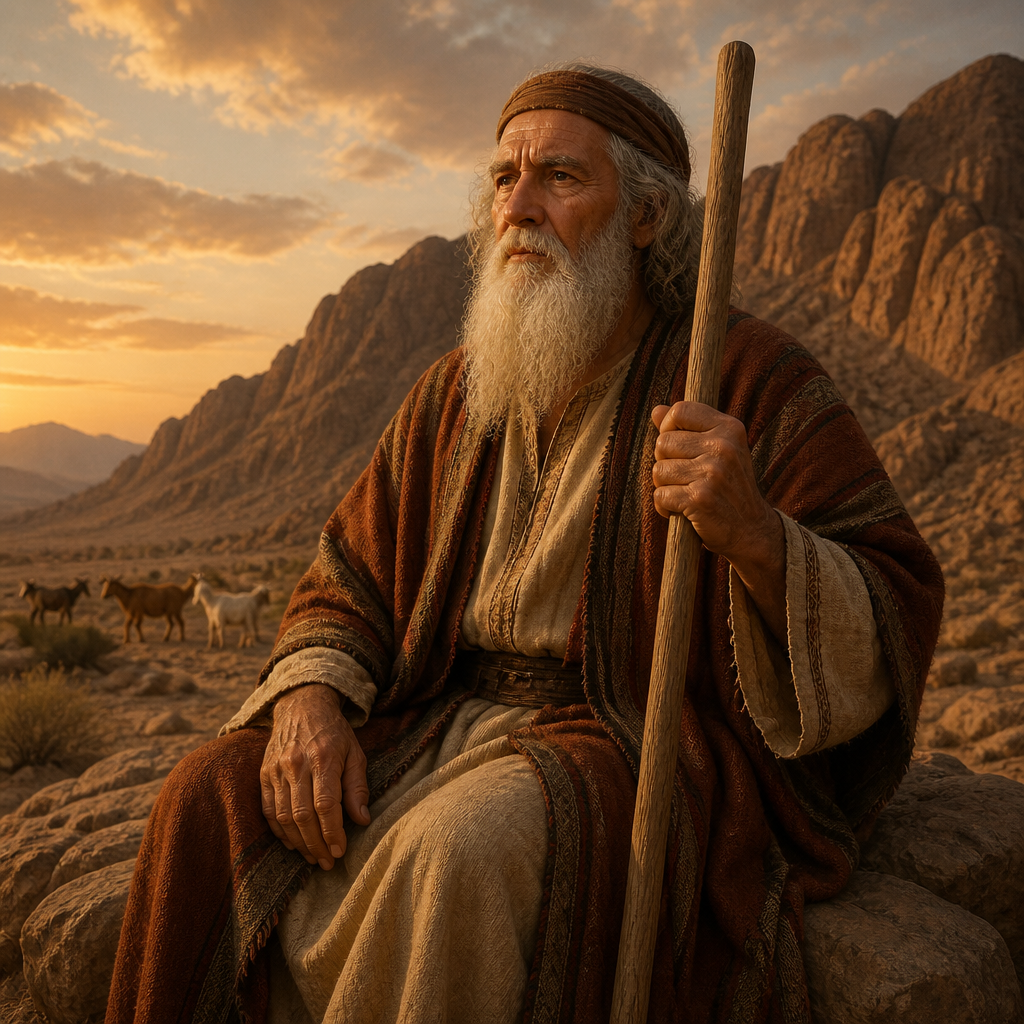
Jethro, identified as the priest of Midian, is a pivotal figure in the narrative of the Exodus and the development of Israel’s early judicial structure. As a member of the Midianite people, he represents a unique intersection between the lineage of Abraham (through Keturah) and the emerging nation of Israel. Jethro first enters the biblical record when he offers hospitality to Moses, who was fleeing from Egypt after killing an Egyptian taskmaster. This relationship deepened when Jethro gave his daughter Zipporah to Moses in marriage, effectively integrating the future leader of Israel into his household for forty years.
Beyond his role as a relative, Jethro is presented as a man of significant wisdom and spiritual insight. He is famously known for his visit to the Israelite camp at the mountain of God after the Exodus from Egypt. During this encounter, he offered sacrifices to God and provided Moses with crucial administrative advice on how to delegate authority among the people. His presence serves as a bridge between the wandering Israelites and the surrounding desert tribes, and his acknowledgment of the Lord’s power marks a significant moment of inter-ethnic spiritual recognition in the Pentateuch.
Background and Family
Jethro was a priest of Midian, a region located in the northwestern Arabian Peninsula, east of the Gulf of Aqaba. The biblical text identifies him by multiple names, including Reuel (Exodus 2:18), which may denote a clan name or a formal title. As a Midianite, he was a descendant of Abraham through his second wife, Keturah, suggesting a distant ancestral link to the Hebrews.
Jethro was a man of status and family; he is recorded as having seven daughters and at least one son, Hobab (Numbers 10:29). His role as a priest suggests he was a spiritual and communal leader within his tribe, though the specific nature of Midianite worship prior to his encounter with Moses remains a subject of scholarly discussion. His family life became inextricably linked with the history of Israel when his daughter, Zipporah, married Moses, subsequently bearing two sons, Gershom and Eliezer.
Major Life Events
Sanctuary for Moses
The relationship between Jethro and Moses began at a well in Midian. After Moses defended Jethro’s daughters from shepherds who were harassing them, Reuel (Jethro) invited Moses to his home. This led to a long period of residence in Midian, during which Moses shepherded Jethro’s flocks. It was while tending Jethro’s sheep near Mount Horeb that Moses encountered the burning bush and received his commission from God to return to Egypt (Exodus 3:1).
The Exodus Reunion
After the Israelites were delivered from Egypt, Jethro traveled to the wilderness of Sinai to meet Moses. He brought with him Zipporah and Moses' two sons, who had been staying with him. Upon hearing Moses recount the miracles of the Exodus and the deliverance from Pharaoh, Jethro expressed profound joy. He declared, "Blessed be the LORD, who has delivered you from the hand of the Egyptians and of Pharaoh" (Exodus 18:10). This confession culminated in Jethro offering burnt offerings and sacrifices to God, joined by Aaron and the elders of Israel in a communal meal.
The Administrative Reform
One of Jethro’s most lasting contributions was his observation of Moses’ judicial methods. Seeing Moses sitting alone from morning until evening to judge the people's disputes, Jethro warned him that he would wear himself out. He proposed a hierarchical system of governance:
"Select capable men from all the people—men who fear God, trustworthy men who hate dishonest gain—and appoint them as officials over thousands, hundreds, fifties and tens." (Exodus 18:21)
Moses implemented this advice, creating the first structured judicial system for the nation, which allowed Moses to focus on the most difficult cases and his role as a mediator between God and the people. Shortly after this, Jethro returned to his own land.
Relationship to Other Biblical Figures
Jethro’s primary relationship was as a mentor and father-in-law to Moses. His hospitality provided the necessary refuge for Moses to mature during his forty-year exile. He also maintained a respectful relationship with the leadership of Israel, specifically Aaron and the elders, who acknowledged his priestly status by dining with him in the presence of God. His son, Hobab, was later invited by Moses to serve as a guide for the Israelites through the wilderness, showing the continued reliance of the Israelites on the Midianite knowledge of the terrain.
Spiritual Significance
Jethro is often viewed by scholars as a "righteous Gentile" who recognized the sovereignty of the God of Israel before the formal giving of the Law at Sinai. His declaration in Exodus 18:11—"Now I know that the LORD is greater than all other gods"—is a pivotal moment of confession. His role demonstrates that God’s redemptive work in the Exodus had an impact beyond the ethnic boundaries of Israel. Furthermore, his administrative wisdom highlights the biblical principle that spiritual leadership requires practical organization and the delegation of authority to remain sustainable and effective.
Theologically, Jethro represents the inclusion of non-Israelites in the story of salvation and the acknowledgment of Yahweh's supremacy by foreign nations. His confession of faith and his participation in sacrificial worship alongside Aaron demonstrate that knowledge of God was not strictly confined to the Hebrews during the pre-Sinaitic period.
Historically and legally, Jethro is the architect of Israel’s judicial delegation. By advising Moses to appoint 'men of truth' to handle minor disputes, he established a precedent for decentralized leadership and the importance of character in civil administration. This 'Jethro Principle' remains a foundation for both religious and secular organizational theory, emphasizing that even divinely appointed leaders require wise counsel and structured support.
Frequently Asked Questions
Is Jethro the same person as Reuel?
Yes, Exodus 2:18 refers to the father of Zipporah as Reuel, while Exodus 3:1 refers to him as Jethro. It is common in the Pentateuch for significant figures to have multiple names or for a text to use a personal name and a clan name interchangeably.
What was Jethro's religion?
He is described as a 'priest of Midian.' While he likely practiced the traditional religion of his tribe initially, the Bible records him offering sacrifices to the LORD (Yahweh) and confessing Yahweh's supremacy after the Exodus.
What advice did Jethro give to Moses?
Jethro advised Moses to delegate the task of judging the people's disputes to trustworthy men, creating a hierarchy of officials over groups of thousands, hundreds, fifties, and tens to prevent Moses from burning out.
Who was Jethro's son?
Jethro's son was Hobab. Moses later asked Hobab to stay with the Israelites to serve as their 'eyes' in the wilderness because of his knowledge of the desert.
Did Jethro go to the Promised Land with Israel?
No, Exodus 18:27 states that after his visit to Moses at Horeb, Jethro sent his way and returned to his own country (Midian).
Family & Relationships
 JethroThis page
Children
 ZipporahDaughterExodus 18:2
Inferred
Exodus 18:2 names Jethro and Zipporah in the same verse but does not state a daughter tie between them; the link rests on the surrounding narrative.Evidence: Exodus 18:2
 HobabSonNumbers 10:29
Inferred
No verse names Hobab and Jethro together; the father link is carried from the surrounding genealogy and is not stated in Scripture.Evidence: Numbers 10:29
Extended family
 MosesSon-in-lawExodus 3:1Stated
 Gershom, Son of MosesGrandsonExodus 2:22
Inferred
Reconstructed through Moses: Exodus 3:1 ties Jethro to Moses; Judges 18:30 ties Moses to Gershom. No verse states the grandson link between Jethro and Gershom directly.Evidence: Exodus 2:22
Connected Figures
Family
Daughter · Exodus 18:2
The Midianite wife of Moses who saved his life by performing an emergency circumcision during his return to Egypt.
Egypt and WildernessFirst: Exodus 2:217 versesDaughter of a priest, Shepherdess
Son · Numbers 10:29
A Midianite and son of Reuel who served as a guide and ally to the Israelites during their wilderness wanderings.
Egypt and WildernessFirst: Numbers 10:296 versesDesert guide
Son-in-law · Exodus 3:1
The preeminent prophet and lawgiver of Israel who led the Hebrews out of Egyptian bondage and mediated the Covenant at Mount Sinai.
Egypt and WildernessFirst: Exodus 2:10844 versesProphet, Judge, and LawgiverLevi
Grandson · Exodus 2:22
Gershom was the firstborn son of the prophet Moses and Zipporah, born in Midian during Moses' exile from Egypt.
Categories
Mentions by Book
- Exodus13
- Numbers1
Scripture References
All 14 indexed verses, in canonical order, from the Berean Standard Bible.
Exodus · 13
- Exodus 2:18
When the daughters returned to their father Reuel, he asked them, “Why have you returned so early today?”
- Exodus 2:22Partial
And she gave birth to a son, and Moses named him Gershom, saying, “I have become a foreigner in a foreign land.”
Cited as evidence on a family card; added so References, Key Verses and Mentions by Book share one index.
- Exodus 3:1
Meanwhile, Moses was shepherding the flock of his father-in-law Jethro, the priest of Midian. He led the flock to the far side of the wilderness and came to Horeb, the mountain of God.
- Exodus 4:18
Then Moses went back to his father-in-law Jethro and said to him, “Please let me return to my brothers in Egypt to see if they are still alive.” “Go in peace,” Jethro replied.
- Exodus 18:1
Now Moses’ father-in-law Jethro, the priest of Midian, heard about all that God had done for Moses and His people Israel, and how the LORD had brought Israel out of Egypt.
- Exodus 18:2
After Moses had sent back his wife Zipporah, his father-in-law Jethro had received her,
- Exodus 18:5
Moses’ father-in-law Jethro, along with Moses’ wife and sons, came to him in the desert, where he was encamped at the mountain of God.
- Exodus 18:6
He sent word to Moses, “I, your father-in-law Jethro, am coming to you with your wife and her two sons.”
- Exodus 18:9
And Jethro rejoiced over all the good things the LORD had done for Israel, whom He had rescued from the hand of the Egyptians.
- Exodus 18:10
Jethro declared, “Blessed be the LORD, who has delivered you from the hand of the Egyptians and of Pharaoh, and who has delivered the people from the hand of the Egyptians.
- Exodus 18:11Partial
Now I know that the LORD is greater than all other gods, for He did this when they treated Israel with arrogance.”
Cited as a key verse; added so References, Key Verses and Mentions by Book share one index.
- Exodus 18:12
Then Moses’ father-in-law Jethro brought a burnt offering and sacrifices to God, and Aaron came with all the elders of Israel to eat bread with Moses’ father-in-law in the presence of God.
- Exodus 18:21Partial
Furthermore, select capable men from among the people—God-fearing, trustworthy men who are averse to dishonest gain. Appoint them over the people as leaders of thousands, of hundreds, of fifties, and of tens.
Cited as a key verse; added so References, Key Verses and Mentions by Book share one index.
Numbers · 1
- Numbers 10:29Partial
Then Moses said to Hobab, the son of Moses’ father-in-law Reuel the Midianite, “We are setting out for the place of which the LORD said: ‘I will give it to you.’ Come with us, and we will treat you well, for the LORD has promised good things to Israel.”
Cited as evidence on a family card; added so References, Key Verses and Mentions by Book share one index.