Abraham
Who was Abraham in the Bible?
The first of the three biblical patriarchs and the father of the nation of Israel, known for his unwavering faith and his covenant relationship with God.
Abraham is the central figure of the patriarchal period and a primary focus of the book of Genesis. Born as Abram in Ur of the Chaldeans, he was called by God to leave his kindred and father's house to travel to a land that God would show him. This call initiated a series of divine promises including the gift of land, numerous descendants, and a blessing that would extend to all the families of the earth. Abraham is distinguished in the biblical narrative by his willingness to obey God's commands, even when they seemed impossible or required immense personal sacrifice.
His life is characterized by the transition from a wandering nomad to a powerful, wealthy patriarch who interacted with kings and established altars to the LORD throughout the land of Canaan. As the father of Isaac and Ishmael, and the progenitor of multiple nations through his third wife Keturah, Abraham's legacy is foundational to the identity of the people of Israel. In the New Testament, he is frequently cited as the supreme example of faith, with his belief in God being credited to him as righteousness long before the establishment of the Mosaic Law.
Background and Family
Abraham was the son of Terah, a descendant of Shem. He was born in Ur of the Chaldeans and was originally named Abram. He had two brothers, Nahor and Haran; Haran died early, leaving a son named Lot, whom Abraham eventually mentored. Abraham married his half-sister Sarai (later Sarah), who was initially barren. The family migrated from Ur to Haran, where Terah died. Following his father’s death, God commanded the seventy-five-year-old Abram to depart for Canaan (Genesis 12:1-4).
Abraham’s family expanded significantly throughout his life. Because Sarah remained childless for many years, she gave her Egyptian servant Hagar to Abraham, resulting in the birth of Ishmael. Later, in his old age, Abraham and Sarah miraculously conceived Isaac, the son of the promise. After Sarah's death, Abraham married Keturah, who bore him six more sons: Zimran, Jokshan, Medan, Midian, Ishbak, and Shuah. These descendants became the ancestors of various tribes and nations in the ancient Near East.
Major Life Events
The Call and the Covenant
The defining moment of Abraham's life was his departure from Haran to Canaan. Upon arrival, God appeared to him and promised the land to his offspring. A significant shift occurred in Genesis 17, when God changed his name from Abram ("exalted father") to Abraham ("father of a multitude"). It was at this time that the covenant of circumcision was established as an everlasting sign between God and Abraham’s descendants.
The Destruction of Sodom and Gomorrah
Abraham is portrayed as a hospitable host and a bold intercessor. When three divine visitors approached his tent, he provided a lavish feast. Upon learning that God intended to destroy the wicked city of Sodom, where his nephew Lot resided, Abraham negotiated with God, asking if the city would be spared for the sake of fifty righteous people, eventually bargaining down to ten. Although the city was destroyed, God remembered Abraham and rescued Lot from the catastrophe.
The Offering of Isaac
The most significant test of Abraham's faith occurred when God commanded him to offer his son Isaac as a burnt offering on Mount Moriah. Abraham obeyed, traveling three days to the site. Just as he drew his knife to slay his son, the Angel of the LORD stopped him, providing a ram caught in a thicket as a substitute. This event confirmed Abraham’s fear of God and resulted in a renewal of the divine oath to bless all nations through his offspring.
Relationship to Other Biblical Figures
Abraham's relationship with Lot is a study in grace and conflict. After their herdsmen quarreled over grazing land, Abraham generously allowed Lot first choice of the territory, eventually rescuing Lot when he was captured by a coalition of kings. Abraham also showed deep concern for his son Ishmael, pleading for his blessing even after Isaac was designated the primary heir.
His interaction with Melchizedek, the King of Salem and priest of God Most High, is another pivotal moment. After a military victory, Abraham gave Melchizedek a tenth of all his spoils, recognizing a priesthood that predated the Levites. In his later years, Abraham ensured the continuity of his lineage by sending his servant to find a wife for Isaac from his own kindred, rather than among the Canaanites.
Spiritual Significance
Abraham is the biblical archetype of faith. The author of Hebrews notes that by faith, Abraham obeyed the call to go to a place he would later receive as an inheritance, even though he did not know where he was going (Hebrews 11:8). His life demonstrates a move from self-reliance—seen in his twice-repeated deception regarding Sarah being his sister to protect himself—to total reliance on God’s provision.
His spiritual significance extends into the New Testament, where the Apostle Paul uses Abraham to illustrate the doctrine of justification by faith. Paul argues that Abraham’s righteousness was not earned through works or the law, but was a gift from God received through belief. Consequently, all who share the faith of Abraham are considered his spiritual children. He is uniquely titled the "Friend of God" (Isaiah 41:8; James 2:23), reflecting the intimate, conversational relationship he maintained with the Creator.
Abraham’s theological importance cannot be overstated; he serves as the root of the olive tree of Israel and the primary recipient of the unconditional promises that shape the entire biblical narrative. The 'Abrahamic Covenant' establishes the framework for the land of Israel, the Davidic kingship, and ultimately the arrival of Jesus Christ. In the New Testament, Abraham is the proof-text for the gospel being extended to the Gentiles, as God promised that 'all nations' would be blessed through him.
Furthermore, Abraham represents the transition from polytheistic backgrounds to a monotheistic relationship with the LORD. His life illustrates the concepts of election, testing, and substitutionary sacrifice. By offering Isaac, he provided a prophetic shadow of God the Father offering His only Son, making his life a central pillar in both Old and New Testament theology.
Frequently Asked Questions
What does the name Abraham mean?
The name Abraham means 'father of a multitude' or 'father of many nations.' It was changed by God from his birth name, Abram, which meant 'exalted father.'
How old was Abraham when Isaac was born?
Abraham was 100 years old when Isaac was born, a birth considered miraculous because of both his and Sarah's advanced age.
Who were Abraham's wives and partners?
Abraham's wife was Sarah. He also had children with Hagar (Sarah's servant) and later married Keturah after Sarah's death.
Why did Abraham lie about Sarah being his sister?
Abraham feared that because Sarah was beautiful, foreign kings (such as Pharaoh and Abimelech) would kill him to take her. Sarah was actually his half-sister, the daughter of his father but not his mother.
What is the sign of the covenant God made with Abraham?
The physical sign of the covenant was circumcision, which Abraham and all males in his household performed as a mark of their set-apart status for God.
Family & Relationships
Parents
 TerahFatherGenesis 11:27Stated
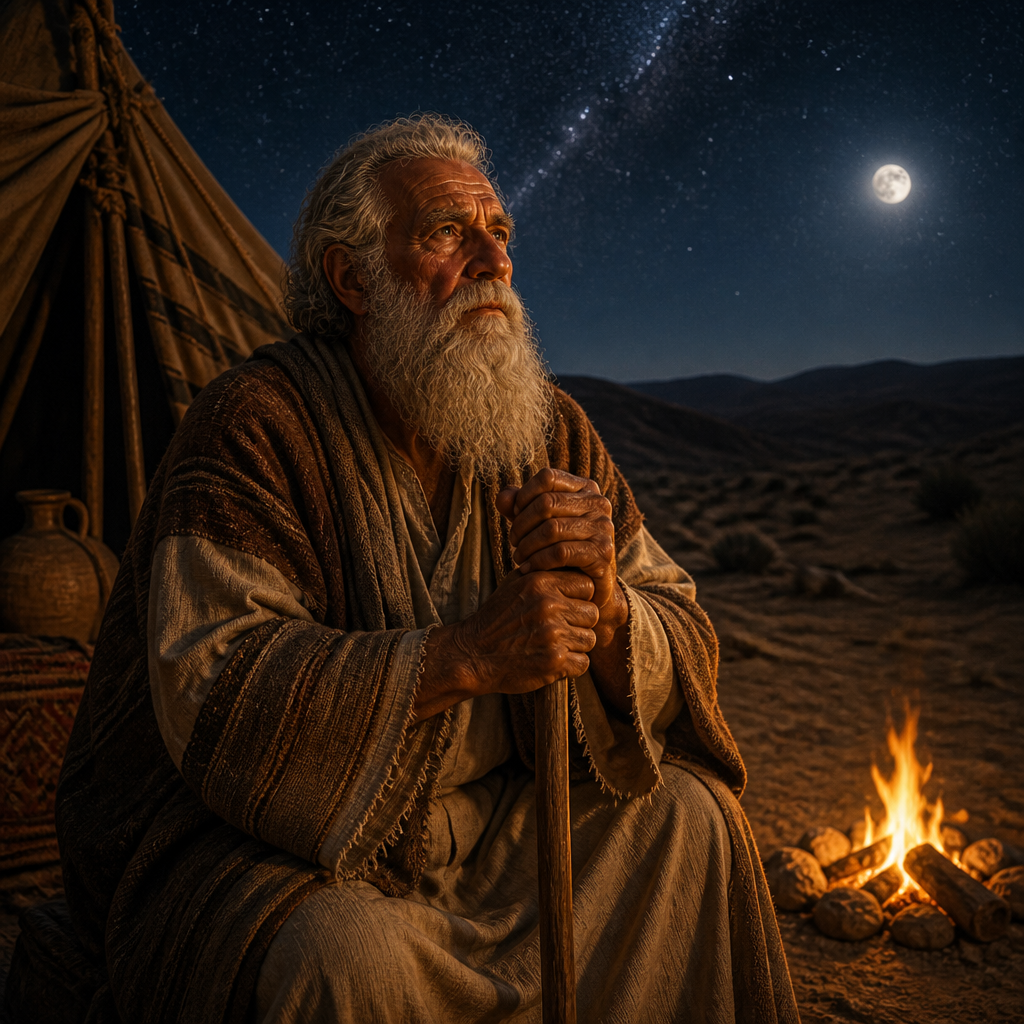 AbrahamThis page
 Haran, Son of TerahBrotherGenesis 11:27Stated
 Nahor, Brother of AbrahamBrotherGenesis 22:23Stated
Children
Extended family
 ReumahSister-in-lawGenesis 22:24
Inferred
Reconstructed through Nahor: Genesis 22:24 ties Reumah to Nahor; Genesis 22:23 ties Nahor to Abraham. No verse states the brother-in-law link between Reumah and Abraham directly.Evidence: Genesis 22:24; Genesis 22:23
 AbidaGrandsonGenesis 25:4
Inferred
Reconstructed through Keturah: Genesis 25:4 ties Abida to Keturah (itself an inferred link); Genesis 25:1 ties Keturah to Abraham. No verse states the grandfather link between Abida and Abraham directly.Evidence: Genesis 25:4; Genesis 25:1; Genesis 25:2
 AdbeelGrandsonGenesis 25:13
Inferred
Reconstructed through Ishmael: Genesis 16:15 ties Abram to Ishmael; Genesis 25:13 ties Ishmael to Adbeel. No verse states the grandson link between Abraham and Adbeel directly.Evidence: Genesis 25:13; 1 Chronicles 1:29; Genesis 17:23
 Dedan, Son of JokshanGrandsonGenesis 25:3
Inferred
1 Chronicles 1:32 lists Abraham and Dedan among the sons of jokshan, but does not say how the two of them are related.Evidence: Genesis 25:3; 1 Chronicles 1:32; Genesis 25:1; Genesis 25:2
 DumahGrandsonGenesis 25:14
Inferred
No verse names Abraham and Dumah together; the grandson link is carried from the surrounding genealogy and is not stated in Scripture.Evidence: Genesis 25:14; Genesis 25:16; Genesis 17:23
 EldaahGrandsonGenesis 25:4
Inferred
Reconstructed through Keturah: Genesis 25:1 ties Abraham to Keturah; Genesis 25:4 ties Keturah to Eldaah. No verse states the grandson link between Abraham and Eldaah directly.Evidence: Genesis 25:4; 1 Chronicles 1:32
 Ephah, Son of MidianGrandsonGenesis 25:1
Inferred
Reconstructed through Keturah: Genesis 25:4 ties Ephah to Keturah (itself an inferred link); Genesis 25:1 ties Keturah to Abraham. No verse states the grandfather link between Ephah and Abraham directly.Evidence: Genesis 25:1; Genesis 25:2; Genesis 25:4; 1 Chronicles 1:33
 Epher, Son of MidianGrandsonGenesis 25:4
Inferred
Reconstructed through Keturah: Genesis 25:1 ties Abraham to Keturah; Genesis 25:4 ties Keturah to Epher (itself an inferred link). No verse states the grandson link between Abraham and Epher directly.Evidence: Genesis 25:4; Genesis 25:1; Genesis 25:2
 Hadad, Son of IshmaelGrandsonGenesis 17:23
Inferred
No verse names Hadad and Abraham together; the grandfather link is carried from the surrounding genealogy and is not stated in Scripture.Evidence: Genesis 17:23; Genesis 25:15; Genesis 25:16
 Hanoch, Son of MidianGrandsonGenesis 25:4
Inferred
Reconstructed through Keturah: Genesis 25:1 ties Abraham to Keturah; Genesis 25:4 ties Keturah to Hanoch (itself an inferred link). No verse states the grandson link between Abraham and Hanoch directly.Evidence: Genesis 25:4; Genesis 25:1; Genesis 25:2
 JeturGrandson1 Chronicles 1:31
Inferred
No verse names Abraham and Jetur together; the grandson link is carried from the surrounding genealogy and is not stated in Scripture.Evidence: 1 Chronicles 1:31; Genesis 17:23
 KedarGrandsonGenesis 25:13
Inferred
Reconstructed through Ishmael: Genesis 25:13 ties Kedar to Ishmael; Genesis 16:15 ties Ishmael to Abram. No verse states the grandfather link between Kedar and Abraham directly.Evidence: Genesis 25:13; 1 Chronicles 1:29; Genesis 17:23
 KedemahGrandson1 Chronicles 1:31
Inferred
No verse names Abraham and Kedemah together; the grandson link is carried from the surrounding genealogy and is not stated in Scripture.Evidence: 1 Chronicles 1:31; Genesis 17:23
 MassaGrandsonGenesis 25:14
Inferred
No verse names Massa and Abraham together; the grandfather link is carried from the surrounding genealogy and is not stated in Scripture.Evidence: Genesis 25:14; Genesis 25:16; Genesis 17:23
 Mibsam, Son of IshmaelGrandsonGenesis 17:23
Inferred
Reconstructed through Ishmael: Genesis 25:13 ties Mibsam to Ishmael; Genesis 16:15 ties Ishmael to Abram. No verse states the grandfather link between Mibsam and Abraham directly.Evidence: Genesis 17:23; Genesis 25:13; 1 Chronicles 1:29
 Mishma, Son of IshmaelGrandsonGenesis 25:14
Inferred
No verse names Mishma and Abraham together; the grandfather link is carried from the surrounding genealogy and is not stated in Scripture.Evidence: Genesis 25:14; Genesis 25:16; Genesis 17:23
 Nahor, Grandfather of AbrahamGrandfatherLuke 3:34
Inferred
Luke 3:34 names Abraham and Nahor in the same verse but does not state a grandfather tie between them; the link rests on the surrounding narrative.Evidence: Luke 3:34; Genesis 11:27; Genesis 11:31; Joshua 24:2
 NaphishGrandsonGenesis 17:23
Inferred
No verse names Naphish and Abraham together; the grandfather link is carried from the surrounding genealogy and is not stated in Scripture.Evidence: Genesis 17:23; 1 Chronicles 1:31
 NebaiothGrandsonGenesis 25:13
Inferred
Reconstructed through Ishmael: Genesis 16:15 ties Abram to Ishmael; Genesis 25:13 ties Ishmael to Nebaioth. No verse states the grandson link between Abraham and Nebaioth directly.Evidence: Genesis 25:13; Genesis 17:23
 ReuGreat-Great-GrandfatherGenesis 11:18
Inferred
No verse names Reu and Abraham together; the great-great-grandson link is carried from the surrounding genealogy and is not stated in Scripture.Evidence: Genesis 11:18
 SerugGreat-GrandfatherGenesis 11:23
Inferred
No verse names Serug and Abraham together; the great-grandson link is carried from the surrounding genealogy and is not stated in Scripture.Evidence: Genesis 11:23
 Sheba, Son of JokshanGrandsonGenesis 25:3
Inferred
1 Chronicles 1:32 lists Sheba and Abraham among the sons of jokshan, but does not say how the two of them are related.Evidence: Genesis 25:3; 1 Chronicles 1:32; Genesis 25:1; Genesis 25:2
 TemaGrandsonGenesis 25:15
Inferred
No verse names Abraham and Tema together; the grandson link is carried from the surrounding genealogy and is not stated in Scripture.Evidence: Genesis 25:15; Genesis 25:16; Genesis 17:23
 ShemAncestorGenesis 5:32
Inferred
No verse names Shem and Abraham together; the descendant link is carried from the surrounding genealogy and is not stated in Scripture.Evidence: Genesis 5:32
 Aram, Grandson of NahorGreat-NephewGenesis 11:26
Inferred
No verse names Aram and Abraham together; the great-uncle link is carried from the surrounding genealogy and is not stated in Scripture.Evidence: Genesis 11:26
 Ben-ammiGreat-NephewGenesis 11:26
Inferred
No verse names Abraham and Ben-ammi together; the great-nephew link is carried from the surrounding genealogy and is not stated in Scripture.Evidence: Genesis 11:26
 BethuelNephewGenesis 24:47
Inferred
Genesis 22:23 names Abraham and Bethuel in the same verse but does not state a nephew tie between them; the link rests on the surrounding narrative.Evidence: Genesis 24:47; Genesis 22:23
 Buz, Son of NahorNephewGenesis 22:23
Inferred
No verse names Buz and Abraham together; the uncle link is carried from the surrounding genealogy and is not stated in Scripture.Evidence: Genesis 22:23; Genesis 22:20; Genesis 22:21
 ChesedNephewGenesis 22:20
Inferred
Reconstructed through Bethuel: Genesis 22:23 ties Abraham to Bethuel (itself an inferred link); Genesis 22:22 ties Bethuel to Chesed. No verse states the nephew link between Abraham and Chesed directly.Evidence: Genesis 22:20; Genesis 22:22; Genesis 22:23
 GahamNephewGenesis 22:24
Inferred
Reconstructed through Nahor: Genesis 22:23 ties Abraham to Nahor; Genesis 22:24 ties Nahor to Gaham. No verse states the nephew link between Abraham and Gaham directly.Evidence: Genesis 22:24; Genesis 22:23
 HazoNephewGenesis 22:20
Inferred
Reconstructed through Bethuel: Genesis 22:22 ties Hazo to Bethuel; Genesis 22:23 ties Bethuel to Abraham (itself an inferred link). No verse states the uncle link between Hazo and Abraham directly.Evidence: Genesis 22:20; Genesis 22:22; Genesis 22:23
 JidlaphNephewGenesis 22:23
Inferred
Reconstructed through Bethuel: Genesis 22:22 ties Jidlaph to Bethuel; Genesis 22:23 ties Bethuel to Abraham (itself an inferred link). No verse states the uncle link between Jidlaph and Abraham directly.Evidence: Genesis 22:23; Genesis 22:20; Genesis 22:22
 Kemuel, Son of NahorNephewGenesis 22:20
Inferred
No verse names Abraham and Kemuel together; the nephew link is carried from the surrounding genealogy and is not stated in Scripture.Evidence: Genesis 22:20; Genesis 22:21; Genesis 22:23
 LotNephewGenesis 11:27
Inferred
Genesis 11:27 names Abram and Lot in the same verse but does not state a nephew tie between them; the link rests on the surrounding narrative.Evidence: Genesis 11:27
 PildashNephewGenesis 22:20
Inferred
Reconstructed through Bethuel: Genesis 22:22 ties Pildash to Bethuel; Genesis 22:23 ties Bethuel to Abraham (itself an inferred link). No verse states the uncle link between Pildash and Abraham directly.Evidence: Genesis 22:20; Genesis 22:22; Genesis 22:23
 TahashNephewGenesis 22:24
Inferred
Reconstructed through Nahor: Genesis 22:23 ties Abraham to Nahor; Genesis 22:24 ties Nahor to Tahash. No verse states the nephew link between Abraham and Tahash directly.Evidence: Genesis 22:24; Genesis 22:23
 TebahNephewGenesis 22:24
Inferred
Reconstructed through Nahor: Genesis 22:23 ties Abraham to Nahor; Genesis 22:24 ties Nahor to Tebah. No verse states the nephew link between Abraham and Tebah directly.Evidence: Genesis 22:24; Genesis 22:23
 Uz, Son of NahorNephewGenesis 22:20
Inferred
No verse names Uz and Abraham together; the uncle link is carried from the surrounding genealogy and is not stated in Scripture.Evidence: Genesis 22:20; Genesis 22:21; Genesis 22:23
 Lot's WifeRelativeGenesis 11:26
Inferred
No verse names Abraham and Lot's Wife together; the relative link is carried from the surrounding genealogy and is not stated in Scripture.Evidence: Genesis 11:26
 Maacah, Child of NahorRelativeGenesis 22:24
Inferred
Reconstructed through Nahor: Genesis 22:24 ties Maacah to Nahor; Genesis 22:23 ties Nahor to Abraham. No verse states the relative link between Maacah and Abraham directly.Evidence: Genesis 22:24; Genesis 22:23
Connected Figures
Family
Father · Genesis 11:27
A foundational patriarch and the father of Abraham who led his family out of Ur of the Chaldeans toward the land of Canaan.
PatriarchsFirst: Genesis 11:2412 versesPatriarchal leader

Wife · Genesis 16:3
An Egyptian woman who served as Sarai’s maidservant and became the mother of Ishmael, Abraham’s firstborn son.
PatriarchsFirst: Genesis 16:119 versesMaidservant

Wife · Genesis 25:1
The second wife or concubine of the patriarch Abraham who bore him six sons, becoming the ancestress of various Arabian and Eastern tribes.
Wife · Genesis 11:29
The wife of Abraham and mother of Isaac, recognized as the primary matriarch of the Hebrew people and a recipient of God's covenantal promise.

Son · Genesis 21:3
The miracle son of Abraham and Sarah, Isaac was the second Hebrew patriarch and the child of promise through whom the covenant of God was established.
PatriarchsFirst: Genesis 17:19125 versesPatriarch, Shepherd, Farmer

Son · Genesis 25:1–2
Ishbak was a son of Abraham and his second wife Keturah, serving as a patriarchal figure and founder of a North Arabian tribe.

Son · Genesis 16:15
Ishmael was the firstborn son of Abraham through Hagar, the forefather of the Ishmaelite tribes, and a patriarch whom God promised would father twelve princes.

Son · Genesis 25:1–2
A son of Abraham and his second wife Keturah, Jokshan is recognized as a patriarch and the progenitor of the Sheba and Dedan tribes.
PatriarchsFirst: Genesis 25:26 versesPatriarchal head of tribes

Son · Genesis 25:1–2
A son of the patriarch Abraham through his second wife Keturah, Medan is recognized as the progenitor of an early Arab tribe during the Patriarchal Period.

Son · Genesis 25:1–2
Midian was the fourth son of Abraham by his wife Keturah and the progenitor of the Midianite people.

Son · Genesis 25:1–2
The sixth and final son of Abraham by his wife Keturah, Shuah was an early patriarch who contributed to the expansion of Semitic tribes in the East.

Son · Genesis 25:1–2
The firstborn son of Abraham and his second wife Keturah, recognized as a patriarch of an Eastern tribe.
PatriarchsFirst: Genesis 25:25 versesPatriarchal tribal founder
Categories
Mentions by Book
- Genesis185
- Exodus9
- Leviticus1
- Numbers1
- Deuteronomy7
- Joshua2
- 1 Kings1
- 2 Kings1
- 1 Chronicles6
- 2 Chronicles2
- Nehemiah1
- Psalms4
- Isaiah4
- Jeremiah1
- Ezekiel1
- Micah1
- Matthew6
- Mark1
- Luke14
- John9
- Acts7
- Romans9
- 2 Corinthians1
- Galatians9
- Hebrews10
- James2
- 1 Peter1
Scripture References
All 296 indexed verses, in canonical order, from the Berean Standard Bible.
- Genesis 5:32Partial
After Noah was 500 years old, he became the father of Shem, Ham, and Japheth.
Cited as evidence on a family card; added so References, Key Verses and Mentions by Book share one index.
- Genesis 11:18Partial
When Peleg was 30 years old, he became the father of Reu.
Cited as evidence on a family card; added so References, Key Verses and Mentions by Book share one index.
- Genesis 11:23Partial
And after he had become the father of Nahor, Serug lived 200 years and had other sons and daughters.
Cited as evidence on a family card; added so References, Key Verses and Mentions by Book share one index.
- Genesis 11:24Partial
When Nahor was 29 years old, he became the father of Terah.
Cited as evidence on a family card; added so References, Key Verses and Mentions by Book share one index.
- Genesis 11:25Partial
And after he had become the father of Terah, Nahor lived 119 years and had other sons and daughters.
Cited as evidence on a family card; added so References, Key Verses and Mentions by Book share one index.
- Genesis 11:26
When Terah was 70 years old, he became the father of Abram, Nahor, and Haran.
- Genesis 11:27
This is the account of Terah. Terah became the father of Abram, Nahor, and Haran. And Haran became the father of Lot.
- Genesis 11:29Partial
And Abram and Nahor took wives for themselves. Abram’s wife was named Sarai, and Nahor’s wife was named Milcah; she was the daughter of Haran, who was the father of both Milcah and Iscah.
- Genesis 11:31Partial
And Terah took his son Abram, his grandson Lot son of Haran, and his daughter-in-law Sarai the wife of Abram, and they set out from Ur of the Chaldeans for the land of Canaan. But when they arrived in Haran, they settled there.
- Genesis 12:1
Then the LORD said to Abram, “Leave your country, your kindred, and your father’s household, and go to the land I will show you.
- Genesis 12:2Partial
I will make you into a great nation, and I will bless you; I will make your name great, so that you will be a blessing.
Cited as a key verse; added so References, Key Verses and Mentions by Book share one index.
- Genesis 12:3Partial
I will bless those who bless you and curse those who curse you; and all the families of the earth will be blessed through you.”
Cited as a key verse; added so References, Key Verses and Mentions by Book share one index.
- Genesis 12:4Partial
So Abram departed, as the LORD had directed him, and Lot went with him. Abram was seventy-five years old when he left Haran.
- Genesis 12:5
And Abram took his wife Sarai, his nephew Lot, and all the possessions and people they had acquired in Haran, and set out for the land of Canaan. When they came to the land of Canaan,
- Genesis 12:6
Abram traveled through the land as far as the site of the Oak of Moreh at Shechem. And at that time the Canaanites were in the land.
- Genesis 12:7
Then the LORD appeared to Abram and said, “I will give this land to your offspring.” So Abram built an altar there to the LORD, who had appeared to him.
- Genesis 12:9
And Abram journeyed on toward the Negev.
- Genesis 12:10
Now there was a famine in the land. So Abram went down to Egypt to live there for a while because the famine was severe.
- Genesis 12:14
So when Abram entered Egypt, the Egyptians saw that the woman was very beautiful.
- Genesis 12:16
He treated Abram well on her account, and Abram acquired sheep and cattle, male and female donkeys, menservants and maidservants, and camels.
- Genesis 12:17
The LORD, however, afflicted Pharaoh and his household with severe plagues because of Abram’s wife Sarai.
- Genesis 12:18
So Pharaoh summoned Abram and asked, “What have you done to me? Why didn’t you tell me she was your wife?
- Genesis 13:1
So Abram went up out of Egypt into the Negev—he and his wife and all his possessions—and Lot was with him.
- Genesis 13:2
And Abram had become extremely wealthy in livestock and silver and gold.
- Genesis 13:4
to the site where he had built the altar. And there Abram called on the name of the LORD.
- Genesis 13:5
Now Lot, who was traveling with Abram, also had flocks and herds and tents.
- Genesis 13:7
And there was discord between the herdsmen of Abram and the herdsmen of Lot. At that time the Canaanites and the Perizzites were also living in the land.
- Genesis 13:8
So Abram said to Lot, “Please let there be no contention between you and me, or between your herdsmen and my herdsmen. After all, we are kinsmen.
- Genesis 13:12
Abram lived in the land of Canaan, but Lot settled in the cities of the plain and pitched his tent toward Sodom.
- Genesis 13:14
After Lot had departed, the LORD said to Abram, “Now lift up your eyes from the place where you are, and look to the north and south and east and west,
- Genesis 13:18
So Abram moved his tent and went to live near the Oaks of Mamre at Hebron, where he built an altar to the LORD.
- Genesis 14:12
They also carried off Abram’s nephew Lot and his possessions, since Lot was living in Sodom.
- Genesis 14:13Partial
Then an escapee came and reported this to Abram the Hebrew. Now Abram was living near the Oaks of Mamre the Amorite, a brother of Eshcol and Aner, all of whom were bound by treaty to Abram.
- Genesis 14:14
And when Abram heard that his relative had been captured, he mobilized the 318 trained men born in his household, and they set out in pursuit as far as Dan.
- Genesis 14:19
and he blessed Abram and said: “Blessed be Abram by God Most High, Creator of heaven and earth,
- Genesis 14:21
The king of Sodom said to Abram, “Give me the people, but take the goods for yourself.”
- Genesis 14:22
But Abram replied to the king of Sodom, “I have raised my hand to the LORD God Most High, Creator of heaven and earth,
- Genesis 14:23
that I will not accept even a thread, or a strap of a sandal, or anything that belongs to you, lest you should say, ‘I have made Abram rich.’
- Genesis 15:1Partial
After these events, the word of the LORD came to Abram in a vision: “Do not be afraid, Abram. I am your shield, your very great reward.”
- Genesis 15:2
But Abram replied, “O Lord GOD, what can You give me, since I remain childless, and the heir of my house is Eliezer of Damascus?”
- Genesis 15:3
Abram continued, “Behold, You have given me no offspring, so a servant in my household will be my heir.”
- Genesis 15:6Partial
Abram believed the LORD, and it was credited to him as righteousness.
Cited as a key verse; added so References, Key Verses and Mentions by Book share one index.
- Genesis 15:11
And the birds of prey descended on the carcasses, but Abram drove them away.
- Genesis 15:12
As the sun was setting, Abram fell into a deep sleep, and suddenly great terror and darkness overwhelmed him.
- Genesis 15:13
Then the LORD said to Abram, “Know for certain that your descendants will be strangers in a land that is not their own, and they will be enslaved and mistreated four hundred years.
- Genesis 15:18
On that day the LORD made a covenant with Abram, saying, “To your descendants I have given this land—from the river of Egypt to the great River Euphrates—
- Genesis 16:1
Now Abram’s wife Sarai had borne him no children, but she had an Egyptian maidservant named Hagar.
- Genesis 16:2Partial
So Sarai said to Abram, “Look now, the LORD has prevented me from bearing children. Please go to my maidservant; perhaps I can build a family by her.” And Abram listened to the voice of Sarai.
- Genesis 16:3Partial
So after he had lived in Canaan for ten years, his wife Sarai took her Egyptian maidservant Hagar and gave her to Abram to be his wife.
- Genesis 16:5
Then Sarai said to Abram, “May the wrong done to me be upon you! I delivered my servant into your arms, and ever since she saw that she was pregnant, she has treated me with contempt. May the LORD judge between you and me.”
- Genesis 16:6
“Here,” said Abram, “your servant is in your hands. Do whatever you want with her.” Then Sarai treated Hagar so harshly that she fled from her.
- Genesis 16:15Partial
And Hagar bore Abram a son, and Abram gave the name Ishmael to the son she had borne.
- Genesis 16:16Partial
Abram was eighty-six years old when Hagar bore Ishmael to him.
- Genesis 17:1Partial
When Abram was ninety-nine years old, the LORD appeared to him and said, “I am God Almighty. Walk before Me and be blameless.
- Genesis 17:3
Then Abram fell facedown, and God said to him,
- Genesis 17:5
No longer will you be called Abram, but your name will be Abraham, for I have made you a father of many nations.
- Genesis 17:9
God also said to Abraham, “You must keep My covenant—you and your descendants in the generations after you.
- Genesis 17:15
Then God said to Abraham, “As for Sarai your wife, do not call her Sarai, for her name is to be Sarah.
- Genesis 17:17
Abraham fell facedown. Then he laughed and said to himself, “Can a child be born to a man who is a hundred years old? Can Sarah give birth at the age of ninety?”
- Genesis 17:18
And Abraham said to God, “O that Ishmael might live under Your blessing!”
- Genesis 17:22
When He had finished speaking with Abraham, God went up from him.
- Genesis 17:23Partial
On that very day Abraham took his son Ishmael and all those born in his household or purchased with his money—every male among the members of Abraham’s household—and he circumcised them, just as God had told him.
- Genesis 17:24
So Abraham was ninety-nine years old when he was circumcised,
- Genesis 17:26
Abraham and his son Ishmael were circumcised on the same day.
- Genesis 18:6
So Abraham hurried into the tent and said to Sarah, “Quick! Prepare three seahs of fine flour, knead it, and bake some bread.”
- Genesis 18:7
Meanwhile, Abraham ran to the herd, selected a tender and choice calf, and gave it to a servant, who hurried to prepare it.
- Genesis 18:11
And Abraham and Sarah were already old and well along in years; Sarah had passed the age of childbearing.
- Genesis 18:13
And the LORD asked Abraham, “Why did Sarah laugh and say, ‘Can I really bear a child when I am old?’
- Genesis 18:16
When the men got up to leave, they looked out over Sodom, and Abraham walked along with them to see them off.
- Genesis 18:17
And the LORD said, “Shall I hide from Abraham what I am about to do?
- Genesis 18:18
Abraham will surely become a great and powerful nation, and through him all the nations of the earth will be blessed.
- Genesis 18:19
For I have chosen him, so that he will command his children and his household after him to keep the way of the LORD by doing what is right and just, in order that the LORD may bring upon Abraham what He has promised.”
- Genesis 18:22
And the two men turned away and went toward Sodom, but Abraham remained standing before the LORD.
- Genesis 18:23
Abraham stepped forward and said, “Will You really sweep away the righteous with the wicked?
- Genesis 18:27
Then Abraham answered, “Now that I have ventured to speak to the Lord—though I am but dust and ashes—
- Genesis 18:33Partial
When the LORD had finished speaking with Abraham, He departed, and Abraham returned home.
- Genesis 19:15Partial
At daybreak the angels hurried Lot along, saying, “Get up! Take your wife and your two daughters who are here, or you will be swept away in the punishment of the city.”
Cited as evidence on a family card; added so References, Key Verses and Mentions by Book share one index.
- Genesis 19:27
Early the next morning, Abraham got up and returned to the place where he had stood before the LORD.
- Genesis 19:29
So when God destroyed the cities of the plain, He remembered Abraham, and He brought Lot out of the catastrophe that destroyed the cities where he had lived.
- Genesis 19:38Partial
The younger daughter also gave birth to a son, and she named him Ben-ammi. He is the father of the Ammonites of today.
Cited as evidence on a family card; added so References, Key Verses and Mentions by Book share one index.
- Genesis 20:1
Now Abraham journeyed from there to the region of the Negev and settled between Kadesh and Shur. While he was staying in Gerar,
- Genesis 20:2
Abraham said of his wife Sarah, “She is my sister.” So Abimelech king of Gerar had Sarah brought to him.
- Genesis 20:9
Then Abimelech called Abraham and asked, “What have you done to us? How have I sinned against you, that you have brought such tremendous guilt upon me and my kingdom? You have done things to me that should not be done.”
- Genesis 20:10
Abimelech also asked Abraham, “What prompted you to do such a thing?”
- Genesis 20:11
Abraham replied, “I thought to myself, ‘Surely there is no fear of God in this place. They will kill me on account of my wife.’
- Genesis 20:14
So Abimelech brought sheep and cattle, menservants and maidservants, and he gave them to Abraham and restored his wife Sarah to him.
- Genesis 20:17
Then Abraham prayed to God, and God healed Abimelech and his wife and his maidservants, so that they could again bear children—
- Genesis 20:18
for on account of Abraham’s wife Sarah, the LORD had completely closed all the wombs in Abimelech’s household.
- Genesis 21:2
So Sarah conceived and bore a son to Abraham in his old age, at the very time God had promised.
- Genesis 21:3
And Abraham gave the name Isaac to the son Sarah bore to him.
- Genesis 21:4
When his son Isaac was eight days old, Abraham circumcised him, as God had commanded him.
- Genesis 21:5
Abraham was a hundred years old when his son Isaac was born to him.
- Genesis 21:7
She added, “Who would have told Abraham that Sarah would nurse children? Yet I have borne him a son in his old age.”
- Genesis 21:8
So the child grew and was weaned, and Abraham held a great feast on the day Isaac was weaned.
- Genesis 21:9
But Sarah saw that the son whom Hagar the Egyptian had borne to Abraham was mocking her son,
- Genesis 21:10
and she said to Abraham, “Expel the slave woman and her son, for the slave woman’s son will never share in the inheritance with my son Isaac!”
- Genesis 21:11
Now this matter distressed Abraham greatly because it concerned his son Ishmael.
- Genesis 21:12
But God said to Abraham, “Do not be distressed about the boy and your maidservant. Listen to everything that Sarah tells you, for through Isaac your offspring will be reckoned.
- Genesis 21:14
Early in the morning, Abraham got up, took bread and a skin of water, put them on Hagar’s shoulders, and sent her away with the boy. She left and wandered in the Wilderness of Beersheba.
- Genesis 21:22
At that time Abimelech and Phicol the commander of his army said to Abraham, “God is with you in all that you do.
- Genesis 21:24
And Abraham replied, “I swear it.”
- Genesis 21:25
But when Abraham complained to Abimelech about a well that Abimelech’s servants had seized,
- Genesis 21:27
So Abraham brought sheep and cattle and gave them to Abimelech, and the two men made a covenant.
- Genesis 21:28
Abraham separated seven ewe lambs from the flock,
- Genesis 21:29
and Abimelech asked him, “Why have you set apart these seven ewe lambs?”
- Genesis 21:34
And Abraham resided in the land of the Philistines for a long time.
- Genesis 22:1Partial
Some time later God tested Abraham and said to him, “Abraham!” “Here I am,” he answered.
- Genesis 22:3
So Abraham got up early the next morning, saddled his donkey, and took along two of his servants and his son Isaac. He split the wood for a burnt offering and set out for the place God had designated.
- Genesis 22:4
On the third day Abraham looked up and saw the place in the distance.
- Genesis 22:5
“Stay here with the donkey,” Abraham told his servants. “The boy and I will go over there to worship, and then we will return to you.”
- Genesis 22:6
Abraham took the wood for the burnt offering and placed it on his son Isaac. He himself carried the fire and the sacrificial knife, and the two of them walked on together.
- Genesis 22:7
Then Isaac said to his father Abraham, “My father!” “Here I am, my son,” he replied. “The fire and the wood are here,” said Isaac, “but where is the lamb for the burnt offering?”
- Genesis 22:8
Abraham answered, “God Himself will provide the lamb for the burnt offering, my son.” And the two walked on together.
- Genesis 22:9
When they arrived at the place God had designated, Abraham built the altar there and arranged the wood. He bound his son Isaac and placed him on the altar, atop the wood.
- Genesis 22:10
Then Abraham reached out his hand and took the knife to slaughter his son.
- Genesis 22:11Partial
Just then the angel of the LORD called out to him from heaven, “Abraham, Abraham!” “Here I am,” he replied.
- Genesis 22:12Partial
“Do not lay a hand on the boy or do anything to him,” said the angel, “for now I know that you fear God, since you have not withheld your only son from me.”
Cited as a key verse; added so References, Key Verses and Mentions by Book share one index.
- Genesis 22:13Partial
Then Abraham looked up and saw behind him a ram in a thicket, caught by its horns. So he went and took the ram and offered it as a burnt offering in place of his son.
- Genesis 22:14
And Abraham called that place The LORD Will Provide. So to this day it is said, “On the mountain of the LORD it will be provided.”
- Genesis 22:15
And the angel of the LORD called to Abraham from heaven a second time,
- Genesis 22:19Partial
Abraham went back to his servants, and they got up and set out together for Beersheba. And Abraham settled in Beersheba.
- Genesis 22:20
Some time later, Abraham was told, “Milcah has also borne sons to your brother Nahor:
- Genesis 22:21Partial
Uz the firstborn, his brother Buz, Kemuel (the father of Aram),
Cited as evidence on a family card; added so References, Key Verses and Mentions by Book share one index.
- Genesis 22:22Partial
Chesed, Hazo, Pildash, Jidlaph, and Bethuel.”
Cited as evidence on a family card; added so References, Key Verses and Mentions by Book share one index.
- Genesis 22:23
And Bethuel became the father of Rebekah. Milcah bore these eight sons to Abraham’s brother Nahor.
- Genesis 22:24Partial
Moreover, Nahor’s concubine, whose name was Reumah, bore Tebah, Gaham, Tahash, and Maacah.
Cited as evidence on a family card; added so References, Key Verses and Mentions by Book share one index.
- Genesis 23:2
She died in Kiriath-arba (that is, Hebron) in the land of Canaan, and Abraham went out to mourn and to weep for her.
- Genesis 23:3
Then Abraham got up from beside his dead wife and said to the Hittites,
- Genesis 23:5
The Hittites replied to Abraham,
- Genesis 23:7
Then Abraham rose and bowed down before the people of the land, the Hittites.
- Genesis 23:10
Now Ephron was sitting among the sons of Heth. So in the presence of all the Hittites who had come to the gate of his city, Ephron the Hittite answered Abraham,
- Genesis 23:12
Again Abraham bowed down before the people of the land
- Genesis 23:14
Ephron answered Abraham,
- Genesis 23:16Partial
Abraham agreed to Ephron’s terms and weighed out for him the price he had named in the hearing of the Hittites: four hundred shekels of silver, according to the standard of the merchants.
- Genesis 23:18
to Abraham’s possession in the presence of all the Hittites who had come to the gate of his city.
- Genesis 23:19
After this, Abraham buried his wife Sarah in the cave of the field at Machpelah near Mamre (that is, Hebron) in the land of Canaan.
- Genesis 23:20
So the field and its cave were deeded by the Hittites to Abraham as a burial site.
- Genesis 24:1Partial
By now Abraham was old and well along in years, and the LORD had blessed him in every way.
- Genesis 24:2
So Abraham instructed the chief servant of his household, who managed all he owned, “Place your hand under my thigh,
- Genesis 24:6
Abraham replied, “Make sure that you do not take my son back there.
- Genesis 24:9
So the servant placed his hand under the thigh of his master Abraham and swore an oath to him concerning this matter.
- Genesis 24:12Partial
“O LORD, God of my master Abraham,” he prayed, “please grant me success today, and show kindness to my master Abraham.
- Genesis 24:15
Before the servant had finished praying, Rebekah came out with her jar on her shoulder. She was the daughter of Bethuel son of Milcah, the wife of Abraham’s brother Nahor.
- Genesis 24:27
saying, “Blessed be the LORD, the God of my master Abraham, who has not withheld His kindness and faithfulness from my master. As for me, the LORD has led me on the journey to the house of my master’s relatives.”
- Genesis 24:34
“I am Abraham’s servant,” he replied.
- Genesis 24:42
So when I came to the spring today, I prayed: O LORD, God of my master Abraham, if only You would make my journey a success!
- Genesis 24:47Partial
Then I asked her, ‘Whose daughter are you?’ She replied, ‘The daughter of Bethuel son of Nahor, whom Milcah bore to him.’ So I put the ring on her nose and the bracelets on her wrists.
Cited as evidence on a family card; added so References, Key Verses and Mentions by Book share one index.
- Genesis 24:48
Then I bowed down and worshiped the LORD; and I blessed the LORD, the God of my master Abraham, who led me on the right road to take the granddaughter of my master’s brother for his son.
- Genesis 24:52
When Abraham’s servant heard their words, he bowed down to the ground before the LORD.
- Genesis 24:59
So they sent their sister Rebekah on her way, along with her nurse and Abraham’s servant and his men.
- Genesis 25:1
Now Abraham had taken another wife, named Keturah,
- Genesis 25:2Partial
and she bore him Zimran, Jokshan, Medan, Midian, Ishbak, and Shuah.
Cited as evidence on a family card; added so References, Key Verses and Mentions by Book share one index.
- Genesis 25:3Partial
Jokshan was the father of Sheba and Dedan. And the sons of Dedan were the Asshurites, the Letushites, and the Leummites.
Cited as evidence on a family card; added so References, Key Verses and Mentions by Book share one index.
- Genesis 25:4Partial
The sons of Midian were Ephah, Epher, Hanoch, Abida, and Eldaah. All these were descendants of Keturah.
Cited as evidence on a family card; added so References, Key Verses and Mentions by Book share one index.
- Genesis 25:5
Abraham left everything he owned to Isaac.
- Genesis 25:6
But while he was still alive, Abraham gave gifts to the sons of his concubines and sent them away from his son Isaac to the land of the east.
- Genesis 25:7
Abraham lived a total of 175 years.
- Genesis 25:8
And at a ripe old age he breathed his last and died, old and contented, and was gathered to his people.
- Genesis 25:10Partial
This was the field that Abraham had bought from the Hittites. Abraham was buried there with his wife Sarah.
- Genesis 25:11
After Abraham’s death, God blessed his son Isaac, who lived near Beer-lahai-roi.
- Genesis 25:12Partial
This is the account of Abraham’s son Ishmael, whom Hagar the Egyptian, Sarah’s maidservant, bore to Abraham.
- Genesis 25:13Partial
These are the names of the sons of Ishmael in the order of their birth: Nebaioth the firstborn of Ishmael, then Kedar, Adbeel, Mibsam,
Cited as evidence on a family card; added so References, Key Verses and Mentions by Book share one index.
- Genesis 25:14Partial
Mishma, Dumah, Massa,
Cited as evidence on a family card; added so References, Key Verses and Mentions by Book share one index.
- Genesis 25:15Partial
Hadad, Tema, Jetur, Naphish, and Kedemah.
Cited as evidence on a family card; added so References, Key Verses and Mentions by Book share one index.
- Genesis 25:19Partial
This is the account of Abraham’s son Isaac. Abraham became the father of Isaac,
- Genesis 26:1
Now there was another famine in the land, subsequent to the one that had occurred in Abraham’s time. And Isaac went to Abimelech king of the Philistines at Gerar.
- Genesis 26:3
Stay in this land as a foreigner, and I will be with you and bless you. For I will give all these lands to you and your offspring, and I will confirm the oath that I swore to your father Abraham.
- Genesis 26:5
because Abraham listened to My voice and kept My charge, My commandments, My statutes, and My laws.”
- Genesis 26:15
So the Philistines took dirt and stopped up all the wells that his father’s servants had dug in the days of his father Abraham.
- Genesis 26:18Partial
Isaac reopened the wells that had been dug in the days of his father Abraham, which the Philistines had stopped up after Abraham died. And he gave these wells the same names his father had given them.
- Genesis 26:24Partial
and that night the LORD appeared to him and said, “I am the God of your father Abraham. Do not be afraid, for I am with you. I will bless you and multiply your descendants for the sake of My servant Abraham.”
- Genesis 28:4Partial
And may He give the blessing of Abraham to you and your descendants, so that you may possess the land where you dwell as a foreigner, the land God gave to Abraham.”
- Genesis 28:9
Esau went to Ishmael and married Mahalath, the sister of Nebaioth and daughter of Abraham’s son Ishmael, in addition to the wives he already had.
- Genesis 28:13
And there at the top the LORD was standing and saying, “I am the LORD, the God of your father Abraham and the God of Isaac. I will give you and your descendants the land on which you now lie.
- Genesis 31:42
If the God of my father, the God of Abraham and the Fear of Isaac, had not been with me, surely by now you would have sent me away empty-handed. But God has seen my affliction and the toil of my hands, and last night He rendered judgment.”
- Genesis 31:53
May the God of Abraham and the God of Nahor, the God of their father, judge between us.” So Jacob swore by the Fear of his father Isaac.
- Genesis 32:9
Then Jacob declared, “O God of my father Abraham, God of my father Isaac, the LORD who told me, ‘Go back to your country and to your kindred, and I will make you prosper,’
- Genesis 35:12
The land that I gave to Abraham and Isaac I will give to you, and I will give this land to your descendants after you.”
- Genesis 35:27
Jacob returned to his father Isaac at Mamre, near Kiriath-arba (that is, Hebron), where Abraham and Isaac had stayed.
- Genesis 48:15
Then he blessed Joseph and said: “May the God before whom my fathers Abraham and Isaac walked, the God who has been my shepherd all my life to this day,
- Genesis 48:16
the angel who has redeemed me from all harm—may He bless these boys. And may they be called by my name and the names of my fathers Abraham and Isaac, and may they grow into a multitude upon the earth.”
- Genesis 49:30
The cave is in the field of Machpelah near Mamre, in the land of Canaan. This is the field Abraham purchased from Ephron the Hittite as a burial site.
- Genesis 49:31
There Abraham and his wife Sarah are buried, there Isaac and his wife Rebekah are buried, and there I buried Leah.
- Genesis 50:13
They carried him to the land of Canaan and buried him in the cave at Machpelah in the field near Mamre, which Abraham had purchased from Ephron the Hittite as a burial site.
- Genesis 50:24
Then Joseph said to his brothers, “I am about to die, but God will surely visit you and bring you up from this land to the land He promised on oath to Abraham, Isaac, and Jacob.”
- Exodus 2:24
So God heard their groaning, and He remembered His covenant with Abraham, Isaac, and Jacob.
- Exodus 3:6
Then He said, “I am the God of your father, the God of Abraham, the God of Isaac, and the God of Jacob.” At this, Moses hid his face, for he was afraid to look at God.
- Exodus 3:15
God also told Moses, “Say to the Israelites, ‘The LORD, the God of your fathers—the God of Abraham, the God of Isaac, and the God of Jacob—has sent me to you.’ This is My name forever, and this is how I am to be remembered in every generation.
- Exodus 3:16
Go, assemble the elders of Israel and say to them, ‘The LORD, the God of your fathers—the God of Abraham, Isaac, and Jacob—has appeared to me and said: I have surely attended to you and have seen what has been done to you in Egypt.
- Exodus 4:5
“This is so that they may believe that the LORD, the God of their fathers—the God of Abraham, the God of Isaac, and the God of Jacob—has appeared to you.”
- Exodus 6:3
I appeared to Abraham, to Isaac, and to Jacob as God Almighty, but by My name the LORD I did not make Myself known to them.
- Exodus 6:8
And I will bring you into the land that I swore to give to Abraham, Isaac, and Jacob. I will give it to you as a possession. I am the LORD!’”
- Exodus 32:13
Remember Your servants Abraham, Isaac, and Israel, to whom You swore by Your very self when You declared, ‘I will make your descendants as numerous as the stars in the sky, and I will give your descendants all this land that I have promised, and it shall be their inheritance forever.’”
- Exodus 33:1
Then the LORD said to Moses, “Leave this place, you and the people you brought up out of the land of Egypt, and go to the land that I promised to Abraham, Isaac, and Jacob when I said, ‘I will give it to your descendants.’
- Leviticus 26:42
then I will remember My covenant with Jacob and My covenant with Isaac and My covenant with Abraham, and I will remember the land.
- Numbers 32:11
‘Because they did not follow Me wholeheartedly, not one of the men twenty years of age or older who came out of Egypt will see the land that I swore to give Abraham, Isaac, and Jacob—
- Deuteronomy 1:8
See, I have placed the land before you. Enter and possess the land that the LORD swore He would give to your fathers Abraham, Isaac, and Jacob, and to their descendants after them.”
- Deuteronomy 6:10
And when the LORD your God brings you into the land He swore to your fathers, to Abraham, Isaac, and Jacob, that He would give you—a land with great and splendid cities that you did not build,
- Deuteronomy 9:5
It is not because of your righteousness or uprightness of heart that you are going in to possess their land, but it is because of their wickedness that the LORD your God is driving out these nations before you, to keep the promise He swore to your fathers, to Abraham, Isaac, and Jacob.
- Deuteronomy 9:27
Remember Your servants Abraham, Isaac, and Jacob. Overlook the stubbornness of this people and the wickedness of their sin.
- Deuteronomy 29:13
and so that He may establish you today as His people, and He may be your God as He promised you and as He swore to your fathers, to Abraham, Isaac, and Jacob.
- Deuteronomy 30:20
and that you may love the LORD your God, obey Him, and hold fast to Him. For He is your life, and He will prolong your life in the land that the LORD swore to give to your fathers, to Abraham, Isaac, and Jacob.”
- Deuteronomy 34:4
And the LORD said to him, “This is the land that I swore to give Abraham, Isaac, and Jacob when I said, ‘I will give it to your descendants.’ I have let you see it with your own eyes, but you will not cross into it.”
- Joshua 24:2
And Joshua said to all the people, “This is what the LORD, the God of Israel, says: ‘Long ago your fathers, including Terah the father of Abraham and Nahor, lived beyond the Euphrates and worshiped other gods.
- Joshua 24:3
But I took your father Abraham from beyond the Euphrates and led him through all the land of Canaan, and I multiplied his descendants. I gave him Isaac,
- 1 Kings 18:36
At the time of the evening sacrifice, Elijah the prophet approached the altar and said, “O LORD, God of Abraham, Isaac, and Israel, let it be known this day that You are God in Israel and that I am Your servant and have done all these things at Your command.
- 2 Kings 13:23
But the LORD was gracious to Israel and had compassion on them, and He turned toward them because of His covenant with Abraham, Isaac, and Jacob. And to this day, the LORD has been unwilling to destroy them or cast them from His presence.
- 1 Chronicles 1:27
and Abram (that is, Abraham).
- 1 Chronicles 1:28
The sons of Abraham were Isaac and Ishmael.
- 1 Chronicles 1:32
The sons born to Keturah, Abraham’s concubine: Zimran, Jokshan, Medan, Midian, Ishbak, and Shuah. The sons of Jokshan: Sheba and Dedan.
- 1 Chronicles 1:34
Abraham was the father of Isaac. The sons of Isaac: Esau and Israel.
- 1 Chronicles 16:16
the covenant He made with Abraham, and the oath He swore to Isaac.
- 1 Chronicles 29:18
O LORD, God of our fathers Abraham, Isaac, and Israel, keep this desire forever in the intentions of the hearts of Your people, and direct their hearts toward You.
- 2 Chronicles 20:7
Our God, did You not drive out the inhabitants of this land before Your people Israel and give it forever to the descendants of Abraham Your friend?
- 2 Chronicles 30:6
At the command of the king, the couriers went throughout Israel and Judah with letters from the king and his officials, which read: “Children of Israel, return to the LORD, the God of Abraham, Isaac, and Israel, so that He may return to those of you who remain, who have escaped the grasp of the kings of Assyria.
- Nehemiah 9:7
You are the LORD, the God who chose Abram, who brought him out of Ur of the Chaldeans and gave him the name Abraham.
- Psalms 47:9
The nobles of the nations have assembled as the people of the God of Abraham; for the shields of the earth belong to God; He is highly exalted.
- Psalms 105:6
O offspring of His servant Abraham, O sons of Jacob, His chosen ones.
- Psalms 105:9
the covenant He made with Abraham, and the oath He swore to Isaac.
- Psalms 105:42
For He remembered His holy promise to Abraham His servant.
- Isaiah 29:22
Therefore the LORD who redeemed Abraham says of the house of Jacob: “No longer will Jacob be ashamed and no more will his face grow pale.
- Isaiah 41:8
“But you, O Israel, My servant, Jacob, whom I have chosen, descendant of Abraham My friend—
- Isaiah 51:2
Look to Abraham your father, and to Sarah who gave you birth. When I called him, he was but one; then I blessed him and multiplied him.
- Isaiah 63:16
Yet You are our Father, though Abraham does not know us and Israel does not acknowledge us. You, O LORD, are our Father; our Redeemer from Everlasting is Your name.
- Jeremiah 33:26
then I would also reject the descendants of Jacob and of My servant David, so as not to take from his descendants rulers over the descendants of Abraham, Isaac, and Jacob. For I will restore them from captivity and will have compassion on them.”
- Ezekiel 33:24
“Son of man, those living in the ruins in the land of Israel are saying, ‘Abraham was only one man, yet he possessed the land. But we are many; surely the land has been given to us as a possession.’
- Micah 7:20
You will show faithfulness to Jacob and loving devotion to Abraham, as You swore to our fathers from the days of old.
- Matthew 1:1
This is the record of the genealogy of Jesus Christ, the son of David, the son of Abraham:
- Matthew 1:2
Abraham was the father of Isaac, Isaac the father of Jacob, and Jacob the father of Judah and his brothers.
- Matthew 1:17
In all, then, there were fourteen generations from Abraham to David, fourteen from David to the exile to Babylon, and fourteen from the exile to the Christ.
- Matthew 3:9Partial
And do not presume to say to yourselves, ‘We have Abraham as our father.’ For I tell you that out of these stones God can raise up children for Abraham.
- Matthew 8:11
I say to you that many will come from the east and the west to share the banquet with Abraham, Isaac, and Jacob in the kingdom of heaven.
- Matthew 22:32
‘I am the God of Abraham, the God of Isaac, and the God of Jacob’? He is not the God of the dead, but of the living.”
- Mark 12:26
But concerning the dead rising, have you not read about the burning bush in the Book of Moses, how God told him, ‘I am the God of Abraham, the God of Isaac, and the God of Jacob’?
- Luke 1:55
as He promised to our fathers, to Abraham and his descendants forever.”
- Luke 1:73
the oath He swore to our father Abraham, to grant us
- Luke 3:8Partial
Produce fruit, then, in keeping with repentance. And do not begin to say to yourselves, ‘We have Abraham as our father.’ For I tell you that out of these stones God can raise up children for Abraham.
- Luke 3:34
the son of Jacob, the son of Isaac, the son of Abraham, the son of Terah, the son of Nahor,
- Luke 13:16
Then should not this daughter of Abraham, whom Satan has kept bound for eighteen long years, be released from her bondage on the Sabbath day?”
- Luke 13:28
There will be weeping and gnashing of teeth when you see Abraham, Isaac, Jacob, and all the prophets in the kingdom of God, but you yourselves are thrown out.
- Luke 16:22
One day the beggar died and was carried by the angels to Abraham’s side. And the rich man also died and was buried.
- Luke 16:23
In Hades, where he was in torment, he looked up and saw Abraham from afar, with Lazarus by his side.
- Luke 16:24
So he cried out, ‘Father Abraham, have mercy on me and send Lazarus to dip the tip of his finger in water and cool my tongue. For I am in agony in this fire.’
- Luke 16:25
But Abraham answered, ‘Child, remember that during your lifetime you received your good things, while Lazarus received bad things. But now he is comforted here, while you are in agony.
- Luke 16:29
But Abraham replied, ‘They have Moses and the Prophets; let your brothers listen to them.’
- Luke 16:30
‘No, father Abraham,’ he said, ‘but if someone is sent to them from the dead, they will repent.’
- Luke 19:9
Jesus said to him, “Today salvation has come to this house, because this man too is a son of Abraham.
- Luke 20:37
Even Moses demonstrates that the dead are raised, in the passage about the burning bush. For he calls the Lord ‘the God of Abraham, the God of Isaac, and the God of Jacob.’
- John 8:33
“We are Abraham’s descendants,” they answered. “We have never been slaves to anyone. How can You say we will be set free?”
- John 8:37
I know you are Abraham’s descendants, but you are trying to kill Me because My word has no place within you.
- John 8:39Partial
“Abraham is our father,” they replied. “If you were children of Abraham,” said Jesus, “you would do the works of Abraham.
- John 8:40
But now you are trying to kill Me, a man who has told you the truth that I heard from God. Abraham never did such a thing.
- John 8:52
“Now we know that You have a demon!” declared the Jews. “Abraham died, and so did the prophets, yet You say that anyone who keeps Your word will never taste death.
- John 8:53
Are You greater than our father Abraham? He died, as did the prophets. Who do You claim to be?”
- John 8:56
Your father Abraham rejoiced that he would see My day. He saw it and was glad.”
- John 8:57
Then the Jews said to Him, “You are not yet fifty years old, and You have seen Abraham?”
- John 8:58
“Truly, truly, I tell you,” Jesus declared, “before Abraham was born, I am!”
- Acts 3:13
The God of Abraham, Isaac, and Jacob, the God of our fathers, has glorified His servant Jesus. You handed Him over and rejected Him before Pilate, even though he had decided to release Him.
- Acts 3:25
And you are sons of the prophets and of the covenant God made with your fathers when He said to Abraham, ‘Through your offspring all the families of the earth will be blessed.’
- Acts 7:2
And Stephen declared: “Brothers and fathers, listen to me! The God of glory appeared to our father Abraham while he was still in Mesopotamia, before he lived in Haran,
- Acts 7:16
Their bones were carried back to Shechem and placed in the tomb that Abraham had bought from the sons of Hamor at Shechem for a price he paid in silver.
- Acts 7:17
As the time drew near for God to fulfill His promise to Abraham, our people in Egypt increased greatly in number.
- Acts 7:32
‘I am the God of your fathers, the God of Abraham, Isaac, and Jacob.’ Moses trembled with fear and did not dare to look.
- Acts 13:26
Brothers, children of Abraham, and you Gentiles who fear God, it is to us that this message of salvation has been sent.
- Romans 4:1
What then shall we say that Abraham, our forefather according to the flesh, has discovered?
- Romans 4:2
If Abraham was indeed justified by works, he had something to boast about, but not before God.
- Romans 4:3
For what does the Scripture say? “Abraham believed God, and it was credited to him as righteousness.”
- Romans 4:9
Is this blessing only on the circumcised, or also on the uncircumcised? We have been saying that Abraham’s faith was credited to him as righteousness.
- Romans 4:12
And he is also the father of the circumcised who not only are circumcised, but who also walk in the footsteps of the faith that our father Abraham had before he was circumcised.
- Romans 4:13
For the promise to Abraham and his offspring that he would be heir of the world was not given through the law, but through the righteousness that comes by faith.
- Romans 4:16
Therefore, the promise comes by faith, so that it may rest on grace and may be guaranteed to all Abraham’s offspring—not only to those who are of the law, but also to those who are of the faith of Abraham. He is the father of us all.
- Romans 9:7
Nor because they are Abraham’s descendants are they all his children. On the contrary, “Through Isaac your offspring will be reckoned.”
- Romans 11:1
I ask then, did God reject His people? Certainly not! I am an Israelite myself, a descendant of Abraham, from the tribe of Benjamin.
- 2 Corinthians 11:22
Are they Hebrews? So am I. Are they Israelites? So am I. Are they descendants of Abraham? So am I.
- Galatians 3:6
So also, “Abraham believed God, and it was credited to him as righteousness.”
- Galatians 3:7
Understand, then, that those who have faith are sons of Abraham.
- Galatians 3:8
The Scripture foresaw that God would justify the Gentiles by faith, and foretold the gospel to Abraham: “All nations will be blessed through you.”
- Galatians 3:9
So those who have faith are blessed along with Abraham, the man of faith.
- Galatians 3:14
He redeemed us in order that the blessing promised to Abraham would come to the Gentiles in Christ Jesus, so that by faith we might receive the promise of the Spirit.
- Galatians 3:16
The promises were spoken to Abraham and to his seed. The Scripture does not say, “and to seeds,” meaning many, but “and to your seed,” meaning One, who is Christ.
- Galatians 3:18
For if the inheritance depends on the law, then it no longer depends on a promise; but God freely granted it to Abraham through a promise.
- Galatians 3:29
And if you belong to Christ, then you are Abraham’s seed and heirs according to the promise.
- Galatians 4:22
For it is written that Abraham had two sons, one by the slave woman and the other by the free woman.
- Hebrews 2:16
For surely it is not the angels He helps, but the descendants of Abraham.
- Hebrews 6:13
When God made His promise to Abraham, since He had no one greater to swear by, He swore by Himself,
- Hebrews 7:1
This Melchizedek was king of Salem and priest of God Most High. He met Abraham returning from the slaughter of the kings and blessed him,
- Hebrews 7:2
and Abraham apportioned to him a tenth of everything. First, his name means “king of righteousness.” Then also, “king of Salem” means “king of peace.”
- Hebrews 7:4
Consider how great Melchizedek was: Even the patriarch Abraham gave him a tenth of the plunder.
- Hebrews 7:5
Now the law commands the sons of Levi who become priests to collect a tenth from the people—that is, from their brothers—though they too are descended from Abraham.
- Hebrews 7:6
But Melchizedek, who did not trace his descent from Levi, collected a tenth from Abraham and blessed him who had the promises.
- Hebrews 7:9
And so to speak, Levi, who collects the tenth, paid the tenth through Abraham.
- Hebrews 11:8
By faith Abraham, when called to go to a place he would later receive as his inheritance, obeyed and went, without knowing where he was going.
- Hebrews 11:17
By faith Abraham, when he was tested, offered up Isaac on the altar. He who had received the promises was ready to offer his one and only son,
- James 2:21
Was not our father Abraham justified by what he did when he offered his son Isaac on the altar?
- James 2:23
And the Scripture was fulfilled that says, “Abraham believed God, and it was credited to him as righteousness,” and he was called a friend of God.
- 1 Peter 3:6
just as Sarah obeyed Abraham and called him lord. And you are her children if you do what is right and refuse to give way to fear.