Nebaioth
Who was Nebaioth in the Bible?
Nebaioth was the firstborn son of Ishmael, a grandson of Abraham, and a patriarch of a prominent Arabian tribe identified with pastoral wealth.
Nebaioth is a significant genealogical and tribal figure in the patriarchal history of the Old Testament. As the firstborn son of Ishmael, he occupies a position of prominence among the twelve princes promised by God to Ishmael. His name is consistently listed first in the genealogies of Ishmael's descendants, establishing him as the primary heir to his father's nomadic and tribal legacy in the desert regions east of Canaan.
Beyond his role as a son, Nebaioth represents the head of a pastoral nation that maintained a presence in the biblical consciousness for centuries. His identity is often paired with his brother Kedar, together representing the desert-dwelling peoples of Arabia. While the biblical text provides little regarding his personal character, his inclusion in the lineages of both the patriarchs and the future restoration of Israel underscores his lasting historical and prophetic relevance.
Background and Family
Nebaioth appears in the biblical record primarily within the genealogical frameworks of Genesis and 1 Chronicles. He was the eldest son of Ishmael, who was himself the son of the patriarch Abraham and the Egyptian handmaid Hagar. The birth of Nebaioth occurred during the Patriarchal Period, likely in the desert regions where Ishmael settled after being sent away from Abraham’s household.
As the firstborn, Nebaioth led a list of twelve brothers: Kedar, Adbeel, Mibsam, Mishma, Dumah, Massa, Hadad, Tema, Jetur, Naphish, and Kedemah. These twelve sons are described in Genesis 25:16 as "twelve princes according to their nations," fulfilling the divine promise made to Abraham that Ishmael would be fruitful and beget a great nation. Nebaioth also had a sister named Mahalath (also called Basemath), who became a wife to their cousin Esau, further intertwining the Ishmaelite line with the descendants of Isaac.
Major Life Events
The biblical narrative does not record specific biographical incidents or dialogue for Nebaioth. Instead, his presence is noted in the context of tribal identity and inter-family relations. In Genesis 28:9 and Genesis 36:3, he is explicitly identified as the brother of Mahalath/Basemath when she marries Esau. This mention serves to validate the status and identity of Esau's wife, linking her to the prominent firstborn of Ishmael.
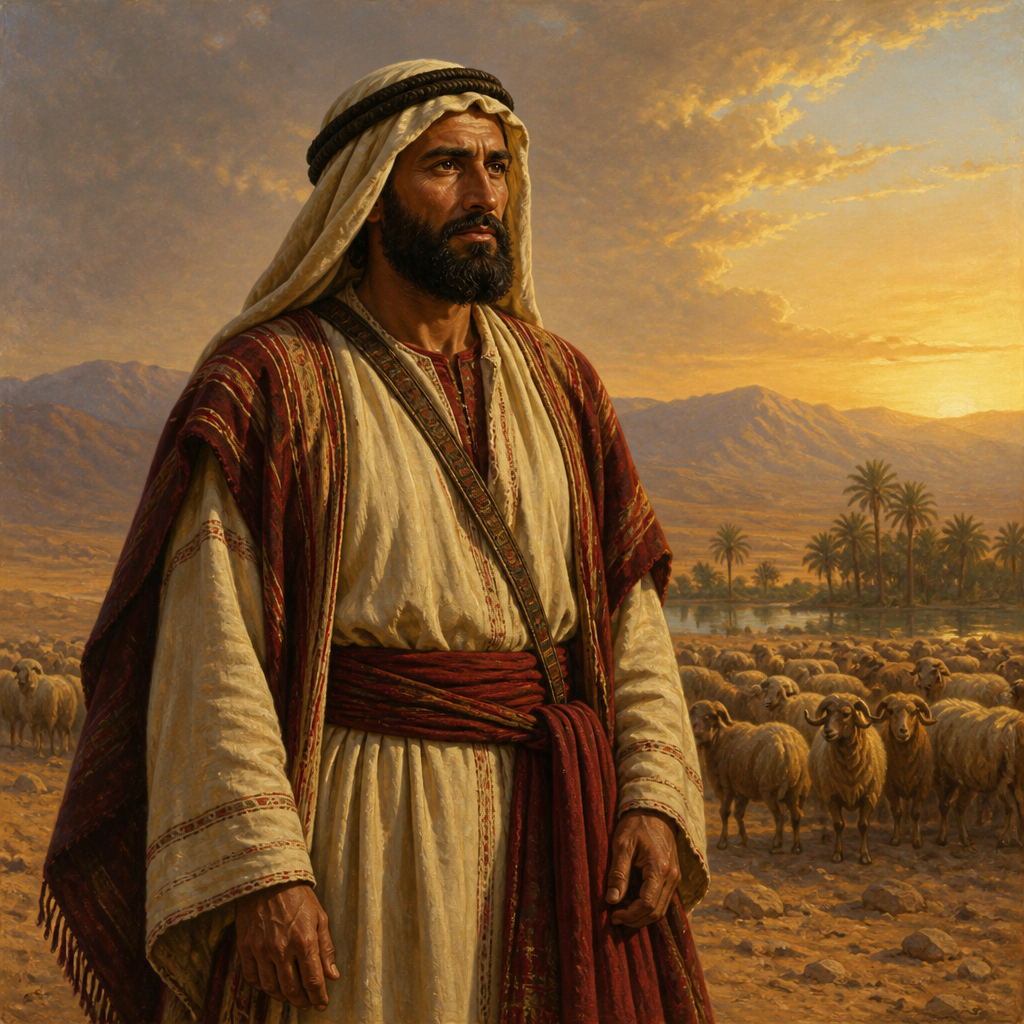
In the prophetic literature, specifically Isaiah 60:7, the name "Nebaioth" shifts from an individual to a collective representation of his descendants. The verse mentions "the rams of Nebaioth," suggesting that his name had become synonymous with a wealthy pastoral society known for its livestock. This indicates that the tribe founded by Nebaioth thrived in the arid regions of Arabia, maintaining a culture centered on herding and trade.
Relationship to Other Biblical Figures
Nebaioth’s primary relationships are defined by his status as a firstborn and a brother. As the grandson of Abraham, he represents a branch of the Abrahamic family that remained distinct from the line of the covenant promise (Isaac) yet remained under the umbrella of God's providential care. His relationship with Kedar is particularly notable; the two are frequently mentioned together as the most prominent of the Ishmaelite clans. Furthermore, his relationship to Esau through his sister's marriage highlights the ongoing social and political connections between the various nomadic groups related to the house of Abraham.
Spiritual Significance
While Nebaioth is a minor figure in terms of narrative action, his spiritual significance lies in the fulfillment of God’s word and his inclusion in future hope. His existence is a testament to the fact that God honors His promises to Hagar and Ishmael.
In the Book of Isaiah, Nebaioth takes on a symbolic role in the vision of a restored Zion. Isaiah 60:7 envisions a time when the nations, including the tribes of Arabia, will come to Jerusalem to worship the Lord. The "rams of Nebaioth" serving on the altar signify that the descendants of Ishmael—once cast out from the immediate household of Abraham—will eventually be included in the universal worship of God. This points to a theological theme of inclusion, where the firstborn of Ishmael contributes to the glory of the house of the God of Israel.
Nebaioth is significant as the fulfillment of God's promise to Ishmael to make him the father of twelve princes. As the firstborn, he represents the beginning of the Ishmaelite nations, which are often viewed as both rivals and kin to the Israelites. His mention in Isaiah suggests that he is a representative of the Gentile nations who will eventually be brought into the fold of God's people.
The inclusion of Nebaioth in the genealogies of 1 Chronicles ensures his place in the historical memory of Israel, documenting the broad reach of Abraham's biological lineage. He serves as a bridge between the early patriarchal era and the later prophetic descriptions of the Arabian peoples.
Frequently Asked Questions
Who was Nebaioth's father?
Nebaioth was the firstborn son of Ishmael, who was the son of Abraham and Hagar.
What is Nebaioth known for?
He is primarily known as the first of the twelve princes of Ishmael and for the pastoral tribe that bore his name, mentioned in prophetic literature.
How many brothers did Nebaioth have?
Nebaioth had eleven brothers: Kedar, Adbeel, Mibsam, Mishma, Dumah, Massa, Hadad, Tema, Jetur, Naphish, and Kedemah.
Which biblical book mentions the 'rams of Nebaioth'?
The book of Isaiah, specifically in chapter 60, verse 7, mentions the rams of Nebaioth serving God on His altar.
Was Nebaioth related to Esau?
Yes, Nebaioth was Esau's brother-in-law, as his sister Mahalath (Basemath) married Esau.
Family & Relationships
Parents
 Ishmael, Son of AbrahamFatherGenesis 25:13Stated
 NebaiothThis page
 AdbeelBrotherGenesis 25:13Stated
 DumahBrotherGenesis 25:13–14Stated
 Hadad, Son of IshmaelBrotherGenesis 25:13–15Stated
 JeturBrotherGenesis 25:13–15Stated
 KedarBrotherGenesis 25:13Stated
 KedemahBrotherGenesis 25:13–15Stated
 Mahalath, Wife of EsauSisterGenesis 28:9Stated
 MassaBrotherGenesis 25:13–14Stated
 Mibsam, Son of IshmaelBrotherGenesis 25:13Stated
 Mishma, Son of IshmaelBrotherGenesis 25:13–14Stated
 NaphishBrotherGenesis 25:13–15Stated
 TemaBrotherGenesis 25:13–15Stated
Extended family
 AbrahamGrandfatherGenesis 25:13
Inferred
Reconstructed through Ishmael: Genesis 16:15 ties Abram to Ishmael; Genesis 25:13 ties Ishmael to Nebaioth. No verse states the grandson link between Abraham and Nebaioth directly.Evidence: Genesis 25:13; Genesis 17:23
Connected Figures
Family
Father · Genesis 25:13
Ishmael was the firstborn son of Abraham through Hagar, the forefather of the Ishmaelite tribes, and a patriarch whom God promised would father twelve princes.
Brother · Genesis 25:13
Adbeel was the third son of Ishmael and a grandson of Abraham, recognized as one of the twelve princes and tribal leaders of the Ishmaelite people.
PatriarchsFirst: Genesis 25:139 versesTribal Prince and Patriarch
Brother · Genesis 25:13–14
Dumah was the sixth son of Ishmael and a grandson of Abraham, serving as a tribal patriarch in the Arabian peninsula.
PatriarchsFirst: Genesis 25:149 versesPatriarchal tribal leader
Brother · Genesis 25:13–15
Hadad was one of the twelve sons of Ishmael and a grandson of the patriarch Abraham, serving as a tribal chieftain in the Arabian peninsula.
PatriarchsFirst: Genesis 25:159 versesTribal Chieftain
Brother · Genesis 25:13–15
Jetur was the tenth son of Ishmael and a grandson of Abraham, recognized as a tribal patriarch among the descendants of Ishmael in the Arabian peninsula.
PatriarchsFirst: Genesis 25:159 versesTribal Prince
Brother · Genesis 25:13
Kedar was the second son of Ishmael and a foundational patriarch of a major nomadic tribal confederation in the Arabian desert.
Brother · Genesis 25:13–15
Kedemah was the twelfth and youngest son of Ishmael and a grandson of Abraham, serving as a tribal patriarch in the Arabian peninsula.
Sister · Genesis 28:9
Mahalath was the daughter of Ishmael and granddaughter of Abraham who became a wife of Esau in an attempt to please his parents.
Brother · Genesis 25:13–14
Massa was one of the twelve sons of Ishmael and a grandson of Abraham, serving as a tribal patriarch in the Arabian peninsula.
Brother · Genesis 25:13
A son of Ishmael and one of the twelve tribal princes who descended from Abraham, serving as a patriarchal figure in the Arabian peninsula.
PatriarchsFirst: Genesis 25:136 versesTribal Prince and Patriarch
Brother · Genesis 25:13–14
A son of Ishmael and a prince of a nomadic Arabian tribe during the Patriarchal Period.
PatriarchsFirst: Genesis 25:149 versesTribal Prince
Brother · Genesis 25:13–15
Naphish was a son of Ishmael and the progenitor of a nomadic Arabian tribe mentioned in the genealogies of Genesis and 1 Chronicles.
PatriarchsFirst: Genesis 25:157 versesTribal Prince
Categories
Mentions by Book
- Genesis9
- 1 Chronicles1
Scripture References
All 10 indexed verses, in canonical order, from the Berean Standard Bible.
Genesis · 9
- Genesis 16:15Partial
And Hagar bore Abram a son, and Abram gave the name Ishmael to the son she had borne.
Cited as evidence on a family card; added so References, Key Verses and Mentions by Book share one index.
- Genesis 16:16Partial
Abram was eighty-six years old when Hagar bore Ishmael to him.
Cited as evidence on a family card; added so References, Key Verses and Mentions by Book share one index.
- Genesis 17:23Partial
On that very day Abraham took his son Ishmael and all those born in his household or purchased with his money—every male among the members of Abraham’s household—and he circumcised them, just as God had told him.
Cited as evidence on a family card; added so References, Key Verses and Mentions by Book share one index.
- Genesis 17:26Partial
Abraham and his son Ishmael were circumcised on the same day.
Cited as evidence on a family card; added so References, Key Verses and Mentions by Book share one index.
- Genesis 25:13
These are the names of the sons of Ishmael in the order of their birth: Nebaioth the firstborn of Ishmael, then Kedar, Adbeel, Mibsam,
- Genesis 25:14Partial
Mishma, Dumah, Massa,
Cited as evidence on a family card; added so References, Key Verses and Mentions by Book share one index.
- Genesis 25:15Partial
Hadad, Tema, Jetur, Naphish, and Kedemah.
Cited as evidence on a family card; added so References, Key Verses and Mentions by Book share one index.
- Genesis 28:9
Esau went to Ishmael and married Mahalath, the sister of Nebaioth and daughter of Abraham’s son Ishmael, in addition to the wives he already had.
- Genesis 36:3
and Basemath daughter of Ishmael and sister of Nebaioth.
1 Chronicles · 1
- 1 Chronicles 1:29
These are their genealogies: Nebaioth the firstborn of Ishmael, then Kedar, Adbeel, Mibsam,