Hagar
Who was Hagar in the Bible?
An Egyptian woman who served as Sarai’s maidservant and became the mother of Ishmael, Abraham’s firstborn son.
Hagar was an Egyptian woman who lived during the Patriarchal Period, serving as the maidservant to Sarai, the wife of Abram (later Abraham). When Sarai remained childless after a decade in the land of Canaan, she followed the custom of the era by offering Hagar to Abram as a wife to build a family through her. This decision led to the birth of Ishmael, Abram's first son, but also precipitated intense domestic conflict that resulted in Hagar's eventual departure into the wilderness.
Hagar is the first person in Scripture said to be met by the angel of the LORD, and the only person in the Old Testament who gives God a name of her own: El Roi, "a God of seeing" (Genesis 16:7, 13). God had spoken directly with Adam, Eve, Noah and Abram before her. Her story serves as a bridge between the immediate family of the patriarchs and the broader nations that would descend from Abraham's lineage.
Background and Family
Hagar is identified in the book of Genesis as an Egyptian. While the text does not detail how she entered the household of Abram and Sarai, her presence as a maidservant is established by Genesis 16 and, after Ishmael's birth, again in Genesis 21:1. Following a period of ten years in Canaan, during which Sarai was unable to conceive, Sarai took Hagar and gave her to Abram to be his wife. This arrangement was a legal and social practice intended to ensure the continuation of the patriarch's line. Through this union, Hagar became the mother of Ishmael, whom she bore when Abram was eighty-six years old.
Major Life Events
The life of Hagar is defined by two major episodes of flight and divine encounter. The first occurred shortly after she conceived Ishmael. The text records that when Hagar realized she was pregnant, she began to despise her mistress, Sarai. In response, Sarai treated her harshly, leading Hagar to flee toward the wilderness. Near a spring on the way to Shur, an angel of the Lord found her. The angel instructed her to return and submit to Sarai, but also provided a prophecy regarding her unborn son, promising that his descendants would be too numerous to count. It was during this encounter that Hagar called the Lord "You are the God who sees me" (El Roi).
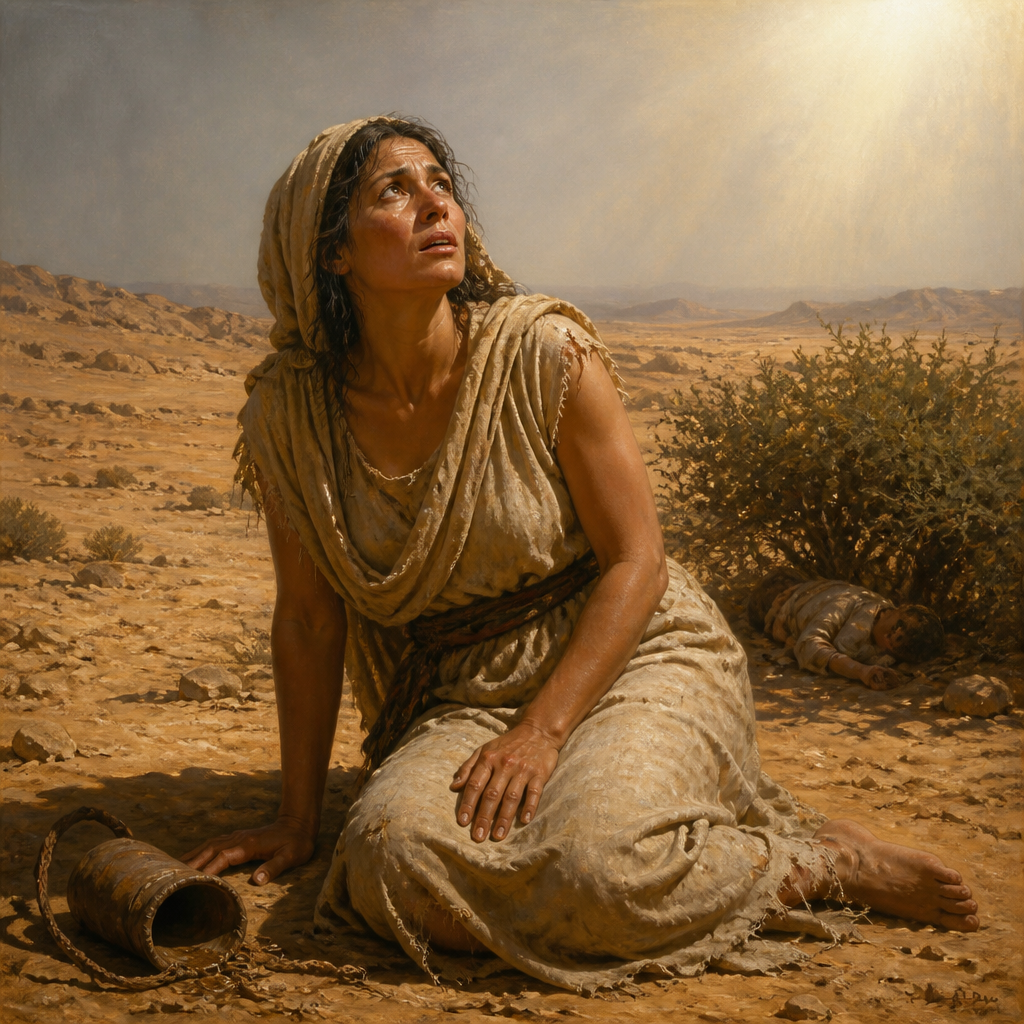
The second major event occurred after the birth of Isaac, the son of the promise to Sarah. During a feast celebrating Isaac’s weaning, Sarah observed Ishmael mocking the younger child. Distressed, Sarah demanded that Abraham expel Hagar and her son. Though Abraham was reluctant, God instructed him to comply, promising that Ishmael would also become a great nation because he was Abraham's offspring. Abraham provided Hagar with bread and a skin of water and sent her into the Wilderness of Beersheba.
As their supplies failed, Hagar placed Ishmael under a bush and sat some distance away, unable to watch the boy die. However, God heard the boy's voice, and the angel of God called to Hagar from heaven. God opened her eyes to see a well of water, sustaining their lives. The narrative concludes Hagar's personal history by noting that God was with the boy as he grew in the wilderness and that Hagar eventually secured a wife for him from the land of Egypt.
Relationship to Other Biblical Figures
Hagar’s primary relationships were defined by her status as a subordinate within the patriarchal household. As a maidservant to Sarai, she was subject to her mistress's authority, which became a source of significant friction. Her relationship with Abraham was that of a secondary wife and the mother of his firstborn. While Abraham showed concern for her and Ishmael, he ultimately deferred to Sarah’s demands and God’s direction regarding their departure. Her most vital bond was with her son, Ishmael, whose survival and future she fought for in the desert.
Spiritual Significance
Hagar occupies a unique place in biblical theology. In the Genesis narrative, she represents God’s care for the marginalized and his faithfulness to the promises made to Abraham regarding his physical descendants. The New Testament, specifically in the writings of Paul, uses Hagar as an allegory. In Galatians 4, she is contrasted with Sarah to represent two covenants. Hagar is associated with Mount Sinai and the covenant of law, representing those in slavery, whereas Sarah represents the Jerusalem above and the covenant of promise. This typological use emphasizes the distinction between physical lineage and the spiritual inheritance found through faith.
Hagar’s significance lies in her role as the mother of the Ishmaelites and her direct interaction with God. She is the first person in Scripture visited by the angel of the LORD, though not the first to whom God spoke and is credited with naming God 'El Roi' (The God who sees me). Theologically, she demonstrates that God’s providence extends beyond the primary line of the covenant to include those affected by the complexities of the patriarchal family.
In the New Testament, Hagar is used by the Apostle Paul in Galatians 4:24-25 as an illustration of the Old Covenant. She represents the law and the earthly Jerusalem, contrasting with Sarah, who represents the promise and the heavenly Jerusalem. This ensures Hagar remains a central figure in the discussion of biblical covenants and the history of salvation.
Frequently Asked Questions
Where was Hagar from?
Hagar was an Egyptian maidservant belonging to Sarai.
Who was Hagar’s son?
Hagar’s son was Ishmael, the firstborn son of Abraham.
What name did Hagar give to God?
She called God 'El Roi,' which means 'You are the God who sees me,' after her encounter with the angel in the wilderness.
Why did Hagar leave Abraham’s household?
She was sent away by Abraham at Sarah's demand after Sarah saw Ishmael mocking Isaac, an action that God permitted while promising to care for Hagar and the boy.
What role does Hagar play in the New Testament?
In Galatians 4, Hagar is used as an allegory for the covenant of the Law given at Mount Sinai, representing those in slavery.
Family & Relationships
 AbrahamHusbandGenesis 16:3Stated
 HagarThis page
Children
 Ishmael, Son of AbrahamSonGenesis 16:15Stated
Extended family
 KedarGrandsonGenesis 25:13
Inferred
Reconstructed through Ishmael: Genesis 16:15 ties Hagar to Ishmael; Genesis 25:13 ties Ishmael to Kedar. No verse states the grandson link between Hagar and Kedar directly.Evidence: Genesis 25:13; 1 Chronicles 1:29; Genesis 16:15; Genesis 16:16
 SarahRelativeGenesis 16:15
Inferred
Reconstructed through Abraham: Genesis 11:29 ties Sarai to Abram; Genesis 16:3 ties Abram to Hagar. No verse states the relative link between Sarah and Hagar directly.Evidence: Genesis 16:15; Genesis 11:29; Genesis 11:31; Genesis 12:5; Genesis 12:17
Connected Figures
Family
Husband · Genesis 16:3
The first of the three biblical patriarchs and the father of the nation of Israel, known for his unwavering faith and his covenant relationship with God.
PatriarchsFirst: Genesis 11:26296 versesPatriarch, nomad, wealthy livestock owner
Son · Genesis 16:15
Ishmael was the firstborn son of Abraham through Hagar, the forefather of the Ishmaelite tribes, and a patriarch whom God promised would father twelve princes.
Grandson · Genesis 25:13
Kedar was the second son of Ishmael and a foundational patriarch of a major nomadic tribal confederation in the Arabian desert.
Relative · Genesis 16:15
The wife of Abraham and mother of Isaac, recognized as the primary matriarch of the Hebrew people and a recipient of God's covenantal promise.
Categories
Mentions by Book
- Genesis17
- Galatians2
Scripture References
All 19 indexed verses, in canonical order, from the Berean Standard Bible.
Genesis · 17
- Genesis 11:29Partial
And Abram and Nahor took wives for themselves. Abram’s wife was named Sarai, and Nahor’s wife was named Milcah; she was the daughter of Haran, who was the father of both Milcah and Iscah.
Cited as evidence on a family card; added so References, Key Verses and Mentions by Book share one index.
- Genesis 11:31Partial
And Terah took his son Abram, his grandson Lot son of Haran, and his daughter-in-law Sarai the wife of Abram, and they set out from Ur of the Chaldeans for the land of Canaan. But when they arrived in Haran, they settled there.
Cited as evidence on a family card; added so References, Key Verses and Mentions by Book share one index.
- Genesis 12:5Partial
And Abram took his wife Sarai, his nephew Lot, and all the possessions and people they had acquired in Haran, and set out for the land of Canaan. When they came to the land of Canaan,
Cited as evidence on a family card; added so References, Key Verses and Mentions by Book share one index.
- Genesis 12:17Partial
The LORD, however, afflicted Pharaoh and his household with severe plagues because of Abram’s wife Sarai.
Cited as evidence on a family card; added so References, Key Verses and Mentions by Book share one index.
- Genesis 16:1
Now Abram’s wife Sarai had borne him no children, but she had an Egyptian maidservant named Hagar.
- Genesis 16:3
So after he had lived in Canaan for ten years, his wife Sarai took her Egyptian maidservant Hagar and gave her to Abram to be his wife.
- Genesis 16:4
And he slept with Hagar, and she conceived. But when Hagar realized that she was pregnant, she began to despise her mistress.
- Genesis 16:8
“Hagar, servant of Sarai,” he said, “where have you come from, and where are you going?” “I am running away from my mistress Sarai,” she replied.
- Genesis 16:13
So Hagar gave this name to the LORD who had spoken to her: “You are the God who sees me,” for she said, “Here I have seen the One who sees me!”
Cited as a key verse; added so References, Key Verses and Mentions by Book share one index.
- Genesis 16:15Partial
And Hagar bore Abram a son, and Abram gave the name Ishmael to the son she had borne.
- Genesis 16:16
Abram was eighty-six years old when Hagar bore Ishmael to him.
- Genesis 21:9
But Sarah saw that the son whom Hagar the Egyptian had borne to Abraham was mocking her son,
- Genesis 21:14
Early in the morning, Abraham got up, took bread and a skin of water, put them on Hagar’s shoulders, and sent her away with the boy. She left and wandered in the Wilderness of Beersheba.
- Genesis 21:17Partial
Then God heard the voice of the boy, and the angel of God called to Hagar from heaven, “What is wrong, Hagar? Do not be afraid, for God has heard the voice of the boy where he lies.
- Genesis 21:18Partial
Get up, lift up the boy, and take him by the hand, for I will make him into a great nation.”
Cited as a key verse; added so References, Key Verses and Mentions by Book share one index.
- Genesis 25:12
This is the account of Abraham’s son Ishmael, whom Hagar the Egyptian, Sarah’s maidservant, bore to Abraham.
- Genesis 25:13Partial
These are the names of the sons of Ishmael in the order of their birth: Nebaioth the firstborn of Ishmael, then Kedar, Adbeel, Mibsam,
Cited as evidence on a family card; added so References, Key Verses and Mentions by Book share one index.
Galatians · 2
- Galatians 4:24
These things serve as illustrations, for the women represent two covenants. One covenant is from Mount Sinai and bears children into slavery: This is Hagar.
- Galatians 4:25
Now Hagar stands for Mount Sinai in Arabia and corresponds to the present-day Jerusalem, because she is in slavery with her children.