Noah
Who was Noah in the Bible?
A righteous patriarch who built an ark to preserve humanity and animals from a divine global flood, becoming the second father of the human race.
Noah was a pivotal patriarch in the book of Genesis, recognized as the tenth of the pre-flood (antediluvian) patriarchs in the line of Seth. He is primarily known for his role in the Great Flood narrative, where he was chosen by God to survive a catastrophic judgment against a world filled with corruption and violence. According to the biblical record, Noah was a man of exceptional character, described as righteous and blameless among the people of his time, and one who walked faithfully with God.
His life marks a major transition in the biblical narrative, shifting from the primordial history of the world to the establishment of a formal covenant between God and all living creatures. Following the flood, Noah became a symbolic father figure for all subsequent nations, as the human population was replenished through his three sons: Shem, Ham, and Japheth. His legacy is one of obedience, preservation, and the enduring promise of divine mercy represented by the rainbow.
Background and Family
Noah was the son of Lamech and a grandson of Methuselah, making him part of the tenth generation of humanity according to the genealogies in Genesis 5. His name is traditionally interpreted to mean 'rest' or 'comfort,' a name given by his father in the hope that Noah would provide relief from the toil of the ground which God had cursed. He lived during a period of extreme moral decline, characterized by pervasive wickedness and violence. Noah was the father of three sons—Shem, Ham, and Japheth—all of whom were born after Noah had reached the age of 500.
Major Life Events
The Command and the Ark
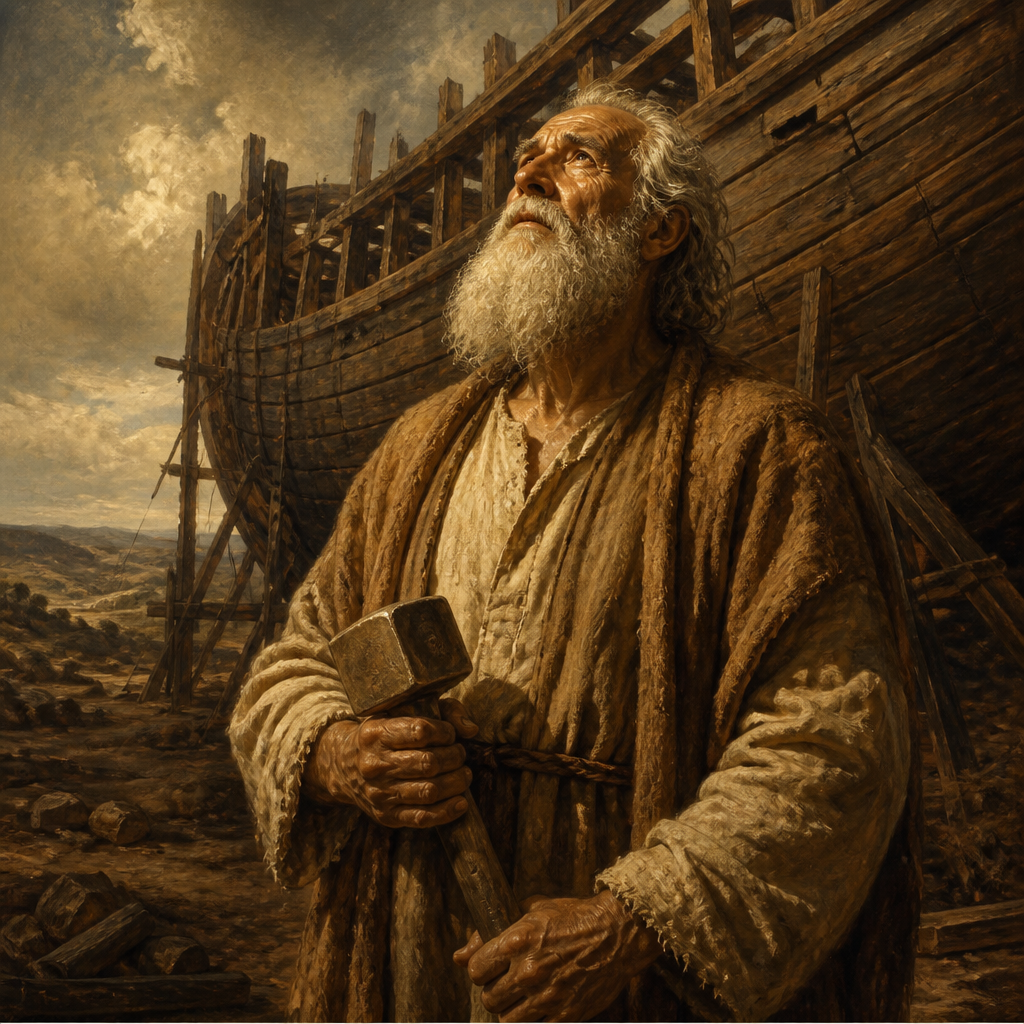
The central event of Noah’s life began when God, grieving the state of His creation, decided to bring a flood to destroy all life on earth. However, because Noah 'found favor in the eyes of the Lord,' God provided him with specific instructions to build a massive wooden vessel known as an ark. This vessel was to be constructed of gopher wood and sealed with pitch, measuring approximately 300 cubits long, 50 cubits wide, and 30 cubits high. Noah was commanded to bring his wife, his sons, and his sons' wives into the ark, along with pairs of every kind of animal to ensure the survival of each species.
The Great Flood
When Noah was 600 years old, the floodwaters came upon the earth, originating from both the 'fountains of the great deep' and the 'windows of the heavens.' For forty days and nights, rain fell, submerging even the highest mountains. Genesis dates the Flood's beginning to month 2, day 17 of Noah's 600th year (Genesis 7:11). The ground was dry by month 2, day 27 of his 601st year, when God told his family to leave the ark (Genesis 8:13–16). To test the condition of the earth, Noah released a raven and later a dove; it was the second flight of the dove, returning with an olive leaf, that signaled the return of vegetation.
The Covenant and the Rainbow
Upon exiting the ark on the mountains of Ararat, Noah’s first act was to build an altar and offer sacrifices to God. In response, God promised never again to destroy the earth with a flood and established the Noahic Covenant. As a sign of this perpetual promise, God placed a rainbow in the clouds. Genesis 9:3–6 gives humanity animals for food, forbids eating meat with its lifeblood, and requires an accounting for human bloodshed because people are made in God's image.
Relationship to Other Biblical Figures
Noah serves as a bridge between the world of Adam and the world of the later patriarchs like Abraham. He is often compared to Adam; just as Adam was told to 'be fruitful and multiply,' Noah received the same command to restart human civilization. In the New Testament, Noah is linked to the ministry of Jesus and the apostles. The author of Hebrews includes him in the 'Hall of Faith,' while the apostle Peter refers to him as a 'herald of righteousness,' suggesting that Noah spent his time during the ark's construction warning his contemporaries of the coming judgment.
Spiritual Significance
Noah serves as a foundational figure in the legal and covenantal history of the Bible. The Noahic Covenant is unique because it is universal, applying not just to a specific nation or tribe, but to all of humanity and every living creature. It establishes the sanctity of life and the basic moral framework for human society.
Theologically, Noah is the ultimate example of perseverance and obedience. Hebrews 11:7 commends Noah's faith: he responded to God's warning by preparing an ark to save his household. In the New Testament, Jesus uses the 'days of Noah' as a warning for the end times, emphasizing that Noah’s lifestyle of readiness and righteousness is the standard for those awaiting the final judgment.
In biblical theology, Noah is a prototype of the 'righteous remnant.' He represents the idea that God preserves a faithful few even in times of universal apostasy. The Ark is frequently used in Christian typology as a symbol of the Church or of salvation through Christ, providing safety from judgment. Furthermore, the Flood is interpreted in the New Testament (specifically 1 Peter 3) as a prefiguration of baptism. Noah’s life demonstrates the principle of 'salvation by faith,' as he acted on divine warnings regarding events he could not yet see, illustrating a total reliance on the word of God over physical evidence.
Frequently Asked Questions
How long did it take Noah to build the ark?
While the Bible does not give a specific start date, Genesis 6:3 sets a limit of 120 years, which many readers take as a countdown before the Flood; the verse does not call it the building time, and Scripture never states how long the ark took.
How old was Noah when he died?
Noah lived to be 950 years old, dying 350 years after the Great Flood.
What kind of wood was the ark made of?
The Bible specifies 'gopher wood,' though the exact botanical identity of this wood remains a subject of debate among linguists and historians, with suggestions ranging from cypress to cedar.
Where did the ark land?
According to Genesis 8:4, the ark came to rest on the 'mountains of Ararat,' a region in modern-day eastern Turkey.
How many of each animal did Noah take?
Noah was instructed to take two of every kind of animal, but for 'clean' animals and birds, he was told to take seven pairs (or seven individuals).
Family & Relationships
Parents
 Lamech, Father of NoahFatherLuke 3:36Stated
 Noah's WifeWifeGenesis 7:7Stated
 NoahThis page
Extended family
 Ham's WifeDaughter-in-lawGenesis 7:13
Inferred
No verse names Ham's Wife and Noah together; the father-in-law link is carried from the surrounding genealogy and is not stated in Scripture.Evidence: Genesis 7:13; Genesis 9:18
 Japheth's WifeDaughter-in-lawGenesis 7:13
Inferred
No verse names Noah and Japheth's Wife together; the daughter-in-law link is carried from the surrounding genealogy and is not stated in Scripture.Evidence: Genesis 7:13; Genesis 9:18
 Shem's WifeDaughter-in-lawGenesis 7:13
Inferred
No verse names Noah and Shem's Wife together; the daughter-in-law link is carried from the surrounding genealogy and is not stated in Scripture.Evidence: Genesis 7:13; 1 Chronicles 1:4; Luke 3:36
 Aram, Son of ShemGrandson1 Chronicles 1:4
Inferred
Reconstructed through Arphaxad: Genesis 10:22 ties Aram to Arphaxad; Luke 3:36 ties Arphaxad to Noah (itself an inferred link). No verse states the grandfather link between Aram and Noah directly.Evidence: 1 Chronicles 1:4; Luke 3:36; Genesis 10:22
 ArphaxadGrandsonLuke 3:36
Inferred
Luke 3:36 names Noah and Arphaxad in the same verse but does not state a grandson tie between them; the link rests on the surrounding narrative.Evidence: Luke 3:36; 1 Chronicles 1:4
 Asshur, Son of ShemGrandsonGenesis 10:22
Inferred
Reconstructed through Shem: 1 Chronicles 1:4 ties Noah to Shem; Genesis 10:22 ties Shem to Asshur. No verse states the grandson link between Noah and Asshur directly.Evidence: Genesis 10:22; 1 Chronicles 1:4; Luke 3:36
 Canaan, Son of HamGrandsonGenesis 9:18
Inferred
Genesis 9:18 lists Noah and Canaan among the sons of noah, but does not say how the two of them are related.Evidence: Genesis 9:18; Genesis 9:22
 Elam, Son of ShemGrandsonGenesis 10:22
Inferred
Reconstructed through Arphaxad: Genesis 10:22 ties Elam to Arphaxad; Luke 3:36 ties Arphaxad to Noah (itself an inferred link). No verse states the grandfather link between Elam and Noah directly.Evidence: Genesis 10:22; 1 Chronicles 1:17; 1 Chronicles 1:4; Luke 3:36
 ElishahGreat-GrandsonGenesis 5:29
Inferred
Reconstructed through Japheth and Javan: Genesis 9:18 ties Noah to Japheth; Genesis 10:2 ties Japheth to Javan; Genesis 10:4 ties Javan to Elishah. No verse states the great-grandson link between Noah and Elishah directly.Evidence: Genesis 5:29
 Enoch, Son of JaredGreat-Grandfather1 Chronicles 1:3
Inferred
1 Chronicles 1:3 names Enoch and Noah in the same verse but does not state a great-grandson tie between them; the link rests on the surrounding narrative.Evidence: 1 Chronicles 1:3
 JaredGreat-GrandfatherGenesis 5:15
Inferred
Reconstructed through Enoch: Luke 3:37 ties Jared to Enoch; 1 Chronicles 1:3 ties Enoch to Noah (itself an inferred link). No verse states the great-grandson link between Jared and Noah directly.Evidence: Genesis 5:15
 JavanGrandsonGenesis 10:2
Inferred
Reconstructed through Japheth: Genesis 10:2 ties Javan to Japheth; Genesis 9:18 ties Japheth to Noah. No verse states the grandfather link between Javan and Noah directly.Evidence: Genesis 10:2; Genesis 9:18
 LudGrandsonGenesis 10:22
Inferred
Reconstructed through Shem: 1 Chronicles 1:4 ties Noah to Shem; Genesis 10:22 ties Shem to Lud. No verse states the grandson link between Noah and Lud directly.Evidence: Genesis 10:22; 1 Chronicles 1:4; Luke 3:36
 MadaiGrandsonGenesis 10:2
Inferred
Reconstructed through Japheth: Genesis 9:18 ties Noah to Japheth; Genesis 10:2 ties Japheth to Madai. No verse states the grandson link between Noah and Madai directly.Evidence: Genesis 10:2; Genesis 9:18
 MagogGrandsonGenesis 10:2
Inferred
Reconstructed through Japheth: Genesis 9:18 ties Noah to Japheth; Genesis 10:2 ties Japheth to Magog. No verse states the grandson link between Noah and Magog directly.Evidence: Genesis 10:2; Genesis 9:18
 MeshechGrandsonGenesis 10:2
Inferred
Reconstructed through Japheth: Genesis 10:2 ties Meshech to Japheth; Genesis 9:18 ties Japheth to Noah. No verse states the grandfather link between Meshech and Noah directly.Evidence: Genesis 10:2; Genesis 9:18
 MethuselahGrandfatherLuke 3:36
Inferred
Reconstructed through Enoch: 1 Chronicles 1:3 ties Noah to Enoch (itself an inferred link); Luke 3:37 ties Enoch to Methuselah. No verse states the grandfather link between Noah and Methuselah directly.Evidence: Luke 3:36; Luke 3:37
 NimrodGreat-GrandsonGenesis 5:29
Inferred
Reconstructed through Cush and Ham: Genesis 10:8 ties Nimrod to Cush; Genesis 10:6 ties Cush to Ham; Genesis 9:18 ties Ham to Noah. No verse states the great-grandfather link between Nimrod and Noah directly.Evidence: Genesis 5:29
 TirasGrandsonGenesis 9:18
Inferred
Reconstructed through Japheth: Genesis 10:2 ties Tiras to Japheth; Genesis 9:18 ties Japheth to Noah. No verse states the grandfather link between Tiras and Noah directly.Evidence: Genesis 9:18; Genesis 10:2
 TubalGrandsonGenesis 9:18
Inferred
Reconstructed through Japheth: Genesis 9:18 ties Noah to Japheth; Genesis 10:2 ties Japheth to Tubal. No verse states the grandson link between Noah and Tubal directly.Evidence: Genesis 9:18; Genesis 10:2
 CainanGreat-GrandsonLuke 3:36Stated
 EnoshAncestorGenesis 4:26
Inferred
No verse names Enosh and Noah together; the descendant link is carried from the surrounding genealogy and is not stated in Scripture.Evidence: Genesis 4:26
 SethAncestorGenesis 4:25
Inferred
No verse names Seth and Noah together; the descendant link is carried from the surrounding genealogy and is not stated in Scripture.Evidence: Genesis 4:25
Connected Figures
Family
Father · Luke 3:36
Lamech was the son of Methuselah and the father of Noah, known for his prophecy regarding his son providing comfort from the cursed ground.
Wife · Genesis 7:7
The matriarch of the post-Flood human race and one of the eight survivors aboard the Ark during the Genesis deluge.

Son · Genesis 9:18
The second son of Noah and an ancestor of numerous southern nations, known as one of the eight survivors of the Great Flood.
Primeval HistoryFirst: Genesis 5:3217 versesArk builder and husbandman

Son · Genesis 9:18
Japheth was one of the three sons of Noah and a survivor of the Great Flood, traditionally viewed as the progenitor of the Indo-European and Aegean peoples.
Primeval HistoryFirst: Genesis 5:3215 versesArk builder and patriarch

Son · 1 Chronicles 1:4
The eldest or middle son of Noah, an Ark survivor, and the foundational patriarch of the Semitic peoples, including the Israelites.
Primeval HistoryFirst: Genesis 5:3226 versesPatriarch and Ark survivor
Daughter-in-law · Genesis 7:13
One of the eight survivors of the Great Flood and a programmatic matriarch of the post-diluvian human race through her four sons.
Daughter-in-law · Genesis 7:13
One of the eight survivors of the Great Flood and a foundational maternal ancestor of post-diluvian humanity through the line of Japheth.
Primeval HistoryFirst: Genesis 5:294 versesMatriarch and Ark survivor
Daughter-in-law · Genesis 7:13
One of the eight survivors of the Great Flood and a female progenitor of a significant portion of the post-diluvian human race.
Primeval HistoryFirst: Genesis 5:295 versesHomemaker and pioneer
Grandson · 1 Chronicles 1:4
Aram was a son of Shem and grandson of Noah, recognized as a primary ancestor of various Semitic peoples in the ancient Near East.
Grandson · Luke 3:36
A post-flood patriarch, son of Shem, and ancestor of Abraham through whom the messianic lineage is traced.
Grandson · Genesis 10:22
Asshur was a son of Shem and a grandson of Noah, recognized in the Table of Nations as a foundational figure in post-flood genealogy.
Grandson · Genesis 9:18
Canaan was the son of Ham and the grandson of Noah, known primarily for being the recipient of Noah's curse and the progenitor of several significant ancient Near Eastern tribes.
Primeval HistoryFirst: Genesis 9:1810 versesProgenitor of nations
Categories
Mentions by Book
- Genesis44
- 1 Chronicles3
- Isaiah1
- Ezekiel2
- Matthew2
- Luke4
- Hebrews1
- 1 Peter1
- 2 Peter1
Scripture References
All 59 indexed verses, in canonical order, from the Berean Standard Bible.
- Genesis 4:25Partial
And Adam again had relations with his wife, and she gave birth to a son and named him Seth, saying, “God has granted me another seed in place of Abel, since Cain killed him.”
Cited as evidence on a family card; added so References, Key Verses and Mentions by Book share one index.
- Genesis 4:26Partial
And to Seth also a son was born, and he called him Enosh. At that time men began to call upon the name of the LORD.
Cited as evidence on a family card; added so References, Key Verses and Mentions by Book share one index.
- Genesis 5:15Partial
When Mahalalel was 65 years old, he became the father of Jared.
Cited as evidence on a family card; added so References, Key Verses and Mentions by Book share one index.
- Genesis 5:29
And he named him Noah, saying, “May this one comfort us in the labor and toil of our hands caused by the ground that the LORD has cursed.”
- Genesis 5:30
And after he had become the father of Noah, Lamech lived 595 years and had other sons and daughters.
- Genesis 5:32Partial
After Noah was 500 years old, he became the father of Shem, Ham, and Japheth.
- Genesis 6:8
Noah, however, found favor in the eyes of the LORD.
- Genesis 6:9Partial
This is the account of Noah. Noah was a righteous man, blameless in his generation; Noah walked with God.
- Genesis 6:10
And Noah had three sons: Shem, Ham, and Japheth.
- Genesis 6:13
Then God said to Noah, “The end of all living creatures has come before Me, because through them the earth is full of violence. Now behold, I will destroy both them and the earth.
- Genesis 6:22
So Noah did everything precisely as God had commanded him.
- Genesis 7:1
Then the LORD said to Noah, “Go into the ark, you and all your family, because I have found you righteous in this generation.
- Genesis 7:5
And Noah did all that the LORD had commanded him.
- Genesis 7:6
Now Noah was 600 years old when the floodwaters came upon the earth.
- Genesis 7:7
And Noah and his wife, with his sons and their wives, entered the ark to escape the waters of the flood.
- Genesis 7:9Partial
came to Noah to enter the ark, two by two, male and female, as God had commanded Noah.
- Genesis 7:11
In the six hundredth year of Noah’s life, on the seventeenth day of the second month, all the fountains of the great deep burst forth, and the floodgates of the heavens were opened.
- Genesis 7:13Partial
On that very day Noah entered the ark, along with his sons Shem, Ham, and Japheth, and his wife, and the three wives of his sons—
- Genesis 7:15
They came to Noah to enter the ark, two by two of every creature with the breath of life.
- Genesis 7:23
And every living thing on the face of the earth was destroyed—man and livestock, crawling creatures and birds of the air; they were blotted out from the earth, and only Noah and those with him in the ark remained.
- Genesis 8:1
But God remembered Noah and all the animals and livestock that were with him in the ark. And God sent a wind over the earth, and the waters began to subside.
- Genesis 8:6
After forty days Noah opened the window he had made in the ark
- Genesis 8:11
And behold, the dove returned to him in the evening with a freshly plucked olive leaf in her beak. So Noah knew that the waters had receded from the earth.
- Genesis 8:13
In Noah’s six hundred and first year, on the first day of the first month, the waters had dried up from the earth. So Noah removed the covering from the ark and saw that the surface of the ground was dry.
- Genesis 8:15
Then God said to Noah,
- Genesis 8:18
So Noah came out, along with his sons and his wife and his sons’ wives.
- Genesis 8:20
Then Noah built an altar to the LORD. And taking from every kind of clean animal and clean bird, he offered burnt offerings on the altar.
- Genesis 9:1
And God blessed Noah and his sons and said to them, “Be fruitful and multiply and fill the earth.
- Genesis 9:8
Then God said to Noah and his sons with him,
- Genesis 9:11Partial
And I establish My covenant with you: Never again will all life be cut off by the waters of a flood; never again will there be a flood to destroy the earth.”
Cited as a key verse; added so References, Key Verses and Mentions by Book share one index.
- Genesis 9:17
So God said to Noah, “This is the sign of the covenant that I have established between Me and every creature on the earth.”
- Genesis 9:18
The sons of Noah who came out of the ark were Shem, Ham, and Japheth. And Ham was the father of Canaan.
- Genesis 9:19
These three were the sons of Noah, and from them the whole earth was populated.
- Genesis 9:20
Now Noah, a man of the soil, proceeded to plant a vineyard.
- Genesis 9:22Partial
And Ham, the father of Canaan, saw his father’s nakedness and told his two brothers outside.
Cited as evidence on a family card; added so References, Key Verses and Mentions by Book share one index.
- Genesis 9:24
When Noah awoke from his drunkenness and learned what his youngest son had done to him,
- Genesis 9:28
After the flood, Noah lived 350 years.
- Genesis 9:29
So Noah lived a total of 950 years, and then he died.
- Genesis 10:1
This is the account of Noah’s sons Shem, Ham, and Japheth, who also had sons after the flood.
- Genesis 10:2Partial
The sons of Japheth: Gomer, Magog, Madai, Javan, Tubal, Meshech, and Tiras.
Cited as evidence on a family card; added so References, Key Verses and Mentions by Book share one index.
- Genesis 10:4Partial
And the sons of Javan: Elishah, Tarshish, the Kittites, and the Rodanites.
Cited as evidence on a family card; added so References, Key Verses and Mentions by Book share one index.
- Genesis 10:8Partial
Cush was the father of Nimrod, who began to be a mighty one on the earth.
Cited as evidence on a family card; added so References, Key Verses and Mentions by Book share one index.
- Genesis 10:22Partial
The sons of Shem: Elam, Asshur, Arphaxad, Lud, and Aram.
Cited as evidence on a family card; added so References, Key Verses and Mentions by Book share one index.
- Genesis 10:32
All these are the clans of Noah’s sons, according to their generations and nations. From these the nations of the earth spread out after the flood.
- 1 Chronicles 1:3
Enoch, Methuselah, Lamech, Noah.
Cited as evidence on a family card; added so References, Key Verses and Mentions by Book share one index.
- 1 Chronicles 1:4
The sons of Noah: Shem, Ham, and Japheth.
- 1 Chronicles 1:17Partial
The sons of Shem: Elam, Asshur, Arphaxad, Lud, and Aram. The sons of Aram: Uz, Hul, Gether, and Meshech.
Cited as evidence on a family card; added so References, Key Verses and Mentions by Book share one index.
- Isaiah 54:9Partial
“For to Me this is like the days of Noah, when I swore that the waters of Noah would never again cover the earth. So I have sworn that I will not be angry with you or rebuke you.
- Ezekiel 14:14
then even if these three men—Noah, Daniel, and Job—were in it, their righteousness could deliver only themselves, declares the Lord GOD.
- Ezekiel 14:20
then as surely as I live, declares the Lord GOD, even if Noah, Daniel, and Job were in it, they could not deliver their own sons or daughters. Their righteousness could deliver only themselves.
- Matthew 24:37
As it was in the days of Noah, so will it be at the coming of the Son of Man.
- Matthew 24:38
For in the days before the flood, people were eating and drinking, marrying and giving in marriage, up to the day Noah entered the ark.
- Luke 3:36
the son of Cainan, the son of Arphaxad, the son of Shem, the son of Noah, the son of Lamech,
- Luke 3:37Partial
the son of Methuselah, the son of Enoch, the son of Jared, the son of Mahalalel, the son of Cainan,
Cited as evidence on a family card; added so References, Key Verses and Mentions by Book share one index.
- Luke 17:26
Just as it was in the days of Noah, so also will it be in the days of the Son of Man:
- Luke 17:27
People were eating and drinking, marrying and being given in marriage, up to the day Noah entered the ark. Then the flood came and destroyed them all.
- Hebrews 11:7
By faith Noah, when warned about things not yet seen, in godly fear built an ark to save his family. By faith he condemned the world and became heir of the righteousness that comes by faith.
- 1 Peter 3:20
who disobeyed long ago when God waited patiently in the days of Noah while the ark was being built. In the ark a few people, only eight souls, were saved through water.
- 2 Peter 2:5
if He did not spare the ancient world when He brought the flood on its ungodly people, but preserved Noah, a preacher of righteousness, among the eight;