Ham's Wife
Who was Ham's Wife in the Bible?
One of the eight survivors of the Great Flood and a programmatic matriarch of the post-diluvian human race through her four sons.
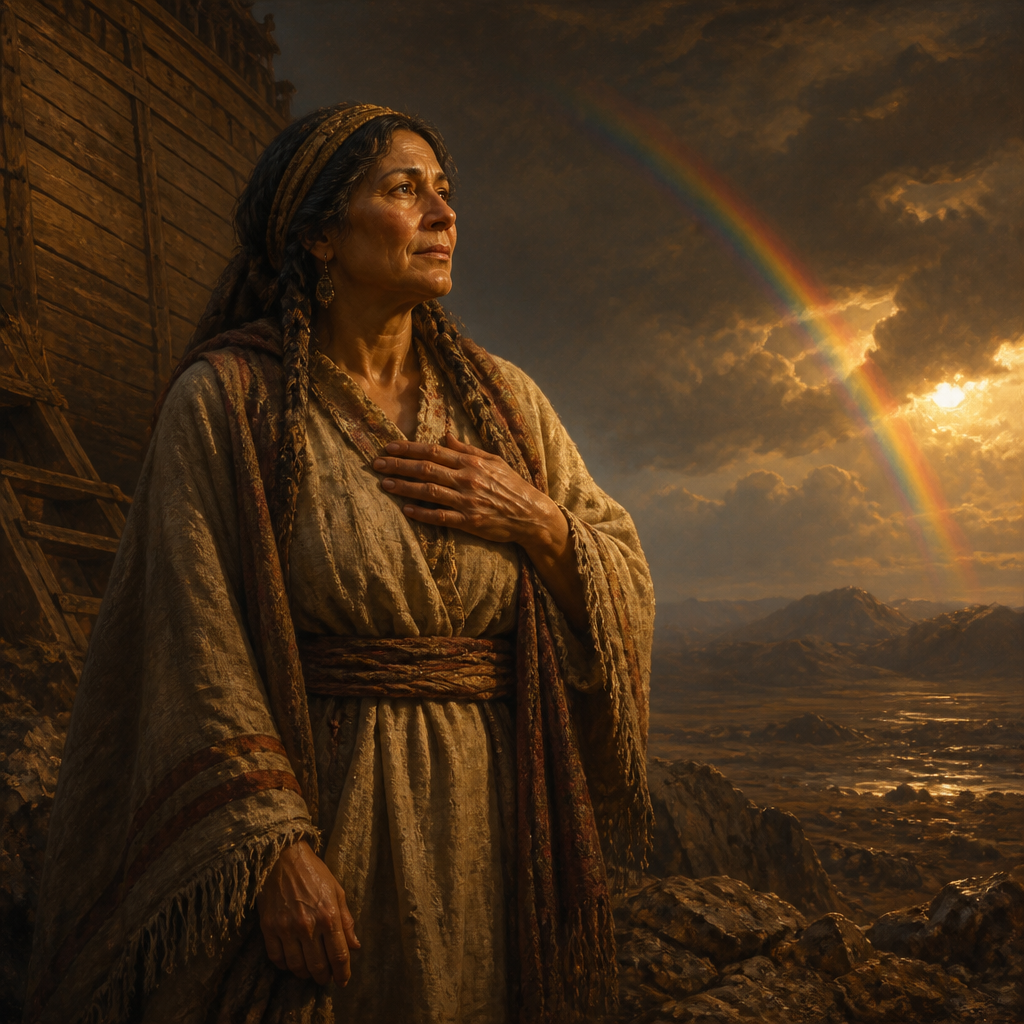
Ham's wife is an unnamed figure in the Book of Genesis and one of the eight individuals who survived the global deluge by entering the ark. Though her name is never recorded in the biblical canon, her presence is essential to the narrative arc of human survival and the repopulating of the earth according to the 'Table of Nations.' She is first mentioned implicitly in Genesis 6:18 when God establishes a covenant with Noah, extending protection to his sons and their respective wives.
Background and Family
The biblical record identifies Ham's wife as one of the four women aboard Noah's ark. While her lineage and personal history prior to the flood are omitted, her status as the wife of Ham places her within the immediate family of Noah, the 'righteous man' chosen to preserve life. Biblical scholarship often notes that her anonymity in the text highlights the narrative's focus on the lineage of Noah and the specific administrative roles of the men, yet her biological and symbolic role as a 'mother of nations' is functionally vital.
According to the genealogies in Genesis 10, she was the maternal ancestor of four major lines: Cush, Mizraim, Put, and Canaan. These descendants populated vast regions of the ancient world, including Ethiopia, Egypt, Libya, and the Levant. Her entry into the ark represents the preservation of the female line in the face of universal judgment, ensuring the continuity of the human species alongside her mother-in-law and two sisters-in-law.
Major Life Events
The primary event defining her life is the Great Flood. She lived through an era described in Genesis 6 as one of profound moral corruption and violence. Her selection for the ark was tied to the covenant God made with Noah. The process of boarding the ark, surviving the year-long inundation, and finally disembarking on Mount Ararat constitutes the core of her historical and theological presence.
Following the exit from the ark, she witnessed the first post-diluvian sacrifice and the establishment of the rainbow covenant. Though she is not mentioned by name during the incident involving Ham's indiscretion regarding Noah's nakedness (Genesis 9), the consequences of that event shaped the future of her progeny, particularly her son Canaan. Her life represents the transition from the 'world that was' to the current world, acting as a bridge between the antediluvian civilization and the rise of the first historical nations.
Relationship to Other Biblical Figures
As the daughter-in-law of Noah and the wife of Ham, she occupied a central position in the post-flood familial hierarchy. Her relationship with her husband, Ham, is defined by their shared survival and the raising of their four sons in a desolate, recovering world.
She was a peer to the wives of Shem and Japheth. Together, these three women became the matriarchs of all subsequent human tribes. While the Bible does not record their interactions, their shared experience of surviving the destruction of their entire world likely forged a unique bond. Her relationship with her son Canaan is particularly significant in the biblical narrative, as he became the progenitor of the Canaanites, a group that would later feature prominently in the history of Israel.
Spiritual Significance
She is one of the eight human beings who survived the Flood, making her a foundational matriarch of the post-diluvian world. Through her offspring, she contributed to the cultural and ethnic diversity of the ancient Near East and Africa, fulfilling the command to 'be fruitful and multiply' in a new creation context.
The spiritual significance of Ham's wife lies in her role as a recipient of God's common and special grace. She was not saved by her own recorded merit, but through her inclusion in Noah's household under the covenantal protection of God. This illustrates the biblical theme of 'household salvation' or representative headship, where the family shares in the blessings (or judgments) of the patriarch.
Furthermore, she is a testament to the sovereign plan of God to preserve and proliferate humanity despite its flaws. In later Jewish and Christian traditions, various names were assigned to her (such as Naeltamauk or Egyptus in extra-biblical texts), reflecting a desire by later scholars to honor her vital role. Theologically, she stands as one of the eight souls (1 Peter 3:20) who were 'brought safely through the water,' serving as a type of the church or the redeemed who survive judgment through divine provision.
Frequently Asked Questions
What was the name of Ham's wife?
The Bible does not provide a name for Ham's wife. Various extra-biblical traditions suggest names like Naeltamauk or Egyptus, but these are not found in the Hebrew scriptures.
How many children did she have?
According to Genesis 10, her husband Ham fathered four sons: Cush, Mizraim, Put, and Canaan. It is generally understood that she was the mother of these four.
Was she cursed along with Canaan?
The biblical text in Genesis 9:25 records a curse specifically on Canaan, Ham's son. The text does not explicitly mention any curse directed at Ham's wife.
How long did she stay in the Ark?
She remained in the ark for approximately one year, from the time the rains began until the earth was dry enough for the family to disembark on Mount Ararat.
Which nations are descended from her?
Her descendants include the peoples of Ethiopia (Cush), Egypt (Mizraim), Libya (Put), and the region of Palestine (Canaan).
Family & Relationships
 HamHusbandGenesis 7:13Stated
 Ham's WifeThis page
Children
 Canaan, Son of HamSonGenesis 9:18
Inferred
No verse names Ham's Wife and Canaan together; the son link is carried from the surrounding genealogy and is not stated in Scripture.Evidence: Genesis 9:18; Genesis 9:22; Genesis 7:13
 Cush, Son of HamSonGenesis 7:13
Inferred
No verse names Cush and Ham's Wife together; the mother link is carried from the surrounding genealogy and is not stated in Scripture.Evidence: Genesis 7:13; Genesis 10:6; 1 Chronicles 1:8
Extended family
 NoahFather-in-lawGenesis 7:13
Inferred
No verse names Ham's Wife and Noah together; the father-in-law link is carried from the surrounding genealogy and is not stated in Scripture.Evidence: Genesis 7:13; Genesis 9:18
Connected Figures
Family
Husband · Genesis 7:13
The second son of Noah and an ancestor of numerous southern nations, known as one of the eight survivors of the Great Flood.
Primeval HistoryFirst: Genesis 5:3217 versesArk builder and husbandman
Son · Genesis 9:18
Canaan was the son of Ham and the grandson of Noah, known primarily for being the recipient of Noah's curse and the progenitor of several significant ancient Near Eastern tribes.
Primeval HistoryFirst: Genesis 9:1810 versesProgenitor of nations
Son · Genesis 7:13
Cush was the eldest son of Ham and the father of Nimrod, serving as the patriarchal ancestor of various African and Arabian nations in the Table of Nations.
Primeval HistoryFirst: Genesis 10:66 versesPatriarchal head of nations
Father-in-law · Genesis 7:13
A righteous patriarch who built an ark to preserve humanity and animals from a divine global flood, becoming the second father of the human race.
Primeval HistoryFirst: Genesis 5:2959 versesShipbuilder, preacher, and husbandman (farmer)
Mentions by Book
- Genesis6
- 1 Peter1
Scripture References
All 7 indexed verses, in canonical order, from the Berean Standard Bible.
Genesis · 6
- Genesis 5:29Partial
And he named him Noah, saying, “May this one comfort us in the labor and toil of our hands caused by the ground that the LORD has cursed.”
Cited as evidence on a family card; added so References, Key Verses and Mentions by Book share one index.
- Genesis 5:32Partial
After Noah was 500 years old, he became the father of Shem, Ham, and Japheth.
Cited as evidence on a family card; added so References, Key Verses and Mentions by Book share one index.
- Genesis 7:13Partial
On that very day Noah entered the ark, along with his sons Shem, Ham, and Japheth, and his wife, and the three wives of his sons—
Cited as a key verse; added so References, Key Verses and Mentions by Book share one index.
- Genesis 8:18Partial
So Noah came out, along with his sons and his wife and his sons’ wives.
Cited as a key verse; added so References, Key Verses and Mentions by Book share one index.
- Genesis 9:18Partial
The sons of Noah who came out of the ark were Shem, Ham, and Japheth. And Ham was the father of Canaan.
Cited as evidence on a family card; added so References, Key Verses and Mentions by Book share one index.
- Genesis 10:6Partial
The sons of Ham: Cush, Mizraim, Put, and Canaan.
Cited as evidence on a family card; added so References, Key Verses and Mentions by Book share one index.
1 Peter · 1
- 1 Peter 3:20Partial
who disobeyed long ago when God waited patiently in the days of Noah while the ark was being built. In the ark a few people, only eight souls, were saved through water.
Cited as a key verse; added so References, Key Verses and Mentions by Book share one index.