Shem
Who was Shem in the Bible?
The eldest or middle son of Noah, an Ark survivor, and the foundational patriarch of the Semitic peoples, including the Israelites.
Shem occupies a pivotal role in the biblical narrative as one of the eight individuals who survived the Great Flood. As a son of Noah, he represents a critical link between the antediluvian world and the post-flood restart of humanity. His name, which means 'name' or 'reknown' in Hebrew, carries significant weight in the genealogical records of Genesis, serving as the root for the term 'Semitic.'
Beyond his survival on the Ark, Shem is characterized in the Masoretic text as a man of moral integrity who, along with his brother Japheth, showed deep respect for his father’s dignity. The biblical record presents him not merely as a survivor, but as a righteous forebear whose lineage would eventually produce figures such as Abraham, David, and according to Christian theology, Jesus Christ. His life spans the transition from the long-lived generations of the early patriarchs to the emerging civilizations of the ancient Near East.
Background and Family
Shem is introduced in the Book of Genesis as one of the three sons of Noah (Genesis 5:32). While there is some scholarly debate regarding the birth order of the brothers—Shem, Ham, and Japheth—Shem is almost always listed first, indicating his preeminence in the covenantal lineage. Genesis 5:32 says Noah was 500 years old when he began to father sons; Shem himself was born about two years later, since Genesis 11:10 makes him 100 two years after the Flood and Genesis 7:6 puts the Flood in Noah's 600th year. He grew up in an era described by the biblical text as one of profound moral decay and violence, which ultimately led to the divine decree of the Flood.
Shem entered the Ark with his wife, his parents, and his two brothers and their wives. He remained on the vessel for over a year during the deluge. Following the descent from Mount Ararat, Shem became the father of five sons: Elam, Asshur, Arpachshad, Lud, and Aram. These sons are traditionally viewed as the progenitors of the Elamites, Assyrians, Chaldeans, Lydians, and Arameans, making Shem the ancestral head of the major civilizations of the Levant and Mesopotamia.
Major Life Events
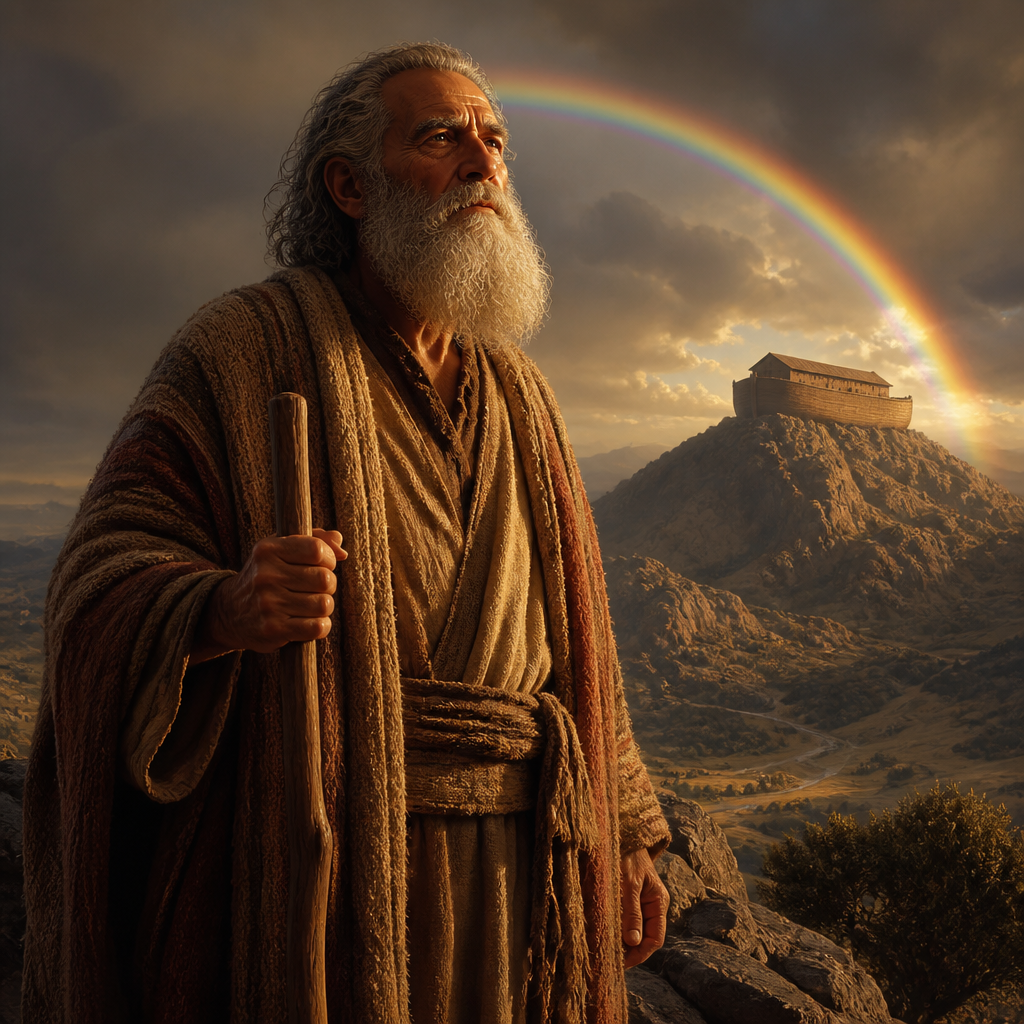
The defining event of Shem’s life was the construction of and survival within the Ark. As a primary witness to the destruction of the old world, Shem participated in the first sacrifice offered by Noah upon dry land and received the blessing of the Noahic Covenant, symbolized by the rainbow. This covenant established the sanctity of life and the promise that the earth would never again be destroyed by water.
A significant moral test occurred shortly after the Flood. When Noah became intoxicated and lay uncovered in his tent, Ham viewed his father’s nakedness and informed his brothers. In contrast, Shem and Japheth took a garment, walked backward into the tent to avoid looking at their father, and covered him (Genesis 9:23). This act of filial piety led to a specific patriarchal blessing. Noah prophesied, "Blessed be the Lord, the God of Shem," an unusual phrasing that linked the identity of the Creator specifically to Shem's lineage.
Relationship to Other Biblical Figures
Shem serves as the genealogical bridge between Noah and Abraham. The 'Table of Nations' in Genesis 10 and the specific genealogy in Genesis 11 trace a direct line from Shem through nine generations to Abram (Abraham). This makes Shem the 'father of all the children of Eber' (Genesis 10:21), a phrase from which the term 'Hebrew' is likely derived.
In Jewish tradition and some historical commentaries, Shem has frequently been identified with the enigmatic figure Melchizedek, the King of Salem and Priest of the Most High God who met Abraham in Genesis 14. While the biblical text does not explicitly state they are the same person, the overlapping lifespans—Shem lived for 600 years, surviving until the time of Jacob according to the Masoretic chronology—provided the basis for this identification in the Talmud and other rabbinic literature. This connection highlights Shem's perceived role as a keeper of monotheism in an increasingly polytheistic world.
Spiritual Significance
Shem is theologically significant as the progenitor of the Semitic people and the specific line through which the covenant with Abraham and the eventual birth of Jesus Christ are traced. In the narrative of the Flood, he represents the continuity of human righteousness and the preservation of divine knowledge across a global catastrophe. His blessing from Noah uniquely identifies his lineage with the 'God of Shem,' setting the stage for the later identification of Yahweh as the God of Israel.
Furthermore, Shem's role in the 'Table of Nations' provides a biblical framework for understanding the early distribution of humanity and the shared origins of the ancient Near Eastern civilizations. His inclusion in both Old and New Testament genealogies solidifies his position as a foundational figure in redemptive history, representing the branch of humanity designated to carry the promise of the Messiah.
Theologically, Shem represents the 'chosen line' through which the divine promise would be fulfilled. In the blessing pronounced by Noah, it is said that God will 'dwell in the tents of Shem' (Genesis 9:27). This is interpreted by many scholars as a prophecy of the divine presence (Shekinah) inhabiting the Tabernacle and Temple later built by Shem’s descendants, the Israelites.
In the New Testament, Shem is included in the genealogy of Jesus in the Gospel of Luke (Luke 3:36), affirming his status as a key ancestor of the Messiah. His life is seen as a testament to the preservation of a righteous remnant. While his brothers founded nations that often stood in opposition to the biblical faith, Shem’s legacy is defined by his preservation of the knowledge of the one true God during the transition from the antediluvian era to the era of the patriarchs.
Frequently Asked Questions
How long did Shem live?
According to Genesis 11:10-11, Shem lived for a total of 600 years. He was 100 years old when he fathered Arpachshad, two years after the Flood, and lived for 500 years after that.
Was Shem the oldest son of Noah?
The Bible usually lists the brothers as 'Shem, Ham, and Japheth,' suggesting Shem was the eldest. However, Genesis 10:21 can be translated to call Japheth the elder, leading to varying interpretations among scholars.
Who are the descendants of Shem?
His primary descendants include the Elamites, Assyrians, Chaldeans (ancestors of the Hebrews), Lydians, and Arameans. These are collectively known as the Semitic peoples.
Is Shem mentioned in the New Testament?
Yes, Shem is listed in the genealogy of Jesus Christ found in Luke 3:36, confirming his role as a Messianic ancestor.
What does the name 'Shem' mean?
The name Shem (שֵׁם) means 'name,' 'fame,' or 'renown' in Hebrew, signifying a position of honor or authority.
Family & Relationships
Parents
 NoahFather1 Chronicles 1:4Stated
 Shem's WifeWifeGenesis 7:13Stated
 ShemThis page
Children
 Aram, Son of ShemSonGenesis 10:22Stated
 ArphaxadSonLuke 3:36Stated
 Asshur, Son of ShemSonGenesis 10:22Stated
 Elam, Son of ShemSonGenesis 10:22Stated
 LudSonGenesis 10:22Stated
Extended family
 Eber, Son of ShelahGreat-GrandsonGenesis 10:21
Inferred
Genesis 10:21 lists Eber and Shem among the sons of eber, but does not say how the two of them are related.Evidence: Genesis 10:21
 GetherGrandsonGenesis 10:22
Inferred
Reconstructed through Uz: Genesis 10:23 ties Gether to Uz; 1 Chronicles 1:17 ties Uz to Shem (itself an inferred link). No verse states the grandfather link between Gether and Shem directly.Evidence: Genesis 10:22; Genesis 10:23
 HadoramGreat-Great-GrandsonGenesis 5:32
Inferred
No verse names Hadoram and Shem together; the great-great-grandfather link is carried from the surrounding genealogy and is not stated in Scripture.Evidence: Genesis 5:32
 HulGrandsonGenesis 10:23
Inferred
Reconstructed through Uz: Genesis 10:23 ties Hul to Uz; 1 Chronicles 1:17 ties Uz to Shem (itself an inferred link). No verse states the grandfather link between Hul and Shem directly.Evidence: Genesis 10:23; Genesis 10:22
 MashGrandsonGenesis 10:22
Inferred
Reconstructed through Uz: Genesis 10:23 ties Mash to Uz; 1 Chronicles 1:17 ties Uz to Shem (itself an inferred link). No verse states the grandfather link between Mash and Shem directly.Evidence: Genesis 10:22; Genesis 10:23
 PelegGreat-Great-GrandsonGenesis 10:22
Inferred
Reconstructed through Eber: Genesis 10:25 ties Peleg to Eber; Genesis 10:21 ties Eber to Shem (itself an inferred link). No verse states the great-great-grandfather link between Peleg and Shem directly.Evidence: Genesis 10:22
 Shelah, Son of CainanGreat-GrandsonGenesis 10:24
Inferred
Reconstructed through Eber: Genesis 10:24 ties Shelah to Eber; Genesis 10:21 ties Eber to Shem (itself an inferred link). No verse states the great-grandfather link between Shelah and Shem directly.Evidence: Genesis 10:24
 Uz, Son of AramGrandsonGenesis 10:23
Inferred
1 Chronicles 1:17 lists Uz and Shem among the sons of shem, but does not say how the two of them are related.Evidence: Genesis 10:23; 1 Chronicles 1:17; Genesis 10:22
 UzalGreat-Great-GrandsonGenesis 10:27
Inferred
No verse names Shem and Uzal together; the great-great-grandson link is carried from the surrounding genealogy and is not stated in Scripture.Evidence: Genesis 10:27
 CainanGrandsonLuke 3:36Stated
 AbrahamDescendantGenesis 5:32
Inferred
No verse names Shem and Abraham together; the descendant link is carried from the surrounding genealogy and is not stated in Scripture.Evidence: Genesis 5:32
 Canaan, Son of HamNephewGenesis 9:18
Inferred
Genesis 9:18 lists Shem and Canaan among the sons of noah, but does not say how the two of them are related.Evidence: Genesis 9:18; Genesis 9:22; Genesis 6:10
Connected Figures
Family
Father · 1 Chronicles 1:4
A righteous patriarch who built an ark to preserve humanity and animals from a divine global flood, becoming the second father of the human race.
Primeval HistoryFirst: Genesis 5:2959 versesShipbuilder, preacher, and husbandman (farmer)
Wife · Genesis 7:13
One of the eight survivors of the Great Flood and a female progenitor of a significant portion of the post-diluvian human race.
Primeval HistoryFirst: Genesis 5:295 versesHomemaker and pioneer
Son · Genesis 10:22
Aram was a son of Shem and grandson of Noah, recognized as a primary ancestor of various Semitic peoples in the ancient Near East.
Son · Luke 3:36
A post-flood patriarch, son of Shem, and ancestor of Abraham through whom the messianic lineage is traced.
Son · Genesis 10:22
Asshur was a son of Shem and a grandson of Noah, recognized in the Table of Nations as a foundational figure in post-flood genealogy.
Son · Genesis 10:22
A son of Shem and grandson of Noah, recognized as the eponymous ancestor of the Elamite people in the Table of Nations.
Primeval HistoryFirst: Genesis 10:224 versesProgenitor of nations
Son · Genesis 10:22
Lud was a son of Shem and a grandson of Noah, traditionally identified as the eponymous ancestor of the Lydian people.
Primeval HistoryFirst: Genesis 10:224 versesPatriarchal Progenitor

Brother · Genesis 6:10
The second son of Noah and an ancestor of numerous southern nations, known as one of the eight survivors of the Great Flood.
Primeval HistoryFirst: Genesis 5:3217 versesArk builder and husbandman

Brother · Genesis 6:10
Japheth was one of the three sons of Noah and a survivor of the Great Flood, traditionally viewed as the progenitor of the Indo-European and Aegean peoples.
Primeval HistoryFirst: Genesis 5:3215 versesArk builder and patriarch
Great-Grandson · Genesis 10:21
Eber was a foundational post-diluvian patriarch, the great-grandson of Shem and a direct ancestor of Abraham through whom the lineage of the 'Hebrews' is traditionally traced.
Grandson · Genesis 10:22
Gether was a son of Aram and a grandson of Shem, listed in the Table of Nations as a founder of a post-Flood tribal lineage.
Primeval HistoryFirst: Genesis 10:233 versesEarly Tribal Founder
Great-Great-Grandson · Genesis 5:32
A son of Joktan and descendant of Shem, Hadoram was an early patriarch mentioned in the Table of Nations as a founder of a post-Flood tribal group.
Categories
Mentions by Book
- Genesis22
- 1 Chronicles3
- Luke1
Scripture References
All 26 indexed verses, in canonical order, from the Berean Standard Bible.
- Genesis 5:32
After Noah was 500 years old, he became the father of Shem, Ham, and Japheth.
- Genesis 6:10
And Noah had three sons: Shem, Ham, and Japheth.
- Genesis 7:13
On that very day Noah entered the ark, along with his sons Shem, Ham, and Japheth, and his wife, and the three wives of his sons—
- Genesis 9:18
The sons of Noah who came out of the ark were Shem, Ham, and Japheth. And Ham was the father of Canaan.
- Genesis 9:22Partial
And Ham, the father of Canaan, saw his father’s nakedness and told his two brothers outside.
Cited as evidence on a family card; added so References, Key Verses and Mentions by Book share one index.
- Genesis 9:23
Then Shem and Japheth took a garment and placed it across their shoulders, and walking backward, they covered their father’s nakedness. Their faces were turned away so that they did not see their father’s nakedness.
- Genesis 9:26
He also declared: “Blessed be the LORD, the God of Shem! May Canaan be the servant of Shem.
- Genesis 9:27
May God expand the territory of Japheth; may he dwell in the tents of Shem, and may Canaan be his servant.”
- Genesis 10:1
This is the account of Noah’s sons Shem, Ham, and Japheth, who also had sons after the flood.
- Genesis 10:21
And sons were also born to Shem, the older brother of Japheth; Shem was the forefather of all the sons of Eber.
- Genesis 10:22
The sons of Shem: Elam, Asshur, Arphaxad, Lud, and Aram.
- Genesis 10:23Partial
The sons of Aram: Uz, Hul, Gether, and Mash.
Cited as evidence on a family card; added so References, Key Verses and Mentions by Book share one index.
- Genesis 10:24Partial
Arphaxad was the father of Shelah, and Shelah was the father of Eber.
Cited as evidence on a family card; added so References, Key Verses and Mentions by Book share one index.
- Genesis 10:25Partial
Two sons were born to Eber: One was named Peleg, because in his days the earth was divided, and his brother was named Joktan.
Cited as evidence on a family card; added so References, Key Verses and Mentions by Book share one index.
- Genesis 10:27Partial
Hadoram, Uzal, Diklah,
Cited as evidence on a family card; added so References, Key Verses and Mentions by Book share one index.
- Genesis 10:28Partial
Obal, Abimael, Sheba,
Cited as evidence on a family card; added so References, Key Verses and Mentions by Book share one index.
- Genesis 10:29Partial
Ophir, Havilah, and Jobab. All these were sons of Joktan.
Cited as evidence on a family card; added so References, Key Verses and Mentions by Book share one index.
- Genesis 10:30Partial
Their territory extended from Mesha to Sephar, in the eastern hill country.
Cited as evidence on a family card; added so References, Key Verses and Mentions by Book share one index.
- Genesis 10:31
These are the sons of Shem, according to their clans, languages, lands, and nations.
- Genesis 11:10Partial
This is the account of Shem. Two years after the flood, when Shem was 100 years old, he became the father of Arphaxad.
- Genesis 11:11
And after he had become the father of Arphaxad, Shem lived 500 years and had other sons and daughters.
- Genesis 11:26Partial
When Terah was 70 years old, he became the father of Abram, Nahor, and Haran.
Cited as evidence on a family card; added so References, Key Verses and Mentions by Book share one index.
- 1 Chronicles 1:4
The sons of Noah: Shem, Ham, and Japheth.
- 1 Chronicles 1:17
The sons of Shem: Elam, Asshur, Arphaxad, Lud, and Aram. The sons of Aram: Uz, Hul, Gether, and Meshech.
- 1 Chronicles 1:24
So from Shem came Arphaxad, Shelah,
- Luke 3:36
the son of Cainan, the son of Arphaxad, the son of Shem, the son of Noah, the son of Lamech,