Nimrod
Who was Nimrod in the Bible?
A descendant of Noah and son of Cush known as the first 'mighty one' on the earth and a legendary hunter before the LORD.
Nimrod was a significant patriarchal figure appearing in the Table of Nations following the Great Flood. As the son of Cush and grandson of Ham, he represents the early post-diluvian generation that began to re-establish human civilization and dominance over the natural world. He is uniquely distinguished in the Genesis record as the first individual to be described as a 'mighty one' (Hebrew: gibbor) on the earth, signaling a shift in the scale of human influence and physical prowess.
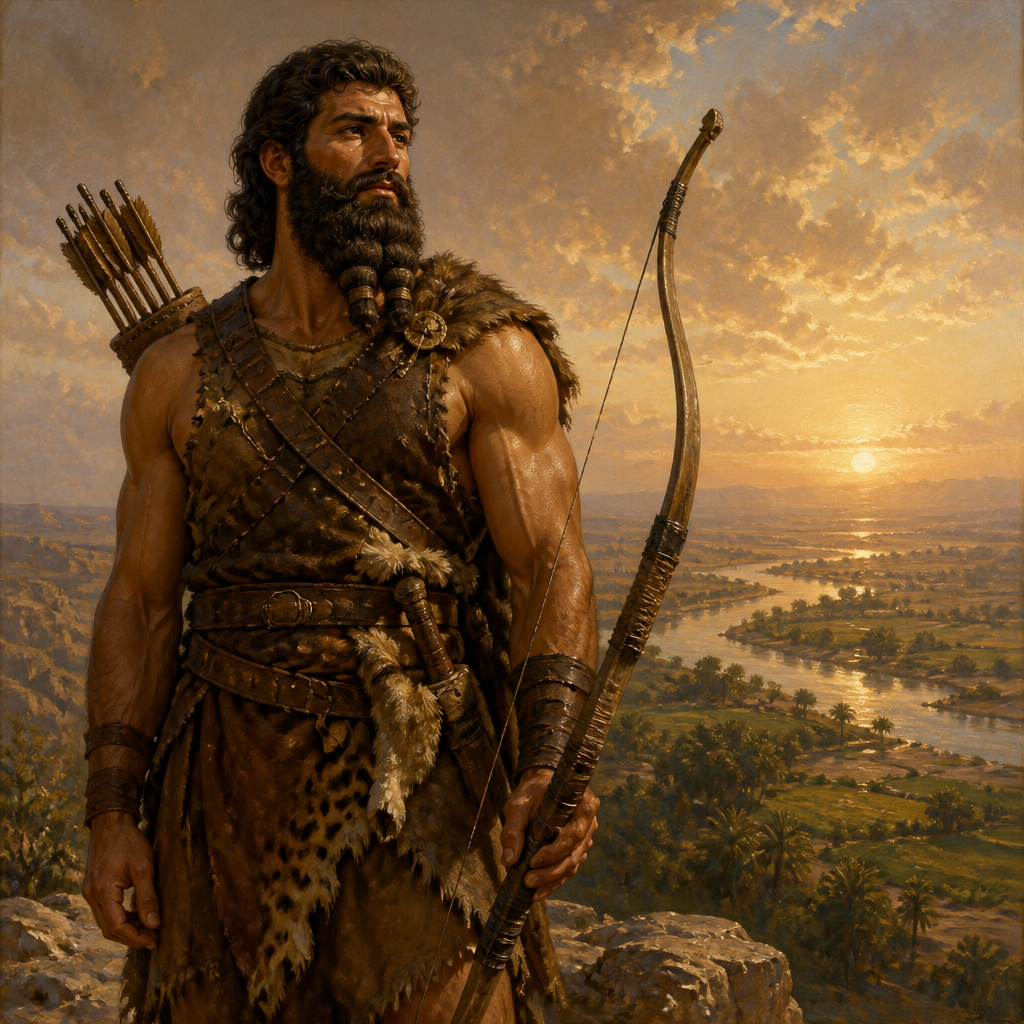
His legacy is primarily defined by his reputation as a 'mighty hunter before the LORD,' a description so evocative that it became a proverbial saying in the ancient world. While the biblical text is concise regarding his specific life events, his presence in the genealogies of both Genesis and 1 Chronicles, as well as a later prophetic reference in Micah, underscores his lasting identification with the lands of Mesopotamia and the early development of post-Flood societies.
Background and Family
Nimrod emerged during the primeval era as a member of the third generation following Noah. According to the genealogical records in Genesis 10 and 1 Chronicles 1, he was the son of Cush, who was the eldest son of Ham. This lineage places Nimrod within the Hamitic branch of the post-flood human family.
Nimrod was part of a large immediate family. The scriptures identify his siblings as Seba, Havilah, Sabtah, Raamah, and Sabteca. Among the descendants of Cush, Nimrod is given special prominence; while his brothers are listed as heads of various groups or regions, the text pauses to provide a specific characterization of Nimrod’s personal stature and reputation.
Major Life Events
The biblical record focuses on Nimrod’s transition from a descendant of Cush to a figure of international renown. He is described as the one who "began to be a mighty one on the earth" (Genesis 10:8). The Hebrew term used here, gibbor, often denotes a warrior or a man of great strength and valor. This suggests that Nimrod was perhaps the first prominent leader or hero to arise in the new world following the Deluge.
His primary vocation was that of a hunter. The Bible notes he was a "mighty hunter before the LORD" (Genesis 10:9). The phrase "before the LORD" has been interpreted by scholars in various ways, ranging from divine favor to simply a superlative indicating he was the greatest hunter in the sight of God and man. His skills were so legendary that they gave rise to a common proverb: "Like Nimrod, a mighty hunter before the LORD."
Relationship to Other Biblical Figures
As a great-grandson of Noah, Nimrod stands as a foundational figure in the transition from the immediate family of the ark to the broader nations of the ancient Near East. His primary recorded relationships are strictly genealogical, connecting him to his father Cush and his numerous brothers. Unlike later patriarchs such as Abraham, there are no recorded dialogues between Nimrod and his contemporaries or the Creator.
In the prophetic literature, Nimrod’s name is inextricably linked to the geography of the ancient world. The prophet Micah refers to the "land of Nimrod" in conjunction with Assyria (Micah 5:6). This indicates that centuries after his life, his name remained the definitive label for the territories he once influenced or inhabited, serving as a geographical marker for the region of Mesopotamia.
Spiritual Significance
Nimrod represents the emergence of human potency and organized activity in the post-flood era. The brevity of his mention leaves his moral character somewhat ambiguous in the primary text; he is defined by his might and his skill rather than by specific acts of righteousness or rebellion. However, his inclusion in the Table of Nations serves a vital structural purpose in the Bible, showing how the command to "fill the earth" resulted in the rise of powerful individuals who shaped the first civilizations.
Theologically, Nimrod illustrates the biblical theme of the "mighty man." His status as a hunter suggests a role in protecting early settlements from wild animals, a necessary step in the development of agriculture and urbanization. By the time of the prophet Micah, Nimrod functions as a symbol of the ancient imperial powers—Assyria and Babylon—that would eventually come into conflict with the people of Israel, representing the worldly strength that stands in contrast to the divine deliverance promised to God’s people.
Nimrod is significant as the first individual described in scripture as a 'mighty one' (gibbor) following the Flood. He represents the dawn of human heroism and the consolidation of physical power. His description as a 'mighty hunter' establishes him as a legendary figure whose reputation survived long enough to become a common proverb and a geographical designation for the Mesopotamian region.
Furthermore, Nimrod provides a genealogical link between the family of Noah and the subsequent rise of the great Mesopotamian powers. His presence in 1 Chronicles and Micah confirms that the biblical authors viewed him not just as a mythological figure, but as a historical patriarch whose influence defined the early landscape of the ancient Near East.
Frequently Asked Questions
Who was Nimrod's father?
Nimrod was the son of Cush, who was the son of Ham and the grandson of Noah.
What is Nimrod most famous for in the Bible?
He is most famous for being a 'mighty hunter before the LORD' and the first 'mighty one' to arise on the earth after the Flood.
In which books of the Bible is Nimrod mentioned?
Nimrod is mentioned in three books: Genesis, 1 Chronicles, and Micah.
What does the phrase 'mighty hunter before the LORD' mean?
It is an ancient proverbial expression signifying that Nimrod was unsurpassed in his skill and strength as a hunter, recognized even by God.
What land is associated with Nimrod?
The Bible associates Nimrod with the land of Assyria and the broader Mesopotamian region, which the prophet Micah explicitly calls 'the land of Nimrod.'
Family & Relationships
Parents
 Cush, Son of HamFatherGenesis 10:8Stated
 NimrodThis page
 Havilah, Son of CushBrotherGenesis 10:7–8Stated
 RaamahBrotherGenesis 10:7–8Stated
 SabtahBrotherGenesis 10:7–8Stated
 SabtecaBrotherGenesis 10:7–8Stated
 SebaBrotherGenesis 10:7–9Stated
Extended family
 HamGrandfatherGenesis 10:6
Inferred
Reconstructed through Cush: Genesis 10:8 ties Nimrod to Cush; Genesis 10:6 ties Cush to Ham. No verse states the grandfather link between Nimrod and Ham directly.Evidence: Genesis 10:6; 1 Chronicles 1:8; Genesis 10:8; 1 Chronicles 1:10
 NoahGreat-GrandfatherGenesis 5:29
Inferred
Reconstructed through Cush and Ham: Genesis 10:8 ties Nimrod to Cush; Genesis 10:6 ties Cush to Ham; Genesis 9:18 ties Ham to Noah. No verse states the great-grandfather link between Nimrod and Noah directly.Evidence: Genesis 5:29
Connected Figures
Family
Father · Genesis 10:8
Cush was the eldest son of Ham and the father of Nimrod, serving as the patriarchal ancestor of various African and Arabian nations in the Table of Nations.
Primeval HistoryFirst: Genesis 10:66 versesPatriarchal head of nations
Brother · Genesis 10:7–8
A son of Cush and grandson of Ham, Havilah was a post-Flood figure within the Table of Nations, representing an early lineage of the Cushite people.
Brother · Genesis 10:7–8
A grandson of Ham and son of Cush who is listed among the early post-Flood patriarchs in the Table of Nations.
Brother · Genesis 10:7–8
Sabtah was the third son of Cush and a grandson of Ham, listed in the Table of Nations as a progenitor of early post-flood peoples.
Brother · Genesis 10:7–8
A son of Cush and a descendant of Noah through the line of Ham, listed in the Table of Nations.
Brother · Genesis 10:7–9
Seba was the first-born son of Cush and a grandson of Ham, listed in the Table of Nations as a foundational figure in post-Flood genealogy.
Primeval HistoryFirst: Genesis 10:75 versesAncestral Head
Grandfather · Genesis 10:6
The second son of Noah and an ancestor of numerous southern nations, known as one of the eight survivors of the Great Flood.
Primeval HistoryFirst: Genesis 5:3217 versesArk builder and husbandman
Great-Grandfather · Genesis 5:29
A righteous patriarch who built an ark to preserve humanity and animals from a divine global flood, becoming the second father of the human race.
Primeval HistoryFirst: Genesis 5:2959 versesShipbuilder, preacher, and husbandman (farmer)
Categories
Mentions by Book
- Genesis5
- 1 Chronicles1
Scripture References
All 6 indexed verses, in canonical order, from the Berean Standard Bible.
Genesis · 5
- Genesis 5:29Partial
And he named him Noah, saying, “May this one comfort us in the labor and toil of our hands caused by the ground that the LORD has cursed.”
Cited as evidence on a family card; added so References, Key Verses and Mentions by Book share one index.
- Genesis 10:6Partial
The sons of Ham: Cush, Mizraim, Put, and Canaan.
Cited as evidence on a family card; added so References, Key Verses and Mentions by Book share one index.
- Genesis 10:7Partial
The sons of Cush: Seba, Havilah, Sabtah, Raamah, and Sabteca. And the sons of Raamah: Sheba and Dedan.
Cited as evidence on a family card; added so References, Key Verses and Mentions by Book share one index.
- Genesis 10:8
Cush was the father of Nimrod, who began to be a mighty one on the earth.
- Genesis 10:9
He was a mighty hunter before the LORD; so it is said, “Like Nimrod, a mighty hunter before the LORD.”
1 Chronicles · 1
- 1 Chronicles 1:10
Cush was the father of Nimrod, who began to be a mighty one on the earth.