Peter
Who was Peter in the Bible?
The leader of the twelve apostles, known for his confession of Christ, his denial and restoration, and his foundational role in the early Christian church.
Peter, also known as Simon or Cephas, was a Galilean fisherman who became the most prominent of Jesus Christ's disciples and a cornerstone of the early Church. Originally from Bethsaida and later residing in Capernaum, he was called from his fishing nets alongside his brother Andrew. His name, given by Jesus, means 'Rock,' symbolizing the foundational role he would play in the transition from a Jewish sect to a global movement after the Resurrection.
Throughout the Gospels, Peter is depicted as a man of impulsive passion and deep devotion, often acting as the spokesman for the apostolic group. While his journey is marked by significant failures, including his public denial of Jesus during the Passion, his post-resurrection restoration and leadership on the Day of Pentecost established him as the primary apostolic authority in Jerusalem. His life ended in martyrdom in Rome, traditionally during the reign of Emperor Nero.
His writings, preserved as two epistles in the New Testament, reflect a mature theology focused on suffering, hope, and the growth of the Church. As a central figure in both the Gospels and the Book of Acts, Peter remains a primary source of study for understanding the synthesis of Jewish tradition and Christian revelation in the first century AD.
Background and Family
Born as Simon (or Shimon), Peter was the son of Jonas (or John) and lived in the region of Galilee. He was raised in Bethsaida, a fishing village on the northern shore of the Sea of Galilee, but later relocated to the larger town of Capernaum. Peter was a professional fisherman, a trade he shared with his brother Andrew and their partners, the sons of Zebedee (James and John). This background suggests a man of physical strength, accustomed to the rigors of manual labor and the unpredictability of the sea.
Peter was married; the Synoptic Gospels record Jesus healing his mother-in-law at their home in Capernaum (Mark 1:29–31). This domestic detail suggests that Peter's house likely served as a base of operations for Jesus during His Galilean ministry. Unlike some other disciples, Peter appears to have traveled with his wife during his later missionary journeys, as noted by the apostle Paul (1 Corinthians 9:5).
Major Life Events
Peter’s life was transformed when his brother Andrew introduced him to Jesus, who immediately renamed him Cephas (Aramaic) or Peter (Greek). His formal call occurred during a miraculous catch of fish, where Jesus told him he would henceforth be a "fisher of men" (Luke 5:1–11). Within the inner circle of three—Peter, James, and John—Peter was granted witness to events hidden from others, such as the Transfiguration and the raising of Jairus’s daughter.
In a pivotal moment at Caesarea Philippi, Peter confessed Jesus as "the Christ, the Son of the living God." In response, Jesus declared that upon this rock He would build His church (Matthew 16:16–19). However, Peter’s journey was not without conflict; he famously attempted to walk on water but sank due to doubt, and he was sharply rebuked by Jesus for rejecting the necessity of the Cross. His most significant low point occurred during Jesus' trial when, fearful for his life, he denied knowing Christ three times.
Following the Resurrection, Peter was restored by Jesus by the Sea of Galilee (John 21). Ten days after the Ascension, at Pentecost, Peter delivered a powerful sermon that resulted in three thousand conversions, effectively launching the Church. His subsequent ministry was marked by the healing of a lame man at the Temple, the confrontation with Ananias and Sapphira, and the visionary encounter at Joppa that led to the baptism of the Roman centurion Cornelius, signaling the inclusion of Gentiles into the faith.
Relationship to Other Biblical Figures
Peter functioned as the primus inter pares (first among equals) within the Twelve. His relationship with Jesus was characterized by a push-and-pull dynamic of fervent love and human misunderstanding. Among the apostles, he was closest to John, often appearing alongside him in the early chapters of Acts as they faced the Sanhedrin.
His relationship with the apostle Paul was more complex. While they shared the same mission, they clashed in the "Incident at Antioch" over Peter's temporary withdrawal from table fellowship with Gentiles to appease the circumcision party (Galatians 2:11–14). Despite this tension, Peter speaks of Paul's writings with respect in his final epistle, referring to him as "our beloved brother Paul" (2 Peter 3:15).
Spiritual Significance
Peter’s theological significance lies in his role as the 'Rock' and the 'Key-holder' of the Kingdom, serving as the bridge between the life of Jesus and the establishment of the early Church. He was the first to recognize the divinity of Christ and the first to officially open the Gospel to the Gentile world. His transition from a fisherman to a sophisticated theologian and martyr underscores the New Testament theme of the Holy Spirit's empowerment of ordinary individuals.
Furthermore, his writings provide the biblical basis for the concept of 'Living Stones' comprising the Church and offer an authoritative perspective on the reliability of apostolic testimony. His life pattern of sin, repentance, and restoration serves as a foundational archetype for Christian discipleship, prioritizing the heart's devotion over legalistic adherence.
Peter is the quintessence of the "redeemed failure." His life demonstrates that spiritual leadership is not predicated on perfection but on the transformative power of grace. Theologically, Peter bridges the gap between the Old Covenant and the New. As a devout Jew, he initially struggled with the abolition of dietary laws and the admission of Gentiles, but he eventually became the primary advocate for the universality of the Gospel at the Jerusalem Council (Acts 15).
His two epistles contribute significant insights into the nature of the "Royal Priesthood" and the expectation of the Parousia (Second Coming). Peter emphasizes the role of suffering as a refining fire for the believer, reflecting his own transition from a man who fled the Cross to a man who, according to tradition, was crucified upside down because he felt unworthy to die in the same manner as his Lord.
Frequently Asked Questions
Why did Jesus change Simon's name to Peter?
Jesus changed his name to Petros (Greek) or Cephas (Aramaic), meaning 'Rock,' to signify his future role as a stable, foundational leader of the Church.
Was Peter the first Pope?
Catholic tradition regards Peter as the first Pope based on Jesus' statement in Matthew 16, while Protestant traditions view 'the rock' as referring to Peter’s confession of faith or to Christ Himself.
Did Peter really walk on water?
Yes, according to Matthew 14:28–31, Peter briefly walked on the water at Jesus' command, though he began to sink when he took his eyes off Jesus and became afraid of the wind.
How did Peter die?
While the Bible does not record his death, early church tradition (such as Eusebius) states he was martyred in Rome by crucifixion upside down during the persecution of Nero, c. 64-67 AD.
What business was Peter in before following Jesus?
Peter was a commercial fisherman on the Sea of Galilee, likely part of a cooperative with his brother Andrew and the sons of Zebedee.
Family & Relationships
Parents
 John, Father of Simon PeterFatherJohn 1:42Stated
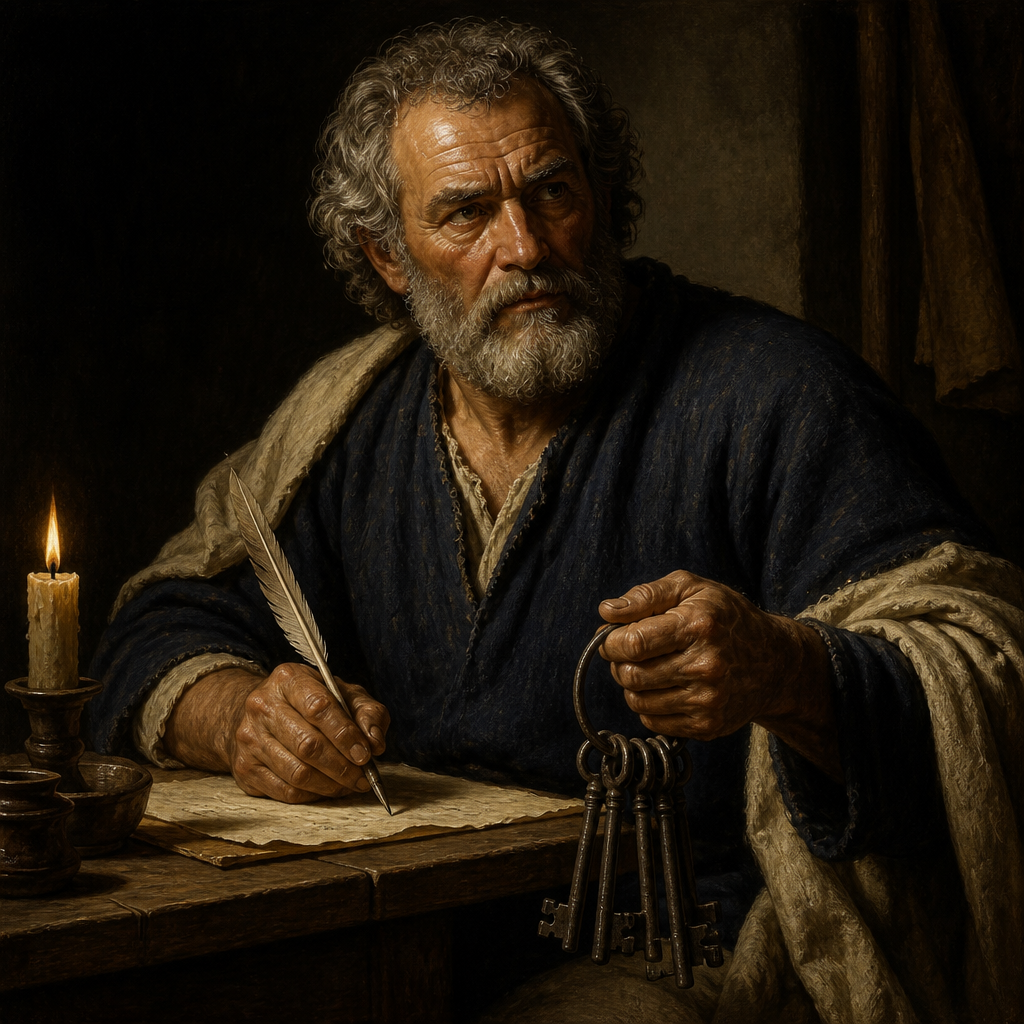 PeterThis page
 AndrewBrotherMatthew 4:18Stated
Extended family
 Peter's Mother-in-LawMother-in-lawMatthew 8:14Stated
Connected Figures
Family
Father · John 1:42
A man of the first century AD primarily known as the father of the prominent apostles Simon Peter and Andrew.
Brother · Matthew 4:18
One of the twelve apostles of Jesus, the brother of Simon Peter, and a former disciple of John the Baptist noted for bridging the gap between individuals and Christ.
The GospelsFirst: Matthew 4:1817 versesFisherman, Apostle
Mother-in-law · Matthew 8:14
The mother of Simon Peter's wife who was miraculously healed of a high fever by Jesus in Capernaum.
Categories
Mentions by Book
- Matthew26
- Mark24
- Luke26
- John34
- Acts57
- 1 Corinthians4
- Galatians6
- 1 Peter2
- 2 Peter1
Scripture References
All 180 indexed verses, in canonical order, from the Berean Standard Bible.
- Matthew 4:18
As Jesus was walking beside the Sea of Galilee, He saw two brothers, Simon called Peter and his brother Andrew. They were casting a net into the sea, for they were fishermen.
- Matthew 8:14
When Jesus arrived at Peter’s house, He saw Peter’s mother-in-law sick in bed with a fever.
- Matthew 10:2
These are the names of the twelve apostles: first Simon, called Peter, and his brother Andrew; James son of Zebedee, and his brother John;
- Matthew 14:28
“Lord, if it is You,” Peter replied, “command me to come to You on the water.”
- Matthew 14:29
“Come,” said Jesus. Then Peter got down out of the boat, walked on the water, and came toward Jesus.
- Matthew 15:15
Peter said to Him, “Explain this parable to us.”
- Matthew 16:16
Simon Peter answered, “You are the Christ, the Son of the living God.”
- Matthew 16:17
Jesus replied, “Blessed are you, Simon son of Jonah! For this was not revealed to you by flesh and blood, but by My Father in heaven.
- Matthew 16:18
And I tell you that you are Peter, and on this rock I will build My church, and the gates of Hades will not prevail against it.
- Matthew 16:22
Peter took Him aside and began to rebuke Him. “Far be it from You, Lord!” he said. “This shall never happen to You!”
- Matthew 16:23
But Jesus turned and said to Peter, “Get behind Me, Satan! You are a stumbling block to Me. For you do not have in mind the things of God, but the things of men.”
- Matthew 17:1
After six days Jesus took with Him Peter, James, and John the brother of James, and led them up a high mountain by themselves.
- Matthew 17:4
Peter said to Jesus, “Lord, it is good for us to be here. If You wish, I will put up three shelters—one for You, one for Moses, and one for Elijah.”
- Matthew 17:24
After they had arrived in Capernaum, the collectors of the two-drachma tax came to Peter and asked, “Does your Teacher pay the two drachmas?”
- Matthew 17:25
“Yes,” he answered. When Peter entered the house, Jesus preempted him. “What do you think, Simon?” He asked. “From whom do the kings of the earth collect customs and taxes: from their own sons, or from others?”
- Matthew 17:26
“From others,” Peter answered. “Then the sons are exempt,” Jesus said to him.
- Matthew 18:21
Then Peter came to Jesus and asked, “Lord, how many times shall I forgive my brother who sins against me? Up to seven times?”
- Matthew 19:27
“Look,” Peter replied, “we have left everything to follow You. What then will there be for us?”
- Matthew 26:33
Peter said to Him, “Even if all fall away on account of You, I never will.”
- Matthew 26:35
Peter replied, “Even if I have to die with You, I will never deny You.” And all the other disciples said the same thing.
- Matthew 26:37
He took with Him Peter and the two sons of Zebedee and began to be sorrowful and deeply distressed.
- Matthew 26:40
Then Jesus returned to the disciples and found them sleeping. “Were you not able to keep watch with Me for one hour?” He asked Peter.
- Matthew 26:58
But Peter followed Him at a distance, right up to the courtyard of the high priest. And he went in and sat down with the guards to see the outcome.
- Matthew 26:69
Meanwhile, Peter was sitting out in the courtyard, and a servant girl came up to him. “You also were with Jesus the Galilean,” she said.
- Matthew 26:73
After a little while, those standing nearby came up to Peter. “Surely you are one of them,” they said, “for your accent gives you away.”
- Matthew 26:75
Then Peter remembered the word that Jesus had spoken: “Before the rooster crows, you will deny Me three times.” And he went outside and wept bitterly.
- Mark 1:16
As Jesus was walking beside the Sea of Galilee, He saw Simon and his brother Andrew. They were casting a net into the sea, for they were fishermen.
- Mark 1:29
As soon as Jesus and His companions had left the synagogue, they went with James and John to the home of Simon and Andrew.
- Mark 1:30
Simon’s mother-in-law was sick in bed with a fever, and they promptly told Jesus about her.
- Mark 1:36
Simon and his companions went to look for Him,
- Mark 3:16
These are the twelve He appointed: Simon (whom He named Peter),
- Mark 5:37
And He did not allow anyone to accompany Him except Peter, James, and John the brother of James.
- Mark 8:29
“But what about you?” Jesus asked. “Who do you say I am?” Peter answered, “You are the Christ.”
- Mark 8:32
He spoke this message quite frankly, and Peter took Him aside and began to rebuke Him.
- Mark 8:33
But Jesus, turning and looking at His disciples, rebuked Peter and said, “Get behind Me, Satan! For you do not have in mind the things of God, but the things of men.”
- Mark 9:2
After six days Jesus took with Him Peter, James, and John, and led them up a high mountain by themselves. There He was transfigured before them.
- Mark 9:5
Peter said to Jesus, “Rabbi, it is good for us to be here. Let us put up three shelters—one for You, one for Moses, and one for Elijah.”
- Mark 10:28
Peter began to say to Him, “Look, we have left everything and followed You.”
- Mark 11:21
Peter remembered it and said, “Look, Rabbi! The fig tree You cursed has withered.”
- Mark 13:3
While Jesus was sitting on the Mount of Olives opposite the temple, Peter, James, John, and Andrew asked Him privately,
- Mark 14:29
Peter declared, “Even if all fall away, I never will.”
- Mark 14:33
He took with Him Peter, James, and John, and began to be deeply troubled and distressed.
- Mark 14:37
Then Jesus returned and found them sleeping. “Simon, are you asleep?” He asked. “Were you not able to keep watch for one hour?
- Mark 14:54
Peter followed Him at a distance, right into the courtyard of the high priest. And he sat with the officers and warmed himself by the fire.
- Mark 14:66
While Peter was in the courtyard below, one of the servant girls of the high priest came down
- Mark 14:67
and saw him warming himself there. She looked at Peter and said, “You also were with Jesus the Nazarene.”
- Mark 14:70
But he denied it again. After a little while, those standing nearby said once more to Peter, “Surely you are one of them, for you too are a Galilean.”
- Mark 14:72
And immediately the rooster crowed a second time. Then Peter remembered the word that Jesus had spoken to him: “Before the rooster crows twice, you will deny Me three times.” And he broke down and wept.
- Mark 16:6
But he said to them, “Do not be alarmed. You are looking for Jesus the Nazarene, who was crucified. He has risen! He is not here! See the place where they put Him.
- Mark 16:7
But go, tell His disciples and Peter, ‘He is going ahead of you into Galilee. There you will see Him, just as He told you.’”
- Luke 4:38Partial
After Jesus had left the synagogue, He went to the home of Simon, whose mother-in-law was suffering from a high fever. So they appealed to Jesus on her behalf,
- Luke 5:3
Jesus got into the boat belonging to Simon and asked him to put out a little from shore. And sitting down, He taught the people from the boat.
- Luke 5:4
When Jesus had finished speaking, He said to Simon, “Put out into deep water and let down your nets for a catch.”
- Luke 5:5
“Master,” Simon replied, “we have worked hard all night without catching anything. But because You say so, I will let down the nets.”
- Luke 5:8
When Simon Peter saw this, he fell at Jesus’ knees. “Go away from me, Lord,” he said, “for I am a sinful man.”
- Luke 5:10Partial
and so were his partners James and John, the sons of Zebedee. “Do not be afraid,” Jesus said to Simon. “From now on you will catch men.”
- Luke 6:14
Simon, whom He named Peter, and his brother Andrew; James and John; Philip and Bartholomew;
- Luke 8:45
“Who touched Me?” Jesus asked. But they all denied it. “Master,” said Peter, “the people are crowding and pressing against You.”
- Luke 8:51
When He entered the house, He did not allow anyone to go in with Him except Peter, John, James, and the child’s father and mother.
- Luke 9:20
“But what about you?” Jesus asked. “Who do you say I am?” Peter answered, “The Christ of God.”
- Luke 9:28
About eight days after Jesus had said these things, He took with Him Peter, John, and James, and went up on a mountain to pray.
- Luke 9:32
Meanwhile Peter and his companions were overcome by sleep, but when they awoke, they saw Jesus’ glory and the two men standing with Him.
- Luke 9:33
As Moses and Elijah were leaving, Peter said to Jesus, “Master, it is good for us to be here. Let us put up three shelters—one for You, one for Moses, and one for Elijah.” (He did not know what he was saying.)
- Luke 12:41
“Lord,” said Peter, “are You addressing this parable to us, or to everyone else as well?”
- Luke 18:28
“Look,” said Peter, “we have left all we had to follow You.”
- Luke 22:8
Jesus sent Peter and John, saying, “Go and make preparations for us to eat the Passover.”
- Luke 22:31Partial
Simon, Simon, Satan has asked to sift all of you like wheat.
- Luke 22:34
But Jesus replied, “I tell you, Peter, the rooster will not crow today until you have denied three times that you know Me.”
- Luke 22:54
Then they seized Jesus, led Him away, and took Him into the house of the high priest. And Peter followed at a distance.
- Luke 22:55
When those present had kindled a fire in the middle of the courtyard and sat down together, Peter sat down among them.
- Luke 22:58
A short time later, someone else saw him and said, “You also are one of them.” But Peter said, “Man, I am not.”
- Luke 22:60
“Man, I do not know what you are talking about,” Peter replied. And immediately, while he was still speaking, the rooster crowed.
- Luke 22:61Partial
And the Lord turned and looked at Peter. Then Peter remembered the word that the Lord had spoken to him: “Before the rooster crows today, you will deny Me three times.”
- Luke 22:62
And he went outside and wept bitterly.
- Luke 24:12
Peter, however, got up and ran to the tomb. And after bending down and seeing only the linen cloths, he went away, wondering to himself what had happened.
- Luke 24:34
and saying, “The Lord has indeed risen and has appeared to Simon!”
- John 1:40
Andrew, Simon Peter’s brother, was one of the two who heard John’s testimony and followed Jesus.
- John 1:41
He first found his brother Simon and told him, “We have found the Messiah” (which is translated as Christ).
- John 1:42
Andrew brought him to Jesus, who looked at him and said, “You are Simon son of John. You will be called Cephas” (which is translated as Peter).
- John 1:44
Now Philip was from Bethsaida, the same town as Andrew and Peter.
- John 6:8
One of His disciples, Andrew, Simon Peter’s brother, said to Him,
- John 6:68
Simon Peter replied, “Lord, to whom would we go? You have the words of eternal life.
- John 13:6
He came to Simon Peter, who asked Him, “Lord, are You going to wash my feet?”
- John 13:8
“Never shall You wash my feet!” Peter told Him. Jesus answered, “Unless I wash you, you have no part with Me.”
- John 13:9
“Then, Lord,” Simon Peter replied, “not only my feet, but my hands and my head as well!”
- John 13:24
So Simon Peter motioned to him to ask Jesus which one He was talking about.
- John 13:36
“Lord, where are You going?” Simon Peter asked. Jesus answered, “Where I am going, you cannot follow Me now, but you will follow later.”
- John 13:37
“Lord,” said Peter, “why can’t I follow You now? I will lay down my life for You.”
- John 18:10
Then Simon Peter drew his sword and struck the servant of the high priest, cutting off his right ear. The servant’s name was Malchus.
- John 18:11
“Put your sword back in its sheath!” Jesus said to Peter. “Shall I not drink the cup the Father has given Me?”
- John 18:15
Now Simon Peter and another disciple were following Jesus. Since that disciple was known to the high priest, he also went with Jesus into the courtyard of the high priest.
- John 18:16Partial
But Peter stood outside at the door. Then the disciple who was known to the high priest went out and spoke to the doorkeeper, and brought Peter in.
- John 18:17
At this, the servant girl watching the door said to Peter, “Aren’t you also one of this man’s disciples?” “I am not,” he answered.
- John 18:18
Because it was cold, the servants and officers were standing around a charcoal fire they had made to keep warm. And Peter was also standing with them, warming himself.
- John 18:25
Simon Peter was still standing and warming himself. So they asked him, “Aren’t you also one of His disciples?” He denied it and said, “I am not.”
- John 18:26
One of the high priest’s servants, a relative of the man whose ear Peter had cut off, asked, “Didn’t I see you with Him in the garden?”
- John 18:27
Peter denied it once more, and immediately a rooster crowed.
- John 20:2
So she came running to Simon Peter and the other disciple, the one whom Jesus loved. “They have taken the Lord out of the tomb,” she said, “and we do not know where they have put Him!”
- John 20:3
Then Peter and the other disciple set out for the tomb.
- John 20:4
The two were running together, but the other disciple outran Peter and reached the tomb first.
- John 20:6
Simon Peter arrived just after him. He entered the tomb and saw the linen cloths lying there.
- John 21:2
Simon Peter, Thomas called Didymus, Nathanael from Cana in Galilee, the sons of Zebedee, and two other disciples were together.
- John 21:3
Simon Peter told them, “I am going fishing.” “We will go with you,” they said. So they went out and got into the boat, but caught nothing that night.
- John 21:7Partial
Then the disciple whom Jesus loved said to Peter, “It is the Lord!” As soon as Simon Peter heard that it was the Lord, he put on his outer garment (for he had removed it) and jumped into the sea.
- John 21:11
So Simon Peter went aboard and dragged the net ashore. It was full of large fish, 153, but even with so many, the net was not torn.
- John 21:15
When they had finished eating, Jesus asked Simon Peter, “Simon son of John, do you love Me more than these?” “Yes, Lord,” he answered, “You know I love You.” Jesus replied, “Feed My lambs.”
- John 21:16
Jesus asked a second time, “Simon son of John, do you love Me?” “Yes, Lord,” he answered, “You know I love You.” Jesus told him, “Shepherd My sheep.”
- John 21:17
Jesus asked a third time, “Simon son of John, do you love Me?” Peter was deeply hurt that Jesus had asked him a third time, “Do you love Me?” “Lord, You know all things,” he replied. “You know I love You.” Jesus said to him, “Feed My sheep.
- John 21:20
Peter turned and saw the disciple whom Jesus loved following them. He was the one who had leaned back against Jesus at the supper to ask, “Lord, who is going to betray You?”
- John 21:21
When Peter saw him, he asked, “Lord, what about him?”
- Acts 1:13
When they arrived, they went to the upper room where they were staying: Peter and John, James and Andrew, Philip and Thomas, Bartholomew and Matthew, James son of Alphaeus, Simon the Zealot, and Judas son of James.
- Acts 1:15
In those days Peter stood up among the brothers (a gathering of about a hundred and twenty) and said,
- Acts 2:14
Then Peter stood up with the Eleven, lifted up his voice, and addressed the crowd: “Men of Judea and all who dwell in Jerusalem, let this be known to you, and listen carefully to my words.
- Acts 2:37
When the people heard this, they were cut to the heart and asked Peter and the other apostles, “Brothers, what shall we do?”
- Acts 2:38
Peter replied, “Repent and be baptized, every one of you, in the name of Jesus Christ for the forgiveness of your sins, and you will receive the gift of the Holy Spirit.
- Acts 3:1
One afternoon Peter and John were going up to the temple at the hour of prayer, the ninth hour.
- Acts 3:3
When he saw Peter and John about to enter, he asked them for money.
- Acts 3:4
Peter looked directly at him, as did John. “Look at us!” said Peter.
- Acts 3:6
But Peter said, “Silver or gold I do not have, but what I have I give you: In the name of Jesus Christ of Nazareth, get up and walk!”
- Acts 3:11
While the man clung to Peter and John, all the people were astonished and ran to them in the walkway called Solomon’s Colonnade.
- Acts 3:12
And when Peter saw this, he addressed the people: “Men of Israel, why are you surprised by this? Why do you stare at us as if by our own power or godliness we had made this man walk?
- Acts 4:8
Then Peter, filled with the Holy Spirit, said to them, “Rulers and elders of the people!
- Acts 4:13
When they saw the boldness of Peter and John and realized that they were unschooled, ordinary men, they marveled and took note that these men had been with Jesus.
- Acts 4:19
But Peter and John replied, “Judge for yourselves whether it is right in God’s sight to listen to you rather than God.
- Acts 5:3
Then Peter said, “Ananias, how is it that Satan has filled your heart to lie to the Holy Spirit and withhold some of the proceeds from the land?
- Acts 5:8
“Tell me,” said Peter, “is this the price you and your husband got for the land?” “Yes,” she answered, “that is the price.”
- Acts 5:9
“How could you agree to test the Spirit of the Lord?” Peter replied. “Look, the feet of the men who buried your husband are at the door, and they will carry you out also.”
- Acts 5:15
As a result, people brought the sick into the streets and laid them on cots and mats, so that at least Peter’s shadow might fall on some of them as he passed by.
- Acts 5:29
But Peter and the other apostles replied, “We must obey God rather than men.
- Acts 8:14
When the apostles in Jerusalem heard that Samaria had received the word of God, they sent Peter and John to them.
- Acts 8:20
But Peter replied, “May your silver perish with you, because you thought you could buy the gift of God with money!
- Acts 9:32
As Peter traveled throughout the area, he went to visit the saints in Lydda.
- Acts 9:34
“Aeneas,” Peter said to him, “Jesus Christ heals you! Get up and put away your mat.” Immediately Aeneas got up,
- Acts 9:38
Since Lydda was near Joppa, the disciples, hearing that Peter was there, sent two men to urge him, “Come to us without delay.”
- Acts 9:39
So Peter got up and went with them. On his arrival, they took him to the upper room. All the widows stood around him, weeping and showing him the tunics and other clothing that Dorcas had made while she was still with them.
- Acts 9:40Partial
Then Peter sent them all out of the room. He knelt down and prayed, and turning toward her body, he said, “Tabitha, get up!” She opened her eyes, and seeing Peter, she sat up.
- Acts 10:5
Now send men to Joppa to call for a man named Simon who is called Peter.
- Acts 10:9
The next day at about the sixth hour, as the men were approaching the city on their journey, Peter went up on the roof to pray.
- Acts 10:13
Then a voice said to him: “Get up, Peter, kill and eat!”
- Acts 10:14
“No, Lord!” Peter answered. “I have never eaten anything impure or unclean.”
- Acts 10:17
While Peter was puzzling over the meaning of the vision, the men sent by Cornelius found Simon’s house and approached the gate.
- Acts 10:18
They called out to ask if Simon called Peter was staying there.
- Acts 10:19
As Peter continued to reflect on the vision, the Spirit said to him, “Behold, three men are looking for you.
- Acts 10:21
So Peter went down to the men and said, “Here am I, the one you are looking for. Why have you come?”
- Acts 10:23
So Peter invited them in as his guests. And the next day he got ready and went with them, accompanied by some of the brothers from Joppa.
- Acts 10:25
As Peter was about to enter, Cornelius met him and fell at his feet to worship him.
- Acts 10:26
But Peter helped him up. “Stand up,” he said, “I am only a man myself.”
- Acts 10:32
Therefore send to Joppa for Simon, who is called Peter. He is a guest in the home of Simon the tanner, by the sea.’
- Acts 10:34
Then Peter began to speak: “I now truly understand that God does not show favoritism,
- Acts 10:44
While Peter was still speaking these words, the Holy Spirit fell upon all who heard his message.
- Acts 10:45
All the circumcised believers who had accompanied Peter were astounded that the gift of the Holy Spirit had been poured out even on the Gentiles.
- Acts 10:46
For they heard them speaking in tongues and exalting God. Then Peter said,
- Acts 11:2
So when Peter went up to Jerusalem, the circumcised believers took issue with him
- Acts 11:4
But Peter began and explained to them the whole sequence of events:
- Acts 11:7
Then I heard a voice saying to me, ‘Get up, Peter, kill and eat.’
- Acts 11:13
He told us how he had seen an angel standing in his house and saying, ‘Send to Joppa for Simon who is called Peter.
- Acts 12:3
And seeing that this pleased the Jews, Herod proceeded to seize Peter during the Feast of Unleavened Bread.
- Acts 12:5
So Peter was kept in prison, but the church was fervently praying to God for him.
- Acts 12:6
On the night before Herod was to bring him to trial, Peter was sleeping between two soldiers, bound with two chains, with sentries standing guard at the entrance to the prison.
- Acts 12:7
Suddenly an angel of the Lord appeared and a light shone in the cell. He tapped Peter on the side and woke him up, saying, “Get up quickly.” And the chains fell off his wrists.
- Acts 12:11
Then Peter came to himself and said, “Now I know for sure that the Lord has sent His angel and rescued me from Herod’s grasp and from everything the Jewish people were anticipating.”
- Acts 12:13
He knocked at the outer gate, and a servant girl named Rhoda came to answer it.
- Acts 12:14Partial
When she recognized Peter’s voice, she was so overjoyed that she forgot to open the gate, but ran inside and announced, “Peter is standing at the gate!”
- Acts 12:16
But Peter kept on knocking, and when they opened the door and saw him, they were astounded.
- Acts 12:18
At daybreak there was no small commotion among the soldiers as to what had become of Peter.
- Acts 15:7
After much discussion, Peter got up and said to them, “Brothers, you know that in the early days God made a choice among you that the Gentiles would hear from my lips the message of the gospel and believe.
- Acts 15:14
Simon has told us how God first visited the Gentiles to take from them a people to be His own.
- 1 Corinthians 1:12
What I mean is this: Individuals among you are saying, “I follow Paul,” “I follow Apollos,” “I follow Cephas,” or “I follow Christ.”
- 1 Corinthians 3:22
whether Paul or Apollos or Cephas or the world or life or death or the present or the future. All of them belong to you,
- 1 Corinthians 9:5
Have we no right to take along a believing wife, as do the other apostles and the Lord’s brothers and Cephas?
- 1 Corinthians 15:5
and that He appeared to Cephas and then to the Twelve.
- Galatians 1:18
Only after three years did I go up to Jerusalem to confer with Cephas, and I stayed with him fifteen days.
- Galatians 2:7
On the contrary, they saw that I had been entrusted to preach the gospel to the uncircumcised, just as Peter had been to the circumcised.
- Galatians 2:8
For the One who was at work in Peter’s apostleship to the circumcised was also at work in my apostleship to the Gentiles.
- Galatians 2:9
And recognizing the grace that I had been given, James, Cephas, and John—those reputed to be pillars—gave me and Barnabas the right hand of fellowship, so that we should go to the Gentiles, and they to the circumcised.
- Galatians 2:11
When Cephas came to Antioch, however, I opposed him to his face, because he stood condemned.
- Galatians 2:14
When I saw that they were not walking in line with the truth of the gospel, I said to Cephas in front of them all, “If you, who are a Jew, live like a Gentile and not like a Jew, how can you compel the Gentiles to live like Jews?”
- 1 Peter 1:1
Peter, an apostle of Jesus Christ, To the elect who are exiles of the Dispersion throughout Pontus, Galatia, Cappadocia, Asia, and Bithynia, chosen
- 1 Peter 2:9Partial
But you are a chosen people, a royal priesthood, a holy nation, a people for God’s own possession, to proclaim the virtues of Him who called you out of darkness into His marvelous light.
Cited as a key verse; added so References, Key Verses and Mentions by Book share one index.
- 2 Peter 1:1
Simon Peter, a servant and apostle of Jesus Christ, To those who through the righteousness of our God and Savior Jesus Christ have received a faith as precious as ours: