Eve
Who was Eve in the Bible?
Eve is the first woman mentioned in the Bible, considered the mother of all living and the wife of Adam in the Genesis creation narrative.
Eve is a central figure in the Hebrew Bible and the Christian Old Testament, identified as the first woman and the biological progenitor of the human race. Her name, derived from the Hebrew root 'chayah' meaning 'to live,' reflects her role as the 'mother of all living' (Genesis 3:20). According to the Book of Genesis, she was created by God as a companion for Adam, the first man, and lived with him in the Garden of Eden until their expulsion.
Historically and theologically, Eve is most famously associated with the narrative of the Fall of Man. Her interaction with the serpent and the subsequent decision to eat from the Tree of Knowledge of Good and Evil are foundational moments in Western theology, shaping concepts of original sin, moral agency, and the human condition. Despite her brief appearance in the biblical text, her influence on literature, art, and philosophy is immense.
Background and Family
Eve’s origin is detailed in the second chapter of Genesis. Unlike Adam, who was formed from the dust of the ground, Eve was created from Adam’s own body. The text describes God causing a deep sleep to fall upon Adam and taking one of his ribs (or 'side' in some translations) to fashion the woman. This unique creation highlights a fundamental ontological connection between the two, as Adam exclaims, "This is now bone of my bones and flesh of my flesh" (Genesis 2:23). This relationship serves as the biblical archetype for marriage and human companionship.
Eve was placed in the Garden of Eden, a terrestrial paradise where she and Adam lived in a state of innocence and direct communion with God. Her family expanded after the expulsion from Eden, as she gave birth to three named sons—Cain, Abel, and Seth—as well as other unnamed sons and daughters. Her role as a mother is emphasized in her reactions to the births of her children, where she often acknowledges the help of the Lord in bringing forth new life.
Major Life Events
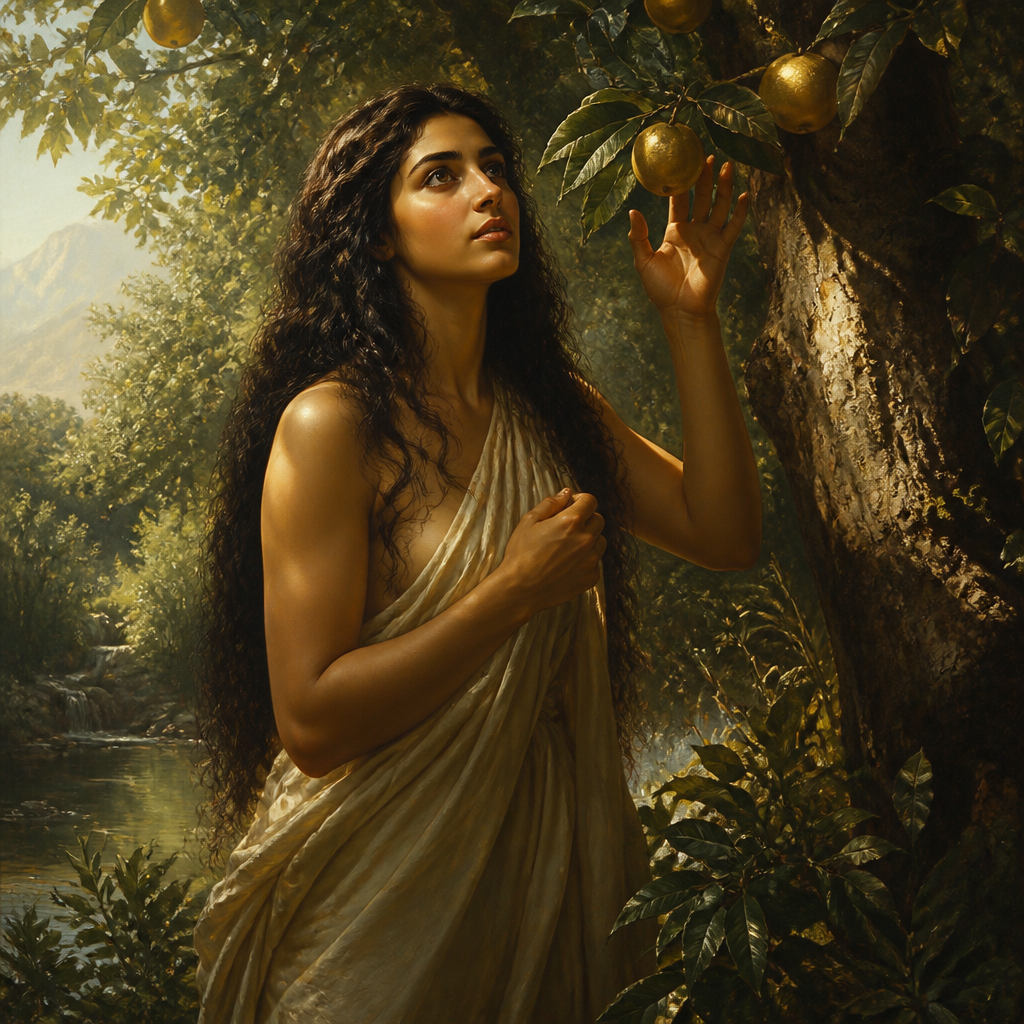
The most defining event in Eve’s life is the Temptation and the Fall. Genesis 3 records a dialogue between Eve and a serpent, described as more crafty than any other beast. The serpent questioned God’s prohibition regarding the Tree of the Knowledge of Good and Evil, suggesting that eating its fruit would grant wisdom and make Eve like God. Seeing that the fruit was visually appealing, good for food, and desirable for gaining wisdom, Eve ate and then shared the fruit with Adam.
This act of disobedience led to immediate self-consciousness and shame, symbolized by the couple's attempt to clothe themselves with fig leaves and hide from God. When confronted, Eve explained, "The serpent deceived me, and I ate." As a consequence, she was told that her pain in childbearing would increase and that her relationship with her husband would be characterized by a struggle for dominance. Following this, she and Adam were cast out of Eden to prevent them from eating from the Tree of Life and living forever in a fallen state.
Post-Edenic life for Eve was marked by the harsh realities of labor and mortality. She experienced the first recorded instance of human tragedy when her eldest son, Cain, murdered her second son, Abel. The biblical narrative concludes her story on a note of hope with the birth of Seth, whom she viewed as a divine replacement for Abel, ensuring the continuation of the human lineage.
Relationship to Other Biblical Figures
Eve’s primary relationship is with Adam, to whom she was a "helper fit for him" (ezer kenegdo). This Hebrew term implies a partner of equal status who provides essential support. Her relationship with God is initially one of direct transparency but becomes one of accountability and judgment following the Fall.
In the New Testament, Eve is mirrored by Mary, often called the 'New Eve' in Christian tradition. While Eve brought disobedience and death into the world through a tree, Mary is seen as the vessel of obedience and life through Christ’s sacrifice on a tree (the cross). The Apostle Paul also uses Eve as a cautionary figure, warning the church not to be led astray just as the serpent deceived Eve by his craftiness (2 Corinthians 11:3).
Spiritual Significance
Eve's primary significance lies in her role as the biological mother of humanity and the first individual to exercise moral choice, albeit through disobedience. She is central to the doctrine of the Fall, which explains the presence of suffering and sin in the world from a biblical perspective. Her creation also establishes the foundational theology of human relationships and gender equality in the 'image of God.'
In New Testament theology, Eve serves as a typology for the Church and a contrast to the obedience of Mary. Her narrative provides the framework for understanding the need for redemption, as the 'seed of the woman' mentioned in the curses of Genesis is traditionally interpreted as a prophecy of the coming Messiah who would reverse the effects of the Fall.
Eve’s spiritual significance is multifaceted. In theological discourse, she represents the vulnerability of human will but also the resilience of the human spirit under divine grace. The promise made in Genesis 3:15, often called the Protevangelium or the 'first gospel,' speaks of the offspring of the woman eventually crushing the head of the serpent. This places Eve at the beginning of a redemptive history that points toward a future victory over evil.
Furthermore, Eve’s creation establishes the biblical basis for the dignity of women, as she is made in the image of God (Imago Dei) alongside Adam. While her actions in the Garden are often debated in terms of gender roles and guilt, modern scholarship increasingly focuses on her role as a pioneer of human moral agency and the mother of all human cultures and civilizations.
Frequently Asked Questions
What does the name Eve mean?
The name Eve comes from the Hebrew 'Chavvah,' which is related to the word for 'life.' It means 'living' or 'life-giver,' as she was the mother of all living people.
How was Eve created according to the Bible?
Genesis 2 states that God caused a deep sleep to fall upon Adam, took one of his ribs (or his 'side'), and fashioned it into a woman to be Adam's companion.
Who were Eve's children?
The Bible explicitly names three of her sons: Cain, Abel, and Seth. Genesis 5:4 also mentions that Adam and Eve had other 'sons and daughters' whose names were not recorded.
Was Eve or Adam more responsible for the Fall?
The Bible presents a shared responsibility. While Eve was the first to be deceived by the serpent and eat the fruit, Adam was with her and also ate. Paul’s letters often emphasize Adam's role in bringing sin into the world, while also noting Eve’s deception.
What is the 'Protevangelium' in relation to Eve?
It refers to Genesis 3:15, where God tells the serpent that the woman's offspring will crush his head. This is traditionally viewed by Christians as the first prophecy of Jesus Christ defeating Satan.
Family & Relationships
 AdamHusbandGenesis 3:20Stated
 EveThis page
Children
 AbelSonGenesis 4:1–2Stated
 CainSonGenesis 4:1Stated
 Cain's WifeDaughterGenesis 5:4
Inferred
Genesis 5:4 says Adam had other sons and daughters, and Genesis 3:20 calls Eve the mother of all the living; no verse says whose daughter she was.Evidence: Genesis 5:4; Genesis 3:20
 SethSonGenesis 4:25Stated
Connected Figures
Family
Husband · Genesis 3:20
Adam is the first human being created by God, the husband of Eve, and the progenitor of the human race in the book of Genesis.
Primeval HistoryFirst: Genesis 2:1934 versesSteward of Eden, Farmer
Son · Genesis 4:1–2
The second son of Adam and Eve, Abel was a shepherd whose righteous sacrifice and subsequent murder by his brother Cain made him the first human to experience death.
Son · Genesis 4:1
Cain was the firstborn son of Adam and Eve, known as the first murderer in biblical history for killing his brother Abel.
Primeval HistoryFirst: Genesis 4:121 versesFarmer / Tiller of the soil
Daughter · Genesis 5:4
The unnamed woman mentioned in Genesis 4 who accompanied Cain to the land of Nod and began his lineage by bearing their son Enoch.
Primeval HistoryFirst: Genesis 2:194 versesMatriarch of the first city
Son · Genesis 4:25
The third son of Adam and Eve, Seth was born after the death of Abel and became the ancestor of the line of the faithful leading to Noah.
Categories
Mentions by Book
- Genesis6
- Luke1
- 2 Corinthians1
- 1 Timothy1
Scripture References
All 9 indexed verses, in canonical order, from the Berean Standard Bible.
Genesis · 6
- Genesis 2:23Partial
And the man said: “This is now bone of my bones and flesh of my flesh; she shall be called ‘woman,’ for out of man she was taken.”
Cited as a key verse; added so References, Key Verses and Mentions by Book share one index.
- Genesis 3:6Partial
When the woman saw that the tree was good for food and pleasing to the eyes, and that it was desirable for obtaining wisdom, she took the fruit and ate it. She also gave some to her husband who was with her, and he ate it.
Cited as a key verse; added so References, Key Verses and Mentions by Book share one index.
- Genesis 3:20
And Adam named his wife Eve, because she would be the mother of all the living.
- Genesis 4:1
And Adam had relations with his wife Eve, and she conceived and gave birth to Cain. “With the help of the LORD I have brought forth a man,” she said.
- Genesis 4:2Partial
Later she gave birth to Cain’s brother Abel. Now Abel was a keeper of sheep, while Cain was a tiller of the soil.
Cited as evidence on a family card; added so References, Key Verses and Mentions by Book share one index.
- Genesis 4:25Partial
And Adam again had relations with his wife, and she gave birth to a son and named him Seth, saying, “God has granted me another seed in place of Abel, since Cain killed him.”
Cited as evidence on a family card; added so References, Key Verses and Mentions by Book share one index.
Luke · 1
- Luke 3:38Partial
the son of Enosh, the son of Seth, the son of Adam, the son of God.
Cited as evidence on a family card; added so References, Key Verses and Mentions by Book share one index.
2 Corinthians · 1
- 2 Corinthians 11:3
I am afraid, however, that just as Eve was deceived by the serpent’s cunning, your minds may be led astray from your simple and pure devotion to Christ.
1 Timothy · 1
- 1 Timothy 2:13
For Adam was formed first, and then Eve.