Cain
Who was Cain in the Bible?
Cain was the firstborn son of Adam and Eve, known as the first murderer in biblical history for killing his brother Abel.
Cain is a foundational figure in the Book of Genesis, identified as the first human being born of woman. Representing the eldest generation of the post-Edenic human family, his narrative introduces the themes of sibling rivalry, the ethics of worship, and the gravity of human sin. His life is defined by a transition from a tiller of the soil to a fugitive and, eventually, the founder of the first human city.
His story, primarily recorded in Genesis 4, serves as a bridge between the Fall of Man and the further degradation of human morality in the antediluvian world. As the firstborn, Cain initially held a position of privilege, yet his failure to master his own impulses led to a catastrophic act that fundamentally altered the trajectory of his lineage and the biblical concept of justice and mercy.
Background and Family
Cain was born to Adam and Eve following their expulsion from the Garden of Eden. His birth is accompanied by a significant exclamation from Eve: "I have produced a man with the help of the Lord" (Genesis 4:1). The name Cain (Qayin) is linguistically linked to the Hebrew verb 'qanah', meaning 'to get' or 'to acquire,' reflecting his status as the first addition to the human family. He was joined by a younger brother, Abel. As the siblings matured, they engaged in distinct essential labors: Cain became a "tiller of the ground," a farmer who worked the soil that had been cursed following his parents' disobedience, while Abel became a "keeper of sheep."
Major Life Events
The Sacrifice and the Countenance
The central conflict of Cain’s life began when both brothers brought offerings to God. Cain presented the fruit of the ground, while Abel offered the firstlings of his flock and their fat portions. The biblical text notes that the Lord had regard for Abel and his offering, but for Cain and his offering, He had no regard. While the text does not explicitly state why Cain’s offering was rejected, many commentators suggest it was a matter of internal disposition or the quality of the fruits provided.
Upon the rejection of his sacrifice, Cain became "very angry," and his face fell. In a notable display of divine patience, God addressed Cain directly, warning him that sin was crouching at his door like a predator, and that he must master it. This moment is often cited as the first explicit biblical discussion of human free will and the internal struggle against moral failure.
The First Murder and the Curse
Ignoring the divine warning, Cain invited Abel out into the field, where he rose up against him and killed him. When God later inquired, "Where is Abel your brother?" Cain famously responded with the dismissive rhetorical question, "Am I my brother's keeper?" This defiance was met with a swift judgment. God declared that Abel's blood was crying out from the ground, and as a result, Cain would no longer be able to coax life from the soil. He was sentenced to be a "fugitive and a wanderer on the earth."
The Mark of Cain and the City of Enoch
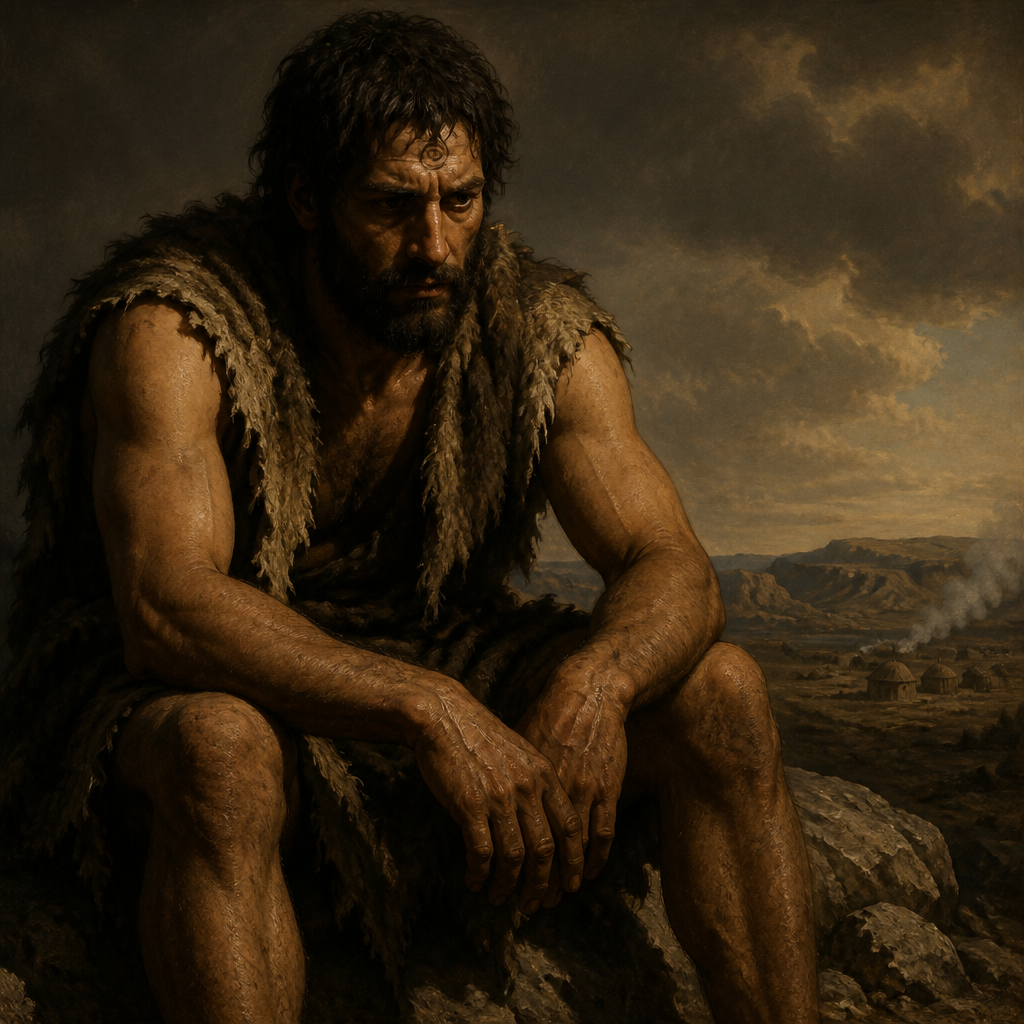
Fearful that his exile would lead to his death at the hands of others, Cain lamented that his punishment was more than he could bear. In a complex act of both justice and protection, God placed a "mark" on Cain—not as a sign of shame, but as a warning to others that anyone who harmed Cain would suffer sevenfold vengeance. Cain then went out from the presence of the Lord and settled in the land of Nod, east of Eden. There, he married and fathered a son, Enoch. Significant for the development of civilization, Cain built a city, naming it after his son, marking the transition from nomadic wandering to settled urban life for his descendants.
Relationship to Other Biblical Figures
Cain’s relationship with his parents, Adam and Eve, is characterized by the loss of their second son and the exile of their first. Following the death of Abel and the departure of Cain, Eve bore a third son named Seth, whom she viewed as a replacement for Abel. Within the broader biblical genealogy, Cain is the progenitor of a line of innovators, including Jabal (the father of those who live in tents), Jubal (musical instruments), and Tubal-cain (forged tools of bronze and iron). However, this line is typically contrasted with the "righteous" line of Seth. In the New Testament, Cain is used as a cautionary archetype; 1 John 3:12 warns believers not to be like Cain, who was "of the evil one."
Spiritual Significance
Cain is significant as the first human to commit murder, illustrating the profound consequences of the Fall of Man on subsequent generations. His story establishes the concept of the 'two ways'—the way of the righteous (represented by Abel) and the way of the wicked (represented by Cain). He identifies the necessity of proper heart disposition in worship and the destructive power of unchecked envy and anger.
Furthermore, Cain's narrative is the biblical origin point for civilizational developments like urbanization and metallurgy. Despite his sin, the protection afforded to him by God through the 'Mark of Cain' introduces the theological theme of common grace and the divine limitation on human vengeance, setting a precedent for the sanctity of life within a fallen world.
Theologically, Cain serves as the archetype of the "man of flesh" who relies on his own efforts rather than faith. The Epistle to the Hebrews notes that it was by faith that Abel offered a better sacrifice than Cain. Cain’s story illustrates the rapid escalation of the power of sin: from the intellectual pride and disobedience of Adam to the premeditated violence and fratricide of the next generation.
Furthermore, the "Mark of Cain" and his subsequent protection reveal a tension between divine wrath and divine mercy. Even in his fallen state as a murderer, Cain is not totally abandoned by God, suggesting that the preservation of human life and the restraint of cycles of vengeance are priorities in the biblical order. His founding of a city also introduces the biblical theme of the city as a place of human independence and potential rebellion against God, a motif that recurs at the Tower of Babel and elsewhere in the Old Testament.
Frequently Asked Questions
What was the Mark of Cain?
The Bible does not specify the physical nature of the mark. Its purpose was protective, intended to warn others that killing Cain would result in severe divine retribution.
Who was Cain's wife?
The Bible does not name her, but tradition and genealogical logic suggest she was either a sister or a close relative, as the initial human population grew from Adam and Eve.
Why was Cain's sacrifice rejected?
While not explicitly stated, Hebrews 11:4 suggests Abel offered his in faith, while Cain did not. Others suggest Cain provided a 'leftover' offering rather than the 'firstfruits'.
Where was the Land of Nod?
The text describes it only as being 'east of Eden.' The name 'Nod' is derived from the Hebrew word for 'wandering,' reflecting Cain's status as a fugitive.
Did Cain repent for killing Abel?
The biblical text never records a formal act of repentance; Cain expresses remorse for the severity of his punishment, but not necessarily for the sin itself.
Family & Relationships
 Cain's WifeWifeGenesis 4:17Stated
 CainThis page
Children
 Enoch, Son of CainSonGenesis 4:17Stated
Extended family
 IradGrandsonGenesis 4:18
Inferred
Reconstructed through Enoch: Genesis 4:18 ties Irad to Enoch; Genesis 4:17 ties Enoch to Cain. No verse states the grandfather link between Irad and Cain directly.Evidence: Genesis 4:18; Genesis 4:17
 MehujaelGreat-GrandsonGenesis 4:1
Inferred
Reconstructed through Irad and Enoch: Genesis 4:18 ties Mehujael to Irad; Genesis 4:18 ties Irad to Enoch; Genesis 4:17 ties Enoch to Cain. No verse states the great-grandfather link between Mehujael and Cain directly.Evidence: Genesis 4:1
 MethusaelGreat-Great-Great-GrandsonGenesis 4:1
Inferred
No verse names Cain and Methushael together; the great-great-great-grandson link is carried from the surrounding genealogy and is not stated in Scripture.Evidence: Genesis 4:1
 Adah, Wife of LamechDescendantGenesis 4:17
Inferred
No verse names Adah and Cain together; the ancestor link is carried from the surrounding genealogy and is not stated in Scripture.Evidence: Genesis 4:17
 JabalDescendantGenesis 4:20
Inferred
No verse names Cain and Jabal together; the descendant link is carried from the surrounding genealogy and is not stated in Scripture.Evidence: Genesis 4:20
 JubalDescendantGenesis 4:20
Inferred
No verse names Jubal and Cain together; the ancestor link is carried from the surrounding genealogy and is not stated in Scripture.Evidence: Genesis 4:20
 Lamech, Son of MethushaelDescendantGenesis 4:18
Inferred
No verse names Cain and Lamech together; the descendant link is carried from the surrounding genealogy and is not stated in Scripture.Evidence: Genesis 4:18
 ZillahDescendantGenesis 4:19
Inferred
No verse names Cain and Zillah together; the descendant link is carried from the surrounding genealogy and is not stated in Scripture.Evidence: Genesis 4:19
Connected Figures
Family

Father · Genesis 4:1
Adam is the first human being created by God, the husband of Eve, and the progenitor of the human race in the book of Genesis.
Primeval HistoryFirst: Genesis 2:1934 versesSteward of Eden, Farmer

Mother · Genesis 4:1
Eve is the first woman mentioned in the Bible, considered the mother of all living and the wife of Adam in the Genesis creation narrative.
Primeval HistoryFirst: Genesis 3:209 versesMother of all living
Wife · Genesis 4:17
The unnamed woman mentioned in Genesis 4 who accompanied Cain to the land of Nod and began his lineage by bearing their son Enoch.
Primeval HistoryFirst: Genesis 2:194 versesMatriarch of the first city
Son · Genesis 4:17
The firstborn son of Cain and the namesake of the first city recorded in the Bible, signifying the beginning of autonomous human civilization.
Primeval HistoryFirst: Genesis 4:174 versesSon of a City-builder

Brother · Genesis 4:2
The second son of Adam and Eve, Abel was a shepherd whose righteous sacrifice and subsequent murder by his brother Cain made him the first human to experience death.

Brother · Genesis 4:25
The third son of Adam and Eve, Seth was born after the death of Abel and became the ancestor of the line of the faithful leading to Noah.
Grandson · Genesis 4:18
Irad was the son of Enoch and the grandson of Cain, representing the third generation of the Cainite lineage in the Book of Genesis.
Primeval HistoryFirst: Genesis 4:182 versesEarly urbanite / Patriarch of Cain's line
Great-Grandson · Genesis 4:1
The son of Irad and great-grandson of Cain, Mehujael is a pivotal figure in the genealogies of the antediluvian world.
Primeval HistoryFirst: Genesis 4:182 versesPatriarch of the Cainite line
Great-Great-Great-Grandson · Genesis 4:1
Methushael was a descendant of Cain, the son of Mehujael and the father of Lamech, representing the sixth generation of humanity in the Cainite line.
Primeval HistoryFirst: Genesis 4:183 versesPatriarch of the Cainite line
Descendant · Genesis 4:17
Adah was the first wife of Lamech and the second woman named in the Bible after Eve, playing a pivotal role in the antediluvian genealogy of Cain.
Descendant · Genesis 4:20
Jabal was a descendant of Cain and is identified in the Book of Genesis as the father of those who live in tents and raise livestock.
Primeval HistoryFirst: Genesis 4:205 versesPatriarch of nomadic pastoralists
Descendant · Genesis 4:20
Jubal was a descendant of Cain and is traditionally recognized as the father of all who play the harp and the flute, establishing the foundation of musical arts.
Primeval HistoryFirst: Genesis 4:215 versesMusical instrument maker and musician
Categories
Mentions by Book
- Genesis18
- Hebrews1
- 1 John1
- Jude1
Scripture References
All 21 indexed verses, in canonical order, from the Berean Standard Bible.
Genesis · 18
- Genesis 4:1
And Adam had relations with his wife Eve, and she conceived and gave birth to Cain. “With the help of the LORD I have brought forth a man,” she said.
- Genesis 4:2
Later she gave birth to Cain’s brother Abel. Now Abel was a keeper of sheep, while Cain was a tiller of the soil.
- Genesis 4:3
So in the course of time, Cain brought some of the fruit of the soil as an offering to the LORD,
- Genesis 4:5Partial
but He had no regard for Cain and his offering. So Cain became very angry, and his countenance fell.
- Genesis 4:6
“Why are you angry,” said the LORD to Cain, “and why has your countenance fallen?
- Genesis 4:8Partial
Then Cain said to his brother Abel, “Let us go out to the field.” And while they were in the field, Cain rose up against his brother Abel and killed him.
- Genesis 4:9
And the LORD said to Cain, “Where is your brother Abel?” “I do not know!” he answered. “Am I my brother’s keeper?”
- Genesis 4:13
But Cain said to the LORD, “My punishment is greater than I can bear.
- Genesis 4:15Partial
“Not so!” replied the LORD. “If anyone slays Cain, then Cain will be avenged sevenfold.” And the LORD placed a mark on Cain, so that no one who found him would kill him.
- Genesis 4:16
So Cain went out from the presence of the LORD and settled in the land of Nod, east of Eden.
- Genesis 4:17
And Cain had relations with his wife, and she conceived and gave birth to Enoch. Then Cain built a city and named it after his son Enoch.
- Genesis 4:18Partial
Now to Enoch was born Irad, and Irad was the father of Mehujael, and Mehujael was the father of Methusael, and Methusael was the father of Lamech.
Cited as evidence on a family card; added so References, Key Verses and Mentions by Book share one index.
- Genesis 4:19Partial
And Lamech married two women, one named Adah and the other Zillah.
Cited as evidence on a family card; added so References, Key Verses and Mentions by Book share one index.
- Genesis 4:20Partial
Adah gave birth to Jabal; he was the father of those who dwell in tents and raise livestock.
Cited as evidence on a family card; added so References, Key Verses and Mentions by Book share one index.
- Genesis 4:21Partial
And his brother’s name was Jubal; he was the father of all who play the harp and flute.
Cited as evidence on a family card; added so References, Key Verses and Mentions by Book share one index.
- Genesis 4:22
And Zillah gave birth to Tubal-cain, a forger of every implement of bronze and iron. And the sister of Tubal-cain was Naamah.
Cited as evidence on a family card; added so References, Key Verses and Mentions by Book share one index.
- Genesis 4:24
If Cain is avenged sevenfold, then Lamech seventy-sevenfold.”
- Genesis 4:25
And Adam again had relations with his wife, and she gave birth to a son and named him Seth, saying, “God has granted me another seed in place of Abel, since Cain killed him.”
Hebrews · 1
- Hebrews 11:4
By faith Abel offered God a better sacrifice than Cain did. By faith he was commended as righteous when God gave approval to his gifts. And by faith he still speaks, even though he is dead.
1 John · 1
- 1 John 3:12
Do not be like Cain, who belonged to the evil one and murdered his brother. And why did Cain slay him? Because his own deeds were evil, while those of his brother were righteous.
Jude · 1
- Jude 1:11
Woe to them! They have traveled the path of Cain; they have rushed for profit into the error of Balaam; they have perished in Korah’s rebellion.