Esau
Who was Esau in the Bible?
The firstborn son of Isaac and Rebekah, a skillful hunter and the progenitor of the Edomites, known for selling his birthright for a bowl of stew.
Esau was a significant biblical patriarch of the second generation of Abraham’s descendants. As the elder twin brother of Jacob, he was the natural heir to the covenantal promises given to his grandfather, Abraham. Born to Isaac and Rebekah in the land of Canaan, Esau is described as a man of the outdoors, possessing a rugged constitution and a temperament that contrasted sharply with his brother’s quiet, domestic nature. His life is defined largely by his relationship with Jacob, characterized by intense rivalry, betrayal, and eventual reconciliation.
Esau’s legacy extends beyond his personal narrative into the geopolitical landscape of the ancient Near East. He is identified in the biblical record as Edom, the father of the Edomite nation. While he was excluded from the primary line of the Messianic promise—a selection the New Testament attributes to divine sovereignty—he was nevertheless granted a vast inheritance in the region of Mount Seir. The biblical account portrays him as a complex figure: a man of impulsive passion who could harbor lethal grudges, yet also a man capable of profound forgiveness and familial affection.
Background and Family
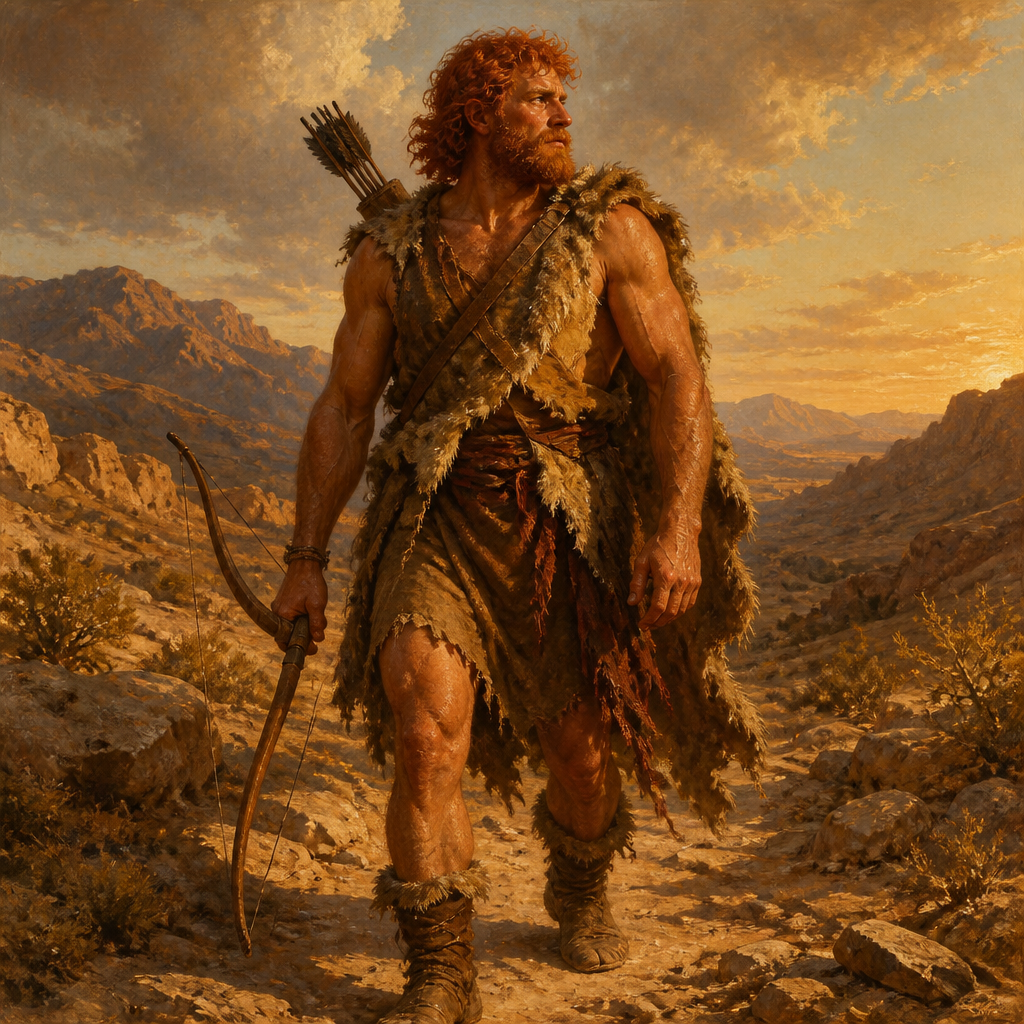
Esau was born in the land of Canaan during the Patriarchal Period, specifically when his father, Isaac, was sixty years old (Genesis 25:26). His birth was marked by a struggle in the womb with his twin brother, Jacob, a physical conflict that served as a divine portent of the future nations that would descend from them. At birth, Esau was noted for being strikingly red and covered in hair "like a fur coat," a physical characteristic that influenced his name (interpreted as 'hairy') and his secondary name, Edom ('red').
Growing up, Esau became a skillful hunter and a "man of the field," earning the particular favor of his father, Isaac, who enjoyed the wild game Esau provided. However, the domestic dynamic was fractured, as Rebekah favored Jacob. Esau’s familial life became further complicated by his marriages. At age forty, he married two Hittite women, Judith and Basemath (also identified as Adah and Oholibamah in later genealogies). These unions were a source of great grief to Isaac and Rebekah due to the women’s Canaanite origins. In an attempt to appease his parents later in life, Esau also married Mahalath, the daughter of his uncle Ishmael.
Major Life Events
The Sale of the Birthright
The first pivotal event in Esau's life occurred when he returned from the field famished. Finding Jacob cooking a red lentil stew, Esau demanded some of the food. Jacob seized the opportunity to bargain for Esau’s birthright—the double portion of the inheritance and the spiritual leadership of the family. Esau, prioritizing his immediate physical hunger over his long-term inheritance, famously remarked, "I am about to die, so what good is a birthright to me?" (Genesis 25:32). By swearing an oath and eating the meal, the text records that Esau "despised his birthright."
The Stolen Blessing
Years later, when Isaac was old and blind, he intended to bestow the patriarchal blessing upon Esau. He sent Esau to hunt and prepare a meal before the ceremony. During Esau's absence, Jacob, prompted by Rebekah, disguised himself as Esau and deceived his father into giving him the blessing intended for the firstborn. When Esau returned and discovered the deception, he let out a "loud and bitter cry." Isaac, though devastated, could not revoke the blessing given to Jacob. Esau received a secondary blessing: he would live away from the richness of the earth and serve his brother, but would eventually break his brother's yoke. Consumed by rage, Esau plotted to kill Jacob after their father's death, forcing Jacob to flee to Haran.
Reconciliation and Later Years
After twenty years of separation, Jacob returned to Canaan, fearing Esau’s retaliation. However, when the two met, Esau displayed unexpected grace. Instead of attacking with his four hundred men, he ran to meet Jacob, embraced him, and wept (Genesis 33:4). He initially declined Jacob’s lavish gifts, stating he already had plenty. Following the burial of their father Isaac, Esau realized that the land of Canaan could not support both his and Jacob’s vast livestock. Consequently, he migrated to the hill country of Seir, where he displaced the Horites and established the nation of Edom.
Relationship to Other Biblical Figures
Esau’s primary relationship was with his brother, Jacob (Israel). Their lives are presented as a study in contrasts: the hunter versus the shepherd, the impulsive versus the calculating, and the rejected versus the chosen. While they reconciled personally, the nations descending from them—Edom and Israel—remained frequent adversaries throughout biblical history. Esau also maintained a close bond with his father, Isaac, who saw in Esau a reflection of a rugged, traditional masculinity. In the New Testament, Esau is used by the Apostle Paul in Romans 9 as a primary example of God's elective purposes, illustrating that divine promise is not based on human effort or birth order.
Spiritual Significance
The spiritual legacy of Esau is predominantly cautionary. The book of Hebrews (12:16) labels him as "godless" or "profane," specifically because he traded a permanent spiritual inheritance for a momentary physical satisfaction. He represents the "man of the flesh" who lacks appreciation for the sacred. The prophetic books, particularly Obadiah and Malachi, use Esau (Edom) as a symbol of human pride and opposition to God’s kingdom. However, the Genesis account also offers a nuanced portrait of a man who, despite losing his primary inheritance, achieved great material success and demonstrated a capacity for mercy that exceeded the expectations of his contemporaries.
Esau serves as a pivotal figure in the biblical narrative of election and the origin of nations. Theologically, he is the archetype of the 'profane' person who fails to value spiritual promises, selling his birthright for temporary gratification. His exclusion from the covenant line, despite being the firstborn, underscores the theme that God's sovereign choice often subverts human tradition and merit.
Furthermore, Esau is the progenitor of the Edomites, a nation that occupies a significant role in the prophetic warnings of the Old Testament. The phrase 'Jacob I loved, but Esau I hated' (Malachi 1:2-3; Romans 9:13) remains one of the most discussed theological statements in scripture, representing the distinction between the line of promise and the line of natural descent, as well as God's judgment upon the pride and violence associated with the house of Esau.
Frequently Asked Questions
Why did Esau sell his birthright for a bowl of stew?
Esau sold his birthright because he was famished and prioritized his immediate physical needs over his long-term spiritual and legal inheritance. The Bible notes that in doing so, he 'despised' his birthright, viewing it as worthless compared to his current hunger.
What does the name 'Edom' mean?
'Edom' means 'Red.' It refers both to Esau's appearance at birth (being red and hairy) and the 'red stew' for which he traded his birthright. It became the name of the nation he founded.
Did Esau ever forgive Jacob?
Yes. When Jacob returned from Paddan-aram after twenty years, Esau met him with a peaceful heart. Instead of seeking revenge for the stolen blessing, Esau embraced Jacob and wept, demonstrating a spirit of reconciliation.
Who were Esau's wives?
Esau married Judith (daughter of Beeri the Hittite), Basemath (daughter of Elon the Hittite), and later Mahalath (daughter of Ishmael and sister of Nebaioth) to try and please his parents.
Where is the land of Seir?
The land of Seir, also known as the country of Edom, is a mountainous region south of the Dead Sea where Esau settled and his descendants drove out the original Horite inhabitants.
Family & Relationships
 Adah, Wife of EsauWifeGenesis 36:10Stated
 Adah, Wife of LamechWifeGenesis 36:10Stated
 JudithWifeGenesis 26:34Stated
 Mahalath, Wife of EsauWifeGenesis 28:9Stated
 OholibamahWifeGenesis 36:14Stated
 EsauThis page
 JacobBrotherGenesis 27:30Stated
Children
 Eliphaz, Son of EsauSonGenesis 36:10Stated
 JalamSonGenesis 36:14Stated
 Jeush, Son of EsauSonGenesis 36:14Stated
 Korah, Son of EsauSonGenesis 36:14Stated
 Reuel, Son of EsauSonGenesis 36:4Stated
Extended family
 AnahFather-in-lawGenesis 36:14
Inferred
Genesis 36:14 lists Anah and Esau among the sons of esau’s, but does not say how the two of them are related.Evidence: Genesis 36:14; Genesis 36:18; Genesis 36:2; Genesis 36:25
 Beeri the HittiteFather-in-lawGenesis 26:34
Inferred
Genesis 26:34 names Beeri and Esau in the same verse but does not state a son-in-law tie between them; the link rests on the surrounding narrative.Evidence: Genesis 26:34
 Dishon, Son of AnahBrother-in-lawGenesis 36:25
Inferred
Reconstructed through Oholibamah: Genesis 36:25 ties Dishon to Oholibamah; Genesis 36:14 ties Oholibamah to Esau. No verse states the brother-in-law link between Dishon and Esau directly.Evidence: Genesis 36:25; Genesis 36:14; Genesis 36:18
 Elon the HittiteFather-in-lawGenesis 36:2
Inferred
Genesis 36:2 lists Esau and Elon among the daughters of canaan, but does not say how the two of them are related.Evidence: Genesis 36:2; Genesis 36:10
 AmalekGrandsonGenesis 36:12
Inferred
Genesis 36:12 lists Esau and Amalek among the sons of esau’s, but does not say how the two of them are related.Evidence: Genesis 36:12
 GatamGrandsonGenesis 36:11
Inferred
Reconstructed through Amalek: Genesis 36:12 ties Esau to Amalek (itself an inferred link); Genesis 36:16 ties Amalek to Gatam. No verse states the grandson link between Esau and Gatam directly.Evidence: Genesis 36:11; Genesis 36:12
 Kenaz, Son of EliphazGrandsonGenesis 36:12
Inferred
Reconstructed through Eliphaz: Genesis 36:11 ties Kenaz to Eliphaz; Genesis 36:10 ties Eliphaz to Esau. No verse states the grandfather link between Kenaz and Esau directly.Evidence: Genesis 36:12; Genesis 36:11
 Korah, Grandson of AdahGrandsonGenesis 36:4
Inferred
Genesis 36:5 lists Korah and Esau among the sons of esau, but does not say how the two of them are related.Evidence: Genesis 36:4; Genesis 36:5; Genesis 36:12
 MizzahGrandsonGenesis 36:17
Inferred
Genesis 36:17 lists Mizzah and Esau among the sons of esau’s, but does not say how the two of them are related.Evidence: Genesis 36:17; Genesis 36:13
 Nahath, Grandson of EsauGrandsonGenesis 36:17
Inferred
Genesis 36:17 lists Nahath and Esau among the sons of esau’s, but does not say how the two of them are related.Evidence: Genesis 36:17; Genesis 36:13; 1 Chronicles 1:37
 OmarGrandsonGenesis 36:12
Inferred
Reconstructed through Eliphaz: Genesis 36:11 ties Omar to Eliphaz; Genesis 36:10 ties Eliphaz to Esau. No verse states the grandfather link between Omar and Esau directly.Evidence: Genesis 36:12; Genesis 36:11
 Shammah, Grandson of EsauGrandsonGenesis 36:13
Inferred
Genesis 36:13 lists Esau and Shammah among the sons of reuel, but does not say how the two of them are related.Evidence: Genesis 36:13; Genesis 36:17
 TemanGrandsonGenesis 36:12
Inferred
Reconstructed through Eliphaz: Genesis 36:11 ties Teman to Eliphaz; Genesis 36:10 ties Eliphaz to Esau. No verse states the grandfather link between Teman and Esau directly.Evidence: Genesis 36:12; Genesis 36:11; 1 Chronicles 1:36
 ZephoGrandsonGenesis 36:12
Inferred
Reconstructed through Eliphaz: Genesis 36:11 ties Zepho to Eliphaz; Genesis 36:10 ties Eliphaz to Esau. No verse states the grandfather link between Zepho and Esau directly.Evidence: Genesis 36:12; Genesis 36:11
 Zerah, Grandson of EsauGrandsonGenesis 36:17
Inferred
Genesis 36:17 lists Zerah and Esau among the sons of esau’s, but does not say how the two of them are related.Evidence: Genesis 36:17; Genesis 36:13
 Achbor, Father of Baal-hananDescendantGenesis 25:25
Inferred
No verse names Esau and Achbor together; the descendant link is carried from the surrounding genealogy and is not stated in Scripture.Evidence: Genesis 25:25
 AlvahDescendantGenesis 36:40
Inferred
Genesis 36:40 names Alvah and Esau in the same verse but does not state an ancestor tie between them; the link rests on the surrounding narrative.Evidence: Genesis 36:40
 BedadDescendantGenesis 25:25
Inferred
No verse names Esau and Bedad together; the descendant link is carried from the surrounding genealogy and is not stated in Scripture.Evidence: Genesis 25:25
 Elah, Chief of EdomDescendantGenesis 36:40
Inferred
No verse names Esau and Elah together; the descendant link is carried from the surrounding genealogy and is not stated in Scripture.Evidence: Genesis 36:40
 JethethDescendantGenesis 36:40
Inferred
Genesis 36:40 names Jetheth and Esau in the same verse but does not state an ancestor tie between them; the link rests on the surrounding narrative.Evidence: Genesis 36:40
 Jobab, King of EdomDescendantGenesis 25:25
Inferred
No verse names Esau and Jobab together; the descendant link is carried from the surrounding genealogy and is not stated in Scripture.Evidence: Genesis 25:25
 PinonDescendantGenesis 36:40
Inferred
No verse names Esau and Pinon together; the descendant link is carried from the surrounding genealogy and is not stated in Scripture.Evidence: Genesis 36:40
 ZibeonRelativeGenesis 36:2
Inferred
Genesis 36:2 lists Zibeon and Esau among the daughters of canaan, but does not say how the two of them are related.Evidence: Genesis 36:2
Connected Figures
Family

Father · Genesis 27:5
The miracle son of Abraham and Sarah, Isaac was the second Hebrew patriarch and the child of promise through whom the covenant of God was established.
PatriarchsFirst: Genesis 17:19125 versesPatriarch, Shepherd, Farmer

Mother · Genesis 27:5
The wife of Isaac and mother of Esau and Jacob, Rebekah was a central matriarch of Israel known for her hospitality, her role in the patriarchal succession, and her divine oracle regarding her sons.
Wife · Genesis 36:10
A Canaanite woman from the Hittite tribe who became a wife of Esau and a foundational matriarch of the Edomite nation through her son Eliphaz.
PatriarchsFirst: Genesis 26:346 versesMatriarch of Edom
Wife · Genesis 36:10
Adah was the first wife of Lamech and the second woman named in the Bible after Eve, playing a pivotal role in the antediluvian genealogy of Cain.
Wife · Genesis 26:34
Judith was a Hittite woman who became one of the first two wives of Esau, the son of Isaac.
PatriarchsFirst: Genesis 26:343 versesMatriarch in the house of Esau
Wife · Genesis 28:9
Mahalath was the daughter of Ishmael and granddaughter of Abraham who became a wife of Esau in an attempt to please his parents.
Wife · Genesis 36:14
A wife of Esau and a descendant of the Hivite and Horite peoples, Oholibamah was a prominent matriarch whose sons became powerful chiefs in the land of Edom.
Son · Genesis 36:10
Eliphaz was the firstborn son of Esau and Adah, serving as a foundational patriarch and chief within the nation of Edom.
PatriarchsFirst: Genesis 36:411 versesChief and Patriarch
Son · Genesis 36:14
Jalam was a son of Esau and Oholibamah who became a prominent tribal chief and patriarch in the land of Edom.
Son · Genesis 36:14
A son of Esau and Oholibamah who became a prominent clan leader and chief among the Edomites in the land of Seir.
Son · Genesis 36:14
An Edomite chief and the son of Esau and Oholibamah, recognized as a tribal leader in the land of Canaan during the Patriarchs.
Son · Genesis 36:4
Reuel was a patriarch of the Edomites, the son of Esau and Mahalath, and the progenitor of four major clans in the land of Seir.
Categories
Mentions by Book
- Genesis61
- 1 Chronicles3
- Obadiah6
- Romans1
- Hebrews2
Scripture References
All 73 indexed verses, in canonical order, from the Berean Standard Bible.
- Genesis 25:25
The first one came out red, covered with hair like a fur coat; so they named him Esau.
- Genesis 25:26
After this, his brother came out grasping Esau’s heel; so he was named Jacob. And Isaac was sixty years old when the twins were born.
- Genesis 25:27
When the boys grew up, Esau became a skillful hunter, a man of the field, while Jacob was a quiet man who stayed at home.
- Genesis 25:28
Because Isaac had a taste for wild game, he loved Esau; but Rebekah loved Jacob.
- Genesis 25:29
One day, while Jacob was cooking some stew, Esau came in from the field and was famished.
- Genesis 25:32
“Look,” said Esau, “I am about to die, so what good is a birthright to me?”
- Genesis 25:34Partial
Then Jacob gave some bread and lentil stew to Esau, who ate and drank and then got up and went away. Thus Esau despised his birthright.
- Genesis 26:34
When Esau was forty years old, he took as his wives Judith daughter of Beeri the Hittite and Basemath daughter of Elon the Hittite.
- Genesis 27:1
When Isaac was old and his eyes were so weak that he could no longer see, he called his older son Esau and said to him, “My son.” “Here I am,” Esau replied.
- Genesis 27:5Partial
Now Rebekah was listening to what Isaac told his son Esau. So when Esau went into the field to hunt game and bring it back,
- Genesis 27:6
Rebekah said to her son Jacob, “Behold, I overheard your father saying to your brother Esau,
- Genesis 27:11
Jacob answered his mother Rebekah, “Look, my brother Esau is a hairy man, but I am smooth-skinned.
- Genesis 27:15
And Rebekah took the finest clothes in the house that belonged to her older son Esau, and she put them on her younger son Jacob.
- Genesis 27:19
Jacob said to his father, “I am Esau, your firstborn. I have done as you told me. Please sit up and eat some of my game, so that you may bless me.”
- Genesis 27:21
Then Isaac said to Jacob, “Please come closer so I can touch you, my son. Are you really my son Esau, or not?”
- Genesis 27:22
So Jacob came close to his father Isaac, who touched him and said, “The voice is the voice of Jacob, but the hands are the hands of Esau.”
- Genesis 27:23
Isaac did not recognize him, because his hands were hairy like those of his brother Esau; so he blessed him.
- Genesis 27:24
Again he asked, “Are you really my son Esau?” And he replied, “I am.”
- Genesis 27:30
As soon as Isaac had finished blessing him and Jacob had left his father’s presence, his brother Esau returned from the hunt.
- Genesis 27:32
But his father Isaac replied, “Who are you?” “I am Esau, your firstborn son,” he answered.
- Genesis 27:34
When Esau heard his father’s words, he let out a loud and bitter cry and said to his father, “Bless me too, O my father!”
- Genesis 27:37
But Isaac answered Esau: “Look, I have made him your master and given him all his relatives as servants; I have sustained him with grain and new wine. What is left that I can do for you, my son?”
- Genesis 27:38Partial
Esau said to his father, “Do you have only one blessing, my father? Bless me too, O my father!” Then Esau wept aloud.
- Genesis 27:41Partial
Esau held a grudge against Jacob because of the blessing his father had given him. And Esau said in his heart, “The days of mourning for my father are at hand; then I will kill my brother Jacob.”
- Genesis 27:42Partial
When the words of her older son Esau were relayed to Rebekah, she sent for her younger son Jacob and told him, “Look, your brother Esau is consoling himself by plotting to kill you.
- Genesis 28:5
So Isaac sent Jacob to Paddan-aram, to Laban son of Bethuel the Aramean, the brother of Rebekah, who was the mother of Jacob and Esau.
- Genesis 28:6
Now Esau learned that Isaac had blessed Jacob and sent him to Paddan-aram to take a wife there, commanding him, “Do not marry a Canaanite woman,”
- Genesis 28:8
And seeing that his father Isaac disapproved of the Canaanite women,
- Genesis 28:9
Esau went to Ishmael and married Mahalath, the sister of Nebaioth and daughter of Abraham’s son Ishmael, in addition to the wives he already had.
- Genesis 32:4
He instructed them, “You are to say to my master Esau, ‘Your servant Jacob says: I have been staying with Laban and have remained there until now.
- Genesis 32:6
When the messengers returned to Jacob, they said, “We went to your brother Esau, and now he is coming to meet you—he and four hundred men with him.”
- Genesis 32:8
He thought, “If Esau comes and attacks one camp, then the other camp can escape.”
- Genesis 32:11
Please deliver me from the hand of my brother Esau, for I am afraid that he may come and attack me and the mothers and children with me.
- Genesis 32:13
Jacob spent the night there, and from what he had brought with him, he selected a gift for his brother Esau:
- Genesis 32:17
He instructed the one in the lead, “When my brother Esau meets you and asks, ‘To whom do you belong, where are you going, and whose animals are these before you?’
- Genesis 32:18
then you are to say, ‘They belong to your servant Jacob. They are a gift, sent to my lord Esau. And behold, Jacob is behind us.’”
- Genesis 32:19
He also instructed the second, the third, and all those following behind the herds: “When you meet Esau, you are to say the same thing to him.
- Genesis 33:1
Now Jacob looked up and saw Esau coming toward him with four hundred men. So he divided the children among Leah, Rachel, and the two maidservants.
- Genesis 33:4
Esau, however, ran to him and embraced him, threw his arms around his neck, and kissed him. And they both wept.
- Genesis 33:9
“I already have plenty, my brother,” Esau replied. “Keep what belongs to you.”
- Genesis 33:15
“Let me leave some of my people with you,” Esau said. But Jacob replied, “Why do that? Let me find favor in the sight of my lord.”
- Genesis 33:16
So that day Esau started on his way back to Seir,
- Genesis 35:1
Then God said to Jacob, “Arise, go up to Bethel, and settle there. Build an altar there to the God who appeared to you when you fled from your brother Esau.”
- Genesis 35:29
Then he breathed his last and died and was gathered to his people, old and full of years. And his sons Esau and Jacob buried him.
- Genesis 36:2
Esau took his wives from the daughters of Canaan: Adah daughter of Elon the Hittite, Oholibamah daughter of Anah and granddaughter of Zibeon the Hivite,
- Genesis 36:4
And Adah bore Eliphaz to Esau, Basemath gave birth to Reuel,
- Genesis 36:5
and Oholibamah gave birth to Jeush, Jalam, and Korah. These were the sons of Esau, who were born to him in the land of Canaan.
- Genesis 36:6
Later, Esau took his wives and sons and daughters and all the people of his household, along with his livestock, all his other animals, and all the property he had acquired in Canaan, and he moved to a land far away from his brother Jacob.
- Genesis 36:10Partial
These are the names of Esau’s sons: Eliphaz son of Esau’s wife Adah, and Reuel son of Esau’s wife Basemath.
- Genesis 36:11Partial
The sons of Eliphaz were Teman, Omar, Zepho, Gatam, and Kenaz.
Cited as evidence on a family card; added so References, Key Verses and Mentions by Book share one index.
- Genesis 36:12Partial
Additionally, Timna, a concubine of Esau’s son Eliphaz, gave birth to Amalek. These are the grandsons of Esau’s wife Adah.
- Genesis 36:13
These are the sons of Reuel: Nahath, Zerah, Shammah, and Mizzah. They are the grandsons of Esau’s wife Basemath.
- Genesis 36:14Partial
These are the sons of Esau’s wife Oholibamah (daughter of Anah and granddaughter of Zibeon) whom she bore to Esau: Jeush, Jalam, and Korah.
- Genesis 36:15Partial
These are the chiefs among the sons of Esau. The sons of Eliphaz the firstborn of Esau: Chiefs Teman, Omar, Zepho, Kenaz,
- Genesis 36:18Partial
These are the sons of Esau’s wife Oholibamah: Chiefs Jeush, Jalam, and Korah. They are the chiefs descended from Esau’s wife Oholibamah, the daughter of Anah.
- Genesis 36:25Partial
These are the children of Anah: Dishon and Oholibamah daughter of Anah.
Cited as evidence on a family card; added so References, Key Verses and Mentions by Book share one index.
- Genesis 36:33Partial
When Bela died, Jobab son of Zerah from Bozrah reigned in his place.
Cited as evidence on a family card; added so References, Key Verses and Mentions by Book share one index.
- Genesis 36:35Partial
When Husham died, Hadad son of Bedad, who defeated Midian in the country of Moab, reigned in his place. And the name of his city was Avith.
Cited as evidence on a family card; added so References, Key Verses and Mentions by Book share one index.
- Genesis 36:38Partial
When Shaul died, Baal-hanan son of Achbor reigned in his place.
Cited as evidence on a family card; added so References, Key Verses and Mentions by Book share one index.
- Genesis 36:40
These are the names of Esau’s chiefs, according to their families and regions, by their names: Chiefs Timna, Alvah, Jetheth,
- Genesis 36:41Partial
Oholibamah, Elah, Pinon,
Cited as evidence on a family card; added so References, Key Verses and Mentions by Book share one index.
- 1 Chronicles 1:34
Abraham was the father of Isaac. The sons of Isaac: Esau and Israel.
- 1 Chronicles 1:35
The sons of Esau: Eliphaz, Reuel, Jeush, Jalam, and Korah.
- 1 Chronicles 1:37Partial
The sons of Reuel: Nahath, Zerah, Shammah, and Mizzah.
Cited as evidence on a family card; added so References, Key Verses and Mentions by Book share one index.
- Obadiah 1:6
But how Esau will be pillaged, his hidden treasures sought out!
- Obadiah 1:8
In that day, declares the LORD, will I not destroy the wise men of Edom and the men of understanding in the mountains of Esau?
- Obadiah 1:9
Then your mighty men, O Teman, will be terrified, so that everyone in the mountains of Esau will be cut down in the slaughter.
- Obadiah 1:18Partial
Then the house of Jacob will be a blazing fire, and the house of Joseph a burning flame; but the house of Esau will be stubble—Jacob will set it ablaze and consume it. Therefore no survivor will remain from the house of Esau.” For the LORD has spoken.
- Obadiah 1:19
Those from the Negev will possess the mountains of Esau; those from the foothills will possess the land of the Philistines. They will occupy the fields of Ephraim and Samaria, and Benjamin will possess Gilead.
- Obadiah 1:21
The deliverers will ascend Mount Zion to rule over the mountains of Esau. And the kingdom will belong to the LORD.
- Romans 9:13
So it is written: “Jacob I loved, but Esau I hated.”
- Hebrews 11:20
By faith Isaac blessed Jacob and Esau concerning the future.
- Hebrews 12:16
See to it that no one is sexually immoral, or is godless like Esau, who for a single meal sold his birthright.