Rebekah
Who was Rebekah in the Bible?
The wife of Isaac and mother of Esau and Jacob, Rebekah was a central matriarch of Israel known for her hospitality, her role in the patriarchal succession, and her divine oracle regarding her sons.
Rebekah was a pivotal figure in the Book of Genesis, serving as the second of the four great matriarchs of Israel. The daughter of Bethuel and sister of Laban, she was brought from Paddan-aram to Canaan to marry Isaac, the son of Abraham. Her entry into the biblical narrative is marked by a demonstration of extraordinary character and hospitality, which led Abraham’s servant to identify her as the chosen spouse for the heir of the covenant promise.
Throughout her life, Rebekah acted as a decisive and influential figure within the patriarchal family. She is notably the only matriarch recorded to have received a direct oracle from God regarding the future of her children. Her actions, particularly her intervention in the blessing of her sons Jacob and Esau, were instrumental in ensuring that the line of the promise continued through Jacob, who would later be named Israel.
Background and Family
Rebekah’s lineage is carefully detailed in the Genesis record to emphasize her connection to the family of Abraham. She was the daughter of Bethuel, who was the son of Milcah and Nahor (Abraham’s brother). This made her a first cousin once removed to her future husband, Isaac. She grew up in the region of Aram-Naharaim, specifically in the city of Nahor. The biblical text introduces her in Genesis 22:23, though her story truly begins in Genesis 24 when Abraham, seeking a wife for Isaac from among his own kin rather than the Canaanites, sends his senior servant on a mission to his homeland.
Major Life Events
The Meeting at the Well
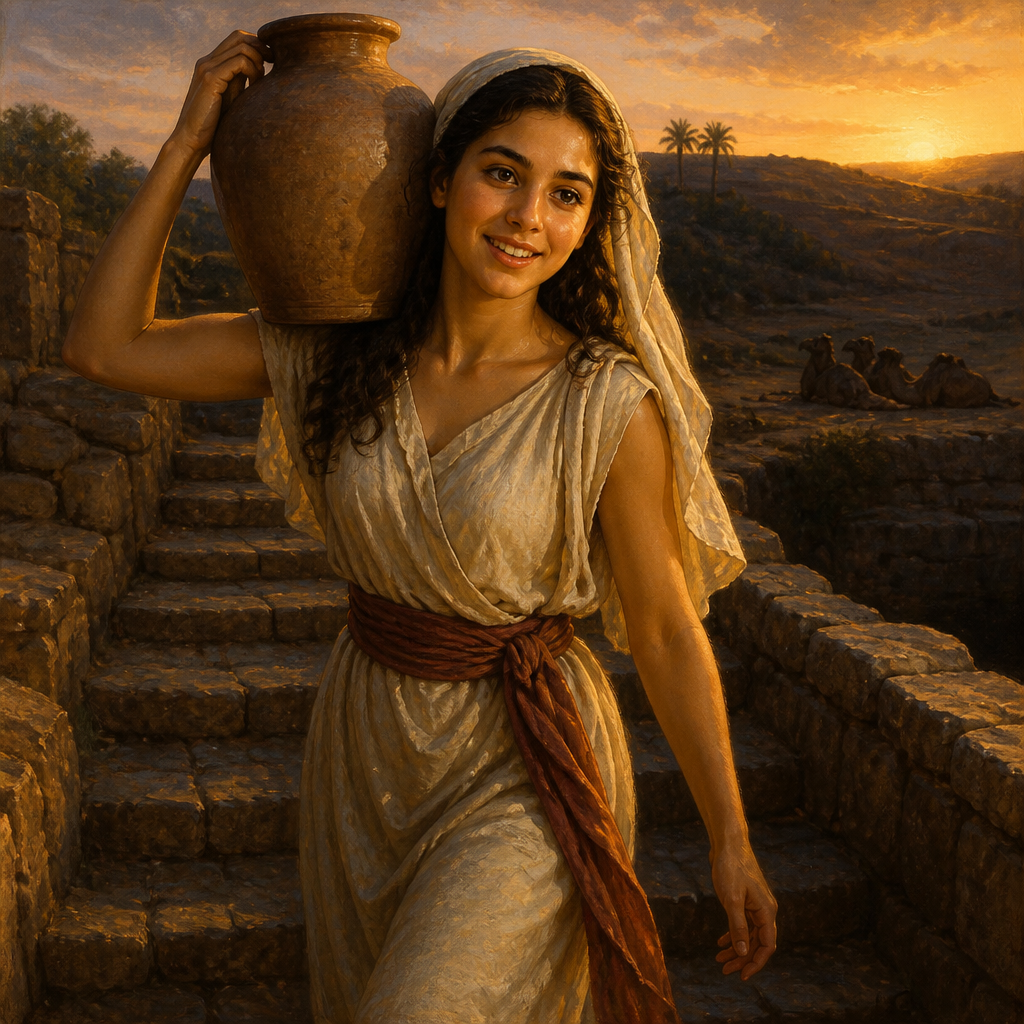
The servant of Abraham prayed for a sign: that the woman chosen by God would not only offer him a drink but also volunteer to water his ten camels. Rebekah appeared and fulfilled this specific sign with remarkable industry, drawing enough water to satisfy the thirst of ten camels—an arduous task that demonstrated her strength and generosity. Upon learning her identity, the servant presented her with gold jewelry and sought lodging with her family. Her brother, Laban, and father, Bethuel, recognized the hand of God in the matter and agreed to the marriage. Critically, when asked if she would leave immediately to go to a land she had never seen, Rebekah decisively answered, “I will go” (Genesis 24:58).
Marriage and Motherhood
Upon arriving in Canaan, Rebekah met Isaac in the fields of Lahai Roi. The text notes that Isaac took her into his mother Sarah’s tent and she became his wife; he loved her, and she provided him comfort following the death of his mother. For twenty years, however, Rebekah remained barren. After Isaac prayed to the Lord on her behalf, she conceived twins. The pregnancy was difficult, as the children struggled within her. Seeking the Lord, she received a significant prophecy: “Two nations are in your womb... the older will serve the younger” (Genesis 25:23). She subsequently gave birth to Esau and Jacob.
The Deception for the Blessing
As the boys grew, a rift formed in the household: Isaac favored Esau, the hunter, while Rebekah favored Jacob. When Isaac, in his old age and blindness, prepared to give the patriarchal blessing to Esau, Rebekah intervened. Recalling the divine oracle or perhaps acting on her own intuition regarding her sons' characters, she orchestrated a plan for Jacob to disguise himself as Esau. She prepared the meat, placed Esau’s garments on Jacob, and covered Jacob's hands with goat skins to mimic his brother's hairiness. The plan succeeded, and Jacob received the blessing of the firstborn.
Later Years and Death
Following the deception, Esau plotted to kill Jacob. Rebekah again took the initiative, advising Jacob to flee to her brother Laban in Haran. To secure Isaac’s approval for this departure, she expressed her grief over Esau’s Hittite wives, suggesting Jacob must find a wife from their own kin. While the text does not record a final reunion between Rebekah and Jacob, it confirms her place of honor in death. She was buried in the Cave of Machpelah in Hebron, the family sepulcher containing the remains of Abraham, Sarah, and eventually Isaac, Jacob, and Leah (Genesis 49:31).
Relationship to Other Biblical Figures
Rebekah’s primary relationships define the transitions of the patriarchal era. As the wife of Isaac, she bridged the generation between the founding patriarch Abraham and the twelve tribes of Israel. Her relationship with her brother Laban established the link that would later bring Jacob back to Mesopotamia to find his own wives. Most significantly, her preferential relationship with Jacob helped secure the covenantal line, despite the traditional customs of primogeniture that favored Esau.
Spiritual Significance
Rebekah is a complex figure of faith and action. Her initial willingness to leave her home mirrors Abraham’s own journey of faith. Theologically, she represents the sovereignty of God’s choice over human tradition. The Apostle Paul cites Rebekah in Romans 9:10-12 to illustrate the concept of divine election, noting that God’s purpose in selection does not depend on human effort or the order of birth, but on His own calling. Her life illustrates the tension between divine promise and human maneuvering, yet she remains a foundational mother of the faith through whom the promise of a great nation was physically realized.
Rebekah is central to the narrative of the Abrahamic covenant, serving as the bridge between the first generation (Abraham/Sarah) and the third (Jacob/Leah/Rachel). She is the only matriarch to receive a direct prophetic revelation from God regarding the destiny of her descendants, placing her in a unique position of spiritual authority. Her decisive character—from her immediate agreement to marry Isaac to her calculated efforts to secure Jacob’s blessing—ensured that the biblical promise of the 'younger serving the older' was fulfilled, despite the cultural expectations of the time.
In the New Testament, Rebekah is highlighted as a primary example of God's elective grace. By choosing Jacob over Esau before the children were even born or had done anything good or bad, God demonstrated that His covenantal purposes are rooted in His own will. Rebekah’s presence in the Cave of Machpelah alongside the other patriarchs and matriarchs confirms her status as a foundational pillar of the Israelite identity and the redemptive history of the Bible.
Frequently Asked Questions
Why did Rebekah help Jacob trick Isaac?
The Bible suggests Rebekah acted because she favored Jacob and remembered the divine oracle she received during pregnancy, which stated that 'the older shall serve the younger' (Genesis 25:23).
Where was Rebekah from?
Rebekah was from Paddan-aram (or Aram-Naharaim) in Mesopotamia, specifically the city of Nahor, which was the homeland of Abraham’s extended family.
How did Abraham’s servant know Rebekah was the right wife for Isaac?
He prayed for a sign that the chosen woman would not only give him a drink but also volunteer to water all ten of his camels, which Rebekah did immediately upon meeting him.
Who were Rebekah’s children?
She had twin sons, Esau (the elder) and Jacob (the younger, who was later renamed Israel).
Where is Rebekah buried?
She is buried in the Cave of Machpelah in Hebron, alongside Abraham, Sarah, Isaac, Jacob, and Leah.
Family & Relationships
Parents
 BethuelFatherGenesis 22:23Stated
Extended family
 JudithDaughter-in-lawGenesis 26:34
Inferred
Reconstructed through Esau: Genesis 26:34 ties Judith to Esau (itself an inferred link); Genesis 27:5 ties Esau to Rebekah. No verse states the mother-in-law link between Judith and Rebekah directly.Evidence: Genesis 26:34
 Milcah, Matriarch of Nahor's LineGrandmotherGenesis 22:23
Inferred
Genesis 22:23 names Milcah and Rebekah in the same verse but does not state a granddaughter tie between them; the link rests on the surrounding narrative.Evidence: Genesis 22:23; Genesis 25:20; Genesis 24:15
 Nahor, Brother of AbrahamGrandfatherGenesis 24:47
Inferred
Genesis 22:23 names Nahor and Rebekah in the same verse but does not state a granddaughter tie between them; the link rests on the surrounding narrative.Evidence: Genesis 24:47; Genesis 22:23; Genesis 25:20
Connected Figures
Family
Father · Genesis 22:23
Bethuel was a patriarch from Paddan-aram, the son of Nahor and Milcah, and the father of Rebekah and Laban.
PatriarchsFirst: Genesis 22:2212 versesPatriarchal head of household

Husband · Genesis 24:67
The miracle son of Abraham and Sarah, Isaac was the second Hebrew patriarch and the child of promise through whom the covenant of God was established.
PatriarchsFirst: Genesis 17:19125 versesPatriarch, Shepherd, Farmer

Son · Genesis 27:5
The firstborn son of Isaac and Rebekah, a skillful hunter and the progenitor of the Edomites, known for selling his birthright for a bowl of stew.
PatriarchsFirst: Genesis 25:2573 versesSkillful hunter, man of the field, Chief

Son · Genesis 27:11
The third patriarch of the covenant, whom God renamed Israel after he wrestled with God, and the father of the twelve tribes.
PatriarchsFirst: Genesis 25:26228 versesPatriarch, Shepherd

Brother · Genesis 25:20
A resourceful and opportunistic Aramean patriarch, brother of Rebekah and father-in-law to Jacob, known for his complex domestic and labor negotiations.
PatriarchsFirst: Genesis 24:2950 versesShepherd, Livestock Owner
Daughter-in-law · Genesis 26:34
Judith was a Hittite woman who became one of the first two wives of Esau, the son of Isaac.
PatriarchsFirst: Genesis 26:343 versesMatriarch in the house of Esau
Grandmother · Genesis 22:23
Milcah was a prominent matriarch in the line of Terah, the wife of Nahor, and the grandmother of Rebekah.
Grandfather · Genesis 24:47
The son of Terah and brother of Abraham, Nahor remained in Mesopotamia and became the progenitor of several tribes through his twelve sons.
PatriarchsFirst: Genesis 11:2620 versesPatriarchal leader and tribal founder
Categories
Mentions by Book
- Genesis33
- Romans1
Scripture References
All 34 indexed verses, in canonical order, from the Berean Standard Bible.
- Genesis 22:23
And Bethuel became the father of Rebekah. Milcah bore these eight sons to Abraham’s brother Nahor.
- Genesis 24:15
Before the servant had finished praying, Rebekah came out with her jar on her shoulder. She was the daughter of Bethuel son of Milcah, the wife of Abraham’s brother Nahor.
- Genesis 24:29
Now Rebekah had a brother named Laban, and he rushed out to the man at the spring.
- Genesis 24:30
As soon as he saw the ring, and the bracelets on his sister’s wrists, and heard Rebekah’s words, “The man said this to me,” he went and found the man standing by the camels near the spring.
- Genesis 24:45
And before I had finished praying in my heart, there was Rebekah coming out with her jar on her shoulder, and she went down to the spring and drew water. So I said to her, ‘Please give me a drink.’
- Genesis 24:46Partial
She quickly lowered her jar from her shoulder and said, ‘Drink, and I will water your camels as well.’ So I drank, and she also watered the camels.
Cited as evidence on a family card; added so References, Key Verses and Mentions by Book share one index.
- Genesis 24:47Partial
Then I asked her, ‘Whose daughter are you?’ She replied, ‘The daughter of Bethuel son of Nahor, whom Milcah bore to him.’ So I put the ring on her nose and the bracelets on her wrists.
Cited as evidence on a family card; added so References, Key Verses and Mentions by Book share one index.
- Genesis 24:51
Rebekah is here before you. Take her and go, and let her become the wife of your master’s son, just as the LORD has decreed.”
- Genesis 24:53
Then he brought out jewels of silver and gold, and articles of clothing, and he gave them to Rebekah. He also gave precious gifts to her brother and her mother.
- Genesis 24:58
They called Rebekah and asked her, “Will you go with this man?” “I will go,” she replied.
- Genesis 24:59
So they sent their sister Rebekah on her way, along with her nurse and Abraham’s servant and his men.
- Genesis 24:60
And they blessed Rebekah and said to her, “Our sister, may you become the mother of thousands upon thousands. May your offspring possess the gates of their enemies.”
- Genesis 24:61Partial
Then Rebekah and her servant girls got ready, mounted the camels, and followed the man. So the servant took Rebekah and left.
- Genesis 24:64
And when Rebekah looked up and saw Isaac, she got down from her camel
- Genesis 24:67
And Isaac brought her into the tent of his mother Sarah and took Rebekah as his wife. And Isaac loved her and was comforted after his mother’s death.
- Genesis 25:20
and Isaac was forty years old when he married Rebekah, the daughter of Bethuel the Aramean from Paddan-aram and the sister of Laban the Aramean.
- Genesis 25:21
Later, Isaac prayed to the LORD on behalf of his wife, because she was barren. And the LORD heard his prayer, and his wife Rebekah conceived.
- Genesis 25:23Partial
and He declared to her: “Two nations are in your womb, and two peoples from within you will be separated; one people will be stronger than the other, and the older will serve the younger.”
Cited as a key verse; added so References, Key Verses and Mentions by Book share one index.
- Genesis 25:28
Because Isaac had a taste for wild game, he loved Esau; but Rebekah loved Jacob.
- Genesis 26:7
But when the men of that place asked about his wife, he said, “She is my sister.” For he was afraid to say, “She is my wife,” since he thought to himself, “The men of this place will kill me on account of Rebekah, because she is so beautiful.”
- Genesis 26:8
When Isaac had been there a long time, Abimelech king of the Philistines looked down from the window and was surprised to see Isaac caressing his wife Rebekah.
- Genesis 26:34Partial
When Esau was forty years old, he took as his wives Judith daughter of Beeri the Hittite and Basemath daughter of Elon the Hittite.
Cited as evidence on a family card; added so References, Key Verses and Mentions by Book share one index.
- Genesis 26:35
And they brought grief to Isaac and Rebekah.
- Genesis 27:5
Now Rebekah was listening to what Isaac told his son Esau. So when Esau went into the field to hunt game and bring it back,
- Genesis 27:6
Rebekah said to her son Jacob, “Behold, I overheard your father saying to your brother Esau,
- Genesis 27:11
Jacob answered his mother Rebekah, “Look, my brother Esau is a hairy man, but I am smooth-skinned.
- Genesis 27:15
And Rebekah took the finest clothes in the house that belonged to her older son Esau, and she put them on her younger son Jacob.
- Genesis 27:42
When the words of her older son Esau were relayed to Rebekah, she sent for her younger son Jacob and told him, “Look, your brother Esau is consoling himself by plotting to kill you.
- Genesis 27:46
Then Rebekah said to Isaac, “I am weary of my life because of these Hittite women. If Jacob takes a Hittite wife from among them, what good is my life?”
- Genesis 28:5
So Isaac sent Jacob to Paddan-aram, to Laban son of Bethuel the Aramean, the brother of Rebekah, who was the mother of Jacob and Esau.
- Genesis 29:12
He told Rachel that he was Rebekah’s son, a relative of her father, and she ran and told her father.
- Genesis 35:8
Now Deborah, Rebekah’s nurse, died and was buried under the oak below Bethel. So Jacob named it Allon-bacuth.
- Genesis 49:31
There Abraham and his wife Sarah are buried, there Isaac and his wife Rebekah are buried, and there I buried Leah.
- Romans 9:10Partial
Not only that, but Rebecca’s children were conceived by one man, our father Isaac.
Cited as a key verse; added so References, Key Verses and Mentions by Book share one index.