Leah
Who was Leah in the Bible?
The elder daughter of Laban and the first wife of Jacob, Leah was the biological mother of six of the twelve tribes of Israel and the matriarch of the priestly and royal lines.
Leah was a central matriarch of the nation of Israel during the Patriarchal Period (c. 2000–1800 BC). As the eldest daughter of Laban, she was brought into a complicated marital arrangement with her cousin Jacob through her father's deception. While the biblical narrative frequently contrasts her with her younger sister, Rachel, Leah's role in the formation of the covenant people is monumental, as she bore more sons to Jacob than any other woman in his household.
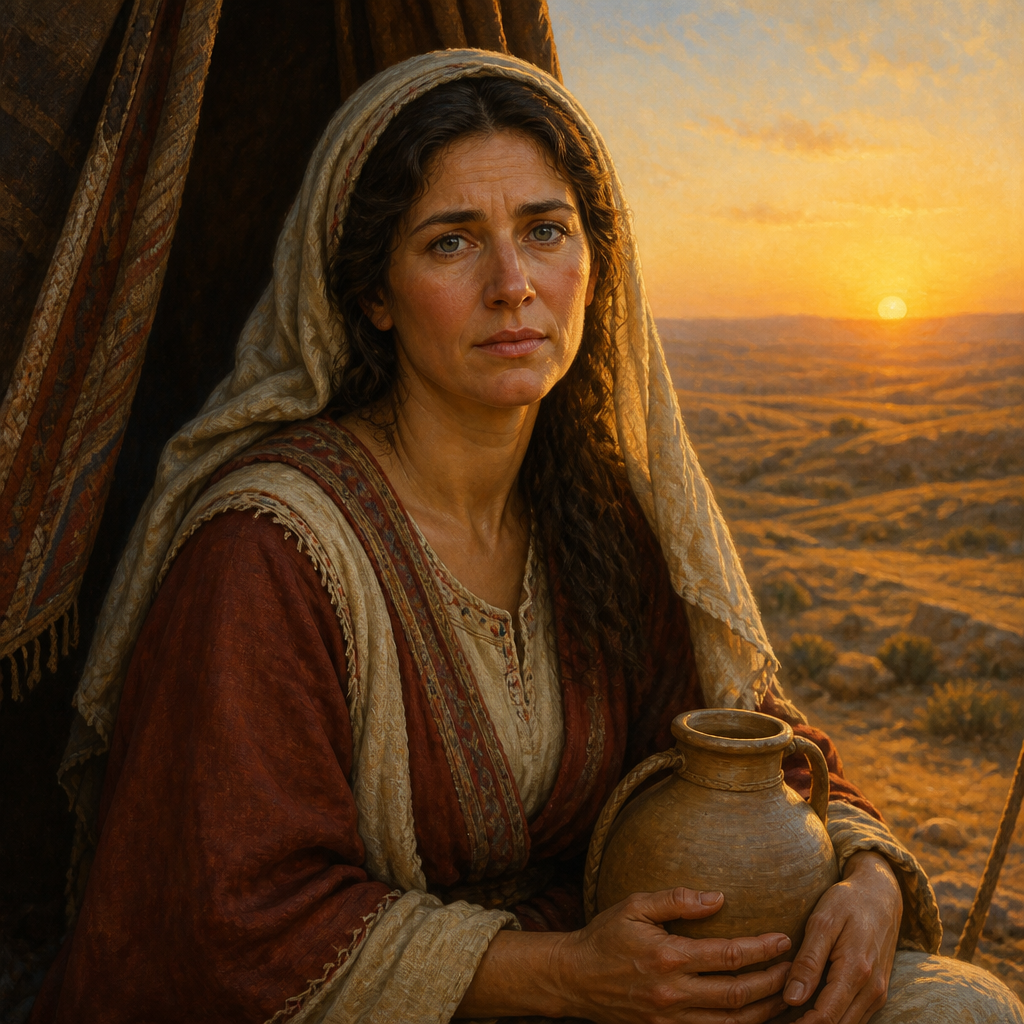
Despite the emotional hardships of being the "unloved" wife in a polygamous marriage, Leah is depicted as a woman of deep faith who viewed her fertility through the lens of divine providence. Her life was defined by a shift from seeking her husband's validation to praising God, and she eventually secured a place of high honor as the woman buried alongside Jacob in the family tomb at Machpelah.
Background and Family
Leah was born in Paddan-aram, the daughter of Laban and the granddaughter of Bethuel. She is introduced in Genesis 29:16 as the elder sister of Rachel. The biblical text offers a physical description that has long intrigued scholars, noting that "Leah had weak eyes" (Genesis 29:17). While some interpretations suggest this meant she lacked the visual sparkle or beauty of Rachel, others argue it may have referred to a physical ailment or simply a softer appearance compared to her "shapely and beautiful" sister.
Her entry into marriage was marked by controversy. Jacob, her cousin, had traveled to Paddan-aram to seek a wife and fell in love with Rachel. After Jacob served Laban for seven years, Laban deceived him by substituting Leah for Rachel under the cover of darkness on the wedding night. When Jacob discovered the switch the following morning, Laban justified his actions by citing local custom, which forbade marrying off a younger daughter before the elder. Consequently, Leah became Jacob's first wife, though she was quickly followed by Rachel, leading to a lifelong domestic rivalry.
Major Life Events
The narrative of Leah’s life is largely defined by the "contest of the womb" between herself and Rachel. Genesis 29:31 states that when the Lord saw Leah was unloved, He opened her womb while Rachel remained barren. This divine intervention resulted in the birth of four consecutive sons: Reuben, Simeon, Levi, and Judah. The names Leah chose for these children reflect her emotional journey, transitioning from a desperate hope that her husband would love her to a final declaration of praise to the Lord upon the birth of Judah.
When Leah temporarily stopped conceiving, she followed the custom of the time by giving her servant Zilpah to Jacob as a wife. Through Zilpah, two more sons, Gad and Asher, were added to the family. Later, following a famous incident involving mandrakes—a plant believed to aid fertility—Leah conceived again, bearing Issachar and Zebulun, and finally a daughter named Dinah. In total, Leah was the biological mother of six of the twelve sons who would become the heads of the tribes of Israel.
Relationship to Other Biblical Figures
Leah’s primary relationship was with Jacob, a man whose affections were clearly set on Rachel. This created a household dynamic of favoritism and jealousy. Despite this, Leah remained a steadfast part of the family unit. When Jacob eventually fled Laban’s service to return to Canaan, Leah stood in solidarity with her husband and sister against their father’s unfair treatment (Genesis 31:14-16).
Leah also maintained a complex relationship with her sister, Rachel. While they were rivals for Jacob's attention, they were also partners in "building the house of Israel." This duality is captured in the book of Ruth, where the elders of Bethlehem bless Boaz by praying that his new wife, Ruth, be like "Rachel and Leah, who together built up the house of Israel" (Ruth 4:11).
Spiritual Significance
Leah’s spiritual significance lies in her role as the mother of the two most prominent tribes in Israel’s history: Levi and Judah. From the line of Levi came the entire priesthood of Israel, including Moses and Aaron. From the line of Judah came the Davidic monarchy and, ultimately, the Messiah. Although Rachel was Jacob's preferred choice, the biblical record highlights that God’s redemptive plan moved primarily through the lineage of the "unloved" wife.
Furthermore, Leah’s end-of-life status indicates a final victory of recognition. While Rachel died on the road to Bethlehem and was buried there, Leah lived to see the family settle in Canaan. Upon her death, she was buried in the Cave of Machpelah, the sacred burial site of the patriarchs. When Jacob himself was dying in Egypt, he requested to be buried in that same cave, where he had buried Leah (Genesis 49:31), forever linking her to the covenantal line of Abraham, Sarah, Isaac, and Rebekah.
Leah represents the biblical theme of God's favor toward the marginalized and overlooked. Though she lived in the shadow of her sister’s beauty and her husband’s preference, she was the primary vessel for the continuation of the Abrahamic covenant. Her motherhood provided the numerical foundation of the nation, and her sons Levi and Judah established the religious and political structures of Israel.
In the broader biblical canon, Leah is remembered alongside Rachel as a foundational figure of the nation. The inclusion of her burial in the Cave of Machpelah underscores her status as a legitimate and honored matriarch, signaling that her contributions were essential to the fulfillment of the divine promises given to the patriarchs.
Frequently Asked Questions
What does the Bible mean when it says Leah had 'weak eyes'?
The Hebrew word 'rakot' (Genesis 29:17) can be translated as 'weak,' 'tender,' or 'soft.' Some scholars believe it refers to a lack of luster or a physical deformity, while others suggest it meant her eyes were sensitive or simply not as striking as Rachel's.
How many children did Leah have?
Leah had seven biological children: six sons (Reuben, Simeon, Levi, Judah, Issachar, and Zebulun) and one daughter (Dinah). She also claimed the two sons of her maidservant Zilpah (Gad and Asher) as her own.
Why did Laban trick Jacob into marrying Leah?
Laban claimed it was a custom in their land that the older daughter must be married before the younger daughter. However, it was also a way for Laban to secure another seven years of labor from Jacob.
Where was Leah buried?
Leah was buried in the Cave of Machpelah in Hebron. This was the family tomb purchased by Abraham, where Abraham, Sarah, Isaac, Rebekah, and eventually Jacob were also buried.
Which tribes of Israel descended from Leah?
The tribes of Reuben, Simeon, Levi, Judah, Issachar, and Zebulun were direct descendants of Leah. Additionally, the tribes of Gad and Asher descended from her maidservant Zilpah.
Family & Relationships
Parents
 LabanFatherGenesis 29:23Stated
Children
 DinahDaughterGenesis 30:21Stated
 Issachar, Ninth Son of JacobSonGenesis 35:23Stated
 Judah, Son of JacobSonGenesis 35:23Stated
 Levi, Son of JacobSonGenesis 29:34Stated
 ReubenSonGenesis 29:32Stated
 Simeon, Son of JacobSonGenesis 35:23Stated
 ZebulunSonGenesis 35:23Stated
Connected Figures
Family
Father · Genesis 29:23
A resourceful and opportunistic Aramean patriarch, brother of Rebekah and father-in-law to Jacob, known for his complex domestic and labor negotiations.
PatriarchsFirst: Genesis 24:2950 versesShepherd, Livestock Owner

Husband · Genesis 30:9
The third patriarch of the covenant, whom God renamed Israel after he wrestled with God, and the father of the twelve tribes.
PatriarchsFirst: Genesis 25:26228 versesPatriarch, Shepherd
Daughter · Genesis 30:21
The only daughter of Jacob and Leah mentioned in the patriarchal narratives, known for the incident at Shechem that led to a violent conflict between her brothers and the Hivites.
Son · Genesis 35:23
The ninth son of Jacob and the fifth born to Leah, Issachar was a patriarch whose descendants formed one of the prominent twelve tribes of Israel.
PatriarchsFirst: Genesis 30:1813 versesPatriarchIssachar
Son · Genesis 35:23
The fourth son of Jacob and Leah, ancestor of the Tribe of Judah and the Davidic line, known for his leadership and pivotal role in the preservation of his family.
PatriarchsFirst: Genesis 29:3538 versesPatriarch and ShepherdJudah
Son · Genesis 29:34
The third son of Jacob and Leah, a patriarch whose descendants were set apart as the priestly and ministerial class for the nation of Israel.
PatriarchsFirst: Genesis 29:3416 versesPatriarchLevi
Son · Genesis 29:32
Reuben was the firstborn son of Jacob and Leah, the founding patriarch of the Tribe of Reuben, and a complex figure known for both his attempts to save Joseph and his loss of the birthright.
PatriarchsFirst: Genesis 29:3221 versesPatriarch and shepherdReuben
Son · Genesis 35:23
Simeon was the second son of Jacob and Leah, a founding patriarch of Israel known for his volatile temperament and the eventual dispersal of his tribe within Judah.
PatriarchsFirst: Genesis 29:3319 versesPatriarch, shepherdSimeon
Son · Genesis 35:23
Zebulun was the tenth son of Jacob and the sixth and final son born to Leah, serving as the eponymous patriarch of one of the twelve tribes of Israel.
PatriarchsFirst: Genesis 30:2011 versesPatriarchZebulun

Sister · Genesis 29:23–25
The beloved wife of the patriarch Jacob and the biological mother of Joseph and Benjamin, recognized as a foundational matriarch of the nation of Israel.
PatriarchsFirst: Genesis 29:648 versesShepherdess
Categories
Mentions by Book
- Genesis34
- Ruth1
Scripture References
All 35 indexed verses, in canonical order, from the Berean Standard Bible.
- Genesis 29:16
Now Laban had two daughters; the older was named Leah, and the younger was named Rachel.
- Genesis 29:17
Leah had weak eyes, but Rachel was shapely and beautiful.
- Genesis 29:23
But when evening came, Laban took his daughter Leah and gave her to Jacob, and he slept with her.
- Genesis 29:24
And Laban gave his servant girl Zilpah to his daughter Leah as her maidservant.
- Genesis 29:25
When morning came, there was Leah! “What have you done to me?” Jacob said to Laban. “Wasn’t it for Rachel that I served you? Why have you deceived me?”
- Genesis 29:30
Jacob slept with Rachel as well, and indeed, he loved Rachel more than Leah. So he worked for Laban another seven years.
- Genesis 29:31
When the LORD saw that Leah was unloved, He opened her womb; but Rachel was barren.
- Genesis 29:32
And Leah conceived and gave birth to a son, and she named him Reuben, for she said, “The LORD has seen my affliction. Surely my husband will love me now.”
- Genesis 29:34
Once again Leah conceived and gave birth to a son, and she said, “Now at last my husband will become attached to me, because I have borne him three sons.” So he was named Levi.
Cited as evidence on a family card; added so References, Key Verses and Mentions by Book share one index.
- Genesis 29:35
And once more she conceived and gave birth to a son and said, “This time I will praise the LORD.” So she named him Judah. Then Leah stopped having children.
Cited as a key verse; added so References, Key Verses and Mentions by Book share one index.
- Genesis 30:9
When Leah saw that she had stopped having children, she gave her servant Zilpah to Jacob as a wife.
- Genesis 30:10
And Leah’s servant Zilpah bore Jacob a son.
- Genesis 30:11
Then Leah said, “How fortunate!” So she named him Gad.
- Genesis 30:12
When Leah’s servant Zilpah bore Jacob a second son,
- Genesis 30:13
Leah said, “How happy I am! For the women call me happy.” So she named him Asher.
- Genesis 30:14Partial
Now during the wheat harvest, Reuben went out and found some mandrakes in the field. When he brought them to his mother, Rachel begged Leah, “Please give me some of your son’s mandrakes.”
- Genesis 30:16
When Jacob came in from the field that evening, Leah went out to meet him and said, “You must come with me, for I have hired you with my son’s mandrakes.” So he slept with her that night.
- Genesis 30:17
And God listened to Leah, and she conceived and bore a fifth son to Jacob.
- Genesis 30:18
Then Leah said, “God has rewarded me for giving my maidservant to my husband.” So she named him Issachar.
- Genesis 30:19
Again Leah conceived and bore a sixth son to Jacob.
- Genesis 30:20
“God has given me a good gift,” she said. “This time my husband will honor me, because I have borne him six sons.” And she named him Zebulun.
- Genesis 30:21
After that, Leah gave birth to a daughter and named her Dinah.
Cited as evidence on a family card; added so References, Key Verses and Mentions by Book share one index.
- Genesis 31:4
So Jacob sent word and called Rachel and Leah to the field where his flocks were,
- Genesis 31:14
And Rachel and Leah replied, “Do we have any portion or inheritance left in our father’s house?
- Genesis 31:33Partial
So Laban went into Jacob’s tent, then Leah’s tent, and then the tents of the two maidservants, but he found nothing. Then he left Leah’s tent and entered Rachel’s tent.
- Genesis 33:1
Now Jacob looked up and saw Esau coming toward him with four hundred men. So he divided the children among Leah, Rachel, and the two maidservants.
- Genesis 33:2
He put the maidservants and their children in front, Leah and her children next, and Rachel and Joseph at the rear.
- Genesis 33:7
Leah and her children also approached and bowed down, and then Joseph and Rachel approached and bowed down.
- Genesis 34:1
Now Dinah, the daughter Leah had borne to Jacob, went out to visit the daughters of the land.
- Genesis 35:23
The sons of Leah were Reuben the firstborn of Jacob, Simeon, Levi, Judah, Issachar, and Zebulun.
- Genesis 35:26
And the sons of Leah’s maidservant Zilpah were Gad and Asher. These are the sons of Jacob, who were born to him in Paddan-aram.
- Genesis 46:15
These are the sons of Leah born to Jacob in Paddan-aram, in addition to his daughter Dinah. The total number of sons and daughters was thirty-three.
- Genesis 46:18
These are the sons of Jacob born to Zilpah—whom Laban gave to his daughter Leah—sixteen in all.
- Genesis 49:31
There Abraham and his wife Sarah are buried, there Isaac and his wife Rebekah are buried, and there I buried Leah.
- Ruth 4:11
“We are witnesses,” said the elders and all the people at the gate. “May the LORD make the woman entering your home like Rachel and Leah, who together built up the house of Israel. May you be prosperous in Ephrathah and famous in Bethlehem.