Asher
Who was Asher in the Bible?
Asher was the eighth son of Jacob, the second born to Zilpah, and the ancestral patriarch of the Tribe of Asher, known for the fertile lands and prosperity promised in his father's blessing.
Asher was one of the twelve sons of the patriarch Jacob and a founding father of the nation of Israel. Born in Paddan-aram to Zilpah, the handmaid of Leah, Asher holds a unique position in the patriarchal narrative as a figure whose name signifies joy and blessing. His birth was met with a declaration of happiness by Leah, who viewed him as a source of favor among women. As one of the twelve brothers, he was a participant in the foundational events of the Israelite identity, including the family's migration to Egypt during the time of Joseph.
While the biblical record provides fewer specific narrative details regarding Asher’s personal life compared to brothers like Joseph or Judah, he is consistently listed in the genealogies of the Torah and the histories of the Chronicler. He is the progenitor of a tribe that would eventually occupy a lush, fertile portion of the Promised Land along the Mediterranean coast. His legacy is framed largely by the prophetic blessings of Jacob and Moses, which emphasize agricultural abundance and royal favor.
Background and Family
Asher was born in Paddan-aram during the final years of Jacob’s service to his father-in-law, Laban. His birth order is recorded as the eighth son of Jacob and the second son born to Zilpah, Leah’s servant (Genesis 35:26). At his birth, Leah exclaimed, “How happy I am! For the women call me happy,” leading to the name Asher, which translates to “happy” or “blessed” (Genesis 30:13).
Asher grew up among a large household of eleven brothers and at least one sister, Dinah. The genealogical records in Genesis 46:17 and 1 Chronicles 7:30 provide a detailed look at his immediate descendants. Asher’s children included four sons—Imnah, Ishvah, Ishvi, and Beriah—and a daughter named Serah. The explicit mention of his daughter Serah is notable in biblical genealogies, suggesting she held a position of significance within the family lineage. Two grandsons, Heber and Malchiel, are also recorded as being born to his son Beriah before the family’s descent into Egypt.
Major Life Events
Asher’s life is primarily situated within the broader context of the patriarchal migrations. As a son of Jacob, he was involved in the complex and often tumultuous relationship between his brothers and Joseph. Though the text does not isolate Asher's individual actions during the sale of Joseph or the later journeys to Egypt to buy grain, he is accounted for as one of the seventy members of the house of Jacob who settled in the land of Goshen (Genesis 46:27).
Before Jacob’s death, Asher received a specific prophetic blessing from his father. Jacob’s words for Asher were brief but pointed toward material prosperity: “Asher’s food will be rich; he shall provide royal delicacies” (Genesis 49:20). This blessing served as a harbinger of the tribe's future, suggesting that Asher’s descendants would inhabit land capable of producing high-quality agricultural goods fit for a king’s table.
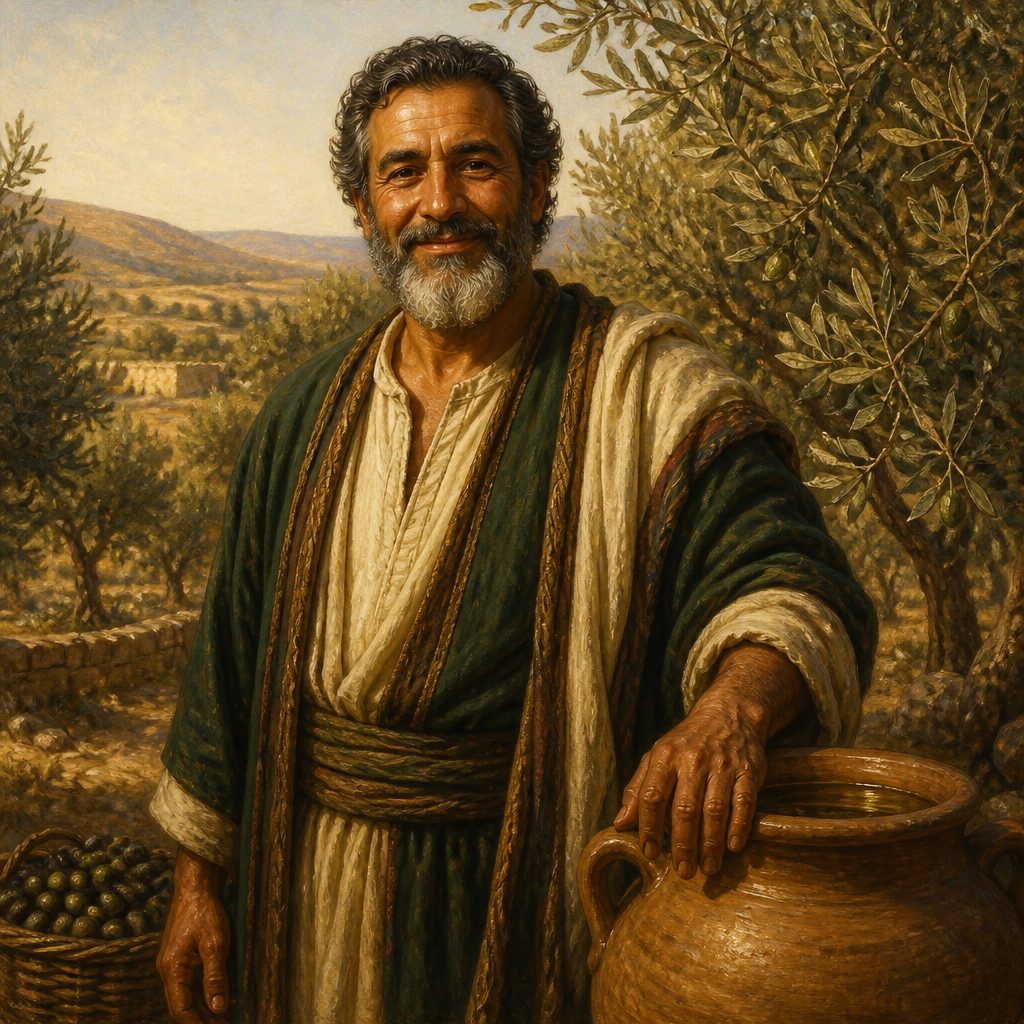
Centuries later, as the Israelites prepared to enter Canaan, Moses offered a final blessing on the tribes. He reinforced the theme of Asher’s favor, saying, “May Asher be the most blessed of sons; may he be the most favored among his brothers and dip his foot in oil” (Deuteronomy 33:24). This metaphor of dipping one's foot in oil likely referred to the abundance of olive groves in the territory Asher would eventually inherit.
Relationship to Other Biblical Figures
Asher is inextricably linked to his brothers, the heads of the other tribes of Israel. As a child of Zilpah, he was particularly associated with his full brother, Gad. In the camping arrangements during the Wilderness Wanderings, the Tribe of Asher was positioned in the camp of Dan, alongside the tribe of Naphtali, under the leadership of Pagiel son of Ocran (Numbers 2:27).
In the New Testament, Asher’s lineage remains visible. The Gospel of Luke identifies the prophetess Anna, who recognized the infant Jesus in the temple, as being from the tribe of Asher (Luke 2:36).
Spiritual Significance
The figure of Asher represents the theme of divine providence and material blessing. His name itself—Happy—sets a tone of optimism. While other tribes were often characterized by their military prowess (like Judah) or their priestly duties (like Levi), Asher’s identity was tied to the goodness of the earth and the sharing of its bounty.
In the book of Revelation, Asher is included in the sealing of the 144,000, with 12,000 members of the tribe listed among the servants of God (Revelation 7:6). This inclusion underscores the enduring spiritual significance of the patriarchal heads; though the tribal boundaries in Canaan eventually faded, the names of the sons of Jacob remain permanent fixtures in the biblical vision of God’s redeemed people. Asher stands as a testament to the fulfillment of God’s promise to make Jacob’s descendants numerous and to provide for them a land flowing with milk and honey.
Asher occupies a significant role as one of the twelve patriarchs whose lives serve as the foundation for the tribal structure of Israel. His theological importance lies in the fulfillment of the Abrahamic covenant regarding the fruitfulness of the land. The blessings pronounced over him by Jacob and Moses highlight the concept that material prosperity and 'royal delicacies' are gifts from God meant for the sustenance of the nation.
Furthermore, Asher's inclusion in both the Old Testament genealogies and the New Testament (via the prophetess Anna and the Book of Revelation) provides a thread of continuity for the people of Israel. His legacy suggests that even the 'lesser' known brothers in the patriarchal narrative contribute essential qualities to the collective identity of the people of God, emphasizing that happiness and favor are integral components of the divine promise.
Frequently Asked Questions
What does the name 'Asher' mean?
The name Asher comes from the Hebrew word for 'happy' or 'blessed.' It was given to him by Leah because she believed the other women would call her happy for his birth.
Who was Asher's mother?
Asher's mother was Zilpah, who was the handmaid of Leah. She was given to Jacob as a wife and also bore Asher's brother, Gad.
What was the territory of Asher known for?
According to the blessings of Jacob and Moses, Asher's territory was known for its fertility, particularly for producing 'royal delicacies' and abundant olive oil.
Is Asher mentioned in the New Testament?
Yes, Asher is mentioned in Luke 2:36 as the tribe of the prophetess Anna, and in Revelation 7:6 as one of the tribes from which 12,000 people were sealed.
Who were Asher's children?
The Bible names four sons: Imnah, Ishvah, Ishvi, and Beriah; and one daughter, Serah.
Family & Relationships
 AsherThis page
 Benjamin, Son of JacobBrotherExodus 1:3–4Stated
 DanBrotherExodus 1:4Stated
 DinahSisterGenesis 34:3
Inferred
Reconstructed through Jacob: Genesis 34:3 ties Dinah to Jacob; Genesis 35:26 ties Jacob to Asher. No verse states the brother link between Dinah and Asher directly.Evidence: Genesis 34:3; Genesis 35:26
 Gad, Son of JacobBrotherGenesis 35:26Stated
 Issachar, Ninth Son of JacobBrotherExodus 1:3–4Stated
 Joseph, Son of JacobBrother1 Chronicles 2:2Stated
 Judah, Son of JacobBrotherExodus 1:2–4Stated
 Levi, Son of JacobBrotherExodus 1:2–4Stated
 NaphtaliBrotherExodus 1:4Stated
 ReubenBrotherExodus 1:2–4Stated
 Simeon, Son of JacobBrotherExodus 1:2–4Stated
 ZebulunBrotherExodus 1:3–4Stated
Children
 Beriah, Son of AsherSonGenesis 46:17Stated
 Imnah, Son of AsherSonGenesis 46:17Stated
 IshvahSonGenesis 46:17Stated
 IshviSonGenesis 46:17Stated
 SerahDaughterGenesis 46:17Stated
Extended family
 Heber, Grandson of AsherGrandsonGenesis 46:17
Inferred
Genesis 46:17 lists Asher and Heber among the children of asher, but does not say how the two of them are related.Evidence: Genesis 46:17; 1 Chronicles 7:31
 MalchielGrandsonGenesis 46:17
Inferred
Genesis 46:17 lists Malchiel and Asher among the children of asher, but does not say how the two of them are related.Evidence: Genesis 46:17
 AshvathGreat-Great-Grandson1 Chronicles 7:30
Inferred
Reconstructed through Heber and Japhlet: Genesis 46:17 ties Asher to Heber (itself an inferred link); 1 Chronicles 7:32 ties Heber to Japhlet; 1 Chronicles 7:33 ties Japhlet to Ashvath. No verse states the great-great-grandson link between Asher and Ashvath directly.Evidence: 1 Chronicles 7:30
 BimhalGreat-Great-GrandsonGenesis 30:13
Inferred
Reconstructed through Japhlet and Heber: 1 Chronicles 7:33 ties Bimhal to Japhlet; 1 Chronicles 7:32 ties Japhlet to Heber; Genesis 46:17 ties Heber to Asher (itself an inferred link). No verse states the great-great-grandfather link between Bimhal and Asher directly.Evidence: Genesis 30:13
 Hotham, Grandson of AsherGrandson1 Chronicles 7:30
Inferred
Reconstructed through Heber: 1 Chronicles 7:32 ties Hotham to Heber; Genesis 46:17 ties Heber to Asher (itself an inferred link). No verse states the grandfather link between Hotham and Asher directly.Evidence: 1 Chronicles 7:30
 Shomer, Grandson of AsherGreat-GrandsonGenesis 30:13
Inferred
Reconstructed through Heber: Genesis 46:17 ties Asher to Heber (itself an inferred link); 1 Chronicles 7:32 ties Heber to Shomer. No verse states the great-grandson link between Asher and Shomer directly.Evidence: Genesis 30:13
Connected Figures
Family

Father · Genesis 35:23–26
The third patriarch of the covenant, whom God renamed Israel after he wrestled with God, and the father of the twelve tribes.
PatriarchsFirst: Genesis 25:26228 versesPatriarch, Shepherd

Mother · Genesis 35:26
Zilpah was a maidservant given to Leah by Laban, who later became a wife to the patriarch Jacob and the mother of two of the twelve tribes of Israel, Gad and Asher.
PatriarchsFirst: Genesis 29:249 versesMaidservant and wife
Son · Genesis 46:17
A son of the patriarch Asher and founder of the Beriite clan, who traveled to Egypt with Jacob and established a prominent lineage within the Tribe of Asher.
Son · Genesis 46:17
Imnah was the firstborn son of the patriarch Asher and the founder of the Imnite clan during the Egyptian sojourn and the Exodus.
Son · Genesis 46:17
Ishvah was the second son of Asher and a grandson of the patriarch Jacob, identified as a member of the generation that entered Egypt.
Egypt and WildernessFirst: Genesis 46:172 versesNomadic pastoralistAsher
Son · Genesis 46:17
Ishvi was a son of Asher, a grandson of Jacob, and the foundational ancestor of the Ishvite clan within the tribe of Asher.
Daughter · Genesis 46:17
The daughter of Asher who is uniquely listed among the descendants of Jacob migrating to Egypt and again in the census taken on the plains of Moab.
Egypt and WildernessFirst: Genesis 46:173 versesTribal matriarchAsher
Brother · Exodus 1:3–4
The youngest son of Jacob and Rachel, Benjamin was the beloved patriarch of one of the twelve tribes of Israel and a central figure in the narrative of Joseph's rise in Egypt.
PatriarchsFirst: Genesis 35:1823 versesPatriarchBenjamin
Brother · Exodus 1:4
The fifth son of the patriarch Jacob and the first son born to his concubine Bilhah, serving as the eponymous ancestor of the Tribe of Dan.
PatriarchsFirst: Genesis 30:613 versesPatriarchDan
Sister · Genesis 34:3
The only daughter of Jacob and Leah mentioned in the patriarchal narratives, known for the incident at Shechem that led to a violent conflict between her brothers and the Hivites.
Brother · Genesis 35:26
The seventh son of Jacob and the firstborn of Zilpah, Gad was a patriarch of Israel whose descendants became a warrior tribe known for their courage and inheritance east of the Jordan River.
PatriarchsFirst: Genesis 30:1111 versesPatriarchGad
Brother · Exodus 1:3–4
The ninth son of Jacob and the fifth born to Leah, Issachar was a patriarch whose descendants formed one of the prominent twelve tribes of Israel.
PatriarchsFirst: Genesis 30:1813 versesPatriarchIssachar
Categories
Mentions by Book
- Genesis9
- Exodus3
- 1 Chronicles3
Scripture References
All 15 indexed verses, in canonical order, from the Berean Standard Bible.
Genesis · 9
- Genesis 30:9Partial
When Leah saw that she had stopped having children, she gave her servant Zilpah to Jacob as a wife.
Cited as evidence on a family card; added so References, Key Verses and Mentions by Book share one index.
- Genesis 30:13
Leah said, “How happy I am! For the women call me happy.” So she named him Asher.
- Genesis 34:3Partial
And his soul was drawn to Dinah, the daughter of Jacob. He loved the young girl and spoke to her tenderly.
Cited as evidence on a family card; added so References, Key Verses and Mentions by Book share one index.
- Genesis 35:23Partial
The sons of Leah were Reuben the firstborn of Jacob, Simeon, Levi, Judah, Issachar, and Zebulun.
Cited as evidence on a family card; added so References, Key Verses and Mentions by Book share one index.
- Genesis 35:24Partial
The sons of Rachel were Joseph and Benjamin.
Cited as evidence on a family card; added so References, Key Verses and Mentions by Book share one index.
- Genesis 35:25Partial
The sons of Rachel’s maidservant Bilhah were Dan and Naphtali.
Cited as evidence on a family card; added so References, Key Verses and Mentions by Book share one index.
- Genesis 35:26
And the sons of Leah’s maidservant Zilpah were Gad and Asher. These are the sons of Jacob, who were born to him in Paddan-aram.
- Genesis 46:17
The children of Asher: Imnah, Ishvah, Ishvi, Beriah, and their sister Serah. The sons of Beriah: Heber and Malchiel.
- Genesis 49:20
Asher’s food will be rich; he shall provide royal delicacies.
Exodus · 3
- Exodus 1:2Partial
Reuben, Simeon, Levi, and Judah;
Cited as evidence on a family card; added so References, Key Verses and Mentions by Book share one index.
- Exodus 1:3Partial
Issachar, Zebulun, and Benjamin;
Cited as evidence on a family card; added so References, Key Verses and Mentions by Book share one index.
- Exodus 1:4
Dan and Naphtali; Gad and Asher.
1 Chronicles · 3
- 1 Chronicles 7:31Partial
The sons of Beriah: Heber, as well as Malchiel, who was the father of Birzaith.
Cited as evidence on a family card; added so References, Key Verses and Mentions by Book share one index.
- 1 Chronicles 7:32Partial
Heber was the father of Japhlet, Shomer, and Hotham, and of their sister Shua.
Cited as evidence on a family card; added so References, Key Verses and Mentions by Book share one index.
- 1 Chronicles 7:33Partial
The sons of Japhlet: Pasach, Bimhal, and Ashvath. These were Japhlet’s sons.
Cited as evidence on a family card; added so References, Key Verses and Mentions by Book share one index.