Joseph, Son of Jacob
Who was Joseph, Son of Jacob, in the Bible?
The favored son of Jacob who, after being sold into slavery by his brothers, rose to become the Grand Vizier of Egypt and preserved the lineage of Israel during a regional famine.
This is one of 9 people named Joseph in the Bible. See all 9 →
Joseph, the eleventh son of the patriarch Jacob and the firstborn of his beloved wife Rachel, stands as one of the most pivotal figures in the book of Genesis. His life serves as the bridge between the nomadic patriarchal era of Canaan and the long sojourn of the Israelites in Egypt. Known for his prophetic dreams and his steadfast integrity under pressure, Joseph’s narrative is a profound exploration of divine providence—the concept that God directs human affairs toward a good end, even through the medium of human evil and suffering.
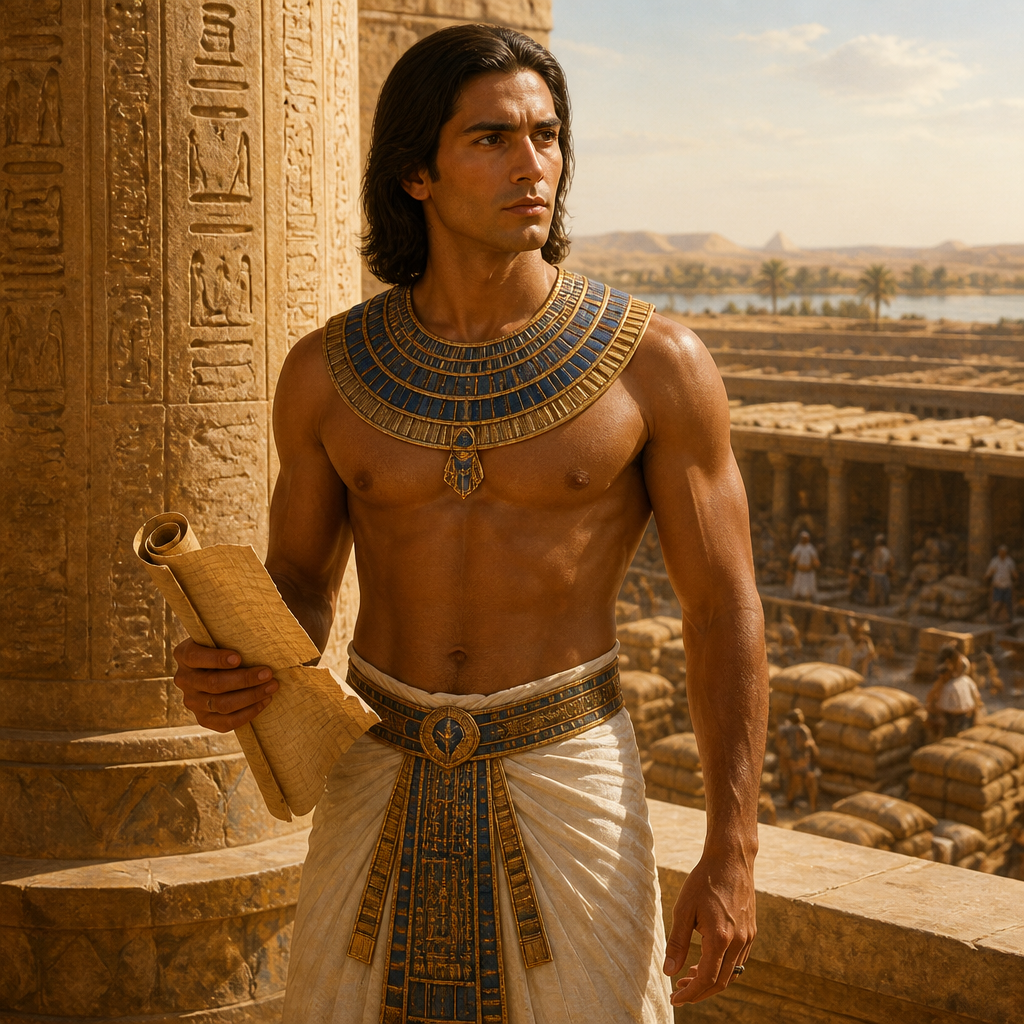
From his youth in Canaan to his rise in the Egyptian court, Joseph’s story is marked by dramatic reversals of fortune. He transitioned from a favored son to a slave, from a trusted household manager to a forgotten prisoner, and finally from a dungeon to the right hand of Pharaoh. His administration of Egypt’s resources during a seven-year famine not only saved the Egyptian empire but also provided a sanctuary for his own family, ensuring the survival of the twelve tribes of Israel.
Background and Family
Joseph was born in Paddan-aram to Jacob and Rachel after many years of his mother’s infertility (Genesis 30:22-24). As the first son of Jacob’s favored wife, he occupied a position of unique affection in his father’s heart. This favoritism was famously symbolized by a "robe of many colors" (or a long-sleeved tunic) gifted to him by Jacob (Genesis 37:3). Joseph grew up in a large, complex household consisting of four mothers and twelve brothers. The biblical record notes that by age seventeen, Joseph was already reporting the misdeeds of his brothers to his father, which, combined with Jacob’s blatant favoritism, fostered deep-seated resentment among his siblings.
His family life was further strained by two prophetic dreams Joseph received. In these visions, his brothers’ sheaves of grain bowed to his sheaf, and the sun, moon, and eleven stars bowed to him. These dreams were interpreted by his family as a prediction of Joseph’s future sovereignty over them, inciting his brothers to murderous jealousy.
Major Life Events
Betrayal and Slavery
While checking on his brothers at Dothan, Joseph was ambushed. His brothers initially plotted to kill him but were persuaded by Reuben to cast him into a pit instead. Ultimately, at Judah’s suggestion, they sold Joseph for twenty shekels of silver to a passing caravan of Ishmaelite and Midianite traders, who took him to Egypt. To cover their crime, the brothers dipped Joseph’s robe in goat’s blood, leading Jacob to believe his son had been devoured by a wild beast.
The House of Potiphar and Imprisonment
In Egypt, Joseph was purchased by Potiphar, the captain of Pharaoh’s guard. Despite his status as a slave, the text emphasizes that "the LORD was with Joseph" (Genesis 39:2), and he soon rose to become the overseer of Potiphar’s entire estate. His career was interrupted when Potiphar’s wife falsely accused him of attempted rape after he refused her repeated sexual advances. Maintaining his integrity, Joseph was cast into prison. Even in the dungeon, Joseph’s administrative talents and divine favor led to him being placed in charge of the other prisoners.
Rise to Power
Joseph’s path to the throne began when he interpreted the dreams of Pharaoh’s cupbearer and baker, correctly predicting their respective restoration and execution. Two years later, when Pharaoh was troubled by dreams of seven lean cows devouring seven fat cows, the cupbearer remembered Joseph. Joseph interpreted Pharaoh’s dreams as a warning of seven years of plenty followed by seven years of severe famine. Impressed by Joseph’s wisdom, Pharaoh appointed him as second-in-command over all Egypt, naming him Zaphnath-paaneah and giving him Asenath, the daughter of an Egyptian priest, as a wife.
Reconciliation and the Sojourn
During the ensuing famine, Joseph’s brothers arrived in Egypt to buy grain. Through a series of tests, Joseph observed their character and discovered they had changed, particularly in their protectiveness toward his younger brother Benjamin. In a climactic moment, Joseph revealed his identity, weeping so loudly the Egyptians heard him. He invited his entire family to settle in the land of Goshen. Before his death at age 110, Joseph made the Israelites swear to carry his bones back to Canaan when God eventually led them out of Egypt—a request fulfilled centuries later during the Exodus (Exodus 13:19, Joshua 24:32).
Relationship to Other Biblical Figures
Joseph’s primary relationships define the transition of the covenant from a family to a nation. His relationship with Jacob was one of intense mutual devotion; Jacob’s grief over Joseph’s perceived death lasted decades, and Joseph’s final years were spent honoring his father’s last wishes. With his brothers, particularly Judah and Reuben, the relationship evolved from fratricidal jealousy to profound reconciliation. As a father, Joseph raised two sons, Ephraim and Manasseh, who were uniquely adopted by Jacob to become two of the twelve tribes, effectively giving Joseph a double portion of the inheritance.
Spiritual Significance
Theologically, Joseph is presented as a model of the "righteous sufferer" who remains faithful to God regardless of his circumstances. He is the first major biblical figure to explicitly articulate the doctrine of divine providence, telling his brothers: "As for you, you meant evil against me, but God meant it for good" (Genesis 50:20). His life demonstrates that God’s promises to Abraham regarding the preservation of his descendants were not thwarted by human sin but were actually fulfilled through it. Furthermore, Joseph’s refusal of Potiphar’s wife is cited as a standard for moral purity, and his dying request regarding his bones is held up in the New Testament (Hebrews 11:22) as a supreme example of faith in God’s future promises.
Joseph serves as the bridge between the age of the individual patriarchs and the national history of Israel. His administrative success in Egypt allowed for the 'incubation' of the Hebrew people, providing the geographic and economic stability necessary for them to grow from a large family into a great nation. He is unique among the patriarchs for having no recorded moral failures in the text, instead being characterized by wisdom, administrative brilliance, and a capacity for total forgiveness.
In the broader biblical canon, Joseph is frequently used as a symbol for the whole (the 'House of Joseph'). His story introduces the theme of the 'exalted servant,' where humiliation and suffering are the divinely ordained precursors to glory and the salvation of others. This pattern is often cited by scholars as a foundational archetype for later biblical understandings of leadership and redemption.
Frequently Asked Questions
Why did Joseph’s brothers hate him so much?
The hatred was fueled by three factors: their father Jacob’s open favoritism, the gift of a special ornate robe, and Joseph’s own reports of dreams that predicted he would rule over them.
What were Joseph’s sons' names and their significance?
His sons were Manasseh (meaning 'God has made me forget all my trouble') and Ephraim (meaning 'God has made me fruitful in the land of my suffering'). They became two of the twelve tribes of Israel.
What happened to Joseph’s bones?
As he requested on his deathbed, his body was embalmed in Egypt. During the Exodus, Moses took the bones with him, and they were eventually buried at Shechem in land purchased by Jacob.
Did Joseph actually become King of Egypt?
No, he was not the Pharaoh. He held the rank of Grand Vizier or Prime Minister, described as being second only to Pharaoh in authority over the entire land.
Family & Relationships
 AsenathWifeGenesis 41:45Stated
 Joseph, Son of JacobThis page
 AsherBrother1 Chronicles 2:2Stated
 Benjamin, Son of JacobBrotherGenesis 42:4Stated
 DanBrother1 Chronicles 2:2Stated
 DinahSisterGenesis 46:29Stated
 Gad, Son of JacobBrother1 Chronicles 2:2Stated
 Issachar, Ninth Son of JacobBrother1 Chronicles 2:1–2Stated
 Judah, Son of JacobBrotherGenesis 46:28Stated
 Levi, Son of JacobBrother1 Chronicles 2:1–2Stated
 NaphtaliBrother1 Chronicles 2:2Stated
 ReubenBrother1 Chronicles 2:1–2Stated
 Simeon, Son of JacobBrother1 Chronicles 2:1–2Stated
 ZebulunBrother1 Chronicles 2:1–2Stated
Children
 EphraimSonGenesis 46:20Stated
 Manasseh, Son of JosephSonGenesis 46:20Stated
Connected Figures
Family

Father · Genesis 35:23–26
The third patriarch of the covenant, whom God renamed Israel after he wrestled with God, and the father of the twelve tribes.
PatriarchsFirst: Genesis 25:26228 versesPatriarch, Shepherd

Mother · Genesis 35:24
The beloved wife of the patriarch Jacob and the biological mother of Joseph and Benjamin, recognized as a foundational matriarch of the nation of Israel.
PatriarchsFirst: Genesis 29:648 versesShepherdess
Wife · Genesis 41:45
An Egyptian noblewoman and the wife of the patriarch Joseph, who bore him the two tribal ancestors, Manasseh and Ephraim.
PatriarchsFirst: Genesis 41:453 versesNoblewoman
Son · Genesis 46:20
The second son of Joseph and Asenath, Ephraim was adopted by his grandfather Jacob and received the primary blessing of the firstborn, becoming the progenitor of a dominant tribe in Israel.
PatriarchsFirst: Genesis 41:5216 versesPatriarchEphraim
Son · Genesis 46:20
The firstborn son of Joseph and Asenath, Manasseh became the progenitor of one of the largest and most strategically positioned tribes of Israel.
PatriarchsFirst: Genesis 41:5111 versesPatriarchManasseh
Brother · 1 Chronicles 2:2
Asher was the eighth son of Jacob, the second born to Zilpah, and the ancestral patriarch of the Tribe of Asher, known for the fertile lands and prosperity promised in his father's blessing.
PatriarchsFirst: Genesis 30:1315 versesPatriarchAsher
Brother · Genesis 42:4
The youngest son of Jacob and Rachel, Benjamin was the beloved patriarch of one of the twelve tribes of Israel and a central figure in the narrative of Joseph's rise in Egypt.
PatriarchsFirst: Genesis 35:1823 versesPatriarchBenjamin
Brother · 1 Chronicles 2:2
The fifth son of the patriarch Jacob and the first son born to his concubine Bilhah, serving as the eponymous ancestor of the Tribe of Dan.
PatriarchsFirst: Genesis 30:613 versesPatriarchDan
Sister · Genesis 46:29
The only daughter of Jacob and Leah mentioned in the patriarchal narratives, known for the incident at Shechem that led to a violent conflict between her brothers and the Hivites.
Brother · 1 Chronicles 2:2
The seventh son of Jacob and the firstborn of Zilpah, Gad was a patriarch of Israel whose descendants became a warrior tribe known for their courage and inheritance east of the Jordan River.
PatriarchsFirst: Genesis 30:1111 versesPatriarchGad
Brother · 1 Chronicles 2:1–2
The ninth son of Jacob and the fifth born to Leah, Issachar was a patriarch whose descendants formed one of the prominent twelve tribes of Israel.
PatriarchsFirst: Genesis 30:1813 versesPatriarchIssachar
Brother · Genesis 46:28
The fourth son of Jacob and Leah, ancestor of the Tribe of Judah and the Davidic line, known for his leadership and pivotal role in the preservation of his family.
PatriarchsFirst: Genesis 29:3538 versesPatriarch and ShepherdJudah
Categories
Mentions by Book
- Genesis144
- Exodus4
- Joshua1
- 1 Chronicles1
- Acts4
- Hebrews2
Scripture References
All 156 indexed verses, in canonical order, from the Berean Standard Bible.
- Genesis 30:24
She named him Joseph, and said, “May the LORD add to me another son.”
- Genesis 30:25
Now after Rachel had given birth to Joseph, Jacob said to Laban, “Send me on my way so I can return to my homeland.
- Genesis 33:2
He put the maidservants and their children in front, Leah and her children next, and Rachel and Joseph at the rear.
- Genesis 33:7
Leah and her children also approached and bowed down, and then Joseph and Rachel approached and bowed down.
- Genesis 34:3Partial
And his soul was drawn to Dinah, the daughter of Jacob. He loved the young girl and spoke to her tenderly.
Cited as evidence on a family card; added so References, Key Verses and Mentions by Book share one index.
- Genesis 35:23Partial
The sons of Leah were Reuben the firstborn of Jacob, Simeon, Levi, Judah, Issachar, and Zebulun.
Cited as evidence on a family card; added so References, Key Verses and Mentions by Book share one index.
- Genesis 35:24
The sons of Rachel were Joseph and Benjamin.
- Genesis 35:25Partial
The sons of Rachel’s maidservant Bilhah were Dan and Naphtali.
Cited as evidence on a family card; added so References, Key Verses and Mentions by Book share one index.
- Genesis 35:26Partial
And the sons of Leah’s maidservant Zilpah were Gad and Asher. These are the sons of Jacob, who were born to him in Paddan-aram.
Cited as evidence on a family card; added so References, Key Verses and Mentions by Book share one index.
- Genesis 37:2Partial
This is the account of Jacob. When Joseph was seventeen years old, he was tending the flock with his brothers, the sons of his father’s wives Bilhah and Zilpah, and he brought their father a bad report about them.
- Genesis 37:3
Now Israel loved Joseph more than his other sons, because Joseph had been born to him in his old age; so he made him a robe of many colors.
- Genesis 37:5
Then Joseph had a dream, and when he told it to his brothers, they hated him even more.
- Genesis 37:13
Israel said to him, “Are not your brothers pasturing the flocks at Shechem? Get ready; I am sending you to them.” “I am ready,” Joseph replied.
- Genesis 37:17
“They have moved on from here,” the man answered. “I heard them say, ‘Let us go to Dothan.’” So Joseph set out after his brothers and found them at Dothan.
- Genesis 37:23
So when Joseph came to his brothers, they stripped him of his robe—the robe of many colors he was wearing—
- Genesis 37:28Partial
So when the Midianite traders passed by, his brothers pulled Joseph out of the pit and sold him for twenty shekels of silver to the Ishmaelites, who took him to Egypt.
- Genesis 37:29
When Reuben returned to the pit and saw that Joseph was not there, he tore his clothes,
- Genesis 37:31
Then they took Joseph’s robe, slaughtered a young goat, and dipped the robe in its blood.
- Genesis 37:33
His father recognized it and said, “It is my son’s robe! A vicious animal has devoured him. Joseph has surely been torn to pieces!”
- Genesis 39:1
Meanwhile, Joseph had been taken down to Egypt, where an Egyptian named Potiphar, an officer of Pharaoh and captain of the guard, bought him from the Ishmaelites who had taken him there.
- Genesis 39:2
And the LORD was with Joseph, and he became a successful man, serving in the household of his Egyptian master.
- Genesis 39:4
Joseph found favor in his sight and became his personal attendant. Potiphar put him in charge of his household and entrusted him with everything he owned.
- Genesis 39:5
From the time that he put Joseph in charge of his household and all he owned, the LORD blessed the Egyptian’s household on account of him. The LORD’s blessing was on everything he owned, both in his house and in his field.
- Genesis 39:6Partial
So Potiphar left all that he owned in Joseph’s care; he did not concern himself with anything except the food he ate. Now Joseph was well-built and handsome,
- Genesis 39:7
and after some time his master’s wife cast her eyes upon Joseph and said, “Sleep with me.”
- Genesis 39:10
Although Potiphar’s wife spoke to Joseph day after day, he refused to go to bed with her or even be near her.
- Genesis 39:20
So Joseph’s master took him and had him thrown into the prison where the king’s prisoners were confined. While Joseph was there in the prison,
- Genesis 39:21
the LORD was with him and extended kindness to him, granting him favor in the eyes of the prison warden.
- Genesis 39:22
And the warden put all the prisoners under Joseph’s care, so that he was responsible for all that was done in the prison.
- Genesis 40:3
and imprisoned them in the house of the captain of the guard, the same prison where Joseph was confined.
- Genesis 40:4
The captain of the guard assigned them to Joseph, and he became their personal attendant. After they had been in custody for some time,
- Genesis 40:6
When Joseph came to them in the morning, he saw that they were distraught.
- Genesis 40:8
“We both had dreams,” they replied, “but there is no one to interpret them.” Then Joseph said to them, “Don’t interpretations belong to God? Tell me your dreams.”
- Genesis 40:9
So the chief cupbearer told Joseph his dream: “In my dream there was a vine before me,
- Genesis 40:12
Joseph replied, “This is the interpretation: The three branches are three days.
- Genesis 40:16
When the chief baker saw that the interpretation was favorable, he said to Joseph, “I too had a dream: There were three baskets of white bread on my head.
- Genesis 40:18
Joseph replied, “This is the interpretation: The three baskets are three days.
- Genesis 40:22
But Pharaoh hanged the chief baker, just as Joseph had described to them in his interpretation.
- Genesis 40:23
The chief cupbearer, however, did not remember Joseph; he forgot all about him.
- Genesis 41:14
So Pharaoh sent for Joseph, who was quickly brought out of the dungeon. After he had shaved and changed his clothes, he went in before Pharaoh.
- Genesis 41:15
Pharaoh said to Joseph, “I had a dream, and no one can interpret it. But I have heard it said of you that when you hear a dream you can interpret it.”
- Genesis 41:16
“I myself cannot do it,” Joseph replied, “but God will give Pharaoh a sound answer.”
- Genesis 41:17
Then Pharaoh said to Joseph: “In my dream I was standing on the bank of the Nile,
- Genesis 41:25
At this, Joseph said to Pharaoh, “The dreams of Pharaoh are one and the same. God has revealed to Pharaoh what He is about to do.
- Genesis 41:39
Then Pharaoh said to Joseph, “Since God has made all this known to you, there is no one as discerning and wise as you.
- Genesis 41:40Partial
You shall be in charge of my house, and all my people are to obey your commands. Only with regard to the throne will I be greater than you.”
Cited as a key verse; added so References, Key Verses and Mentions by Book share one index.
- Genesis 41:41
Pharaoh also told Joseph, “I hereby place you over all the land of Egypt.”
- Genesis 41:42
Then Pharaoh removed the signet ring from his finger, put it on Joseph’s finger, clothed him in garments of fine linen, and placed a gold chain around his neck.
- Genesis 41:44
And Pharaoh declared to Joseph, “I am Pharaoh, but without your permission, no one in all the land of Egypt shall lift his hand or foot.”
- Genesis 41:45Partial
Pharaoh gave Joseph the name Zaphenath-paneah, and he gave him Asenath daughter of Potiphera, priest of On, to be his wife. And Joseph took charge of all the land of Egypt.
- Genesis 41:46Partial
Now Joseph was thirty years old when he entered the service of Pharaoh king of Egypt. And Joseph left Pharaoh’s presence and traveled throughout the land of Egypt.
- Genesis 41:49
So Joseph stored up grain in such abundance, like the sand of the sea, that he stopped keeping track of it; for it was beyond measure.
- Genesis 41:50
Before the years of famine arrived, two sons were born to Joseph by Asenath daughter of Potiphera, priest of On.
- Genesis 41:51
Joseph named the firstborn Manasseh, saying, “God has made me forget all my hardship and all my father’s household.”
- Genesis 41:54
the seven years of famine began, just as Joseph had said. And although there was famine in every country, there was food throughout the land of Egypt.
- Genesis 41:55
When extreme hunger came to all the land of Egypt and the people cried out to Pharaoh for food, he told all the Egyptians, “Go to Joseph and do whatever he tells you.”
- Genesis 41:56
When the famine had spread over all the land, Joseph opened up all the storehouses and sold grain to the Egyptians; for the famine was severe in the land of Egypt.
- Genesis 41:57
And every nation came to Joseph in Egypt to buy grain, because the famine was severe over all the earth.
- Genesis 42:3
So ten of Joseph’s brothers went down to buy grain from Egypt.
- Genesis 42:4
But Jacob did not send Joseph’s brother Benjamin with his brothers, for he said, “I am afraid that harm might befall him.”
- Genesis 42:6Partial
Now Joseph was the ruler of the land; he was the one who sold grain to all its people. So when his brothers arrived, they bowed down before him with their faces to the ground.
- Genesis 42:7
And when Joseph saw his brothers, he recognized them, but he treated them as strangers and spoke harshly to them. “Where have you come from?” he asked. “From the land of Canaan,” they replied. “We are here to buy food.”
- Genesis 42:8
Although Joseph recognized his brothers, they did not recognize him.
- Genesis 42:9
Joseph remembered his dreams about them and said, “You are spies! You have come to see if our land is vulnerable.”
- Genesis 42:14
Then Joseph declared, “Just as I said, you are spies!
- Genesis 42:18
and on the third day he said to them, “I fear God. So do this and you will live:
- Genesis 42:23
They did not realize that Joseph understood them, since there was an interpreter between them.
- Genesis 42:25
Then Joseph gave orders to fill their bags with grain, to return each man’s silver to his sack, and to give them provisions for their journey. This order was carried out,
- Genesis 42:36
Their father Jacob said to them, “You have deprived me of my sons. Joseph is gone and Simeon is no more. Now you want to take Benjamin. Everything is going against me!”
- Genesis 43:15
So the men took these gifts, along with double the amount of silver, and Benjamin as well. Then they hurried down to Egypt and stood before Joseph.
- Genesis 43:16
When Joseph saw Benjamin with his brothers, he said to the steward of his house, “Take these men to my house. Slaughter an animal and prepare it, for they shall dine with me at noon.”
- Genesis 43:17Partial
The man did as Joseph had commanded and took the brothers to Joseph’s house.
- Genesis 43:18
But the brothers were frightened that they had been taken to Joseph’s house. “We have been brought here because of the silver that was returned in our bags the first time,” they said. “They intend to overpower us and take us as slaves, along with our donkeys.”
- Genesis 43:19
So they approached Joseph’s steward and spoke to him at the entrance to the house.
- Genesis 43:24
And the steward took the men into Joseph’s house, gave them water to wash their feet, and provided food for their donkeys.
- Genesis 43:25
Since the brothers had been told that they were going to eat a meal there, they prepared their gift for Joseph’s arrival at noon.
- Genesis 43:26
When Joseph came home, they presented him with the gifts they had brought, and they bowed to the ground before him.
- Genesis 43:29
When Joseph looked up and saw his brother Benjamin, his own mother’s son, he asked, “Is this your youngest brother, the one you told me about?” Then he declared, “May God be gracious to you, my son.”
Cited as evidence on a family card; added so References, Key Verses and Mentions by Book share one index.
- Genesis 43:30
Joseph hurried out because he was moved to tears for his brother, and he went to a private room to weep.
- Genesis 44:2
Put my cup, the silver one, in the mouth of the youngest one’s sack, along with the silver for his grain.” So the steward did as Joseph had instructed.
- Genesis 44:4
They had not gone far from the city when Joseph told his steward, “Pursue the men at once, and when you overtake them, ask, ‘Why have you repaid good with evil?
- Genesis 44:14
When Judah and his brothers arrived at Joseph’s house, he was still there, and they fell to the ground before him.
- Genesis 44:15
“What is this deed you have done?” Joseph declared. “Do you not know that a man like me can surely divine the truth?”
- Genesis 45:1Partial
Then Joseph could no longer control himself before all his attendants, and he cried out, “Send everyone away from me!” So none of them were with Joseph when he made himself known to his brothers.
- Genesis 45:3Partial
Joseph said to his brothers, “I am Joseph! Is my father still alive?” But they were unable to answer him, because they were terrified in his presence.
- Genesis 45:4Partial
Then Joseph said to his brothers, “Please come near me.” And they did so. “I am Joseph, your brother,” he said, “the one you sold into Egypt!
- Genesis 45:9
Now return quickly to my father and tell him, ‘This is what your son Joseph says: God has made me lord of all Egypt. Come down to me without delay.
- Genesis 45:14
Then Joseph threw his arms around his brother Benjamin and wept, and Benjamin wept as they embraced.
Cited as evidence on a family card; added so References, Key Verses and Mentions by Book share one index.
- Genesis 45:16
When the news reached Pharaoh’s house that Joseph’s brothers had come, Pharaoh and his servants were pleased.
- Genesis 45:17
Pharaoh said to Joseph, “Tell your brothers, ‘Do as follows: Load your animals and return to the land of Canaan.
- Genesis 45:21
So the sons of Israel did as they were told. Joseph gave them wagons as Pharaoh had instructed, and he also gave them provisions for their journey.
- Genesis 45:26
“Joseph is still alive,” they said, “and he is ruler over all the land of Egypt!” But Jacob was stunned, for he did not believe them.
- Genesis 45:27Partial
However, when they relayed all that Joseph had told them, and when he saw the wagons that Joseph had sent to carry him back, the spirit of their father Jacob was revived.
- Genesis 45:28
“Enough!” declared Israel. “My son Joseph is still alive! I will go to see him before I die.”
- Genesis 46:4
I will go down with you to Egypt, and I will surely bring you back. And Joseph’s own hands will close your eyes.”
- Genesis 46:19
The sons of Jacob’s wife Rachel: Joseph and Benjamin.
- Genesis 46:20
Manasseh and Ephraim were born to Joseph in the land of Egypt by Asenath daughter of Potiphera, priest of On.
- Genesis 46:27
And with the two sons who had been born to Joseph in Egypt, the members of Jacob’s family who went to Egypt were seventy in all.
- Genesis 46:28
Now Jacob had sent Judah ahead of him to Joseph to get directions to Goshen. When Jacob’s family arrived in the land of Goshen,
- Genesis 46:29
Joseph prepared his chariot and went there to meet his father Israel. Joseph presented himself to him, embraced him, and wept profusely.
- Genesis 46:30
Then Israel said to Joseph, “Finally I can die, now that I have seen your face and know that you are still alive!”
- Genesis 46:31
Joseph said to his brothers and to his father’s household, “I will go up and inform Pharaoh: ‘My brothers and my father’s household from the land of Canaan have come to me.
- Genesis 47:1
So Joseph went and told Pharaoh: “My father and my brothers, with their flocks and herds and all they own, have come from the land of Canaan and are now in Goshen.”
- Genesis 47:5
Pharaoh said to Joseph, “Now that your father and brothers have come to you,
- Genesis 47:7
Then Joseph brought in his father Jacob and presented him before Pharaoh, and Jacob blessed Pharaoh.
- Genesis 47:11
So Joseph settled his father and brothers in the land of Egypt and gave them property in the best part of the land, the district of Rameses, as Pharaoh had commanded.
- Genesis 47:12
Joseph also provided his father and brothers and all his father’s household with food for their families.
- Genesis 47:14Partial
Joseph collected all the money to be found in the land of Egypt and the land of Canaan in exchange for the grain they were buying, and he brought it into Pharaoh’s palace.
- Genesis 47:15
When the money from the lands of Egypt and Canaan was gone, all the Egyptians came to Joseph and said, “Give us food. Why should we die before your eyes? For our funds have run out!”
- Genesis 47:16
“Then bring me your livestock,” said Joseph. “Since the money is gone, I will sell you food in exchange for your livestock.”
- Genesis 47:17Partial
So they brought their livestock to Joseph, and he gave them food in exchange for their horses, their flocks and herds, and their donkeys. Throughout that year he provided them with food in exchange for all their livestock.
- Genesis 47:20
So Joseph acquired for Pharaoh all the land in Egypt; the Egyptians, one and all, sold their fields because the famine was so severe upon them. The land became Pharaoh’s,
- Genesis 47:23
Then Joseph said to the people, “Now that I have acquired you and your land for Pharaoh this day, here is seed for you to sow in the land.
- Genesis 47:26
So Joseph established a law that a fifth of the produce belongs to Pharaoh, and it is in effect in the land of Egypt to this day. Only the priests’ land does not belong to Pharaoh.
- Genesis 47:29
When the time drew near for Israel to die, he called his son Joseph and said to him, “If I have found favor in your eyes, put your hand under my thigh and promise to show me kindness and faithfulness. Do not bury me in Egypt,
- Genesis 48:1
Some time later Joseph was told, “Your father is ill.” So he set out with his two sons, Manasseh and Ephraim.
- Genesis 48:2
When Jacob was told, “Your son Joseph has come to you,” Israel rallied his strength and sat up in bed.
- Genesis 48:3
Jacob said to Joseph, “God Almighty appeared to me at Luz in the land of Canaan, and there He blessed me
- Genesis 48:9
Joseph said to his father, “They are the sons God has given me in this place.” So Jacob said, “Please bring them to me, that I may bless them.”
- Genesis 48:11
“I never expected to see your face again,” Israel said to Joseph, “but now God has let me see your children as well.”
- Genesis 48:12
Then Joseph removed his sons from his father’s knees and bowed facedown.
- Genesis 48:13
And Joseph took both of them—with Ephraim in his right hand toward Israel’s left hand, and Manasseh in his left hand toward Israel’s right hand—and brought them close to him.
- Genesis 48:15
Then he blessed Joseph and said: “May the God before whom my fathers Abraham and Isaac walked, the God who has been my shepherd all my life to this day,
- Genesis 48:17
When Joseph saw that his father had placed his right hand on Ephraim’s head, he was displeased and took his father’s hand to move it from Ephraim’s head to Manasseh’s.
- Genesis 48:18
“Not so, my father!” Joseph said. “This one is the firstborn; put your right hand on his head.”
- Genesis 48:21
Then Israel said to Joseph, “Look, I am about to die, but God will be with you and bring you back to the land of your fathers.
- Genesis 49:22
Joseph is a fruitful vine—a fruitful vine by a spring, whose branches scale the wall.
- Genesis 49:26
The blessings of your father have surpassed the blessings of the ancient mountains and the bounty of the everlasting hills. May they rest on the head of Joseph, on the brow of the prince of his brothers.
- Genesis 50:1
Then Joseph fell upon his father’s face, wept over him, and kissed him.
- Genesis 50:2
And Joseph directed the physicians in his service to embalm his father Israel. So they embalmed him,
- Genesis 50:4
When the days of mourning had passed, Joseph said to Pharaoh’s court, “If I have found favor in your eyes, please tell Pharaoh that
- Genesis 50:7
Then Joseph went to bury his father, and all the servants of Pharaoh accompanied him—the elders of Pharaoh’s household and all the elders of the land of Egypt—
- Genesis 50:8
along with all of Joseph’s household, and his brothers, and his father’s household. Only their children and flocks and herds were left in Goshen.
- Genesis 50:14
After Joseph had buried his father, he returned to Egypt with his brothers and all who had gone with him to bury his father.
- Genesis 50:15Partial
When Joseph’s brothers saw that their father was dead, they said, “What if Joseph bears a grudge? Then he will surely repay us for all the evil that we did to him.”
- Genesis 50:16
So they sent word to Joseph, saying, “Before he died, your father commanded,
- Genesis 50:17Partial
‘This is what you are to say to Joseph: I beg you, please forgive the transgression and sin of your brothers, for they did you wrong.’ So now, Joseph, please forgive the transgression of the servants of the God of your father.” When their message came to him, Joseph wept.
- Genesis 50:19
But Joseph replied, “Do not be afraid. Am I in the place of God?
- Genesis 50:20Partial
As for you, what you intended against me for evil, God intended for good, in order to accomplish a day like this—to preserve the lives of many people.
Cited as a key verse; added so References, Key Verses and Mentions by Book share one index.
- Genesis 50:22Partial
Now Joseph and his father’s household remained in Egypt, and Joseph lived to the age of 110.
- Genesis 50:23Partial
He saw Ephraim’s sons to the third generation, and indeed the sons of Machir son of Manasseh were brought up on Joseph’s knees.
- Genesis 50:24
Then Joseph said to his brothers, “I am about to die, but God will surely visit you and bring you up from this land to the land He promised on oath to Abraham, Isaac, and Jacob.”
- Genesis 50:25
And Joseph made the sons of Israel take an oath and said, “God will surely attend to you, and then you must carry my bones up from this place.”
- Genesis 50:26
So Joseph died at the age of 110. And they embalmed his body and placed it in a coffin in Egypt.
- Exodus 1:5
The descendants of Jacob numbered seventy in all, including Joseph, who was already in Egypt.
- Exodus 1:6
Now Joseph and all his brothers and all that generation died,
- Exodus 1:8
Then a new king, who did not know Joseph, came to power in Egypt.
- Exodus 13:19
Moses took the bones of Joseph with him because Joseph had made the sons of Israel swear a solemn oath when he said, “God will surely attend to you, and then you must carry my bones with you from this place.”
- Joshua 24:32Partial
And the bones of Joseph, which the Israelites had brought up out of Egypt, were buried at Shechem in the plot of land that Jacob had purchased from the sons of Hamor, Shechem’s father, for a hundred pieces of silver. So it became an inheritance for Joseph’s descendants.
- 1 Chronicles 2:1Partial
These were the sons of Israel: Reuben, Simeon, Levi, Judah, Issachar, Zebulun,
Cited as evidence on a family card; added so References, Key Verses and Mentions by Book share one index.
- Acts 7:9
Because the patriarchs were jealous of Joseph, they sold him as a slave into Egypt. But God was with him
- Acts 7:13Partial
On their second visit, Joseph revealed his identity to his brothers, and his family became known to Pharaoh.
- Acts 7:14
Then Joseph sent for his father Jacob and all his relatives, seventy-five in all.
- Acts 7:18
Then another king, who knew nothing of Joseph, arose over Egypt.
- Hebrews 11:21
By faith Jacob, when he was dying, blessed each of Joseph’s sons and worshiped as he leaned on the top of his staff.
- Hebrews 11:22
By faith Joseph, when his end was near, spoke about the exodus of the Israelites and gave instructions about his bones.
Others Named Joseph
Compare all 9 bearers →Joseph, Earthly Father of JesusMatthew 1:16
A righteous descendant of David who served as the legal father of Jesus and the husband of the Virgin Mary during the early 1st century AD.
Joseph, Priest of ShebaniahNehemiah 12:14
A prominent priest and head of a paternal house who served in Jerusalem during the generation following the return from the Babylonian exile.
Joseph, Son of Asaph1 Chronicles 25:2
A Levite musician and son of Asaph who served as a leader of the temple worship singers during the reign of King David and the United Monarchy.
Joseph, Father of IgalNumbers 13:7
A man from the tribe of Issachar during the Exodus, known as the father of Igal, one of the twelve spies sent by Moses to scout the land of Canaan.
Joseph called BarsabbasActs 1:23
A prominent early disciple nominated alongside Matthias to replace Judas Iscariot among the twelve apostles following the ascension of Jesus Christ.
Joseph, Son of JonamLuke 3:30
A member of the tribe of Judah and an ancestor of Jesus Christ, positioned within the Davidic line as recorded in the Lucan genealogy.
Joseph, Son of BaniEzra 10:42
A descendant of Bani who, during the return from the Babylonian exile, was identified as one of the Israelites who had married a foreign woman and subsequently repented.
Joseph, Son of MattathiasLuke 3:24
A member of the tribe of Judah and an ancestor of Jesus Christ recorded in the Lucan genealogy between the Divided Monarchy and the First Century AD.