Issachar, Ninth Son of Jacob
Who was Issachar, Ninth Son of Jacob, in the Bible?
The ninth son of Jacob and the fifth born to Leah, Issachar was a patriarch whose descendants formed one of the prominent twelve tribes of Israel.
This is one of 2 people named Issachar in the Bible. See all 2 →
Issachar was the ninth son of the biblical patriarch Jacob and the fifth son born to his first wife, Leah. His birth is recorded in the Book of Genesis within the context of the domestic competition between Leah and her sister Rachel. The name Issachar is traditionally interpreted to mean 'man of hire' or 'there is a reward,' reflecting Leah’s belief that God had rewarded her for her faithfulness and for providing her maidservant to Jacob.
Though Issachar himself is not the subject of extensive narrative dialogue in the Old Testament, he is a foundational figure in the history of Israel. As one of the twelve sons of Israel, he became the progenitor of the Tribe of Issachar. His life spans the later years of the Patriarchal Period, beginning in Paddan-aram and concluding in Egypt, where he and his four sons—Tola, Puah, Jashub, and Shimron—migrated during the great famine to join his brother Joseph.
Background and Family
The origins of Issachar are rooted in a specific and somewhat unusual event involving mandrakes found by his older brother Reuben. According to Genesis 30:14–18, Leah used these mandrakes to 'hire' the company of Jacob from Rachel. When Leah subsequently conceived and gave birth to her fifth son, she declared, "God has rewarded me for giving my maidservant to my husband." Consequently, she named the child Issachar (Genesis 30:18). This etymology—linked to the concept of 'hire' (sakar)—would later be echoed in the prophetic blessings regarding his tribe’s industrious nature.
Issachar grew up as part of a large, complex household alongside his ten brothers and one sister, Dinah. He was one of the six sons of Leah who formed the core of the Jacobite family. While the biblical text does not detail his specific interactions with his brothers during the Joseph narrative, he was among those who traveled to Egypt to seek grain and eventually settled there under the protection of the Egyptian vizier, his brother Joseph (Genesis 46:13).
Major Life Events
Issachar’s life is defined less by personal exploits and more by his inclusion in the formal structures of the emerging nation of Israel. His primary contribution to the biblical record is the establishment of his house through his four sons: Tola, Puah (also rendered as Puvah), Jashub (or Job), and Shimron. These four sons became the heads of the clans that would eventually comprise the tribal population recorded in the wilderness censuses of Numbers.
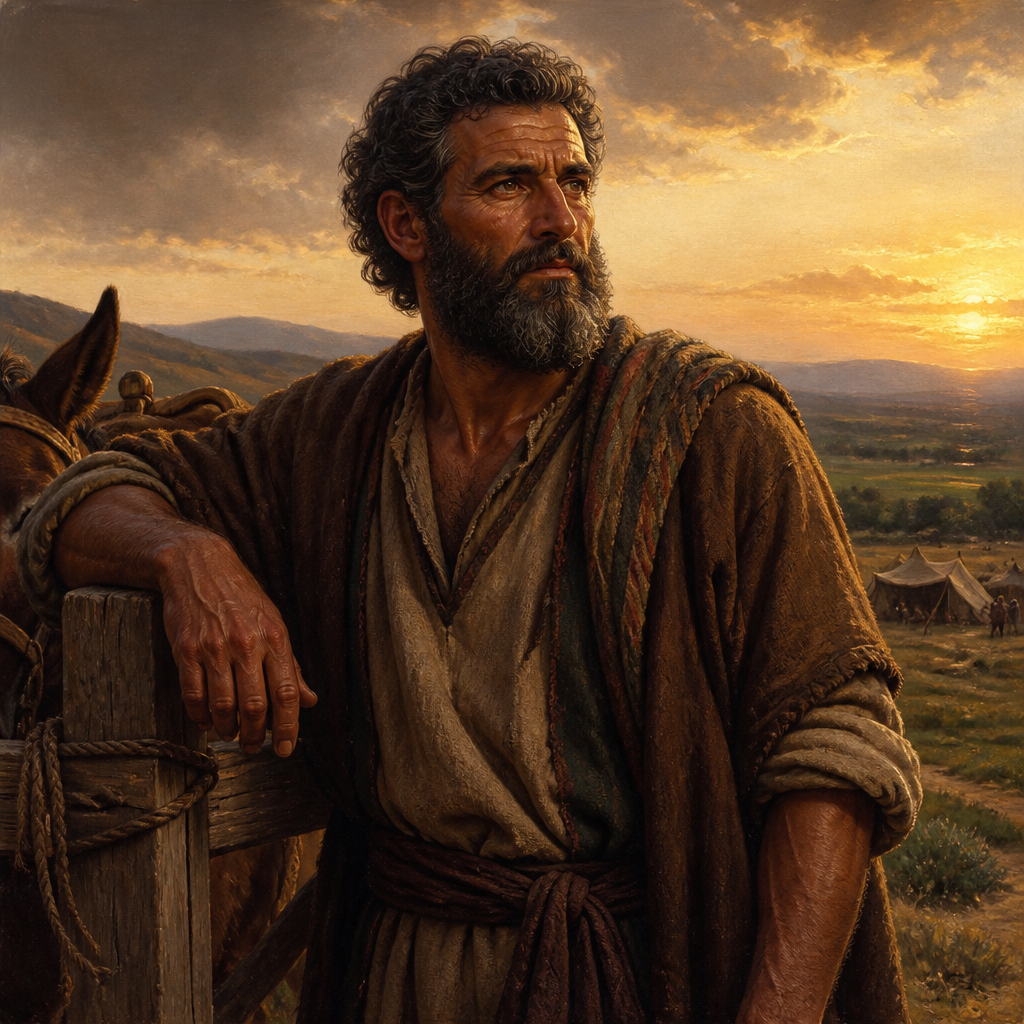
The most descriptive information regarding Issachar comes from the deathbed blessing of his father, Jacob, in Genesis 49. Jacob describes Issachar as a "strong donkey, lying down between the sheepfolds" (Genesis 49:14). This imagery suggests a man or a people characterized by physical strength and a willingness to labor. Jacob further notes that Issachar "saw that a resting place was good and that the land was pleasant, so he bowed his shoulder to bear a burden and became a slave at forced labor" (Genesis 49:15). Scholars often interpret this as a reference to the tribe's future settlement in the fertile Jezreel Valley, where they would prioritize agricultural stability and commerce.
Relationship to Other Biblical Figures
Issachar maintains a close proximity to his full brother Zebulun throughout the biblical text. In the blessings of Moses in Deuteronomy 33:18, the two are grouped together: "Rejoice, Zebulun, in your journeys, and Issachar, in your tents." This indicates a complementary relationship between the seafaring/mercantile Zebulun and the agrarian/settled Issachar.
Historically, his descendants remained loyal to the cause of Israel during the Period of the Judges. The Song of Deborah (Judges 5:15) highlights the princes of Issachar for their bravery, noting that they were with Deborah and Barak in the valley against the Canaanite forces. Furthermore, the tribe produced Tola, a judge who led Israel for twenty-three years (Judges 10:1-2), and later provided the men of wisdom who supported David’s rise to the throne—men described as having "understanding of the times, to know what Israel ought to do" (1 Chronicles 12:32).
Spiritual Significance
In the broader theological framework of the Bible, Issachar represents the reward of faithfulness and the virtue of quiet, industrious service. While he does not possess the leadership mandate of Judah or the priestly calling of Levi, he is essential to the tribal integrity of the covenant people. His name remains preserved in the eschatological vision of the New Testament; in Revelation 7:7, the Tribe of Issachar is listed among the 144,000 who are sealed, with 12,000 members accounted for. This signifies that despite the tribe's historical tendency toward quiet labor, they remain a distinct and honored portion of God’s people through all generations of biblical history.
Issachar serves as a vital link in the patriarchal lineage, ensuring the fulfillment of the promise made to Abraham regarding a numerous and structured progeny. His inclusion in the twelve tribes establishes a pattern of diversity within the nation of Israel, where different tribes contribute different strengths—in his case, agricultural stability and tactical wisdom. Theologically, his name (meaning 'reward') serves as a reminder of God's providence in the domestic and social spheres of the patriarchs' lives.
Furthermore, the 'sons of Issachar' mentioned in 1 Chronicles 12:32 provide a biblical model for spiritual discernment. Their ability to 'understand the times' has become a common motif in Christian and Jewish thought regarding the necessity of applying divine wisdom to contemporary political and social contexts. Thus, Issachar’s legacy transitions from a physical laborer to a symbol of intellectual and spiritual insight.
Frequently Asked Questions
What does the name 'Issachar' mean?
The name is derived from the Hebrew words 'Ish' (man) and 'Sakar' (hire/reward), literally meaning 'Man of Hire' or 'There is a reward.' This refers to the circumstances of his birth involving the mandrakes Leah gave to Rachel.
Who were the sons of Issachar?
According to Genesis 46:13 and 1 Chronicles 7:1, Issachar had four sons: Tola, Puah (or Puvah), Jashub (or Job), and Shimron.
What was Jacob's prophecy concerning Issachar?
Jacob described Issachar as a 'strong donkey' stooping between two burdens. This symbolized a tribe that was physically strong and preferred the peace and productivity of the land over political dominance.
Which judge of Israel came from Issachar?
Tola, the son of Puah, was a member of the tribe of Issachar who judged Israel for twenty-three years following the time of Abimelech (Judges 10:1-2).
Is Issachar mentioned in the New Testament?
Yes, Issachar is mentioned in Revelation 7:7, where 12,000 members of his tribe are listed as being sealed among the 144,000 servants of God.
Family & Relationships
 Issachar, Ninth Son of JacobThis page
 AsherBrotherExodus 1:3–4Stated
 Benjamin, Son of JacobBrotherExodus 1:3Stated
 DanBrotherExodus 1:3–4Stated
 DinahSisterGenesis 34:3
Inferred
Reconstructed through Simeon: Genesis 34:25 ties Dinah to Simeon; Genesis 35:23 ties Simeon to Issachar. No verse states the brother link between Dinah and Issachar directly.Evidence: Genesis 34:3; Exodus 1:1
 Gad, Son of JacobBrotherExodus 1:3–4Stated
 Joseph, Son of JacobBrother1 Chronicles 2:1–2Stated
 Judah, Son of JacobBrotherGenesis 35:23Stated
 Levi, Son of JacobBrotherGenesis 35:23Stated
 NaphtaliBrotherExodus 1:3–4Stated
 ReubenBrotherGenesis 35:23Stated
 Simeon, Son of JacobBrotherGenesis 35:23Stated
 ZebulunBrotherGenesis 35:23Stated
Children
 Puah, Son of IssacharSon1 Chronicles 7:1Stated
 ShimronSonGenesis 46:13Stated
 Tola, Son of IssacharSonGenesis 46:13Stated
 Jashub, Son of IssacharSonNumbers 26:23–24Stated
Connected Figures
Family

Father · Genesis 35:23–26
The third patriarch of the covenant, whom God renamed Israel after he wrestled with God, and the father of the twelve tribes.
PatriarchsFirst: Genesis 25:26228 versesPatriarch, Shepherd

Mother · Genesis 35:23
The elder daughter of Laban and the first wife of Jacob, Leah was the biological mother of six of the twelve tribes of Israel and the matriarch of the priestly and royal lines.
Son · 1 Chronicles 7:1
Puah was a son of Issachar and a tribal leader whose descendants formed the Punite clan during the Egyptian sojourn and the Exodus.
Son · Genesis 46:13
Shimron was the fourth son of Issachar, a grandson of Jacob, and the foundational ancestor of the Shimronite clan within the tribe of Issachar.
Son · Genesis 46:13
Tola was the eldest son of Issachar and a tribal patriarch who founded the Tolaite clan during the Egyptian sojourn and the wilderness period.
Egypt and WildernessFirst: Genesis 46:135 versesPatriarchal leader and founder of the Tolaite clanIssachar
Son · Numbers 26:23–24
Jashub was the third son of Issachar and the founding patriarch of the Jashubite clan during the Egyptian sojourn and the wilderness wanderings.
Brother · Exodus 1:3–4
Asher was the eighth son of Jacob, the second born to Zilpah, and the ancestral patriarch of the Tribe of Asher, known for the fertile lands and prosperity promised in his father's blessing.
PatriarchsFirst: Genesis 30:1315 versesPatriarchAsher
Brother · Exodus 1:3
The youngest son of Jacob and Rachel, Benjamin was the beloved patriarch of one of the twelve tribes of Israel and a central figure in the narrative of Joseph's rise in Egypt.
PatriarchsFirst: Genesis 35:1823 versesPatriarchBenjamin
Brother · Exodus 1:3–4
The fifth son of the patriarch Jacob and the first son born to his concubine Bilhah, serving as the eponymous ancestor of the Tribe of Dan.
PatriarchsFirst: Genesis 30:613 versesPatriarchDan
Sister · Genesis 34:3
The only daughter of Jacob and Leah mentioned in the patriarchal narratives, known for the incident at Shechem that led to a violent conflict between her brothers and the Hivites.
Brother · Exodus 1:3–4
The seventh son of Jacob and the firstborn of Zilpah, Gad was a patriarch of Israel whose descendants became a warrior tribe known for their courage and inheritance east of the Jordan River.
PatriarchsFirst: Genesis 30:1111 versesPatriarchGad
Brother · 1 Chronicles 2:1–2
The favored son of Jacob who, after being sold into slavery by his brothers, rose to become the Grand Vizier of Egypt and preserved the lineage of Israel during a regional famine.
PatriarchsFirst: Genesis 30:24156 versesShepherd, Slave, Household Manager, Prisoner, Grand Vizier of Egypt
Categories
Mentions by Book
- Genesis9
- Exodus2
- Numbers1
- 1 Chronicles1
Scripture References
All 13 indexed verses, in canonical order, from the Berean Standard Bible.
Genesis · 9
- Genesis 30:18
Then Leah said, “God has rewarded me for giving my maidservant to my husband.” So she named him Issachar.
- Genesis 30:19Partial
Again Leah conceived and bore a sixth son to Jacob.
Cited as evidence on a family card; added so References, Key Verses and Mentions by Book share one index.
- Genesis 30:20Partial
“God has given me a good gift,” she said. “This time my husband will honor me, because I have borne him six sons.” And she named him Zebulun.
Cited as evidence on a family card; added so References, Key Verses and Mentions by Book share one index.
- Genesis 30:21Partial
After that, Leah gave birth to a daughter and named her Dinah.
Cited as evidence on a family card; added so References, Key Verses and Mentions by Book share one index.
- Genesis 35:23
The sons of Leah were Reuben the firstborn of Jacob, Simeon, Levi, Judah, Issachar, and Zebulun.
- Genesis 35:24Partial
The sons of Rachel were Joseph and Benjamin.
Cited as evidence on a family card; added so References, Key Verses and Mentions by Book share one index.
- Genesis 35:25Partial
The sons of Rachel’s maidservant Bilhah were Dan and Naphtali.
Cited as evidence on a family card; added so References, Key Verses and Mentions by Book share one index.
- Genesis 35:26Partial
And the sons of Leah’s maidservant Zilpah were Gad and Asher. These are the sons of Jacob, who were born to him in Paddan-aram.
Cited as evidence on a family card; added so References, Key Verses and Mentions by Book share one index.
- Genesis 49:14
Issachar is a strong donkey, lying down between the sheepfolds.
Exodus · 2
- Exodus 1:3
Issachar, Zebulun, and Benjamin;
- Exodus 1:4Partial
Dan and Naphtali; Gad and Asher.
Cited as evidence on a family card; added so References, Key Verses and Mentions by Book share one index.
Numbers · 1
- Numbers 26:24Partial
the Jashubite clan from Jashub, and the Shimronite clan from Shimron.
Cited as evidence on a family card; added so References, Key Verses and Mentions by Book share one index.
1 Chronicles · 1
- 1 Chronicles 2:2Partial
Dan, Joseph, Benjamin, Naphtali, Gad, and Asher.
Cited as evidence on a family card; added so References, Key Verses and Mentions by Book share one index.
Others Named Issachar
Compare all 2 bearers →Issachar, Son of Obed-edom1 Chronicles 26:5
Issachar was a Levite gatekeeper of the Korahite clan who served in the tabernacle during the reign of King David.