Rachel
Who was Rachel in the Bible?
The beloved wife of the patriarch Jacob and the biological mother of Joseph and Benjamin, recognized as a foundational matriarch of the nation of Israel.
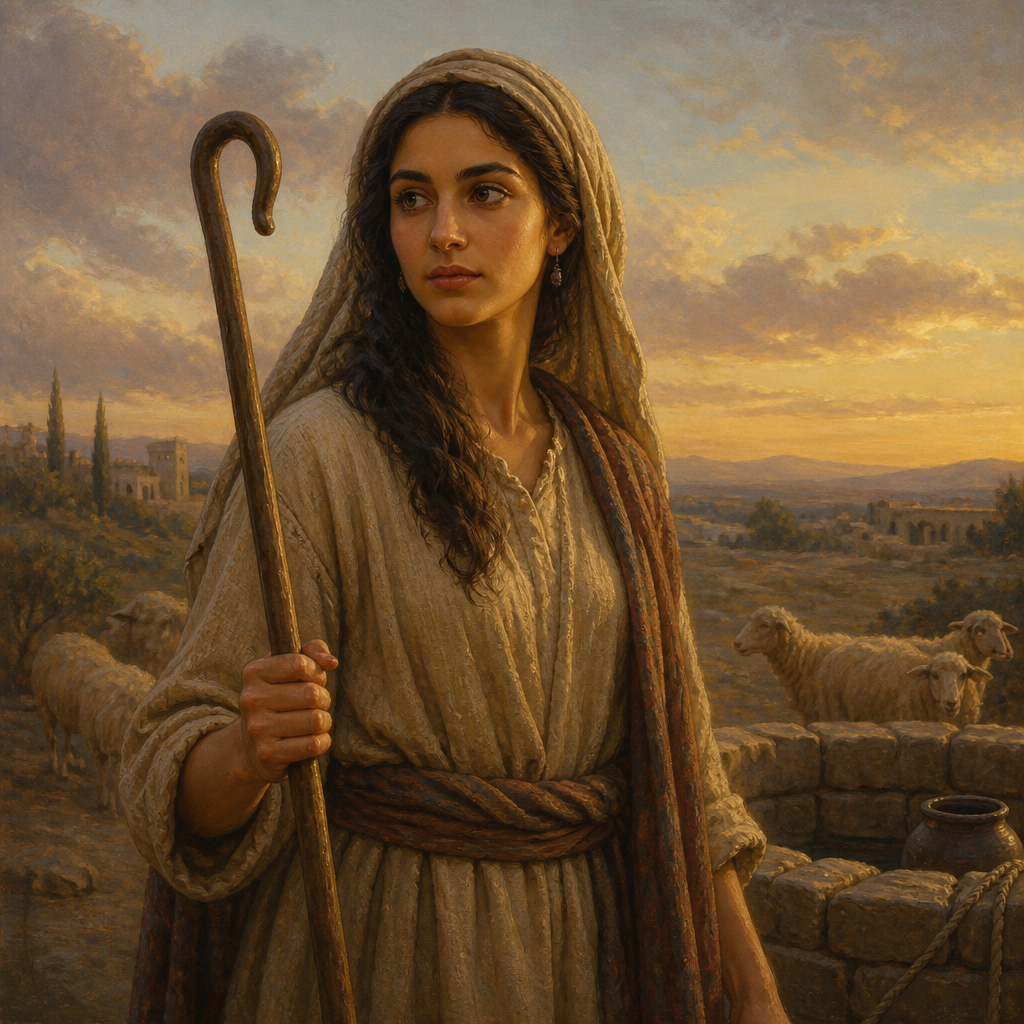
Rachel, the daughter of Laban and the younger sister of Leah, is one of the most prominent female figures in the book of Genesis. Known for her physical beauty and her status as Jacob's favorite wife, Rachel's life was defined by a complex mixture of romantic devotion, intense sibling rivalry, and the struggle of infertility. She first appears in the biblical narrative as a shepherdess tending her father's flocks in Haran, where she encounters Jacob, who had fled from his brother Esau.
Her story is central to the formation of the Twelve Tribes of Israel. Through her own children, Joseph and Benjamin, and those of her handmaid Bilhah, Rachel contributed four tribal heads to the Israelite nation. Her life was tragically cut short during childbirth, and her burial place near Bethlehem remains a significant site in biblical geography. Rachel is often depicted in later scripture and tradition as a symbolic mother of the nation, weeping for her descendants during times of exile and hardship.
Background and Family
Rachel was the younger daughter of Laban, a Syrian living in Paddan-aram (Haran), and the niece of Rebekah. The biblical record introduces her in Genesis 29:6 as a shepherdess, a role that distinguishes her as industrious. When Jacob arrived at the well in Haran, he was struck by her appearance; the text notes that while her older sister Leah had "weak eyes," Rachel was "shapely and beautiful" (Genesis 29:17).
Jacob’s affection for Rachel was immediate and profound. He agreed to serve Laban for seven years to earn her hand in marriage, a period the text describes as seeming like "but a few days because of his love for her" (Genesis 29:20). However, the family dynamic was complicated by Laban’s deception. On the wedding night, Laban substituted Leah for Rachel. When Jacob discovered the ruse, Laban insisted that the older daughter must be married first but allowed Jacob to marry Rachel one week later in exchange for another seven years of labor. This established a polygamous household characterized by competition between the two sisters for Jacob’s affection and the blessing of children.
Major Life Events
The Struggle with Barrenness
For many years, Rachel remained childless while Leah bore several sons. This infertility caused Rachel deep emotional distress, leading to the desperate plea to Jacob, “Give me children, or I will die!” (Genesis 30:1). Following the precedent set by Sarah, Rachel gave her maidservant, Bilhah, to Jacob as a surrogate. Bilhah gave birth to Dan and Naphtali, whom Rachel claimed as her own to vindicate her struggle against her sister.
Eventually, the biblical narrative records that "God remembered Rachel" and she gave birth to Joseph (Genesis 30:22-24). His birth marked a turning point, signaling the end of her reproach and leading Jacob to finally seek a return to his own land in Canaan.
The Departure from Haran
When Jacob fled from Laban, Rachel took a significant and controversial action: she stole her father’s household idols (teraphim). The motivations for this act are not explicitly stated in the text, though scholars suggest they may have represented inheritance rights or a lingering connection to her father's pagan practices. When Laban pursued them and searched the tents, Rachel successfully hid the idols by sitting on a camel's saddle and claiming she could not rise due to her menstrual cycle (Genesis 31:34-35). Jacob, unaware of her theft, had pronounced a death curse on whoever possessed the idols, a detail that some commentators link to her premature death.
Death and Burial
Rachel’s life ended during the journey to Ephrath (Bethlehem). As she was in hard labor with her second son, she named him Ben-oni ("son of my sorrow"), but Jacob renamed him Benjamin ("son of my right hand"). Rachel died during the birth and was buried beside the road rather than in the family cave of Machpelah. Jacob erected a pillar over her grave to mark the site (Genesis 35:19-20).
Relationship to Other Biblical Figures
Rachel’s primary relationship was her enduring bond with Jacob, who continued to favor her and her children above his other wives and sons. This favoritism later manifested in Jacob’s special treatment of Joseph, which fueled the resentment of Joseph’s half-brothers. Rachel also shared a lifelong, competitive relationship with her sister Leah. The two were forced into a shared domestic life that revolved around childbearing and the acquisition of their husband’s attention, famously illustrated by the trade of Reuben’s mandrakes for a night with Jacob (Genesis 30:14-15).
Spiritual Significance
Rachel serves as a foundational figure in the "House of Israel." In Ruth 4:11, the elders of Bethlehem pray that Ruth would be like "Rachel and Leah, who together built up the house of Israel." Beyond her role as a physical mother, Rachel took on a symbolic spiritual role in later prophecy. In Jeremiah 31:15, she is portrayed as a mother weeping in Ramah for her children who have been taken into exile. This passage is famously cited in Matthew 2:18 in the context of the Massacre of the Innocents by Herod the Great, framing Rachel as the ultimate empathetic figure for the suffering of the nation of Israel.
Rachel’s theological significance lies in her role as a recipient of divine remembrance despite her initial barrenness, illustrating the biblical theme of God’s sovereignty over the womb and the lineage of the covenant. Her life reflects the complexities of the patriarchal era, including the tensions of polygamy and the transition from Mesopotamian idolatry to the worship of the God of Abraham.
In the broader biblical canon, Rachel becomes a metaphorical figure for the collective grief and hope of Israel. Her presence in the New Testament (Matthew 2:18) connects the patriarchal narratives to the life of Christ, establishing a continuity of redemptive history where the sorrows of the mothers of Israel are acknowledged and eventually addressed through the Messiah.
Frequently Asked Questions
Why did Rachel steal her father's household idols?
The Bible does not give a specific reason, but common scholarly interpretations include a desire to secure her father's inheritance, a belief in their protective power, or an attempt to prevent her father from using them for divination to find the fleeing family.
How many children did Rachel have?
Rachel had two biological sons: Joseph and Benjamin. She also claimed two sons, Dan and Naphtali, born to her maidservant Bilhah.
Where is Rachel buried?
She was buried on the way to Ephrath, which is modern-day Bethlehem. Jacob set up a pillar to mark her grave, which is mentioned as a landmark in later scriptures like 1 Samuel 10:2.
What does the name Rachel mean?
The name Rachel (רָחֵל) in Hebrew literally means 'ewe,' which is consistent with her occupation as a shepherdess when she is first introduced.
Why did Jacob love Rachel more than Leah?
The Bible attributes this to Rachel's beauty and the immediate connection Jacob felt when he met her at the well. Despite the years of labor and the family conflicts, Jacob’s preference for Rachel remained constant throughout his life.
Family & Relationships
Parents
 LabanFatherGenesis 29:28Stated
Children
 Benjamin, Son of JacobSonGenesis 35:24Stated
 Joseph, Son of JacobSonGenesis 35:24Stated
Extended family
 AshbelGrandson1 Chronicles 8:1
Inferred
Reconstructed through Benjamin: 1 Chronicles 8:1 ties Ashbel to Benjamin; Genesis 35:24 ties Benjamin to Rachel. No verse states the grandmother link between Ashbel and Rachel directly.Evidence: 1 Chronicles 8:1; Genesis 35:24
Connected Figures
Family
Father · Genesis 29:28
A resourceful and opportunistic Aramean patriarch, brother of Rebekah and father-in-law to Jacob, known for his complex domestic and labor negotiations.
PatriarchsFirst: Genesis 24:2950 versesShepherd, Livestock Owner

Husband · Genesis 46:19
The third patriarch of the covenant, whom God renamed Israel after he wrestled with God, and the father of the twelve tribes.
PatriarchsFirst: Genesis 25:26228 versesPatriarch, Shepherd
Son · Genesis 35:24
The youngest son of Jacob and Rachel, Benjamin was the beloved patriarch of one of the twelve tribes of Israel and a central figure in the narrative of Joseph's rise in Egypt.
PatriarchsFirst: Genesis 35:1823 versesPatriarchBenjamin
Son · Genesis 35:24
The favored son of Jacob who, after being sold into slavery by his brothers, rose to become the Grand Vizier of Egypt and preserved the lineage of Israel during a regional famine.
PatriarchsFirst: Genesis 30:24156 versesShepherd, Slave, Household Manager, Prisoner, Grand Vizier of Egypt

Sister · Genesis 29:23–25
The elder daughter of Laban and the first wife of Jacob, Leah was the biological mother of six of the twelve tribes of Israel and the matriarch of the priestly and royal lines.
Grandson · 1 Chronicles 8:1
Ashbel was the second son of Benjamin and the eponymous founder of the Ashbelite clan during the Egyptian sojourn and the wilderness wanderings.
Egypt and WildernessFirst: Genesis 46:215 versesClan FounderBenjamin
Categories
Mentions by Book
- Genesis43
- Ruth1
- 1 Samuel1
- 1 Chronicles1
- Jeremiah1
- Matthew1
Scripture References
All 48 indexed verses, in canonical order, from the Berean Standard Bible.
- Genesis 29:6
“Is he well?” Jacob inquired. “Yes,” they answered, “and here comes his daughter Rachel with his sheep.”
- Genesis 29:9
While he was still speaking with them, Rachel arrived with her father’s sheep, for she was a shepherdess.
- Genesis 29:10
As soon as Jacob saw Rachel, the daughter of his mother’s brother Laban, with Laban’s sheep, he went up and rolled the stone away from the mouth of the well and watered his uncle’s sheep.
- Genesis 29:11
Then Jacob kissed Rachel and wept aloud.
- Genesis 29:12
He told Rachel that he was Rebekah’s son, a relative of her father, and she ran and told her father.
- Genesis 29:16
Now Laban had two daughters; the older was named Leah, and the younger was named Rachel.
- Genesis 29:17
Leah had weak eyes, but Rachel was shapely and beautiful.
- Genesis 29:18Partial
Since Jacob loved Rachel, he answered, “I will serve you seven years for your younger daughter Rachel.”
- Genesis 29:20
So Jacob served seven years for Rachel, yet it seemed but a few days because of his love for her.
- Genesis 29:23Partial
But when evening came, Laban took his daughter Leah and gave her to Jacob, and he slept with her.
Cited as evidence on a family card; added so References, Key Verses and Mentions by Book share one index.
- Genesis 29:24Partial
And Laban gave his servant girl Zilpah to his daughter Leah as her maidservant.
Cited as evidence on a family card; added so References, Key Verses and Mentions by Book share one index.
- Genesis 29:25
When morning came, there was Leah! “What have you done to me?” Jacob said to Laban. “Wasn’t it for Rachel that I served you? Why have you deceived me?”
- Genesis 29:28
And Jacob did just that. He finished the week’s celebration, and Laban gave him his daughter Rachel as his wife.
- Genesis 29:29
Laban also gave his servant girl Bilhah to his daughter Rachel as her maidservant.
- Genesis 29:30Partial
Jacob slept with Rachel as well, and indeed, he loved Rachel more than Leah. So he worked for Laban another seven years.
- Genesis 29:31
When the LORD saw that Leah was unloved, He opened her womb; but Rachel was barren.
- Genesis 30:1
When Rachel saw that she was not bearing any children for Jacob, she envied her sister. “Give me children, or I will die!” she said to Jacob.
- Genesis 30:2
Jacob became angry with Rachel and said, “Am I in the place of God, who has withheld children from you?”
- Genesis 30:6
Then Rachel said, “God has vindicated me; He has heard my plea and given me a son.” So she named him Dan.
- Genesis 30:7
And Rachel’s servant Bilhah conceived again and bore Jacob a second son.
- Genesis 30:8
Then Rachel said, “In my great struggles, I have wrestled with my sister and won.” So she named him Naphtali.
- Genesis 30:14
Now during the wheat harvest, Reuben went out and found some mandrakes in the field. When he brought them to his mother, Rachel begged Leah, “Please give me some of your son’s mandrakes.”
- Genesis 30:15
But Leah replied, “Is it not enough that you have taken away my husband? Now you want to take my son’s mandrakes as well?” “Very well,” said Rachel, “he may sleep with you tonight in exchange for your son’s mandrakes.”
- Genesis 30:22
Then God remembered Rachel. He listened to her and opened her womb,
- Genesis 30:25
Now after Rachel had given birth to Joseph, Jacob said to Laban, “Send me on my way so I can return to my homeland.
- Genesis 31:4
So Jacob sent word and called Rachel and Leah to the field where his flocks were,
- Genesis 31:14
And Rachel and Leah replied, “Do we have any portion or inheritance left in our father’s house?
- Genesis 31:19
Now while Laban was out shearing his sheep, Rachel stole her father’s household idols.
- Genesis 31:32
If you find your gods with anyone here, he shall not live! In the presence of our relatives, see for yourself if anything is yours, and take it back.” For Jacob did not know that Rachel had stolen the idols.
- Genesis 31:33
So Laban went into Jacob’s tent, then Leah’s tent, and then the tents of the two maidservants, but he found nothing. Then he left Leah’s tent and entered Rachel’s tent.
- Genesis 31:34
Now Rachel had taken Laban’s household idols, put them in the saddlebag of her camel, and was sitting on them. And Laban searched everything in the tent but found nothing.
- Genesis 33:1
Now Jacob looked up and saw Esau coming toward him with four hundred men. So he divided the children among Leah, Rachel, and the two maidservants.
- Genesis 33:2
He put the maidservants and their children in front, Leah and her children next, and Rachel and Joseph at the rear.
- Genesis 33:7
Leah and her children also approached and bowed down, and then Joseph and Rachel approached and bowed down.
- Genesis 35:16
Later, they set out from Bethel, and while they were still some distance from Ephrath, Rachel began to give birth, and her labor was difficult.
- Genesis 35:19
So Rachel died and was buried on the way to Ephrath (that is, Bethlehem).
- Genesis 35:20
Jacob set up a pillar on her grave; it marks Rachel’s tomb to this day.
- Genesis 35:24
The sons of Rachel were Joseph and Benjamin.
- Genesis 35:25
The sons of Rachel’s maidservant Bilhah were Dan and Naphtali.
- Genesis 46:19
The sons of Jacob’s wife Rachel: Joseph and Benjamin.
- Genesis 46:22
These are the sons of Rachel born to Jacob—fourteen in all.
- Genesis 46:25
These are the sons of Jacob born to Bilhah, whom Laban gave to his daughter Rachel—seven in all.
- Genesis 48:7
Now as for me, when I was returning from Paddan, to my sorrow Rachel died along the way in the land of Canaan, some distance from Ephrath. So I buried her there beside the road to Ephrath” (that is, Bethlehem).
- Ruth 4:11
“We are witnesses,” said the elders and all the people at the gate. “May the LORD make the woman entering your home like Rachel and Leah, who together built up the house of Israel. May you be prosperous in Ephrathah and famous in Bethlehem.
- 1 Samuel 10:2
When you leave me today, you will find two men at Rachel’s tomb in Zelzah on the border of Benjamin. They will say to you, ‘The donkeys you seek have been found, and now your father has stopped worrying about the donkeys and started worrying about you, asking, “What should I do about my son?”’
- 1 Chronicles 8:1Partial
Benjamin was the father of Bela his firstborn, Ashbel the second, Aharah the third,
Cited as evidence on a family card; added so References, Key Verses and Mentions by Book share one index.
- Jeremiah 31:15
This is what the LORD says: “A voice is heard in Ramah, mourning and great weeping, Rachel weeping for her children and refusing to be comforted, because they are no more.”
- Matthew 2:18
“A voice is heard in Ramah, weeping and great mourning, Rachel weeping for her children and refusing to be comforted, because they are no more.”