Zebulun
Who was Zebulun in the Bible?
Zebulun was the tenth son of Jacob and the sixth and final son born to Leah, serving as the eponymous patriarch of one of the twelve tribes of Israel.
Zebulun was a son of the patriarch Jacob and the last of the six sons born to Leah during Jacob's time in Paddan-aram. His name, derived from the Hebrew word for 'honor' or 'dwelling,' reflects his mother’s hope that his birth would secure her husband’s favor. Though he is not the central protagonist of the Genesis narrative, he occupies a vital position as one of the twelve tribal progenitors who formed the foundations of the nation of Israel.
Historically and geographically, Zebulun is most significant for the territory his descendants inherited in the Promised Land. Situated in the Galilee region, this tribe played a notable role in the military and spiritual life of the nation. From the martial bravery celebrated in the Song of Deborah to the tribal inheritance that later became the backdrop for the ministry of Jesus Christ, Zebulun’s legacy extends from the patriarchal era into the New Testament.
Background and Family
Zebulun was born to Jacob and Leah in Haran, following the birth of his older brother Issachar. At his birth, Leah exclaimed, "God has given me a good gift... This time my husband will honor me, because I have borne him six sons" (Genesis 30:20). The name Zebulun is linguistically tied to the concepts of 'dwelling' (zabal) and 'honor' (zebul), signifying Leah’s desire for a permanent, honored status within Jacob's household. As the tenth son of Jacob, Zebulun grew up within a complex family dynamic marked by the rivalry between his mother and her sister Rachel.
Zebulun is listed among the family members who migrated to Egypt during the great famine. He was accompanied by his three sons: Sered, Elon, and Jahleel (Genesis 46:14). These three sons became the heads of the Seredite, Elonite, and Jahleelite clans, which formed the core of the tribe of Zebulun.
Major Life Events
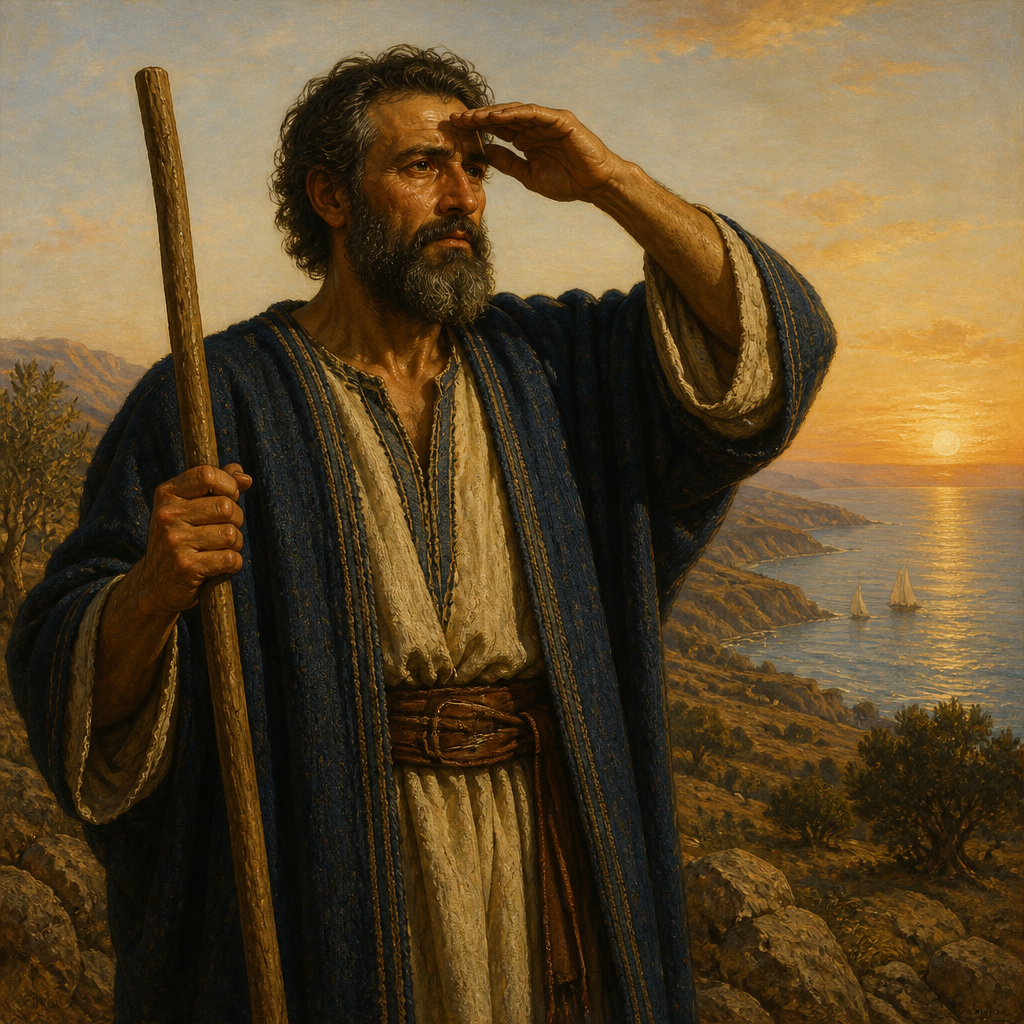
While the biblical text does not record specific personal exploits of Zebulun as an individual, his life is defined by two major prophetic declarations. The first occurred on Jacob's deathbed, where the patriarch blessed his sons. Regarding Zebulun, Jacob prophesied: “Zebulun shall dwell by the seashore and become a harbor for ships; his border shall extend to Sidon” (Genesis 49:13). This blessing foretold a maritime destiny for the tribe, placing them in a strategic position for trade and seafaring, even though their eventual allotment in Joshua was landlocked—suggesting their influence or commercial reach extended to the Mediterranean coasts.
Centuries later, Moses offered a final blessing to the tribes before his death, grouping Zebulun with Issachar: “Rejoice, Zebulun, in your journeys, and Issachar, in your tents” (Deuteronomy 33:18). This reinforces the image of Zebulun as a mobile, outward-looking tribe involved in commerce and travel, contrasting with the more sedentary, agricultural nature of Issachar.
Relationship to Other Biblical Figures
Zebulun shared a close biological and tribal bond with his full brothers: Reuben, Simeon, Levi, Judah, and Issachar. He also had one full sister, Dinah. Throughout the Pentateuch and the Book of Joshua, Zebulun is frequently paired with Issachar due to their shared mother and adjacent territorial borders.
During the period of the Judges, the descendants of Zebulun were distinguished by their loyalty and military prowess. Under the leadership of Deborah and Barak, the men of Zebulun "risked their lives" on the battlefield against Sisera (Judges 5:18). The tribe also produced a judge, Elon the Zebulunite, who led Israel for ten years (Judges 12:11-12). In the time of King David, the tribe showed exceptional commitment; 1 Chronicles 12:33 describes 50,000 soldiers from Zebulun who were "fit for service, trained for battle... who with one purpose were devoted to David."
Spiritual Significance
The most profound spiritual significance of Zebulun appears in the New Testament. The prophet Isaiah had foretold that while the land of Zebulun and Naphtali had been humbled in the past, in the future, God would "honor the Way of the Sea... Galilee of the nations" (Isaiah 9:1). This prophecy was fulfilled in the life of Jesus Christ. As recorded in Matthew 4:13–15, Jesus left Nazareth and dwelt in Capernaum, which was situated in the region of Zebulun and Naphtali. The arrival of the Messiah in this specific tribal territory was seen as the rising of a "great light" to those dwelling in darkness. Thus, the inheritance of this patriarch became the geographical cradle for the Gospel's spread. Zebulun concludes his biblical mention in the Book of Revelation, where 12,000 members of the tribe are among the 144,000 sealed (Revelation 7:8).
Zebulun serves as a vital link in the covenantal history of Israel, representing the fulfillment of God’s promise to multiply Jacob’s descendants into a great nation. His primary theological importance lies in his prophetic destiny as a 'light' to the Gentiles; though a smaller tribe, Zebulun's territory became the primary theater for the earthly ministry of Jesus Christ, demonstrating how God uses specific, often overlooked lineages to accomplish universal salvation.
Additionally, the tribe of Zebulun is consistently characterized by fidelity and sacrificial service. Whether providing 'bearers of the marshal’s staff' in the days of Deborah or providing abundant supplies for David’s coronation, Zebulun represents a spirit of unity and dedication to the divinely appointed leadership of Israel, symbolizing the cooperative effort required within the community of faith.
Frequently Asked Questions
What does the name Zebulun mean?
The name Zebulun is derived from the Hebrew root zabal, meaning to dwell or to honor. His mother Leah chose the name to express her hope that Jacob would dwell with her and honor her after she had borne him six sons.
Who were the sons of Zebulun?
According to Genesis 46:14, Zebulun had three sons: Sered, Elon, and Jahleel. They became the heads of the principal clans within the tribe.
What was the specific blessing Jacob gave to Zebulun?
Jacob prophesied that Zebulun would dwell by the seashore, serve as a harbor for ships, and have borders extending toward Sidon, highlighting a future of maritime commerce.
How is Zebulun connected to Jesus Christ?
Jesus spent much of His ministry in the region of Galilee, which included the ancestral lands of Zebulun. Matthew 4:13–16 cites this as a fulfillment of Isaiah’s prophecy that a great light would shine in the land of Zebulun.
Did the tribe of Zebulun produce any famous leaders?
Yes, Elon the Zebulunite served as a judge of Israel for ten years. Additionally, the tribe was known for its 'marshal’s staff' bearers and its 50,000 soldiers who supported King David with 'one purpose.'
Family & Relationships
 ZebulunThis page
 AsherBrotherExodus 1:3–4Stated
 Benjamin, Son of JacobBrotherExodus 1:3Stated
 DanBrotherExodus 1:3–4Stated
 DinahSisterGenesis 34:3
Inferred
Reconstructed through Simeon: Genesis 34:25 ties Dinah to Simeon; Genesis 35:23 ties Simeon to Zebulun. No verse states the brother link between Dinah and Zebulun directly.Evidence: Genesis 34:3; Exodus 1:1
 Gad, Son of JacobBrotherExodus 1:3–4Stated
 Issachar, Ninth Son of JacobBrotherGenesis 35:23Stated
 Joseph, Son of JacobBrother1 Chronicles 2:1–2Stated
 Judah, Son of JacobBrotherGenesis 35:23Stated
 Levi, Son of JacobBrotherGenesis 35:23Stated
 NaphtaliBrotherExodus 1:3–4Stated
 ReubenBrotherGenesis 35:23Stated
 Simeon, Son of JacobBrotherGenesis 35:23Stated
Children
 Elon, Son of ZebulunSonGenesis 46:14Stated
 JahleelSonGenesis 46:14Stated
 SeredSonGenesis 46:14Stated
Connected Figures
Family

Father · Genesis 35:23–26
The third patriarch of the covenant, whom God renamed Israel after he wrestled with God, and the father of the twelve tribes.
PatriarchsFirst: Genesis 25:26228 versesPatriarch, Shepherd

Mother · Genesis 35:23
The elder daughter of Laban and the first wife of Jacob, Leah was the biological mother of six of the twelve tribes of Israel and the matriarch of the priestly and royal lines.
Son · Genesis 46:14
Elon was the second son of Zebulun and the founding patriarch of the Elonite clan during the Israelite sojourn in Egypt and the subsequent wilderness wanderings.
Egypt and WildernessFirst: Genesis 46:142 versesPatriarchal Clan HeadZebulun
Son · Genesis 46:14
Jahleel was the third son of Zebulun and the ancestral founder of the Jahleelite clan within the tribe of Zebulun.
Egypt and WildernessFirst: Genesis 46:142 versesshepherdZebulun
Son · Genesis 46:14
The firstborn son of Zebulun and the ancestral founder of the Seredite clan within the tribe of Zebulun.
Egypt and WildernessFirst: Genesis 46:142 versesPatriarchal Clan LeaderZebulun
Brother · Exodus 1:3–4
Asher was the eighth son of Jacob, the second born to Zilpah, and the ancestral patriarch of the Tribe of Asher, known for the fertile lands and prosperity promised in his father's blessing.
PatriarchsFirst: Genesis 30:1315 versesPatriarchAsher
Brother · Exodus 1:3
The youngest son of Jacob and Rachel, Benjamin was the beloved patriarch of one of the twelve tribes of Israel and a central figure in the narrative of Joseph's rise in Egypt.
PatriarchsFirst: Genesis 35:1823 versesPatriarchBenjamin
Brother · Exodus 1:3–4
The fifth son of the patriarch Jacob and the first son born to his concubine Bilhah, serving as the eponymous ancestor of the Tribe of Dan.
PatriarchsFirst: Genesis 30:613 versesPatriarchDan
Sister · Genesis 34:3
The only daughter of Jacob and Leah mentioned in the patriarchal narratives, known for the incident at Shechem that led to a violent conflict between her brothers and the Hivites.
Brother · Exodus 1:3–4
The seventh son of Jacob and the firstborn of Zilpah, Gad was a patriarch of Israel whose descendants became a warrior tribe known for their courage and inheritance east of the Jordan River.
PatriarchsFirst: Genesis 30:1111 versesPatriarchGad
Brother · Genesis 35:23
The ninth son of Jacob and the fifth born to Leah, Issachar was a patriarch whose descendants formed one of the prominent twelve tribes of Israel.
PatriarchsFirst: Genesis 30:1813 versesPatriarchIssachar
Brother · 1 Chronicles 2:1–2
The favored son of Jacob who, after being sold into slavery by his brothers, rose to become the Grand Vizier of Egypt and preserved the lineage of Israel during a regional famine.
PatriarchsFirst: Genesis 30:24156 versesShepherd, Slave, Household Manager, Prisoner, Grand Vizier of Egypt
Categories
Mentions by Book
- Genesis7
- Exodus3
- 1 Chronicles1
Scripture References
All 11 indexed verses, in canonical order, from the Berean Standard Bible.
Genesis · 7
- Genesis 30:20
“God has given me a good gift,” she said. “This time my husband will honor me, because I have borne him six sons.” And she named him Zebulun.
- Genesis 34:3Partial
And his soul was drawn to Dinah, the daughter of Jacob. He loved the young girl and spoke to her tenderly.
Cited as evidence on a family card; added so References, Key Verses and Mentions by Book share one index.
- Genesis 35:23
The sons of Leah were Reuben the firstborn of Jacob, Simeon, Levi, Judah, Issachar, and Zebulun.
- Genesis 35:24Partial
The sons of Rachel were Joseph and Benjamin.
Cited as evidence on a family card; added so References, Key Verses and Mentions by Book share one index.
- Genesis 35:25Partial
The sons of Rachel’s maidservant Bilhah were Dan and Naphtali.
Cited as evidence on a family card; added so References, Key Verses and Mentions by Book share one index.
- Genesis 35:26Partial
And the sons of Leah’s maidservant Zilpah were Gad and Asher. These are the sons of Jacob, who were born to him in Paddan-aram.
Cited as evidence on a family card; added so References, Key Verses and Mentions by Book share one index.
- Genesis 49:13
Zebulun shall dwell by the seashore and become a harbor for ships; his border shall extend to Sidon.
Exodus · 3
- Exodus 1:1Partial
These are the names of the sons of Israel who went to Egypt with Jacob, each with his family:
Cited as evidence on a family card; added so References, Key Verses and Mentions by Book share one index.
- Exodus 1:3
Issachar, Zebulun, and Benjamin;
- Exodus 1:4Partial
Dan and Naphtali; Gad and Asher.
Cited as evidence on a family card; added so References, Key Verses and Mentions by Book share one index.
1 Chronicles · 1
- 1 Chronicles 2:2Partial
Dan, Joseph, Benjamin, Naphtali, Gad, and Asher.
Cited as evidence on a family card; added so References, Key Verses and Mentions by Book share one index.