Isaiah
Who was Isaiah in the Bible?
Isaiah, the son of Amoz, was a major prophet in Judah whose ministry spanned the reigns of four kings and who is widely quoted in the New Testament for his messianic and redemptive visions.
Isaiah, the son of Amoz, stands as one of the most prominent figures of the Divided Monarchy period in the history of Israel and Judah. His ministry was centered in the southern kingdom of Judah, specifically within the capital city of Jerusalem, during the 8th century BC. According to the biblical record, Isaiah’s prophetic activity spanned the reigns of four Judean kings: Uzziah, Jotham, Ahaz, and Hezekiah. This era was marked by significant geopolitical shifts, most notably the expansion of the Neo-Assyrian Empire, which posed an existential threat to the region.
Isaiah is characterized by his direct access to the royal court and his role as a spiritual and political advisor to the monarchy. He was not only a messenger of divine judgment against social injustice and idolatry but also a herald of hope, emphasizing the concept of a "remnant" that would be saved and the future arrival of a righteous ruler from the line of Jesse. His writings and oral prophecies are preserved in the Book of Isaiah, and he is the most frequently cited prophet in the New Testament, with his words used to explain the ministry and identity of Jesus Christ.
Beyond his public oracles, the biblical narrative provides glimpses into Isaiah’s personal life and family, illustrating how his domestic reality often served as a living sign for the nation. Through his long and influential career, Isaiah shaped the theological trajectory of the Jewish faith, focusing on the holiness of God and the eventual restoration of Zion.
Background and Family
Isaiah was the son of Amoz, a detail consistently noted across several biblical books (2 Kings 19:2, 2 Chronicles 26:22, Isaiah 1:1). While his specific tribal affiliation is not explicitly stated in the text, his close proximity to the Jerusalem temple and his frequent interactions with the Judean kings suggest he may have been of high social standing or perhaps priestly lineage. Isaiah was a family man whose household was deeply integrated into his prophetic calling. He is recorded as having at least two sons, both of whom were given symbolic names at the direction of the LORD.
His first son, Shear-jashub (meaning "a remnant shall return"), accompanied Isaiah when he confronted King Ahaz during the Syro-Ephraimite crisis (Isaiah 7:3). His second son was named Maher-shalal-hash-baz ("quick to the plunder, swift to the spoil") as a sign of the impending Assyrian conquest of Damascus and Samaria (Isaiah 8:1-4). Additionally, Isaiah refers to his wife as "the prophetess," though it is unclear if this title refers to her own prophetic gift or simply her status as the wife of a prophet (Isaiah 8:3).
Major Life Events
Isaiah’s ministry was defined by the reigns of Uzziah, Jotham, Ahaz, and Hezekiah. One of his earliest recorded tasks was chronicling the acts of King Uzziah (2 Chronicles 26:22). However, his most active and detailed narrative involvement occurs during the reign of King Hezekiah. When the Assyrian king Sennacherib threatened to destroy Jerusalem, Hezekiah sent his officials to Isaiah in sackcloth, seeking a word from God. Isaiah provided the king with divine reassurance, prophesying the withdrawal and eventual death of Sennacherib, a prediction that was fulfilled when the Assyrian army suffered a supernatural defeat (2 Kings 19; Isaiah 37).
Isaiah also played a pivotal role during Hezekiah’s personal crisis. When the king became mortally ill, Isaiah initially delivered a message of impending death but, after Hezekiah’s fervent prayer, was sent back to promise a fifteen-year extension of the king’s life. Isaiah even administered medical treatment, ordering a poultice of figs to be applied to the king’s boil (2 Kings 20:7). To confirm this promise, Isaiah asked for a miraculous sign, resulting in the shadow on the stairway of Ahaz moving backward ten steps (2 Kings 20:9-11).
In a more somber event, Isaiah confronted Hezekiah after the king showed the treasures of Judah to Babylonian envoys. Isaiah accurately foretold that these very treasures, and even Hezekiah’s descendants, would one day be carried away to Babylon (2 Kings 20:14-18).
Relationship to Other Biblical Figures
Isaiah’s primary relationships were with the kings of Judah. His relationship with Hezekiah was particularly close, characterized by mutual prayer and consultation during times of national distress. He also interacted with King Ahaz, offering him a sign from God that Ahaz famously refused (Isaiah 7:10-14).
In the New Testament, Isaiah’s relationship to the apostles and Jesus is one of literary and theological foundationalism. The New Testament writers, including Matthew, Mark, Luke, John, Philip, and Paul, view Isaiah as a primary witness to the gospel. John the Baptist identified his own mission using Isaiah's words (John 1:23). Philip the Evangelist famously explained a passage from Isaiah to an Ethiopian eunuch (Acts 8:28-35). Paul the Apostle frequently quoted Isaiah to explain the inclusion of the Gentiles and the rejection of the gospel by some in Israel (Romans 9-10, 15; Acts 28:25).
Spiritual Significance
Isaiah is often referred to as the "Evangelical Prophet" because of the depth and clarity of his visions concerning the Messiah and the kingdom of God. His significance lies in his uncompromising call for holiness, famously summarized in his vision of the LORD as the "Holy One of Israel." He bridged the gap between immediate historical events—like the Assyrian threat—and far-reaching eschatological hopes.
His prophecies concerning the "suffering servant" (cited in Matthew 8:17 and Acts 8:32-33) and the "Root of Jesse" (Romans 15:12) became the cornerstone of Christian Christology. John 12:41 makes the striking claim that Isaiah actually "saw Jesus’ glory and spoke about Him." Through his recorded visions, Isaiah provided a framework for understanding God's judgment, His mercy toward a remnant, and the eventual global extension of His salvation.
Isaiah's theological impact is unparalleled among the writing prophets. He introduced a profound emphasis on the holiness of God and the necessity of social justice as an expression of true worship. His concept of the 'remnant' provided a theological survival mechanism for the people of Judah during the exile, ensuring that their faith would not vanish despite national defeat. Furthermore, Isaiah's prophecies regarding the birth, suffering, and reign of the Messiah serve as the primary link between the Old Testament expectations and the New Testament fulfillment in Jesus Christ. The New Testament quotes Isaiah more than any other prophet, highlighting his role as the preeminent herald of the Gospel.
Frequently Asked Questions
Who was Isaiah's father?
Isaiah was the son of Amoz.
Which kings did Isaiah serve under?
Isaiah prophesied during the reigns of four kings of Judah: Uzziah, Jotham, Ahaz, and Hezekiah.
What were the names of Isaiah's children?
The Bible mentions two sons: Shear-jashub and Maher-shalal-hash-baz.
How did Isaiah help King Hezekiah when he was sick?
Isaiah told Hezekiah that God would add fifteen years to his life and instructed that a poultice of figs be applied to the king’s boil, leading to his recovery.
Why did Isaiah walk barefoot and naked for three years?
At God's command, Isaiah walked barefoot and naked as a sign and omen against Egypt and Cush, symbolizing their future captivity by the Assyrians (Isaiah 20:2-3).
Family & Relationships
Parents
 AmozFather2 Kings 19:2Stated
 The Prophetess, Wife of IsaiahWife2 Kings 19:2
Inferred
No verse names The Prophetess, Wife of Isaiah and Isaiah together; the husband link is carried from the surrounding genealogy and is not stated in Scripture.Evidence: 2 Kings 19:2
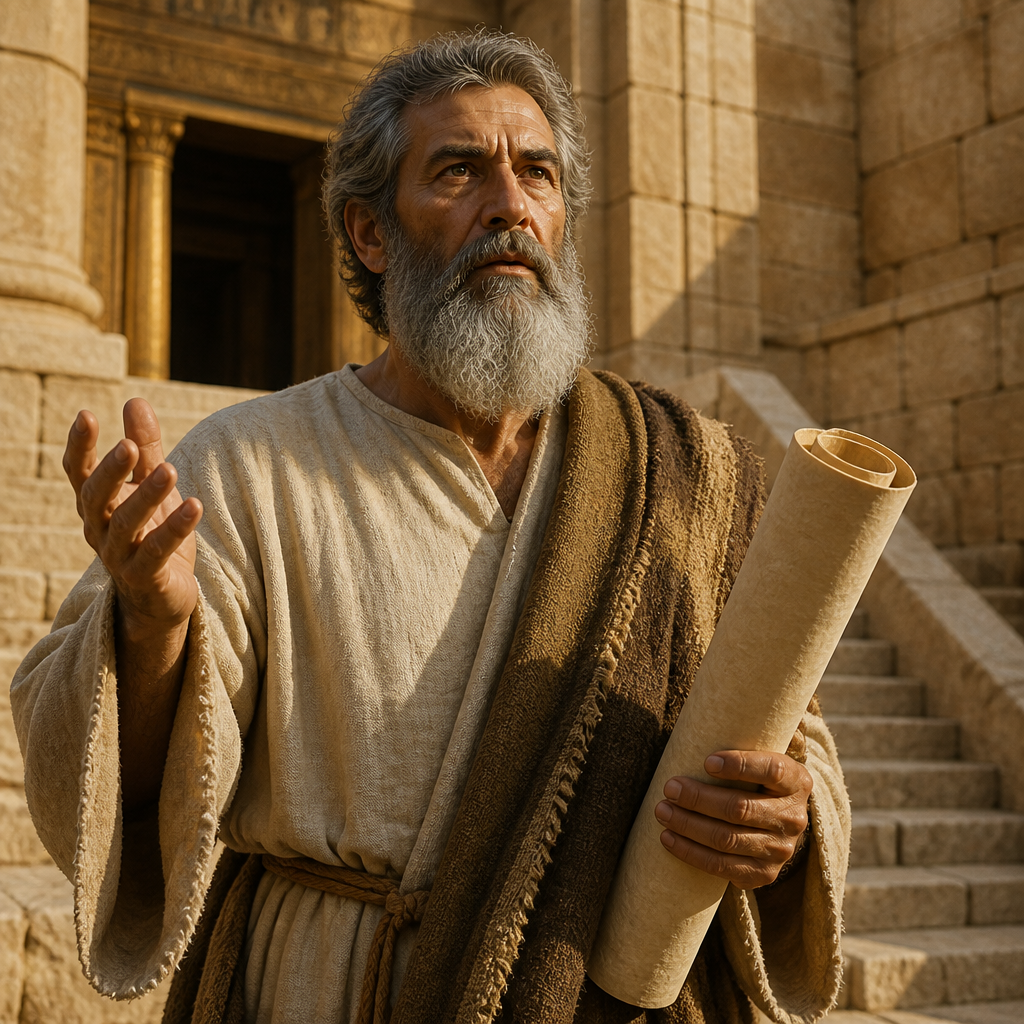 IsaiahThis page
Children
 Maher-shalal-hash-bazSon2 Kings 19:2
Inferred
No verse names Isaiah and Maher-shalal-hash-baz together; the son link is carried from the surrounding genealogy and is not stated in Scripture.Evidence: 2 Kings 19:2
 Shear-jashubSonIsaiah 7:3
Inferred
Isaiah 7:3 names Shear-jashub and Isaiah in the same verse but does not state a father tie between them; the link rests on the surrounding narrative.Evidence: Isaiah 7:3
Connected Figures
Family
Father · 2 Kings 19:2
The father of the prophet Isaiah, serving as a vital genealogical identifier for the prophet during the era of the Divided Monarchy in Judah.
Wife · 2 Kings 19:2
The wife of the prophet Isaiah during the Divided Monarchy, whose title and the birth of her son served as a prophetic sign to Judah.
Son · 2 Kings 19:2
The second son of the prophet Isaiah whose symbolic name predicted the imminent plunder of Damascus and Samaria by the Assyrian Empire.
Divided MonarchyFirst: Isaiah 8:14 versesProphetic sign-child
Son · Isaiah 7:3
The eldest son of the prophet Isaiah whose name, meaning 'a remnant shall return,' served as a prophetic sign to King Ahaz during the Syro-Ephraimite War.
Divided MonarchyFirst: Isaiah 7:32 versesProphetic sign / Son of a prophetEphraim
Categories
Mentions by Book
- 2 Kings13
- 2 Chronicles3
- Isaiah18
- Matthew6
- Mark2
- Luke2
- John4
- Acts3
- Romans5
Scripture References
All 56 indexed verses, in canonical order, from the Berean Standard Bible.
- 2 Kings 19:2
And he sent Eliakim the palace administrator, Shebna the scribe, and the leading priests, all wearing sackcloth, to the prophet Isaiah son of Amoz
- 2 Kings 19:5
So the servants of King Hezekiah went to Isaiah,
- 2 Kings 19:6
who replied, “Tell your master that this is what the LORD says: ‘Do not be afraid of the words you have heard, with which the servants of the king of Assyria have blasphemed Me.
- 2 Kings 19:20
Then Isaiah son of Amoz sent a message to Hezekiah: “This is what the LORD, the God of Israel, says: I have heard your prayer concerning Sennacherib king of Assyria.
- 2 Kings 20:1
In those days Hezekiah became mortally ill. The prophet Isaiah son of Amoz came to him and said, “This is what the LORD says: ‘Put your house in order, for you are about to die; you will not recover.’”
- 2 Kings 20:4
Before Isaiah had left the middle courtyard, the word of the LORD came to him, saying,
- 2 Kings 20:7
Then Isaiah said, “Prepare a poultice of figs.” So they brought it and applied it to the boil, and Hezekiah recovered.
- 2 Kings 20:8
Now Hezekiah had asked Isaiah, “What will be the sign that the LORD will heal me and that I will go up to the house of the LORD on the third day?”
- 2 Kings 20:9
And Isaiah had replied, “This will be a sign to you from the LORD that He will do what He has promised: Would you like the shadow to go forward ten steps, or back ten steps?”
- 2 Kings 20:11
So Isaiah the prophet called out to the LORD, and He brought the shadow back the ten steps it had descended on the stairway of Ahaz.
- 2 Kings 20:14
Then the prophet Isaiah went to King Hezekiah and asked, “Where did those men come from, and what did they say to you?” “They came from a distant land,” Hezekiah replied, “from Babylon.”
- 2 Kings 20:16
Then Isaiah said to Hezekiah, “Hear the word of the LORD:
- 2 Kings 20:19
But Hezekiah said to Isaiah, “The word of the LORD that you have spoken is good.” For he thought, “Will there not at least be peace and security in my lifetime?”
- 2 Chronicles 26:22
As for the rest of the acts of Uzziah, from beginning to end, they are recorded by the prophet Isaiah son of Amoz.
- 2 Chronicles 32:20
In response, King Hezekiah and the prophet Isaiah son of Amoz cried out to heaven in prayer,
- 2 Chronicles 32:32
As for the rest of the acts of Hezekiah and his deeds of loving devotion, they are indeed written in the vision of the prophet Isaiah son of Amoz in the Book of the Kings of Judah and Israel.
- Isaiah 1:1
This is the vision concerning Judah and Jerusalem that Isaiah son of Amoz saw during the reigns of Uzziah, Jotham, Ahaz, and Hezekiah, kings of Judah.
- Isaiah 2:1
This is the message that was revealed to Isaiah son of Amoz concerning Judah and Jerusalem:
- Isaiah 7:3
Then the LORD said to Isaiah, “Go out with your son Shear-jashub to meet Ahaz at the end of the aqueduct that feeds the upper pool, on the road to the Launderer’s Field,
- Isaiah 8:1Partial
Then the LORD said to me, “Take a large scroll and write on it with an ordinary stylus: Maher-shalal-hash-baz.
Cited as evidence on a family card; added so References, Key Verses and Mentions by Book share one index.
- Isaiah 8:3Partial
And I had relations with the prophetess, and she conceived and gave birth to a son. The LORD said to me, “Name him Maher-shalal-hash-baz.
Cited as evidence on a family card; added so References, Key Verses and Mentions by Book share one index.
- Isaiah 13:1
This is the burden against Babylon that Isaiah son of Amoz received:
- Isaiah 20:2
the LORD had already spoken through Isaiah son of Amoz, saying, “Go, remove the sackcloth from your waist and the sandals from your feet.” And Isaiah did so, walking around naked and barefoot.
- Isaiah 20:3
Then the LORD said, “Just as My servant Isaiah has gone naked and barefoot for three years as a sign and omen against Egypt and Cush,
- Isaiah 37:2
And he sent Eliakim the palace administrator, Shebna the scribe, and the leading priests, all wearing sackcloth, to the prophet Isaiah son of Amoz
- Isaiah 37:5
So the servants of King Hezekiah went to Isaiah,
- Isaiah 37:6
who replied, “Tell your master that this is what the LORD says: ‘Do not be afraid of the words you have heard, with which the servants of the king of Assyria have blasphemed Me.
- Isaiah 37:21
Then Isaiah son of Amoz sent a message to Hezekiah: “This is what the LORD, the God of Israel, says: Because you have prayed to Me concerning Sennacherib king of Assyria,
- Isaiah 38:1
In those days Hezekiah became mortally ill. The prophet Isaiah son of Amoz came to him and said, “This is what the LORD says: ‘Put your house in order, for you are about to die; you will not recover.’”
- Isaiah 38:4
And the word of the LORD came to Isaiah, saying,
- Isaiah 38:21
Now Isaiah had said, “Prepare a lump of pressed figs and apply it to the boil, and he will recover.”
- Isaiah 39:3
Then the prophet Isaiah went to King Hezekiah and asked, “Where did those men come from, and what did they say to you?” “They came to me from a distant land,” Hezekiah replied, “from Babylon.”
- Isaiah 39:5
Then Isaiah said to Hezekiah, “Hear the word of the LORD of Hosts:
- Isaiah 39:8
But Hezekiah said to Isaiah, “The word of the LORD that you have spoken is good.” For he thought, “At least there will be peace and security in my lifetime.”
- Matthew 3:3
This is he who was spoken of through the prophet Isaiah: “A voice of one calling in the wilderness, ‘Prepare the way for the Lord, make straight paths for Him.’”
- Matthew 4:14
to fulfill what was spoken through the prophet Isaiah:
- Matthew 8:17
This was to fulfill what was spoken through the prophet Isaiah: “He took up our infirmities and carried our diseases.”
- Matthew 12:17
This was to fulfill what was spoken through the prophet Isaiah:
- Matthew 13:14
In them the prophecy of Isaiah is fulfilled: ‘You will be ever hearing but never understanding; you will be ever seeing but never perceiving.
- Matthew 15:7
You hypocrites! Isaiah prophesied correctly about you:
- Mark 1:2Partial
As it is written in Isaiah the prophet: “Behold, I will send My messenger ahead of You, who will prepare Your way.”
- Mark 7:6
Jesus answered them, “Isaiah prophesied correctly about you hypocrites, as it is written: ‘These people honor Me with their lips, but their hearts are far from Me.
- Luke 3:4
as it is written in the book of the words of Isaiah the prophet: “A voice of one calling in the wilderness, ‘Prepare the way for the Lord, make straight paths for Him.
- Luke 4:17
the scroll of the prophet Isaiah was handed to Him. Unrolling it, He found the place where it was written:
- John 1:23
John replied in the words of Isaiah the prophet: “I am a voice of one calling in the wilderness, ‘Make straight the way for the Lord.’”
- John 12:38
This was to fulfill the word of Isaiah the prophet: “Lord, who has believed our message? And to whom has the arm of the Lord been revealed?”
- John 12:39
For this reason they were unable to believe. For again, Isaiah says:
- John 12:41
Isaiah said these things because he saw Jesus’ glory and spoke about Him.
- Acts 8:28
and on his return was sitting in his chariot reading Isaiah the prophet.
- Acts 8:30
So Philip ran up and heard the man reading Isaiah the prophet. “Do you understand what you are reading?” Philip asked.
- Acts 28:25
They disagreed among themselves and began to leave after Paul had made this final statement: “The Holy Spirit was right when He spoke to your fathers through Isaiah the prophet:
- Romans 9:27
Isaiah cries out concerning Israel: “Though the number of the Israelites is like the sand of the sea, only the remnant will be saved.
- Romans 9:29
It is just as Isaiah foretold: “Unless the Lord of Hosts had left us descendants, we would have become like Sodom, we would have resembled Gomorrah.”
- Romans 10:16
But not all of them welcomed the good news. For Isaiah says, “Lord, who has believed our message?”
- Romans 10:20
And Isaiah boldly says: “I was found by those who did not seek Me; I revealed Myself to those who did not ask for Me.”
- Romans 15:12
And once more, Isaiah says: “The Root of Jesse will appear, One who will arise to rule over the Gentiles; in Him the Gentiles will put their hope.”