Matthew
Who was Matthew in the Bible?
A Galilean tax collector turned apostle of Jesus Christ, traditionally identified as the author of the First Gospel.
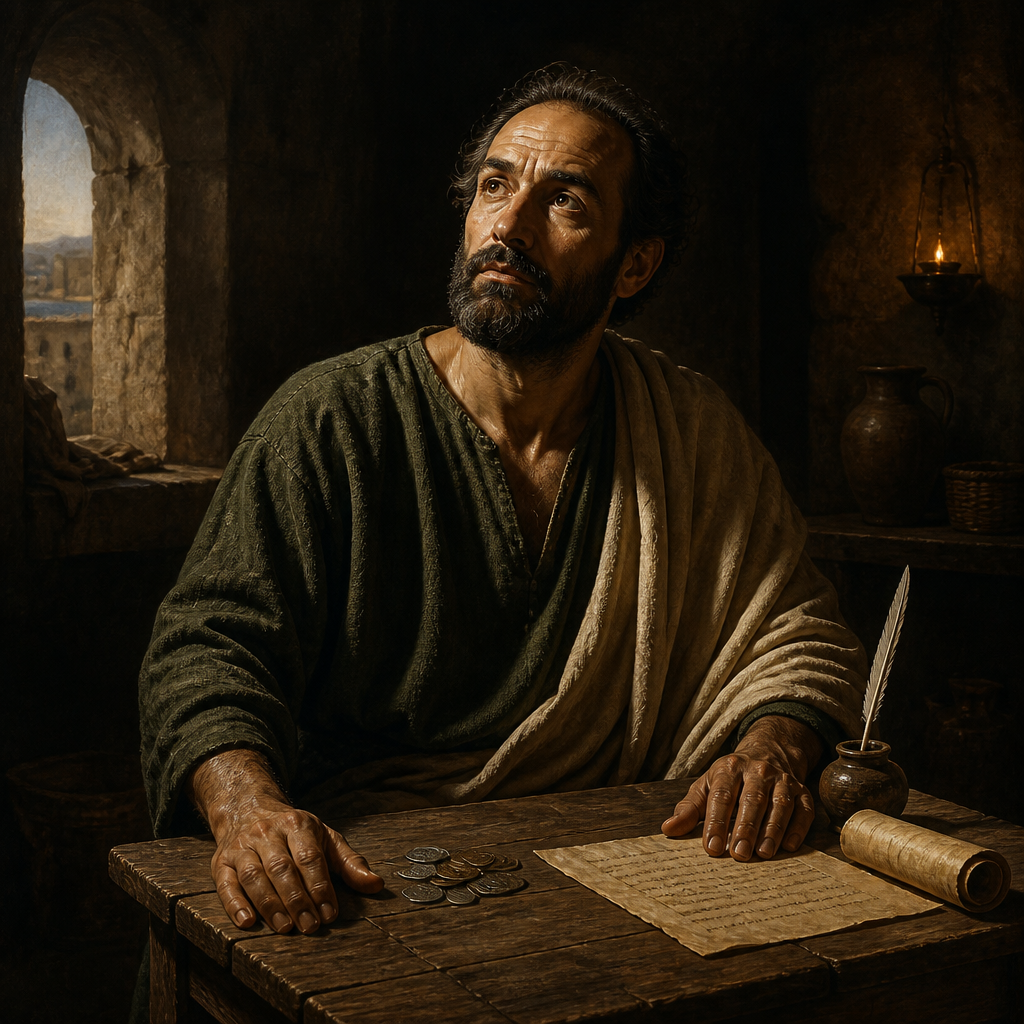
Matthew, also known as Levi, was one of the twelve original apostles chosen by Jesus Christ during His earthly ministry. Originally a publican, or tax collector, in the service of the Roman-backed Herodian government, Matthew occupied a position that was socially and religiously marginalized within Jewish society. His call to discipleship is one of the most striking examples of Jesus reaching out to those considered outcasts by the religious establishment of the time.
Following his call at the tax booth in Capernaum, Matthew became a witness to the teachings, miracles, crucifixion, and resurrection of Jesus. He is historically and traditionally credited with the authorship of the Gospel According to Matthew, a narrative specifically structured to demonstrate to a Jewish audience that Jesus of Nazareth was the long-awaited Messiah promised in the Old Testament scriptures. His life represents a profound transformation from a servant of the Roman economy to a pillar of the early Christian Church.
Background and Family
Matthew was the son of Alphaeus (Mark 2:14) and resided in Capernaum, a bustling commercial hub on the Sea of Galilee. Unlike many of the other apostles who were fishermen, Matthew was a man of letters and finances. He served as a telōnēs (tax collector), specifically stationed at a "customs office." This suggests he was likely responsible for collecting tolls on goods transported along the Via Maris, a major trade route passing through Galilee.
In the Synoptic Gospels, he is referred to both as Matthew and Levi. It was common in the first century AD for Jewish men to have two names—one Hebrew (Levi) and one Greek or a distinct religious name (Matthew, meaning "Gift of Yahweh"). His profession required him to be literate in Aramaic and Greek and proficient in record-keeping, skills that would later serve the early Church in the preservation of the teachings of Jesus. Despite his likely wealth, his profession made him a social pariah; tax collectors were frequently grouped with "sinners" and "prostitutes" because they collaborated with the Roman occupiers and often engaged in extortion.
Major Life Events
The Call of Matthew
The most pivotal moment in Matthew's life occurred while he was sitting at his tax booth. As recorded in Matthew 9:9, Jesus walked by and said simply, "Follow me." In a radical departure from his lucrative career, Matthew rose, left everything behind, and followed Him. To celebrate this transition, Matthew hosted a "great banquet" at his house, inviting a large crowd of his fellow tax collectors and other social outcasts to meet Jesus. This event sparked a significant confrontation with the Pharisees, who questioned why Jesus ate with such people. Jesus responded with the famous dictum: "Those who are well have no need of a physician, but those who are sick... I came not to call the righteous, but sinners."
Apostleship and Ministry
Matthew was formally appointed as one of the Twelve (Matthew 10:3, Luke 6:15), granting him the authority to preach the Kingdom of God and perform healings. He was present during the Sermon on the Mount, the feeding of the five thousand, and the Transfiguration. Following the resurrection of Jesus, Matthew was among those in the Upper Room in Jerusalem awaiting the Holy Spirit at Pentecost (Acts 1:13). While the biblical record focus shifts to Peter and Paul in the book of Acts, church tradition, including the writings of Eusebius and Papias, suggests that Matthew preached among the Hebrews for several years before traveling to other nations, such as Ethiopia, Persia, or Parthia, though the specific details of his later travels are not confirmed by Scripture.
Relationship to Other Biblical Figures
Matthew’s primary relationship was his submission to Jesus Christ as Lord and Master. Within the apostolic circle, Matthew is often paired with Thomas in the lists of the Twelve. As the son of Alphaeus, some scholars have wondered if he was related to James the Less (also the son of Alphaeus), though the Bible never explicitly calls them brothers. His background as a tax collector would have put him in natural tension with Simon the Zealot, another apostle whose political ideology was centered on the violent overthrow of the Roman system that Matthew once served. The unity of these two men under Christ serves as a testament to the reconciling power of the Gospel.
Spiritual Significance
Matthew serves as a vital witness to the Messianic identity of Jesus, particularly through his emphasis on the fulfillment of Old Testament Law and prophecy. His inclusion in the inner circle of the Twelve underscores the inclusive nature of the Gospel, breaking down the social barriers between the 'righteous' religious elite and the 'sinful' outcasts.
Furthermore, his legacy is inextricably linked to the First Gospel, which provided the early Church with a systematic record of Jesus' teachings, most notably the Sermon on the Mount and the Great Commission. His perspective as a former administrator is reflected in the organized, thematic structure of his writings, which helped establish the foundational doctrines of the Christian faith for generations of believers.
The spiritual significance of Matthew lies in his role as the bridge between the Old and New Testaments. As the traditional author of the First Gospel, he meticulously documented how Jesus fulfilled specific messianic prophecies. Matthew’s account is famous for its five great discourses, emphasizing Jesus as the New Moses and the King of Israel.
Theologically, Matthew represents the grace of God toward the unworthy. In the Jewish mind of the 1st century AD, a tax collector was a traitor to the covenant. By choosing Matthew, Jesus demonstrated that no one is beyond the reach of divine redemption. Matthew’s immediate response to Christ—leaving a stable income for an uncertain future—serves as a model of total discipleship. His life reflects the theme that the Kingdom of Heaven is a treasure worth selling everything one owns to possess.
Frequently Asked Questions
Are Matthew and Levi the same person?
Yes. The Gospels of Mark and Luke refer to the call of 'Levi' the tax collector, while the Gospel of Matthew refers to the same event involving 'Matthew.' It was common for individuals in that era to have two names.
What was Matthew's occupation before following Jesus?
Matthew was a tax collector (publican) in Capernaum. This role involved collecting duties on behalf of the Roman-supported local government, a job that made him unpopular with his fellow Jews.
Did Matthew write the Gospel of Matthew?
Universal early church tradition ascribes the First Gospel to Matthew the Apostle. Internal evidence, such as the detailed focus on money and specific numbers, aligns with Matthew's background as a tax collector.
How did Matthew die?
The Bible does not record the death of Matthew. Various church traditions claim he died as a martyr, with some accounts suggesting he was killed by the sword in Ethiopia or Parthia.
What is Matthew's symbol in Christian art?
Matthew is often symbolized by a winged man or an angel, representing the human genealogy of Christ with which his Gospel begins.
Family & Relationships
Parents
 AlphaeusFatherMark 2:14
Inferred
Mark 2:14 names Levi son of Alphaeus; Matthew 9:9 places Matthew in the same tax-booth call, so the site treats Levi and Matthew as one man.Evidence: Mark 2:14; Matthew 9:9
 MatthewThis page
 James son of AlphaeusBrotherMatthew 10:3
Inferred
Matthew 10:3 names James son of Alphaeus and Mark 2:14 names Levi son of Alphaeus; the brotherhood follows only if the two patronymics name the same Alphaeus.Evidence: Matthew 10:3; Mark 2:14
Connected Figures
Family
Father · Mark 2:14
Alphaeus is named as the father of the apostle James, and Levi the tax collector's father is also called Alphaeus; Scripture never says whether they were the same man.
Brother · Matthew 10:3
One of the twelve original apostles of Jesus Christ, distinguished by his parentage to Alphaeus and often identified as 'James the Less' or 'the younger.'
Categories
Mentions by Book
- Matthew3
- Mark3
- Luke4
- Acts1
Scripture References
All 11 indexed verses, in canonical order, from the Berean Standard Bible.
Matthew · 3
- Matthew 9:9
As Jesus went on from there, He saw a man named Matthew sitting at the tax booth. “Follow Me,” He told him, and Matthew got up and followed Him.
- Matthew 10:3
Philip and Bartholomew; Thomas and Matthew the tax collector; James son of Alphaeus, and Thaddaeus;
- Matthew 27:56Partial
Among them were Mary Magdalene, Mary the mother of James and Joseph, and the mother of Zebedee’s sons.
Cited as evidence on a family card; added so References, Key Verses and Mentions by Book share one index.
Mark · 3
- Mark 2:14
As He was walking along, He saw Levi son of Alphaeus sitting at the tax booth. “Follow Me,” He told him, and Levi got up and followed Him.
- Mark 3:18
Andrew, Philip, Bartholomew, Matthew, Thomas, James son of Alphaeus, Thaddaeus, Simon the Zealot,
- Mark 15:40Partial
And there were also women watching from a distance. Among them were Mary Magdalene, Mary the mother of James the younger and of Joses, and Salome.
Cited as evidence on a family card; added so References, Key Verses and Mentions by Book share one index.
Luke · 4
- Luke 5:27
After this, Jesus went out and saw a tax collector named Levi sitting at the tax booth. “Follow Me,” He told him,
- Luke 5:28Partial
and Levi got up, left everything, and followed Him.
Cited as a key verse; added so References, Key Verses and Mentions by Book share one index.
- Luke 5:29
Then Levi hosted a great banquet for Jesus at his house. A large crowd of tax collectors was there, along with others who were eating with them.
- Luke 6:15
Matthew and Thomas; James son of Alphaeus and Simon called the Zealot;
Acts · 1
- Acts 1:13
When they arrived, they went to the upper room where they were staying: Peter and John, James and Andrew, Philip and Thomas, Bartholomew and Matthew, James son of Alphaeus, Simon the Zealot, and Judas son of James.