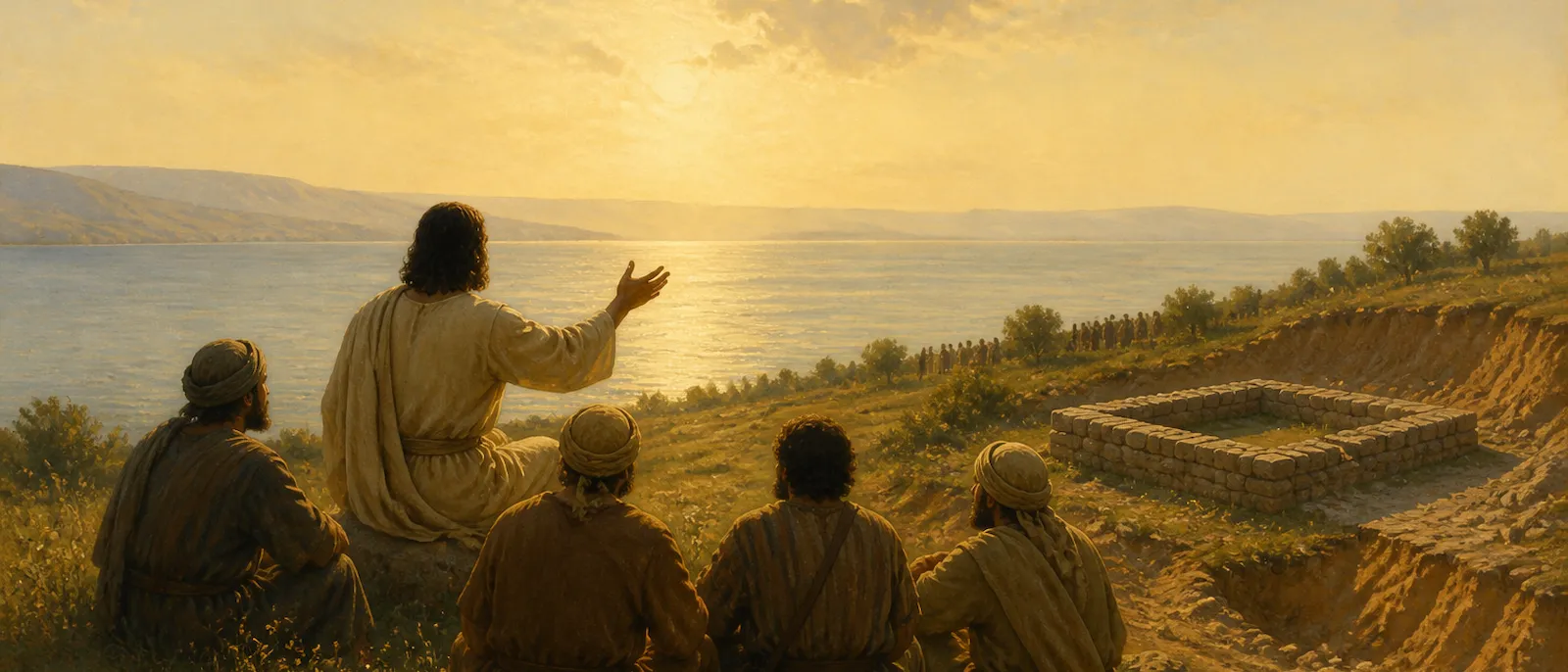
The Sermon on the Mount
Jesus ascends a mountain in Galilee to deliver an extensive teaching to his disciples and the gathered crowds regarding the law and the kingdom of heaven.
- Matthew 5-7
- Galilee
- 1 named participant
What the passage records
Matthew 5-7After seeing the crowds, Jesus goes up on a mountain and sits down, at which point his disciples approach him (Matthew 5:1). He begins his teaching by pronouncing blessings on specific groups, including the poor in spirit, those who mourn, the meek, and those who hunger for righteousness (Matthew 5:3-6). He instructs his followers that they are the salt of the earth and the light of the world, warning them not to lose their flavor or hide their light. Regarding the law and the prophets, Jesus states he did not come to abolish them but to fulfill them, asserting that the law will remain until all is accomplished (Matthew 5:17-18).
Jesus provides several comparisons between traditional teachings and his own instructions, covering topics such as anger, adultery, and oaths. The text does not say exactly how many people were present, but he commands his listeners to love their enemies and pray for those who persecute them so they may be children of their Father in heaven (Matthew 5:44-45). He provides instructions on giving to the needy, praying, and fasting, emphasizing that these acts should be done in secret rather than for public display. Within these instructions, he provides a specific model for prayer and commands his audience to forgive others their trespasses (Matthew 6:9-14).
He further instructs the crowd to seek first the kingdom of God and his righteousness, rather than worrying about food, drink, or clothing (Matthew 6:33). Jesus warns against judging others, using the illustration of a speck and a log in one's eye. He describes the difference between a wide gate leading to destruction and a narrow gate leading to life (Matthew 7:13-14). He concludes by comparing those who hear and do his words to a wise man who built his house on a rock, which remained standing during a storm, whereas those who do not act on his words are like a foolish man who built on sand and suffered a great fall (Matthew 7:24-27).
Outcome
When Jesus finished his sayings, the crowds were astonished at his teaching because he taught as one having authority rather than as the scribes (Matthew 7:28-29).
Who was there
1 person from Matthew 5-7 is listed here.
