Maher-shalal-hash-baz
Who was Maher-shalal-hash-baz in the Bible?
The second son of the prophet Isaiah whose symbolic name predicted the imminent plunder of Damascus and Samaria by the Assyrian Empire.
Maher-shalal-hash-baz was a prophetic figure during the era of the Divided Monarchy in the Kingdom of Judah. He is primarily known as the son of the prophet Isaiah and his wife, referred to as "the prophetess." His existence is inextricably linked to a specific prophetic message regarding the geopolitical crisis facing Judah during the Syro-Ephraimite War in the 8th century BC.
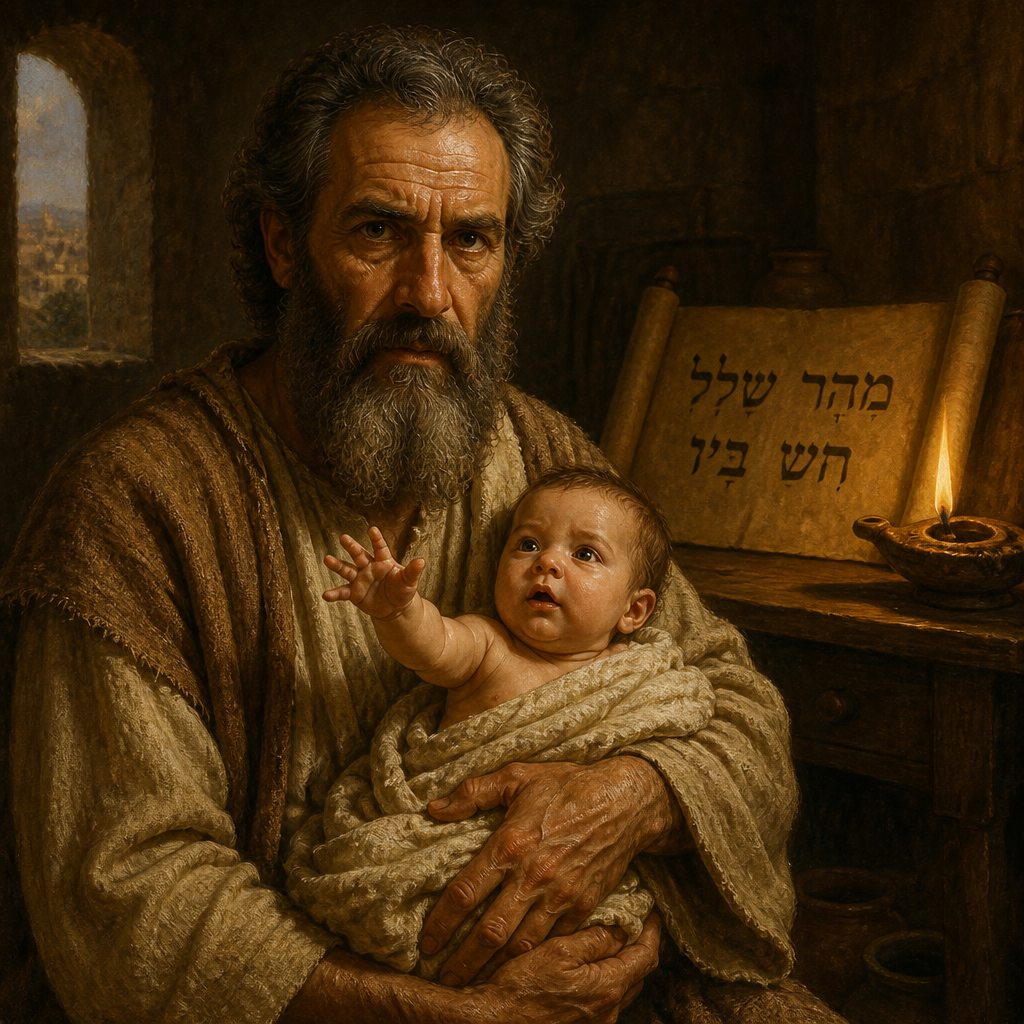
His name, which translates to "Quick to the plunder, swift to the spoil," served as a living sign to King Ahaz and the people of Jerusalem. The LORD commanded Isaiah to record this name on a large scroll before witnesses even before the child was conceived, establishing a divine timeline for the destruction of Judah's northern enemies. As a child of a prophet, Maher-shalal-hash-baz’s very identity was a public testimony of God’s intervention in the history of Israel and the surrounding nations.
Background and Family
Maher-shalal-hash-baz was born into a family deeply immersed in the prophetic ministry of the Southern Kingdom of Judah. His father was Isaiah, son of Amoz, one of the most prominent prophets in the Old Testament. His mother is identified in the biblical text as "the prophetess" (Isaiah 8:3), a title that likely signifies her role as the wife of a prophet or perhaps indicates she held a prophetic gift of her own.
He had at least one older sibling, Shear-jashub, whose name also bore prophetic weight ("A remnant shall return"). The family lived during the tumultuous reign of King Ahaz, a time when the Divided Monarchy faced significant external threats from the coalition of the Northern Kingdom of Israel (Ephraim) and the Aramean kingdom of Syria (Damascus).
Major Life Events
The life of Maher-shalal-hash-baz was marked by divine instruction before he was even conceived. In Isaiah 8:1, the LORD commanded Isaiah to take a large scroll and write the name "Maher-shalal-hash-baz" using an ordinary stylus. This act was witnessed by reliable men, Uriah the priest and Zechariah son of Jeberechiah, to ensure the prophecy's authenticity and timing.
Following this public declaration, Isaiah "had relations with the prophetess," and she conceived. Upon the birth of the boy, the LORD explicitly instructed Isaiah to name him Maher-shalal-hash-baz. The purpose of this specific naming was revealed in the accompanying prophecy: before the child was old enough to speak the words "My father" or "My mother," the wealth of Damascus and the plunder of Samaria would be carried off by the King of Assyria (Isaiah 8:4). This effectively set a countdown of approximately one to two years for the fall of the Syro-Ephraimite coalition.
Relationship to Other Biblical Figures
As the son of Isaiah, Maher-shalal-hash-baz was part of what the prophet described as "the signs and symbols in Israel from the LORD Almighty" (Isaiah 8:18). His relationship to his father was not merely biological but vocational; he and his brother Shear-jashub were living embodiments of Isaiah’s messages to the Davidic court. While the biblical text provides no further details regarding his adult life or subsequent career, his infancy served as a critical pivot point in the survival of the Davidic line during the Assyrian crisis.
Spiritual Significance
The spiritual significance of Maher-shalal-hash-baz lies in the concept of the "prophetic sign-act." In the ancient Near Eastern context, names were often descriptive of character or destiny. By naming his son "Quick to the plunder, swift to the spoil," Isaiah signaled that God was actively moving the Assyrian forces to judge the nations that were threatening Judah.
His existence reminded the people of Judah that God’s word is verifiable and tied to human history. The requirement for witnesses and the public writing of the name emphasized that God’s judgment was not a hidden secret but a declared reality. Maher-shalal-hash-baz stands as a testament to the fact that God uses the ordinary milestones of life—birth, naming, and growth—to communicate His sovereign control over the rise and fall of empires.
Maher-shalal-hash-baz is significant as the bearer of the longest name in the Bible, but more importantly, he serves as a chronological marker for divine prophecy. His birth confirmed that the alliance between Rezin of Syria and Pekah of Israel would fail quickly, providing a visible assurance to the people of Judah of God's protection through the Assyrian instrument of judgment.
Furthermore, he represents the theme of 'prophetic children' found in the book of Isaiah. Along with his brother, he demonstrates that the prophet's entire household was dedicated to the service of the LORD’s word, serving as a physical manifestation of the impending shifts in the geopolitical landscape of the ancient Near East.
Frequently Asked Questions
What does the name Maher-shalal-hash-baz mean?
The name is Hebrew for 'Quick to the plunder, swift to the spoil,' or 'Hasten to the booty! Speed to the prey!'
Who were Maher-shalal-hash-baz's parents?
He was the son of the prophet Isaiah and a woman referred to as 'the prophetess.'
Why did God tell Isaiah to write the name on a scroll?
God commanded the name to be written before witnesses to prove that the prophecy of the fall of Damascus and Samaria was spoken before the events actually happened.
Did Maher-shalal-hash-baz have any siblings?
Yes, he had a brother named Shear-jashub, whose name means 'A remnant shall return.'
How long did the prophecy associated with him take to be fulfilled?
The text indicates it would be fulfilled before the child could say 'My father' or 'My mother,' roughly within two years of his birth.
Family & Relationships
Parents
 IsaiahFather2 Kings 19:2
Inferred
No verse names Isaiah and Maher-shalal-hash-baz together; the son link is carried from the surrounding genealogy and is not stated in Scripture.Evidence: 2 Kings 19:2
 The Prophetess, Wife of IsaiahMotherIsaiah 8:3Stated
 Maher-shalal-hash-bazThis page
 Shear-jashubBrotherIsaiah 7:3
Inferred
No verse names Shear-jashub and Maher-shalal-hash-baz together; the brother link is carried from the surrounding genealogy and is not stated in Scripture.Evidence: Isaiah 7:3
Connected Figures
Family
Father · 2 Kings 19:2
Isaiah, the son of Amoz, was a major prophet in Judah whose ministry spanned the reigns of four kings and who is widely quoted in the New Testament for his messianic and redemptive visions.
Mother · Isaiah 8:3
The wife of the prophet Isaiah during the Divided Monarchy, whose title and the birth of her son served as a prophetic sign to Judah.
Brother · Isaiah 7:3
The eldest son of the prophet Isaiah whose name, meaning 'a remnant shall return,' served as a prophetic sign to King Ahaz during the Syro-Ephraimite War.
Divided MonarchyFirst: Isaiah 7:32 versesProphetic sign / Son of a prophetEphraim
Categories
Mentions by Book
- 2 Kings1
- Isaiah3
Scripture References
All 4 indexed verses, in canonical order, from the Berean Standard Bible.
2 Kings · 1
- 2 Kings 19:2Partial
And he sent Eliakim the palace administrator, Shebna the scribe, and the leading priests, all wearing sackcloth, to the prophet Isaiah son of Amoz
Cited as evidence on a family card; added so References, Key Verses and Mentions by Book share one index.
Isaiah · 3
- Isaiah 7:3Partial
Then the LORD said to Isaiah, “Go out with your son Shear-jashub to meet Ahaz at the end of the aqueduct that feeds the upper pool, on the road to the Launderer’s Field,
Cited as evidence on a family card; added so References, Key Verses and Mentions by Book share one index.
- Isaiah 8:1
Then the LORD said to me, “Take a large scroll and write on it with an ordinary stylus: Maher-shalal-hash-baz.
- Isaiah 8:3
And I had relations with the prophetess, and she conceived and gave birth to a son. The LORD said to me, “Name him Maher-shalal-hash-baz.