Hezekiah, King of Judah
Who was Hezekiah, King of Judah, in the Bible?
The 13th king of Judah, known for his sweeping religious reforms, the miraculous defense of Jerusalem against Assyria, and his restoration of the Passover.
This is one of 4 people named Hezekiah in the Bible. See all 4 →
Hezekiah was one of the few kings of Judah whom the biblical writers regarded as wholly devoted to the Lord. Ascending the throne at age twenty-five during a period of spiritual decline and geopolitical instability, he succeeded his father, the wicked King Ahaz. Unlike his father, who had shuttered the Temple and promoted idolatry, Hezekiah immediately initiated a national reformation, reopening the sanctuary and centralizing worship in Jerusalem according to the Law of Moses. His reign, spanning twenty-nine years from approximately 715 BC to 686 BC, was defined by a steadfast reliance on Yahweh in the face of the encroaching Neo-Assyrian Empire.
Hezekiah’s tenure is recorded with significant detail across three major biblical books: 2 Kings, 2 Chronicles, and Isaiah. He is famously remembered for his defiance of Sennacherib, the king of Assyria, and for the subsequent divine deliverance of Jerusalem. His life was marked by both profound faith and a notable moment of pride regarding his wealth, yet the Chronicler summarizes his legacy as one who 'did what was good and upright and true before the Lord his God.'
Background and Family
Hezekiah was the son of King Ahaz and Abi (also called Abijah), the daughter of Zechariah (2 Chronicles 29:1). He was born into the Davidic line during the Divided Monarchy, a time when the Northern Kingdom of Israel was nearing its collapse and the Southern Kingdom of Judah was under heavy Assyrian influence. Hezekiah’s upbringing stood in stark contrast to his eventual policies; his father Ahaz had been a notorious idolater who even sacrificed his own sons in fire. Despite this dark heritage, Hezekiah turned toward the God of David.
Hezekiah married Hephzibah, and together they had a son named Manasseh, who would eventually succeed him on the throne (2 Kings 21:1). The biblical record also mentions a brother named Maaseiah, who was killed during a conflict with the Northern Kingdom prior to Hezekiah's reign.
Major Life Events
Religious Reformation and the Passover
Upon taking the throne, Hezekiah’s first priority was the spiritual restoration of Judah. He broke down the high places, smashed the sacred stones, and cut down the Asherah poles. Most notably, he destroyed the bronze serpent that Moses had made, because the people had begun to offer incense to it (2 Kings 18:4). He reopened and repaired the doors of the Temple, commanding the Levites to sanctify themselves and the house of the Lord.
Hezekiah is also credited with a massive revival of the Passover. He sent couriers throughout all Israel and Judah—reaching as far north as Ephraim and Zebulun—inviting everyone to Jerusalem. While some mocked the messengers, many traveled to participate in what became the greatest Passover celebration since the days of Solomon (2 Chronicles 30:26).
The Assyrian Crisis
In the fourteenth year of his reign, Hezekiah faced his greatest political challenge. Sennacherib, king of Assyria, invaded Judah and captured its fortified cities. Initially, Hezekiah attempted to buy peace, stripping the gold from the Temple doors to pay a heavy tribute. However, Sennacherib was not satisfied and sent his officials, including the Rabshakeh, to demand the total surrender of Jerusalem. The Assyrian messengers mocked Hezekiah’s trust in God, shouting in Hebrew to the people on the walls that no god had ever delivered a nation from Assyria.
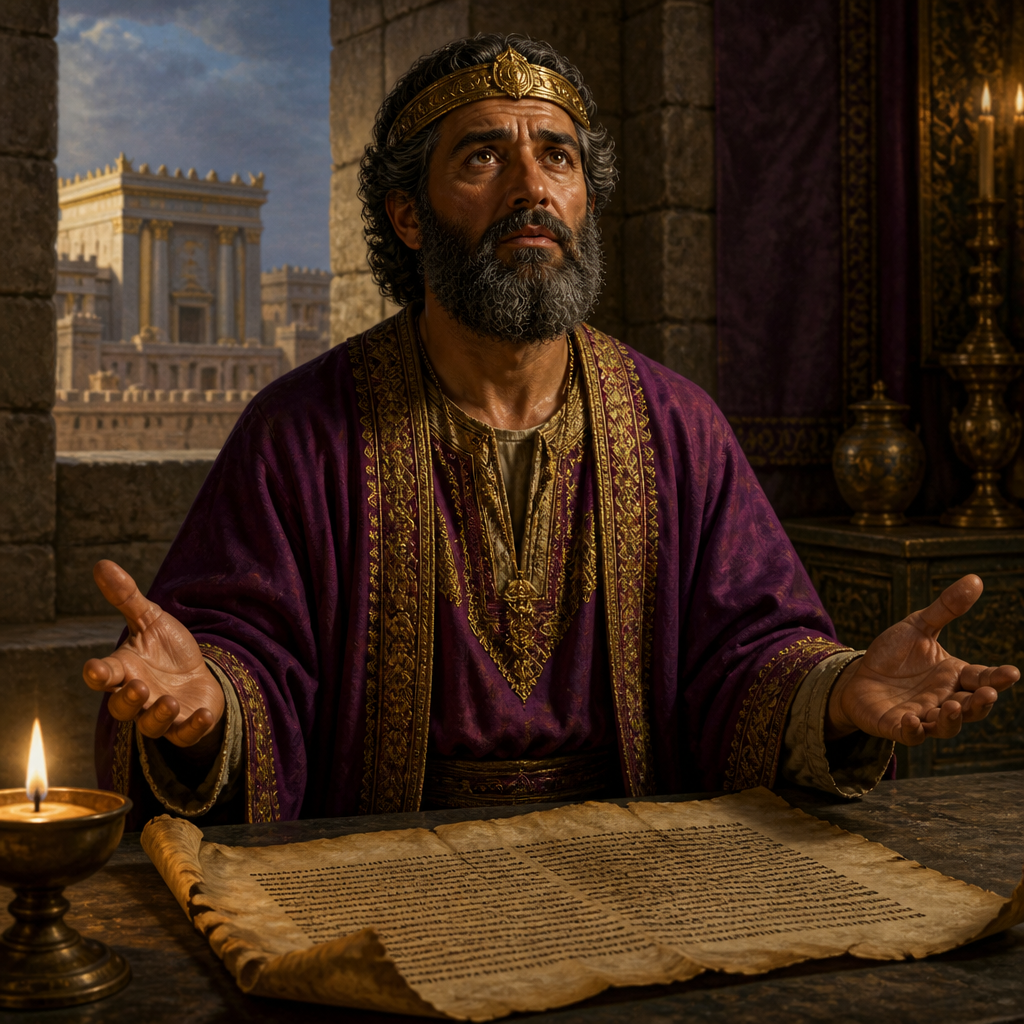
In deep distress, Hezekiah went to the Temple and spread Sennacherib's threatening letter before the Lord. He sought the counsel of the prophet Isaiah, who assured him that God would defend the city. That night, the Angel of the Lord struck down 185,000 Assyrian soldiers in their camp, forcing Sennacherib to withdraw (2 Kings 19:35).
Illness and the Babylonian Envoys
Shortly after the Assyrian crisis, Hezekiah became mortally ill. Isaiah visited him with a message to set his house in order, for he was to die. Hezekiah wept and prayed, reminding God of his faithfulness. In response, God granted him fifteen additional years of life and provided a miraculous sign: the shadow on the stairway of Ahaz went back ten steps (Isaiah 38:8).
However, this extension of life brought a moment of spiritual failure. When envoys from Babylon arrived to congratulate him on his recovery, Hezekiah, in a fit of pride, showed them all the treasures of his house and kingdom. Isaiah rebuked him, prophesying that all those treasures—and Hezekiah’s own descendants—would one day be carried off to Babylon.
Relationship to Other Biblical Figures
Hezekiah maintained a close and vital relationship with the prophet Isaiah, who served as his spiritual advisor and the voice of God during national crises. He also looked back to David as his primary model for kingship, specifically emulating David's organization of the Levites and musical worship. In his later years, his relationship with his son Manasseh was critical, though Manasseh would tragically undo much of his father's work upon his death. The king also supported literary efforts, as the Book of Proverbs notes that the 'men of Hezekiah' transcribed many of Solomon's sayings (Proverbs 25:1).
Spiritual Significance
Hezekiah’s life serves as a primary example of how individual faithfulness can impact a nation's destiny. The Bible evaluates him as a king who 'trusted in the Lord, the God of Israel,' stating that there was no one like him among all the kings of Judah (2 Kings 18:5). Theologically, his reign illustrates the power of intercessory prayer, seen in his petition for the ceremonially unclean who ate the Passover and his plea for deliverance from Assyria. His construction of the Gihon water tunnel (2 Kings 20:20) remains a physical testament to his wisdom and preparation, but the scriptures emphasize that his true strength lay in his reliance on the 'arm of the Lord' rather than the 'arm of flesh' (2 Chronicles 32:8).
Hezekiah is a pivotal figure in the history of the Divided Monarchy, representing a brief but powerful 'golden age' of spiritual renewal for the Southern Kingdom. His reforms slowed Judah's drift toward the idolatry that had already destroyed the Northern Kingdom of Israel. He is unique for his successful resistance against the Assyrian Empire, a feat attributed directly to his faith and prayer rather than military might. Furthermore, his inclusion in the genealogy of Jesus (Matthew 1:9-10) cements his place in the Messianic line, despite the failures of his father Ahaz and his son Manasseh.
Theologically, Hezekiah’s life highlights the tension between human success and spiritual humility. While he was highly favored and miraculously healed, the episode with the Babylonian envoys serves as a warning about the dangers of pride and the long-term consequences of one's actions on future generations. Nevertheless, his legacy remains one of the most positive in the Old Testament, characterized by his zeal for the Temple and his dedication to the Law.
Frequently Asked Questions
Why did Hezekiah destroy the bronze serpent of Moses?
Hezekiah destroyed it because the Israelites had turned it into an idol, calling it Nehushtan and offering incense to it, which violated the command to worship God alone.
How many years were added to Hezekiah's life?
After Hezekiah prayed and wept during a mortal illness, God sent the prophet Isaiah to tell him that fifteen years would be added to his life.
What was Hezekiah's Tunnel?
It was an engineering feat mentioned in 2 Kings 20:20 and 2 Chronicles 32:30 where Hezekiah blocked the upper outlet of the Gihon Spring and channeled water through a tunnel into the City of David to ensure a water supply during the Assyrian siege.
What did Isaiah prophesy after Hezekiah showed his treasures to Babylon?
Isaiah prophesied that everything in the palace and everything the kings of Judah had stored up would be carried off to Babylon, and some of Hezekiah's own descendants would become eunuchs in the palace of the king of Babylon.
How did Hezekiah celebrate the Passover differently?
He invited all of Israel and Judah, including tribes from the defunct Northern Kingdom, and he prayed for God to pardon those who were not ceremonially clean, which resulted in a massive, joyful fourteen-day celebration.
Family & Relationships
Parents
 AbiMother2 Kings 18:2Stated
 Ahaz, King of JudahFather2 Kings 16:20Stated
 HephzibahWife2 Kings 20:21
Inferred
Reconstructed through Manasseh: 2 Kings 20:21 ties Hezekiah to Manasseh; 2 Kings 21:1 ties Manasseh to Hephzibah. No verse states the wife link between Hezekiah and Hephzibah directly.Evidence: 2 Kings 20:21; 2 Kings 21:1; 1 Chronicles 3:13; Jeremiah 15:4; Matthew 1:10
 Hezekiah, King of JudahThis page
 Maaseiah, son of King AhazBrother2 Kings 16:20
Inferred
No verse names Hezekiah and Maaseiah together; the brother link is carried from the surrounding genealogy and is not stated in Scripture.Evidence: 2 Kings 16:20
Children
 Manasseh, King of JudahSon2 Kings 20:21Stated
Connected Figures
Family
Mother · 2 Kings 18:2
Abi was the daughter of Zechariah, the wife of King Ahaz of Judah, and the mother of King Hezekiah, one of Judah's most righteous reformers.
Divided MonarchyFirst: 2 Kings 18:24 versesQueen Consort, Queen Mother
Father · 2 Kings 16:20
The twelfth king of Judah, known for his catastrophic alliance with Assyria, widespread idolatry, and the desecration of the Temple in Jerusalem during the Divided Monarchy.
Divided MonarchyFirst: 2 Kings 15:3842 versesKing of JudahJudah
Wife · 2 Kings 20:21
Hephzibah was the queen consort of King Hezekiah of Judah and the mother of King Manasseh, one of Judah's longest-reigning monarchs.
Divided MonarchyFirst: 2 Kings 21:12 versesQueen of Judah
Son · 2 Kings 20:21
The longest-reigning king of Judah, Manasseh is noted for his extreme idolatry, subsequent Assyrian captivity, and dramatic late-life repentance.
Divided MonarchyFirst: 2 Kings 20:2126 versesKing of JudahJudah
Brother · 2 Kings 16:20
A Judean prince and son of King Ahaz who was killed by Zichri of Ephraim during the Syro-Ephraimite War.
Divided MonarchyFirst: 2 Chronicles 28:74 versesPrince of JudahJudah
Categories
Mentions by Book
- 2 Kings44
- 1 Chronicles2
- 2 Chronicles40
- Proverbs1
- Isaiah30
- Jeremiah3
- Hosea1
- Micah1
- Matthew2
Scripture References
All 124 indexed verses, in canonical order, from the Berean Standard Bible.
- 2 Kings 16:20
And Ahaz rested with his fathers and was buried with them in the City of David, and his son Hezekiah reigned in his place.
- 2 Kings 18:1
In the third year of the reign of Hoshea son of Elah over Israel, Hezekiah son of Ahaz became king of Judah.
- 2 Kings 18:5
Hezekiah trusted in the LORD, the God of Israel. No king of Judah was like him, either before him or after him.
Cited as a key verse; added so References, Key Verses and Mentions by Book share one index.
- 2 Kings 18:9
In the fourth year of Hezekiah’s reign, which was the seventh year of the reign of Hoshea son of Elah over Israel, Shalmaneser king of Assyria marched against Samaria and besieged it.
- 2 Kings 18:10
And at the end of three years, the Assyrians captured it. So Samaria was captured in the sixth year of Hezekiah, which was the ninth year of Hoshea king of Israel.
- 2 Kings 18:13
In the fourteenth year of Hezekiah’s reign, Sennacherib king of Assyria attacked and captured all the fortified cities of Judah.
- 2 Kings 18:14Partial
So Hezekiah king of Judah sent word to the king of Assyria at Lachish, saying, “I have done wrong; withdraw from me, and I will pay whatever you demand from me.” And the king of Assyria exacted from Hezekiah king of Judah three hundred talents of silver and thirty talents of gold.
- 2 Kings 18:15
Hezekiah gave him all the silver that was found in the house of the LORD and in the treasuries of the royal palace.
- 2 Kings 18:16Partial
At that time Hezekiah stripped the gold with which he had plated the doors and doorposts of the temple of the LORD, and he gave it to the king of Assyria.
- 2 Kings 18:17
Nevertheless, the king of Assyria sent the Tartan, the Rabsaris, and the Rabshakeh, along with a great army, from Lachish to King Hezekiah at Jerusalem. They advanced up to Jerusalem and stationed themselves by the aqueduct of the upper pool, on the road to the Launderer’s Field.
- 2 Kings 18:19
The Rabshakeh said to them, “Tell Hezekiah that this is what the great king, the king of Assyria, says: What is the basis of this confidence of yours?
- 2 Kings 18:22
But if you say to me, ‘We trust in the LORD our God,’ is He not the One whose high places and altars Hezekiah has removed, saying to Judah and Jerusalem: ‘You must worship before this altar in Jerusalem’?
- 2 Kings 18:29
This is what the king says: Do not let Hezekiah deceive you; he cannot deliver you from my hand.
- 2 Kings 18:30
Do not let Hezekiah persuade you to trust in the LORD when he says, ‘The LORD will surely deliver us; this city will not be given into the hand of the king of Assyria.’
- 2 Kings 18:31
Do not listen to Hezekiah, for this is what the king of Assyria says: Make peace with me and come out to me. Then every one of you will eat from his own vine and his own fig tree and drink water from his own cistern,
- 2 Kings 18:32
until I come and take you away to a land like your own—a land of grain and new wine, a land of bread and vineyards, a land of olive trees and honey—so that you may live and not die. But do not listen to Hezekiah, for he misleads you when he says, ‘The LORD will deliver us.’
- 2 Kings 18:37
Then Hilkiah’s son Eliakim the palace administrator, Shebna the scribe, and Asaph’s son Joah the recorder came to Hezekiah with their clothes torn, and they relayed to him the words of the Rabshakeh.
- 2 Kings 19:1
On hearing this report, King Hezekiah tore his clothes, put on sackcloth, and entered the house of the LORD.
- 2 Kings 19:3
to tell him, “This is what Hezekiah says: Today is a day of distress, rebuke, and disgrace; for children have come to the point of birth, but there is no strength to deliver them.
- 2 Kings 19:5
So the servants of King Hezekiah went to Isaiah,
- 2 Kings 19:9
Now Sennacherib had been warned about Tirhakah king of Cush: “Look, he has set out to fight against you.” So Sennacherib again sent messengers to Hezekiah, saying,
- 2 Kings 19:10
“Give this message to Hezekiah king of Judah: ‘Do not let your God, in whom you trust, deceive you by saying that Jerusalem will not be delivered into the hand of the king of Assyria.
- 2 Kings 19:14Partial
So Hezekiah received the letter from the messengers, read it, and went up to the house of the LORD and spread it out before the LORD.
- 2 Kings 19:15
And Hezekiah prayed before the LORD: “O LORD, God of Israel, enthroned between the cherubim, You alone are God over all the kingdoms of the earth. You made the heavens and the earth.
- 2 Kings 19:16Partial
Incline Your ear, O LORD, and hear; open Your eyes, O LORD, and see. Listen to the words that Sennacherib has sent to defy the living God.
Cited as a key verse; added so References, Key Verses and Mentions by Book share one index.
- 2 Kings 19:17Partial
Truly, O LORD, the kings of Assyria have laid waste these nations and their lands.
Cited as a key verse; added so References, Key Verses and Mentions by Book share one index.
- 2 Kings 19:18Partial
They have cast their gods into the fire and destroyed them, for they were not gods, but only wood and stone—the work of human hands.
Cited as a key verse; added so References, Key Verses and Mentions by Book share one index.
- 2 Kings 19:19Partial
And now, O LORD our God, please save us from his hand, so that all the kingdoms of the earth may know that You alone, O LORD, are God.”
Cited as a key verse; added so References, Key Verses and Mentions by Book share one index.
- 2 Kings 19:20
Then Isaiah son of Amoz sent a message to Hezekiah: “This is what the LORD, the God of Israel, says: I have heard your prayer concerning Sennacherib king of Assyria.
- 2 Kings 20:1
In those days Hezekiah became mortally ill. The prophet Isaiah son of Amoz came to him and said, “This is what the LORD says: ‘Put your house in order, for you are about to die; you will not recover.’”
- 2 Kings 20:3
“Please, O LORD, remember how I have walked before You faithfully and with wholehearted devotion; I have done what is good in Your sight.” And Hezekiah wept bitterly.
- 2 Kings 20:5
“Go back and tell Hezekiah the leader of My people that this is what the LORD, the God of your father David, says: ‘I have heard your prayer; I have seen your tears. I will surely heal you. On the third day from now you will go up to the house of the LORD.
- 2 Kings 20:8
Now Hezekiah had asked Isaiah, “What will be the sign that the LORD will heal me and that I will go up to the house of the LORD on the third day?”
- 2 Kings 20:10
“It is easy for the shadow to lengthen ten steps,” answered Hezekiah, “but not for it to go back ten steps.”
- 2 Kings 20:12Partial
At that time Merodach-baladan son of Baladan king of Babylon sent letters and a gift to Hezekiah, for he had heard about Hezekiah’s illness.
- 2 Kings 20:13Partial
And Hezekiah received the envoys and showed them all that was in his treasure house—the silver, the gold, the spices, and the precious oil, as well as his armory—all that was found in his storehouses. There was nothing in his palace or in all his dominion that Hezekiah did not show them.
- 2 Kings 20:14Partial
Then the prophet Isaiah went to King Hezekiah and asked, “Where did those men come from, and what did they say to you?” “They came from a distant land,” Hezekiah replied, “from Babylon.”
- 2 Kings 20:15
“What have they seen in your palace?” Isaiah asked. “They have seen everything in my palace,” answered Hezekiah. “There is nothing among my treasures that I did not show them.”
- 2 Kings 20:16
Then Isaiah said to Hezekiah, “Hear the word of the LORD:
- 2 Kings 20:19
But Hezekiah said to Isaiah, “The word of the LORD that you have spoken is good.” For he thought, “Will there not at least be peace and security in my lifetime?”
- 2 Kings 20:20
As for the rest of the acts of Hezekiah, along with all his might and how he constructed the pool and the tunnel to bring water into the city, are they not written in the Book of the Chronicles of the Kings of Judah?
- 2 Kings 20:21
And Hezekiah rested with his fathers, and his son Manasseh reigned in his place.
- 2 Kings 21:1Partial
Manasseh was twelve years old when he became king, and he reigned in Jerusalem fifty-five years. His mother’s name was Hephzibah.
Cited as evidence on a family card; added so References, Key Verses and Mentions by Book share one index.
- 2 Kings 21:3
For he rebuilt the high places that his father Hezekiah had destroyed, and he raised up altars for Baal. He made an Asherah pole, as King Ahab of Israel had done, and he worshiped and served all the host of heaven.
- 1 Chronicles 3:13
Ahaz his son, Hezekiah his son, Manasseh his son,
- 1 Chronicles 4:41
These who were noted by name came in the days of Hezekiah king of Judah. They attacked the Hamites in their dwellings as well as the Meunites who were there, devoting them to destruction even to this day. Then they settled in their place, because there was pasture for their flocks.
- 2 Chronicles 28:7Partial
Zichri, a mighty man of Ephraim, killed Maaseiah the son of the king, Azrikam the governor of the palace, and Elkanah the second to the king.
Cited as evidence on a family card; added so References, Key Verses and Mentions by Book share one index.
- 2 Chronicles 28:27
And Ahaz rested with his fathers and was buried in the city of Jerusalem, but he was not placed in the tombs of the kings of Israel. And his son Hezekiah reigned in his place.
- 2 Chronicles 29:1
Hezekiah was twenty-five years old when he became king, and he reigned in Jerusalem twenty-nine years. His mother’s name was Abijah, the daughter of Zechariah.
- 2 Chronicles 29:18
Then they went in to King Hezekiah and reported, “We have cleansed the entire house of the LORD, the altar of burnt offering with all its utensils, and the table of the showbread with all its utensils.
- 2 Chronicles 29:20
Early the next morning King Hezekiah gathered the city officials and went up to the house of the LORD.
- 2 Chronicles 29:27
And Hezekiah ordered that the burnt offering be sacrificed on the altar. When the burnt offering began, the song of the LORD and the trumpets began as well, accompanied by the instruments of David king of Israel.
- 2 Chronicles 29:30
Then King Hezekiah and his officials ordered the Levites to sing praises to the LORD in the words of David and of Asaph the seer. So they sang praises with gladness and bowed down and worshiped.
- 2 Chronicles 29:31
Then Hezekiah said, “Now that you have consecrated yourselves to the LORD, come near and bring sacrifices and thank offerings to the house of the LORD.” So the assembly brought sacrifices and thank offerings, and all whose hearts were willing brought burnt offerings.
- 2 Chronicles 29:36
Then Hezekiah and all the people rejoiced at what God had prepared for the people, because everything had been accomplished so quickly.
- 2 Chronicles 30:1
Then Hezekiah sent word throughout all Israel and Judah, and he also wrote letters to Ephraim and Manasseh inviting them to come to the house of the LORD in Jerusalem to keep the Passover of the LORD, the God of Israel.
- 2 Chronicles 30:18
A large number of the people—many from Ephraim, Manasseh, Issachar, and Zebulun—had not purified themselves, yet they ate the Passover, contrary to what was written. But Hezekiah interceded for them, saying, “May the LORD, who is good, provide atonement for everyone
- 2 Chronicles 30:20
And the LORD heard Hezekiah and healed the people.
- 2 Chronicles 30:22
And Hezekiah encouraged all the Levites who performed skillfully before the LORD. For seven days they ate their assigned portion, sacrificing peace offerings and giving thanks to the LORD, the God of their fathers.
- 2 Chronicles 30:24
For Hezekiah king of Judah contributed a thousand bulls and seven thousand sheep for the assembly, and the officials contributed a thousand bulls and ten thousand sheep for the assembly, and a great number of priests consecrated themselves.
- 2 Chronicles 31:2
Hezekiah reestablished the divisions of the priests and Levites—each of them according to their duties as priests or Levites—for the burnt offerings and peace offerings, for ministry, for giving thanks, and for singing praises at the gates of the LORD’s dwelling.
- 2 Chronicles 31:8
When Hezekiah and his officials came and viewed the heaps, they blessed the LORD and His people Israel.
- 2 Chronicles 31:9
Then Hezekiah questioned the priests and Levites about the heaps,
- 2 Chronicles 31:11
Then Hezekiah commanded them to prepare storerooms in the house of the LORD, and they did so.
- 2 Chronicles 31:13
Jehiel, Azaziah, Nahath, Asahel, Jerimoth, Jozabad, Eliel, Ismachiah, Mahath, and Benaiah were overseers under the authority of Conaniah and his brother Shimei, by appointment of King Hezekiah and of Azariah the chief official of the house of God.
- 2 Chronicles 31:20
So this is what Hezekiah did throughout Judah. He did what was good and upright and true before the LORD his God.
- 2 Chronicles 31:21Partial
He acted with all his heart in every work that he began in the service of the house of God, and in the law and the commandments, in order to seek his God. And so he prospered.
Cited as a key verse; added so References, Key Verses and Mentions by Book share one index.
- 2 Chronicles 32:2
When Hezekiah saw that Sennacherib had come to make war against Jerusalem,
- 2 Chronicles 32:8
With him is only the arm of flesh, but with us is the LORD our God to help us and to fight our battles.” So the people were strengthened by the words of Hezekiah king of Judah.
- 2 Chronicles 32:9
Later, as Sennacherib king of Assyria and all his forces besieged Lachish, he sent his servants to Jerusalem with a message for King Hezekiah of Judah and all the people of Judah who were in Jerusalem:
- 2 Chronicles 32:11
Is not Hezekiah misleading you to give you over to death by famine and thirst when he says, ‘The LORD our God will deliver us from the hand of the king of Assyria?’
- 2 Chronicles 32:12
Did not Hezekiah himself remove His high places and His altars and say to Judah and Jerusalem, ‘You must worship before one altar, and on it you shall burn sacrifices’?
- 2 Chronicles 32:15
So now, do not let Hezekiah deceive you, and do not let him mislead you like this. Do not believe him, for no god of any nation or kingdom has been able to deliver his people from my hand or from the hand of my fathers. How much less will your God deliver you from my hand!”
- 2 Chronicles 32:16
And the servants of Sennacherib spoke further against the LORD God and against His servant Hezekiah.
- 2 Chronicles 32:17
He also wrote letters mocking the LORD, the God of Israel, and saying against Him: “Just as the gods of the nations did not deliver their people from my hand, so the God of Hezekiah will not deliver His people from my hand.”
- 2 Chronicles 32:20
In response, King Hezekiah and the prophet Isaiah son of Amoz cried out to heaven in prayer,
- 2 Chronicles 32:22
So the LORD saved Hezekiah and the people of Jerusalem from the hands of King Sennacherib of Assyria and all others, and He gave them rest on every side.
- 2 Chronicles 32:23
Many brought offerings to Jerusalem for the LORD and valuable gifts for Hezekiah king of Judah, and from then on he was exalted in the eyes of all nations.
- 2 Chronicles 32:24
In those days Hezekiah became mortally ill. So he prayed to the LORD, who spoke to him and gave him a sign.
- 2 Chronicles 32:25
But because his heart was proud, Hezekiah did not repay the favor shown to him. Therefore wrath came upon him and upon Judah and Jerusalem.
- 2 Chronicles 32:26Partial
Then Hezekiah humbled the pride of his heart—he and the people of Jerusalem—so that the wrath of the LORD did not come upon them during the days of Hezekiah.
- 2 Chronicles 32:27
Hezekiah had very great riches and honor, and he made treasuries for his silver, gold, precious stones, spices, shields, and all kinds of valuable articles.
- 2 Chronicles 32:30Partial
It was Hezekiah who blocked the upper outlet of the Spring of Gihon and channeled it down to the west side of the City of David. And Hezekiah prospered in all that he did.
- 2 Chronicles 32:32
As for the rest of the acts of Hezekiah and his deeds of loving devotion, they are indeed written in the vision of the prophet Isaiah son of Amoz in the Book of the Kings of Judah and Israel.
- 2 Chronicles 32:33
And Hezekiah rested with his fathers and was buried in the upper tombs of David’s descendants. All Judah and the people of Jerusalem paid him honor at his death. And his son Manasseh reigned in his place.
- 2 Chronicles 33:3
For he rebuilt the high places that his father Hezekiah had torn down, and he raised up altars for the Baals and made Asherah poles. And he worshiped and served all the host of heaven.
- Proverbs 25:1
These are additional proverbs of Solomon, which were copied by the men of Hezekiah king of Judah:
- Isaiah 1:1
This is the vision concerning Judah and Jerusalem that Isaiah son of Amoz saw during the reigns of Uzziah, Jotham, Ahaz, and Hezekiah, kings of Judah.
- Isaiah 36:1
In the fourteenth year of Hezekiah’s reign, Sennacherib king of Assyria attacked and captured all the fortified cities of Judah.
- Isaiah 36:2
And the king of Assyria sent the Rabshakeh, with a great army, from Lachish to King Hezekiah at Jerusalem. And he stopped by the aqueduct of the upper pool, on the road to the Launderer’s Field.
- Isaiah 36:4
The Rabshakeh said to them, “Tell Hezekiah that this is what the great king, the king of Assyria, says: What is the basis of this confidence of yours?
- Isaiah 36:7
But if you say to me, ‘We trust in the LORD our God,’ is He not the One whose high places and altars Hezekiah has removed, saying to Judah and Jerusalem, ‘You must worship before this altar’?
- Isaiah 36:14
This is what the king says: Do not let Hezekiah deceive you, for he cannot deliver you.
- Isaiah 36:15
Do not let Hezekiah persuade you to trust in the LORD when he says, ‘The LORD will surely deliver us; this city will not be given into the hand of the king of Assyria.’
- Isaiah 36:16
Do not listen to Hezekiah, for this is what the king of Assyria says: Make peace with me and come out to me. Then every one of you will eat from his own vine and his own fig tree, and drink water from his own cistern,
- Isaiah 36:18
Do not let Hezekiah mislead you when he says, ‘The LORD will deliver us.’ Has the god of any nation ever delivered his land from the hand of the king of Assyria?
- Isaiah 36:22
Then Hilkiah’s son Eliakim the palace administrator, Shebna the scribe, and Asaph’s son Joah the recorder came to Hezekiah with their clothes torn, and they relayed to him the words of the Rabshakeh.
- Isaiah 37:1
On hearing this report, King Hezekiah tore his clothes, put on sackcloth, and entered the house of the LORD.
- Isaiah 37:3
to tell him, “This is what Hezekiah says: Today is a day of distress, rebuke, and disgrace; for children have come to the point of birth, but there is no strength to deliver them.
- Isaiah 37:5
So the servants of King Hezekiah went to Isaiah,
- Isaiah 37:9
Now Sennacherib had been warned about Tirhakah king of Cush: “He has set out to fight against you.” On hearing this, Sennacherib sent messengers to Hezekiah, saying,
- Isaiah 37:10
“Give this message to Hezekiah king of Judah: ‘Do not let your God, in whom you trust, deceive you by saying that Jerusalem will not be delivered into the hand of the king of Assyria.
- Isaiah 37:14Partial
So Hezekiah received the letter from the messengers, read it, and went up to the house of the LORD and spread it out before the LORD.
- Isaiah 37:15
And Hezekiah prayed to the LORD:
- Isaiah 37:21
Then Isaiah son of Amoz sent a message to Hezekiah: “This is what the LORD, the God of Israel, says: Because you have prayed to Me concerning Sennacherib king of Assyria,
- Isaiah 38:1
In those days Hezekiah became mortally ill. The prophet Isaiah son of Amoz came to him and said, “This is what the LORD says: ‘Put your house in order, for you are about to die; you will not recover.’”
- Isaiah 38:2
Then Hezekiah turned his face to the wall and prayed to the LORD,
- Isaiah 38:3
saying, “Please, O LORD, remember how I have walked before You faithfully and with wholehearted devotion; I have done what is good in Your sight.” And Hezekiah wept bitterly.
- Isaiah 38:5
“Go and tell Hezekiah that this is what the LORD, the God of your father David, says: ‘I have heard your prayer; I have seen your tears. Behold, I will add fifteen years to your life.
- Isaiah 38:9
This is a writing by Hezekiah king of Judah after his illness and recovery:
- Isaiah 38:22
And Hezekiah had asked, “What will be the sign that I will go up to the house of the LORD?”
- Isaiah 39:1
At that time Merodach-baladan son of Baladan king of Babylon sent letters and a gift to Hezekiah, for he had heard about Hezekiah’s illness and recovery.
- Isaiah 39:2Partial
And Hezekiah welcomed the envoys gladly and showed them what was in his treasure house—the silver, the gold, the spices, and the precious oil, as well as his entire armory—all that was found in his storehouses. There was nothing in his palace or in all his dominion that Hezekiah did not show them.
- Isaiah 39:3Partial
Then the prophet Isaiah went to King Hezekiah and asked, “Where did those men come from, and what did they say to you?” “They came to me from a distant land,” Hezekiah replied, “from Babylon.”
- Isaiah 39:4
“What have they seen in your palace?” Isaiah asked. “They have seen everything in my palace,” answered Hezekiah. “There is nothing among my treasures that I did not show them.”
- Isaiah 39:5
Then Isaiah said to Hezekiah, “Hear the word of the LORD of Hosts:
- Isaiah 39:8
But Hezekiah said to Isaiah, “The word of the LORD that you have spoken is good.” For he thought, “At least there will be peace and security in my lifetime.”
- Jeremiah 15:4
I will make them a horror to all the kingdoms of the earth because of what Manasseh son of Hezekiah king of Judah did in Jerusalem.
- Jeremiah 26:18
“Micah the Moreshite prophesied in the days of Hezekiah king of Judah and told all the people of Judah that this is what the LORD of Hosts says: ‘Zion will be plowed like a field, Jerusalem will become a heap of rubble, and the temple mount a wooded ridge.’
- Jeremiah 26:19
Did Hezekiah king of Judah or anyone else in Judah put him to death? Did Hezekiah not fear the LORD and seek His favor, and did not the LORD relent of the disaster He had pronounced against them? But we are about to bring great harm on ourselves!”
- Hosea 1:1
This is the word of the LORD that came to Hosea son of Beeri in the days of Uzziah, Jotham, Ahaz, and Hezekiah, kings of Judah, and of Jeroboam son of Jehoash, king of Israel.
- Micah 1:1
This is the word of the LORD that came to Micah the Moreshite in the days of Jotham, Ahaz, and Hezekiah, kings of Judah—what he saw regarding Samaria and Jerusalem:
- Matthew 1:9
Uzziah was the father of Jotham, Jotham the father of Ahaz, and Ahaz the father of Hezekiah.
- Matthew 1:10
Hezekiah was the father of Manasseh, Manasseh the father of Amon, Amon the father of Josiah,
Others Named Hezekiah
Compare all 4 bearers →Hezekiah, Sealer of the CovenantNehemiah 10:17
A leader of the Jewish community who, alongside Nehemiah, signed the formal covenant to remain faithful to God’s law after the return from Babylonian exile.
Hezekiah, Patriarch of the House of AterEzra 2:16
A patriarch within the family of Ater whose 98 descendants returned to Jerusalem from the Babylonian exile.
Hezekiah, Ancestor of ZephaniahZephaniah 1:1
A significant ancestor in the royal lineage of the prophet Zephaniah, likely living during the Divided Monarchy of Judah.