Manasseh, King of Judah
Who was Manasseh, King of Judah, in the Bible?
The longest-reigning king of Judah, Manasseh is noted for his extreme idolatry, subsequent Assyrian captivity, and dramatic late-life repentance.
This is one of 4 people named Manasseh in the Bible. See all 4 →
Manasseh, the son of Hezekiah and Hephzibah, was the fourteenth king of the Kingdom of Judah. Ascending to the throne at the age of twelve, he reigned for fifty-five years (c. 687–642 BC), the longest tenure of any Davidic monarch. His reign is characterized in the biblical narrative as a period of profound spiritual decline, during which he systematically dismantled the religious reforms established by his father and introduced widespread pagan practices to Jerusalem.
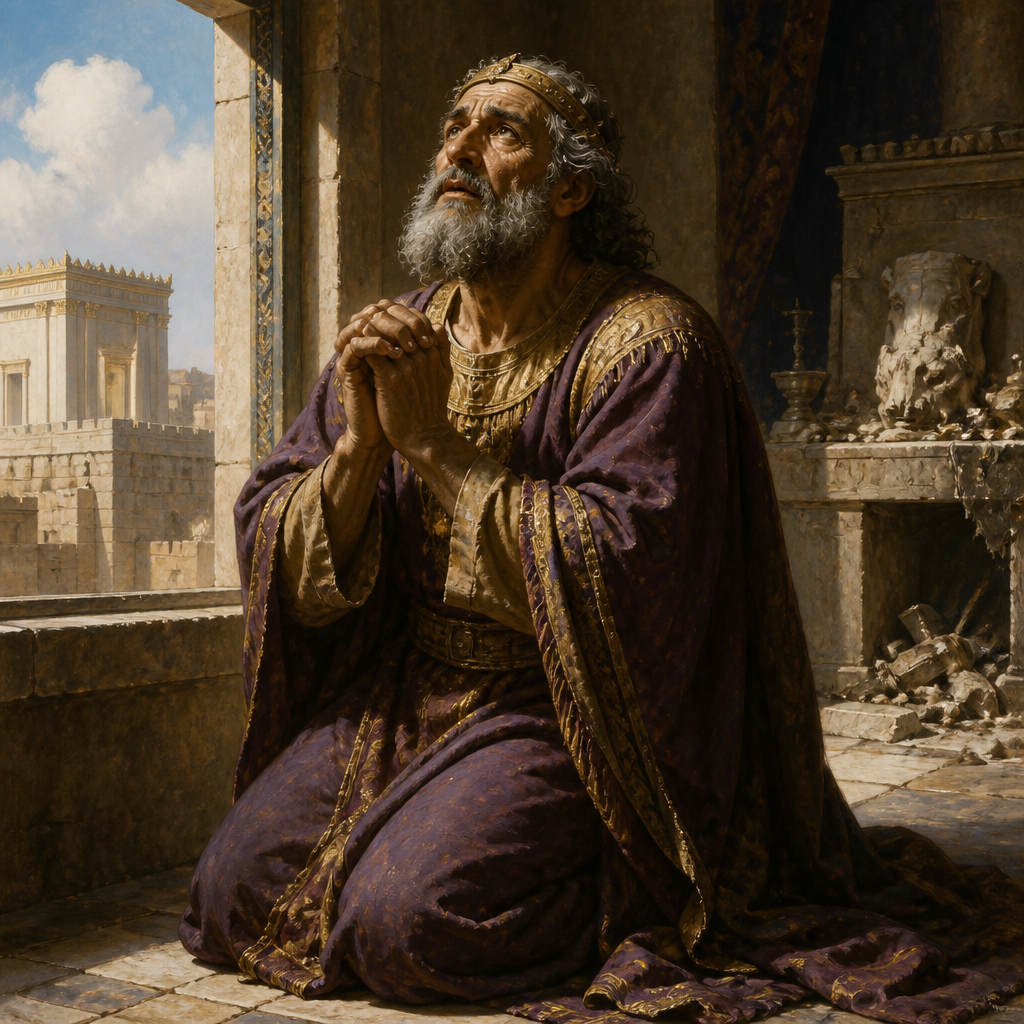
Despite his long reign and initial wickedness, the biblical account in Chronicles provides a unique narrative of his personal transformation. After being taken captive by the Assyrians and brought to Babylon in chains, Manasseh humbled himself before God. His restoration to the throne and his subsequent efforts to purge the idols he had installed mark one of the most significant examples of repentance found in the Old Testament historical books.
Background and Family
Manasseh was born during the latter years of King Hezekiah’s life, a period following Hezekiah’s miraculous recovery from illness. His mother was Hephzibah. According to 2 Kings 21:1, Manasseh was only twelve years old when he began his reign in Jerusalem. He was born into the Tribe of Judah and was a direct descendant in the royal line of David. During his reign, he married Meshullemeth, the daughter of Haruz of Jotbah, who became the mother of his successor, Amon.
Major Life Events
The Era of Apostasy
The early and middle years of Manasseh’s reign were defined by a systematic rejection of Yahwism. The author of 2 Kings notes that Manasseh "did evil in the sight of the LORD," rebuilding the high places his father Hezekiah had destroyed. His religious syncretism was extensive: he erected altars to Baal, made an Asherah pole, and worshiped the "host of heaven." Most egregiously, he built pagan altars within the two courts of the Temple of the LORD and placed a carved image of Asherah in the house where God had said He would put His Name forever.
Manasseh’s wickedness extended to the occult and human sacrifice. He practiced sorcery, divination, and consulted mediums and spiritists. The text records that he sacrificed his own children in the fire in the Valley of Ben Hinnom. Furthermore, he is accused of shedding "so much innocent blood that he filled Jerusalem from end to end" (2 Kings 21:16), a charge that later Jewish tradition associated with the martyrdom of the prophet Isaiah.
Captivity and Repentance
While the Book of Kings focuses on Manasseh’s sins as the catalyst for Judah’s eventual exile, 2 Chronicles 33 provides critical detail regarding his later years. Because Manasseh and the people ignored divine warnings, the Lord brought the commanders of the king of Assyria against them. Manasseh was captured, bound with bronze shackles, and led away with a hook in his nose to Babylon.
In his distress, Manasseh "entreated the favor of the LORD his God and humbled himself greatly." In response to his prayer, God restored him to his kingdom in Jerusalem. This experience led to a genuine conversion; the text states, "Then Manasseh knew that the LORD is God" (2 Chronicles 33:13).
Reform and Final Years
Following his restoration, Manasseh attempted to undo the damage of his earlier reign. He strengthened the city’s defenses, building an outer wall for the City of David and stationing military commanders in the fortified cities of Judah. More importantly, he removed the foreign gods and the idol from the Temple, along with the pagan altars he had built. He restored the altar of the LORD and sacrificed fellowship and thank offerings on it, commanding the people of Judah to serve the LORD. However, the reformation was only partially successful, as the people continued to sacrifice at the high places, though only to the LORD.
Relationship to Other Biblical Figures
Manasseh’s life is framed largely by his relationship to his father, Hezekiah, and his son, Amon. He represents a total departure from the piety of Hezekiah, yet his grandson, Josiah, would later lead the most comprehensive religious reform in Judah's history, perhaps influenced by the records of Manasseh’s late-life repentance. In the New Testament, Manasseh is included in the genealogy of Jesus Christ (Matthew 1:10), preserving his place in the Messianic line despite his recorded atrocities.
Spiritual Significance
Theologically, Manasseh serves as a dual symbol in scripture. On one hand, he represents the pinnacle of rebellion. The sins of Manasseh are cited in 2 Kings 24:3-4 and Jeremiah 15:4 as the primary reason the Lord would not forgive Judah, eventually leading to the Babylonian Captivity. Even the reforms of the righteous King Josiah could not fully avert the judgment incurred by Manasseh’s provocations.
On the other hand, Manasseh’s story in Chronicles is the ultimate testament to the possibility of divine forgiveness. His transition from the most wicked king to a humble penitent demonstrates that no degree of sin is beyond the reach of God's mercy when met with genuine humility. The biblical record balances these two truths: the lasting consequences of sin on a nation and the immediate availability of grace for the individual.
Manasseh is theologically significant as the figure whose apostasy ultimately sealed the fate of the Kingdom of Judah. Despite his personal repentance, the structural and spiritual corruption he introduced—specifically the shedding of innocent blood and the desecration of the Temple—was so severe that the biblical writers identify it as the 'point of no return' for the nation, leading directly to the Babylonian Exile.
Conversely, his narrative in 2 Chronicles provides one of the most striking examples of individual redemption in the Old Testament. It underscores the theme that God’s mercy is accessible even to those who have committed the most heinous abominations, provided there is a sincere humbling of the heart. This tension between national judgment and personal grace makes Manasseh a central figure in the study of divine justice and repentance.
Frequently Asked Questions
How long did Manasseh reign?
Manasseh reigned for fifty-five years in Jerusalem, which is the longest reign of any king in the history of Judah or Israel.
Why was Manasseh taken to Babylon by the Assyrians?
The Bible states that the Lord brought the Assyrian army against Judah because Manasseh and the people refused to listen to God’s warnings and persisted in their wickedness and idolatry.
Did Manasseh ever stop his idol worship?
Yes. According to 2 Chronicles 33, after being taken captive to Babylon, he humbled himself and prayed to God. Upon his return to Jerusalem, he removed the idols and foreign altars he had previously installed.
Who was Manasseh’s mother?
His mother was Hephzibah, the wife of King Hezekiah.
Where was Manasseh buried?
Unlike many of his ancestors who were buried in the City of David, Manasseh was buried in the garden of his own palace, known as the garden of Uzza.
Family & Relationships
Parents
 HephzibahMother2 Kings 21:1Stated
 Hezekiah, King of JudahFather2 Kings 20:21Stated
 MeshullemethWife2 Kings 21:19
Inferred
Reconstructed through Amon: 2 Kings 21:19 ties Meshullemeth to Amon; 2 Chronicles 33:22 ties Amon to Manasseh. No verse states the husband link between Meshullemeth and Manasseh directly.Evidence: 2 Kings 21:19; 2 Chronicles 33:22; Matthew 1:10
 Manasseh, King of JudahThis page
Children
 Amon, King of JudahSon2 Chronicles 33:22Stated
Connected Figures
Family
Mother · 2 Kings 21:1
Hephzibah was the queen consort of King Hezekiah of Judah and the mother of King Manasseh, one of Judah's longest-reigning monarchs.
Divided MonarchyFirst: 2 Kings 21:12 versesQueen of Judah
Father · 2 Kings 20:21
The 13th king of Judah, known for his sweeping religious reforms, the miraculous defense of Jerusalem against Assyria, and his restoration of the Passover.
Divided MonarchyFirst: 2 Kings 16:20124 versesKing of JudahJudah
Wife · 2 Kings 21:19
The wife of King Manasseh and mother of King Amon of Judah during the 7th century BC.
Divided MonarchyFirst: 2 Kings 21:192 versesQueen Mother of Judah
Son · 2 Chronicles 33:22
The fifteenth king of Judah whose brief, two-year reign was marked by extreme idolatry and ended in his assassination by his own officials.
Divided MonarchyFirst: 2 Kings 21:1816 versesKing of JudahJudah
Categories
Mentions by Book
- 2 Kings12
- 1 Chronicles1
- 2 Chronicles11
- Jeremiah1
- Matthew1
Scripture References
All 26 indexed verses, in canonical order, from the Berean Standard Bible.
- 2 Kings 20:21
And Hezekiah rested with his fathers, and his son Manasseh reigned in his place.
- 2 Kings 21:1
Manasseh was twelve years old when he became king, and he reigned in Jerusalem fifty-five years. His mother’s name was Hephzibah.
- 2 Kings 21:9
But the people did not listen and Manasseh led them astray, so that they did greater evil than the nations that the LORD had destroyed before the Israelites.
- 2 Kings 21:11
“Since Manasseh king of Judah has committed all these abominations, acting more wickedly than the Amorites who preceded him, and with his idols has caused Judah to sin,
- 2 Kings 21:16
Moreover, Manasseh shed so much innocent blood that he filled Jerusalem from end to end, in addition to the sin that he had caused Judah to commit, doing evil in the sight of the LORD.
- 2 Kings 21:17
As for the rest of the acts of Manasseh, along with all his accomplishments and the sin that he committed, are they not written in the Book of the Chronicles of the Kings of Judah?
- 2 Kings 21:18
And Manasseh rested with his fathers and was buried in his palace garden, the garden of Uzza. And his son Amon reigned in his place.
- 2 Kings 21:19Partial
Amon was twenty-two years old when he became king, and he reigned in Jerusalem two years. His mother’s name was Meshullemeth daughter of Haruz; she was from Jotbah.
Cited as evidence on a family card; added so References, Key Verses and Mentions by Book share one index.
- 2 Kings 21:20
And he did evil in the sight of the LORD, as his father Manasseh had done.
- 2 Kings 23:12
He pulled down the altars that the kings of Judah had set up on the roof near the upper chamber of Ahaz, and the altars that Manasseh had set up in the two courtyards of the house of the LORD. The king pulverized them there and threw their dust into the Kidron Valley.
- 2 Kings 23:26
Nevertheless, the LORD did not turn away from the fury of His burning anger, which was kindled against Judah because of all that Manasseh had done to provoke Him to anger.
- 2 Kings 24:3
Surely this happened to Judah at the LORD’s command, to remove them from His presence because of the sins of Manasseh and all that he had done,
- 1 Chronicles 3:13
Ahaz his son, Hezekiah his son, Manasseh his son,
- 2 Chronicles 32:33
And Hezekiah rested with his fathers and was buried in the upper tombs of David’s descendants. All Judah and the people of Jerusalem paid him honor at his death. And his son Manasseh reigned in his place.
- 2 Chronicles 33:1
Manasseh was twelve years old when he became king, and he reigned in Jerusalem fifty-five years.
- 2 Chronicles 33:9
So Manasseh led the people of Judah and Jerusalem astray, so that they did greater evil than the nations that the LORD had destroyed before the Israelites.
- 2 Chronicles 33:10
And the LORD spoke to Manasseh and his people, but they did not listen.
- 2 Chronicles 33:11
So the LORD brought against them the military commanders of the king of Assyria, who captured Manasseh, put a hook in his nose, bound him with bronze shackles, and took him to Babylon.
- 2 Chronicles 33:12
And in his distress, Manasseh sought the favor of the LORD his God and earnestly humbled himself before the God of his fathers.
Cited as a key verse; added so References, Key Verses and Mentions by Book share one index.
- 2 Chronicles 33:13
And when he prayed to Him, the LORD received his plea and heard his petition. So He brought him back to Jerusalem and to his kingdom. Then Manasseh knew that the LORD is God.
- 2 Chronicles 33:18
As for the rest of the acts of Manasseh, along with his prayer to his God and the words of the seers who spoke to him in the name of the LORD, the God of Israel, they are indeed written in the Chronicles of the Kings of Israel.
- 2 Chronicles 33:20
And Manasseh rested with his fathers and was buried at his palace. And his son Amon reigned in his place.
- 2 Chronicles 33:22Partial
And he did evil in the sight of the LORD, as his father Manasseh had done. Amon served and sacrificed to all the idols that his father Manasseh had made,
- 2 Chronicles 33:23
but he did not humble himself before the LORD as his father Manasseh had done; instead, Amon increased his guilt.
- Jeremiah 15:4
I will make them a horror to all the kingdoms of the earth because of what Manasseh son of Hezekiah king of Judah did in Jerusalem.
- Matthew 1:10Partial
Hezekiah was the father of Manasseh, Manasseh the father of Amon, Amon the father of Josiah,
Others Named Manasseh
Compare all 4 bearers →Manasseh, Descendant of HashumEzra 10:33
A Jewish returnee from the Babylonian exile who was among the descendants of Hashum recorded as having married a foreign woman.
Manasseh, Descendant of Pahath-moabEzra 10:30
A returnee from the Babylonian exile who was identified among the descendants of Pahath-moab for having married a foreign woman.
Manasseh, Son of JosephGenesis 41:51
The firstborn son of Joseph and Asenath, Manasseh became the progenitor of one of the largest and most strategically positioned tribes of Israel.