Lot
Who was Lot in the Bible?
Lot was the nephew of Abraham who settled in the Jordan Valley, escaped the destruction of Sodom, and became the progenitor of the Moabites and Ammonites.
Lot is a prominent figure in the patriarchal narratives of Genesis, recognized as the son of Haran and the nephew of the patriarch Abraham. His journey begins in Ur of the Chaldeans, from which he travels with his grandfather Terah and uncle Abram to Haran, and eventually into the land of Canaan. Lot is characterized by his close association with Abraham during the early stages of the covenantal journey, participating in the migration to Egypt and the subsequent return to the Negev.
Lot’s life is defined by his choice to settle in the fertile but morally corrupt cities of the Jordan plain, specifically Sodom. His narrative serves as a stark contrast to Abraham's nomadic faithfulness, illustrating the consequences of proximity to wickedness. Despite his choices, the New Testament characterizes him as a 'righteous man' who was distressed by the lawlessness surrounding him, ultimately being rescued by divine intervention before the total destruction of the cities of the plain.
Background and Family
Lot was the son of Haran and the brother of Milcah and Iscah (Genesis 11:27, 29). Following the early death of his father in Ur of the Chaldeans, Lot became a member of the household of his grandfather, Terah. He accompanied Terah, Abram, and Sarai when they moved to Haran. After Terah’s death, Lot chose to follow Abram when the latter received the divine call to depart for Canaan (Genesis 12:4-5).
Lot’s early life was marked by significant wealth; as he traveled with Abram, the text notes that he acquired his own flocks, herds, and tents. This prosperity eventually led to logistical strain. The land could not support both Abram’s and Lot’s vast holdings, resulting in discord between their respective herdsmen (Genesis 13:6-7). In a gesture of peace, Abram offered Lot the choice of land to occupy, prioritizing the preservation of their familial bond.
Major Life Events
The Choice of the Jordan Plain
When given the choice of land, Lot observed that the Jordan Valley was well-watered and lush, comparing it to the 'garden of the LORD' and the land of Egypt (Genesis 13:10). He chose the entire plain of the Jordan and moved his tents as far as Sodom, despite the biblical note that the men of Sodom were 'wicked and were sinning greatly against the LORD.'
Captivity and Rescue
While living in Sodom, Lot became caught in a regional conflict. Four kings from the east, led by Chedorlaomer, attacked the kings of the Sodom region. Lot was captured and his possessions seized. Upon hearing of his nephew's plight, Abram armed 318 trained men, pursued the invaders, and successfully rescued Lot and his goods (Genesis 14:12-16).
The Destruction of Sodom
Lot’s most definitive narrative occurs in Genesis 19. Two angels, appearing as men, arrived in Sodom and were greeted by Lot at the city gate. He insisted on providing them hospitality, showing a protective instinct even when the men of the city surrounded his house demanding to abuse the visitors. Lot’s compromise—offering his daughters to the mob to protect his guests—illustrates the extreme moral pressure of his environment.
The angels revealed that the Lord was about to destroy the city and urged Lot to flee with his family. Despite his initial hesitation and the mocking of his sons-in-law, the angels physically seized Lot, his wife, and his two daughters to lead them to safety. As they fled toward the small town of Zoar, Lot’s wife famously looked back and was transformed into a pillar of salt (Genesis 19:26).
The Aftermath in the Cave
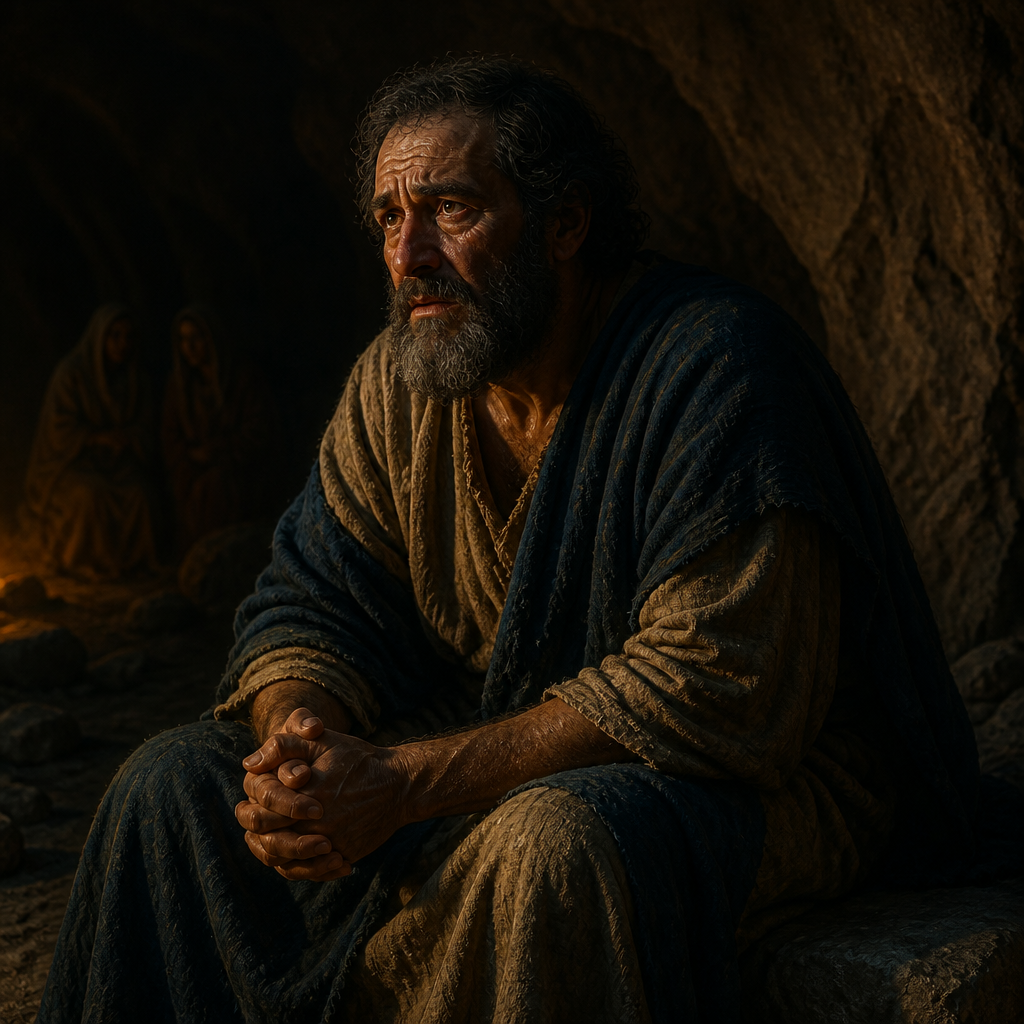
Fearful of staying in Zoar, Lot retreated to the mountains and lived in a cave with his two daughters. Believing they were the last people on earth and desiring to preserve their lineage, the daughters conspired to intoxicate their father and conceive children by him. This resulted in the birth of Moab and Ben-ammi, who became the ancestors of the Moabites and Ammonites, nations that would frequently interact with the future Israelites.
Relationship to Other Biblical Figures
Lot’s relationship with Abraham is the central axis of his story. Abraham functioned as his protector and intercessor; notably, Abraham’s negotiation with God regarding the righteous in Sodom (Genesis 18) was motivated by Lot's presence there. The text explicitly states that 'God remembered Abraham' when He brought Lot out of the catastrophe (Genesis 19:29).
In the New Testament, Lot is mentioned by Jesus as a warning regarding the suddenness of judgment, urging listeners to 'Remember Lot’s wife' (Luke 17:32). The apostle Peter later uses Lot as an example of God's ability to rescue the godly from trials, describing him as a man who was 'tormented in his righteous soul' by the lawless deeds he witnessed (2 Peter 2:7-8).
Spiritual Significance
Lot serves as a complex figure of 'vexed righteousness.' He represents a believer who is technically righteous before God but whose life is compromised by poor choices and worldly attachments. His story warns against the spiritual dangers of choosing comfort and wealth over moral environment. Yet, his rescue underscores the themes of divine mercy and the effectiveness of intercessory prayer, as he was saved largely due to God's covenantal relationship with Abraham. The nations he fathered—Moab and Ammon—remain significant in the biblical narrative as neighbors to Israel, with God later commanding the Israelites not to harass them because they were 'descendants of Lot' (Deuteronomy 2:9, 19).
Lot is a pivotal figure who illustrates the divergence between walking by sight and walking by faith. While Abraham looked toward a city whose builder and maker was God, Lot looked toward the physical fertility of the Jordan plain, which led him into the heart of moral corruption. His life provides a sober warning about the lingering effects of worldly influence on a family, as evidenced by the loss of his wife and the actions of his daughters.
Theologically, Lot functions as a recipient of 'grace by association.' He was not the primary recipient of the covenant, yet he was preserved because of his relationship with the patriarch Abraham. The New Testament's assessment of him in 2 Peter 2:7 provides a vital balance, confirming that despite his catastrophic lapses in judgment and his compromised environment, he maintained a fundamental internal orientation toward righteousness that God recognized and acted upon.
Frequently Asked Questions
Why did Lot's wife turn into a pillar of salt?
As Lot and his family fled Sodom, the angels commanded them not to look back. Lot’s wife disobeyed this command, looking back at the city, and was immediately transformed into a pillar of salt (Genesis 19:26). Jesus later used her as a warning against longing for the world one has left behind.
How was Lot related to Abraham?
Lot was Abraham's nephew. Specifically, Lot was the son of Haran, who was Abraham's brother (Genesis 11:27).
What nations descended from Lot?
Through his two daughters, Lot became the father of Moab (ancestor of the Moabites) and Ben-ammi (ancestor of the Ammonites) (Genesis 19:37-38).
Is Lot considered a righteous man?
Yes, although the Old Testament narrative emphasizes his poor choices, 2 Peter 2:7 in the New Testament explicitly calls him a 'righteous man' who was distressed by the wickedness of Sodom.
Where did Lot go after the destruction of Sodom?
Lot initially fled to the small town of Zoar. However, due to fear, he later moved into the mountains and lived in a cave with his two daughters (Genesis 19:30).
Family & Relationships
Parents
 Haran, Son of TerahFatherGenesis 11:27Stated
 Lot's WifeWifeLuke 17:32Stated
 LotThis page
 IscahSisterGenesis 11:27–29Stated
 Milcah, Matriarch of Nahor's LineSisterGenesis 11:27–29Stated
Children
 Ben-ammiSonGenesis 19:36–38Stated
 MoabSonGenesis 19:36–37Stated
 The Older Daughter of LotDaughterGenesis 19:36Stated
 The Younger Daughter of LotDaughterGenesis 19:36–38Stated
Extended family
 TerahGrandfatherGenesis 11:27
Inferred
Genesis 11:27 names Terah and Lot in the same verse but does not state a grandson tie between them; the link rests on the surrounding narrative.Evidence: Genesis 11:27; Genesis 11:31
 AbrahamUncleGenesis 11:27
Inferred
Genesis 11:27 names Abram and Lot in the same verse but does not state a nephew tie between them; the link rests on the surrounding narrative.Evidence: Genesis 11:27
 SarahAuntGenesis 11:29
Inferred
Reconstructed through Terah: Genesis 11:31 ties Sarai to Terah (itself an inferred link); Genesis 11:27 ties Terah to Lot (itself an inferred link). No verse states the nephew link between Sarah and Lot directly.Evidence: Genesis 11:29
Connected Figures
Family
Father · Genesis 11:27
A patriarch of the family of Terah, brother of Abraham, and the father of Lot who died in Ur of the Chaldeans.
Wife · Luke 17:32
A woman who resided in Sodom and was turned into a pillar of salt for looking back at the city during its divine destruction.
Son · Genesis 19:36–38
The son of Lot and his younger daughter, recognized as the eponymous patriarch of the Ammonite nation.
Son · Genesis 19:36–37
Moab was the firstborn son of Lot by his eldest daughter and the eponymous progenitor of the Moabite nation.
Daughter · Genesis 19:36
The firstborn daughter of Lot who, following the destruction of Sodom, became the mother of Moab and the ancestress of the Moabite nation.
Daughter · Genesis 19:36–38
The younger daughter of Lot was a woman of the Patriarchal era who became the ancestral mother of the Ammonite nation through her son, Ben-ammi.
Sister · Genesis 11:27–29
A daughter of Haran and sister to Milcah and Lot, mentioned within the genealogy of the patriarchal family in the book of Genesis.
Sister · Genesis 11:27–29
Milcah was a prominent matriarch in the line of Terah, the wife of Nahor, and the grandmother of Rebekah.
Grandfather · Genesis 11:27
A foundational patriarch and the father of Abraham who led his family out of Ur of the Chaldeans toward the land of Canaan.
PatriarchsFirst: Genesis 11:2412 versesPatriarchal leader
Uncle · Genesis 11:27
The first of the three biblical patriarchs and the father of the nation of Israel, known for his unwavering faith and his covenant relationship with God.
PatriarchsFirst: Genesis 11:26296 versesPatriarch, nomad, wealthy livestock owner
Aunt · Genesis 11:29
The wife of Abraham and mother of Isaac, recognized as the primary matriarch of the Hebrew people and a recipient of God's covenantal promise.
Categories
Mentions by Book
- Genesis31
- Deuteronomy2
- Psalms1
- Luke3
- 2 Peter1
Scripture References
All 38 indexed verses, in canonical order, from the Berean Standard Bible.
- Genesis 11:27
This is the account of Terah. Terah became the father of Abram, Nahor, and Haran. And Haran became the father of Lot.
- Genesis 11:28Partial
During his father Terah’s lifetime, Haran died in his native land, in Ur of the Chaldeans.
Cited as evidence on a family card; added so References, Key Verses and Mentions by Book share one index.
- Genesis 11:29Partial
And Abram and Nahor took wives for themselves. Abram’s wife was named Sarai, and Nahor’s wife was named Milcah; she was the daughter of Haran, who was the father of both Milcah and Iscah.
Cited as evidence on a family card; added so References, Key Verses and Mentions by Book share one index.
- Genesis 11:31
And Terah took his son Abram, his grandson Lot son of Haran, and his daughter-in-law Sarai the wife of Abram, and they set out from Ur of the Chaldeans for the land of Canaan. But when they arrived in Haran, they settled there.
- Genesis 12:4
So Abram departed, as the LORD had directed him, and Lot went with him. Abram was seventy-five years old when he left Haran.
- Genesis 12:5
And Abram took his wife Sarai, his nephew Lot, and all the possessions and people they had acquired in Haran, and set out for the land of Canaan. When they came to the land of Canaan,
- Genesis 13:1
So Abram went up out of Egypt into the Negev—he and his wife and all his possessions—and Lot was with him.
- Genesis 13:5
Now Lot, who was traveling with Abram, also had flocks and herds and tents.
- Genesis 13:7
And there was discord between the herdsmen of Abram and the herdsmen of Lot. At that time the Canaanites and the Perizzites were also living in the land.
- Genesis 13:8
So Abram said to Lot, “Please let there be no contention between you and me, or between your herdsmen and my herdsmen. After all, we are kinsmen.
- Genesis 13:10
And Lot looked out and saw that the whole plain of the Jordan, all the way to Zoar, was well watered like the garden of the LORD, like the land of Egypt. (This was before the LORD destroyed Sodom and Gomorrah.)
- Genesis 13:11Partial
So Lot chose the whole plain of the Jordan for himself and set out toward the east. And Abram and Lot parted company.
- Genesis 13:12
Abram lived in the land of Canaan, but Lot settled in the cities of the plain and pitched his tent toward Sodom.
- Genesis 13:14
After Lot had departed, the LORD said to Abram, “Now lift up your eyes from the place where you are, and look to the north and south and east and west,
- Genesis 14:12
They also carried off Abram’s nephew Lot and his possessions, since Lot was living in Sodom.
- Genesis 14:16
He retrieved all the goods, as well as his relative Lot and his possessions, together with the women and the rest of the people.
- Genesis 19:1Partial
Now the two angels arrived at Sodom in the evening, and Lot was sitting in the gateway of the city. When Lot saw them, he got up to meet them, bowed facedown,
- Genesis 19:5
They called out to Lot, saying, “Where are the men who came to you tonight? Send them out to us so we can have relations with them!”
- Genesis 19:6
Lot went outside to meet them, shutting the door behind him.
- Genesis 19:9
“Get out of the way!” they replied. And they declared, “This one came here as a foreigner, and he is already acting like a judge! Now we will treat you worse than them.” And they pressed in on Lot and moved in to break down the door.
- Genesis 19:10
But the men inside reached out, pulled Lot into the house with them, and shut the door.
- Genesis 19:12
Then the two men said to Lot, “Do you have anyone else here—a son-in-law, your sons or daughters, or anyone else in the city who belongs to you? Get them out of here,
- Genesis 19:14
So Lot went out and spoke to the sons-in-law who were pledged in marriage to his daughters. “Get up,” he said. “Get out of this place, for the LORD is about to destroy the city!” But his sons-in-law thought he was joking.
- Genesis 19:15
At daybreak the angels hurried Lot along, saying, “Get up! Take your wife and your two daughters who are here, or you will be swept away in the punishment of the city.”
- Genesis 19:18
But Lot replied, “No, my lords, please!
- Genesis 19:23
And by the time the sun had risen over the land, Lot had reached Zoar.
- Genesis 19:29Partial
So when God destroyed the cities of the plain, He remembered Abraham, and He brought Lot out of the catastrophe that destroyed the cities where he had lived.
- Genesis 19:30
Lot and his two daughters left Zoar and settled in the mountains—for he was afraid to stay in Zoar—where they lived in a cave.
- Genesis 19:36
Thus both of Lot’s daughters became pregnant by their father.
- Genesis 19:37Partial
The older daughter gave birth to a son and named him Moab. He is the father of the Moabites of today.
Cited as evidence on a family card; added so References, Key Verses and Mentions by Book share one index.
- Genesis 19:38Partial
The younger daughter also gave birth to a son, and she named him Ben-ammi. He is the father of the Ammonites of today.
Cited as evidence on a family card; added so References, Key Verses and Mentions by Book share one index.
- Deuteronomy 2:9
Then the LORD said to me, “Do not harass the Moabites or provoke them to war, for I will not give you any of their land, because I have given Ar to the descendants of Lot as their possession.”
- Deuteronomy 2:19
But when you get close to the Ammonites, do not harass them or provoke them, for I will not give you any of the land of the Ammonites. I have given it to the descendants of Lot as their possession.”
- Psalms 83:8
Even Assyria has joined them, lending strength to the sons of Lot. Selah
- Luke 17:28
It was the same in the days of Lot: People were eating and drinking, buying and selling, planting and building.
- Luke 17:29
But on the day Lot left Sodom, fire and sulfur rained down from heaven and destroyed them all.
- Luke 17:32
Remember Lot’s wife!
- 2 Peter 2:7
and if He rescued Lot, a righteous man distressed by the depraved conduct of the lawless