Zipporah
Who was Zipporah in the Bible?
The Midianite wife of Moses who saved his life by performing an emergency circumcision during his return to Egypt.
Zipporah was a Midianite woman who became the wife of Moses during his forty-year exile from Egypt. As one of the seven daughters of Jethro (also known as Reuel), a priest of Midian, she entered the biblical narrative after Moses defended her and her sisters from aggressive shepherds at a well. Her marriage to Moses served as a critical link between the Hebrew leader and the Midianite people, providing Moses with a family and a livelihood as a shepherd during his formative years in the wilderness.
While Zipporah appears only briefly in the Pentateuch, her actions are pivotal to the success of Moses’ mission. She is most famous for a mysterious and intense encounter at a lodging place on the way to Egypt, where she intervened to save Moses from divine wrath. Her quick thinking and adherence to the covenant of circumcision underscore her role as a protective figure within the Exodus narrative.
Background and Family
Zipporah's origins are rooted in the land of Midian, located in the northwestern Arabian Peninsula. She was the daughter of Jethro, a priest of Midian, and belonged to a clan that traced its lineage back to Abraham through his wife Keturah. The biblical account introduces her in Exodus 2, where she and her six sisters were harassed by shepherds while attempting to water their father's flock. Moses, having recently fled Egypt after killing an overseer, intervened on their behalf and watered the sheep for them.
In gratitude for his assistance, Jethro invited Moses to eat bread and subsequently gave Zipporah to him in marriage. During their time in Midian, Zipporah bore Moses two sons. The first was named Gershom, reflecting Moses' status as a foreigner in a strange land, and the second was named Eliezer, signifying God’s help in delivering Moses from the sword of Pharaoh. Zipporah’s brother, Hobab, is also noted in the genealogical record of this family unit.
Major Life Events
The Encounter at the Lodging Place
The most significant and enigmatic event involving Zipporah occurs in Exodus 4. As Moses traveled back to Egypt with his family to confront Pharaoh, the text records that the Lord met him at a lodging place and "sought to put him to death." The reason for this divine anger is generally understood by scholars to be Moses' failure to circumcise his son, a fundamental requirement of the Abrahamic covenant.
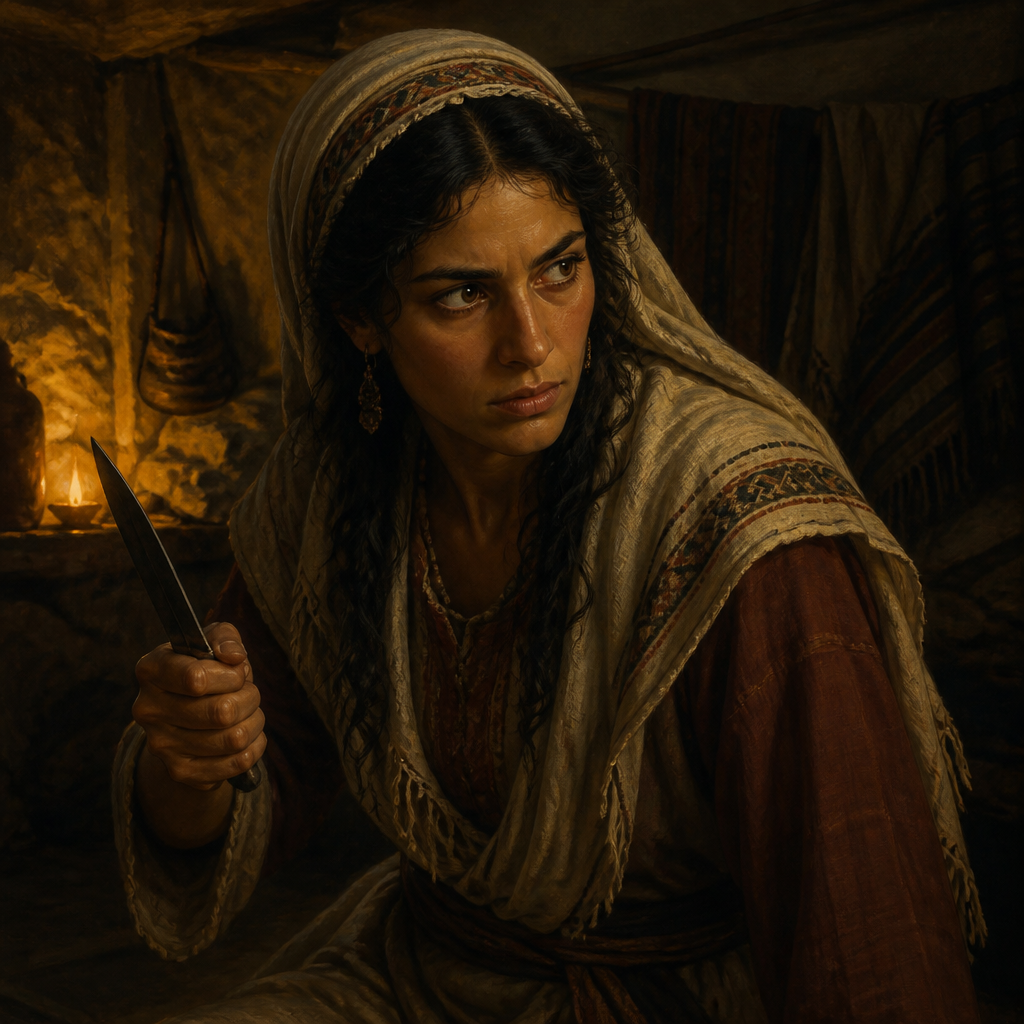
Zipporah immediately grasped the gravity of the situation. Taking a sharp flint knife, she performed the circumcision herself. The text states:
"But Zipporah took a flint knife, cut off her son’s foreskin, and touched it to Moses’ feet. ‘Surely you are a bridegroom of blood to me,’ she said." (Exodus 4:25, BSB)
Her decisive action averted the divine threat, and the Lord let Moses alone. Her declaration regarding a "bridegroom of blood" is a unique and archaic expression that highlights the ritualistic and protective nature of her intervention.
Reunion in the Wilderness
Following the miraculous deliverance of Israel from Egypt, Zipporah reappears in the narrative in Exodus 18. It is revealed that at some point during the plagues or the departure from Egypt, Moses had sent Zipporah and their two sons back to the safety of her father, Jethro. After hearing of the great things God had done for Israel, Jethro brought Zipporah and the children to the Israelite camp at the mountain of God. This reunion facilitated a period of counsel between Jethro and Moses, though the text focuses more on the administrative advice Jethro provided rather than the personal reunion between Zipporah and her husband.
Relationship to Other Biblical Figures
Zipporah’s primary relationship is that of a support system and protector to Moses. As the daughter of a priest, she likely held a position of respect within her own culture before entering the Hebrew narrative. Her relationship with Moses was characterized by the merging of two cultures; she was a Midianite who became the mother of two Hebrew sons. Her father, Jethro, remained a significant influence on Moses, acting as a mentor and advisor, which suggests that Zipporah’s familial ties were instrumental in providing Moses with the stability he needed before assuming leadership of Israel.
Spiritual Significance
Theologically, Zipporah represents the inclusion of non-Israelites in the unfolding plan of God’s redemption. Her role in the circumcision event at the lodging place is paramount. In this instance, Zipporah acts as a surrogate priest, performing a sacred rite that the national leader had neglected. Her actions demonstrate that the covenant requirements were absolute and that Zipporah possessed the spiritual intuition to recognize and rectify a breach in that covenant. Without her intervention, the Exodus might have lacked its primary human leader before it truly began.
Zipporah serves as a critical bridge between the Midianite people and the Israelites. Her presence in the life of Moses during his exile provided him with the necessary refuge and family structure to survive his transition from an Egyptian prince to a desert shepherd. More importantly, her intervention in the circumcision crisis in Exodus 4 portrays her as a vigilant guardian of the covenant. By performing the rite that Moses had neglected, she saved the life of the man who would eventually lead the Israelites out of bondage.
Her story also highlights the role of foreign women in the Pentateuch who act with more faith or decisiveness than their Hebrew counterparts in moments of crisis. While her presence in the text is brief, her actions ensure the continuity of the messianic line and the success of the Exodus mission. She stands as a symbol of the necessity of obedience to God's commands, regardless of one's background or the convenience of the circumstances.
Frequently Asked Questions
What does the name Zipporah mean?
The name Zipporah (Tziporah) is derived from the Hebrew word for 'bird' or 'sparrow'.
Why did Zipporah call Moses a 'bridegroom of blood'?
This phrase, uttered after she circumcised her son, likely refers to the blood of the covenant that saved Moses' life. It suggests that through this act, the marriage bond was re-established or protected under the sign of circumcision.
Was Zipporah with Moses during the ten plagues of Egypt?
The Bible indicates she was not. Exodus 18:2 mentions that Moses had sent her back to her father, Jethro, before she later rejoined him in the wilderness after the Israelites had left Egypt.
Who were Zipporah's children?
She had two sons with Moses: Gershom and Eliezer.
What tribe or nation did Zipporah belong to?
She was a Midianite, the daughter of the priest Jethro.
Family & Relationships
Parents
 JethroFatherExodus 18:2
Inferred
Exodus 18:2 names Jethro and Zipporah in the same verse but does not state a daughter tie between them; the link rests on the surrounding narrative.Evidence: Exodus 18:2
 MosesHusbandExodus 18:2Stated
 ZipporahThis page
 HobabBrotherExodus 2:21
Inferred
No verse names Hobab and Zipporah together; the sister link is carried from the surrounding genealogy and is not stated in Scripture.Evidence: Exodus 2:21
Children
 Eliezer, Son of MosesSonExodus 2:21
Inferred
Reconstructed through Moses: 1 Chronicles 23:15 ties Eliezer to Moses; Exodus 18:2 ties Moses to Zipporah. No verse states the mother link between Eliezer and Zipporah directly.Evidence: Exodus 2:21; Exodus 2:22; 1 Chronicles 23:15
 Gershom, Son of MosesSonExodus 18:2–3Stated
Connected Figures
Family
Father · Exodus 18:2
The Midianite priest and father-in-law of Moses who provided sanctuary, gave administrative counsel, and acknowledged the sovereignty of Yahweh during the Exodus.
Egypt and WildernessFirst: Exodus 2:1814 versesPriest of Midian
Husband · Exodus 18:2
The preeminent prophet and lawgiver of Israel who led the Hebrews out of Egyptian bondage and mediated the Covenant at Mount Sinai.
Egypt and WildernessFirst: Exodus 2:10844 versesProphet, Judge, and LawgiverLevi
Son · Exodus 2:21
The second son of Moses and Zipporah, whose name commemorates God's deliverance of his father from the sword of Pharaoh.
Son · Exodus 18:2–3
Gershom was the firstborn son of the prophet Moses and Zipporah, born in Midian during Moses' exile from Egypt.
Brother · Exodus 2:21
A Midianite and son of Reuel who served as a guide and ally to the Israelites during their wilderness wanderings.
Egypt and WildernessFirst: Numbers 10:296 versesDesert guide
Categories
Mentions by Book
- Exodus5
- Numbers1
- 1 Chronicles1
Scripture References
All 7 indexed verses, in canonical order, from the Berean Standard Bible.
Exodus · 5
- Exodus 2:21
Moses agreed to stay with the man, and he gave his daughter Zipporah to Moses in marriage.
- Exodus 2:22Partial
And she gave birth to a son, and Moses named him Gershom, saying, “I have become a foreigner in a foreign land.”
Cited as evidence on a family card; added so References, Key Verses and Mentions by Book share one index.
- Exodus 4:25
But Zipporah took a flint knife, cut off her son’s foreskin, and touched it to Moses’ feet. “Surely you are a bridegroom of blood to me,” she said.
- Exodus 18:2
After Moses had sent back his wife Zipporah, his father-in-law Jethro had received her,
- Exodus 18:3Partial
along with her two sons. One son was named Gershom, for Moses had said, “I have been a foreigner in a foreign land.”
Cited as evidence on a family card; added so References, Key Verses and Mentions by Book share one index.
Numbers · 1
- Numbers 10:29Partial
Then Moses said to Hobab, the son of Moses’ father-in-law Reuel the Midianite, “We are setting out for the place of which the LORD said: ‘I will give it to you.’ Come with us, and we will treat you well, for the LORD has promised good things to Israel.”
Cited as evidence on a family card; added so References, Key Verses and Mentions by Book share one index.
1 Chronicles · 1
- 1 Chronicles 23:15Partial
The sons of Moses: Gershom and Eliezer.
Cited as evidence on a family card; added so References, Key Verses and Mentions by Book share one index.