Abihu
Who was Abihu in the Bible?
The second son of Aaron who was appointed as a priest but suffered divine judgment for offering unauthorized fire before the LORD.
Abihu was a member of the tribe of Levi and the second-born son of Aaron, the first High Priest of Israel. Born during the period of Egyptian bondage, Abihu lived to see the Exodus and the establishment of the Mosaic Covenant at Mount Sinai. As a member of the priestly family, he occupied a position of immense spiritual authority and was among the select few permitted to approach the presence of God during the early stages of the wilderness journey.
Despite his high calling and the extraordinary privileges he was granted—including witnessing a vision of God on Mount Sinai—Abihu’s life is defined by a singular, catastrophic act of disobedience. Together with his older brother Nadab, he offered 'unauthorized fire' before the LORD, leading to his immediate death. His story serves as a stark biblical warning regarding the sanctity of God's commands and the heavy responsibility placed upon those in religious leadership.
Background and Family
Abihu was the son of Aaron and Elisheba, the daughter of Amminadab and sister of Nahshon (Exodus 6:23). He was part of a prominent family within the tribe of Levi; his father was the brother of Moses, and his mother was from the leading family of the tribe of Judah. Abihu had three brothers: Nadab, who was the firstborn, and two younger brothers, Eleazar and Ithamar. As a member of the first generation of the Aaronic priesthood, Abihu was born into a legacy of divine service and mediation between God and the Israelites.
Major Life Events
The Theophany at Mount Sinai
Abihu was among the elite group of leaders chosen to accompany Moses up Mount Sinai after the delivery of the Ten Commandments. Exodus 24 records that Moses, Aaron, Nadab, Abihu, and seventy elders of Israel went up the mountain to worship. During this event, they were granted a rare vision of the God of Israel. The text describes a pavement of lapis lazuli, as clear as the sky, under God's feet. Crucially, the account notes that God did not lay a hand on these leaders, and they ate and drank in His presence (Exodus 24:9–11). This event established Abihu as a key witness to the divine glory.
Appointment to the Priesthood
In Exodus 28, God explicitly commanded Moses to set Aaron and his four sons—Nadab, Abihu, Eleazar, and Ithamar—apart from the rest of the Israelites to serve as priests. This was a formal induction into a life of ritual purity, sacrificial duties, and the maintenance of the Tabernacle. The sons of Aaron were to wear specific holy garments to signify their office and to symbolize the dignity of their service.
The Incident of Unauthorized Fire
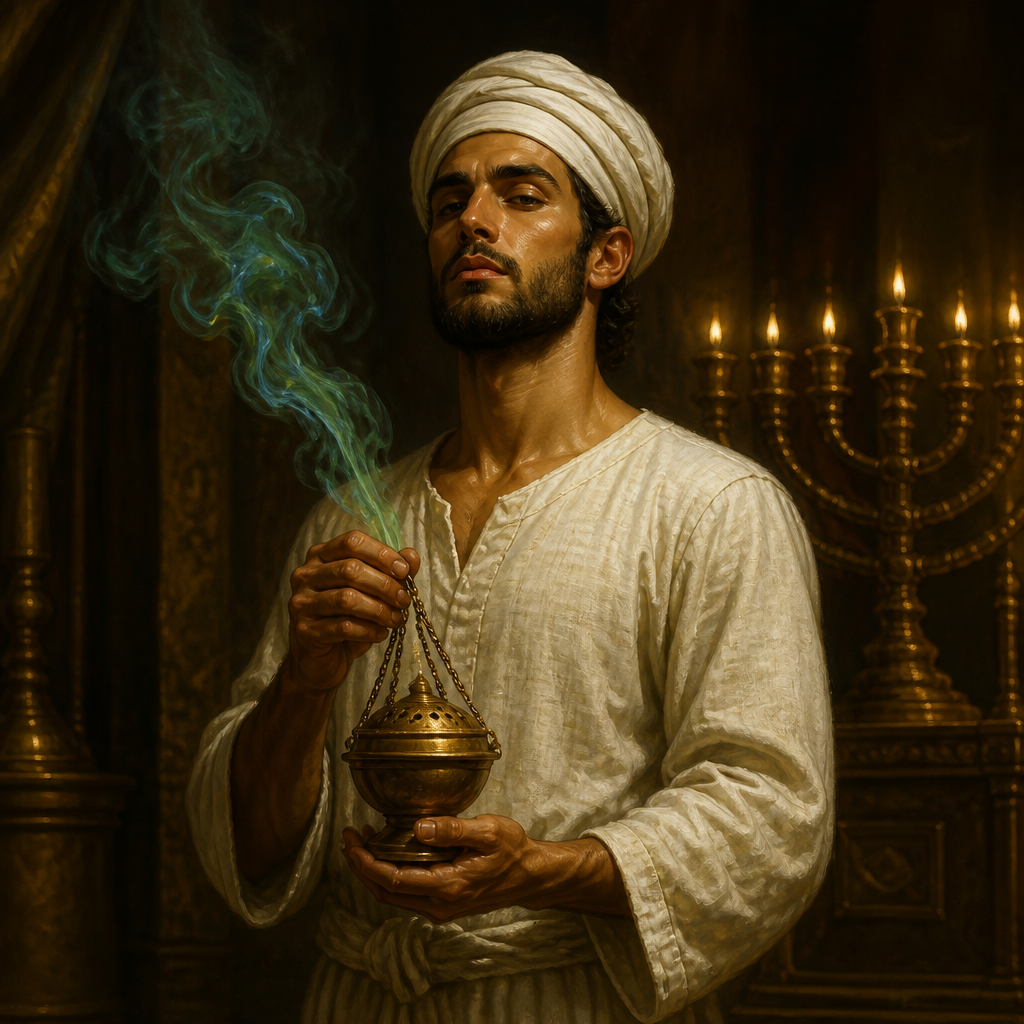
The defining moment of Abihu’s life occurred shortly after the Tabernacle was consecrated. According to Leviticus 10, Abihu and Nadab took their respective censers, put fire in them, added incense, and offered "unauthorized fire" (often translated as "strange fire") before the LORD. The text specifies that this was contrary to the commands God had given. In response to this breach of protocol, fire came out from the presence of the LORD and consumed them, causing their deaths "in the presence of the LORD" (Numbers 3:4).
Relationship to Other Biblical Figures
Abihu’s identity is inextricably linked to his brother, Nadab. The two are almost always mentioned together in the biblical narrative, sharing the same privileges and the same fate. As the second son, Abihu was in the direct line of succession for high priestly duties. However, because he and Nadab died childless (Numbers 3:4, 1 Chronicles 24:2), the line of the priesthood continued only through his younger brothers, Eleazar and Ithamar. This shift in the genealogy highlights the permanent consequences of his actions on his family's legacy.
Spiritual Significance
The narrative of Abihu is central to the biblical concept of holiness. It illustrates that proximity to God requires strict adherence to His instructions. The gravity of Abihu's sin was not necessarily the quality of the incense or the fire itself, but the act of self-willed worship—performing a sacred act that God had not commanded. His death underscored the principle that those who are closest to God are held to the highest standard of accountability. The fact that he was allowed to see God on the mountain but later struck down for a ritual error emphasizes that previous spiritual experiences do not grant immunity from the requirement of ongoing obedience.
Abihu represents the danger of approaching the holy without reverence or divine authorization. His story is foundational to the laws of the priesthood, serving as the primary justification for the rigorous and specific instructions found in the book of Leviticus. The suddenness of his judgment in the Wilderness of Sinai functioned as a 'sign' to the nation of Israel that the presence of God in their midst was both a source of life and a consuming fire that demanded total submission.
Theologically, Abihu’s death marked a transition in the leadership of Israel's spiritual life. Because he died without heirs, the priestly duties were reorganized under Eleazar and Ithamar. This transition is recorded in both the Pentateuch and the genealogies of 1 Chronicles, ensuring that later generations remembered the cost of disregarding the sanctuary's sanctity.
Frequently Asked Questions
What was the 'unauthorized fire' that Abihu offered?
The Bible does not provide technical details on why the fire was unauthorized, but it notes the act was 'contrary to His command.' Scholarly interpretations suggest they may have used fire from a common source rather than the bronze altar, or performed the ritual at a time or in a manner not prescribed by God.
Did Abihu have any children?
No. Numbers 3:4 and 1 Chronicles 24:2 explicitly state that Abihu and his brother Nadab had no sons at the time of their death.
Who were Abihu's parents?
His father was Aaron, the brother of Moses, and his mother was Elisheba, daughter of Amminadab.
Where did Abihu die?
He died in the Wilderness of Sinai, specifically at the Tabernacle, while performing priestly duties.
Why was Abihu allowed to see God on Mount Sinai?
He was chosen as one of the representatives of Israel's leadership to confirm the covenant between God and the people, showing he initially held a position of high favor and trust.
Family & Relationships
 AbihuThis page
 Eleazar, Son of AaronBrotherExodus 6:23Stated
 IthamarBrotherExodus 6:23Stated
 Nadab, Son of AaronBrotherExodus 6:23Stated
Connected Figures
Family

Father · Exodus 6:23
The first High Priest of Israel, elder brother of Moses, and primary spokesman for the Israelites during the Exodus from Egypt.
Egypt and WildernessFirst: Exodus 4:14338 versesHigh Priest, ProphetLevi

Mother · Exodus 6:23
The wife of Aaron the High Priest and a daughter of the tribe of Judah, Elisheba provided the genealogical link between the Levitical priesthood and the Davidic royal line.
Egypt and WildernessFirst: Exodus 6:232 versesMatriarch of the Aaronic PriesthoodJudah
Brother · Exodus 6:23
Eleazar was the third son of Aaron and his successor as the High Priest of Israel, serving as a key leader alongside Moses and Joshua during the wilderness wanderings and the conquest of Canaan.
Egypt and WildernessFirst: Exodus 6:2361 versesHigh PriestLevi
Brother · Exodus 6:23
The youngest son of Aaron and Elisheba, Ithamar was a high-ranking priest who supervised the construction of the Tabernacle and the duties of the Levites during the Wilderness wanderings.
Egypt and WildernessFirst: Exodus 6:2323 versesPriest and Tabernacle AdministratorLevi
Brother · Exodus 6:23
Nadab was the firstborn son of Aaron and a high-ranking priest who was consumed by fire from the LORD for offering unauthorized incense during the wilderness wanderings.
Categories
Mentions by Book
- Exodus4
- Leviticus1
- Numbers4
- 1 Chronicles3
Scripture References
All 12 indexed verses, in canonical order, from the Berean Standard Bible.
Exodus · 4
- Exodus 6:23
And Aaron married Elisheba, the daughter of Amminadab and sister of Nahshon, and she bore him Nadab and Abihu, Eleazar and Ithamar.
- Exodus 24:1
Then the LORD said to Moses, “Come up to the LORD—you and Aaron, Nadab and Abihu, and seventy of Israel’s elders—and you are to worship at a distance.
- Exodus 24:9
Then Moses went up with Aaron, Nadab and Abihu, and seventy of the elders of Israel,
- Exodus 28:1
“Next, have your brother Aaron brought to you from among the Israelites, along with his sons Nadab, Abihu, Eleazar, and Ithamar, to serve Me as priests.
Leviticus · 1
- Leviticus 10:1
Now Aaron’s sons Nadab and Abihu took their censers, put fire in them and added incense, and offered unauthorized fire before the LORD, contrary to His command.
Numbers · 4
- Numbers 3:2
These are the names of the sons of Aaron: Nadab the firstborn, then Abihu, Eleazar, and Ithamar.
- Numbers 3:4
Nadab and Abihu, however, died in the presence of the LORD when they offered unauthorized fire before the LORD in the Wilderness of Sinai. And since they had no sons, only Eleazar and Ithamar served as priests during the lifetime of their father Aaron.
- Numbers 26:60
Nadab, Abihu, Eleazar, and Ithamar were born to Aaron,
- Numbers 26:61
but Nadab and Abihu died when they offered unauthorized fire before the LORD.
1 Chronicles · 3
- 1 Chronicles 6:3
The children of Amram: Aaron, Moses, and Miriam. The sons of Aaron: Nadab, Abihu, Eleazar, and Ithamar.
- 1 Chronicles 24:1
These were the divisions of the descendants of Aaron. The sons of Aaron were Nadab, Abihu, Eleazar, and Ithamar.
- 1 Chronicles 24:2
But Nadab and Abihu died before their father did, and they had no sons; so Eleazar and Ithamar served as priests.