Jonathan, Son of King Saul
A prince of Israel and renowned warrior of the Tribe of Benjamin, famous for his profound covenantal friendship with David and his loyalty to God over his own royal succession.
Jonathan was the eldest son of Saul, the first king of Israel, and a central figure during the United Monarchy. A member of the Tribe of Benjamin, he was not only a prince but also a distinguished military commander who displayed exceptional courage in the wars against the Philistines. Despite being the natural heir to the throne, Jonathan is best remembered for his selfless recognition of David as God’s chosen successor, leading to one of the most celebrated friendships in biblical literature.
His life was characterized by a difficult tension between his loyalty to his father, King Saul, and his devotion to his friend, David, whom Saul sought to destroy. Jonathan’s story is a tragic one, marked by his attempt to mediate between a jealous monarch and a rising hero, culminating in his death alongside his father and brothers on the heights of Mount Gilboa. His legacy survived through his son Mephibosheth and the eternal covenant he established with the house of David.
Background and Family
Jonathan was born into the Tribe of Benjamin as the son of Saul and Ahinoam. As the firstborn of the king, he occupied a position of high status and responsibility within the early Israelite monarchy. The biblical genealogies in 1 Samuel and 1 Chronicles list his siblings as Abinadab, Malchi-shua, Ish-bosheth (also called Esh-baal), Merab, and Michal. He also had half-brothers, Armoni and Mephibosheth, through his father’s concubine Rizpah.
Jonathan was a father himself; his son was also named Mephibosheth (referred to as Merib-baal in 1 Chronicles). This son was famously injured as a child when his nurse dropped him while fleeing after the news of Jonathan’s death arrived from Jezreel, leaving him lame in both feet. Jonathan lived during the transition of Israel from a loose confederation of tribes under judges to a centralized kingdom, a period defined by constant military friction with the Philistines.
Major Life Events
The Victory at Michmash
Jonathan first appears in the biblical narrative as a capable military leader. In 1 Samuel 13, he leads a thousand men in Gibeah and successfully attacks a Philistine outpost at Geba. His most famous military exploit occurs at the pass of Michmash. Demonstrating immense faith, Jonathan and his armor-bearer privately left the Israelite camp to confront the Philistine garrison. Jonathan’s philosophy was recorded as: “Nothing can hinder the LORD from saving, whether by many or by few” (1 Samuel 14:6).
After receiving a sign from God, the two men climbed the cliffs of Bozez and Seneh and struck down approximately twenty Philistines. This act of bravery sparked a panic in the Philistine camp and led to a general Israelite victory. During the pursuit, Jonathan unknowingly broke a rash fast imposed by Saul by eating wild honey. When Saul discovered this via lot, he intended to execute Jonathan to fulfill his oath, but the Israelite army intervened, refusing to allow their hero to be killed.
The Covenant with David
Following David’s victory over Goliath, 1 Samuel 18 records that the souls of Jonathan and David were "knit together." Jonathan loved David as his own soul and symbolized his recognition of David’s future kingship by stripping himself of his royal robe, tunic, sword, bow, and belt, and giving them to David. This was a significant political and personal act, effectively transferring his rights as heir to his friend.
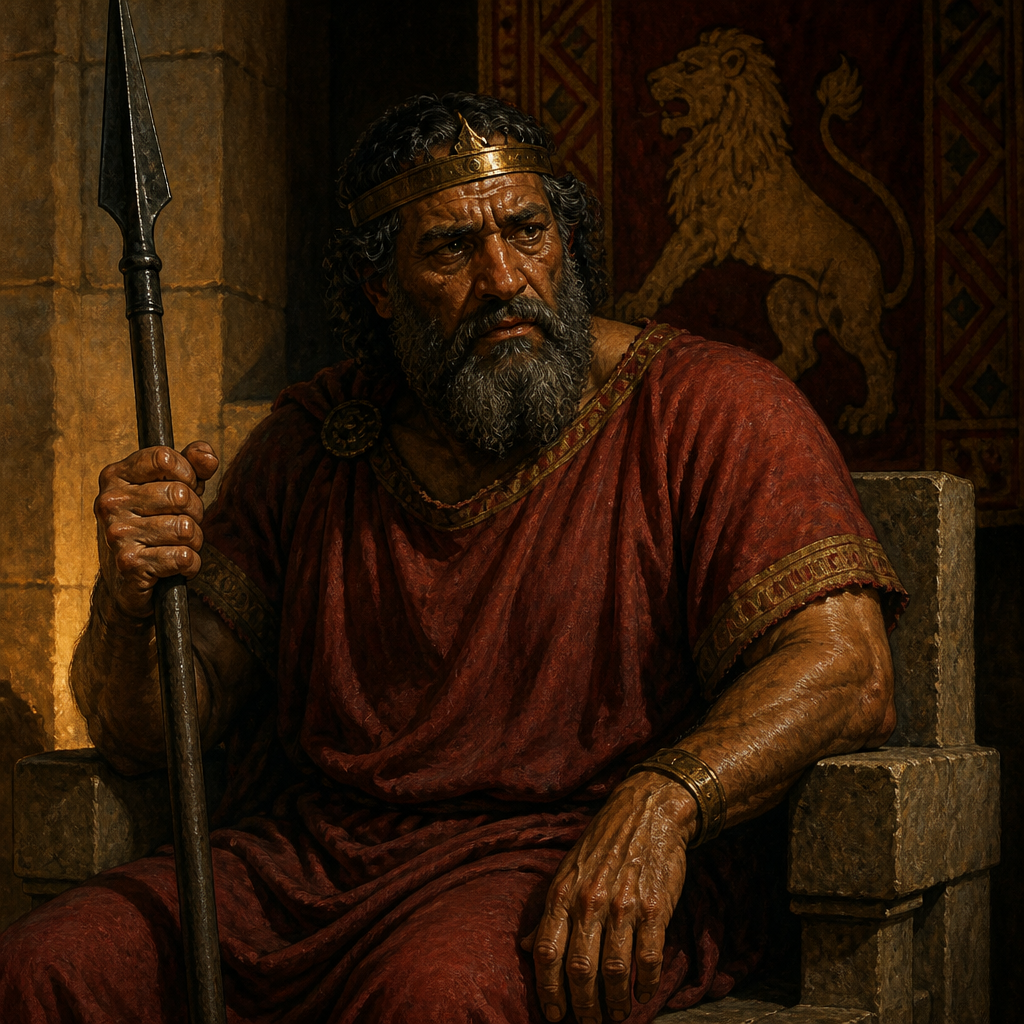
As Saul’s jealousy of David grew into murderous intent, Jonathan acted as a protector. He warned David of Saul’s plans, advocated for David’s innocence before the king, and risked his own life to facilitate David’s escape. In 1 Samuel 20, the two devised a signal involving arrows to communicate Saul’s intent. When Saul realized Jonathan was aiding David, he insulted Jonathan’s mother and even hurled a spear at his own son in a fit of rage.
Death at Mount Gilboa
Jonathan’s life ended in battle against the Philistines. In a final stand on Mount Gilboa, the Philistines overtook the Israelite forces. Jonathan was killed alongside his brothers Abinadab and Malchi-shua. Saul also perished in the conflict. The Philistines desecrated their bodies, hanging them on the wall of Beth-shan, but the men of Jabesh-gilead eventually recovered the remains for a proper burial. David, upon hearing the news, composed a famous lament, praising Jonathan as "swifter than eagles" and "stronger than lions," mourning that Jonathan’s love was "extraordinary, surpassing the love of women" (2 Samuel 1:23-26).
Relationship to Other Biblical Figures
Jonathan’s primary relationship was his complex bond with his father, Saul. Despite Saul’s descent into madness and his attempts to kill Jonathan, Jonathan remained loyal to his father and the defense of Israel until the end. His relationship with David is the biblical archetype of platonic devotion and covenantal loyalty. He chose his spiritual conviction that David was God’s anointed over his own dynastic ambitions. Later, David honored this bond by showing extreme kindness to Jonathan’s son, Mephibosheth, restoring his lands and giving him a permanent place at the royal table.
Spiritual Significance
Jonathan serves as a model of faith and selflessness. His actions at Michmash demonstrate a theology of divine sovereignty—believing that God does not require large numbers to achieve victory. More significantly, Jonathan represents the rare virtue of a man who willingly steps aside from power because he recognizes the hand of God on another. In the biblical narrative of the United Monarchy, Jonathan is the bridge between the failed house of Saul and the rising house of David, ensuring that the transition of the kingdom was marked not by civil war between the two friends, but by a holy covenant that David would respect for generations.
Spiritual Significance
Jonathan is theologically significant as a figure of 'covenantal loyalty' (hesed). He represents the ideal of the 'faithful remnant' within the house of Saul, choosing to align himself with the will of God regarding the messianic line of David rather than pursuing his own legal claim to the throne. His self-divestment of his royal regalia to David is often seen by scholars as a symbolic recognition of the shift in the divine mandate from the Tribe of Benjamin to the Tribe of Judah.
Furthermore, Jonathan’s character provides a moral foil to Saul; where Saul is paranoid and disobedient, Jonathan is courageous and trusting. His death on Mount Gilboa is portrayed as a national tragedy, highlighting the high cost of Saul's failures while simultaneously clearing the way for David’s undisputed reign. The lasting nature of his covenant, which protected his descendants even after his death, underscores the biblical theme of the enduring power of oaths made before the LORD.
Frequently Asked Questions
Why did Jonathan give his clothes and weapons to David?
Jonathan gave David his robe, tunic, sword, bow, and belt to symbolize a covenant of friendship and his recognition that David, not himself, was the rightful future king of Israel. It was a formal act of transferring his status as the heir apparent to David.
How did Jonathan die?
Jonathan died in battle against the Philistines on Mount Gilboa. He was killed alongside his father, King Saul, and his brothers Abinadab and Malchi-shua, as recorded in 1 Samuel 31 and 1 Chronicles 10.
Did Jonathan ever become king?
No, Jonathan never became king. Although he was King Saul's eldest son and the natural heir, he recognized that God had chosen David to lead Israel. He died while his father was still reigning or at the moment the reign ended.
What happened to Jonathan's children?
Jonathan had a son named Mephibosheth (also called Merib-baal). After Jonathan's death, Mephibosheth was cared for by a nurse and later brought into King David's court, where he was treated with great honor and restored to his family's lands due to David's oath to Jonathan.
Connected Figures
Categories
Mentions by Book
- 1 Samuel60
- 2 Samuel17
- 1 Chronicles5
Family & Relationships
Child
1 Samuel 13:2
Sibling
1 Samuel 13:2
Sibling
1 Samuel 13:2
Sibling
1 Samuel 13:2
Sibling
1 Samuel 13:2
Sibling
1 Samuel 13:2
Sibling
1 Samuel 13:2
Sibling
1 Samuel 13:2
Sibling
1 Samuel 14:49
Parent
1 Samuel 14:50
Sibling
2 Samuel 21:8
Sibling
2 Samuel 2:8
Parent
1 Samuel 9:2
Sibling
1 Samuel 14:49
Sibling
2 Samuel 21:8
Sibling
1 Samuel 14:49
Sibling
1 Samuel 14:49
Others Named Jonathan, Son of King Saul
Jonathan1 Chronicles 11:34
Warrior living at the time of United Monarchy
JonathanNehemiah 12:14
Man living at the time of Exile and Return
JonathanJudges 18:30
Levite living before Israel's Monarchy
Jonathan1 Kings 1:42
Priest living at the time of United Monarchy
JonathanEzra 8:6
Man living at the time of Exile and Return
Jonathan1 Chronicles 27:25
Man living at the time of Divided Monarchy
JonathanEzra 10:15
Man living at the time of Exile and Return
JonathanNehemiah 12:35
Man living at the time of Exile and Return
Jonathan1 Chronicles 2:32
Man living at the time of Divided Monarchy
JonathanJeremiah 40:8
Man living at the time of Divided Monarchy
JonathanJeremiah 37:15
Man living at the time of Divided Monarchy