Menander
A 4th-century BC Greek playwright whose maxim regarding corrupting influences was quoted by the Apostle Paul in his first letter to the Corinthians.
Menander (c. 342–291 BC) was a Greek dramatist and the most famous representative of Athenian New Comedy. While he lived centuries before the birth of Jesus Christ, his literary influence extended deep into the Hellenistic and Roman worlds. He is best known in biblical studies for providing a specific secular proverb that the Apostle Paul incorporated into the New Testament canon to warn the early church against the dangers of false teaching and moral laxity.
In 1 Corinthians 15:33, Paul writes, 'Do not be deceived: Bad company ruins good morals.' This line is a direct quotation from Menander’s lost play, *Thais*. The inclusion of Menander in the Pauline epistles highlights the apostle's education in Greek literature and his willingness to use cultural touchstones from the pagan world to reinforce Christian ethical standards. As such, Menander belongs to a small group of pagan authors whose works were preserved, in fragment, through the inspired text of Scripture.
Background and Family
Menander was born in Athens around 342 BC to a wealthy and influential family. His father, Diopeithes, was an Athenian general and governor, and his mother was named Hegesistrate. Growing up in the intellectual heart of Greece, Menander was a pupil of the philosopher Theophrastus, who was the successor to Aristotle. This philosophical background deeply influenced Menander’s writing, moving Greek drama away from the political satire of Old Comedy (represented by Aristophanes) toward 'New Comedy,' which focused on domestic life, social manners, and the moral dilemmas of ordinary people.
Menander was remarkably prolific, reportedly writing over 100 plays during his career, though he only won the prize at the Lenaia festival eight times. Despite his moderate success during his lifetime, his reputation grew exponentially after his death in 291 BC. His works became standard texts for education throughout the Mediterranean, ensuring that his maxims were well-known to educated citizens of the Roman Empire, including Saul of Tarsus.
Major Life Events
While Menander’s biography is largely defined by his literary output in Athens, the most significant 'event' regarding his biblical relevance occurred centuries after his death. During the mid-1st century AD, the Apostle Paul was addressing the church at Corinth, a city deeply immersed in Greek culture and philosophy. The Corinthian believers were struggling with the doctrine of the resurrection, and some were being influenced by skeptics who denied the physical return to life.
To combat this, Paul utilized a line from Menander’s play Thais. The line—phtheirousin ēthē chrēst’ homiliai kakai ('Evil communications corrupt good manners')—had become a common proverb in the Greek-speaking world. By citing Menander, Paul met the Corinthians on their own cultural ground, using a familiar secular truth to underscore a spiritual warning: that associating with those who deny core Christian truths would eventually lead to the erosion of the believers' character and faith.
Relationship to Other Biblical Figures
Menander has no direct personal relationship with biblical figures, as he died approximately 290 years before the birth of Christ. However, his intellectual relationship with the Apostle Paul is profound. Paul’s use of Menander demonstrates that the apostle was 'all things to all men' (1 Corinthians 9:22), possessing the literacy to engage with the high culture of the Gentiles.
Menander is one of only three pagan authors quoted by Paul in the New Testament. The others include the Cretan poet Epimenides (quoted in Titus 1:12) and the Cilician poet Aratus (quoted in Acts 17:28). This grouping shows a consistent pattern in Paul’s ministry: he did not view all pagan literature as worthless, but rather as a source of 'general revelation' or common-sense wisdom that could be redeemed for the sake of the Gospel.
Spiritual Significance
Menander's significance lies in his role as a cultural bridge used by the Apostle Paul. By quoting Menander, Paul demonstrated that the Gospel could speak to the Greek mind using its own vocabulary and wisdom. The specific quote, 'Bad company ruins good morals,' provides a succinct ethical mandate that has become a staple of Christian discipleship, warning believers that their social environment is a primary factor in their spiritual health.
Furthermore, the inclusion of Menander’s verse in 1 Corinthians 15 validates the use of external scholarly resources to support biblical truth. It shows that the apostles were not isolated from their culture but were actively critiquing and harvesting it to build the Church. Menander represents the 'spoils of the Egyptians' concept—taking the best of secular thought and subordinating it to the authority of Christ.
The presence of Menander’s words in 1 Corinthians 15:33 serves as a perpetual warning regarding the power of environment and association. While the immediate context was the denial of the resurrection, the spiritual principle is universal: the company one keeps inevitably shapes one's moral compass.
For the early church, this was a call to separation from the hedonistic or skeptical philosophies of the surrounding Greco-Roman world. Theologically, it affirms that truth is true wherever it is found; even a pagan playwright could correctly identify a fundamental law of human nature. By canonizing this verse, the Holy Spirit emphasizes that the Christian life is not lived in a vacuum, and that holiness requires discerning boundaries in one's social and intellectual associations. Menander’s inadvertent contribution to the Bible remains one of the most cited warnings against the subtle influence of peer pressure and false ideology.
Frequently Asked Questions
Which verse in the Bible quotes Menander?
Menander is quoted in 1 Corinthians 15:33: 'Do not be deceived: Bad company ruins good morals.'
Did Menander know he was being quoted in the Bible?
No, Menander lived and died in the 4th and 3rd centuries BC, roughly three hundred years before the New Testament was written.
In which play did Menander write the famous quote?
The quote 'Evil communications corrupt good manners' originally appeared in Menander’s play titled 'Thais', which is now mostly lost to history.
Why did Paul quote a pagan playwright?
Paul likely quoted Menander because the line was a well-known proverb that effectively illustrated his point about the dangers of listening to false teachers in Corinth.
Was Menander a Christian?
No, Menander was a pagan Greek who lived during the Hellenistic period, centuries before the arrival of Christianity.
Connected Figures
Paul the Apostle
Author who quoted his work
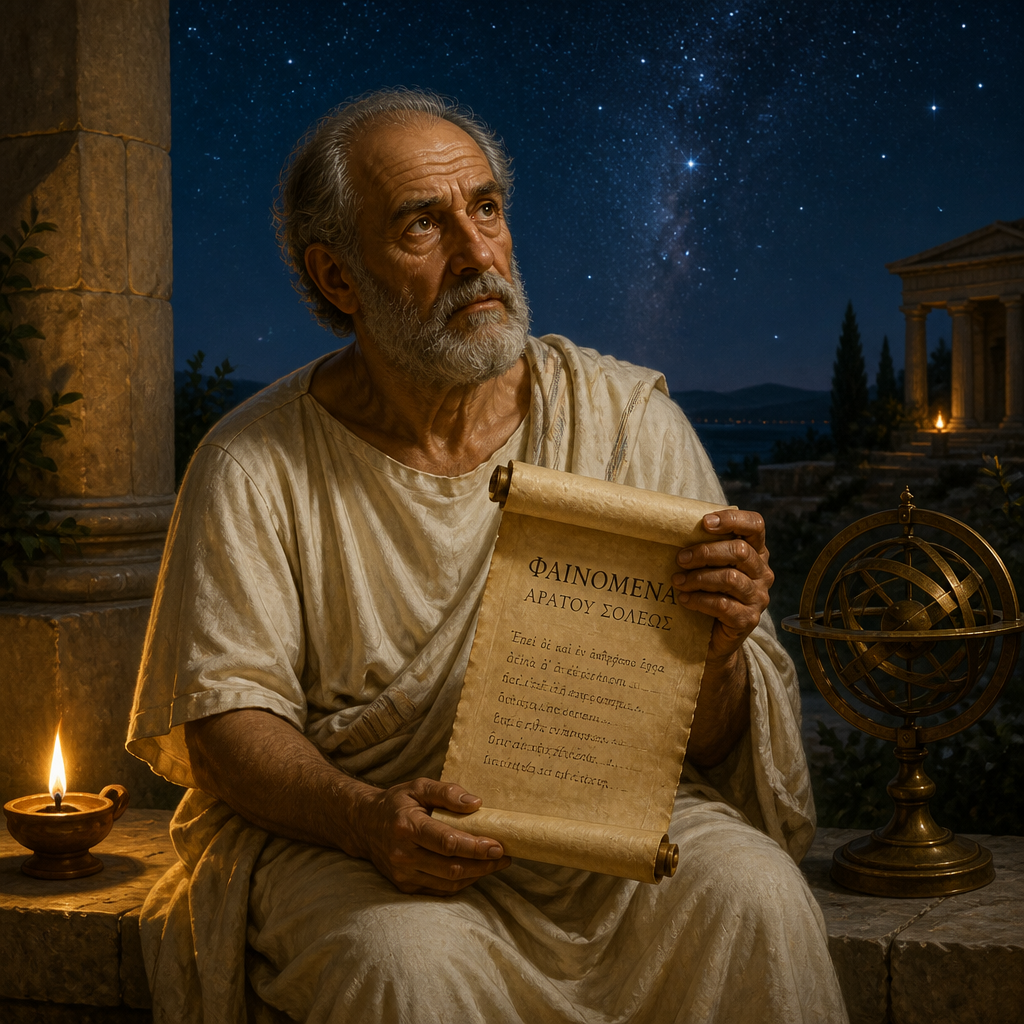
Aratus
Fellow pagan poet quoted by Paul

Epimenides
Fellow pagan poet quoted by Paul